
HYPE is Hyperliquid's native token, notable for on-chain perpetual trading, 90%+ fee buybacks, and early spot ETF traction near $900M volume — bridging DeFi and institutional crypto access.
- x.com39
- theblock.co9
- coindesk.com8
- cointelegraph.com5
- app.hyperliquid.xyz2
- ir.eyenovia.com2
- prnewswire.com2
+43 sources across the wider coverage universe
 eole becomes first Japan-listed company to buy HYPE, acquiring 1,078 tokens and planning ¥100 million allocation2026-07
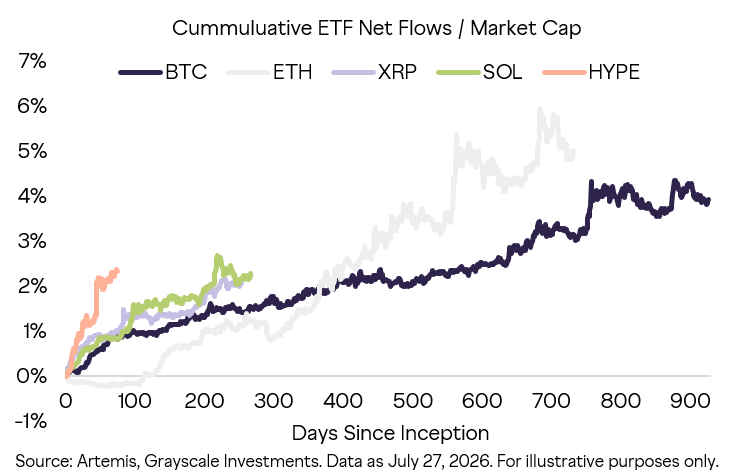 HYPE ETF flows outpace Bitcoin, Solana and XRP launches relative to market cap2026-07
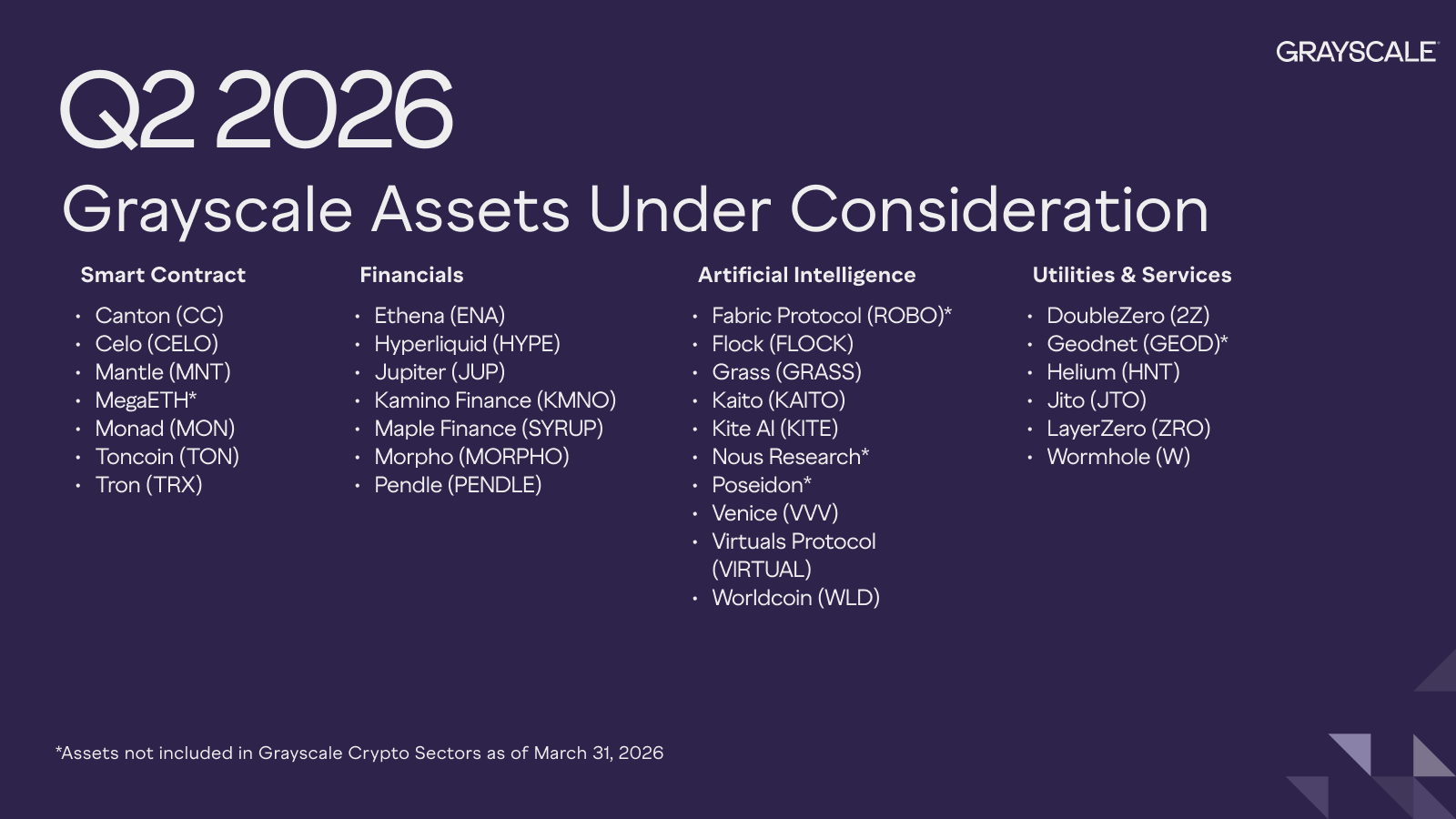 Grayscale adds HYPE, PENDLE, VIRTUAL, and MegaETH among 30 assets to Q2 consideration list2026-04
 Runaway bot loses $482K trading HYPE and ZEC on Lighter as risk engine prevents liquidations2026-07
 Bitwise locks in 0.67% fee and BHYP ticker for Hyperliquid ETF as Grayscale, VanEck chase HYPE exposure2026-04
 Analysts say Hyperliquid’s USDC revenue-sharing deal could redirect $160M away from Circle and Coinbase while significantly boosting value accrual for the HYPE ecosystem2026-05
HYPE is the native token of Hyperliquid, a fully on-chain perpetual futures exchange that has grown into one of the most closely watched protocols in decentralized finance — notable for routing more than 90% of its trading fees back into open-market token buybacks rather than to venture capital backers or a foundation treasury.
What Hyperliquid Is — and Why HYPE Exists
Most decentralized exchanges are wrappers around fragmented liquidity pools. Hyperliquid took a different architectural bet: build a purpose-designed Layer 1 blockchain whose entire state machine is an order book. Every trade, cancel, and liquidation settles on-chain in milliseconds, without the routing latency that typically makes on-chain perps uncompetitive with centralized venues.
HYPE is the gas and governance token that powers that chain. Beyond paying transaction fees, it serves as the economic claim on the protocol's fee revenue through a structured buyback mechanism. That dual role — utility token and quasi-equity instrument — is what has drawn both retail traders and institutional analysts to treat it differently from most altcoins.
The protocol launched its mainnet in late 2024 with no venture capital investors on the cap table and no public presale, a structural rarity in crypto. The entire float arrived through a community airdrop and open-market accumulation, which removed the typical early-investor overhang that suppresses price in the months after a token launch.

Binance to list Hyperliquid's HYPE token with Seed Tag applied

How the Buyback Mechanism Works
Hyperliquid's Assistance Fund (AF) is the on-chain treasury that receives the majority of platform fee revenue. According to analysis by Citrini Research, Hyperliquid accounts for nearly half of all crypto token buybacks in 2025 — and more than 90% of platform fees flow into the AF to repurchase HYPE on the open market.
This creates a structural bid beneath the token price that scales with trading volume. When open interest expands — as it did with a 32% surge recorded in mid-2026 — fee revenue rises, the AF buys more HYPE, and the circulating supply shrinks. It is a self-reinforcing loop that resembles corporate share buybacks more than the inflationary emission schedules typical of DeFi protocols.
Grayscale's research team, writing through analyst LowBeta, made this framing explicit: while assets like BTC are digital commodities valued by supply-demand dynamics, HYPE can be valued using discounted cash flow methods because it has visible, recurring fee revenue tied to platform usage. That is an uncommon claim to make about a DeFi token, and it reflects how seriously the buyback architecture is being taken by institutional analysts.
Readers click HYPE stories not for trading signals but to track whether Hyperliquid is converting exchange dominance into durable infrastructure — the corporate treasury rebrands and HyperEVM buildout headlines reveal readers watching for the moment speculative volume crystallizes into a permanent financial layer.
ETF Products and Institutional Access
The most concrete sign of institutional interest materialized in the form of spot HYPE exchange-traded products. Within their first month of trading, three spot HYPE ETF products accumulated approximately $153 million in net inflows and generated nearly $900 million in cumulative trading volume — inflow velocity that compares favorably with the early months of spot Bitcoin and Ethereum ETF launches.
Grayscale entered the space directly with its Hyperliquid Staking ETF (ticker: HYPG), marketed as offering HYPE exposure at the lowest gross management fee among U.S. ETPs, at 0.29%, with staking yield included. The staking wrapper matters because HYPE staked on the Hyperliquid network participates in validator rewards, adding a yield component on top of the token's price exposure — structurally similar to how Ethereum staking ETFs are being constructed.
Coinbase Derivatives added HYPE monthly and perpetual-style futures to its regulated product suite alongside Binance Coin futures, giving U.S. institutional traders another avenue to gain or hedge exposure through a compliant framework. These listings matter because they create a regulated price discovery mechanism and allow funds with restrictions on direct token custody to participate.
Two regulatory developments are cited by analysts as potential additional catalysts: CFTC formal approval of perpetual futures products, and U.S. regulatory clarity that would allow domestic retail access to decentralized exchanges. Either outcome would materially expand the addressable market for Hyperliquid's core product.
On-Chain Accumulation Patterns
Large wallet behavior on Hyperliquid has attracted consistent attention from on-chain analysts. A wallet identified as 0x6436 withdrew more than 1.23 million HYPE (roughly $85 million at prevailing prices) from centralized exchanges over the course of a week, depositing it directly into Hyperliquid for staking. That single wallet's activity represents meaningful demand pressure at scale.
Shorter-term trader behavior tells a different story about market dynamics. Garrett Jin, a known on-chain participant, sold his entire 184,102 HYPE position worth approximately $13.55 million at $73.60 — then began buying back within 24 hours, repurchasing 81,703 HYPE at roughly $6 million as prices pulled back. That rapid reversal illustrates the speculative velocity that also surrounds the token: large positions are being established, tested, and re-established on short timeframes, which contributes to the open interest and volume data driving fee revenue.
Hyperion DeFi, a yield protocol built on top of Hyperliquid, announced plans to unwind $29 million in HYPE-collateralized positions with partners Felix and Native Markets as its USDH stablecoin product sunsets. The 800,000 HYPE being reclaimed is earmarked for new yield strategies, which suggests continued infrastructure building around the token even as individual products are retired.

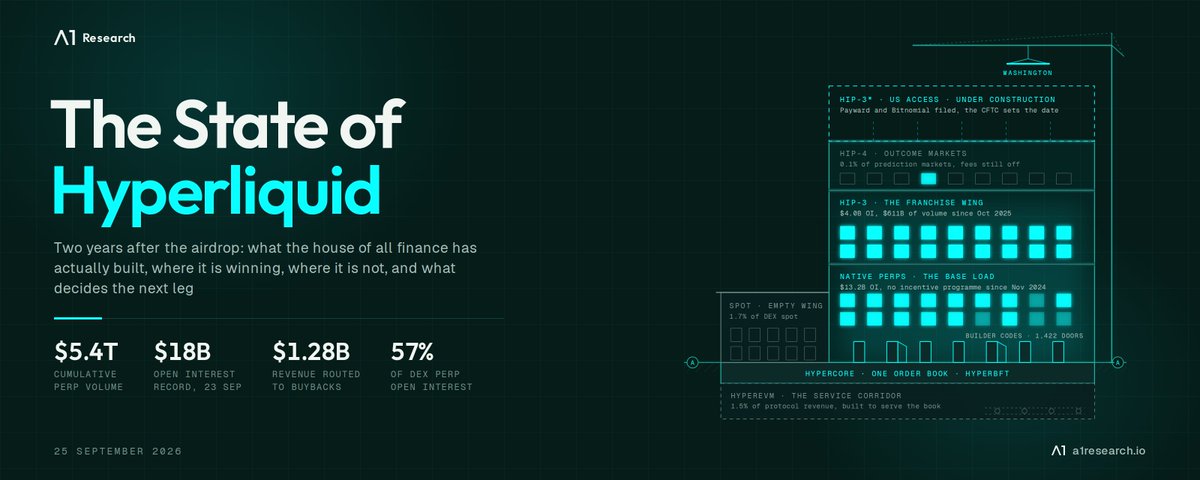
Two years after Hyperliquid's airdrop: $5.4T in perp volume, $1.28B in HYPE buybacks, and rooms still empty
Competitive Position
Former Hyperliquid skeptic Pavel Paramonov published a reversal arguing that HYPE is among crypto's few genuinely investable assets, citing three structural advantages: the absence of VC investors with cliff-vesting schedules to dump, the active token buyback program, and a growing competitive threat to Binance's dominance in perpetuals trading volume.
The Binance comparison is significant context. Binance processes the largest volume of any centralized crypto derivatives venue globally. For a decentralized exchange to be framed as a credible challenger — rather than a niche alternative — reflects how much on-chain perps infrastructure has matured. Hyperliquid's order book architecture, because it settles on its own chain rather than Ethereum mainnet, avoids the gas cost and latency penalties that have historically made on-chain perpetuals impractical for active traders.
The Infinex integration added another distribution layer: Hyperliquid's spot order book is now accessible through the Infinex interface that traders already use for perps, with the HYPE/USDC market recording $138 million in volume. USDC as the primary quote currency matters because it ties liquidity directly into the stablecoin infrastructure that dominates DeFi settlement, and aligns with the Circle/USDC ecosystem that underpins most serious on-chain trading operations.
- 01HYPE token listings and distribution
The KuCoin listing was the single most-clicked headline, signaling readers tracked HYPE's accessibility and legitimacy as it moved onto major centralized exchanges after its airdrop genesis.
- 02Corporate treasury rebrand plays
Two separate public companies — Sonnet BioTherapeutics and Eyenovia — announced HYPE token treasury strategies, drawing readers who see the MicroStrategy playbook being replicated on a DEX-native token.
- 03Hyperliquid DEX volume milestones
The $500B perp volume milestone and $13B daily volume headlines pulled readers validating whether Hyperliquid's on-chain performance actually justified the token price rather than being narrative-driven.
- 04HyperEVM buildout and permissionless infrastructure
The HyperEVM mainnet launch, HIP-3 activation, and permissionless perps testnet together told a sequential infrastructure story that readers followed as a test of whether Hyperliquid could expand beyond a single-product DEX.
- 05Hype cycle as crypto's structural flaw
Recurring 'hype vs. substance' framing across Bitcoin L2s, PYUSD, Plasma, Taproot Wizards, and Berachain headlines shows readers using HYPE as a lens for the broader pattern of narrative-driven collapses.
- 06HYPE long-term price speculation
The $1,000 by 2030 analyst forecast and Arthur Hayes endorsing Hyperliquid as the DeFi model of the future attracted readers drawn to high-conviction bull cases backed by fee and buyback mechanics.
HIP-4 and Derivatives Expansion
Hyperliquid's HIP-4 proposal extends the protocol's infrastructure beyond perpetuals into options markets. HIP-4 is being expanded to support ETH, HYPE, and SOL as underlyings, with BTC, ETH, and SOL options planned for rollout through Hypercall. SPX options — referencing the S&P 500 index, a $3 trillion-per-day instrument in traditional markets — are also on the roadmap.
If options infrastructure matures on Hyperliquid, it addresses one of the persistent gaps in DeFi derivatives: the ability to construct structured payoffs, hedges, and yield strategies without routing through centralized intermediaries. That would expand the platform's addressable market beyond directional traders to include more sophisticated DeFi participants who currently use off-chain venues for options exposure.
Valuation Framework and Risks
Applying a cash flow lens to HYPE requires accepting several assumptions that carry meaningful uncertainty. Trading volume on any exchange — centralized or decentralized — is cyclical and sensitive to broader market conditions. A sustained crypto bear market would compress fee revenue, reduce AF buyback capacity, and remove the structural bid. The token's price is therefore doubly exposed: to directional crypto risk and to platform-specific volume risk.
Arthur Hayes, the BitMEX co-founder, sold his HYPE position above $72 citing concerns that AI-related dollar liquidity absorption was limiting Bitcoin's upside — a macro argument that would apply broadly to risk assets including HYPE. He subsequently re-entered at $2.09 million worth after prices pulled back, signaling short-term caution rather than structural skepticism, but his initial sale highlighted how quickly large positions can reverse sentiment in a token with this degree of institutional attention.
The no-VC structure, while cited as a positive by analysts focused on supply overhang, also means the protocol has relied entirely on its own revenue and community resources for growth capital. That works when volume is high and the AF is well-funded; it becomes a constraint if the protocol needs to fund aggressive infrastructure expansion during a low-volume period.
Smart contract and oracle risk remain baseline considerations for any on-chain derivatives venue. Hyperliquid's architecture differs from Ethereum-native protocols, but concentrated liquidity and high leverage are conditions under which a single vulnerability or oracle manipulation can cause cascading losses. The protocol's track record is short relative to its current asset base.
- 2024-11launch
HYPE Genesis Event announced with Nov 11 deadline for participation
- 2024-11milestone
HYPE airdrop distributed to early Hyperliquid users
- 2025-02launch
HyperEVM mainnet goes live with HyperBFT security and WHYPE contract
- 2025-03milestone
Hyperliquid crosses $500B cumulative ETH perp volume, 15x YTD growth
- 2025-04governance
HIP-3 activates permissionless perp market creation requiring 500K HYPE stake
- 2025-05milestone
Sonnet BioTherapeutics announces $888M merger and rebrand as Hyperliquid Strategies with HYPE treasury reserve
- 2025-05milestone
Eyenovia acquires ~1.04M HYPE tokens at ~$34 average and rebrands as Hyperion DeFi
- 2025-06launch
KuCoin lists HYPE token, expanding centralized exchange access
Outlook
The structural case for HYPE rests on three converging trends: the maturation of regulated institutional access through ETFs and listed derivatives, the self-reinforcing mechanics of volume-driven buybacks, and Hyperliquid's demonstrated ability to attract order flow away from centralized competitors without VC subsidies. The launch of spot HYPE ETPs with $900 million in first-month volume and $153 million in net inflows suggests institutional demand is moving from speculative interest to allocated positions.
Near-term price action will likely remain sensitive to broader crypto market conditions — the altcoin rally that pushed HYPE up 34% in a single week was correlated with Ethereum's surge and Bitcoin's consolidation near $65,000, not isolated to Hyperliquid-specific catalysts. Regulatory clarity around U.S. access to decentralized exchanges and formal CFTC treatment of perpetual futures represent the two external variables most likely to expand the platform's addressable market materially. Until those are resolved, HYPE trades as a high-beta expression of both DeFi adoption and institutional crypto demand simultaneously.
Latest HYPE news
Community notes
Spot something off or out of date? Drop a note. Editors review topic notes daily and roll accepted fixes into the explainer — contributors are recognized in the monthly $SQUID drop.
Loading notes…
Help improve this topic
Have a story or tip about this topic? Submit it. See something missing? Leave a note. Editors review daily; accepted submissions and fixes count toward the monthly $SQUID drop.