
Bitwise Asset Management is a crypto-specialist ETF and fund issuer known for BITB, BHYP (Hyperliquid), and the USCC tokenized carry fund, with influential research on institutional digital asset adoption.
+11 sources across the wider coverage universe
 Avalanche gains Wall Street access as Bitwise Asset Management lists AVAX ETF on NYSE, unlocking institutional exposure and staking yields2026-04
 Bitwise CIO: Bitcoin's addressable market could surpass gold's $34T as Iran conflict cements its dual currency role2026-04
 Bitwise locks in 0.67% fee and BHYP ticker for Hyperliquid ETF as Grayscale, VanEck chase HYPE exposure2026-04
 Ethena launches a dedicated lending market on Jupiter Lend, with Bitwise overseeing risk management and institutional participation on Solana2026-05
 Aave welcomes Bitwise's rebranded Crypto Carry Fund to Horizon, with more than $120M deposited into the tokenized fund leveraging market-neutral crypto yield opportunities2026-06
 Bitwise model values Bitcoin at $224K if adopted as insurance against G20 sovereign defaults, framing BTC as a hedge against mounting government debt risks2026-06
Bitwise Asset Management is a San Francisco-based crypto-specialist investment firm that creates and manages exchange-traded funds, separately managed accounts, and institutional products designed to give investors regulated exposure to digital assets.
Founded in 2017, Bitwise has grown into one of the most prominent pure-play crypto asset managers in the United States, sitting alongside BlackRock and Fidelity in the fiercely competitive spot ETF market. What distinguishes it from those legacy giants is singular focus: Bitwise operates exclusively in digital assets, meaning its research, product design, and public commentary are entirely oriented toward the crypto market rather than spread across equities, fixed income, or commodities.
What Bitwise Actually Does
At its core, Bitwise builds financial wrappers around crypto assets—vehicles that allow pension funds, registered investment advisors (RIAs), family offices, and retail investors to gain exposure to cryptocurrencies through familiar brokerage accounts, without directly holding private keys.
Its product range spans several categories:
- Spot ETFs — The firm offers U.S.-listed spot Bitcoin (BITB) and spot Ethereum (ETHW) ETFs following the SEC's landmark approvals in January and May 2024 respectively.
- Thematic and single-asset ETPs — In European markets, Bitwise lists exchange-traded products (ETPs) on exchanges including Deutsche Börse Xetra. A recent example is the Canton Network ETP, launched on Xetra at a 0.85% total expense ratio (TER), giving institutional European investors access to the Canton Network ecosystem.
- Tokenized funds — The firm's Crypto Carry Fund, rebranded as the USCC (USD Crypto Carry) fund, crossed $120 million in deposits after being welcomed onto Aave's Horizon institutional lending platform, representing one of the more significant real-world asset (RWA) integrations in decentralized finance to date.
- Staking-integrated products — Bitwise launched BHYP, the first U.S. ETF offering exposure to Hyperliquid's HYPE token, on the New York Stock Exchange on May 15, 2026. Notably, BHYP is natively staked by the provider—meaning the fund accrues staking rewards rather than holding idle tokens.

Bitwise crypto model portfolios launch on Vise platform, reaching 135,000+ accounts
The Research and Public Voice
Bitwise punches well above its weight in terms of industry commentary, largely through Chief Investment Officer Matt Hougan and research director André Dragosch. Their public output functions both as genuine market analysis and as thought leadership that reinforces the firm's brand among financial advisors.
On Bitcoin cycles and valuation: Hougan has consistently argued that debating a Bitcoin "bottom" is the wrong frame—what matters is whether the next cycle top still lies ahead. This reframing positions Bitcoin's short-term drawdowns as noise within a longer secular trend. Separately, Dragosch has been willing to take more cautious near-term views, at points flagging as much as 20% further downside for Bitcoin, with a "max pain" scenario around $48,000—a level that would represent a meaningful correction from recent highs.
One illustrative valuation exercise: a Bitwise model estimated Bitcoin's fair value at roughly $224,000 if it were adopted as insurance against G20 sovereign debt defaults—framing BTC as a hedge against mounting government debt risk rather than purely a speculative asset.
On advisor sentiment: Bitwise surveys RIAs regularly and publishes findings on what traditional finance (TradFi) practitioners actually want. A recurring theme in recent research is that stablecoins and tokenization now generate more advisor interest than Bitcoin itself. Ethereum, Solana, Chainlink, and Avalanche were identified as primary beneficiaries of this institutional curiosity. This is a notable data point: even as Bitwise operates a Bitcoin ETF, its own research suggests the center of gravity for advisor conversations has shifted toward infrastructure-layer tokens and programmable money.
On market sentiment: Hougan has described crypto as a "contrarian bet" during periods when AI stocks dominate investor attention, implicitly positioning digital assets as a diversification play against technology concentration risk. The firm has also flagged Bitcoin's sensitivity to macro risk-off moves, characterizing it as a potential "canary in the coal mine" as broader risk appetite contracts.
Readers treat Bitwise as a regulatory canary: every SEC delay or filing on a Bitwise product—whether Bitcoin, Ethereum, Solana, XRP, or Dogecoin—gets clicked because it signals the outer boundary of what the agency will tolerate in crypto exposure breadth, not because readers care about Bitwise specifically.
The HYPE Moment: Bitwise and Hyperliquid
Perhaps the most talked-about Bitwise move of 2025-2026 has been its aggressive positioning in Hyperliquid and the associated HYPE token.
Hyperliquid is a high-performance Layer 1 blockchain purpose-built for decentralized perpetual futures trading. HYPE is its native token, used for governance, staking, and fee payment. Despite a roughly 77% price gain in the year leading up to mid-2026, Bitwise publicly called HYPE "the most mispriced" asset in crypto—a striking claim given the rally already in place.
The firm's thesis classifies HYPE as a "Gen 2" crypto token: unlike first-generation assets that are primarily stores of value or raw infrastructure plays, HYPE is tied to a protocol with real, measurable revenue from trading fees. Bitwise argues that on a revenue-multiple basis, HYPE trades at a significant discount to comparable on-chain exchanges.
The product response was immediate. BHYP—the Bitwise Hyperliquid ETF—launched on the NYSE on May 15, 2026, becoming the first U.S. fund to offer natively staked HYPE exposure. Within weeks, ETF flows reflected genuine institutional demand: Bitwise ETF clients purchased a total of $35.9 million in HYPE in a single week following launch, an 18x increase from the prior week. Total holdings reached $19.78 million in staked HYPE before that weekly surge. The HYPE token itself jumped roughly 23% in the days surrounding the ETF launches from multiple providers including 21Shares.
Bitwise's public statement that Hyperliquid "could become core financial infrastructure" represents one of the stronger endorsements from any traditional asset manager toward a DeFi-native protocol.
Bitwise survey asks 15 of the world's largest investment firms how they allocate to crypto

Navigating the SEC and Regulatory Environment
Bitwise's entire product strategy is built on regulatory engagement rather than avoidance. The firm was one of the original applicants for a spot Bitcoin ETF in the United States, filing with the SEC years before the eventual January 2024 approval. That persistence paid off: BITB launched as part of the first cohort of approved spot Bitcoin ETFs, giving Bitwise immediate access to the enormous capital flows that followed.
The regulatory context matters because Bitwise's market position depends on the SEC's ongoing willingness to approve new crypto product types. Each new ETF or ETP requires either a successful 19b-4 filing with the SEC (for U.S. listings) or compliance with European financial regulations (for Xetra-listed products). The BHYP launch demonstrates that the post-2024 regulatory environment has become meaningfully more permissive—a single-asset ETF for an altcoin like HYPE would have been essentially inconceivable under the prior SEC leadership.
Key regulatory dynamics to watch for Bitwise going forward:
- Staking approval precedent: BHYP's natively staked structure is a deliberate test case. If it draws no SEC enforcement action, it opens the door to staking-integrated ETFs across other proof-of-stake assets.
- Spot Ethereum ETF staking: The SEC initially required spot ETH ETF applicants to exclude staking. If that restriction is revisited, Bitwise's ETHW fund could become eligible for yield-bearing features.
- RWA and tokenized fund regulation: The USCC fund's integration with Aave Horizon sits at the intersection of DeFi and TradFi in a way that regulators have not fully addressed. How the SEC and CFTC treat tokenized fund structures will shape how aggressively Bitwise can expand this product line.
- 01SEC ETF approval cascade
Repeated SEC delays and public comment periods on Bitwise filings made each regulatory step a proxy for the entire crypto ETF pipeline's fate.
- 02Multi-asset 10-crypto index fund
The BITW index ETF covering BTC, ETH, SOL, XRP, ADA and five others drew repeated clicks because it represented the first regulatory test of a diversified-basket crypto product.
- 03Institutional staking expansion
Bitwise acquiring Chorus One, the Ethereum Foundation routing 70,000 ETH through Bitwise infrastructure, and the Lombard yield platform showed readers an asset manager crossing from passive ETF custody into active onchain yield—a structurally new risk profile.
- 04ETF inflow and outflow signals
Daily flow data—$42M inflows, first-ever outflow days, $122B industry AUM—was clicked as a real-time sentiment gauge for institutional crypto conviction.
- 05DeFi yield product launches
The tokenized Crypto Carry Fund, Vaults curation entry, and the Jupiter Lend lending market showed readers Bitwise moving into structured DeFi yield, carrying smart-contract and counterparty risk not present in ETFs.
- 06CIO macro and price predictions
Matt Hougan's public calls on Bitcoin as a buying opportunity, Bitcoin vs. Gold comparisons, and stablecoin legislation forecasts were clicked as credentialed institutional guidance rather than retail speculation.
Institutional Distribution and the Advisor Channel
Bitwise's go-to-market strategy is heavily oriented toward financial advisors. Unlike direct-to-consumer crypto platforms, Bitwise distributes primarily through the RIA channel, wirehouses, and broker-dealers—the same intermediaries that manage the majority of U.S. retirement and wealth management assets.
This explains the volume of research Bitwise publishes on advisor sentiment: it's both genuine insight and a direct sales tool. When Hougan publishes data showing that advisors are increasingly interested in stablecoins and tokenization, he is simultaneously educating that audience and positioning Bitwise as the firm they should call when they want to act on those interests.
The Aave Horizon integration for the USCC Crypto Carry Fund represents an evolution of this strategy. By depositing tokenized fund shares into institutional DeFi infrastructure, Bitwise is demonstrating a pathway for traditional asset management products to generate yield inside on-chain systems—a proposition that is directly relevant to the segment of the advisor market looking for income-generating crypto exposure beyond simple price appreciation.
Bitwise launches first ETP giving mainstream exposure to Lighter's LIT staking token

Competitive Position
Bitwise competes across multiple dimensions:
Against large asset managers (BlackRock, Fidelity, Invesco): These firms have distribution scale and brand recognition that Bitwise cannot match. BlackRock's IBIT Bitcoin ETF has consistently dominated inflows—on a single day in May 2026, IBIT alone saw $326 million in outflows, a number larger than many competitors' total AUM. Bitwise's edge is agility and specialization: it moves faster into new product categories (HYPE ETF, Canton Network ETP, tokenized carry fund) than any large diversified manager would.
Against crypto-native firms (21Shares, VanEck crypto division): Competition here is closer. The HYPE ETF race, for instance, saw both Bitwise and 21Shares launch products in the same period. Bitwise's differentiator in this segment is its staking-integration approach and the credibility of its research voice.
In the RWA space: The USCC fund on Aave Horizon places Bitwise in competition with firms like Ondo Finance and BlackRock's BUIDL fund for the institutional tokenized yield market. Aave's endorsement of Bitwise as an approved asset issuer on Horizon—citing it as setting a "high standard for institutional adoption of RWAs"—is a meaningful competitive signal.
- 2024-01launch
Bitwise Bitcoin ETF (BITB) launches alongside first wave of US spot BTC ETFs
- 2024-03regulatory
SEC opens public comment period for Grayscale, Bitwise, and Fidelity spot Ethereum ETFs
- 2024-07launch
Bitwise spot Ethereum ETF (ETHW) approved and begins trading
- 2024-09regulatory
FTX bankruptcy estate seeks court approval to liquidate $744M in Grayscale and Bitwise holdings
- 2025-01regulatory
NYSE American files to list options on Bitwise Bitcoin ETF
- 2025-04launch
Bitwise launches tokenized Crypto Carry Fund in partnership with Superstate
- 2025-05milestone
Bitwise Solana ETF (BSOL) debuts with $69.5M first-day inflows, surpassing rival Solana products
- 2025-06milestone
Bitwise acquires Chorus One, adding $2.2B institutional staking operation across Ethereum and multi-chain
Outlook
Bitwise's trajectory reflects broader trends in the crypto market: institutional access is expanding, regulatory clarity is gradually improving (though unevenly), and the frontier of investable assets is moving beyond Bitcoin and Ethereum toward DeFi-native tokens with actual revenue streams.
The firm's near-term bets are clear: Hyperliquid and HYPE as a "Gen 2" infrastructure play, tokenized funds as a bridge between DeFi yields and TradFi capital, and continued geographic expansion through European ETP listings. Its research arm will likely continue to track the shift in advisor interest from Bitcoin toward stablecoins, tokenization, and smart-contract platforms—both as a genuine analytical focus and as a product pipeline signal.
What remains uncertain is macro context. Bitwise's own analysts have flagged meaningful short-term downside scenarios for Bitcoin, and a sustained risk-off environment would compress inflows across all its products simultaneously. The firm's concentration in digital assets is its competitive strength in bull markets and its primary vulnerability in bear ones.
For investors and market watchers, Bitwise functions as a useful real-time signal: what products it launches, what tokens it endorses, and where it sees institutional demand building tends to be a reasonably accurate read of where sophisticated capital is heading next.
Latest Bitwise news
Bitwise crypto model portfolios launch on Vise platform, reaching 135,000+ accountsBitwise survey asks 15 of the world's largest investment firms how they allocate to cryptoBitwise launches first ETP giving mainstream exposure to Lighter's LIT staking token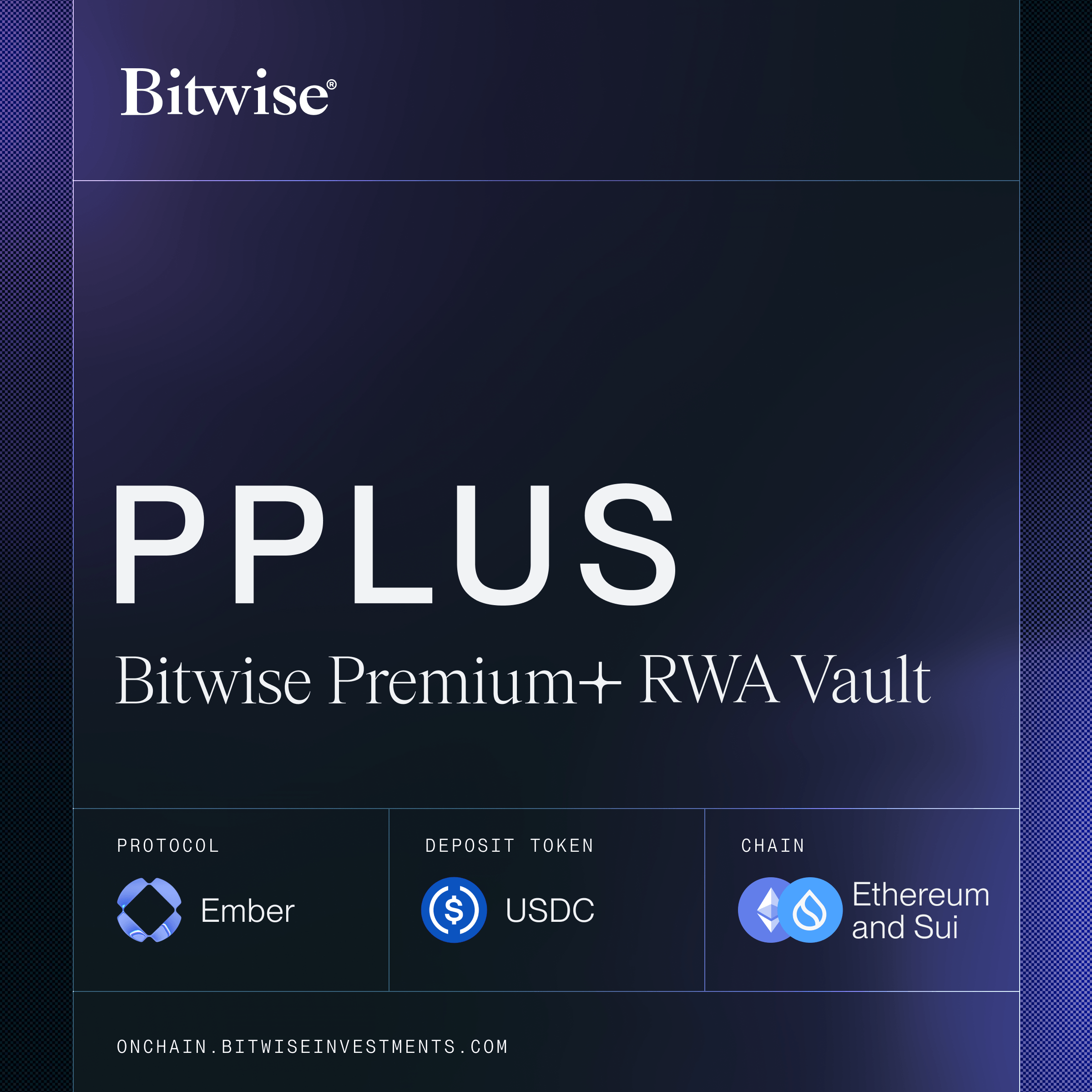 Bitwise launches PPLUS, a leveraged RWA vault on Ember Protocol targeting 10%+ yield for non-U.S. investors
Community notes
Spot something off or out of date? Drop a note. Editors review topic notes daily and roll accepted fixes into the explainer — contributors are recognized in the monthly $SQUID drop.
Loading notes…
Help improve this topic
Have a story or tip about this topic? Submit it. See something missing? Leave a note. Editors review daily; accepted submissions and fixes count toward the monthly $SQUID drop.