
Fidelity Investments has become a dominant force in crypto through spot Bitcoin and Ethereum ETFs, tokenized money market funds, and stablecoin reserve management, rivaling BlackRock for institutional digital asset market share.
+8 sources across the wider coverage universe
 Morgan Stanley debuts spot Bitcoin ETF at 0.14% fee, undercutting BlackRock and Fidelity2026-04
 BlackRock IBIT absorbs $292M as Fidelity and ARK bleed funds, Bitcoin ETFs inch toward $100B2026-04
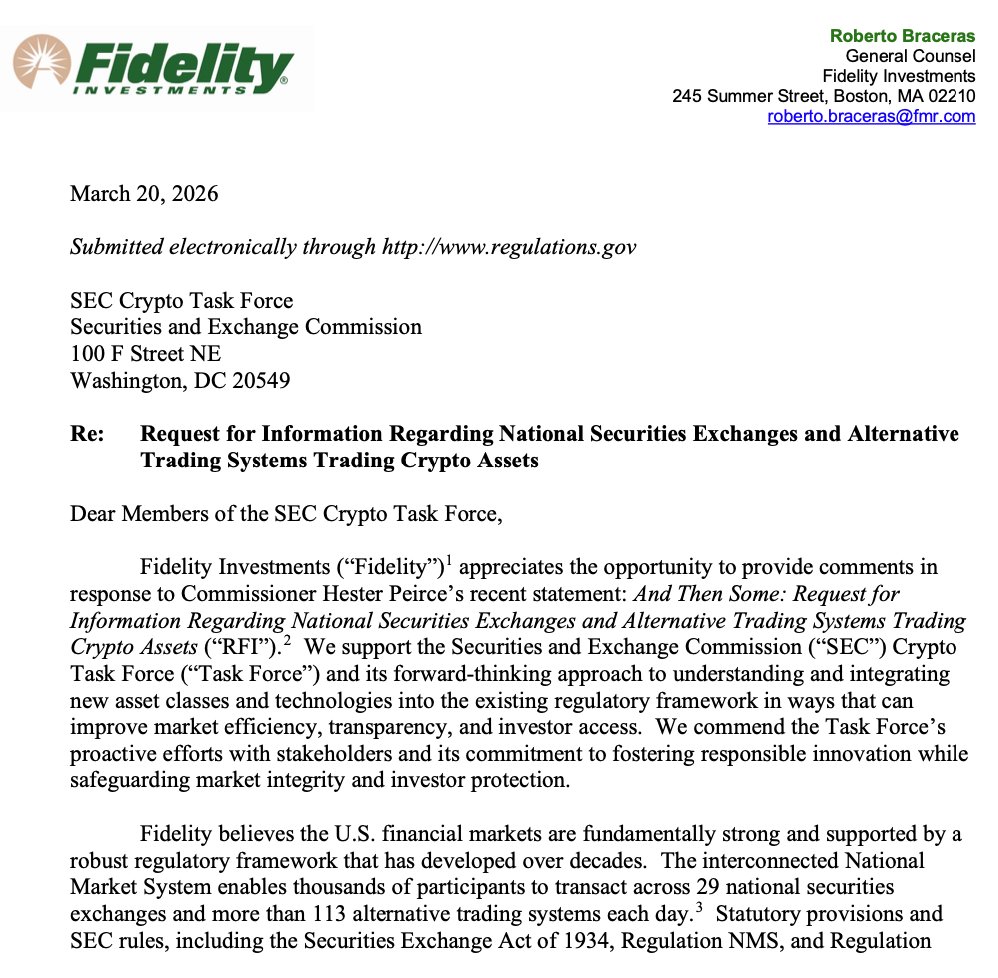 Fidelity urges SEC to clarify crypto rules for broker‑dealers and ATS integration into existing market structures2026-03
 Citadel, Schwab, and Fidelity-backed EDX Markets files for OCC national trust bank charter2026-04
 BlackRock, Fidelity and Goldman Sachs back Clarity Act as Senate's August recess nears2026-07
 Global finance giants Visa, ANZ, ChinaAMC, and Fidelity International complete HKMA e‑HKD cross‑border settlement pilot using Chainlink for secure, compliant, atomic transfers of regulated assets2026-03
One of the world's largest privately held financial services firms, Fidelity Investments has evolved from a mutual fund pioneer into one of the most consequential institutional actors in the digital asset space.
What Fidelity Is — and Why Crypto Markets Watch It
Founded in 1946 and headquartered in Boston, Fidelity Investments manages roughly $14 trillion in assets across its various businesses. Its affiliate, Fidelity International, serves over 2.8 million customers with more than $1 trillion in client assets outside the United States. Unlike publicly traded rivals such as BlackRock, Fidelity remains family-controlled, which has historically allowed it to take longer-horizon bets — including early, sustained investment in digital asset infrastructure.
Fidelity's crypto-relevant entities operate primarily through Fidelity Digital Assets, a subsidiary launched in 2018 that provides institutional custody and trading, and through Fidelity Digital Asset Management, which oversees crypto investment products for retail and institutional clients. That infrastructure, built years before most Wall Street peers engaged seriously with the asset class, positioned the firm to move quickly when U.S. regulators began approving spot crypto ETFs.

Morgan Stanley debuts spot Bitcoin ETF at 0.14% fee, undercutting BlackRock and Fidelity
$6.2T in captive advisory assets and 16,000 wealth advisors who can default-route into MSBT — that's what makes the 0.14% fee lethal, not the 11bps undercut itself. At a 2% recommended crypto allocation, MS's theoretical demand pipeline dwarfs IBIT's entire $55B AUM by roughly 3x. Day-one flows already confirmed the dynamic: $34M into MSBT while the broader BTC ETF complex hemorrhaged $124M in outflows — MS is cannibalizing existing issuers, not expanding the pie.
The Bitcoin ETF Race: FBTC and the Duopoly With BlackRock
The January 2024 approval of U.S. spot Bitcoin ETFs was a watershed moment, and Fidelity was among the first cohort to launch. Its product, the Fidelity Wise Origin Bitcoin Fund (FBTC), quickly became one of the two dominant vehicles in the category — alongside BlackRock's iShares Bitcoin Trust (IBIT) — cementing what market observers have described as a duopoly over 2025 and 2026 inflows.
That dominance has held even through significant price turbulence. Despite Bitcoin falling roughly 29% from its 2025 peak, FBTC and IBIT continued to absorb the majority of net new capital flowing into the spot ETF category. On days when the broader Bitcoin ETF cohort recorded outflows — such as June 17, 2026, when the category saw a combined net outflow of approximately $82.2 million — FBTC frequently posted the largest individual inflow figure, recording $14.02 million net positive on that same date according to SoSoValue data. This pattern recurs frequently: even as other ETF issuers experience redemptions, FBTC tends to attract or retain assets.
The fee competition has intensified. When Morgan Stanley launched a spot Bitcoin ETF at a 0.14% management fee — below both BlackRock and Fidelity's standard rates — it signaled that the category is maturing into a commoditized vehicle where basis-point differences become competitive battlegrounds. FBTC has responded with periodic fee adjustments, and Fidelity has leaned into the custody and brand trust argument that sophisticated institutional allocators weigh alongside price.
Readers engage with Fidelity not as a passive crypto convert but as an active institutional architect — the click pattern shows sustained interest in each layer of their build-out: ETF distribution, exchange infrastructure, onchain tokenization, and now a bank charter plus stablecoin, revealing that readers track Fidelity as a bellwether for how TradFi absorbs crypto rails rather than merely adopts crypto assets.
Ethereum ETFs: A More Contested Landscape
Fidelity's reach into spot Ethereum ETFs mirrors its Bitcoin strategy but faces stiffer competition. The Fidelity Ethereum Fund (FETH) launched alongside other spot Ethereum products following SEC approval in mid-2024. The Ethereum ETF market has proven more volatile in terms of flows: on May 12, 2026, Ethereum spot ETFs collectively shed approximately $131 million in a single session, with various issuers trading the leading-outflow position week to week.
BlackRock's ETHA has at times dominated Ethereum ETF outflows on negative days, while Grayscale's converted trust products also contribute to volatility in the category. FETH occupies a mid-tier position in the Ethereum ETF landscape — meaningful but not as dominant relative to peers as FBTC is in the Bitcoin category. This reflects the broader Ethereum market dynamic: institutional conviction around Ether as a treasury or portfolio allocation asset remains less consolidated than Bitcoin's "digital gold" narrative.
BlackRock IBIT absorbs $292M as Fidelity and ARK bleed funds, Bitcoin ETFs inch toward $100B
Tokenized Funds: FDIT, FILQ, and the Race to Put Assets Onchain
Perhaps the more structurally significant development in Fidelity's digital asset strategy is its embrace of tokenized fund infrastructure. The firm's tokenized money market fund, operating under the ticker FDIT, is part of a cohort of products from the world's largest asset managers that has collectively surpassed $15 billion in tokenized assets on-chain. Franklin Templeton's BENJI, BlackRock's BUIDL, and Janus Henderson's JTRSY are direct competitors in this emerging category.
In parallel, Fidelity International — the separate, non-U.S. entity — launched its first tokenized fund, FILQ, using Chainlink's infrastructure to deliver on-chain net asset value (NAV) data. The fund received a top-tier AAA-mf credit rating from Moody's, alongside similar ratings for BlackRock's tokenized money market products, marking a significant moment for institutional credibility of on-chain fund structures. Moody's rating signals that tokenized funds can meet the same credit standards as their traditional equivalents — a necessary precondition for mainstream institutional adoption.
The FILQ launch uses Chainlink's oracle network to publish NAV data on-chain in real time, enabling the fund to interact with decentralized finance protocols as yield-bearing collateral. This points toward a future where regulated, yield-generating instruments from traditional finance serve as the "always-on collateral" layer for on-chain markets — a significant bridge between legacy finance and the DeFi ecosystem.
Stablecoin Reserve Management: The GENIUS Act Play
Fidelity's most recent strategic move involves positioning itself as a reserve asset manager for stablecoin issuers. Alongside State Street, the firm launched a money market fund specifically structured to comply with the GENIUS Act — the U.S. legislative framework advancing stablecoin regulation through Congress. This move is designed to capture a slice of the reserve management business as compliant stablecoins scale.
The context matters: total stablecoin supply has nearly tripled since early 2021, climbing from under $110 billion to more than $300 billion as of mid-2026, according to Fidelity's own research. That growth creates an enormous demand for high-quality, compliant reserve assets — Treasury bills, money market instruments, and similar vehicles that back each tokenized dollar one-to-one. Stablecoin issuers such as Circle (USDC) and potential new entrants need custodians and managers for those reserves, and Fidelity is making an explicit bid for that mandate.
This is a calculated positioning. Rather than issuing a stablecoin itself, Fidelity is targeting the picks-and-shovels layer: the plumbing that makes dollar-denominated stablecoins credible and compliant. It mirrors how the firm approached Bitcoin — not by holding it on its balance sheet early, but by building the custody and product infrastructure that institutional demand eventually required.

Fidelity urges SEC to clarify crypto rules for broker‑dealers and ATS integration into existing market structures

Clarification for crypto rules is long overdue already. SEC, please bucket up.
Data and Oracle Infrastructure
Fidelity's engagement with blockchain-native data infrastructure extends beyond its own products. The firm has participated in Pyth Network's data marketplace, publishing financial data on-chain alongside Tradeweb, Euronext, OTC Markets, and Singapore Exchange FX. This positions Fidelity's pricing data as a first-party source for decentralized applications that require reliable, real-time financial reference prices — an emerging revenue stream and a way to maintain relevance as financial infrastructure migrates toward permissionless rails.
The Chainlink integration for FILQ's NAV reporting is a related data-layer commitment. Publishing authoritative NAV data on-chain via a decentralized oracle network is architecturally meaningful: it means the fund's value is verifiable without relying on a single centralized data source, which matters for DeFi composability and auditability.
- 01Bitcoin ETF inflows race
The head-to-head between FBTC and BlackRock's IBIT for AUM dominance gave readers a live scoreboard for institutional crypto adoption speed.
- 02Ethereum ETF approval path
Sequential SEC filings, staking add-on proposals, and repeated delays created a multi-chapter regulatory drama readers followed closely.
- 03Fidelity-backed EDX Markets
A Citadel/Schwab/Fidelity-owned compliant exchange filing for an OCC bank charter signaled a credible non-Coinbase institutional trading layer emerging.
- 04Onchain tokenization of TradFi assets
OnChain Treasury shares and the Chainlink NAV partnership showed Fidelity moving beyond ETFs into live blockchain settlement infrastructure.
- 05Stablecoin and bank charter push
OCC conditional approval and FIDD stablecoin plans positioned Fidelity as a direct challenger to Circle and Tether on regulated dollar rails.
- 06ETH accumulation signals
Direct ETH purchases by Fidelity Digital Assets were read as conviction trades, not just product hedging, drawing speculative attention.
Competitive Positioning Against BlackRock and Peers
The Fidelity-BlackRock dynamic defines the current institutional crypto landscape in the United States. BlackRock's IBIT consistently leads in absolute AUM due to the firm's distribution network and brand among sovereign wealth funds and large pension allocators. Fidelity competes on retail depth — it has one of the largest retail brokerage customer bases in the country — as well as on the credibility of Fidelity Digital Assets' multi-year track record in crypto custody.
Charles Schwab's entry into spot Bitcoin trading for retail customers adds another dimension to this competition. As Schwab opens Bitcoin access for its brokerage clients, it competes directly with Fidelity's retail crypto offering, putting pressure on fees and platform features. The fee comparison between Schwab, Robinhood, and Fidelity for Bitcoin exposure has become a routine topic for retail investors evaluating their options — a sign that the product has matured from novelty to utility.
Meanwhile, Morgan Stanley's debut of a spot Bitcoin ETF at 0.14% — undercutting both IBIT and FBTC — illustrates that large incumbents view this as a strategic category worth pricing aggressively to gain market share.
Institutional Flows and Market Signal Value
FBTC's flow data has taken on signal value in the broader crypto market. Because Bitcoin spot ETF holdings are disclosed daily through SEC filings and aggregators like SoSoValue, traders and analysts track FBTC net inflows and outflows as a proxy for institutional sentiment. A day when FBTC posts net inflows during a broader ETF outflow session is interpreted as durable demand from Fidelity's institutional and retail client base absorbing selling pressure from other channels.
This dynamic — where Fidelity's product becomes a real-time barometer of institutional conviction — is a structural feature of the transparent ETF wrapper that was not present when crypto was traded predominantly through exchanges and OTC desks. It creates a new information layer for market participants and adds regulatory visibility that large investors view as a feature, not a bug.
BlackRock and Fidelity together depositing $81 million in ETH to Coinbase Prime during a sell-off period also generated attention as a signal of positioning behavior: two of the largest ETF issuers accumulating or repositioning collateral in a down market is read by observers as a counter-cyclical institutional move.
- 2023-06launch
EDX Markets launches with Fidelity, Citadel, Schwab backing
- 2024-01regulatory
US spot Bitcoin ETFs approved; FBTC launches alongside IBIT
- 2024-05regulatory
SEC solicits public comment on Fidelity spot Ethereum ETF
- 2024-05regulatory
Fidelity files S-1 for spot Ethereum ETF
- 2024-10milestone
Citi and Fidelity demo real-time forex swap on blockchain at Singapore Fintech Festival
- 2025-05launch
Fidelity launches OnChain share class for Treasury Money Market Fund on Ethereum
- 2025-12regulatory
Fidelity Digital Assets receives conditional OCC national trust bank approval
- 2026-06launch
Fidelity prepares to launch FIDD stablecoin via Fidelity Digital Assets NA
Outlook
Fidelity's trajectory in digital assets points toward deeper vertical integration: custody, spot ETFs, tokenized money market funds, stablecoin reserve management, and on-chain data publishing are no longer separate experiments — they are converging into a unified institutional-grade digital asset platform. The GENIUS Act's progress through Congress will likely accelerate the stablecoin reserve opportunity if it passes in a form that mandates high-quality reserve backing. Tokenized fund AUM crossing $15 billion is an early signal, not a ceiling; as DeFi protocols increasingly accept regulated, yield-bearing tokens as collateral, demand from on-chain liquidity venues for products like FDIT and FILQ could grow substantially.
The primary risk to this trajectory is regulatory: a reversal in SEC posture on spot crypto ETFs, unfavorable stablecoin legislation, or increased scrutiny of tokenized securities could slow or constrain product launches. Competitive compression on fees will also test profitability. But Fidelity's private ownership structure gives it runway to absorb short-term cost pressure while the market matures — a structural advantage that has defined its crypto strategy from the beginning.
Latest Fidelity news
Morgan Stanley debuts spot Bitcoin ETF at 0.14% fee, undercutting BlackRock and FidelityBlackRock IBIT absorbs $292M as Fidelity and ARK bleed funds, Bitcoin ETFs inch toward $100BFidelity urges SEC to clarify crypto rules for broker‑dealers and ATS integration into existing market structuresCitadel, Schwab, and Fidelity-backed EDX Markets files for OCC national trust bank charterGlobal finance giants Visa, ANZ, ChinaAMC, and Fidelity International complete HKMA e‑HKD cross‑border settlement pilot using Chainlink for secure, compliant, atomic transfers of regulated assets Fidelity moves to add staking and quarterly payouts to its nearly $900M spot Ether ETF, with investors set to receive a share of generated staking rewards
Community notes
Spot something off or out of date? Drop a note. Editors review topic notes daily and roll accepted fixes into the explainer — contributors are recognized in the monthly $SQUID drop.
Loading notes…
Help improve this topic
Have a story or tip about this topic? Submit it. See something missing? Leave a note. Editors review daily; accepted submissions and fixes count toward the monthly $SQUID drop.