
Crypto litigation spans SEC enforcement, investor class actions, NFT IP disputes, and DeFi protocol liability — shaping industry rules through court decisions rather than comprehensive federal legislation.
+20 sources across the wider coverage universe
 Pumpfun and Solana Face $5.5B RICO Lawsuit Alleging Coordinated Memecoin Scheme That Wiped Out Retail Investors2025-12
 Jane Street Accused of Orchestrating 2022 Terra UST–LUNA Death Spiral, Triggering $40B Crypto Meltdown, as Terraform Bankruptcy Administrator Files Manhattan Lawsuit in February 20262026-02
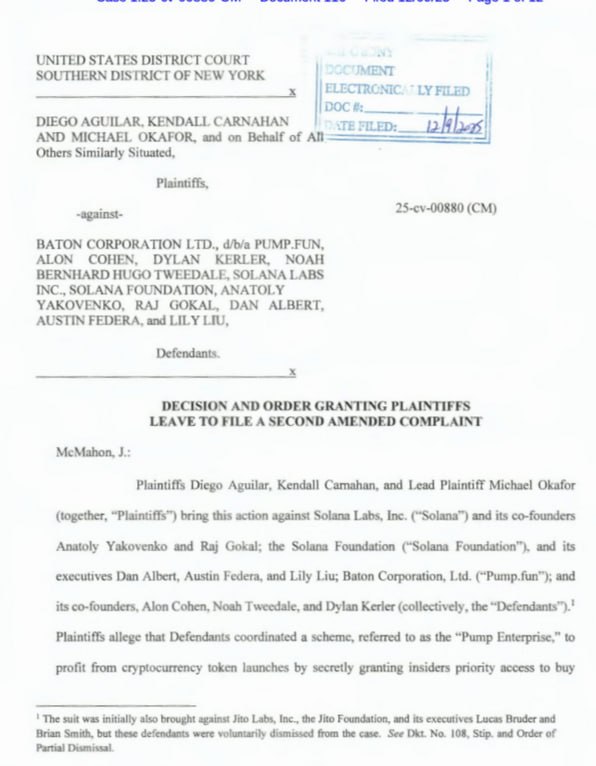 Judge Allows Amended Lawsuit Alleging Pump.fun Marketplace Was Tilted to Favor Insiders on Solana2025-12
 Anthropic sues U.S. government after being designated a "supply chain risk" for refusing to remove AI safety guardrails2026-03
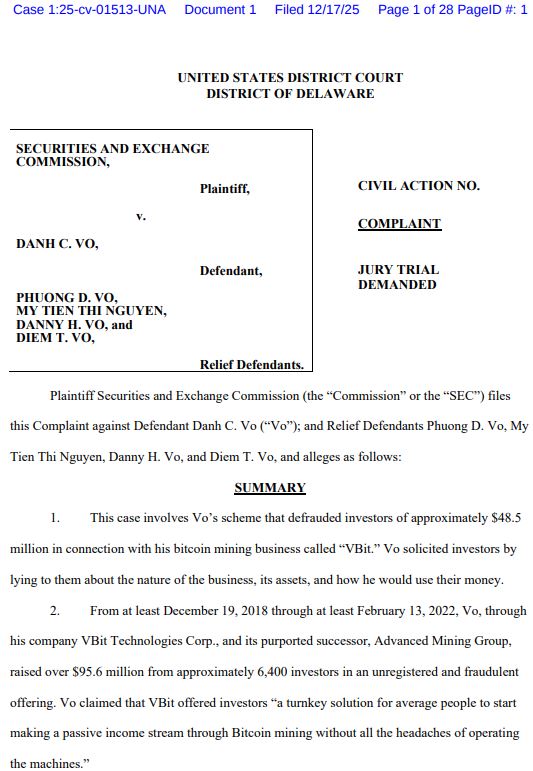 SEC says third-party Bitcoin mining services are securities offerings in new lawsuit. The SEC charged a Philadelphia-based Bitcoin mining entrepreneur with running an illegal securities scheme and misappropriating over $48 million of customer funds.2025-12
 VC firm lawsuit against Curve Founder Michael Egorov dismissed by California court, due to defendant living in Switzerland at the time of the alleged misdeeds2023-09
Cryptocurrency litigation has become one of the defining forces shaping the industry's legal landscape, encompassing regulatory enforcement actions, investor class actions, intellectual property disputes, and criminal proceedings that collectively determine how digital assets are governed.
Why Crypto Attracts Litigation
Few sectors generate as much legal activity per dollar of market capitalization as cryptocurrency. Several structural factors explain why:
Regulatory ambiguity. The United States has never passed comprehensive federal crypto legislation. Instead, the Securities and Exchange Commission (SEC), the Commodity Futures Trading Commission (CFTC), the Department of Justice (DOJ), and state attorneys general all assert overlapping jurisdiction. When agencies disagree about whether a token is a security or a commodity, litigation becomes the default mechanism for resolving the question.
Large retail losses. When exchanges collapse or protocols are exploited, ordinary investors lose real money and look for defendants with identifiable assets. Class action attorneys are well-practiced at aggregating small claims into viable mass suits.
Immutable public records. Blockchain transaction histories are unusually transparent, giving plaintiffs (and prosecutors) detailed evidence trails that would be difficult or impossible to obtain in traditional finance.
Novel IP questions. NFTs, open-source protocols, and AI-adjacent crypto tools have generated a wave of intellectual property disputes over trademarks, copyrights, and trade secrets that existing law is still ill-equipped to resolve cleanly.

Pumpfun and Solana Face $5.5B RICO Lawsuit Alleging Coordinated Memecoin Scheme That Wiped Out Retail Investors

This is bad for business
The Regulatory Enforcement Lawsuit
The most consequential category of crypto litigation involves government agencies suing industry participants.
SEC Enforcement
The SEC has argued for years that most token sales constitute unregistered securities offerings under the 1933 Securities Act's Howey test, which defines a security as an investment of money in a common enterprise with an expectation of profits from others' efforts. The agency's aggressive stance produced landmark cases against Ripple (XRP), Coinbase, Binance, and dozens of smaller projects.
The SEC's 2023 suits against Coinbase and Binance were particularly significant because they named specific tokens as unregistered securities, potentially affecting the entire secondary market for those assets. The Coinbase case raised a foundational question: can a digital asset traded on a secondary market still qualify as a security when the original issuer is no longer involved in its promotion? Courts have not delivered a uniform answer.
The SEC settled its long-running lawsuit with TRON founder Justin Sun in 2025, extracting civil penalties while Sun neither admitted nor denied wrongdoing — a resolution pattern common in agency enforcement that leaves broader legal questions unresolved for the industry.
The DOJ has historically taken a harder line. Its prosecution of FTX founder Sam Bankman-Fried resulted in a conviction on fraud and conspiracy charges in late 2023, with a 25-year sentence handed down in 2024. FTX's collapse in November 2022 also triggered an avalanche of civil claims from creditors, institutional lenders, and retail customers — many still working through bankruptcy proceedings.
The Changing DOJ Posture
Under the Trump administration's DOJ leadership in 2025–2026, the department signaled a more developer-friendly approach, declining to pursue certain prosecutorial theories that had previously targeted open-source software authors. After losing a high-profile lawsuit in that vein, the DOJ's willingness to treat protocol developers as criminally liable for user behavior appeared to recede. This shift has meaningful implications for how decentralized finance (DeFi) projects structure themselves.
Readers are most captivated not by who is accused but by whether defendants can escape accountability on procedural grounds — jurisdiction, standing, and agency overreach — revealing that crypto lawsuits are as much battles over legal architecture as they are over underlying conduct.
Class Action Lawsuits: Investor and Consumer Claims
Class actions allow large groups of similarly situated plaintiffs to sue collectively, making it economically viable to pursue claims over relatively small individual losses.
Exchange and Lender Collapse Claims
The FTX bankruptcy generated some of the largest individual creditor claims in crypto history. Beyond the criminal case, civil suits targeted third parties — including banks, venture capital firms, and celebrity endorsers — alleging they facilitated or promoted fraud. JPMorgan Chase faced a lawsuit alleging its accounts served as the "exclusive vehicle" in a $328 million crypto Ponzi scheme, illustrating how traditional financial institutions can be drawn into digital asset litigation even when they play no direct role in blockchain activity.
Swan Bitcoin faced a lawsuit approaching $1 billion related to the collapse of Prime Trust, a qualified custodian that held customer assets. The case highlights a recurring pattern: when a custody or settlement layer fails, the next layer up in the distribution chain gets sued.
Circle, the issuer of the USDC stablecoin, was hit with a class action over its handling of the $285 million Drift Protocol hack — specifically whether the company responded adequately to protect users. Stablecoin issuers and protocol treasuries increasingly face claims not just for direct wrongdoing but for alleged failures in incident response.
NFT and IP Disputes
The NFT market generated a distinct wave of intellectual property litigation. Yuga Labs, creator of the Bored Ape Yacht Club, pursued and ultimately settled a copyright case with artist Ryder Ripps, who had minted "RR/BAYC" NFTs Yuga characterized as infringing. In a separate proceeding, Yuga secured a $9 million judgment. These cases established that NFT collections can be protected under existing copyright law even when the underlying image files are technically viewable on the public internet.
At the other end of the IP spectrum, the Pudgy Penguins brand — itself a crypto-native NFT project — was targeted by a trademark infringement suit from a legacy apparel company. The irony of a traditional brand asserting IP rights against a community-created crypto project underscores how IP law cuts in both directions in this space.
Jane Street Accused of Orchestrating 2022 Terra UST–LUNA Death Spiral, Triggering $40B Crypto Meltdown, as Terraform Bankruptcy Administrator Files Manhattan Lawsuit in February 2026

"It all started on May 7, when Terraform quietly withdrew 150 million TerraUSD from the decentralized stablecoin-focused trading platform Curve3pool. The lawsuit alleges that within 10 minutes, before Terraform informed the public of anything, a wallet linked to Jane Street also withdrew 85 million TerraUSD from the same pool. This supposedly triggered the market panic. Kwon clarified on the following day that the 150 million withdrawals was mean to move coins to a new liquidity pool for stablecoins, but it was too late. Then, On May 9, with TerraUSD starting to slip, Jane Street's Pratt fired off a group chat to Kwon and team, floating offers to buy bitcoin or Luna. Kwon shot back that Jump's co-founder Bill DiSomma should have clued them in earlier about Terraform's fundraising push."
Prediction Markets and State-Level Fights
Regulatory litigation is not limited to federal authorities. Kalshi, an exchange regulated by the CFTC that operates event contracts and prediction markets, filed a federal lawsuit against Minnesota's attempt to ban its services under state gambling law. The case sits at the intersection of federal preemption, CFTC jurisdiction, and states' rights — a three-way tension with no settled answer.
Separately, a New York lawsuit sought legal ownership of 39,069 dormant Bitcoin addresses, raising questions about abandoned property law and whether unclaimed crypto assets can escheat to state governments. The legal theory is novel: traditional abandoned property statutes were written for bank accounts and physical assets, not bearer instruments that exist on a decentralized ledger.
Trade Secrets and Market Structure
The Jane Street lawsuit — a civil dispute over alleged theft of proprietary trading strategies by former employees who moved to a competing firm — briefly intersected with crypto markets when claims surfaced that the strategies in question had been used to trade Bitcoin and other digital assets. Trade secret claims are largely procedurally identical to those in traditional finance, but their consequences for crypto markets can be outsized when the strategies involve substantial price-moving capital.
Similarly, Binance's decision to file a defamation lawsuit against the Wall Street Journal over reporting on the exchange's finances introduced a new dynamic: crypto companies using litigation not merely as a defense but as an offensive reputational tool against media coverage. Binance simultaneously denied a reported DOJ probe while initiating the suit, a posture that drew significant attention to the limits of using court filings as public relations instruments.
Judge Allows Amended Lawsuit Alleging Pump.fun Marketplace Was Tilted to Favor Insiders on Solana
Bitcoin ATMs and Consumer Protection Suits
Bitcoin ATM operators have faced a growing wave of regulatory and civil actions, often centered on their use by scam victims — particularly elderly consumers coerced by phone-based fraudsters into depositing cash. Missouri's demand for restitution against CoinFlip, and the company's characterization of the action as "meritless," illustrates a tension between machine operators who argue they post required warnings and regulators who contend those warnings are insufficient given known fraud patterns.
These cases matter for the broader industry because courts and regulators deciding how much due diligence an intermediary must perform before processing a transaction will effectively set the compliance floor for any business that touches retail consumers.
- 01SEC jurisdiction overreach battles
Coinbase, Binance, Kraken, Consensys, and Grayscale all contested whether the SEC had authority to act, making the agency's reach the central drama rather than the underlying allegations.
- 02Founder jurisdictional escape
Egorov's Swiss residency defeating a California court's jurisdiction drew the most clicks of any story, signaling readers are fascinated by how personal geography can nullify corporate liability.
- 03Retail investor class actions
Jump Trading's alleged Terra manipulation, the Pumpfun RICO filing, and Bancor losses show readers tracking whether ordinary losers in crypto crashes can hold large players accountable.
- 04State AG crypto enforcement
NY AG Letitia James tripling the DCG fraud allegation to $3B and extracting a $22M KuCoin settlement demonstrated that state prosecutors were filling enforcement gaps the SEC left open.
- 05Bankruptcy estate clawbacks
Celsius suing Tether for $2.4B in BTC, eventually settling for $299.5M, showed readers how collapsed platforms weaponize litigation to claw back assets for creditors.
- 06Protocol dismissal victories
Uniswap and PoolTogether having class actions dismissed on standing or jurisdictional grounds set a precedent that DeFi protocols can defeat suits before reaching the merits.
Injunctions and Asset Freezes
Courts have broad equitable powers to freeze assets before a final judgment to prevent defendants from dissipating wealth. In the Dominion Capital lawsuit against crypto lender BlockFills, a U.S. judge issued a temporary restraining order freezing 70.6 Bitcoin — demonstrating that crypto assets held on identifiable wallets or at custodians are fully reachable by court order. This is an important corrective to the misconception that blockchain custody confers immunity from legal process.
Trends Shaping Future Litigation
Several structural trends suggest crypto litigation will intensify before it stabilizes:
Legislative clarity, whenever it comes, will spawn transition lawsuits. Any comprehensive U.S. crypto bill will require existing projects to comply with new requirements, and the transition period will generate disputes over grandfathering, registration timelines, and retroactive liability.
DeFi protocol litigation is early-stage. Courts are only beginning to grapple with how to assign liability in autonomous smart contract systems where no single party controls the protocol. Uniswap Labs survived a "scam token" class action when a judge determined the protocol itself could not be held responsible for tokens traded on it — but that ruling is likely not the last word on the subject.
International coordination is increasing. The DOJ, SEC, and their counterparts in the UK, EU, and Asia have signed cooperation agreements that make it harder for crypto companies to structure around any single jurisdiction. Binance's global settlements in 2023 and 2024, which touched multiple enforcement agencies simultaneously, are the template for future multi-agency actions.
Private litigation follows enforcement. Regulatory actions create a roadmap for plaintiff attorneys: once the SEC or DOJ identifies a legal theory that survives judicial scrutiny, civil class actions applying the same theory to the same facts typically follow within months.
- 2022-05exploit
Terra/Luna collapse triggers manipulation allegations against Jump Trading
- 2022-07regulatory
Celsius Network files for bankruptcy, setting stage for Tether clawback suit
- 2023-06regulatory
SEC files simultaneous lawsuits against Coinbase and Binance
- 2023-08milestone
Grayscale wins DC Circuit ruling against SEC, clears path for spot Bitcoin ETF
- 2023-11regulatory
CZ pleads guilty; Binance pays $4.3B DOJ settlement
- 2024-04regulatory
Consensys sues SEC preemptively to block MetaMask and ETH classification action
- 2024-06regulatory
California appeals court upholds dismissal of VC lawsuit against Egorov on jurisdictional grounds
- 2025-03milestone
Tether settles Celsius lawsuit for $299.5M, far below $4.5B claimed
Outlook
The volume and variety of crypto litigation reflects an industry maturing under legal pressure rather than legislative consensus. Exchanges, custodians, protocol developers, NFT creators, and infrastructure providers now routinely carry litigation risk as a line item in their operational models. The outcomes of pending cases — particularly those testing DeFi protocol liability, stablecoin issuer duties, and the reach of state gambling and securities laws — will define the legal perimeter within which the next generation of crypto products is built. Until Congress acts, the courtroom remains the primary venue where those boundaries get drawn.
Latest Lawsuit news
Pumpfun and Solana Face $5.5B RICO Lawsuit Alleging Coordinated Memecoin Scheme That Wiped Out Retail InvestorsJane Street Accused of Orchestrating 2022 Terra UST–LUNA Death Spiral, Triggering $40B Crypto Meltdown, as Terraform Bankruptcy Administrator Files Manhattan Lawsuit in February 2026Judge Allows Amended Lawsuit Alleging Pump.fun Marketplace Was Tilted to Favor Insiders on SolanaAnthropic sues U.S. government after being designated a "supply chain risk" for refusing to remove AI safety guardrailsSEC says third-party Bitcoin mining services are securities offerings in new lawsuit. The SEC charged a Philadelphia-based Bitcoin mining entrepreneur with running an illegal securities scheme and misappropriating over $48 million of customer funds. Binance founder CZ is facing a new lawsuit accusing the exchange of enabling over $1B in Hamas-linked transactions, escalating his already mounting legal troubles. Plaintiffs say Binance knowingly let sanctioned groups move funds even after previous penalties.
Community notes
Spot something off or out of date? Drop a note. Editors review topic notes daily and roll accepted fixes into the explainer — contributors are recognized in the monthly $SQUID drop.
Loading notes…
Help improve this topic
Have a story or tip about this topic? Submit it. See something missing? Leave a note. Editors review daily; accepted submissions and fixes count toward the monthly $SQUID drop.