
In-depth explainer on Alchemy Pay (ACH), covering its fiat–crypto gateway, NFT checkout, RWA platform, Web3 digital bank, ACH tokenomics, Alchemy Chain roadmap, and global licensing and securities compliance strategy for a crypto-savvy audience.
+5 sources across the wider coverage universe
 Alchemy Pay adds Rhode Island currency transmitter license, bringing U.S. state approvals to 162026-05
 Oak Grove Ventures, Alchemy pay’s partner, powers Gate group’s bold acquisition of Japan’s Coin Master crypto exchange.2024-12
 Alchemy Pay secures money transmitter license in United States, boosting crypto payment solutions2023-09
 Alchemy Pay partners with Fiat24 to power Web3 Digital Bank service with Swiss-regulated banking solutions.2025-09
 Alchemy Pay has launched a fiat-to-RWA investment platform in partnership with xStocks, enabling users across 170+ countries to buy tokenized U.S. stocks and ETFs directly using local fiat via Visa, Mastercard, SEPA, Apple Pay, Google Pay, and more. The platform’s assets are backed 1:1 by regulated custodians, allow fractional ownership starting at $1, and use real-time data and liquidity to ensure transparency and smooth access.2025-09
 Alchemy Pay partners with Backed to offer tokenized ETFs and equities to global users2025-06
Alchemy Pay: A Comprehensive Guide to the Fiat–Crypto Payment Gateway
As a hybrid fiat–crypto payment gateway, Alchemy Pay connects traditional money rails with blockchain ecosystems for businesses, developers, and end users across more than a hundred jurisdictions. By combining card networks, bank transfers, and local payment methods with on-chain settlement, the project aims to make digital assets, Web3 services, and tokenized securities accessible through familiar fiat payment experiences.
Alchemy Pay occupies a central niche in the infrastructure that links conventional finance and crypto, positioning itself as a regulated payments company rather than a purely on-chain protocol. Founded in the late 2010s in Asia, with sources citing both 2017 and 2018 as its launch window, the company has grown from a gateway serving early crypto merchants to a multi-product platform offering on‑ and off‑ramps, NFT checkout, a Web3 digital banking service, and a real‑world asset (RWA) investment platform. Its network spans more than 70 countries through at least 300 payment channels and touches over two million merchants via partnerships with firms such as Binance, Shopify, NIUM, and QFPay. At the same time, its fiat on‑ and off‑ramp now supports payments in 173 countries, underlining a strategy centered on broad geographic coverage and local regulatory compliance. The project’s native token, ACH, is an ERC‑20 asset on Ethereum and is described by the team as the network token underpinning the Alchemy Pay ecosystem and its planned Alchemy Chain payment blockchain. For a crypto news audience, understanding how Alchemy Pay operates, how it is regulated, and where it is expanding provides insight into broader trends in compliant fiat–crypto payments and tokenized finance.
Background: Mission, Origins, and Market Role
Alchemy Pay’s stated mission is to “bridge the fiat and crypto global economies,” a phrase that recurs throughout its corporate communications and technical roadmaps. In practice, this means building infrastructure that allows users to enter and exit crypto positions using local currencies, while enabling merchants and platforms to accept digital assets without needing to manage blockchain complexity directly. Rather than operating as a consumer-facing exchange in the traditional sense, Alchemy Pay sits in the background of many Web3 interfaces, wallets, NFT marketplaces, and centralized exchanges, offering white‑label payment rails that handle KYC, risk controls, and settlement across fiat and crypto. This positioning reflects a broader trend in crypto infrastructure toward modularity, in which specialist providers handle specific functions—such as on‑ramps or compliance—on behalf of a wide variety of applications.
There is some variation in public descriptions of the project’s founding year, with Alchemy Pay’s profile on CoinMarketCap noting a 2018 founding in Singapore, while recent corporate materials describe the company as founded in 2017. Despite this minor discrepancy, the narrative is consistent: the project emerged during the early growth of commercial crypto payment acceptance and sought to fill a gap between merchants who were comfortable with cards and bank transfers and users who wanted to pay in crypto. Over time, this initial focus evolved into a broader gateway model, with Alchemy Pay frequently describing itself as a pioneer of hybrid fiat–digital currency gateways for businesses and investors. The strategy has relied heavily on partnerships, embedding its technology into third‑party platforms rather than trying to dominate end‑user interfaces.
Scale is a critical part of that value proposition. According to CoinMarketCap’s profile, Alchemy Pay is supported in over 70 countries and connects to around 300 payment channels, enabling touchpoints with more than two million merchants largely via partner integrations with Binance, Shopify, NIUM, and QFPay. More recent disclosures state that its on‑ and off‑ramp services support fiat payments in 173 countries, suggesting substantial expansion beyond its earlier footprint. These ramps incorporate global card networks such as Visa and Mastercard, regional systems like SEPA, and a large set of local payment methods, as well as emerging markets infrastructure such as mobile wallets. By abstracting away the differences among these domestic systems, Alchemy Pay aims to offer a relatively uniform onboarding experience for users around the world who wish to acquire or cash out cryptocurrencies.
The company has steadily expanded its product portfolio beyond simple buy‑crypto flows. Today, its core offerings include a fiat on‑ and off‑ramp, an NFT checkout service, a Web3 digital bank product aimed at enterprises, and an RWA investment platform that supports tokenized stocks and ETFs. These services are tied together by the ACH network token and, increasingly, by the planned Alchemy Chain blockchain, which is designed as a stablecoin‑native payments network optimized for compliant cross‑border transfers. In parallel, the company has invested heavily in licensing and compliance, obtaining money transmitter licenses across a growing number of U.S. states and working with Hong Kong‑regulated securities firms to secure approvals for virtual asset securities dealing and advisory services.
For the broader crypto ecosystem, Alchemy Pay illustrates how payment gateways can serve as bridges between highly regulated fiat rails and more experimental on‑chain systems. It demonstrates one pathway for incorporating stablecoins, NFTs, and tokenized securities into everyday financial flows without requiring merchants or users to interact directly with complex Web3 interfaces. As regulatory scrutiny of exchanges and stablecoins intensifies globally, the company’s emphasis on licensing and partnerships offers a case study in how crypto‑native firms are adapting to more traditional financial oversight.

Alchemy Pay adds Rhode Island currency transmitter license, bringing U.S. state approvals to 16
Core Products and Technical Architecture
Alchemy Pay’s product suite is built around the concept of a flexible gateway that can interface with both traditional and on‑chain payment instruments. Underneath, its architecture consists of fiat payment integrations, partner relationships with exchanges and liquidity providers, and smart contract infrastructure that coordinates settlement and token interactions. While detailed technical documentation for every subsystem is not publicly enumerated in the available sources, the company’s official communications and updates provide insight into how its key products function and how they fit together.
Fiat–Crypto On‑Ramp and Off‑Ramp
The fiat–crypto ramp is the cornerstone of Alchemy Pay’s business. The company describes its Ramp as a “one‑stop solution to buy and sell crypto and fiat,” which can be integrated by platforms and decentralized applications according to their requirements. This implies that Alchemy Pay provides embeddable interfaces or APIs that allow users of a wallet, exchange, game, or DeFi application to purchase supported tokens using conventional payment methods, or to convert their crypto holdings back into fiat and withdraw to bank accounts or cards. For users, the flow resembles a typical e‑commerce checkout: they select the crypto asset they want, choose a payment method such as a credit card or local bank transfer, complete KYC where required, and have the purchased tokens delivered to a specified wallet address. On the backend, Alchemy Pay coordinates fiat collection, crypto sourcing—often via exchange partners—and on‑chain settlement.
Coverage is a major point of differentiation for the Ramp. Alchemy Pay states that it supports fiat payments in 173 countries, indicating that it has either direct or partner‑mediated access to payment rails in most major regions. This coverage includes global systems such as Visa and Mastercard and locally popular options like SEPA transfers in Europe and region‑specific solutions, alongside more than 300 local payment channels in earlier disclosures. For example, when integrating Apertum Coin’s APTM token, Alchemy Pay highlighted that more than 4.4 million KYC‑verified users in over 173 countries could purchase APTM directly using credit cards and over 300 local payment methods. These data points underscore how the company uses a network of payment partners to reach users beyond the reach of pure card‑based processors.
The ramp’s asset coverage strategy is equally notable. Alchemy Pay has made a point of partnering with specific blockchains and token projects to become their fiat entry point, particularly in niches like gaming, Dash payments, and emerging L2 ecosystems. It has integrated Dash’s native token, enabling users to purchase DASH directly using local fiat currencies across its supported geographies. It has also added native support for USDT0 on the Conflux Network, offering seamless fiat‑to‑crypto access for that stablecoin within the Conflux ecosystem. In the Middle East and North Africa, Alchemy Pay’s on‑ramp supports ADI, the native asset of ADI Chain, which is described as the first institutional L2 for stablecoins and RWAs in the region. Through newsroom coverage, similar integrations have been reported for gaming tokens such as CROSS on CROSS_gamechain and DeFi tokens in the TRON ecosystem, all following the same pattern: Alchemy Pay becomes the designated fiat on‑ramp, while the partner project taps into its global payment reach.
The off‑ramp works in the opposite direction, allowing users to liquidate their crypto holdings back into fiat via bank transfers or cards, though detailed operational specifics are less emphasized in public materials. Conceptually, the off‑ramp requires more intensive compliance and anti‑money laundering controls, since it involves returning funds into the banking system. Alchemy Pay’s focus on licensing, particularly in jurisdictions like the United States, suggests that much of its internal architecture is devoted to KYC, screening, and transaction monitoring systems that satisfy regulators while preserving a smooth user experience.
NFT Checkout and Web3 Commerce
As NFTs rose in popularity, one of the biggest barriers to mainstream adoption was the need for users to acquire crypto before making a purchase. Alchemy Pay’s NFT Checkout product is designed to remove that friction by allowing users to purchase NFTs directly with fiat payment methods, with the crypto leg of the transaction handled behind the scenes. The company describes NFT Checkout as a solution that allows businesses to effectively sell and accept payments for NFTs using various payment methods, including cards and selected local wallets. In practice, a marketplace can embed Alchemy Pay’s widget so that a user can, for example, buy an NFT priced in a blockchain’s native token by paying in their local currency; Alchemy Pay collects the fiat, acquires the requisite token via exchange liquidity, and completes the on‑chain purchase.
One notable dimension of this product is its integration with established payment ecosystems in Asia. Alchemy Pay has highlighted support for wallets such as AlipayHK within its NFT Checkout, signalling an intent to make NFT purchases accessible to users who are comfortable with local e‑wallets but not necessarily with self‑custodied crypto wallets. This aligns with the company’s broader strategy of localizing payment options in individual markets, as seen in its expansion of on‑ramp services in regions like Malaysia through local digital wallets in recent newsroom coverage. For NFT creators and marketplaces, NFT Checkout offers a way to increase conversion among non‑crypto‑native buyers without requiring them to go through the multi‑step process of opening an exchange account, completing KYC, funding it, buying crypto, and then returning to the marketplace.
Technically, NFT Checkout depends on tight integration with both fiat processors and NFT marketplaces, along with precise handling of on‑chain settlement and potential issues such as slippage and gas fees. While the company’s public materials do not detail the internal smart contract architecture, it is reasonable to infer that Alchemy Pay must coordinate fiat confirmation, token purchase, and NFT transfer atomically enough to avoid user experience failures. The service also raises interesting questions about custody and risk—specifically, when in the flow the NFT is considered to have been “delivered” and how refunds or chargebacks are handled in a world where blockchain transactions are irreversible—a challenge common to all fiat–NFT bridges.
Web3 Digital Bank
The Web3 Digital Bank offering addresses a different set of users: Web3 businesses and individuals who need to manage multi‑currency fiat accounts and fiat–crypto conversions in a compliant manner. According to Alchemy Pay, this solution provides multi‑fiat accounts and instant fiat–crypto conversion capabilities, designed to support Web3 enterprises such as crypto projects, exchanges, and DAOs that face difficulties accessing traditional banking services. Rather than replacing banks, Alchemy Pay partners with regulated institutions to provide the underlying banking infrastructure. A key example is its partnership with Fiat24, a Swiss‑regulated financial institution that operates a Web3‑integrated banking model under Swiss regulation.
Through this collaboration, Alchemy Pay’s Web3 Digital Bank service leverages Fiat24’s Swiss banking solutions to offer users a compliant means of managing multi‑fiat accounts and accessing regulated banking products while interacting with Web3 applications. The idea is to bridge on‑chain user identities and assets with off‑chain bank accounts, potentially allowing users to move between wallets and fiat accounts more fluidly. For Web3 companies, the product promises a way to maintain operational fiat balances, pay vendors, and receive revenues from their on‑chain activities without constantly shuttling funds through exchanges.
This model fits into a broader trend of “crypto‑friendly” banking, where regulated institutions partner with crypto infrastructure providers to serve clients who might otherwise be de‑risked by traditional banks. By embedding itself in this bank–crypto interface, Alchemy Pay not only extends its revenue base beyond retail on‑ramps but also deepens its integration with compliance regimes, particularly in jurisdictions like Switzerland where tokenization and digital asset regulation are relatively advanced. For regulators, the presence of such intermediaries may be seen as a way to keep crypto activity within a perimeter where KYC, AML, and prudential standards can be applied.
RWA Platform and Tokenized Securities
One of the most strategically interesting components of Alchemy Pay’s product suite is its platform for investing in tokenized real‑world assets. The company states that its RWA platform allows global users to invest in tokenized real‑world assets using local fiat currencies, lowering entry barriers and democratizing access to traditional financial instruments. This is backed by partnerships with tokenization specialists like Backed, whose xStocks product line offers tokenized versions of leading global stocks and ETFs. These “xStocks” are designed for non‑U.S. users and represent tokenized equities and ETFs backed 1:1 by underlying securities held with regulated custodians, with fractional ownership starting at around one U.S. dollar and real‑time data and liquidity feeds.
Alchemy Pay’s role in this arrangement is to provide the fiat on‑ and off‑ramp and user interface through which individuals in over 170 countries can use local payment methods—Visa, Mastercard, SEPA transfers, Apple Pay, Google Pay, and others—to acquire these tokenized assets. The RWA platform thus resembles a cross‑border brokerage service layered on top of blockchain infrastructure, with the added twist that the assets are represented as tokens and may be used within DeFi or wallet environments. For users in jurisdictions with limited access to U.S. or European securities markets, such a gateway could provide exposure to diversified portfolios via ETFs or blue‑chip stocks, albeit subject to local regulatory constraints.
This RWA initiative brings Alchemy Pay directly into the orbit of securities regulation, which explains its parallel work with licensed securities firms and regulatory approvals in markets like Hong Kong. Because tokenized stocks and ETFs will generally be treated as securities under most legal frameworks, offering them to retail users requires either direct licensing or partnerships with licensed broker‑dealers and advisors. By integrating with HTF Securities—a firm regulated by the Hong Kong Securities and Futures Commission (SFC)—and contributing to upgrades of HTF’s Type 1 (dealing in securities) and Type 4 (advising on securities) licenses to include virtual assets, Alchemy Pay is building a structure in which tokenized securities can be offered and advised upon within established securities law. This stands in contrast to earlier waves of tokenized equities that were often offered without clear regulatory status.
Alchemy Chain: Toward a Stablecoin‑Native Payment Blockchain
Beyond its current Web2.5‑style gateway operations, Alchemy Pay is also developing its own blockchain, known as Alchemy Chain, which is framed as a “stablecoin payment‑native” network. According to its technical roadmap and subsequent updates, Alchemy Chain is intended to provide a base layer optimized for compliant cross‑border payments, stablecoin transactions, and integration with regulated financial institutions. The chain’s architecture and key features—while not fully disclosed in public technical documentation—are discussed in company updates that describe a focus on scalability, low‑latency settlement, and native support for stablecoins as primary transacting units rather than volatile native tokens.
A crucial component of Alchemy Chain’s economic design is the ACH Supply Framework, announced as a mechanism to adjust the total supply of ACH tokens to support the new blockchain. Under this framework, the total supply of ACH is set to increase from 10,000,000,000 to 10,800,000,000 tokens in 2026. The additional 800 million ACH are positioned as necessary to power the stablecoin payment‑native blockchain, likely serving as incentives for validators, liquidity providers, or ecosystem participants, though detailed allocation plans are not exhaustively outlined in the available sources. The decision to modestly increase supply, rather than launching a separate token for the chain, suggests a desire to maintain continuity and align the existing ACH community with the project’s long‑term infrastructure ambitions.
Updates in early 2026 indicated that the Alchemy Chain testnet had gone live, marking a significant step toward a mainnet launch and signaling that the chain is moving from design toward practical testing. In broader communications, Alchemy Pay has framed Alchemy Chain as part of a “compliant cross‑border payments” strategy, potentially positioning the chain as the settlement layer for institutional stablecoin flows and RWA transactions, rather than as a generalized smart‑contract platform competing head‑on with existing L1s. If executed as described, the chain could offer regulators and institutions a more controlled environment in which stablecoins and tokenized assets circulate under clearly defined compliance and monitoring rules, with ACH acting as the network’s economic enabler.
From a technical and strategic perspective, Alchemy Chain represents an attempt to move up the stack—from being a service provider embedded in others’ ecosystems to operating its own settlement infrastructure. This transition is non‑trivial: it requires bootstrapping validator participation, ensuring security, and attracting developers and partners to build on the chain. It also introduces new layers of regulatory and technical risk. However, if Alchemy Pay can successfully align its existing network of payment channels, partners, and regulatory licenses with a purpose‑built chain, it may gain more control over costs, settlement finality, and programmable compliance than it could achieve while depending solely on third‑party blockchains.
Developer Experience and Integration Model
Across these products, Alchemy Pay’s integration model emphasizes APIs, SDKs, and SaaS‑style solutions that allow developers to plug into its payment rails without needing to reinvent compliance and fiat connectivity. The company notes that commercial businesses and developers access its services by integrating payment channels, APIs, and other software‑as‑a‑service solutions, implying that the gateway can be embedded into e‑commerce checkouts, exchange deposit pages, DeFi front ends, or gaming applications with minimal additional infrastructure. In the case of its Ramp, Alchemy Pay positions itself as a one‑stop provider that handles the complexities of different fiat payment methods, KYC, fraud screening, and coordination with on‑chain transfers.
For developers, this arrangement offers a trade‑off. On one hand, outsourcing on‑ramp and compliance functions to an established provider can greatly reduce time to market and regulatory risk. On the other, it introduces platform dependence: if a project’s primary fiat on‑ramp is a third‑party gateway, that project is exposed to the gateway’s pricing, uptime, and regulatory status. Alchemy Pay’s push to expand its regulatory footprint and build its own blockchain can thus be seen as an effort to reassure partners that its infrastructure will remain available and compliant over the long term. For a crypto developer audience, the company’s value proposition lies in abstracting away the “last mile” between users’ bank accounts and the tokens or NFTs that a given application wants to offer.
Readers engage Alchemy Pay primarily through its partnership dealflow that unlocks new market access — US licensing and tokenized-asset rails — not its underlying ACH token or payment-widget mechanics, revealing that the real story is whether Alchemy Pay can become infrastructure for regulated financial rails rather than a crypto-native tool.
ACH Token and Economic Design
The ACH token plays a central role in Alchemy Pay’s ecosystem and future plans, even as many of its current services continue to rely heavily on off‑chain infrastructure. ACH is an ERC‑20 token native to the Ethereum blockchain and is identified as the Alchemy Pay network token across official profiles. This dual identity—as both a conventional ERC‑20 asset and the designated token of a payment gateway—places ACH within the category of infrastructure tokens that derive value from the usage and growth of an underlying platform rather than from serving as a general‑purpose money or personalized meme token.
Originally, the total supply of ACH was set at 10 billion tokens, a figure that is widely cited in earlier materials and reflected in the supply breakdowns referenced in the ACH Supply Framework announcement. However, in preparation for launching Alchemy Chain as a stablecoin payment‑native blockchain, Alchemy Pay introduced a supply framework that increases the total ACH supply to 10.8 billion in 2026. The stated rationale is to power the new blockchain’s economic and incentive structures, although the specific mechanisms—such as staking rewards, validator incentives, ecosystem grants, or liquidity mining—are not described in granular detail in the publicly available summary. The decision not to create a separate chain token but instead to modestly expand ACH supply suggests a desire for continuity: holders of ACH are, by design, linked to both the existing payment gateway business and the future Alchemy Chain network.
From an economic perspective, this supply adjustment represents a relatively small inflation of 8 percent relative to the original cap, but it nonetheless introduces familiar tokenomics questions about dilution and value capture. Because ACH’s explicit utility functions are not exhaustively enumerated in the cited sources, one must infer from context what roles the token may play. Alchemy Pay consistently describes ACH as its network token and emphasizes that the ACH Supply Framework is tied to enabling a payment‑native blockchain. It is therefore reasonable to understand ACH as a token intended to underwrite network operations, reimburse participants in the ecosystem, and potentially act as a base asset for fees or staking on Alchemy Chain. However, without explicit confirmation in official documentation, analysts should be cautious about ascribing specific mechanisms—such as governance rights or fee‑burning—to ACH.
ACH also serves a signaling role, aligning the interests of early supporters with the long‑term trajectory of the company’s infrastructure. As Alchemy Pay expands its regulatory footprint and product suite, the token provides a transparent, on‑chain representation of the project’s perceived value, influenced by factors such as adoption of its ramp, growth of its merchant network, and progress on Alchemy Chain. At the same time, the token’s price is subject to broader crypto market conditions, speculative cycles, and liquidity constraints. This dual nature—as both an economic component of the network and a traded asset on secondary markets—introduces a volatile feedback loop that can complicate long‑term planning but also provides access to capital and community engagement that purely private companies may lack.
For holders and prospective investors, the critical analytical questions revolve around how effectively ACH is integrated into Alchemy Pay’s core operations and whether usage of the gateway’s products translates into sustained demand for the token. To the extent that fees, rewards, or required deposits are denominated in ACH, and that Alchemy Chain becomes a widely used settlement layer, the token’s utility could be reinforced. Conversely, if most of the company’s revenue is realized in fiat and stablecoins and if partner integrations treat ACH primarily as an optional speculative asset, the linkage between business performance and token value may be less direct. The introduction of the ACH Supply Framework and the emphasis on a stablecoin‑native blockchain suggest that the company is aware of this dynamic and is seeking to tighten the relationship between token and network, but the eventual shape of that relationship remains to be tested in practice.

Alchemy Pay has launched a fiat-to-RWA investment platform in partnership with xStocks, enabling users across 170+ countries to buy tokenized U.S. stocks and ETFs directly using local fiat via Visa, Mastercard, SEPA, Apple Pay, Google Pay, and more. The platform’s assets are backed 1:1 by regulated custodians, allow fractional ownership starting at $1, and use real-time data and liquidity to ensure transparency and smooth access.

a lot of RWA coming out
Compliance, Licensing, and the Securities Angle
One of the most distinguishing features of Alchemy Pay, compared with earlier generations of crypto payment processors, is its emphasis on regulatory compliance and formal licensing. This strategy reflects the realities of operating at the intersection of fiat and crypto: collecting and disbursing fiat funds, particularly when it involves stablecoins or tokenized securities, typically triggers money transmission, securities, or payment services regulations in multiple jurisdictions. Alchemy Pay’s public communications highlight repeated progress in obtaining licenses and partnering with regulated institutions, especially in the United States and Hong Kong.
U.S. Money Transmitter and Currency Transmitter Licenses
In the United States, companies that accept, transmit, or exchange money on behalf of customers—whether fiat currency or certain categories of digital assets—are generally required to register as money services businesses at the federal level and to obtain money transmitter or currency transmitter licenses at the state level. Alchemy Pay’s recent developments in this area show a concerted effort to build a compliant U.S. footprint. Company updates note that in 2025 alone, Alchemy Pay secured six U.S. Money Transmitter Licenses and advanced its compliance footprint across several other jurisdictions, underscoring the centrality of U.S. state licensing to its global strategy.
A key milestone was the acquisition of a Money Transmitter License in Delaware, after which Alchemy Pay reported holding such licenses in fifteen U.S. states, including Arkansas, Iowa, Minnesota, New Hampshire, and others. Subsequent progress included securing a currency transmitter license from Rhode Island authorities, which increased its license coverage to sixteen states and further expanded its regulated service provision in one of the world’s largest financial markets. The Rhode Island approval was positioned as critical to strengthening Alchemy Pay’s U.S. regulatory footprint and enabling compliant fiat‑to‑crypto payment services and stablecoin‑powered infrastructure within that jurisdiction.
More recently, Alchemy Pay announced that it had obtained a money transmitter license in Maine, bringing its U.S. coverage to seventeen states. The Maine license builds on earlier approvals, such as those in Arizona and other states mentioned in licensing press releases, and signals an ongoing strategy to achieve nationwide coverage over time. Each additional state license allows Alchemy Pay to legally offer its on‑ and off‑ramp services to residents of that state, subject to local consumer protection and AML requirements. For a payment gateway whose value proposition rests largely on global accessibility, the ability to serve U.S. residents under a robust regulatory framework is both commercially and reputationally important.
These licensing efforts do not eliminate regulatory risk; U.S. authorities have demonstrated that compliance expectations can evolve rapidly, particularly with respect to stablecoins, tokenized securities, and the classification of crypto assets. However, by treating licenses as a prerequisite rather than a retrospective fix, Alchemy Pay signals that it intends to operate as a regulated financial services provider rather than as an unlicensed crypto startup. For platform partners that integrate its ramp into their products, this may reduce the risk that their own operations will be disrupted by enforcement actions related to unlicensed money transmission.
Hong Kong SFC Type 1 and Type 4 License Upgrades
Alchemy Pay’s engagement with securities regulation is particularly visible in Hong Kong, a jurisdiction that has taken a relatively proactive approach to building a regulated virtual asset framework. In collaboration with HTF Securities Limited, a licensed corporation regulated by the Hong Kong Securities and Futures Commission (SFC), Alchemy Pay has contributed to two significant license upgrades involving virtual assets.
First, HTF Securities’ existing SFC Type 1 license—covering “dealing in securities”—was uplifted to include virtual asset dealing services for both professional and retail investors. This license upgrade enables HTF Securities, in partnership with Alchemy Pay, to offer regulated dealing services in virtual assets, including tokenized securities and potentially certain categories of crypto, within Hong Kong’s established securities law framework. The integration of virtual asset dealing into a Type 1 license is notable because it treats tokenized instruments and certain digital assets as part of the regulated securities space rather than as an unregulated sideline.
Second, HTF Securities’ SFC Type 4 license—covering “advising on securities”—was upgraded to include virtual asset advisory services. This authorization allows HTF to provide regulated advisory services related to virtual assets to both professional and retail investors, again in collaboration with Alchemy Pay. Together, the Type 1 and Type 4 upgrades mean that Alchemy Pay’s partner can both deal in and advise on virtual asset securities, creating a regulated channel through which Alchemy Pay’s RWA platform and tokenized securities offerings can be marketed and serviced in Hong Kong.
These regulatory developments intersect closely with Alchemy Pay’s RWA strategy. By ensuring that offerings of tokenized stocks and ETFs, through partnerships like that with Backed’s xStocks, are tied to regulated dealing and advisory licenses, the company is attempting to avoid the legal and reputational pitfalls that plagued early tokenized securities projects. For investors in Hong Kong and potentially other markets where SFC‑style licenses are recognized, this could provide greater confidence that their tokenized holdings are subject to familiar protections and regulatory oversight.
Global Compliance Footprint and Institutional Partnerships
Beyond the United States and Hong Kong, Alchemy Pay highlights a broader global compliance push, including progress in Australia, South Korea, Switzerland, and other jurisdictions. The company’s materials emphasize that in 2025 alone it made “consistent progress” in building a globally regulated payment ecosystem, though granular details of each jurisdiction’s licensing regime are not fully enumerated in the available summaries. What is clear is that Alchemy Pay seeks to present itself as a compliant intermediary, embedding its operations within existing financial regulatory frameworks rather than circumventing them.
Partnerships with regulated institutions demonstrate this approach. In Switzerland, for instance, Alchemy Pay’s collaboration with Fiat24 allows it to offer Web3 digital bank services using a Swiss‑regulated banking solution. Users and enterprises interacting with this service are therefore dealing with accounts and products that fall under Swiss financial regulation, even though their entry point may be a Web3 interface facilitated by Alchemy Pay. Similarly, in the tokenized securities space, the reliance on regulated custodians and broker‑dealers, as described in the xStocks integration, ensures that underlying assets are held in compliant structures even as their representations circulate as tokens.
For regulators, this model offers a way to integrate crypto payments and tokenization into the existing supervisory perimeter without relinquishing oversight. For Alchemy Pay and its partners, it opens channels to institutional participants and mainstream users who may be unwilling or unable to use unregulated exchanges or self‑custody solutions. However, it also means that the company must continuously adapt to evolving regulations, which may impose new requirements on KYC, reporting, and permissible asset classes.
Why Compliance Matters for Fiat–Crypto Payments
At a conceptual level, Alchemy Pay’s focus on compliance reflects a deeper structural reality: any business that connects crypto assets to the traditional banking system cannot remain insulated from financial regulation. Accepting fiat payments to purchase crypto often constitutes money transmission or payment services activity, triggering licensing requirements, capital obligations, and AML duties. Converting crypto back to fiat for withdrawal raises further questions about source‑of‑funds verification and sanctions screening. When tokenized securities and RWAs are added to the mix, securities and investment regulations also come into play.
For users, the presence of licensed intermediaries like Alchemy Pay can be a double‑edged sword. On one hand, regulatory compliance can provide protections such as recourse in the event of fraud, standardized disclosures, and alignment with consumer protection laws. On the other, it typically entails KYC procedures, transaction monitoring, and limitations based on jurisdiction or investor status. The user experience may be less frictionless than interacting with a purely decentralized protocol, but the trade‑off is a higher degree of legal clarity and, in some cases, access to asset classes—such as tokenized stocks—that cannot be offered outside regulated channels.
For the crypto ecosystem, the rise of compliant fiat–crypto gateways like Alchemy Pay may accelerate mainstream adoption while shifting some activity away from unregulated exchanges. However, it also raises questions about centralization and the degree to which regulatory pressure could influence which assets are supported, how stablecoins are handled, and what types of DeFi integrations are permitted. As regulators globally refine their approaches to stablecoins, crypto exchanges, and tokenized securities, the regulatory perimeter within which Alchemy Pay operates is likely to continue evolving, requiring ongoing adaptation in both its legal strategy and technical architecture.
- 01Oak Grove Gate Group acquisition
The 210-click lead suggests readers saw Alchemy Pay's investor/partner network as a strategic force reshaping Asian crypto exchange consolidation, not just a payments vendor.
- 02US money transmitter licensing↗
A rolling state-by-state license count (15 → 16 → 18 states) gave readers a concrete compliance scoreboard to track, making regulatory progress feel like a live competition metric.
- 03RWA tokenized stock access↗
The xStocks and Backed partnerships let readers see Alchemy Pay as an on-ramp to tokenized equities across 170+ countries, framing it as a retail brokerage disruptor rather than a crypto gateway.
- 04Swiss Web3 banking rails↗
The Fiat24 deal positioned Alchemy Pay as plumbing for a regulated European digital bank, appealing to readers tracking institutional-grade fiat-crypto integration.
- 05Alchemy Chain own blockchain↗
Announcing a proprietary chain with a native stablecoin shifted the narrative from payment plugin to independent payment-native L1, attracting readers following infrastructure bets.
- 06Hong Kong SFC license upgrades↗
Sequential Type 1 and Type 4 SFC license milestones signaled an Asia regulatory moat being built alongside the US state-license campaign.
Ecosystem, Integrations, and Real‑World Use Cases
Alchemy Pay’s impact on the crypto ecosystem is best understood through the lens of its integrations: with merchants, token projects, exchanges, and institutional partners. Rather than building a monolithic platform, the company has positioned itself as infrastructure that others can embed, enabling a wide range of use cases across payments, gaming, DeFi, and tokenized securities.
Merchant Network and Platform Partnerships
According to its CoinMarketCap profile, Alchemy Pay provides online and offline merchants with convenient acceptance of both fiat and crypto, enabling easy onboarding to blockchain ecosystems and making Web3 services accessible. It is supported in over 70 countries, connects to about 300 payment channels, and has touchpoints with more than two million merchants through partnerships with industry leaders such as Binance, Shopify, NIUM, and QFPay. These figures suggest that Alchemy Pay’s merchant footprint is heavily mediated by major platforms: a single integration with a large exchange or e‑commerce provider can expose its gateway to millions of end users.
Exchange partnerships are particularly significant. For example, Alchemy Pay has previously partnered with MEXC Global to provide fiat on‑ramps and crypto acceptance, presenting itself as an inventor of hybrid fiat–digital currency gateway solutions for businesses and investors. By embedding its payment widget into exchange deposit flows or OTC buying interfaces, Alchemy Pay effectively becomes the engine that allows fiat‑based users to enter a given exchange’s ecosystem without the exchange itself needing to manage card processing and local payment licenses. Similar dynamics likely apply to its relationships with Binance and other exchanges, where Alchemy Pay’s ramp may appear as one of several fiat purchase options available to users.
On the merchant side, integrations with platforms like Shopify and QFPay provide indirect access to millions of merchants who may use Alchemy Pay’s services without necessarily being aware of the brand behind their crypto acceptance features. In such cases, Alchemy Pay’s role may include converting crypto payments into fiat for merchant settlement, or enabling merchants to accept crypto in a way that is reconciled alongside their conventional payment methods. This “white‑label” positioning means that the company’s brand visibility may be lower among end users than among the developers and businesses who integrate its APIs, but it also means that its reach can be extensive even when it is not front‑and‑center.
Token and Blockchain Integrations
A significant part of Alchemy Pay’s ecosystem strategy involves partnering with specific blockchains and tokens to act as their designated fiat on‑ramp. The integration with Dash offers one example: by supporting fiat on‑ramp access for Dash’s native token, Alchemy Pay allows users to purchase DASH directly using local currencies through its global fiat payment channels. This integration not only supports Dash’s use as a payments asset but also exemplifies how Alchemy Pay plugs into existing crypto communities that prioritize fast, low‑cost transactions.
The addition of native support for USDT0 on the Conflux Network represents another strategic integration. By integrating USDT0, a stablecoin deployed on Conflux, into its payment gateway, Alchemy Pay enables users to acquire this specific stablecoin directly from fiat, enhancing its utility within the Conflux ecosystem and potentially encouraging its adoption in DeFi protocols on that network. From Conflux’s perspective, partnering with a global fiat gateway like Alchemy Pay addresses the “last mile” problem of how users obtain the stablecoin needed to participate in on‑chain activities.
Similarly, Alchemy Pay’s support for ADI, the native token of ADI Chain—the first institutional L2 for stablecoins and RWAs in the MENA region—illustrates its focus on networks that position themselves as institutional or compliance‑friendly. By offering an easy way for users to “grab ADI” through its on‑ramp, Alchemy Pay helps bootstrap liquidity and user participation in a layer‑2 ecosystem that aligns with its own emphasis on regulated, stablecoin‑centric finance. Integration with Apertum’s APTM token extends this pattern: Alchemy Pay enables 4.4 million KYC‑verified users across 173+ countries to purchase APTM using credit cards and more than 300 local payment methods, providing fiat access that can accelerate ecosystem growth for the Apertum blockchain.
Beyond these specific examples, newsroom coverage points to integrations with gaming ecosystems such as CROSS_gamechain, where Alchemy Pay has added CROSS to its global fiat on‑ramp to expand access to CROSS‑based gaming experiences. Similar coverage notes its role in supporting TRON ecosystem tokens such as SUN via its ramps. In each case, the logic is consistent: token projects gain a global fiat entry point without needing to negotiate separate card and bank integrations country‑by‑country, while Alchemy Pay broadens its asset coverage and user base.
RWA, Digital Banking, and Institutional Ecosystem
Alchemy Pay’s partnerships around tokenized securities and digital banking underscore its ambition to serve not just retail crypto users but also institutions and traditional investors. The collaboration with Backed, which brought xStocks’ tokenized stocks and ETFs onto Alchemy Pay’s platform, is central to this institutional narrative. By integrating xStocks, Alchemy Pay allows non‑U.S. users to access tokenized versions of leading global stocks and ETFs using local fiat currencies, with the underlying assets held 1:1 by regulated custodians. Features such as fractional ownership from one dollar and real‑time data feeds reinforce the notion that tokenization can democratize access to securities markets, provided that regulatory and custody structures are robust.
On the banking side, the partnership with Fiat24 anchors the Web3 Digital Bank service in Swiss regulation, giving Web3 businesses and individuals a compliant, reliable means of managing multi‑fiat accounts and instant fiat–crypto conversions. This collaboration situates Alchemy Pay at the nexus of DeFi, centralized exchanges, and regulated banking, allowing it to act as an intermediary that understands the needs of all three constituencies. For institutions that might be wary of holding assets directly on public blockchains or using unregulated exchanges, such an arrangement can offer a more palatable entry point into digital assets and tokenized RWAs.
Alchemy Pay also connects to the broader venture and exchange ecosystem through relationships highlighted in public communications, such as its association with Oak Grove Ventures, a partner involved in Gate Group’s acquisition of a Japanese crypto exchange according to social media coverage. While details of these relationships are often high‑level, they suggest that Alchemy Pay is embedded in a network of venture, exchange, and infrastructure actors focused on regulated digital asset markets in Asia and beyond. In combination with its SFC‑related securities licenses and European banking partnerships, this positions the company as a conduit between crypto‑native innovation and traditional capital markets infrastructure.
Community, Developers, and Network Effects
Network effects in Alchemy Pay’s ecosystem stem from both the breadth of its integrations and the depth of its compliance and payments stack. As more token projects, NFT platforms, and exchanges adopt its on‑ and off‑ramp, users become more likely to encounter Alchemy Pay’s services in multiple contexts, increasing familiarity and potentially trust. Conversely, as more regulators and banking partners approve its operations, platforms that might otherwise build their own payment infrastructure may choose to rely on Alchemy Pay instead, creating a virtuous cycle of adoption.
Recent newsroom coverage has emphasized that Alchemy Pay’s ecosystem now includes more than 1,200 partners, including marquee names like Binance and Shopify, reinforcing the idea that its growth is driven by integration density rather than a single flagship application. For developers, this ecosystem can be attractive: building on an infrastructure provider that is already widely integrated can reduce friction when users move across platforms, particularly if they can reuse KYC information or payment preferences. At the same time, the company’s close ties to regulatory and banking institutions may reassure developers that the rails they are using are unlikely to be abruptly cut off by compliance issues, a risk that has affected some payment providers in earlier crypto cycles.

Alchemy Pay partners with Fiat24 to power Web3 Digital Bank service with Swiss-regulated banking solutions.
Positioning in the Broader Crypto Payments Landscape
Alchemy Pay operates in a crowded and evolving landscape of fiat–crypto gateways, stablecoin issuers, payment processors, and on‑chain protocols. Its distinctive positioning arises from three core elements: a hybrid model that combines fiat payment services with blockchain infrastructure; an explicit focus on regulatory licensing and institutional partnerships; and a product suite that spans retail on‑ramps, NFT commerce, digital banking, and tokenized securities.
Unlike centralized exchanges that primarily target trading and custodial services, Alchemy Pay’s business model is closer to that of a payment processor or PSP (payment service provider) that has extended its capabilities to include crypto assets and tokenized instruments. It emphasizes merchant acceptance and fiat on‑ and off‑ramps integrated into third‑party platforms rather than building a standalone consumer trading interface. This makes it more analogous to Web2 payment gateways adapted for Web3 than to pure crypto exchanges, even though it sometimes partners with exchanges to deliver its services.
Compared with purely on‑chain payment protocols, which might aim to enable payments entirely within the crypto ecosystem using stablecoins or native tokens, Alchemy Pay places greater emphasis on interfacing with traditional card networks, banks, and local payment methods. Its role is less about designing new cryptographic mechanisms for peer‑to‑peer transfers and more about managing the messy interfaces between regulated fiat systems and blockchain ledgers. The development of Alchemy Chain can be seen as an attempt to bring more of this complexity on‑chain, but even in that context the company’s messaging focuses on “compliant cross‑border payments” and stablecoin transaction flows, reinforcing the idea that its core competence lies in bridging regulated and decentralized systems rather than in reinventing base‑layer consensus.
In terms of regulatory posture, Alchemy Pay stands out among crypto infrastructure providers in the extent to which it foregrounds licensing and partnerships with regulated securities firms and banks. While many crypto projects have historically avoided direct engagement with securities and payment regulators, Alchemy Pay appears to have embraced the view that long‑term viability in fiat–crypto payments requires deep integration into existing regulatory frameworks. This approach may constrain its ability to offer certain high‑risk or unregulated products, but it also makes it a more credible counterpart for institutional clients and conservative jurisdictions.
Strategically, the combination of retail payment services, tokenized securities, digital banking, and a purpose‑built blockchain suggests that Alchemy Pay aspires to be a full‑stack infrastructure provider for regulated digital asset finance. Its RWA platform and securities licenses point toward a future in which tokenized equities and ETFs are as easy to acquire and use as stablecoins, while its Web3 digital bank and Alchemy Chain aim to provide the account and settlement layers for such activity. For crypto‑native users, this may open new avenues for integrating RWAs into DeFi strategies; for traditional investors, it may provide a familiar regulatory and UX wrapper around on‑chain assets.
However, this positioning also exposes Alchemy Pay to competitive pressure from both sides. Traditional payment processors and banks are increasingly experimenting with stablecoin settlement and tokenized deposits, while crypto‑native on‑ramp providers continue to innovate on UX and token support. Alchemy Pay’s hybrid model must therefore offer sufficient advantages—such as broader payment coverage, better regulatory clarity, or deeper integration with tokenized securities—to justify its role as an intermediary.
MEXC Global fiat on-ramp partnership announced
Alchemy Chain cross-border payment network unveiled with Q4 2025 stablecoin target
Delaware money transmitter license secured (15th US state)
Fiat24 Web3 digital bank partnership live with Swiss-regulated banking rails
Backed and xStocks partnerships launch fiat-to-tokenized-equity platform across 170+ countries
HTF Securities Hong Kong SFC Type 1 (Dealing in Securities) license uplifted
HTF Securities Hong Kong SFC Type 4 (Virtual Asset Advisory) license secured
Alchemy Chain testnet goes live; ACH supply framework published
Risks, Trade‑Offs, and Open Questions
As with any infrastructure project operating at the intersection of crypto and traditional finance, Alchemy Pay faces a range of risks and trade‑offs that crypto market observers should consider when evaluating its long‑term prospects. These risks span regulatory, technical, economic, and competitive dimensions.
On the regulatory front, Alchemy Pay’s strategy of pursuing licenses and partnering with regulated institutions mitigates certain legal risks but does not eliminate them. U.S. regulators continue to refine their approaches to stablecoins, tokenized securities, and crypto custody, and changes in state or federal laws could impose new obligations or restrict certain business lines. Similarly, Hong Kong’s virtual asset regime, while currently supportive of regulated activity, may evolve in ways that affect the scope of permitted tokenized securities and advisory services. Internationally, divergent regulatory approaches—ranging from the EU’s MiCA framework to more restrictive stances in some countries—could complicate efforts to maintain consistent product offerings across 173 countries. Alchemy Pay’s heavy investment in licensing suggests an awareness of these challenges, but it also means that a significant portion of its resources must be devoted to regulatory maintenance rather than purely to technical innovation.
Technically, the move to launch Alchemy Chain introduces new security and execution risks. Designing and operating a stablecoin‑native payment blockchain that satisfies institutional requirements and regulatory expectations is a complex undertaking. The chain must achieve sufficient decentralization and security, maintain low transaction costs, and integrate robust compliance features without undermining user privacy or network resilience. The ACH Supply Framework’s expansion of token supply to fund this effort links the chain’s success directly to tokenomics. If Alchemy Chain fails to gain traction, the additional ACH supply could be perceived as dilutive without corresponding increases in utility, potentially affecting token holder confidence.
Economic risks also arise from the interplay between ACH token dynamics and the company’s off‑chain revenue model. Much of Alchemy Pay’s current value proposition is in fiat‑denominated services, such as payment processing, on‑ramp fees, and banking partnerships. If these services generate substantial revenue in fiat or stablecoins without requiring significant ACH usage, there may be a disconnect between the company’s financial performance and the token’s on‑chain demand. The ACH Supply Framework aims to deepen the connection by making ACH integral to Alchemy Chain’s operation, but until the chain is fully launched and widely used, this alignment remains aspirational. Token holders therefore bear both execution risk on the chain and business risk on the gateway services.
From a competitive standpoint, Alchemy Pay must navigate a landscape where both traditional payment companies and crypto‑native gateways are continuously innovating. Established payment processors are experimenting with stablecoin settlement and may eventually integrate crypto on‑ramps into their own offerings, leveraging existing merchant relationships. Crypto‑native competitors can differentiate by supporting a broader range of assets, offering lower fees, or providing deeper integrations with DeFi protocols. In this context, Alchemy Pay’s differentiators—such as its RWA platform, regulated securities licenses, and digital banking partnerships—will need to translate into tangible advantages for users and partners.
Finally, there are broader ecosystem questions about centralization and control. As a regulated gateway, Alchemy Pay necessarily operates within a framework where certain activities—such as transfers to sanctioned addresses or unsupported jurisdictions—must be restricted. While this is acceptable and even desirable for many users and institutional clients, it stands in contrast to the permissionless ethos of decentralized finance. The emergence of stablecoin‑native blockchains with embedded compliance features further raises questions about how much on‑chain activity will become dependent on regulated intermediaries. Alchemy Pay’s trajectory thus reflects a larger debate within crypto about the balance between permissionless innovation and regulatory integration.
Active US multi-state MTL campaign (18+ states) and Hong Kong SFC licenses reduce acute shutdown risk, but operating across 170+ countries means a patchwork of overlapping and evolving payment regulations with no single consolidated license.
Core value proposition depends on centralized partnerships with Visa, Mastercard, SEPA networks, and regulated custodians — disruption or policy changes at any major rail directly impairs the service.
Alchemy Chain is still in testnet phase as of early 2026, meaning the proprietary L1 and its native stablecoin carry unaudited-in-production risk at launch.
ACH token utility is loosely coupled to actual payment volume; the business generates revenue from merchant processing fees rather than token burns or staking, leaving token price largely speculative.
Fiat on-ramp liquidity relies on third-party custodians and banking partners; a partner withdrawal — as with Fiat24 or xStocks custodians — could freeze user access to tokenized positions.
With 1,200+ integrated partners, concentration risk is low in aggregate, but flagship partnerships with Binance and Shopify create reputational dependency on counterparties outside Alchemy Pay's control.
Conclusion
Alchemy Pay has evolved from an early hybrid fiat–crypto payment gateway into a multi‑product infrastructure provider that sits at the crossroads of traditional finance and Web3. Through its fiat on‑ and off‑ramps, NFT Checkout, Web3 Digital Bank, and RWA platform, the company enables users in more than 170 countries to interact with digital assets, NFTs, and tokenized securities using familiar fiat payment methods. Partnerships with exchanges, merchants, and banks give it indirect reach into millions of end‑user experiences, even as its brand remains most visible within developer and crypto infrastructure circles. The ACH token, initially an ERC‑20 asset tied to the gateway’s operations, is being positioned as the network token for the forthcoming Alchemy Chain, a stablecoin‑native blockchain designed for compliant cross‑border payments.
At the same time, Alchemy Pay’s story is as much about regulation as it is about technology. Its accumulation of money transmitter and currency transmitter licenses across the United States, its collaboration with HTF Securities on SFC Type 1 and Type 4 license upgrades in Hong Kong, and its partnerships with regulated institutions like Fiat24 and Backed illustrate a deliberate strategy of embedding crypto payments and tokenization within existing regulatory frameworks. This positioning has enabled it to offer tokenized stocks and ETFs, multi‑fiat banking services, and stablecoin‑based payment infrastructure to users and institutions who might otherwise avoid unregulated crypto platforms.
For a crypto news audience, Alchemy Pay provides a case study in how fiat–crypto gateways can mature into regulated financial infrastructure while still pursuing ambitious on‑chain innovations. Its development of Alchemy Chain, expansion of ACH’s supply and role, and continuing integration with gaming tokens, L2s, and RWAs point to a future in which the boundary between traditional and decentralized finance is increasingly mediated by such hybrid providers. Yet the project also faces non‑trivial risks related to regulatory change, competitive pressure, and the challenge of aligning token economics with off‑chain business realities. How effectively it navigates these challenges will determine whether it becomes a foundational layer of regulated digital asset finance or remains one of many competing gateways in a rapidly evolving landscape.
Outlook
Looking ahead, Alchemy Pay appears poised to deepen its role in regulated digital asset infrastructure if it can successfully launch and scale Alchemy Chain while maintaining and expanding its regulatory footprint. The chain’s focus on stablecoin payments and compliant cross‑border transfers aligns with growing institutional interest in tokenized money and RWAs, and its integration with ACH through the supply framework suggests a tighter coupling between network usage and token value. Continued expansion of U.S. state licensing, further SFC‑type approvals in Hong Kong, and additional partnerships with regulated banks and securities firms could cement its status as a trusted intermediary for both retail and institutional users.
At the same time, the competitive environment will likely intensify as traditional payment processors, banks, and other crypto gateways refine their own offerings. Alchemy Pay’s ability to differentiate through product breadth—combining retail ramps, NFTs, tokenized securities, and digital banking—may prove decisive, especially if it can deliver a seamless user experience that abstracts away regulatory complexity. For now, Alchemy Pay stands as a prominent example of a crypto infrastructure company that has chosen to embrace compliance and securities regulation as core pillars of its strategy, offering a window into how the next generation of fiat–crypto gateways might evolve.
Latest Alchemy Pay news
Alchemy Pay adds Rhode Island currency transmitter license, bringing U.S. state approvals to 16Alchemy Pay has launched a fiat-to-RWA investment platform in partnership with xStocks, enabling users across 170+ countries to buy tokenized U.S. stocks and ETFs directly using local fiat via Visa, Mastercard, SEPA, Apple Pay, Google Pay, and more. The platform’s assets are backed 1:1 by regulated custodians, allow fractional ownership starting at $1, and use real-time data and liquidity to ensure transparency and smooth access.Alchemy Pay partners with Fiat24 to power Web3 Digital Bank service with Swiss-regulated banking solutions.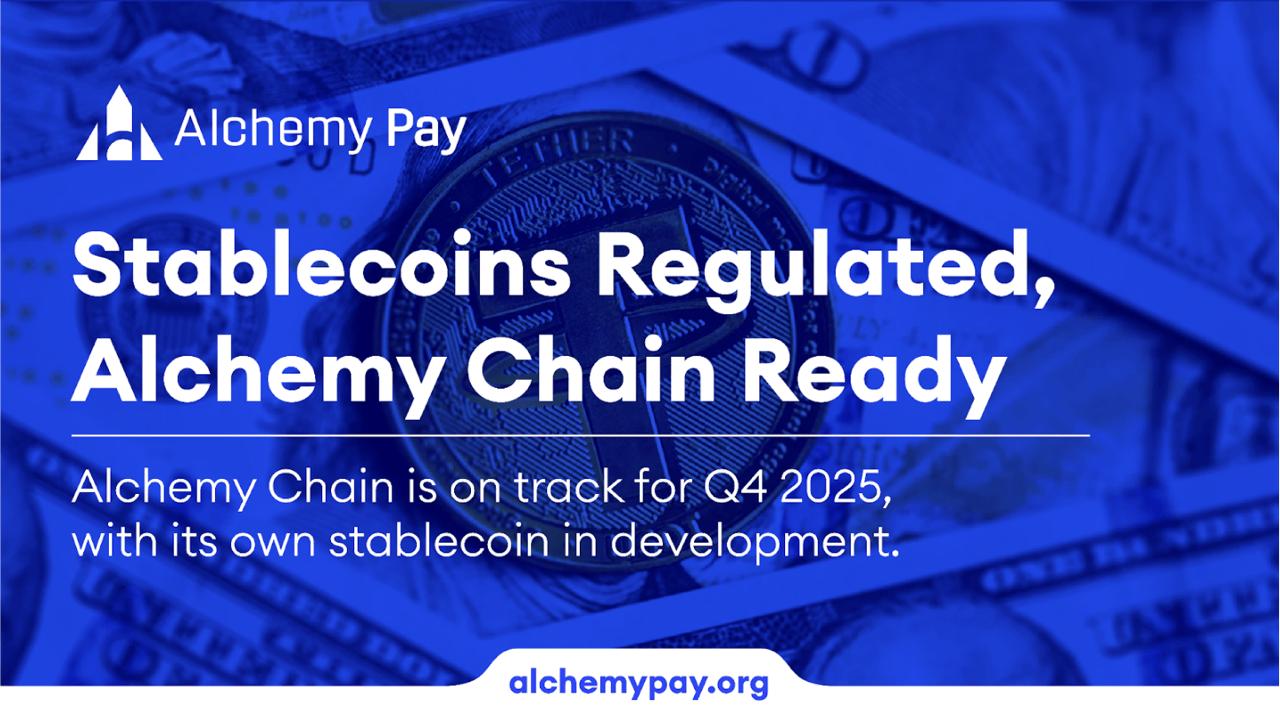 Alchemy Pay unveils Alchemy Chain for compliant cross-border payments, with native stablecoin launch slated for Q4 2025Alchemy Pay partners with Backed to offer tokenized ETFs and equities to global usersOak Grove Ventures, Alchemy pay’s partner, powers Gate group’s bold acquisition of Japan’s Coin Master crypto exchange.
Sources
19 records from 8 domains
alchemypay.org
- alchemypay.org· news-and-press / alchemy-pay-april-update-2025
- alchemypay.org· news-and-press / alchemy-pay-expands-u-s-compliance-with-delaware-money-transmitt…
- alchemypay.org· news-and-press / alchemy-pay-and-htf-securities-successfully-uplift-sfc-type-1-de…
- alchemypay.org· news-and-press / alchemy-pay-partners-with-fiat24-to-power-web3-digital-bank-serv…
- alchemypay.org· news-and-press / alchemy-pay-partners-with-backed-to-integrate-xstocks-on-its-pla…
- alchemypay.org· news-and-press / alchemy-pay-expands-u-s-licensing-footprint-with-arizona-money-t…
- alchemypay.org· news-and-press / alchemy-pay-integrates-dash-to-enable-global-fiat-on-ramp-access…
- alchemypay.org· news-and-press / alchemy-pay-secures-money-transmitter-license-in-maine-advancing…
- alchemypay.org· news-and-press / alchemy-pay-march-update-2026
- alchemypay.org· news-and-press / alchemy-chain-introduces-the-ach-supply-framework-to-power-a-sta…
- alchemypay.org· news-and-press / alchemy-pays-nft-checkout-simplifies-nft-purchase-with-integrati…
coinmarketcap.com
prnewswire.com
alchemy.com
x.com
instagram.com
es.tradingview.com
binance.com
Community notes
Spot something off or out of date? Drop a note. Editors review topic notes daily and roll accepted fixes into the explainer — contributors are recognized in the monthly $SQUID drop.
Loading notes…
Help improve this topic
Have a story or tip about this topic? Submit it. See something missing? Leave a note. Editors review daily; accepted submissions and fixes count toward the monthly $SQUID drop.