
Crypto.com is a global crypto platform offering exchange, card, DeFi, and payment services. In 2026, it's expanding into UAE government payments and U.S. prediction markets via key partnerships.
- crypto.com10
- x.com7
- cointelegraph.com6
- theblock.co5
- coindesk.com3
- unchainedcrypto.com2
- crowdfundinsider.com2
+27 sources across the wider coverage universe
 Crypto.com enters prediction markets via High Roller partnership, targeting $1T opportunity and challenging platforms like Kalshi and Polymarket with US-based event contracts2026-04
 Emirates launches Crypto.com Pay for eligible UAE residents booking flights in AED2026-07
 XYO taps Crypto.com for institutional custody and liquidity support for XYO and XL1 tokens2026-07
 Robinhood holds talks to add Crypto.com event contracts as Kalshi rivalry intensifies2026-07
 FanDuel Predicts adds Crypto.com's OG markets for sports and entertainment contracts2026-06
 Crypto.com partners with South Korea’s largest payment gateway KG Inicis to enable tourists pay for goods and services using digital assets2026-03
Founded in 2016, Crypto.com is one of the world's largest cryptocurrency platforms, offering a vertically integrated suite of services spanning exchange trading, a branded Visa debit card, DeFi tools, NFT marketplaces, and—increasingly—event-contract prediction markets.
What Crypto.com Is
Crypto.com was founded in Hong Kong by Bobby Bao, Gary Or, Kris Marszalek, and Rafael Melo under the original name Monaco. After acquiring the coveted domain Crypto.com in 2018 for a reported $12 million, the company rebranded and expanded rapidly. Marszalek serves as CEO and has remained the most public face of the company through multiple market cycles.
The platform operates across several distinct products:
- Crypto.com Exchange – a centralized spot and derivatives exchange competing with Coinbase, Binance, and Kraken for retail and institutional volume.
- Crypto.com App – a mobile-first interface for buying, selling, earning yield, and spending crypto; the entry point for most retail users.
- Crypto.com Visa Card – a tiered prepaid card offering crypto cashback rewards denominated in CRO, the platform's native token. Higher tiers require staking larger CRO amounts.
- Cronos Chain – an EVM-compatible Layer 1 blockchain developed by the Crypto.com ecosystem, designed to host DeFi protocols, NFTs, and gaming applications.
- DeFi Wallet – a non-custodial wallet giving users control of private keys while still interfacing with Cronos-based dApps.
The company is headquartered in Singapore and holds regulatory licenses in multiple jurisdictions, including the EU, Australia, Canada, South Korea, and, as of 2025–2026, the UAE.

Crypto.com enters prediction markets via High Roller partnership, targeting $1T opportunity and challenging platforms like Kalshi and Polymarket with US-based event contracts
The CRO Token and Cronos Ecosystem
CRO (Cronos) is the native utility and governance token underpinning the Crypto.com ecosystem. It serves multiple functions: staking for card tier benefits, paying transaction fees on the Cronos chain, and participating in ecosystem incentives.
Cronos launched as a standalone EVM chain in late 2021, enabling third-party developers to deploy Solidity-compatible smart contracts. The chain has hosted a range of DeFi protocols, NFT projects, and gaming applications, though it has faced stiff competition from more liquid ecosystems like Ethereum, BNB Chain, and Solana.
In mid-2026, the Cronos network completed a significant upgrade, requiring Crypto.com to temporarily suspend CRO deposits and withdrawals. Such upgrade cycles are standard operational practice for maturing Layer 1 chains but require careful coordination with exchange operations to avoid user disruption.
CRO's price is closely correlated with sentiment toward the broader Crypto.com platform. During bull markets, the card staking mechanic creates demand pressure; during bear markets, unlocking staked CRO can amplify selling. Understanding this flywheel is essential context for evaluating CRO as an asset.
Readers click Crypto.com stories not for platform features but for power struggles: regulatory fights with the SEC and CFTC, the CRO token burn reversal betrayal, and its race to displace Coinbase as the dominant U.S. exchange — revealing an audience tracking who controls the rules of crypto, not who builds the best product.
Payments: The UAE Breakthrough and the Government Services Angle
One of Crypto.com's most significant regulatory milestones of 2026 has been securing a Stored Value Facility (SVF) license from the UAE Central Bank. This license enables the platform to process crypto payments specifically for Dubai government services—a first-of-its-kind arrangement that positions Crypto.com at the intersection of sovereign digital payments and private crypto infrastructure.
The UAE's approach differs from most Western jurisdictions. Rather than treating crypto payments as a compliance liability, Dubai's financial authorities have moved toward active integration of digital assets into government payment rails. The SVF framework—which governs electronic money and prepaid payment instruments—provides a regulated pathway for Crypto.com to handle public-sector transactions without operating as a full banking entity.
This matters for the broader industry because:
1. It establishes a regulatory template other jurisdictions may study or adapt. 2. It demonstrates product-market fit for crypto payment infrastructure at a government scale, validating the thesis that blockchain-based payment settlement can meet institutional reliability standards. 3. It anchors Crypto.com's regional expansion in the Gulf, where several competitors—including Coinbase—are also seeking licenses.
The payments angle ties directly to Crypto.com's core business model: every on-ramp and off-ramp that flows through its platform generates fee revenue and deepens user stickiness.

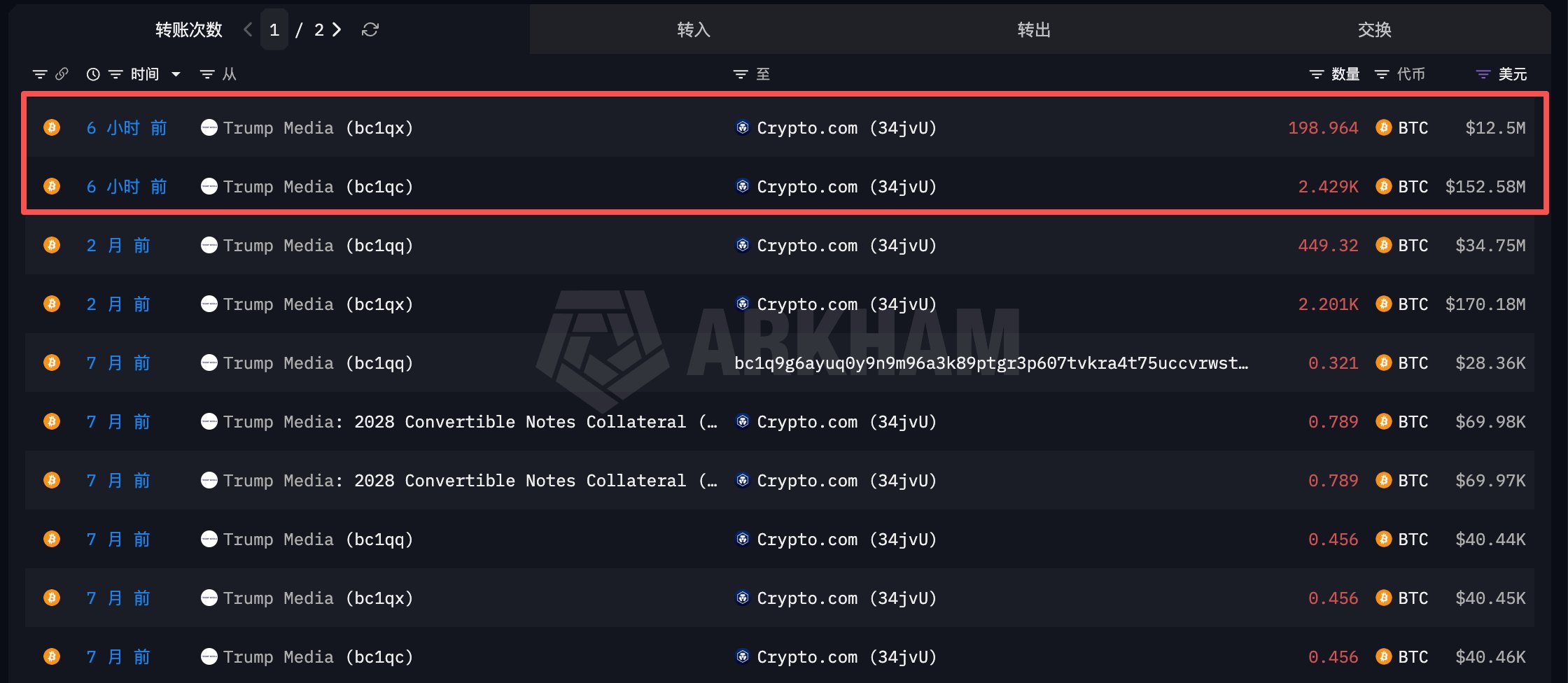
Trump Media transfers 2,628 BTC worth $165M to Crypto.com as EmberCN estimates $555M in losses
Prediction Markets: A New Frontier
Among Crypto.com's most active 2026 strategic moves is its entry into the event contract and prediction market space. This is a segment that grew rapidly in the 2024–2025 cycle, driven by platforms like Polymarket and Kalshi gaining mainstream attention during the U.S. presidential election.
Crypto.com has pursued this expansion via partnerships rather than building from scratch:
- High Roller Technologies: Crypto.com announced a partnership with this publicly listed company to offer U.S.-based event contracts. High Roller's stock price surged roughly 130% on the announcement, reflecting market optimism about the addressable opportunity. The companies have cited a potential $1 trillion market for event contracts, though that figure encompasses the full global sports betting and financial derivatives landscape rather than regulated prediction markets specifically.
- OG Prediction Markets: Crypto.com partnered with OG to bring sports and entertainment event contracts to FanDuel Predicts, the prediction market product from one of the largest U.S. daily fantasy and sports betting operators. This partnership also named Crypto.com and OG as global partners of the United States SailGP Team, illustrating how prediction market deals increasingly bundle sports sponsorship.
- Personnel signal: Underdog Fantasy, a competing platform, hired the former head of Crypto.com's Prediction Exchange in 2026—a move that signals the sector is competitive enough to attract aggressive talent poaching.
The regulatory environment for prediction markets in the United States remains in flux. The Commodity Futures Trading Commission (CFTC) has historically regulated event contracts under the Commodity Exchange Act, but reporting in 2026 indicates CFTC staff were sidelined in at least some proceedings involving Trump-linked entities including Crypto.com, Polymarket, and Gemini as they pushed into prediction markets. This regulatory ambiguity cuts both ways: it creates opportunity for platforms willing to move first, but also tail risk if enforcement priorities shift.
High-Profile Institutional and Political Connections
The transfer of over $204 million in Bitcoin from Trump Media & Technology Group to Crypto.com addresses in 2026 drew significant attention. On-chain analytics firm Lookonchain tracked approximately 2,650 BTC moving to Crypto.com wallets, contextualizing the transfer within what it estimated as a substantial unrealized loss position for Trump Media's BTC holdings.
Whether this represents custodial services, OTC settlement, or another arrangement has not been publicly confirmed in detail. Regardless, the transfer underscores how Crypto.com has become a preferred custody and liquidity destination for large, politically connected entities—a dynamic with both commercial upside and reputational risk given the scrutiny surrounding Trump-affiliated financial activity.
Crypto.com launches 24/7 stock derivatives as tokenized equity market swells 600% in one year

Partnerships, Sports, and Brand Building
Crypto.com operates one of the most aggressive sports and entertainment sponsorship programs in the industry. Its naming rights deal for the Crypto.com Arena in Los Angeles (home to the Lakers and Kings) remains one of the highest-profile crypto brand placements in traditional media.
Recent partnership activity extends this playbook:
- Fanatics Collectibles x UEFA Champions League: A collaboration enabling the first officially licensed Champions League NFT or digital collectible activation through Fanatics' infrastructure, with Crypto.com as the crypto-native partner. This targets the intersection of sports fandom, digital collectibles, and mainstream consumer attention.
- SailGP: The US SailGP Team partnership positions Crypto.com alongside OG Prediction Markets in an emerging sports property that skews toward affluent, internationally mobile audiences—an audience profile that overlaps with crypto adopters.
- Crypto.com Travel: Launched as an in-app travel and entertainment booking experience powered by Bookit, this feature extends the platform's lifestyle ecosystem. The pitch is straightforward: earn CRO rewards on travel purchases while keeping funds within the Crypto.com app.
These moves reflect a consistent strategy of embedding Crypto.com into aspirational lifestyle contexts—sports, travel, luxury—to normalize crypto spending among high-disposable-income consumers.
- 01SEC/CFTC regulatory battles
Crypto.com suing the SEC over Wells Notice jurisdiction and opposing CFTC prediction-market rules drew the highest clicks, signaling readers track its legal fights as a bellwether for the entire industry.
- 02Coinbase volume rivalry
Two separate headlines about surpassing Coinbase in trading volume and North American market share pulled strong engagement, reflecting reader appetite for competitive exchange rankings.
- 03CRO token burn reversal
Reissuing 70 billion previously burned tokens sparked centralization outrage and fueled a 21Shares ETF launch debate, combining governance betrayal with speculative valuation absurdity (P/S of 1,873).
- 04Trump Media prediction market tie-up
Deals with Trump Media for Truth Predict and Made-in-America ETFs fused political narrative with crypto infrastructure, drawing readers tracking regulatory favoritism under the new administration.
- 05Global banking partnerships
Deals with Standard Chartered, Deutsche Bank, Nedbank, and KG Inicis signal a TradFi integration strategy that readers see as legitimizing — or co-opting — crypto's institutional moment.
- 06MiCA compliance and US withdrawal
Delisting USDT in Europe under MiCA and suspending US institutional exchange services revealed how regulatory geography is forcing hard product choices, drawing readers watching compliance trade-offs.
Legal and Regulatory Challenges
Growth at Crypto.com's scale has brought legal complexity:
Trademark litigation: Crypto.com filed suit against a customer over the use of "Crofam" trademarks on a website and app. The term originated organically within the Crypto.com community as a portmanteau of "CRO" and "fam" (family). The suit illustrates the tension between community-generated brand identity and corporate IP enforcement—a dynamic familiar from other token ecosystems.
Data privacy class action: A class of Crypto.com users advanced a lawsuit in 2026 alleging improper third-party data collection. Claims of this type typically center on whether platforms share behavioral or transactional data with advertising or analytics vendors in ways that violate state privacy laws or platform-specific terms of service. The case has not been resolved at time of writing.
Purchase limits for new users: In 2026, Crypto.com implemented or clarified purchase limits for newly onboarded users—a standard anti-fraud and anti-money-laundering control that became a user education topic. New users on centralized exchanges should expect tiered limits tied to KYC verification levels; higher verification unlocks higher transaction ceilings.
These legal dynamics are not unique to Crypto.com but reflect industry-wide pressure from regulators, plaintiffs' attorneys, and community stakeholders as the sector matures.
Competitive Position
Crypto.com competes on multiple axes simultaneously:
| Competitor | Primary overlap |
|---|---|
| Coinbase | Retail exchange, card products, institutional custody, regulatory legitimacy |
| Binance | Global exchange volume, token ecosystem, DeFi products |
| Polymarket / Kalshi | Prediction markets and event contracts |
| Strike / BitPay | Crypto payment processing |
| Gemini | U.S.-regulated custody, prediction market ambitions |
Crypto.com's differentiation historically rests on its card product (which drove early mass adoption) and its willingness to pursue regulatory licenses proactively in emerging markets. Its expansion into prediction markets and government payments represents a bid to extend this multi-product moat rather than compete on exchange fees alone—where margins compress quickly.
- 2024-01regulatory
USDT and 9 tokens delisted in Europe under MiCA rules
- 2024-10milestone
Surpasses Coinbase with $112B October trading volume in North America
- 2024-11regulatory
Receives SEC Wells Notice; files preemptive lawsuit against SEC
- 2025-01governance
Reissues 70 billion burned CRO tokens, triggering community backlash
- 2025-01regulatory
Tennessee orders Crypto.com to cease sports betting contracts
- 2025-02regulatory
SEC closes Crypto.com investigation with no enforcement action
- 2025-03launch
Trump Media partners with Crypto.com for Truth Predict prediction markets
- 2025-06regulatory
OCC grants conditional approval for Crypto.com national trust bank charter
Outlook
Crypto.com enters the second half of the 2020s with a broader product portfolio than most of its peers, but also more moving parts to manage simultaneously. The UAE SVF license gives it a credible foothold in government-grade crypto payments at a moment when sovereign digital finance is becoming a real policy priority across the Gulf and Southeast Asia. The prediction markets expansion, while still early, positions the platform ahead of what could become a large regulated event-contract market if the CFTC establishes a clear framework.
The platform's legal overhead—trademark disputes, data privacy litigation, politically sensitive client relationships—represents friction that will require ongoing management. And like every major centralized exchange, Crypto.com faces the structural tension between regulatory compliance and the decentralization ethos of its core user base.
Investors and users evaluating Crypto.com should watch: regulatory clarity on U.S. event contracts, CRO token velocity metrics as a proxy for ecosystem health, and whether the government payment rails opened by the UAE license can be replicated in other jurisdictions.
Latest Crypto.com news
Crypto.com enters prediction markets via High Roller partnership, targeting $1T opportunity and challenging platforms like Kalshi and Polymarket with US-based event contractsTrump Media transfers 2,628 BTC worth $165M to Crypto.com as EmberCN estimates $555M in lossesCrypto.com launches 24/7 stock derivatives as tokenized equity market swells 600% in one year BitGo Link lets institutions view and move assets across Coinbase, Kraken, Crypto.com and BitGo custodyFanDuel Predicts adds Crypto.com's OG markets for sports and entertainment contracts
 Crypto.com expands Solidus Labs partnership to support US prediction market operations
Community notes
Spot something off or out of date? Drop a note. Editors review topic notes daily and roll accepted fixes into the explainer — contributors are recognized in the monthly $SQUID drop.
Loading notes…
Help improve this topic
Have a story or tip about this topic? Submit it. See something missing? Leave a note. Editors review daily; accepted submissions and fixes count toward the monthly $SQUID drop.