
Comprehensive explainer on CoinGecko, covering its role as a leading crypto data platform, APIs and AI tools, stablecoin and RWA research, use cases for traders and builders, and how its neutral market data underpins modern crypto and AI‑agent workflows.
- x.com11
- coingecko.com5
- cointelegraph.com2
- landing.coingecko.com1
- cryptobriefing.com1
- crypto.news1
- serendb.com1
+3 sources across the wider coverage universe
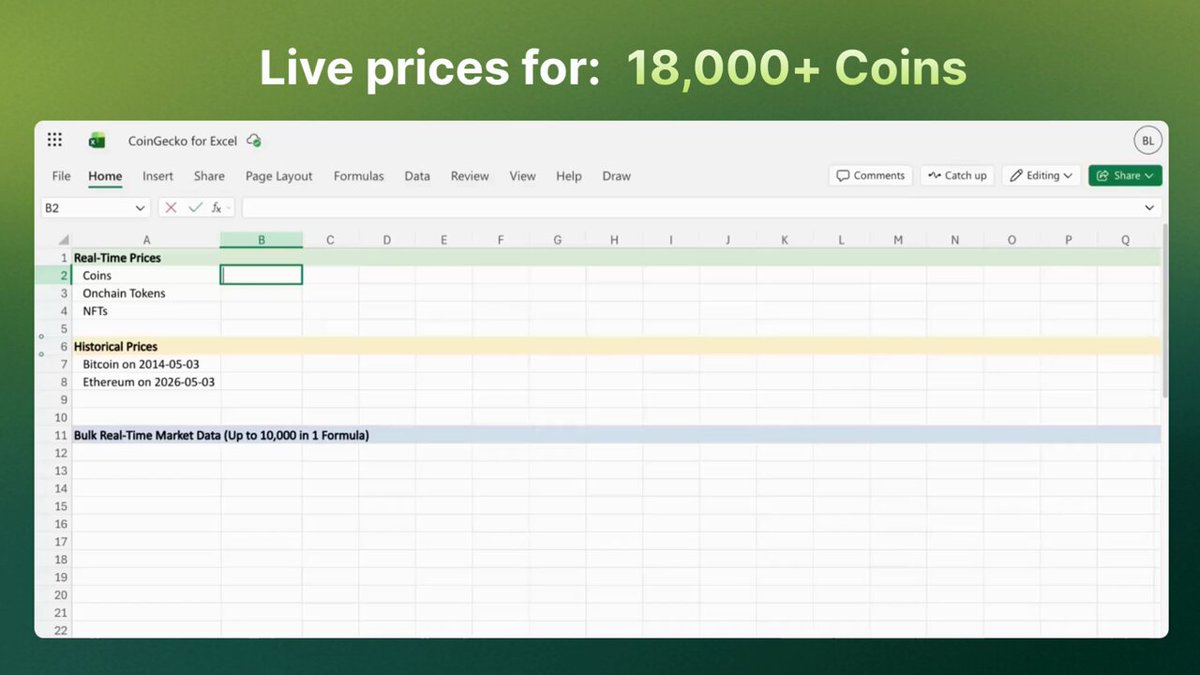 CoinGecko rolls out Excel integration with =CG.PRICE() and 5 formulas, enabling real-time tracking of 37M+ crypto assets directly inside spreadsheets2026-05
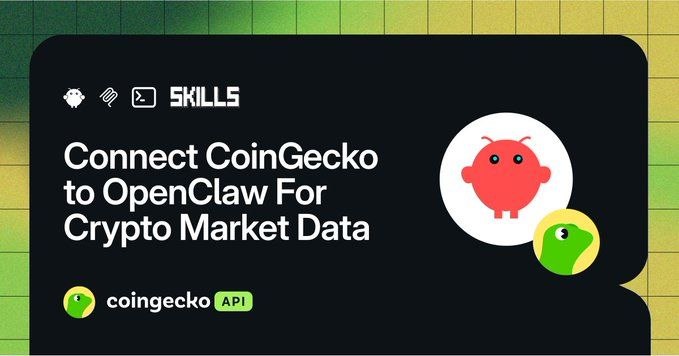 CoinGecko unveils guide linking its market data APIs with OpenClaw AI agents for real-time crypto monitoring, automation and custom trading workflows2026-05
 CoinGecko’s 2026 crypto perps report shows perpetual DEXes are emerging as real challengers to centralized crypto exchanges after CEXes handled more than $85 trillion in trading volume last year2026-05
 CoinGecko publishes new report, outlines four new stablecoin business models to reshape stablecoin issuance, and allow for new entrants despite USDT and USDC dominance2026-04
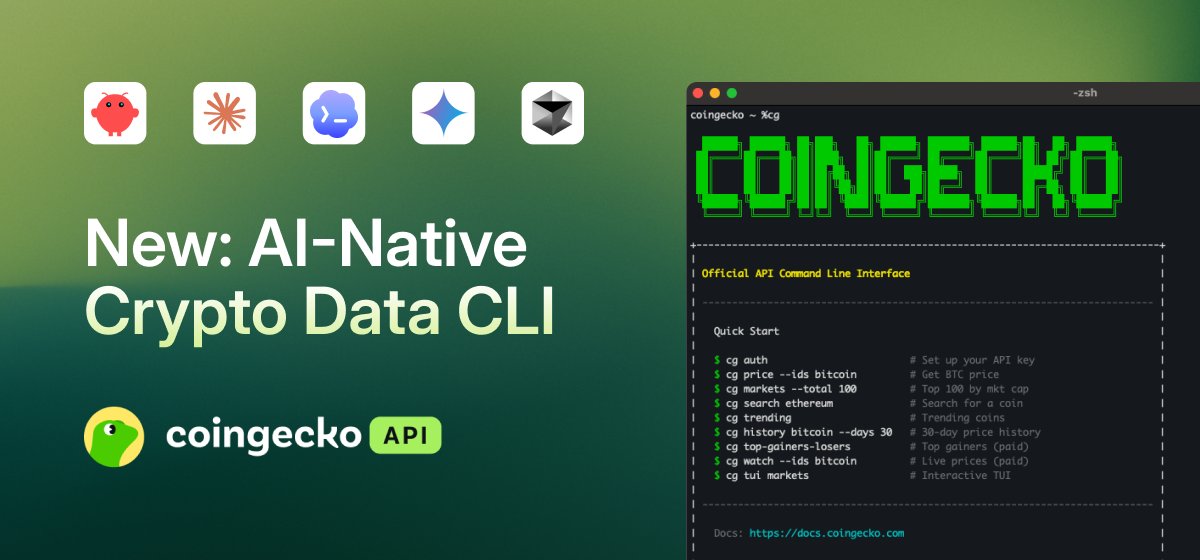 CoinGecko launches a free open‑source CLI that gives AI agents and developers local terminal access to real‑time and historical crypto market data, making crypto AI workflows significantly more efficient.2026-03
 CoinGecko drops its 2026 RWA report, outlining key trends, growth drivers, and market shifts as tokenized real-world assets continue expanding across DeFi2026-05
A leading cryptocurrency data aggregator and analytics platform, CoinGecko provides real‑time and historical market data on thousands of digital assets, powering everything from retail price checks to institutional research and AI‑driven trading workflows. By combining a public website, developer APIs, integrations for tools like Excel, and new AI‑agent interfaces, it has become core infrastructure for tracking crypto markets, stablecoins, and emerging trends like real‑world assets and AI agent tokens.
What CoinGecko Is – And Why It Matters
At its core, CoinGecko is a market data platform that aggregates prices, trading volumes, market capitalization, and metadata for cryptocurrencies across hundreds of centralized and decentralized exchanges. The public website offers live and historical price charts, rankings by market cap, sector breakdowns, NFT collection statistics, and exchange metrics, making it one of the default tabs open on the screens of traders, analysts, and journalists worldwide. Under the hood, the same dataset is exposed via a comprehensive API that developers plug into trading bots, portfolio trackers, research dashboards, and institutional risk systems. CoinGecko also integrates onchain data from GeckoTerminal, extending its coverage beyond listed coins to millions of long‑tail tokens across dozens of networks.
Unlike a custodian or exchange, CoinGecko does not hold user funds or execute trades; instead it functions as neutral data infrastructure that tries to reconstruct the state of the crypto market from disparate venues. That neutrality has made it a reference for everything from stablecoin supply to daily trading volumes, with newsrooms, DeFi protocols, and market commentators routinely citing its dashboards and research reports. CoinGecko’s own studies on topics like perpetual futures, stablecoin business models, and failed tokens are widely referenced to understand the structure and risks of the industry. In parallel, CoinGecko has started to position itself as an “AI‑ready” data layer, exposing its feeds through tools and protocols tailored for AI agents and LLM‑powered applications.
For traders and investors, CoinGecko’s importance is pragmatic: it is often the fastest way to answer basic questions such as “What is ETH trading at right now?” or “How big is USDT compared with USDC?” For builders, its API and developer tooling remove the need to maintain their own complex market‑data infrastructure. For regulators, researchers, and traditional finance trying to understand crypto’s scale and behavior, CoinGecko’s aggregate statistics offer one of the clearer windows into a market that remains fragmented and globally distributed.

CoinGecko’s 2026 Crypto Security Report finds $3.63B stolen across 245 incidents, with supply-chain attacks, smart contract exploits and key compromises leading losses
Origins, Growth, and Business Model
CoinGecko was founded in April 2014 by TM Lee and Bobby Ong, who saw a gap for a neutral, data‑driven view of a rapidly growing but opaque crypto market. Early on, the platform focused on providing real‑time prices, exchange rates, and market capitalization rankings for the handful of major cryptocurrencies and exchanges then in existence. As the industry expanded through multiple market cycles, CoinGecko scaled with it, adding support for new assets, new exchanges, and new categories like DeFi, NFTs, and onchain tokens. By the mid‑2020s it had become one of the most referenced price aggregators in crypto, frequently used alongside or instead of competing platforms when checking valuations and volumes.
A key part of CoinGecko’s growth has been its commitment to making basic data freely accessible. The public website can be used without logging in or paying, and even many API endpoints are available with a free tier, though these are rate‑limited and do not include the full historical depth or advanced features of the paid plans. This model reflects the founders’ view that transparent pricing is a public good for the crypto ecosystem, and that monetization should come from higher‑value services rather than restricting basic access. Over time, those higher‑value services have come to include professional API subscriptions, institutional data products, advertising and sponsorship on the site, branded research reports, and integrations with third‑party tools used by traders and enterprises.
CoinGecko also invests in research as both a public resource and a brand‑building exercise. Its reports on trends such as perpetual futures, stablecoin issuance, and real‑world asset tokenization are distributed freely and are frequently summarized in the broader crypto media. These publications position CoinGecko not just as a passive data pipeline but as a market intelligence provider, interpreting the data it collects to spot structural shifts and emerging risks. Quarterly and thematic reports are typically published in multiple languages, reflecting the platform’s global user base.
By 2024–2025, CoinGecko’s scale and profitability had grown enough that it began exploring strategic options. Reporting indicated the company was considering a potential sale at a valuation around 500 million dollars, hiring investment bank Moelis to advise on the process. In public comments, the CEO emphasized that CoinGecko was profitable and was evaluating options consistent with its long‑term mission, including remaining independent. For users, the prospect of a sale raises questions about future data neutrality, especially if a large exchange or trading firm were to become the owner. At the same time, a sizable valuation underscores how central reliable market data has become to the broader crypto infrastructure stack.
Readers treat CoinGecko not as a price ticker but as a macro framing authority — their highest-engagement clicks are research reports that define emerging asset categories (RWAs at $665M, perps eclipsing CEXes, 52.7% of tokens failed), meaning the platform's real pull is its power to legitimize or delegitimize entire market narratives.
Core Data Platform: Website, API, and Tools
Public Website and Market Dashboards
The most visible part of CoinGecko is the consumer website, which serves as a real‑time dashboard for global crypto markets. The homepage typically highlights total crypto market capitalization, aggregate trading volume, Bitcoin and Ethereum dominance, and lists of top coins by market cap, biggest gainers and losers, and trending tokens. Each coin has a dedicated page with price charts, historical data, links to block explorers and official websites, and breakdowns of liquidity across trading venues, making it a one‑stop reference for basic due diligence.
CoinGecko segments the market into categories such as DeFi, stablecoins, layer‑1 chains, memecoins, and more specialized niches like AI agent tokens and other AI‑related sectors. These category pages aggregate market caps, volumes, and price performance, allowing users to track sector‑level sentiment and flows rather than just individual assets. For example, the “AI Agents” category surfaces tokens linked to protocols building autonomous trading agents and AI‑powered infrastructure, giving traders a way to monitor a thematic trade that cuts across networks and token standards.
Beyond coins and tokens, CoinGecko tracks NFT collections and crypto exchanges. NFT pages display floor prices, trading volumes, and historical charts, while exchange pages show 24‑hour volume, listed pairs, and trust scores or quality metrics. This breadth is increasingly important as crypto usage fragments across fungible tokens, NFTs, and newer structures like tokenized real‑world assets. For many users, CoinGecko is the first place they see data for a newly airdropped token, a freshly listed perpetual pair, or a niche RWA product. Seeing that asset alongside more established ones provides immediate context for scale and liquidity.
CoinGecko complements raw data with curated features like watchlists and, more recently, AI‑assisted portfolio tools. These user‑facing analytics aggregate holdings, performance, and risk metrics, while drawing on the broader CoinGecko dataset to contextualize an individual portfolio within market trends. In practice, this turns the platform into a light analytics dashboard rather than just a static price board, making it easier for retail users to keep track of diversified holdings that may span L1 tokens, DeFi governance coins, stablecoins like USDT and USDC, and newer RWA or AI‑agent tokens.
API and Developer Platform
Underpinning the consumer interface is the CoinGecko API, which exposes market data and metadata in a machine‑readable form suitable for applications, bots, and institutional workflows. The API supports real‑time and historical prices, market caps, trading volumes, and ancillary fields such as circulating supply, fully diluted valuation, and sparkline data. Core endpoints like /simple/price allow developers to fetch spot prices for one or more coins with optional fields like market cap, volume, and 24‑hour price change, while /coins/markets returns richer per‑asset snapshots suitable for ranked tables or watchlists.
For historical analysis, CoinGecko offers endpoints like /coins/{id}/market_chart and /coins/{id}/history, which can return up to 12 years of historical prices, volumes, and market caps depending on data availability and subscription tier. This allows quants and researchers to backtest strategies, examine drawdowns across cycles, or study structural changes such as the rise of stablecoins or the volatility of AI meme tokens. As with most commercial data vendors, advanced historical depth, higher rate limits, and certain premium fields are reserved for Pro API customers, who authenticate via a dedicated domain and API key (sent either in the x-cg-pro-api-key header or as a query parameter).
CoinGecko is explicit about how it expects AI agents and LLM‑based apps to interact with its API. Its AI integration guide emphasizes patterns such as always resolving ambiguous coin names to canonical IDs using search endpoints, bundling multiple IDs in a single request to respect rate limits, and handling missing or null fields gracefully where data is thin. It highlights key endpoints mapped to common user intents, such as fetching spot prices, discovering trending coins, retrieving bulk market data for rankings tables, or querying onchain token prices by contract address. This kind of “intent‑first” documentation reflects the shift from traditional developer integration to AI‑mediated tool use, where a language model must reason about which endpoint best responds to an end‑user question.
The API does not just cover centralized exchange markets. Through onchain integrations, CoinGecko exposes DEX price and liquidity data for more than eight million tokens across over two hundred networks, sourced via GeckoTerminal. This makes it possible to query prices and liquidity for obscure long‑tail tokens that may only trade on automated market makers, a capability that is increasingly important in DeFi where many assets never list on major centralized exchanges. For stablecoin issuers, RWA projects, and protocols building their own risk dashboards, having a unified interface to both CEX and DEX data simplifies monitoring and analytics.
Excel, Google Sheets, and Spreadsheet Workflows
Recognizing that a large portion of market participants still live in spreadsheets, CoinGecko has built dedicated integrations for Microsoft Excel and Google Sheets that allow users to pull live data into familiar environments. The Excel add‑in can be installed from the Microsoft marketplace and, once configured with an API key, introduces a suite of formulas under the CG namespace. Users can enter functions like =CG.PRICE("bitcoin") to retrieve the current USD price of Bitcoin, =CG.HISTORY("bitcoin","2023-12-31") to fetch a historical price for a specific date, or =CG.TOP(limit,[category]) to populate a ranked table of top coins by market cap that dynamically spills into adjacent cells.
The Excel integration also extends beyond simple spot prices. Formulas such as =CG.NFT(id) return current floor prices for NFT collections, while =CG.ONCHAIN(network,address) returns the USD price of a token identified by its contract address on a given network. This design allows analysts to create bespoke dashboards that blend off‑chain and onchain data: for example, a sheet that tracks the value of a portfolio of DeFi governance tokens, LP positions, and NFTs alongside macro indicators like total stablecoin market cap or the dominance of USDT versus USDC. Because the formulas behave like standard Excel functions, they can be combined with charts, pivots, and VBA scripts without requiring new tooling.
Google Sheets users can achieve similar results via a dedicated add‑on, which lets them fetch real‑time prices using simple syntax without writing code. This “don’t code” approach targets retail users, smaller funds, and DAO treasuries that may lack in‑house engineers but still need structured data for reporting and risk oversight. When combined with automation platforms or scheduled refreshes, spreadsheet integrations effectively turn CoinGecko into a lightweight data warehouse for many small and medium‑sized crypto operations, without the overhead of integrating a full‑blown market data terminal.
CoinGecko CLI and Local Data Access
For developers, analysts, and increasingly AI agents, CoinGecko also offers a command‑line interface (CLI) that provides fast, scriptable access to real‑time and historical data. The CLI can be installed via package managers like Homebrew, an install script, or Go tooling, and once authenticated with an API key, it exposes commands for fetching prices, generating CSV reports, streaming WebSocket data, and producing machine‑readable JSON suitable for downstream processing. Interactive dashboards allow users to monitor markets in the terminal, while CSV export options are optimized for use in Python, R, or data‑science workflows.
The CLI is explicitly designed not just for human users but also for AI agents running in local or sandboxed environments. Because it encapsulates authentication and rate‑limit handling, an AI agent can be configured to call CLI commands as external tools rather than directly interacting with HTTP endpoints, reducing the risk of leaking API keys or mis‑configuring requests. CoinGecko highlights use cases like generating historical snapshots for particular date ranges, exporting them to CSV, and feeding those into backtests or risk models, all orchestrated by scripts or AI agents. In effect, the CLI turns CoinGecko’s remote API into a local, Unix‑style tool that integrates cleanly with automation frameworks, cron jobs, and developer workflows.
This local tooling has become especially relevant as crypto‑native AI workflows mature. Automated agents that monitor markets for arbitrage, manage DeFi positions, or generate research reports need reliable, low‑latency access to data without manual intervention. By supporting both human‑interactive and machine‑driven usage, the CLI bridges the gap between traditional developer tooling and the emerging world of autonomous trading and monitoring agents.
- 01RWA tokenization benchmarks↗
The single most-clicked CoinGecko headline was its Q3 2023 report quantifying tokenized T-bills at $665M, signaling readers use CoinGecko data to track institutional on-chain adoption before it becomes mainstream narrative.
- 02SEC securities perimeter mapping↗
180 clicks on CoinGecko's list of 48 SEC-flagged tokens shows readers rely on CoinGecko as a regulatory clearinghouse — if a token appears on that list, its tradability and exchange listings are immediately at risk.
- 03AI developer tooling push↗
Three separate headlines — CLI launch, MCP server beta, and OpenClaw API guide — each drew significant clicks, revealing readers are tracking CoinGecko's pivot from passive data aggregator to active AI infrastructure layer.
- 04Platform breach and data trust↗
The third-party email breach story pulled 129 clicks because a compromised data provider is a systemic risk — traders who share wallet intel or email flows with CoinGecko need to know the blast radius.
- 05Market structure research reports↗
Multiple research-anchored headlines (perps vs. CEXes, stablecoin models, failed-token rate, euro stablecoin gap) all cleared 40–80 clicks, showing readers use CoinGecko publications to benchmark structural shifts rather than just intraday prices.
- 06CoinGecko business trajectory↗
The $500M sale consideration story and 10th anniversary milestone both drew clicks, indicating readers are curious whether the neutral data layer stays independent or gets absorbed into a larger exchange or financial conglomerate.
AI, MCP, and the Agent‑First Data Stack
MCP Server and LLM Connectors
One of CoinGecko’s most forward‑looking initiatives is its Model Context Protocol (MCP) server, a dedicated gateway that allows LLMs and AI agents to query its data securely and in a tool‑oriented way. MCP is an emerging open standard for connecting models to external data and tools; CoinGecko’s implementation exposes its market data as a set of “tools” that an agent can discover, call, and chain together to answer complex questions. With the MCP server live in beta, an AI assistant can, for example, resolve a coin mentioned by name, fetch its current price, pull historical performance over a specified window, and compare it to sector benchmarks, all by composing multiple MCP tool calls.
CoinGecko offers both a public MCP server with keyless, shared‑rate‑limit access and a Pro MCP server where users bring their own API keys for higher limits and a broader tool set. The servers support HTTP streaming and Server‑Sent Events (SSE), enabling low‑latency, real‑time responses suitable for conversational interfaces and continuous monitoring agents. For privacy‑sensitive or latency‑critical use cases, developers can also run a local MCP server using the @coingecko/coingecko-mcp NPM package, which connects to CoinGecko’s Pro or demo API keys but executes entirely on the developer’s machine.
Crucially, major LLM frontends have begun to support MCP connectors, making CoinGecko’s tools available inside popular AI chat products. Documentation shows how to add the CoinGecko MCP server as a custom connector in Claude, with separate URLs for keyless and Pro access, and similar steps are outlined for ChatGPT’s developer‑mode connectors and IDEs like Cursor. Once configured, users can ask open‑ended questions like “What are the top trending cryptocurrencies right now?” and the model will automatically call the relevant MCP tools to fetch price, 24‑hour change, and market cap data before synthesizing a natural‑language answer. This effectively turns CoinGecko into an embedded market data terminal for AI assistants.
SDKs, Tool Schemas, and Agent Design
Beyond MCP, CoinGecko provides SDKs in languages like Python and TypeScript, which developers can wrap as tools for their own custom agents. A typical pattern involves initializing a Coingecko client with a Pro API key and then defining tool schemas that map to SDK methods, such as a get_crypto_price tool designed to fetch current prices for one or more cryptocurrencies. When a model decides to call a tool, the host application executes the corresponding SDK method, passes back the result, and the model incorporates the data into its response. This two‑step pattern ensures that the model does not need direct access to API keys or documentation, only a description of what each tool does.
CoinGecko’s agent‑focused documentation explicitly recommends using the /search or /coins/list endpoints as resolvers, since coin names and tickers are often ambiguous. It also emphasizes including units when reporting prices (for example, specifying “USD” rather than just a number) and handling missing fields for less liquid tokens. These guidelines reflect practical lessons from using market data in conversational contexts: users often phrase questions imprecisely, may forget to specify currencies, and might ask about obscure tokens with thin liquidity or incomplete metadata. Properly designed tools and prompts help agents respond safely and accurately despite these challenges.
For AI‑first crypto products—such as Telegram bots that manage onchain portfolios, research assistants that summarize market moves, or agents that automate trading strategies—CoinGecko’s agent‑ready stack (API, SDKs, MCP, CLI, and spreadsheet integrations) forms a cohesive data backbone. Rather than each builder having to solve data collection, normalization, and error handling from scratch, they can lean on CoinGecko’s infrastructure and focus instead on strategy, user experience, and risk controls.
OpenClaw, SerenAI, and x402 Micropayments
CoinGecko has also begun experimenting with integrations tailored to specific AI‑agent platforms. A detailed guide explains how to connect CoinGecko to OpenClaw, an agent framework that coordinates LLMs, messaging apps like Telegram, and external tools to build conversational crypto assistants. The guide walks through wiring up MCP for natural‑language queries, using the CoinGecko CLI for bulk data pulls and CSV exports, and installing a CoinGecko “skill” that lets agents hit any API endpoint directly. For users who only need occasional data without a subscription, CoinGecko offers x402 pay‑per‑use endpoints that can be paid in USDC on Base or Solana, enabling granular micropayments for AI‑driven workflows.
In parallel, CoinGecko’s partnership with SerenAI reflects a broader trend of coupling data providers with AI infrastructure. By offering free AI‑data hosting and premium API access via x402 micropayments on Base, the collaboration lowers the barrier for smaller developers and communities to build data‑rich agents without upfront enterprise contracts. For stablecoin and RWA projects, the ability to plug into CoinGecko data in a pay‑as‑you‑go fashion is particularly appealing, since their user bases may interact with bots and agents that need occasional but reliable access to price feeds, supply data, and sector analytics.
Altogether, these moves position CoinGecko not just as a web and API platform but as a native component of the emerging agent economy. As crypto users increasingly interact with markets through AI layers—whether Telegram bots, smart wallets, or research copilots—the availability, reliability, and neutrality of the underlying data providers will shape what those agents can safely do.
CoinGecko rolls out Excel integration with =CG.PRICE() and 5 formulas, enabling real-time tracking of 37M+ crypto assets directly inside spreadsheets
Research and Market Intelligence
Perpetual Futures and the CEX–DEX Balance
CoinGecko’s research arm has made derivatives, especially perpetual futures, a recurring focus. Its 2026 State of Crypto Perpetuals report shows that average monthly trading volume among the top 11 centralized perpetual exchanges fell from 7.11 trillion dollars in 2025 to 4.69 trillion dollars in the first four months of 2026. That decline reflects both a broader market downturn and a shift in activity patterns, as traders increasingly explore decentralized perpetual exchanges that allow onchain leverage without centralized custodians.
Despite the drop in volumes, centralized exchanges still handled more than 85 trillion dollars in trading volume over the prior year, underscoring their continued dominance in derivatives. However, CoinGecko’s analysis and broader coverage emphasize that perpetual DEXes are emerging as credible challengers, particularly as they integrate more efficient AMM designs and risk engines inspired by CEX order books. This DEX growth is tightly linked to onchain liquidity and composability; CoinGecko’s integration with GeckoTerminal and its onchain endpoints make it possible to analyze perp volumes alongside spot DEX liquidity and token distribution.
For traders, the implications of this research are practical. A prolonged downturn in centralized perpetual volumes can signal reduced speculative froth, widening spreads, and increased risk of liquidity gaps during large moves. At the same time, rising DEX perps volumes may indicate where risk is migrating onchain, especially around long‑tail assets and narrative trades like AI or RWA tokens. CoinGecko’s ability to track both centralized and decentralized venues gives analysts a more complete picture of where leverage resides and how it may unwind.
Stablecoins, Business Models, and USDT/USDC Dominance
Stablecoins are one of the clearest areas where CoinGecko’s data and analysis shape market understanding. The platform reports circulating supplies, market caps, and trading volumes for major stablecoins like USDT and USDC, alongside smaller competitors and niche products such as euro‑denominated stablecoins. Its stablecoin research highlights how different issuers adopt distinct business models depending on their scale and positioning, from earning interest on reserves to charging transaction fees or embedding stablecoins in broader platforms.
One of CoinGecko’s reports on stablecoin issuance outlines four distinct business models that are reshaping the market, suggesting that new entrants can compete even in a landscape dominated by USDT and USDC. These models span traditional fully‑backed fiat reserves, over‑collateralized crypto‑backed designs, algorithmic or partially collateralized structures, and hybrid models tied to other financial products. By analyzing revenue streams, reserve compositions, and usage patterns, CoinGecko’s research helps explain why some stablecoins are highly profitable while others struggle to gain traction.
CoinGecko’s data has also been used to highlight the stark contrast between dollar‑denominated and euro‑denominated stablecoins. While privately issued, dollar‑pegged coins have grown to an aggregate market capitalization approaching 300 billion dollars, euro stablecoins barely reach around 450 million, amounting to roughly 0.15 percent of the total market. That imbalance reflects both crypto’s USD‑centric infrastructure and regulatory fragmentation in Europe. For traders, it underscores why most onchain liquidity and DeFi yields remain dollar‑centric, and why holding euro stablecoins can entail significant liquidity risk despite potential regulatory comfort.
Perhaps most strikingly, CoinGecko data on protocol revenues shows how profitable some stablecoin issuers have become. In 2025, Tether topped crypto protocol revenue rankings, generating about 5.2 billion dollars in revenue and accounting for nearly 41.9 percent of total protocol revenues, even as broader markets slumped. Stablecoin issuers as a group dominated earnings while trading platforms—both centralized and decentralized—saw their revenues swing sharply with market cycles. Tron, for example, ranked second largely due to USDT transaction activity on its network, illustrating how stablecoins can transform L1s into quasi‑payment rails as much as smart contract platforms.
These findings feed back into onchain behavior. As users seek stability amid volatility, stablecoin usage persists or even grows during downturns, making them a structural pillar of DeFi and centralized trading alike. CoinGecko’s granular breakdown of stablecoin supply by asset, chain, and category gives analysts a window into how value moves through the crypto financial system and how tightly DeFi protocols have become coupled to the fate of USDT, USDC, and a handful of other tokens.
Real‑World Assets and Tokenized Markets
Real‑world assets (RWAs) have emerged as another major focus of CoinGecko’s research and data coverage. The platform tracks tokenized gold products, tokenized treasury bills, tokenized equities, and other assets that aim to bridge traditional financial exposure with blockchain rails. In its RWA reports, CoinGecko quantifies how quickly this niche has grown, noting, for instance, that tokenized stocks alone saw roughly 15.1 billion dollars in trading volume in the first quarter of one recent year, while the broader RWA market surged by over 250 percent to roughly 19.3 billion dollars in value.
These numbers may be small compared with the total crypto market cap, but they represent a rapid shift in how capital markets can be structured. CoinGecko’s RWA coverage also highlights infrastructure players, such as exchanges and brokers that integrate tokenized instruments into existing systems. One example from its 2026 RWA reporting is Gate’s integration of tokenized gold with MT5, extending access across FX and derivatives markets. By tracking these products alongside native crypto assets, CoinGecko enables comparisons of liquidity, volatility, and adoption patterns between RWAs and conventional tokens.
For stablecoin users and DeFi participants, RWAs represent both an opportunity and a new layer of complexity. The same USDC or USDT that circulates in onchain lending protocols may ultimately be backed by treasury bills or bank deposits; now, RWA tokens offer direct tokenized claims on similar instruments. That convergence makes it important to understand concentration risk, legal structures, and liquidity profiles. CoinGecko’s data and reports provide a starting point for evaluating which RWA protocols are gaining traction, how their tokens trade relative to NAV, and how they fit into broader portfolio construction.
Investor Behavior, Altcoins, and “Dead Coins”
CoinGecko also uses surveys and long‑tail token data to map how users behave and how risky the market can be. One survey found that nearly one in ten crypto participants had never bought Bitcoin at all, even though about 63 percent started their crypto journey with BTC. This suggests that as the market matures, more users first encounter crypto through altcoins, memecoins, or applications like NFTs and gaming rather than the original flagship asset. For market educators and regulators, this shift has implications: new entrants may be more exposed to high‑volatility assets before they fully understand the risks.
Those risks are starkly illustrated in CoinGecko’s analysis of failed tokens. Its “dead coins” report notes that 428,383 projects were listed on GeckoTerminal in 2021, but by 2025 that figure had ballooned to nearly 20.2 million projects. More than half—about 52.7 percent—of cryptocurrencies launched since 2021 have already effectively collapsed, with 2025 alone seeing a record 1.8 million project failures. Many of these tokens were short‑lived memecoins or speculative experiments with minimal liquidity and no sustained activity.
For traders and AI agents alike, this data is a reminder that the long tail of “crypto assets” is extremely noisy and hazardous. While CoinGecko’s coverage of millions of tokens via GeckoTerminal is valuable for transparency, it reinforces the need for rigorous filtering when building screeners, portfolio tools, or automated strategies. Signals such as sustained volume, centralized exchange listings, and integration into DeFi protocols become critical filters. CoinGecko’s combination of high‑level statistics and granular project‑level data allows researchers to quantify survivorship bias and to build models that distinguish between durable projects and the flood of tokens that quietly go to zero.
Reddit, Social Data, and Community Signals
Market data does not exist in a vacuum; narratives and community sentiment heavily influence what traders pay attention to. While CoinGecko itself focuses on price and volume, it is frequently integrated into workflows that monitor social platforms like Reddit, X, and Telegram. A publicly shared n8n workflow, for example, continuously scans new posts on r/CryptoCurrency, extracts recently mentioned coins, checks live price movements via CoinGecko, and sends alerts to Discord. By combining social mentions with real‑time price data, such workflows attempt to capture the feedback loop between retail chatter and market moves.
Newsrooms increasingly reflect this convergence. Daily dashboards often pair overnight price moves and top performing tokens from CoinGecko with trending Reddit discussions, creating a single snapshot of both market action and narrative focus. CoinGecko’s own “trending search” endpoints, geared toward AI agents, capture which coins, NFTs, and categories are seeing the most user interest over the past 24 hours, acting as a quantitative proxy for sentiment. For AI‑driven research assistants, pulling trending lists and correlating them with Reddit threads or X posts is an obvious way to identify early‑stage narratives before they show up in mainstream coverage.
In practice, this integration of market and social data reinforces both positive and negative cycles. A memecoin that begins trending on Reddit may quickly appear on CoinGecko’s trending lists, attract speculative capital, and then show up in news dashboards, further amplifying attention. Conversely, a token that fades from both social chatter and trending metrics may see liquidity evaporate and drift toward the “dead coin” category. CoinGecko itself does not attempt to police narratives, but by exposing both enduring and ephemeral assets in a transparent way, it enables more informed, data‑driven analysis of how communities and markets co‑evolve.
CoinGecko founded by Bobby Ong and TM Lee
Q3 2023 report: tokenized T-bills hit $665M, lead on-chain RWA
CoinGecko 10th anniversary milestone
Data breach via third-party email platform; user contacts exposed
Open-source CLI launched for AI agents and developers
MCP Server beta goes live for real-time crypto data via AI agents
Excel integration released with =CG.PRICE() formula covering 37M+ assets
2026 crypto perps report: perpetual DEXes emerge as CEX challengers
How CoinGecko Data Is Used in Practice
Retail Traders and Long‑Term Investors
For most retail users, CoinGecko begins as a simple price‑checking site but often ends up as a daily dashboard. Traders track the prices of core assets like BTC and ETH, monitor new listings, and consult CoinGecko before buying tokens on exchanges or DEXes to confirm contract addresses and basic details. Long‑term investors rely on historical charts to understand drawdowns, previous cycle peaks, and how individual holdings like ETH or layer‑2 tokens have performed relative to BTC over time.
Portfolio tools and watchlists deepen this engagement by aggregating holdings across wallets and exchanges, showing performance, allocations by sector, and exposure to stablecoins or RWAs. When ETH crosses psychologically important levels—such as moving above 2,500 dollars after a period of consolidation—CoinGecko’s price feeds are among the first referenced by news outlets and social media, reinforcing its status as the de facto benchmark. Retail investors increasingly also rely on CoinGecko’s AI insights, which surface analytics and commentary based on portfolio composition and broader market data, though these tools are positioned as informational rather than advisory.
Risk awareness is another area where CoinGecko plays a role. By surfacing upcoming token unlocks, for example, it allows investors to anticipate potential sell pressure from large linear unlocks and vesting schedules. News stories about “token unlock tsunamis” that aggregate hundreds of millions of dollars in upcoming unlocks frequently rely on CoinGecko data, giving users a sense of when to expect mechanical supply shocks. Combined with its research on dead coins and failure rates, these tools encourage more cautious position sizing, especially in altcoins and new narratives.
DeFi, CeFi, Protocols, and RWAs
DeFi protocols, centralized exchanges, and RWA issuers integrate CoinGecko data for different but overlapping purposes. Exchanges and trading venues may use CoinGecko’s market data to cross‑check their own pricing, to display external benchmarks to users, or to monitor competitor volumes and listings. DeFi protocols often rely on CoinGecko’s token lists and metadata to populate front‑ends, display portfolio values, or calculate TVL in USD terms, though for price‑critical functions like onchain oracles they typically use specialized sources aligned with their security assumptions.
RWA platforms and stablecoin issuers use CoinGecko data as part of their transparency and investor relations. Being listed on CoinGecko confers a certain degree of discoverability and legitimacy, especially when the listing includes clear information on backing, collateral, and redemption mechanisms. For example, CoinGecko’s tracking of tokenized gold and tokenized treasury products allows RWA issuers to show how their assets compare to peers in market cap and liquidity terms, while stablecoin issuers can illustrate their share of total stablecoin capitalization or protocol revenue.
In downturns, CoinGecko’s aggregate data becomes a barometer of stress. During prolonged slumps where centralized exchange volumes fall by tens of percent quarter‑over‑quarter and daily volumes drop more than 60 percent from prior peaks, CoinGecko’s charts quantify how much speculative activity has drained from the market. These numbers help DeFi protocols recalibrate incentive programs, risk parameters, and fee structures, while centralized venues may use them to benchmark their own performance against the broader industry.
AI Agents, Quants, and Automation
Quant funds, market‑making firms, and AI‑native projects integrate CoinGecko data more deeply into automated pipelines. Through the API and CLI, they pull tick data, OHLCV series, and order‑book‑adjacent metrics into databases for model training and live trading. AI agents designed to monitor portfolios, rebalance positions, or execute strategies rely on CoinGecko’s MCP server and SDK tools to fetch the latest market context before acting.
Consider an AI agent managing a portfolio that includes BTC, ETH, a basket of altcoins, USDC liquidity positions, and exposure to tokenized treasury RWAs. To decide whether to rebalance, the agent might call CoinGecko tools to retrieve current prices, sector performance, and volatility metrics, check trending narratives that might affect liquidity, and compare portfolio allocations to predefined targets. If the agent identifies a deviation—say, altcoins have rallied and now exceed risk limits—it can propose or execute trades, all while logging the underlying data it used. CoinGecko’s structured endpoints, consistent coin IDs, and historical depth make such workflows feasible.
Developers building such agents must, however, account for the limitations of aggregated data. Thinly traded tokens, DEX pairs with spoofed volume, or new listings with incomplete metadata can trip up naive strategies. CoinGecko’s docs advise agents to handle missing data and to avoid over‑reliance on single endpoints when making critical decisions. Savvy builders often combine CoinGecko with additional sources, but continue to use it as a backbone for high‑level market structure, sector classifications, and long‑term historical benchmarks.
Data Journalists, Research Desks, and Dashboards
Newsrooms, research firms, and independent analysts heavily rely on CoinGecko data to contextualize stories and build dashboards. Daily crypto news columns often open with a snapshot of total market cap, top gainers and losers, and notable moves in majors like BTC and ETH, with CoinGecko and occasionally other aggregators cited as sources. Specialized stories—such as those on stablecoin revenues, RWA growth, or the prevalence of failed tokens—often lean directly on CoinGecko’s research publications.
Internally, many desks maintain dashboards that combine CoinGecko feeds with other indicators like funding rates, onchain flows, and Reddit or X sentiment. These dashboards power coverage such as “market remains in prolonged downturn as CEX trading volume falls 39 percent in Q1” or “daily trading volume has declined 63 percent from a recent peak,” where CoinGecko’s historical volume data provides the quantitative backbone. In parallel, newsroom tools that surface overnight top performing tokens and trending Reddit articles often use CoinGecko’s trending and performance metrics as the market leg of a combined “price plus narrative” view.
By standardizing how asset names, symbols, and IDs are represented, CoinGecko also simplifies the task of linking background information to price charts in stories. If a reporter writes about a new AI agent token or a niche RWA product, referencing its CoinGecko page ensures readers can quickly look up price history, contract addresses, and trading venues. Over time, this has made CoinGecko a default “source of record” for crypto pricing in much the same way that traditional finance stories reference data from terminal vendors or official exchanges.
A breach via a third-party email platform confirmed user contact data was exposed; no passwords compromised, but the incident shows CoinGecko's trust surface extends to vendors it does not fully control.
CoinGecko's own publication of the SEC's 48-token securities list places it at the center of regulatory mapping — if token issuers or exchanges dispute those classifications, CoinGecko's data becomes a legal exhibit, not just market color.
CoinGecko and CoinMarketCap together effectively define 'official' market cap rankings; AI agents and institutional flows that hard-code CoinGecko API calls inherit a single point of failure if the platform throttles, changes pricing, or is acquired.
Reports of a ~$500M sale process raise the question of whether a new owner would restrict API access, monetize data differently, or introduce conflicts of interest in token listing and ranking methodology.
CoinGecko data itself documented a 63% crash in daily trading volumes from February's $440B peak to $163B in March, illustrating how deeply API usage and premium subscription demand are correlated with bull-market activity.
The MCP server, CLI, Excel add-in, and OpenClaw integrations represent defensive moat-building; switching costs rise as AI workflows and spreadsheet models embed CoinGecko endpoints, reducing substitution risk near-term.
Reliability, Security, and Limitations
Data Collection, Methodology, and Coverage
CoinGecko aggregates data from more than a thousand centralized and decentralized exchanges, normalizing trading pairs, volumes, and prices to produce consolidated tickers for each asset it tracks. It applies various filters and heuristics to handle outlier prices, low‑liquidity pairs, and reported volumes that may not accurately reflect true trading activity. For onchain tokens, its integration with GeckoTerminal allows it to ingest DEX pool data for over eight million tokens across more than two hundred networks, vastly expanding coverage beyond the relatively small set of tokens that list on major centralized exchanges.
This breadth is a double‑edged sword. On the one hand, it allows CoinGecko to surface obscure assets, early‑stage tokens, and local market phenomena that might otherwise be invisible. On the other hand, it means that many listed tokens have negligible liquidity or lifespan, contributing to the high rate of “dead coins” documented in its research. Users cannot assume that listing on CoinGecko implies quality or regulatory vetting; instead, the platform functions as a mirror of the market’s fragmentation and experimentation.
CoinGecko’s methodologies for calculating market cap, fully diluted valuation, and volume rely on assumptions about circulating supply, max supply, and which venues to include. For large, well‑known assets like BTC or USDC, these metrics are relatively straightforward. For tokens with complex vesting schedules, opaque treasuries, or algorithmic supply dynamics, estimates can vary across data providers. Serious analysts often cross‑check CoinGecko’s figures with project documentation, onchain data, and competing aggregators, treating any single data source as one input rather than an oracle of truth.
Security, Privacy, and the Email Breach
Because CoinGecko does not custody funds and largely serves public data, its risk profile differs from that of exchanges or custodial wallets. The most sensitive information it handles is user account data, API keys, and communication channels like email. A recent incident in which a third‑party email platform used by CoinGecko was breached underscored that even non‑custodial infrastructure faces security challenges. CoinGecko confirmed the breach, clarified that no passwords were compromised, and reassured users that core systems and funds were unaffected, while advising vigilance against phishing attempts leveraging leaked email addresses.
From a risk‑management perspective, the incident highlights the importance of segregating critical systems, using providers with strong security postures, and minimizing the amount of sensitive data stored with third parties. For developers using CoinGecko’s API, best practices include storing API keys securely, rotating them when necessary, and avoiding hard‑coding them in scripts or exposing them in client‑side applications. Tools like the CLI and MCP server can help by encapsulating keys server‑side, limiting the places where secrets are handled directly.
Users should also recognize the limits of CoinGecko’s responsibility. While it can secure its own infrastructure and communicate transparently about incidents, it cannot prevent phishing campaigns or scams that misuse its brand. As with all crypto‑related services, due diligence, careful link checking, and the use of security tools like password managers and hardware keys remain essential.
What CoinGecko Is Not
CoinGecko’s prominence sometimes leads users to expect functions it was never designed to provide. It is not a trading venue and does not offer order matching, custody, or direct fiat on‑ramps. It is not a price oracle for onchain protocols in the security‑critical sense; DeFi systems typically require tamper‑resistant onchain oracles with specific guarantees that a web API cannot deliver. Nor is CoinGecko a rating agency in the regulatory sense, even though it occasionally provides qualitative or quantitative “scores” for exchanges or assets based on liquidity, transparency, and other factors.
It is also important to understand that CoinGecko’s analysis, including AI‑generated insights and portfolio tools, does not constitute investment advice. The platform explicitly positions these features as informational, and any metrics—such as risk scores, sector exposures, or trend alerts—should be interpreted within the broader context of an investor’s own research and risk tolerance. With millions of tokens, the presence of an asset on CoinGecko does not imply endorsement, and the absence of a token does not necessarily mean it is illegitimate; listing priorities often reflect user demand and resource constraints.
These limitations are not weaknesses so much as clarifications of scope. By remaining focused on data aggregation and analysis rather than trading or custody, CoinGecko can maintain a degree of neutrality and avoid some of the conflicts of interest that exchanges or market‑making firms face when they also provide data. Users who understand that boundary are better equipped to integrate CoinGecko into their workflows appropriately.
CoinGecko unveils guide linking its market data APIs with OpenClaw AI agents for real-time crypto monitoring, automation and custom trading workflows
Business Model, Independence, and Strategic Options
CoinGecko’s business model sits at the intersection of traditional data licensing, SaaS, and media. Its core revenue streams include paid API subscriptions for developers and institutions, premium data products, advertising and sponsorship on its consumer site, and commercial partnerships around research and integrations. Products like the Excel add‑in and CLI are free to install but typically require an API key that may be associated with a paid plan for high‑volume usage, aligning economic incentives around heavy data consumption rather than casual browsing.
The company’s independence from exchanges and large trading firms has long been a selling point. As a privately held data provider, it can in principle treat all venues and projects on equal terms, applying consistent listing criteria and methodologies without being beholden to a trading desk or order‑flow considerations. This independence becomes especially salient in controversies over exchange volume reporting or token listing practices, where users look for data sources perceived as less conflicted.
Reports that CoinGecko has explored a sale at around a 500‑million‑dollar valuation raise questions about how that independence might evolve. If acquired by a large exchange, data vendor, or financial institution, CoinGecko could gain resources and distribution but might face new pressures around product priorities, data licensing, or access tiers. If it remains independent or raises capital while preserving control, it could continue its current trajectory of steady expansion into AI, RWAs, and research. The CEO’s emphasis on profitability suggests the company has some flexibility in choosing its path rather than being forced into a sale by financial necessity.
CoinGecko has also taken minority investment stakes in projects aligned with its vision, such as backing Domination Finance, a decentralized exchange that lets users trade market share rather than price. This kind of strategic bet reflects an interest in new forms of market structure and analytics, which dovetail with CoinGecko’s data expertise. By supporting experiments at the frontier—whether in derivatives, AI agents, or RWAs—CoinGecko positions itself both as an observer and a small‑scale participant in the evolving crypto financial stack.
CoinGecko in the Broader Evolution of Crypto, AI, and RWAs
Seen in a wider context, CoinGecko’s trajectory mirrors the maturation of crypto itself. In the early 2010s, simple price aggregation for a handful of coins and exchanges was a major step forward. Today, the platform is expected to track thousands of coins, millions of onchain tokens, NFTs, perpetuals, RWAs, and stablecoins, while exposing that data not only to humans but to AI agents and algorithmic systems. The scale is such that its Excel integration alone promises access to tens of millions of crypto assets directly inside spreadsheets, reflecting the explosion of tokens in the GeckoTerminal universe.
As markets have grown more complex, the importance of neutral, high‑quality data has only increased. Stablecoin dominance, for instance, cannot be assessed by looking at a single issuer; it requires tracking the supplies, volumes, and revenue streams across USDT, USDC, and a long tail of competitors, along with their distribution across chains and protocols. CoinGecko’s research showing stablecoins’ resilience and profitability during downturns—contrasting with the cyclical revenues of trading platforms—has influenced how investors view stablecoin equities, governance tokens, and their systemic importance.
The rise of RWAs adds another layer. As tokenized treasuries, equities, and commodities proliferate, data providers must bridge two worlds: the onchain representation and the off‑chain underlying. CoinGecko’s RWA reports and listings help users understand how these assets trade relative to their real‑world counterparts, and how they interact with onchain collateral, yield strategies, and stablecoin reserves. For regulators and traditional institutions, such data can inform risk assessments and potential policy responses.
Finally, the integration of AI and agentic workflows into crypto markets makes the design of data interfaces critical. Poorly instrumented, opaque, or biased data feeds can lead AI agents to misprice risk, chase illiquid narratives, or misinterpret structural shifts. CoinGecko’s investment in MCP, SDKs, and agent‑ready documentation recognizes that the next generation of crypto users may experience markets primarily through AI intermediaries. If those intermediaries are to be useful and safe, they require robust, well‑documented, and trustworthy data sources.
Outlook
Looking ahead, CoinGecko is likely to remain one of the central hubs through which crypto participants understand markets, even as those markets evolve toward more onchain activity, more RWAs, and more AI‑driven interactions. Its challenge will be to maintain data quality and perceived neutrality while scaling across new asset types and use cases, and while potentially navigating changes in ownership or strategic focus. Continued investment in transparent methodologies, security, and research will be crucial if it is to retain the trust of traders, builders, and regulators alike.
At the same time, the company’s embrace of AI agents and advanced tooling suggests it sees itself not just as a website but as foundational infrastructure for the next phase of crypto’s development. Whether users are tracking ETH’s latest move, assessing the systemic weight of USDT and USDC, analyzing RWA growth, or wiring up Reddit‑aware trading bots, CoinGecko’s role is to make the underlying data accessible, structured, and as unbiased as possible. In an industry defined by volatility and narrative cycles, that kind of steady, infrastructure‑level contribution may be one of the most enduring.
Latest CoinGecko news
CoinGecko’s 2026 Crypto Security Report finds $3.63B stolen across 245 incidents, with supply-chain attacks, smart contract exploits and key compromises leading lossesCoinGecko rolls out Excel integration with =CG.PRICE() and 5 formulas, enabling real-time tracking of 37M+ crypto assets directly inside spreadsheetsCoinGecko unveils guide linking its market data APIs with OpenClaw AI agents for real-time crypto monitoring, automation and custom trading workflowsCoinGecko’s 2026 crypto perps report shows perpetual DEXes are emerging as real challengers to centralized crypto exchanges after CEXes handled more than $85 trillion in trading volume last yearCoinGecko publishes new report, outlines four new stablecoin business models to reshape stablecoin issuance, and allow for new entrants despite USDT and USDC dominance CoinGecko launches Claude connector, bringing live crypto prices, charts and market data directly into AI chats without leaving the conversation
Sources
19 records from 8 domains
coingecko.com
- coingecko.com· en / api
- coingecko.com
- coingecko.com· en / categories / ai-agents
- coingecko.com· research / publications / state-of-crypto-perpetuals-report-2026
- coingecko.com· learn / how-to-connect-coingecko-openclaw-crypto-data
- coingecko.com· learn / stablecoin-issuance-market-tiger-research
- coingecko.com· research / publications / crypto-community-bitcoin-exposure
- coingecko.com· research / publications / how-many-cryptocurrencies-failed
docs.coingecko.com
yellow.com
x.com
beincrypto.com
n8n.io
facebook.com
instagram.com
Community notes
Spot something off or out of date? Drop a note. Editors review topic notes daily and roll accepted fixes into the explainer — contributors are recognized in the monthly $SQUID drop.
Loading notes…
Help improve this topic
Have a story or tip about this topic? Submit it. See something missing? Leave a note. Editors review daily; accepted submissions and fixes count toward the monthly $SQUID drop.