
A protocol-neutral guide to how pegged assets lose their anchor, how stress spreads through DeFi, and what evidence to inspect before relying on one.
The promise behind a peg
A peg is a promise of reference: one unit is meant to track a chosen value, most often one dollar. That promise can be supported in very different ways, but the user experience is usually similar. The asset is used as a unit of account, a settlement asset, collateral, or a place to wait between risk positions. When the market price drifts, the immediate question is not simply whether a chart has moved. It is whether the mechanism that is supposed to reconnect market price to the reference value can still operate.
Small price deviations can reflect momentary supply-and-demand imbalances; a material depeg is defined by both its size and duration. (Chainlink) A one-off trade through a thin pool and a persistent discount are therefore different events. The first may be a local pricing problem. The second can be a test of redemption access, collateral quality, liquidity, operational continuity, or confidence in the mechanism itself.
The useful starting point is to separate the displayed price from the route that is meant to correct it. A market price can recover because someone is willing and able to arbitrage it. It can also remain off target because the relevant market is shallow, the redemption path is uncertain, or the asset's backing is difficult to value or access. Those are distinct failure paths, even when they leave the same red candle on a chart.

Leviathan Atlas is now charting Depegs — the fault lines that can turn a dollar peg into a DeFi-wide stress test.

Different designs, different anchors
Fiat-backed, crypto-backed, and algorithmic stablecoins use different mechanisms to pursue a peg. (Chainlink) That distinction matters because the question in a stressful moment is design-specific. A reader looking at a reserve-backed asset may focus on the composition, custody, legal claim, and accessibility of reserves. A reader looking at a crypto-backed system may focus on collateral volatility, liquidation capacity, and the parameters that govern when the system reacts. An algorithmic design instead depends heavily on the incentives and market depth that are meant to absorb contractions in confidence.
No label answers every question. A reserve can be reported but unavailable on a relevant timetable. Collateral can be visible onchain but move faster than an auction or oracle system can respond. A liquidity pool can show a close price for a small trade but not support a large exit. A model can be coherent in normal conditions while still relying on several parties, contracts, and markets behaving as expected at the same time.
Liquidity, reserve, banking, oracle, and smart-contract failures are among the mechanisms that can undermine a peg. (Chainlink) That is why a depeg should be treated as a system question rather than a single-price question. The market is observing an asset, but it is also testing the infrastructure around it: information, redemption, custody, trading venues, collateral, and the code or organizations that connect those parts.
Confidence and the redemption path
For an asset that is intended to be redeemed against offchain assets, confidence in the conversion path can be as important as the reported headline value of reserves. The relevant questions are practical: who may redeem, at what size, through which rails, on what timetable, and under which legal and operational conditions? A discount can appear before any final answer is known if market participants fear that the path will be delayed, frozen, limited, or more costly than assumed.
A Federal Reserve note identifies run risk and growing interconnections as stablecoin financial-stability vulnerabilities. (Federal Reserve) The implication for a reader is modest but important: backing is not only an accounting concept. It is also a question of whether a system can meet a rush for conversion without forcing the market to discover material uncertainty all at once.
Disclosure helps a reader locate the right documents, but it is not a substitute for understanding the claim those documents describe. Circle’s transparency page publishes reserve reports and attestations for USDC. (Circle) That is an example of the kind of issuer material a reader can inspect; it is not a conclusion about any asset's future performance. The same discipline applies across models: identify the relevant disclosures, then distinguish what they say from what a market still has to assume.
Ethena founder Guy Young attributes the USDe depeg on Binance to an issue with the exchange's oracle, not due to any fault of the protocol
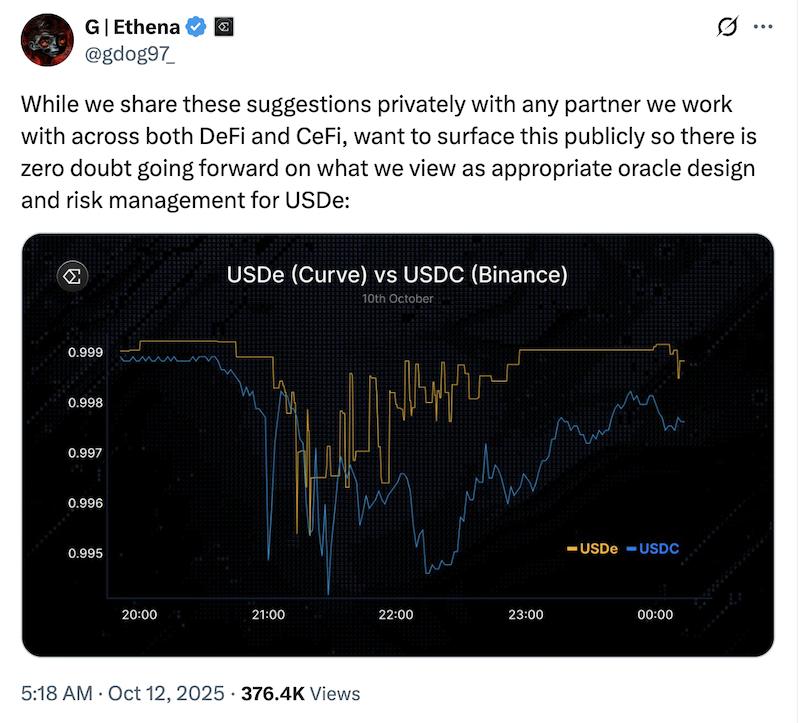

Lol, lies we tell to deceive crypto users.
Where a local price move becomes a broader problem
A sustained depeg can disrupt protocols that rely on the asset as a stable unit of account. (Chainlink) The transmission path is often simple in outline. A lending market may have accepted the asset as collateral or quoted debt against it. A liquidity pool may have paired it with another asset. A treasury, payroll stream, settlement workflow, or derivatives position may have treated it as the stable side of a calculation. Once the reference value becomes uncertain, each of those uses can require a separate adjustment.
In lending, the important detail is not merely the market price of the pegged asset. It is how the protocol measures that price, how often it updates, what collateral factors apply, and what happens when a borrower falls below a threshold. A falling collateral value can trigger liquidation. Liquidations can create more sell pressure or move collateral into thinner markets. A delayed or disputed price feed can make the system slow to react; an overly reactive feed can make a brief dislocation expensive. The mechanisms differ, but the shared lesson is that a peg is often embedded in other risk calculations.
Liquidity can amplify the same process. In an automated pool, an exit from a weakening asset may leave remaining liquidity providers with more of the asset that others are trying to avoid. The pool price may then become a visible signal, even though it represents one venue with one depth profile. Centralized venues, over-the-counter desks, bridges, and cross-chain wrappers can show different prices because conversion between them is not frictionless. A reader should therefore ask which market is being quoted, what size the quote represents, and whether there is a working path from that venue to the mechanism that is meant to restore parity.
Complex third-party service chains can make the source of stress harder for market participants to identify. (Federal Reserve) That uncertainty can matter even before a definitive loss is established. A bridge, custodian, issuer, market maker, oracle provider, exchange, or banking rail may each be operationally distinct, yet users experience the combined system as one asset. When the links are unclear, participants can have difficulty distinguishing a contained incident from a failure of the underlying claim.
Beyond one market
The consequences of a depeg need not remain inside a single pool or application. If an asset is used to move value between venues or jurisdictions, changes in its price and availability can interact with wider markets. An IMF working paper finds that stablecoin inflows can affect parity deviations and foreign-exchange markets. (IMF) That finding does not make every price deviation a macro event. It does show why the plumbing around a peg can matter beyond the first trading screen.
The same caution applies to narratives around a depeg. A durable explanation should not jump from an observed discount to a confident story about cause. It should separate what is visible from what remains to be verified: the quoted prices, the route to redemption or collateral conversion, the state of bridges and price feeds, the rules of dependent protocols, and any official notices. A specific incident may involve several of these at once, and the leading explanation can change as new evidence arrives.

It appears Justin Sun withdrew $1.7 billion ETH from Aave, spiking borrow rates and triggering a brief stETH depeg across DeFi markets.
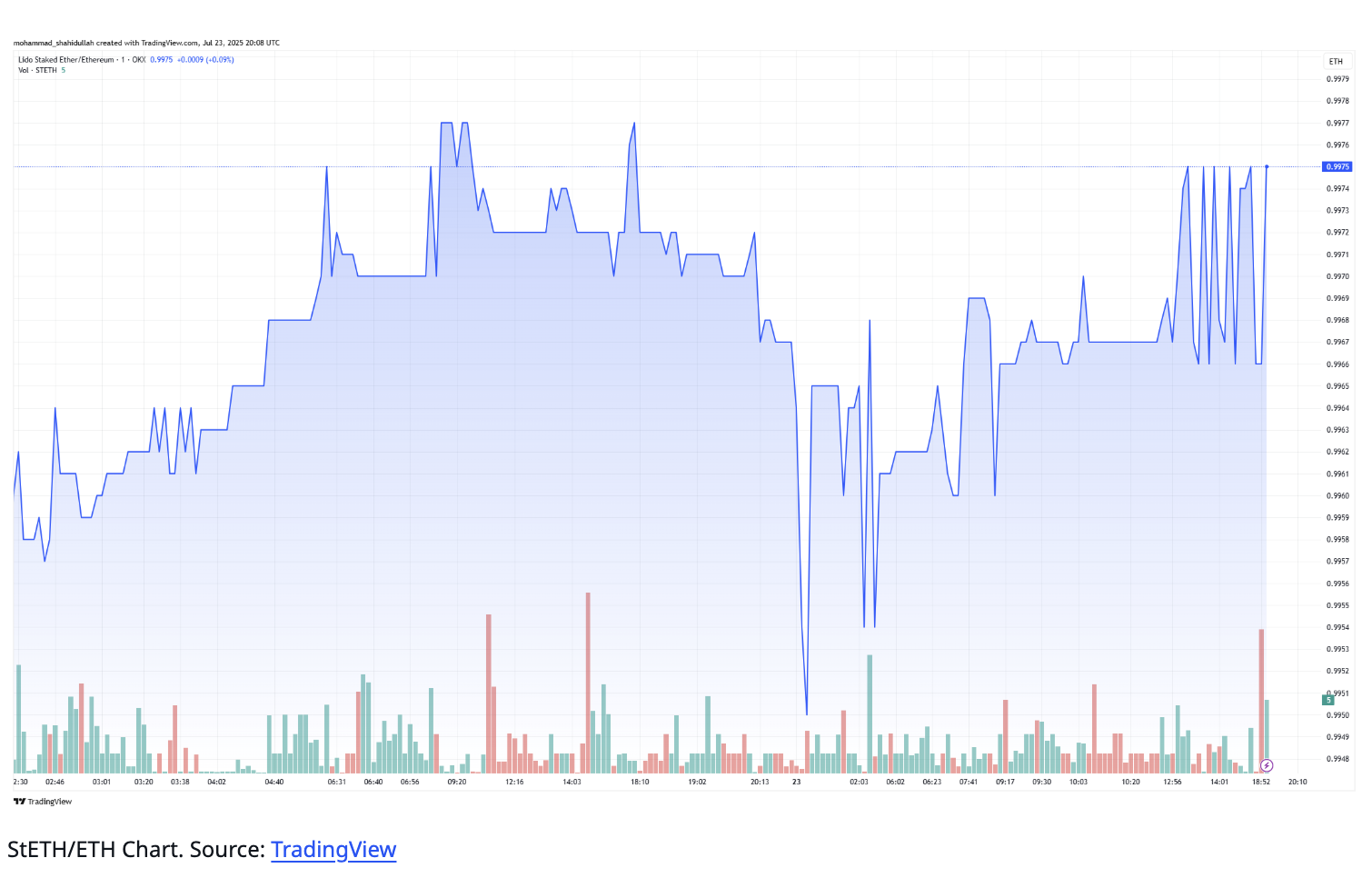
A practical evidence checklist
Before relying on a pegged asset, a reader can map the claim rather than merely follow its market capitalization or social feed. Start with the target: what exactly is the asset meant to track, and on which networks or wrappers does that claim apply? Then identify the correction mechanism: direct redemption, collateral liquidation, market incentives, or some combination. If the answer requires several steps, name those steps and the parties or contracts that perform them.
Next, inspect the documents that speak to the mechanism. For reserve-backed assets, that can include the issuer's published reports, attestation material, redemption terms, and notices about custody or banking arrangements. For crypto-backed designs, it can include collateral composition, liquidation rules, oracle documentation, governance controls, and the venues where collateral can realistically be sold. For bridges or wrappers, it can include the canonical asset, the bridge's mint-and-burn or custody model, and the ability to move back to the reference chain.
Then look at market structure without treating one screen as the entire market. Compare the quoted venue, trade size, depth, spread, and availability of an exit route. Check whether the price feed used by a dependent protocol is the same as the price being discussed. Read official incident communications, but keep a distinction between a status update and independently observable settlement. These are investigation prompts, not a scorecard and not a recommendation to transact.
Finally, map dependencies. If the asset is held as collateral, borrowed against, used in a pool, or needed for settlement, list what would change if the market price stayed away from its target for longer than expected. That exercise makes a depeg less mysterious. It turns a single price movement into a set of testable questions about the mechanisms that are supposed to contain it.
The durable lesson
A depeg is a test of a promise under stress. The most useful response is neither to assume that every small deviation is a collapse nor to assume that a familiar label resolves the risks. Identify the anchor, the path back to it, the liquidity supporting that path, and the systems that depend on it. When those pieces are visible, a reader can judge evidence with more care and avoid confusing an observed price with a complete explanation.
Latest Depeg news
Leviathan Atlas is now charting Depegs — the fault lines that can turn a dollar peg into a DeFi-wide stress test.Ethena founder Guy Young attributes the USDe depeg on Binance to an issue with the exchange's oracle, not due to any fault of the protocolIt appears Justin Sun withdrew $1.7 billion ETH from Aave, spiking borrow rates and triggering a brief stETH depeg across DeFi markets. Kain proposes a solution to the $sUSD depeg
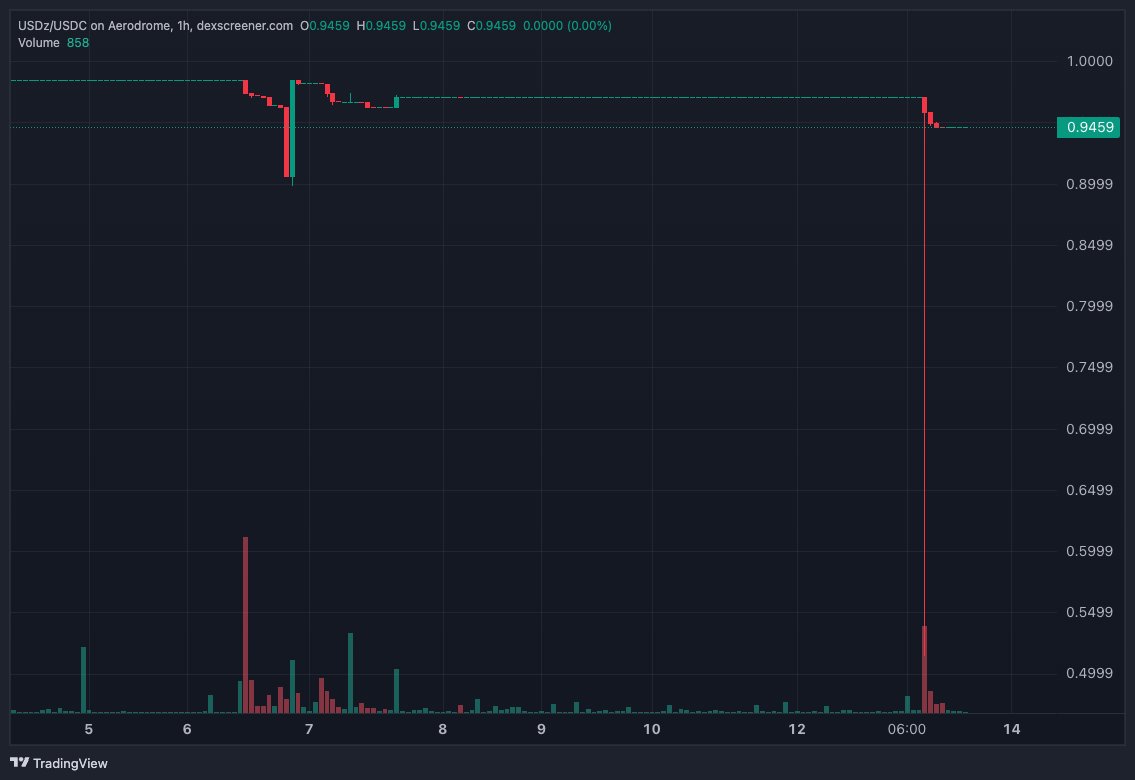 Another stablecoin depeg @AnzenFinance $USDZ drops down to $.95 after someone dumped $800k of the stablecoin
 In today’s The Tentacle, we explore the USD0++ depeg drama that shook DeFi this weekend. Usual Money’s abrupt redemption changes sent ripples through Morpho, Pendle, and beyond—trapping leveraged farmers, spiking interest rates, and raising eyebrows over MEV Capital’s role in the chaos. Is this a case of mismanagement, bad comms, a calculated play, or all three?
We break down the mechanics, the fallout, and what this means for DeFi’s future in our latest newsletter. Don’t miss it—stay informed, stay ahead.
In today’s The Tentacle, we explore the USD0++ depeg drama that shook DeFi this weekend. Usual Money’s abrupt redemption changes sent ripples through Morpho, Pendle, and beyond—trapping leveraged farmers, spiking interest rates, and raising eyebrows over MEV Capital’s role in the chaos. Is this a case of mismanagement, bad comms, a calculated play, or all three?
We break down the mechanics, the fallout, and what this means for DeFi’s future in our latest newsletter. Don’t miss it—stay informed, stay ahead.Sources
4 records from 4 domains
Community notes
Spot something off or out of date? Drop a note. Editors review topic notes daily and roll accepted fixes into the explainer — contributors are recognized in the monthly $SQUID drop.
Loading notes…
Help improve this topic
Have a story or tip about this topic? Submit it. See something missing? Leave a note. Editors review daily; accepted submissions and fixes count toward the monthly $SQUID drop.