
Deep dive explainer on dYdX, the Cosmos-based decentralized perpetuals exchange, covering its orderbook design, USDC-centric markets, DYDX tokenomics, fees, buybacks, governance, integrations, and regulatory context for crypto derivatives traders.
+6 sources across the wider coverage universe
 dYdX Labs and Robinhood Crypto launch Arcus for 95 stock tokens and 35 RWA perps2026-07
 Philippines SEC flags dYdX, Aevo, gTrade and four others as unregistered, promoters risk 21 years prison and $89K fines2026-04
 CLARITY Act yield ban creates headwind for Aave, Uniswap, dYdX while boosting Circle moat2026-03
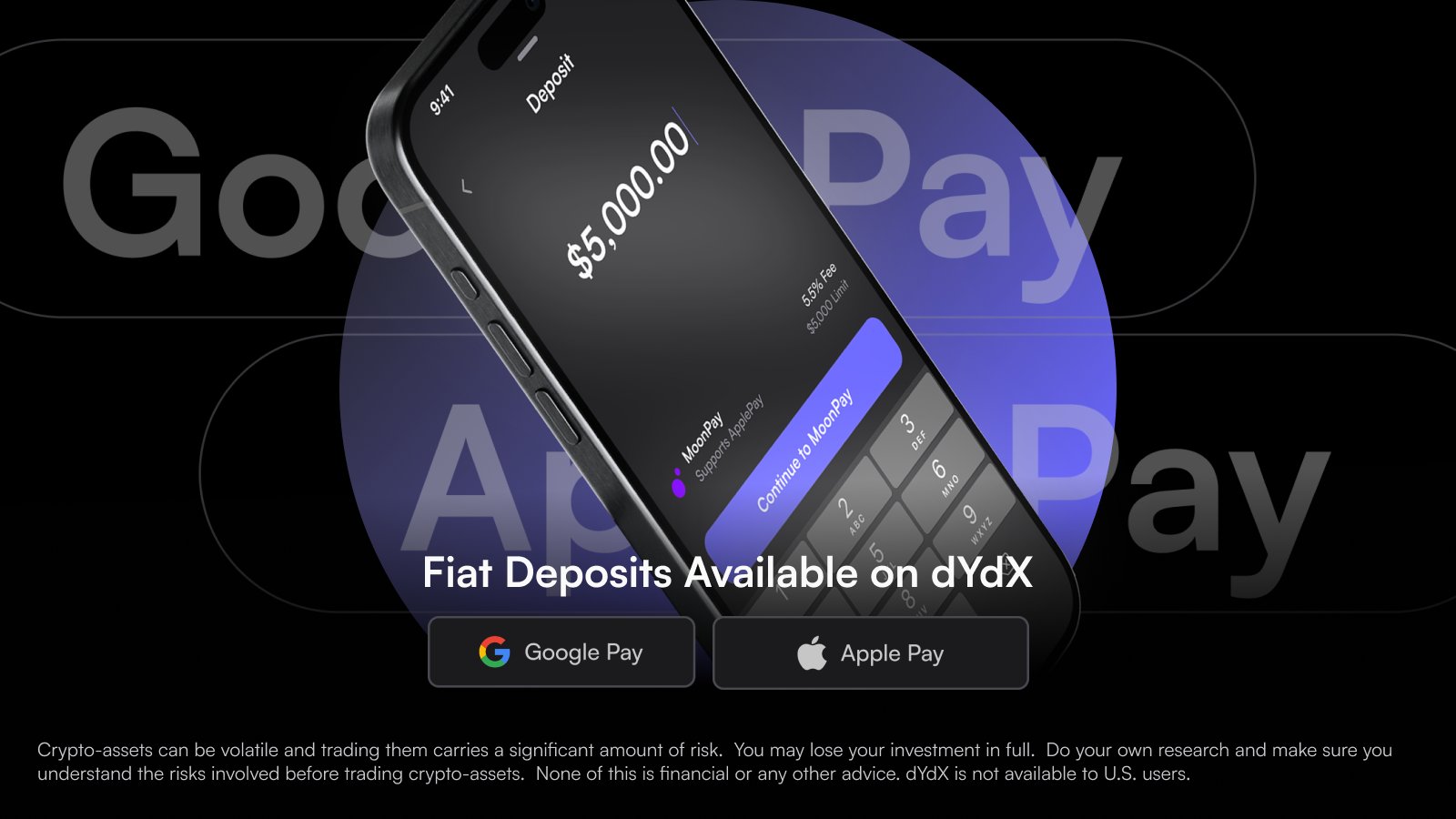 dYdX mobile adds MoonPay fiat deposits via card payments, Apple Pay, and Google Pay2026-06
 dYdX governance winds down 12 low-liquidity perpetual markets with 91% approval2026-04
 dYdX laid off 35% of its workforce, including core contributors, as CEO Antonio Juliano returns from sabbatical.2024-10
dYdX: A Comprehensive Guide to the Decentralized Perpetuals Exchange and its Cosmos Appchain
A leading decentralized derivatives platform, dYdX is a non‑custodial crypto exchange focused on perpetual futures, now powered by its own proof‑of‑stake blockchain built with the Cosmos SDK. By marrying a centralized‑style orderbook with on‑chain settlement, USDC‑denominated markets, and the DYDX governance and staking token, it aims to deliver exchange‑grade performance while remaining transparently onchain and community‑governed.
1. Origins and Evolution of dYdX
Understanding dYdX today requires tracing its path from an Ethereum smart‑contract application to a full sovereign chain with its own validator set and governance. At each stage, the project has tried to solve a specific bottleneck: first self‑custody and basic margin trading, then more capital‑efficient perpetuals, and lately scalability, control over fees and rewards, and institutional‑grade performance. This evolution mirrors a broader shift in decentralized finance, where leading applications increasingly choose to operate their own execution environments rather than share blockspace with general‑purpose chains. dYdX has therefore become both a derivatives venue and a case study in the “appchain” thesis that is now central to the Cosmos ecosystem.
1.1 Early days on Ethereum and Layer 2
dYdX launched as a non‑custodial decentralized exchange on Ethereum, initially offering spot and margin trading via smart contracts. In this first phase, users connected an Ethereum wallet such as MetaMask, retained control of their private keys, and interacted directly with on‑chain contracts that managed collateral, borrowing, and liquidations. The founding vision—led by founder Antonio Juliano—was to bring sophisticated trading instruments like margin and derivatives onchain without relying on centralized custody, while still being accessible to retail users familiar with standard Ethereum wallets.
As DeFi activity grew, dYdX pushed further into derivatives and introduced perpetual futures, using an off‑chain orderbook and matching engine (run by the team) with settlement on Ethereum, then later on a StarkEx Layer 2 system to improve costs and throughput. Users would connect their Ethereum wallet, deposit collateral (typically USDC and ETH), and then trade perpetual contracts like BTC‑USD using margin with substantial leverage. Once connected, traders could deposit USDC and ETH from a centralized exchange such as Coinbase into their wallet and then into dYdX’s contracts, in a flow that felt similar to funding a margin account on a centralized derivatives venue, but without relinquishing custody to a broker or exchange.
At this stage, dYdX adopted a conventional maker‑taker fee schedule similar to centralized exchanges, with maker orders earning lower fees and taker orders incurring higher costs. The CoinSutra review, for example, documents a base structure where maker trades paid around 0.02% and taker trades about 0.05%, with discounts based on trading volume and holdings of the DYDX token. While fee parameters evolved over time, the basic model—charging explicit trading fees while keeping protocol usage non‑custodial—became a core part of the brand. However, regulators also took notice: U.S. persons were barred from using the dYdX exchange and from buying or holding the DYDX token via official channels, reflecting the legal sensitivity of leveraged derivatives and governance tokens in major jurisdictions.
dYdX’s early growth was substantial; by trading volume it became one of the leading decentralized exchanges worldwide, trailing only Uniswap in many rankings, and it quickly established itself as the flagship decentralized platform for crypto perpetuals. Yet operating as a smart‑contract system on Ethereum, even when aided by a Layer 2, imposed constraints on throughput, fees, and feature development. As demand from high‑frequency and institutional traders increased, latency, gas costs, and the limited flexibility of smart‑contract environments became a strategic challenge, setting the stage for a more radical architectural shift.
1.2 The move to a sovereign Cosmos chain (dYdX v4)
In response to these constraints, dYdX re‑architected the protocol as a dedicated blockchain, known as the dYdX Chain or v4, built using the Cosmos SDK and CometBFT consensus. Instead of being one application among many on Ethereum or a Layer 2 rollup, dYdX now runs as a proof‑of‑stake appchain whose entire blockspace is optimized for running a decentralized perpetual futures exchange. Validators in this network participate in CometBFT consensus (the successor to Tendermint), propose and sign blocks, and secure the network by staking the DYDX token and by being subject to slashing in case of misbehavior.
The dYdX Chain architecture deliberately separates order handling from consensus state updates. Validators maintain an in‑memory orderbook, receiving orders via the peer‑to‑peer network and matching them according to a deterministic algorithm, while only the resulting trades and account state updates are committed to the blockchain. This means that raw order data is not itself stored as part of the consensus state, reducing on‑chain bloat and enabling higher throughput and lower latency for active traders. At the same time, the use of a full validator set and on‑chain settlement preserves the core DeFi property that positions and balances can be independently audited and verified from the chain’s state.
A key design choice in v4 is to make trading gasless from the user’s perspective, with traders paying only maker and taker fees in USDC rather than paying gas in a separate token for each transaction. Under the hood, the chain still uses a gas mechanism, but the protocol abstracts it away such that all fees—both trading fees denominated in USDC and gas fees for DYDX‑ or USDC‑denominated transactions—are aggregated and distributed to validators and stakers whenever a new block is committed. This approach aims to combine the predictability of centralized exchanges’ fee schedules with the transparency and revenue‑sharing of a proof‑of‑stake blockchain.
The migration to Cosmos also aligns dYdX with a broader industry trend in which mature DeFi applications such as exchanges and lending protocols deploy their own chains to gain more control over throughput, economics, and governance. Running as an appchain allows dYdX governance to tune parameters like block times, market risk settings, and fee distribution without being constrained by external chain politics or generalized gas markets. At the same time, building with the Cosmos SDK and enabling IBC (Inter‑Blockchain Communication) positions the dYdX Chain to interoperate with other Cosmos chains such as Cosmos Hub and Injective, enabling cross‑chain liquidity and shared stablecoin infrastructure.
1.3 dYdX Labs, the dYdX Foundation, and the wider ecosystem
The evolution from smart contract to sovereign chain has gone hand in hand with a more modular ecosystem structure, in which different entities play distinct roles in development, governance, and stewardship. The commercial development organization behind the core software has rebranded as dYdX Labs, emphasizing its role as a software company building trading products and infrastructure, rather than as the controller of the dYdX Chain itself. In parallel, the dYdX Foundation operates as a non‑profit entity supporting the long‑term success of the protocol and the DYDX token, focusing on community engagement, governance processes, and ecosystem growth.
From a governance standpoint, the dYdX Chain is meant to be community‑owned and community‑run, steered by traders and token holders via formal on‑chain voting. The governance module defines five proposal types—text, parameter changes, community spending, software upgrades, and proposal cancellations—through which staked DYDX holders and validators can decide on everything from risk parameters and fee schedules to new markets and treasury expenditures. This structure is intended to ensure that, while dYdX Labs continues to develop and improve the software, ultimate control over chain parameters and protocol economics lies with the distributed community of token holders and validators.
Security and robustness have also become central concerns as the protocol transitioned into a full‑fledged PoS chain. To harden the codebase, dYdX launched an extensive bug bounty program for the v4 chain, offering up to 1,000,000 USDC in rewards for qualifying vulnerabilities. The bounty, run through platforms such as Cantina, covers critical components of the dYdX Chain’s trading logic and consensus integration and is intended to incentivize external researchers to scrutinize the system before it hosts even larger volumes. This emphasis on security complements the open‑source nature of the chain’s codebase, which is publicly available on GitHub for review and contribution.
In parallel, the protocol’s roadmap has evolved to emphasize performance upgrades, new front‑ends, and deeper token utility, including better integrations with third‑party tools, enhanced features for professional traders, and programs that share protocol revenue with ecosystem participants. This includes a partner fee‑share program and other initiatives that tie the economic success of the trading platform more tightly to the stakeholders building on and using the dYdX Chain.

Injective USDC becomes canonical across Cosmos and dYdX, with Skip:Go migration starting tomorrow

2. Core Design: dYdX Chain, USDC, and Orderbook Architecture
With the shift to a Cosmos‑based appchain, the core design of dYdX now combines three pillars: a high‑throughput proof‑of‑stake blockchain optimized for trading, USDC as the canonical settlement and fee currency, and an off‑chain but validator‑managed central limit orderbook (CLOB). Understanding how these components interact is essential for grasping both the practical user experience and the protocol’s economic model. It also highlights how dYdX’s design choices differ from AMM‑based DEXs and from centralized derivatives exchanges.
2.1 Chain architecture and consensus
The dYdX Chain is built using the Cosmos SDK, a modular framework for building application‑specific blockchains, and employs CometBFT (the evolution of Tendermint) as its consensus engine. In this model, a set of validators propose and vote on blocks using a Byzantine Fault Tolerant consensus algorithm, with each validator’s voting power determined by the amount of DYDX staked with it. Validators are required to run reliable infrastructure, participate in consensus, and follow protocol rules; in return, they receive a share of fees, as well as governance influence and reputational benefits within the ecosystem.
dYdX’s architecture takes advantage of Cosmos’s modularity by defining custom modules for perpetual trading, risk management, funding payments, and fee distribution, integrated with the standard staking, governance, and bank modules. This modular approach allows the protocol to implement trading logic tailored to perpetual futures—such as mark price calculation, funding rate accrual, and position netting—directly at the chain level, rather than in an application sitting on top of a generic EVM. As a result, many operations that would have required multiple transactions or complex smart‑contract interactions in an EVM environment can be handled more efficiently and deterministically in the dYdX Chain’s native modules.
A distinctive architectural choice is the treatment of the orderbook. Validators store and manage the orderbook in memory, off the consensus state, while only the resulting trades and balance changes are finalized onchain. Traders submit orders via RPC or front‑ends; these orders propagate via the P2P network and are incorporated into the in‑memory orderbook, where matching is performed according to the protocol’s rules. When an order matches, a trade is executed, and the resulting position and balance adjustments are written into transactions that are included in blocks and become part of the chain’s canonical state. This design reduces on‑chain data requirements and helps achieve higher throughput and lower latency, at the cost of making raw order data more ephemeral and dependent on validator infrastructure.
To ensure integrity despite this off‑chain order handling, the matching logic is designed to be deterministic across validators, and validators are expected to maintain consistent views of the orderbook. Deviations can, in principle, be detected by comparing observed trades and resulting state transitions to the expected outcomes, and misbehaving validators can be penalized via slashing. That said, the model does rely heavily on correct and timely propagation of orders and can be more complex to reason about than a fully on‑chain AMM, which is one reason dYdX invests in audits, a substantial bug bounty, and careful performance engineering.
2.2 USDC as settlement, margin, and fee currency
USDC, a U.S. dollar‑pegged stablecoin, plays a central role on the dYdX Chain, functioning as the primary quote currency for perpetual markets, the main margin asset, and the unit in which trading fees are denominated. This reliance on a single, widely used stablecoin is intended to simplify the trader experience and reduce complexity compared to multi‑collateral systems where risk parameters must be set for many different tokens. By using USDC as the standard margin currency, dYdX aims to provide predictable PnL, margin, and funding calculations in a dollar‑denominated unit that many traders already use for accounting and risk management.
On the fee side, dYdX’s documentation makes clear that all protocol fees—both trading fees and gas fees associated with transactions—are tracked and distributed in USDC, with the trading interface exposing only maker and taker trading fees to users. The protocol abstracts away traditional gas payments, allowing traders to submit orders and modify positions without worrying about a separate gas token, while still ensuring that validators are compensated for their work via fee distribution mechanisms at each block. This gasless UX is an important differentiator from most EVM‑based DEXs, where users must manage both their trading capital and a separate gas balance.
The importance of USDC extends beyond the dYdX Chain itself into the broader Cosmos ecosystem. Injective and dYdX, together with Cosmos Hub, are adopting Injective USDC as the canonical stablecoin standard, with Injective acting as the primary hub for USDC routing across these chains. According to Injective’s announcement, each USDC on Cosmos Hub and dYdX will correspond to canonical USDC bridged through Injective, making it easier to treat USDC as a fungible, standard unit of account across multiple appchains. This shared standardization is expected to help future USDC activity “flow” more smoothly between Cosmos Hub, dYdX, and other Cosmos zones, improving liquidity and reducing fragmentation.
On the on‑ramp side, dYdX has also integrated with traditional payment systems to make acquiring USDC for trading easier. The dYdX mobile application now supports fiat deposits via MoonPay, allowing users to purchase USDC using card payments, Apple Pay, or Google Pay, and deposit directly to their dYdX accounts. This integration bridges the gap between legacy payment networks and the dYdX Chain, potentially expanding the user base beyond crypto‑native traders who already hold stablecoins. It also underscores the role of USDC as a bridge asset between the traditional banking system and the Cosmos‑based derivatives venue.
The regulatory environment around stablecoin yields in the United States further complicates this picture. Draft language for the CLARITY Act, for example, proposes prohibiting digital asset service providers—including exchanges and brokers—from offering yield directly or indirectly on stablecoin balances, while still allowing activity‑based rewards that are not economically equivalent to interest. For a protocol like dYdX, which uses USDC extensively but structures rewards and staking yields via the DYDX token and trading‑based incentives, this creates both constraints and opportunities. The protocol must ensure that any incentives tied to USDC balances do not resemble deposit interest in the eyes of regulators, while retaining the flexibility to reward active traders and governance participants.
2.3 Orderbook model versus AMMs
Unlike many decentralized exchanges that rely on automated market makers (AMMs) with constant‑product or other bonding curves, dYdX uses a central limit orderbook model that is more reminiscent of centralized exchanges. In an orderbook system, traders place limit orders specifying the price and quantity at which they are willing to buy or sell, and trades occur when compatible orders cross. This design allows for more granular control over execution and can be more efficient for derivatives, where professional market makers often run complex strategies and require tight spreads and deep orderbook depth.
The in‑memory orderbook maintained by validators enables low‑latency matching, since updates need not be written to the blockchain until a trade is actually executed. This can be particularly advantageous for high‑frequency trading and for institutional users accustomed to centralized exchange performance, where micro‑price increments and rapid order placement and cancellation are standard. By contrast, AMM‑based perpetual protocols often rely on oracle feeds and bonding curves to simulate an orderbook, which can be simpler but may struggle to match CLOB‑style capital efficiency and microstructure for very liquid markets.
At the same time, the orderbook model introduces additional complexities in decentralization and transparency. In AMMs, all liquidity sits onchain, and pricing is determined algorithmically by the pool’s reserves; anyone can inspect the pool’s state and determine the price at any moment. In dYdX’s model, the orderbook itself is off‑chain, albeit replicated in validator memory, and only trades and resulting balances are onchain, which may make it harder for external observers to reconstruct full order‑level market microstructure. The protocol attempts to mitigate this with deterministic matching logic and by making historical trade data accessible through APIs and front‑ends, but the trust model remains more complex than that of a basic AMM.
For traders, the CLOB architecture enables features like advanced order types, tighter spreads, and more familiar visualizations (such as depth charts and Level‑2 orderbook views), which align dYdX with the expectations of professional derivatives traders. The protocol’s goal is effectively to deliver centralized‑exchange‑grade functionality—microsecond‑scale matching, rich charting, and advanced order types—while retaining the core DeFi properties of self‑custody, algorithmic settlement, and decentralized governance. This hybrid model is central to dYdX’s positioning as “DeFi’s pro decentralized trading platform.”
Readers clicked dYdX stories not for trading features but for stress tests — the YFI insurance drain, 35% layoffs, and recurring token unlock appearances reveal an audience treating dYdX as a live experiment in whether a Cosmos-native perps DEX can absorb manipulation, regulatory friction, and founder-level turbulence without unraveling its tokenomics.
3. Perpetual Futures and Markets on dYdX
Perpetual futures are the flagship product on dYdX, and the protocol’s architecture and economics are tailored around them. Unlike dated futures that expire on a specific date, perpetuals can be held indefinitely, making them attractive to traders who want to take directional or hedging positions without rolling contracts. dYdX focuses on crypto‑settled perpetuals quoted in USDC, offering markets on major assets like BTC and ETH as well as a curated set of altcoins.
3.1 What are perpetual futures?
A perpetual futures contract is a derivative that combines elements of traditional futures contracts with margin‑based spot trading, but without a fixed expiry date. In a standard futures market, contracts expire on a given date, and the price tends to converge toward the underlying spot price as expiration approaches. Perpetuals instead use a funding rate mechanism: periodic payments exchanged between long and short positions designed to keep the perpetual price anchored near the underlying index price. If the perpetual trades above spot, longs typically pay shorts via a positive funding rate; if it trades below spot, shorts pay longs via a negative funding rate.
Perpetual futures on dYdX are margined in USDC, meaning traders post USDC as collateral and take leveraged long or short positions on underlying assets such as BTC, ETH, or SOL, but PnL and margin are denominated in USDC. This structure simplifies accounting and risk management compared to inverse contracts, where contracts are denominated in the underlying asset. Traders can choose leverage by setting position size relative to their free collateral, subject to initial and maintenance margin requirements and liquidation thresholds. The protocol continuously marks positions to a fair price (often an index composed of multiple spot markets) and compares equity to margin requirements to determine margin health.
From a risk perspective, perpetuals introduce both opportunities and dangers. On the one hand, they allow traders to express directional views, hedge spot holdings, or implement market‑neutral strategies using leverage, without needing to borrow or lend the underlying asset directly. On the other hand, the use of leverage magnifies both gains and losses, and liquidations can occur rapidly in volatile markets. Non‑custodial perpetual platforms like dYdX automate margin calls and liquidations via protocol rules, ensuring that the system remains solvent even when individual traders are wiped out, but this does not reduce the underlying market risk.
Because perpetuals are complex derivatives, their regulatory classification can be more sensitive than spot trading. In some jurisdictions, offering leveraged perpetual futures without appropriate licenses can run afoul of derivatives or securities laws. This is one reason many decentralized perps platforms, including earlier versions of dYdX, have historically blocked or discouraged certain users, such as U.S. residents, from accessing front‑ends. The combination of leverage, funding payments, and potential for significant retail losses ensures that regulators closely watch these markets.
3.2 Trading lifecycle: from funding an account to closing a position
Trading perpetuals on dYdX starts with funding an account on the dYdX Chain, typically by acquiring USDC and, in some cases, DYDX for governance or staking. In earlier iterations on Ethereum, users would obtain USDC from centralized exchanges like Coinbase, send it to their Ethereum wallet, and then deposit it into the dYdX smart contracts. With the dYdX Chain and integrations like MoonPay, the process can be more streamlined: users can fund a wallet with fiat using card payments, Apple Pay, or Google Pay, and have USDC delivered directly to their dYdX‑connected address through MoonPay’s on‑ramp. THORWallet and similar wallets further abstract this process by allowing users to sign in with email, Google, or Apple accounts while still ultimately interacting with self‑custodial infrastructure under the hood.
Once the account holds USDC on the dYdX Chain, traders can allocate collateral to a perpetuals sub‑account and start placing orders. On the trading interface, they select a market—for example, BTC‑USD or SOL‑USD—specify order type (market or limit), size, and leverage, and then submit the order. If it is a limit order, it is added to the orderbook; if it crosses existing orders, it executes immediately as a taker trade. After execution, the trader’s position appears in the positions panel, showing entry price, size, unrealized PnL, margin ratio, and any accrued funding.
Throughout the life of the position, the trader can adjust leverage by adding or removing collateral, partially reduce or increase the position, or set stop‑loss and take‑profit orders to manage risk. Funding payments are periodically debited or credited based on the funding rate and position size, typically every several hours, and are reflected in the account’s USDC balance. If the margin ratio falls below a maintenance threshold, the position becomes eligible for liquidation, at which point the protocol or designated liquidators can close the position to protect the system’s solvency.
To close a position, the trader can place an opposing order of equal or smaller size—for example, selling to close a long or buying to close a short—or use an explicit “close position” function in the interface that automatically submits the necessary order. After closing, unrealized PnL is realized, and the resulting USDC can be withdrawn from the protocol or retained as collateral for new trades. Withdrawals from the dYdX Chain back to other ecosystems may involve IBC transfers within Cosmos or bridging mechanisms for moving USDC between Cosmos and other networks, depending on the user’s needs and on the state of cross‑chain bridging infrastructure.
While the protocol itself remains non‑custodial, some integrated interfaces reduce friction by abstracting away wallet management. THORWallet, for example, enables access to dYdX perpetuals directly from its mobile app, allowing sign‑in with Google, Apple, or email, though users still retain self‑custody of underlying keys and do not need to pass through traditional KYC flows for every new account. This convergence between Web2‑style logins and self‑custodial trading lowers the barrier for new traders but also raises user‑education challenges, as some may not fully appreciate that they are engaging with leveraged derivatives rather than simple spot swaps.
3.3 Markets, liquidity, and recent governance‑led adjustments
The dYdX platform offers a range of perpetual markets, with a focus on deep liquidity for major assets like BTC, ETH, and SOL as well as a curated selection of altcoins and thematic assets. Liquidity is provided by a combination of professional market‑making firms and active traders interacting on the orderbook. For institutional traders, dYdX offers API access, sub‑accounts, and performance features that make it competitive with centralized exchanges, and the project’s leadership has publicly noted that institutional players are becoming a major force in crypto derivatives volume on the platform. This institutional focus partly explains why engineering emphasis has shifted toward performance, uptime, and low latency.
Governance actively manages the roster of markets and their risk parameters. For instance, the dYdX community has recently approved proposals with overwhelming majorities—around 91% support—to wind down a set of low‑liquidity USD perpetual markets, including assets like JASMY, NEIRO, and RAY, whose thin orderbooks and volatility posed heightened risk.[Governance coverage] In practice, winding down a market typically involves restricting new positions, adjusting margin parameters to encourage closure, and eventually halting trading once open interest has been reduced to safe levels. This sort of governance‑driven pruning demonstrates how the protocol prioritizes robust risk management over maintaining a long tail of illiquid markets.
Fee and reward programs also influence market liquidity. dYdX regularly runs trading competitions, sometimes in partnership with quant firms like Voltrade, offering USDC or other rewards for volume and PnL performance in specific markets such as ETH‑USD or SOL‑USD. These competitions can temporarily deepen liquidity and attract new traders, while also serving as marketing tools that highlight the platform’s advanced features and orderbook depth. At the same time, governance decisions affecting fee levels, maker‑taker spreads, or partner revenue shares can significantly impact market‑maker participation and, therefore, the tightness of spreads.
Finally, the platform’s market coverage and fee structures must adapt to changing regulatory and macroeconomic conditions. For example, as new thematic narratives emerge—such as meme coins, restaking tokens, or AI‑related crypto assets—community members may propose listing or delisting related perpetual markets through the governance process. Each such decision requires careful evaluation of potential trading volume, volatility, oracle availability, and legal implications. The governance‑driven nature of these choices means that dYdX’s market set can evolve more dynamically than that of a centralized exchange bound by a single corporate listing committee, but it also requires sustained engagement from token holders and risk experts.

dYdX Labs and Robinhood Crypto launch Arcus for 95 stock tokens and 35 RWA perps
4. Fees, Rewards, Staking, and Buybacks
dYdX’s economic model rests on three interconnected pillars: trading fees paid mostly in USDC, staking rewards paid to validators and delegators in DYDX funded by the protocol’s fee revenue, and token‑level mechanics such as buybacks and partner fee shares. Together, these mechanisms align incentives between traders, validators, liquidity providers, and token holders, while attempting to comply with evolving regulatory expectations around stablecoin yields and token incentives.
4.1 Trading fees and gas abstraction
On the dYdX Chain, users experience trading as “gasless”: they do not pay a separate gas token for orders and position management; instead, they pay maker and taker fees in USDC when trades execute. Under the hood, the chain still tracks gas usage for transactions, but gas fees and trading fees are aggregated and distributed to validators and stakers at the block level, rather than being charged separately to users per transaction. This design simplifies the UX, making dYdX feel more like a centralized exchange with a clear fee schedule, while preserving the fee‑based incentives needed to secure a proof‑of‑stake network.
Fee levels and discounts are determined by a tiered schedule based on each trader’s trailing 30‑day volume across sub‑accounts and markets. Documentation outlines multiple volume tiers, each with corresponding maker and taker fee rates expressed in basis points (bps), with higher‑volume traders benefiting from lower taker fees and, at the highest tiers, even negative maker fees—effectively rebates for adding liquidity. An illustrative snapshot of such a schedule is shown below, with figures drawn from dYdX’s own documentation and subject to change via governance.
| Tier | 30‑day trailing volume (USD) | Taker fee (bps) | Maker fee (bps) |
|---|---|---|---|
| 1 | < 1,000,000 | 5.0 | 1.0 |
| 2 | ≥ 1,000,000 | 4.5 | 1.0 |
| 3 | ≥ 5,000,000 | 4.0 | 0.5 |
| 4 | ≥ 25,000,000 | 3.5 | 0.0 |
| 5 | ≥ 50,000,000 | 3.0 | 0.0 |
| 6 | ≥ 100,000,000 | 2.5 | −0.7 |
| 7 | ≥ 200,000,000 | 2.5 | −1.1 |
As this example suggests, taker fees decrease as volume rises, while maker fees move from positive to zero and eventually negative, incentivizing high‑volume market makers to concentrate activity on dYdX. The existence of negative maker fees means that, for top‑tier market makers, dYdX effectively pays them to provide liquidity, funded by taker fees and the broader protocol revenue pool. This can help bootstrap depth in key markets but must be carefully balanced to ensure net positive fee revenue and sustainable reward flows to validators and stakers.
Historically, prior to the dYdX Chain, the exchange used a simpler fee schedule, such as maker and taker fees of 0.02% and 0.05%, respectively, as documented in earlier reviews. Over time, as the protocol matured and moved to its own chain, the fee schedule became more granular and dynamic, reflecting competition with both centralized exchanges and other decentralized perps venues. Governance retains the power to adjust these parameters via proposals, allowing the community to respond to changes in trading volume, market structure, or regulatory pressure.
It is important for traders to recognize that while trading itself is gasless in the user interface, costs are still being paid at the protocol level and ultimately borne by traders through their fees. This abstraction is mainly a UX improvement, not a fundamental change in economic reality. Nonetheless, by eliminating the need to manage a separate gas token balance, the protocol reduces a common pain point for new DeFi users and aligns fee payments directly with trading activity rather than generalized transaction submission.
4.2 Staking, validator rewards, and partner fee sharing
The DYDX token plays a central role in the chain’s security and governance. Validators must stake DYDX, and token holders can delegate their tokens to validators, contributing to network security and earning a pro‑rata share of staking rewards. These rewards are funded entirely from protocol revenue—namely trading fees and gas fees—minus allocations to community funds and validator commissions. The staking reward formula is explicitly documented as:
\[ \text{Staking Rewards} = \text{Trading Fees} + \text{Gas Fees} - \text{Community Tax} - \text{Validator Commission} \]
In this expression, the Community Tax represents a fraction of fees directed to a community treasury for ecosystem spending, while Validator Commission represents the share of rewards that individual validators retain before distributing the remainder to their delegators. At launch, the community tax was set to 0%, meaning that all fee revenue, net of validator commission, flowed to stakers; however, this parameter can be changed by governance to fund grants, development, or other community initiatives.
The economics of staking are highly sensitive to trading volume, fee levels, the size of the active validator set, and commission rates. A governance forum analysis has highlighted that, at current fee levels and with an active set of 60 validators, more than 17 active validators are operating at a loss, prompting a proposal to reduce the active set to 30 to concentrate rewards and make validation economically sustainable. This illustrates the tradeoff between decentralization and economic viability: a larger validator set can increase censorship resistance and fault tolerance, but if rewards are too thinly spread, smaller validators may be unable to cover operational costs, leading to centralization in practice.
Beyond staking, dYdX has introduced programs to share protocol revenue with ecosystem partners. A Partner Fee Share mechanism allows integrators—such as front‑ends, trading bots, or liquidity partners—that bring volume and liquidity to dYdX to earn up to 50% of protocol fees generated by users they onboard. This model turns dYdX into an infrastructure layer that others can build on, aligning incentives for third‑party interfaces and tooling providers to promote and integrate the protocol. It is also used to structure affiliate programs and referral campaigns, such as the “Affiliate Booster” initiatives that reward partners for driving real trading activity rather than superficial metrics.
Staking yields, as tracked by third‑party analytics sites like StakingRewards, fluctuate over time, sometimes appearing low or even negligible when trading volumes are modest or when commission and community tax settings reduce the share of fees going to delegators. This underlines that DYDX staking is not a fixed‑rate yield product but a variable claim on protocol revenue, whose attractiveness depends on the health and competitiveness of the dYdX trading business. It also interacts with regulatory proposals such as the CLARITY Act: while staking rewards are paid in DYDX and funded by trading revenue, regulators may scrutinize how these yields are marketed, especially to users in jurisdictions where offering certain types of investment returns requires registration.
4.3 Token mechanics, buybacks, and regulatory constraints
The DYDX token began its life as an ERC‑20 governance token on Ethereum, used for managing the Layer 2 protocol and for rewarding traders and liquidity providers. With the launch of the dYdX Chain, the token’s role expanded to include staking for network security, with DYDX serving as the staking token securing the proof‑of‑stake consensus and granting governance rights over chain parameters, fee schedules, community treasury spending, and market listings. On the dYdX Chain, token utility is thus created through staking to validators and participating in governance, aligning token holders with the protocol’s long‑term stability and growth.
A significant development in DYDX token economics has been the introduction of a buyback program funded by protocol revenue. The dYdX Treasury SubDAO proposed allocating 25% of net protocol revenue to buy back DYDX tokens on the open market, with purchases executed monthly. Community governance approved this proposal, and the program began on March 24, with the stated aim of using millions of USDC in platform fees to acquire DYDX and then stake it or distribute it in a manner that boosts network security and reduces circulating supply. According to analysis shared with the community, applying this 25% revenue allocation to past revenue figures would have resulted in buybacks equivalent to approximately 1.55% of the maximum DYDX supply and about 2.15% of the circulating supply over a comparable period.
The mechanics of the buyback program involve purchasing DYDX from secondary markets using USDC accrued as protocol fees, then staking the acquired tokens or distributing them among stakers, “mega depositors,” and the Treasury SubDAO itself. This creates a feedback loop in which trading activity funds token purchases that, in turn, strengthen staking security and potentially support the token’s price by reducing free float. The program has since executed multiple rounds of purchases, with community updates noting that more than one million DYDX have been bought back and redeployed, underlining the material scale of the initiative.
These buybacks sit at the intersection of token economics and regulation. On the one hand, repurchasing and staking protocol tokens with fee revenue resembles traditional corporate buyback programs and dividend mechanics, aligning token holders with protocol cash flows. On the other hand, regulators may scrutinize such programs under securities laws, particularly where they present tokens as investment vehicles whose value is tied to income streams and buybacks. In the U.S., the CLARITY Act’s restrictions on stablecoin yield mainly target interest‑like returns on USDC balances, not necessarily token buybacks, but the broader direction of regulation—requiring clear disclosures and registrations for yield‑bearing products—applies here as well.
dYdX’s design attempts to navigate this by ensuring that staking yields and buyback benefits are tied to protocol usage and governance participation, rather than to passive stablecoin deposits. Activity‑based rewards such as trading competitions, fee rebates, and partner fee share arrangements are more likely to fit within the “permitted” category of rewards under the CLARITY Act’s framework, provided they are not economically equivalent to bank interest. Nevertheless, the evolving regulatory landscape means that the structure and marketing of DYDX‑related rewards and buybacks may need to change over time, especially as the project moves toward greater engagement with U.S. and other tightly regulated markets.
- 01YFI insurance fund drain
A $9M loss wiping 40% of the insurance fund from alleged market manipulation crystallized the systemic risk of thin-liquidity perpetuals on a DEX with a limited backstop, pulling in readers across three separate headlines on the same incident.
- 02Cosmos chain migration stakes↗
The full V4 migration arc — open-source release, testnet, governance vote, token migration portal, and legal threats against violators — attracted readers tracking whether a top-five DEX could replatform to a sovereign appchain without losing liquidity or users.
- 03Trading rewards and staking yield↗
Real USDC fee revenue ($5M distributed to stakers in 30 days against $41B volume) gave readers a concrete, verifiable yield benchmark rarely seen in DeFi governance tokens, distinguishing DYDX from purely speculative assets.
- 04Leadership layoffs and restructuring
A 35% workforce cut timed to the CEO's return from sabbatical — followed by a founder-to-chairman transition and rebrand to dYdX Labs — signaled that even a mid-migration protocol faces the same org-level pressure as any venture-backed startup.
- 05Token unlock overhang
DYDX appeared repeatedly in multi-protocol unlock roundups totaling $750M–$900M+, making it a recurring proxy for readers tracking supply-side sell pressure across the broader market.
- 06Regulatory and legal headwinds↗
The CLARITY Act yield ban, Philippines SEC criminal-penalty designation, and dYdX's own legal threats to token holders migrating without authorization painted a picture of a protocol navigating compliance pressure from multiple jurisdictions simultaneously.
5. Governance, Risk Management, and Regulation
The dYdX Chain is governed through a formal on‑chain process in which staked DYDX holders and validators propose and vote on changes. At the same time, the protocol must manage significant market, technical, and regulatory risks, given its focus on leveraged derivatives and its ambition to attract institutional and retail traders globally. Governance, risk, and regulation intersect in decisions about market listings, leverage limits, validator set size, fee levels, and the structure of rewards and buybacks.
5.1 On‑chain governance mechanics and examples
Governance on the dYdX Chain is implemented via a dedicated Cosmos SDK governance module customized for the protocol’s needs. Token holders stake DYDX to validators, and voting power is proportional to the amount of DYDX bonded, with validators voting on behalf of their delegators unless delegators choose to override their validator’s vote. Proposals are submitted onchain, pass through a deposit period (where proposers must post a minimum stake to prevent spam), and then enter a voting period during which validators and delegators can vote “Yes,” “No,” “No with veto,” or “Abstain.” Quorum and pass thresholds, as well as deposit and voting periods, are themselves configurable via governance.
The governance framework defines five main types of proposals. Text proposals are non‑binding statements of intent or signaling votes, used to gauge community sentiment on issues like strategic direction or partnership priorities. Parameter change proposals adjust protocol parameters such as fees, margin requirements, maximum leverage, or market configurations. Community spending proposals authorize disbursements from the community treasury for grants, marketing, audits, or other expenses. Software upgrade proposals coordinate upgrades to the chain’s binaries or configuration, often involving planned voting and upgrade heights. Cancel proposals can halt or reverse other proposals under certain conditions, providing a safeguard against malicious or misguided changes.
Real‑world governance activity illustrates these mechanisms. The previously mentioned forum proposal to reduce the active validator set from 60 to 30, for instance, is an example of a parameter change proposal aimed at aligning validator economics with protocol revenue. The proposer argues that, at current fee levels, more than 17 active validators are operating at a loss, and that concentrating rewards among a smaller set would make it economically viable to run high‑quality infrastructure, thereby enhancing network reliability. Community members must weigh these arguments against decentralization concerns and the desire to keep the validator set as broad as possible.
Similarly, proposals to wind down low‑liquidity perpetual markets, such as those for JASMY, NEIRO, and RAY, are handled via governance, with parameter changes adjusting margin requirements and eventually delisting the markets once open interest has shrunk.[Governance coverage] High approval rates—around 91% in recent votes—suggest strong consensus among engaged token holders that risk control and market quality should take precedence over maintaining every minor market indefinitely. Such governance activity underscores that the protocol is not static; key aspects of its risk profile and business strategy are collectively managed by the community.
5.2 Risk controls, technical security, and market integrity
dYdX operates at the intersection of multiple risk domains: market risk from leveraged derivative positions, technical risk from its custom chain and off‑chain orderbook architecture, and economic risk from its fee and reward structures. Market risk is managed through margin requirements, liquidation mechanisms, and funding payments designed to keep positions collateralized and markets in line with underlying indices. Perpetuals on dYdX are over‑collateralized, with initial and maintenance margin thresholds enforced by the protocol; if a trader’s equity falls below maintenance margin, partial or full liquidation can occur to protect the system as a whole.
The chain’s technical security is addressed through a multi‑layered approach encompassing code audits, open‑source transparency, a bug bounty program, and continuous monitoring of validator performance. The bug bounty program, offering up to 1,000,000 USDC for critical vulnerabilities in the v4 contracts and chain code, is a particularly notable measure. By incentivizing external security researchers to probe the system for weaknesses, dYdX acknowledges the complexity of its architecture, especially the interplay between off‑chain order handling and on‑chain settlement, and seeks to discover issues before they can be exploited in the wild.
Market integrity also depends on robust oracle infrastructure and index price calculations. While detailed oracle design lies beyond the scope of the sources cited here, perpetuals platforms commonly rely on aggregated prices from multiple centralized exchanges to compute an index price used for funding and liquidations. Any manipulation of these underlying markets or oracle feeds could impact funding rates and liquidation events on dYdX. Consequently, governance must ensure that oracle providers, data sources, and circuit‑breaker rules are chosen and updated with care, and that positions are not excessively concentrated in assets with fragile or thin underlying markets.
Economic risk arises when fee and reward structures create perverse incentives or unsustainable yields. For example, some structured “vault” products built on top of dYdX’s fee‑sharing mechanisms have attracted short‑term capital by offering high yields funded by protocol fee sharing and token incentives. When governance later adjusted fee‑sharing terms or emissions, total value locked (TVL) in such products reportedly declined sharply—by as much as 70% in some cases—highlighting how sensitive speculative capital is to changes in reward rates. This experience underscores the importance of designing incentive programs that attract long‑term aligned participants rather than purely yield‑chasing capital.
5.3 Regulatory headwinds, global access, and CLARITY Act implications
Because dYdX offers leveraged crypto derivatives, it sits squarely within regulators’ field of view. Historically, the protocol and its front‑end providers have barred users from certain jurisdictions, most notably the United States, from accessing the exchange or the DYDX token, as documented by third‑party reviews noting that U.S. citizens are prohibited from using the platform or buying, holding, or trading DYDX. These restrictions reflect concerns that perpetuals may fall under derivatives or securities regulations and that offering them without appropriate licensing could expose operators to enforcement action.
Regulatory scrutiny is not limited to the U.S. The Philippines Securities and Exchange Commission, for example, has flagged dYdX alongside other perpetual swap platforms like Aevo and gTrade as unregistered entities, warning that promoters could face significant prison terms and fines under the country’s securities laws. This highlights how marketing decentralized derivatives platforms in some jurisdictions can be treated similarly to promoting unregistered securities or illegal investment schemes, even when the underlying infrastructure is non‑custodial and globally distributed.
In the U.S., the emerging CLARITY Act adds another layer of complexity, particularly regarding stablecoin yields. The draft language reviewed by industry leaders draws a structural line by prohibiting digital asset service providers—including exchanges and brokers—from offering yield directly or indirectly on stablecoin balances, or in any arrangement that is economically equivalent to bank interest. At the same time, it would allow activity‑based rewards tied to loyalty programs, promotions, subscriptions, transactions, payments, and platform use, so long as they do not meet the economic equivalence standard. The SEC, CFTC, and U.S. Treasury are tasked with defining permissible rewards and drafting anti‑evasion rules within twelve months of enactment.
For dYdX, this means that offering straightforward interest on idle USDC balances would likely be prohibited for U.S.‑facing products, whereas fee discounts, trading competitions, and DYDX‑denominated rewards tied to trading activity are more likely to remain acceptable. The protocol’s reliance on USDC as a settlement and fee currency, and on DYDX for staking and governance, may fit more comfortably within the CLARITY framework than models that pay interest‑like yields on stablecoin deposits. Nevertheless, U.S. regulators could still view DYDX staking yields or buyback‑driven appreciation as investment‑like returns, especially if marketed as such, which would necessitate careful legal structuring and disclosures.
Despite these headwinds, dYdX has signaled a desire to enter or re‑enter the U.S. market in a more compliant form, reportedly planning a fee‑cutting, feature‑expanding push targeted at U.S. users under evolving regulations. Such a move would likely involve front‑ends operated by compliant entities, potentially with KYC, leverage limits, and restrictions on certain tokens or reward programs, while the underlying dYdX Chain remains globally accessible as open‑source software. The tension between protocol neutrality and front‑end compliance is likely to intensify as regulators refine their stance on DeFi derivatives, and dYdX’s response will be closely watched as a bellwether for the sector.
Philippines SEC flags dYdX, Aevo, gTrade and four others as unregistered, promoters risk 21 years prison and $89K fines
6. User Experience, Integrations, and Community
Beyond protocol mechanics and regulation, dYdX’s success depends on delivering a user experience that can compete with centralized exchanges while leveraging the strengths of DeFi. This involves building intuitive interfaces, integrating with wallets and payment providers, enabling rich social and analytical tooling, and nurturing a community of traders, developers, and partners who contribute liquidity and innovation.
6.1 Trading interfaces: web, mobile, MoonPay, THORWallet, and Telegram
The primary interface to dYdX is its web application at dydx.trade, which provides a professional trading dashboard with charts, orderbook, depth visualization, order and position panels, and access to governance and staking features. The interface is designed to resemble a modern centralized exchange, with responsive layouts and real‑time updates, but trades settle on the dYdX Chain. Traders connect a compatible wallet, such as a Cosmos‑enabled wallet, to sign transactions and manage collateral, with the interface handling the details of interacting with the chain’s endpoints.
Recognizing the importance of mobile trading, dYdX has also released mobile applications that integrate closely with the dYdX Chain. A key recent enhancement is the integration of MoonPay to support fiat deposits directly within the mobile app, allowing users to purchase USDC using card payments, Apple Pay, or Google Pay and deposit it directly into their dYdX accounts. This removes the need for new users to go through separate centralized exchanges just to acquire USDC, streamlining the onboarding process and making dYdX more accessible to users who are comfortable with mobile payment methods but may be less familiar with traditional crypto on‑ramps.
THORWallet’s integration illustrates a different approach to UX abstraction. Through this integration, THORWallet users can access dYdX perpetual markets directly from the THORWallet app without giving up self‑custody or switching interfaces. Users can sign in with Google, Apple, or email, and THORWallet manages keys and transaction signing on their behalf while still preserving non‑custodial control. This type of integration leverages dYdX as a back‑end liquidity and execution layer, with third‑party wallets and apps building customized front‑ends for their user bases, in line with the protocol’s partner‑friendly design and fee‑sharing programs.
Looking ahead, dYdX Labs has also outlined plans to bring trading into messaging platforms like Telegram, as part of a roadmap focused on maximizing token utility and expanding access. The idea is to embed trading interfaces into the environments where traders already spend time, making it possible to monitor markets, share ideas, and execute trades without leaving chat applications. This vision is further reflected in features like the dYdX Chat Box, which places a real‑time market chat directly alongside charts and execution panels, creating a more social and interactive trading “deck.” Such features are designed to blend real‑time discussion and decision‑making, acknowledging that many traders rely on community input and shared analysis, not just charts, when making trading decisions.
6.2 Community programs: rewards, affiliates, competitions, and social trading
Community and incentive programs are crucial to dYdX’s strategy of bootstrapping liquidity and sustained usage. The tiered fee schedule discussed earlier already creates an implicit reward system by granting lower fees—and sometimes maker rebates—to high‑volume traders, aligning the protocol’s economics with active usage. Beyond this, dYdX runs periodic trading competitions, often focused on specific markets like ETH‑USD or SOL‑USD, in collaboration with trading firms such as Voltrade, with USDC or other rewards for top performers by volume or PnL. These competitions serve both to deepen liquidity in targeted markets and to attract new traders who may stay to trade beyond the promotional period.
Affiliate and partner programs extend this incentive structure to integrators, influencers, and other ecosystem participants. The Affiliate Booster Program, for instance, offers a mix of proportional volume‑based rewards and milestone bonuses for affiliates who bring real trading volume to the platform. Partners share in protocol fees via the Partner Fee Share mechanism, which can allocate up to 50% of the fees generated by referred users back to the partner. This turns dYdX into a base layer for an ecosystem of third‑party front‑ends, tools, and communities that benefit financially from deepening the protocol’s liquidity and user base.
Social features like the dYdX Chat Box reinforce this community ethos by situating conversation next to execution. Traders can discuss markets, share charts, and react to news in real time, while orders are just a click away. This combination of social interaction and advanced trading tools attempts to recreate the feel of a trading floor or professional chat room within a decentralized exchange interface. It also dovetails with integrations with analytics platforms like TradingView, which dYdX engages for analyst calls and deeper market analysis, helping more advanced users access robust charting and technical tools alongside dYdX’s orderbook.
At the same time, the protocol has learned that not all yields are created equal. Some earlier revenue‑sharing vaults and yield products built around dYdX fee flows experienced dramatic declines in TVL—on the order of 70%—once governance reduced emission rates or adjusted fee splits. This highlights the difference between sustainable, activity‑based rewards and short‑term yield farming schemes that depend heavily on elevated token emissions. As the protocol matures, community discussions increasingly emphasize aligning rewards with productive activity, such as market making, governance participation, and protocol development, rather than maximizing headline APY figures.
DYDX governance token launched via retroactive airdrop
dYdX V4 open-source code released, Cosmos appchain transition begins
- 2023-10exploit
YFI market manipulation drains $9M (~40%) from insurance fund
- 2023-10governance
Stricter margin rules and trade prohibitions imposed post-YFI attack
dYdX Chain mainnet launches; DYDX trading rewards distribution begins
- 2024-08milestone
DYDX among $900M+ multi-token scheduled August unlock cohort
dYdX launches permissionless listings via MegaVault liquidity pool
CLARITY Act yield ban flagged as structural headwind for DYDX fee distribution
7. dYdX in the Broader DeFi and Cosmos Landscape
dYdX does not exist in isolation; it competes and collaborates with other DeFi protocols, interacts deeply with the Cosmos ecosystem, and sits atop the USDC stablecoin infrastructure that underpins much of crypto trading. Understanding its place in this landscape is essential for assessing its long‑term prospects and the risks and opportunities facing its users and token holders.
7.1 Position among DEXs and derivatives protocols
In the broader DEX universe, dYdX is distinctive for its focus on perpetual futures and its use of an orderbook rather than AMMs. While Uniswap dominates spot DEX volume, dYdX has emerged as one of the leading decentralized platforms for perpetual trading, often ranking behind only a handful of centralized exchanges in perps volume and ahead of most other DeFi perps protocols. Competitors like GMX, Synthetix, Aevo, and others mainly operate on EVM chains using various hybrid AMM‑orderbook or pooled liquidity models, whereas dYdX’s appchain architecture gives it a dedicated execution environment with CLOB microstructure.
This positioning allows dYdX to target professional and institutional traders who demand deep liquidity, tight spreads, and sophisticated order types, but also increasingly value self‑custody and transparent settlement. By offering a non‑custodial, yet CEX‑like experience, dYdX aims to capture order flow that might otherwise go to centralized derivatives platforms, especially in jurisdictions where regulators permit non‑custodial derivatives trading. Its support for advanced APIs, institutional‑grade features, and multi‑platform access (web, mobile, third‑party apps) further bolsters this competitive positioning.
From a business‑model perspective, dYdX’s reliance on protocol fees and token‑driven staking economics aligns it more closely with “DeFi blue chips” whose revenues are transparent and shared with token holders, rather than with centralized exchanges where revenue is captured by private shareholders. This transparency allows analysts and community members to track protocol revenue, staking yields, and buyback activity onchain, enhancing accountability and fostering a more data‑driven governance culture. It also means that dYdX’s valuation, as reflected in the DYDX token price, is more directly tied to trading volumes and fee margins than in protocols where token utility is less clear.
7.2 Role within the Cosmos appchain ecosystem and USDC standardization
Within the Cosmos ecosystem, dYdX stands out as a flagship financial appchain focused on derivatives, alongside other specialized chains like Injective for derivatives and orderbook exchanges, and Osmosis for AMM‑based spot trading. By using the Cosmos SDK and integrating with IBC, the dYdX Chain can interoperate with other zones, moving assets like USDC and potentially other tokens between chains without relying on centralized custodial bridges. This positions dYdX as a key component of Cosmos’s emerging “interchain finance” stack, where users can move capital between staking, lending, spot trading, and derivatives across different chains.
The decision by dYdX and Cosmos Hub to adopt Injective USDC as a canonical stablecoin standard underscores how important shared stablecoin infrastructure is to this vision. Under this arrangement, USDC is minted or bridged into Injective, from which it can be routed to dYdX and Cosmos Hub, ensuring that each USDC token on these chains corresponds to the same underlying asset and is treated as fungible. This reduces fragmentation and makes it easier for protocols and users to rely on USDC as a consistent unit of account across the interchain, whether for trading, lending, or collateralization.
Standardized USDC also benefits ecosystem‑wide risk management. By converging on a single, well‑regulated stablecoin as the primary unit of account, Cosmos chains like dYdX can reduce the complexity of collateral management and risk assessment, compared to systems that juggle multiple, potentially riskier stablecoins. It also dovetails with the CLARITY Act’s recognition of stablecoins as critical financial infrastructure, even as it restricts how yield can be offered on them. In practice, dYdX’s dependence on USDC means that any regulatory shocks to USDC’s status—such as changes in banking relationships or reserve requirements—would propagate quickly to the protocol, making regulatory monitoring and contingency planning essential.
7.3 Interplay with USDC, CLARITY Act, and Circle’s emerging moat
The CLARITY Act’s stablecoin yield provisions, as currently drafted, create both challenges and advantages for protocols built around USDC. By prohibiting exchanges and related entities from offering yield on stablecoin balances, the Act would significantly constrain “crypto savings account” style products that pay interest on USDC or similar tokens, especially when such yields are economically equivalent to bank interest. At the same time, the Act explicitly permits activity‑based rewards tied to transactions, payments, and platform use, leaving room for protocols to continue offering fee rebates, loyalty points, and trading competitions, provided they are structured carefully.
For dYdX, which primarily uses USDC as a margin and fee currency rather than as a yield‑bearing deposit asset, the CLARITY framework may be comparatively manageable. The protocol can continue to reward traders with fee discounts based on volume tiers, distribute DYDX staking rewards funded by trading fees, and run trading competitions or partner fee‑sharing programs, so long as these are not framed or structured as interest on USDC deposits. Moreover, by aligning staking rewards with protocol revenue rather than with lending returns on USDC, dYdX reduces its exposure to regulatory concerns about unregistered interest‑bearing accounts.
At the same time, the Act and similar regulatory initiatives strengthen the position of USDC’s issuer, Circle, as a “moat” provider of stablecoin infrastructure. As more protocols converge on USDC as their canonical stablecoin—both to meet user demand and to align with regulatory expectations—Circle’s role as a central issuer with banking relationships and compliance programs becomes more critical. For dYdX, this means that its dependence on USDC brings some stability and institutional acceptability but also introduces concentration risk: any problems with USDC could have immediate and severe consequences for margin, PnL, and fee accounting on the dYdX Chain.
In this environment, dYdX’s tokenomics—particularly its use of DYDX for staking rewards and buybacks—serve as an important diversification mechanism. By ensuring that protocol revenue accrues to DYDX holders rather than simply boosting the value of USDC deposits, dYdX can maintain a distinct economic identity even as it relies on USDC operationally. Governance must nonetheless remain vigilant in monitoring regulatory developments, especially as the protocol expands into more heavily regulated markets like the U.S., and may need to adjust reward structures, marketing language, and front‑end operations to remain compliant while preserving the core value proposition of decentralized, high‑performance derivatives trading.
Outlook
dYdX has evolved from a pioneering Ethereum‑based margin trading dApp into a full‑fledged, Cosmos‑based perpetuals appchain with its own validator set, staking token, and sophisticated tokenomics. Its orderbook architecture, USDC‑denominated markets, and gasless trading model position it as a serious competitor to centralized exchanges for professional and institutional traders, while integrations with mobile apps, MoonPay, THORWallet, and soon messaging platforms like Telegram aim to broaden its appeal to a wider user base. At the same time, the protocol’s reliance on a complex, off‑chain orderbook and its focus on leveraged derivatives underscore the need for robust security practices, careful risk management, and responsive governance.
The road ahead is both promising and fraught. On the opportunity side, dYdX stands to benefit from the maturation of the Cosmos ecosystem, the standardization of USDC as a canonical stablecoin across multiple appchains, and the growing institutional appetite for non‑custodial derivatives venues. Its tokenomics—featuring fee‑funded staking rewards, partner fee shares, and an active buyback program—create clear economic linkages between protocol usage and token value, while on‑chain governance gives the community the tools to adapt parameters as conditions change. On the risk side, evolving regulatory regimes like the CLARITY Act, enforcement actions in emerging markets, and the broader scrutiny of DeFi derivatives will require ongoing adaptation in how dYdX structures and markets its products and rewards.
For traders, builders, and token holders considering engagement with dYdX, the key questions are whether the protocol can maintain deep, reliable liquidity; continue to innovate on user experience and integrations; and successfully navigate regulatory headwinds without sacrificing its core DeFi principles. If it can, dYdX is well‑positioned to remain a foundational piece of the decentralized derivatives landscape and a leading example of what a specialized, appchain‑based financial protocol can achieve.
Latest dYdX news
Injective USDC becomes canonical across Cosmos and dYdX, with Skip:Go migration starting tomorrowdYdX Labs and Robinhood Crypto launch Arcus for 95 stock tokens and 35 RWA perpsPhilippines SEC flags dYdX, Aevo, gTrade and four others as unregistered, promoters risk 21 years prison and $89K finesCLARITY Act yield ban creates headwind for Aave, Uniswap, dYdX while boosting Circle moatdYdX mobile adds MoonPay fiat deposits via card payments, Apple Pay, and Google PaydYdX governance winds down 12 low-liquidity perpetual markets with 91% approvalSources
20 records from 17 domains
github.com
dydx.trade
dydx.foundation
docs.dydx.xyz
stakingrewards.com
youtube.com
coinsutra.com
dydx.xyz
cantina.xyz
x.com
faqs.thorwallet.org
fintechweekly.com
fr.tradingview.com
defiprime.com
injective.com
dydx.forum
docs.dydx.community
Community notes
Spot something off or out of date? Drop a note. Editors review topic notes daily and roll accepted fixes into the explainer — contributors are recognized in the monthly $SQUID drop.
Loading notes…
Help improve this topic
Have a story or tip about this topic? Submit it. See something missing? Leave a note. Editors review daily; accepted submissions and fixes count toward the monthly $SQUID drop.