
Deep explainer on the Solana Foundation, covering its mission, funding and security programs, DeFi and AI-agent strategy, institutional partnerships, and evolving role in positioning Solana as core infrastructure for the agentic internet.
+8 sources across the wider coverage universe
 Triton One partners Solana Foundation to rebuild Solana’s read layer, introducing modular accounts and ledger systems to deliver faster, scalable, low-latency data access2026-04
 Solana launches new developer training program with three live sessions led by Solana Foundation DevRel, featuring two real apps built live during cohort classes2026-05
 Solana Foundation's researcher argues revenue is crypto's new north star, warning chains that fail to generate real onchain fees risk losing capital, builders and relevance2026-06
 Solana Foundation and Google Cloud launch Pay.sh, enabling AI agents to discover, access, and pay for APIs like Gemini and BigQuery using stablecoins in a breakthrough for machine-native commerce2026-05
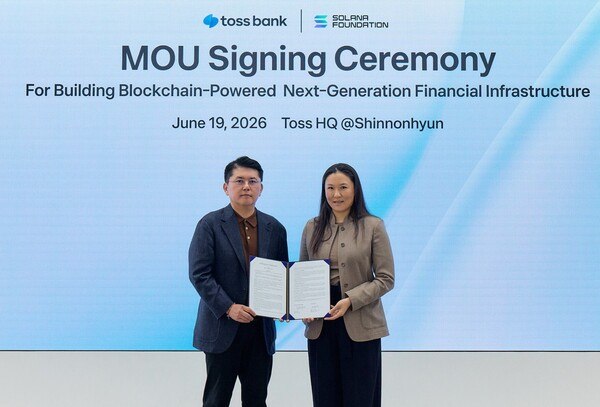 South Korea's Toss Bank partners with Solana for blockchain remittances. The MOU was signed with the Solana Foundation on June 19 to explore blockchain for cross-border remittances and settlements.2026-06
 Solana Foundation lends USDT to Aave to ease liquidity crunch as protocol launches on Solana mainnet this weekend2026-04
Solana Foundation: Stewarding a High-Performance Blockchain into the Agentic Internet Era
The Solana Foundation is a non-profit organization based in Zug, Switzerland, tasked with advancing the adoption, decentralization, and security of the Solana blockchain ecosystem. It sits at the center of a rapidly evolving stack of crypto, DeFi, and AI infrastructure, deploying grants, technical programs, and security initiatives that increasingly position Solana as core infrastructure for both decentralized finance and an emerging “agentic internet” of AI-powered services.
What Is the Solana Foundation?
The Solana Foundation is the primary non-profit steward of the Solana network, a high-performance public blockchain that uses a proof-of-stake consensus mechanism and supports smart contracts. Legally, the Foundation is organized as a Swiss non-profit in Zug and explicitly defines its mandate around three pillars: promoting the adoption of the Solana network, strengthening its decentralization, and enhancing its security. This mandate distinguishes the Foundation from Solana Labs, the San Francisco-based company that originally launched the network in March 2020 and continues to contribute core protocol development. While Solana Labs focuses on building and maintaining the software, the Foundation focuses on nurturing the broader ecosystem of validators, developers, users, and institutions that rely on the network.
To understand the Foundation’s role, it is useful to situate it within the broader architecture of the Solana ecosystem. Solana itself is a public blockchain whose native token, SOL, is used for network fees and staking, with validators participating in a proof-of-stake consensus that secures the ledger. The network is known for emphasizing high throughput and low latency, making it a natural fit for high-frequency DeFi, real-time payments, and machine-to-machine transactions, use cases that the Foundation has increasingly prioritized in its strategy. As usage has broadened from speculative trading to stablecoin payments, on-chain finance, and AI-agent transactions, the Foundation has shifted from basic ecosystem bootstrapping toward more targeted investments in infrastructure, security, and standards. This evolution is visible in its funding programs, delegation strategies, and partnerships with cloud providers and institutional infrastructure firms.
The Foundation’s remit extends beyond simple treasury management or branding. Its grants, delegation, and strategic investment programs influence which types of applications and research receive early support, while its security initiatives and standards work shape how safe and interoperable Solana-based applications can be. In recent years, the organization has also taken on a more explicit role in shaping narratives about what “healthy” crypto ecosystems look like, with internal researchers arguing that sustainable protocol revenue and real on-chain usage are more important than purely speculative metrics, and that chains which fail to generate such revenue risk losing capital, builders, and relevance over time. Together, these activities make the Solana Foundation a central actor in both the technical and economic governance of the Solana ecosystem.

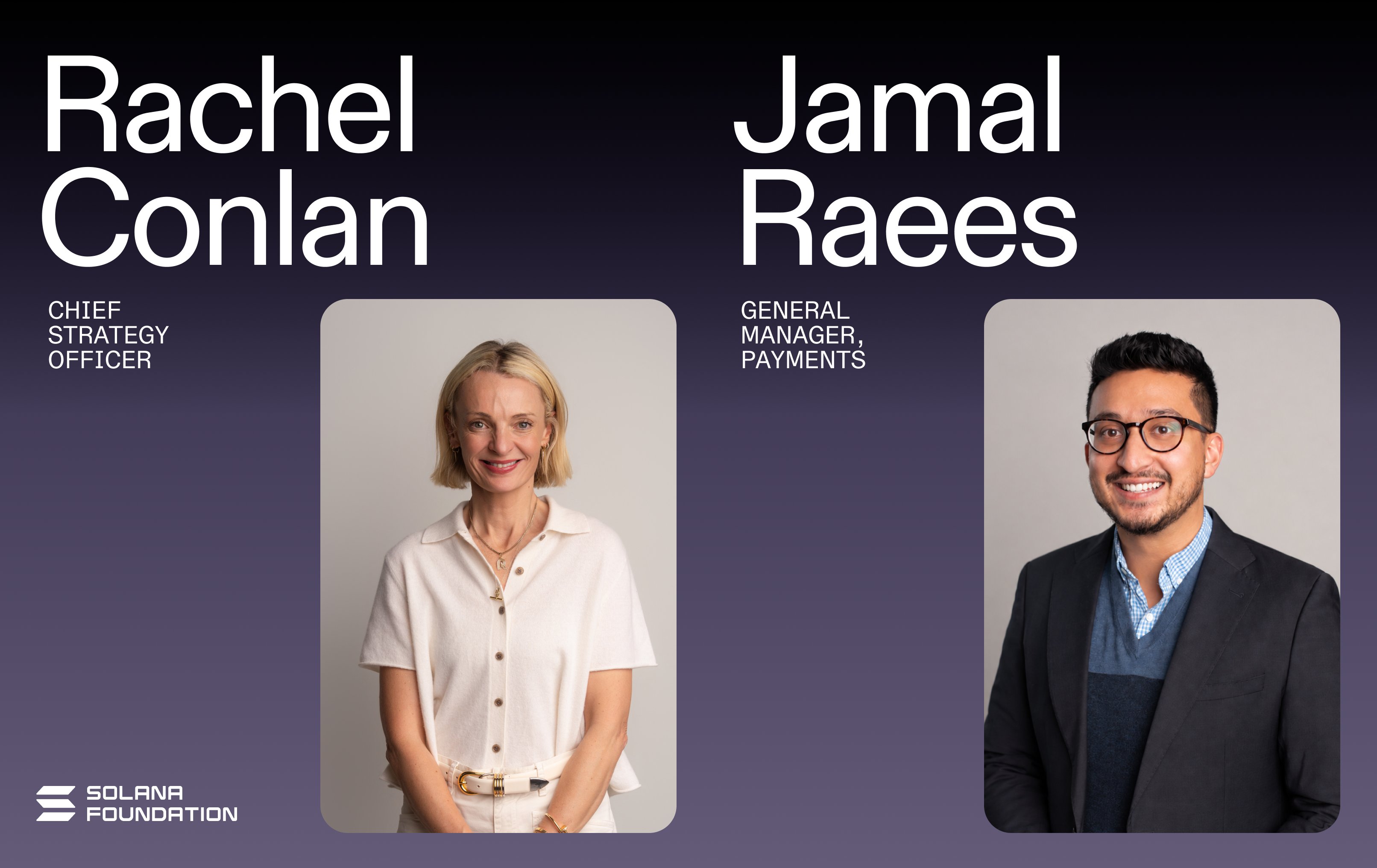
Solana Foundation taps Binance and Polygon veterans for strategy and payments roles
Origins, Mission, and Institutional Structure
Solana’s Technical Context and the Need for a Foundation
Solana was founded in 2018 by Anatoly Yakovenko and Raj Gokal, with the network itself launching in March 2020. From inception, the protocol was designed as a high-throughput, proof-of-stake blockchain that integrates several innovations, such as a novel ordering mechanism and a focus on parallel transaction processing, in order to support thousands of transactions per second at low cost. These technical choices were intended to enable use cases that demand high performance, including sophisticated DeFi protocols, real-time gaming, streaming-based payments, and, more recently, AI agent transactions. In such an environment, the coordination burden on the ecosystem is high: infrastructure must keep pace with demand, security practices must evolve rapidly, and developers need education and tooling to build safely at scale.
This is where the Solana Foundation enters. As a non-profit oriented around the network’s long-term health rather than short-term profit, the Foundation can direct resources toward foundational public goods that might not have a clear commercial payoff but are essential for the ecosystem’s resilience. Examples include supporting validator decentralization through delegation programs, funding open-source tooling and developer education, and underwriting security initiatives that improve the robustness of on-chain applications. By contrast, a purely commercial entity is structurally pressured to focus on high-ROI projects, even if core infrastructure remains underfunded. The existence of a foundation thus mirrors the structure seen in other major blockchain ecosystems, where non-profits help coordinate stakeholders and fund critical, non-rivalrous resources.
The Foundation’s relationship with Solana Labs illustrates this division of roles. Solana Labs, a for-profit company headquartered in San Francisco, led the initial development and launch of the Solana protocol and continues to contribute core software, but it is not the sole or final authority over the network. The Foundation, as an independent entity based in Switzerland, holds part of the SOL token treasury and uses it to support validators, developers, and ecosystem projects that align with its mission of decentralization, adoption, and security. This separation helps mitigate concerns that a single corporate actor might control the protocol, while still leveraging the engineering capacity of a dedicated development company. In practice, the Foundation, Labs, independent teams, and the validator community form a multi-polar governance structure whose exact balance is still evolving.
Legal Home in Zug and Mission Pillars
Zug, Switzerland has become a favored jurisdiction for blockchain foundations due to its relatively clear regulatory environment for non-profit organizations that steward open-source protocols. The Solana Foundation’s registration there reflects this broader industry pattern, allowing it to manage assets, fund grants, and coordinate governance under a legal framework designed for foundations rather than for-profit corporations. Within this framework, the Foundation defines its mission through three intertwined pillars: adoption, decentralization, and security.
Adoption refers to expanding real-world usage of the Solana network, whether by individual developers, startups, enterprises, or, increasingly, AI systems that interact with blockchains as native economic actors. The Foundation pursues this goal through grants, educational programs, partnerships with major technology companies, and initiatives that make the network easier to integrate into existing workflows. Decentralization focuses on the distribution of validators, stake, and governance influence, with the Foundation using tools such as delegation programs and incentives to ensure that no small set of actors can easily control the network. Security encompasses not only the core protocol’s robustness but also the safety of the rapidly growing DeFi and application layer, an area that has prompted significant new initiatives following high-profile exploits.
These three pillars are not fully separable. Pursuing adoption without attention to decentralization can lead to concentration of power among a small number of infrastructure providers. Focusing solely on decentralization without providing robust tooling and support can leave developers struggling to build reliable applications. Likewise, ignoring security in a rush for growth can result in hacks that undermine trust in the ecosystem as a whole. The Solana Foundation’s strategic challenge is to balance these objectives in its funding, partnerships, and public messaging, prioritizing long-term sustainability over short-lived surges in activity.
Institutional Focus on Ecosystem and Institutional Growth
The Foundation’s staffing and organizational structure reflect its mission. Public job descriptions for roles such as Director of Institutional Growth explicitly describe the organization as a non-profit dedicated to the adoption, decentralization, and security of the Solana network, while emphasizing the importance of building relationships with institutional users such as asset managers, trading firms, and payments companies. This dual orientation—to both grassroots developers and large institutions—captures a broader strategic thesis: that Solana’s long-term success depends on simultaneously nurturing open, permissionless innovation and satisfying the risk, compliance, and performance needs of sophisticated enterprises.
In practice, this means the Foundation must be conversant in regulatory, technical, and business concerns. On one side, it funds open-source tools, educational content, and community-driven initiatives like hackathons and microgrants to make it easier for independent builders to experiment. On the other, it participates in industry consortia and standards bodies, such as the Open Transaction Layer initiative, which aims to define interoperable specifications for identity, messaging, and transaction coordination across blockchains. By straddling these worlds, the Foundation attempts to ensure that institutional adoption does not come at the cost of permissionless access, and that grassroots innovation aligns with emerging standards that large enterprises are comfortable adopting.
Readers click Solana Foundation stories not for its grants or developer programs but for its role as a power broker — who it endorses, who it punishes, who poaches its people, and whether its institutional backing translates into real market infrastructure.
Funding, Grants, and Economic Strategy
Milestone-Based Grants and Public Goods
The Solana Foundation’s Funding Program is one of its most visible levers for shaping the ecosystem. According to its public materials, the Foundation primarily provides milestone-based grants for projects that create public goods for the Solana network. In this context, a public good is any resource or infrastructure that is non-excludable and non-rivalrous within the ecosystem, such as open-source developer tooling, core protocol research, documentation, or community education programs. By tying disbursements to milestones, the Foundation attempts to ensure that projects deliver tangible progress rather than simply relying on upfront funding.
Grant applicants are expected to provide a clear overview of their project, explain how it benefits the Solana network as a public good, and present a structured budget with thoughtful milestones. This requirement forces teams to articulate not just their technical roadmap but also how their work fits into the broader ecosystem, and it gives the Foundation a basis for evaluating impact over time. The funding is typically provided in SOL or stablecoins, allowing grantees to manage operational expenses while remaining aligned with the network’s economic growth. While the exact criteria for grant selection are not fully disclosed, public guidance suggests that alignment with the three mission pillars—adoption, decentralization, and security—is a key consideration.
In addition to larger, structured grants, the Foundation’s ecosystem strategy includes support for microgrant programs aimed at early-stage builders, particularly in emerging markets. For example, it highlights Superteam, a community organization that offers quick microgrants of around 10,000 USD equivalent to early Solana builders in regions such as India, Southeast Asia, Eastern Europe, and Africa. This approach acknowledges that early experimentation often happens outside traditional venture capital hubs and that small amounts of capital, combined with mentorship and community support, can catalyze meaningful contributions to the network.
Convertible Grants and Strategic Investments
As the ecosystem has matured, the Foundation has expanded its capital deployment strategy beyond pure grants into more hybrid instruments. It has introduced milestone-based convertible grants for public goods that also have a commercial component, as well as a broader program of strategic investments. Convertible grants are designed for projects that both serve the ecosystem as a public good and pursue a business model that could generate revenue or equity value in the future. In such cases, the grant may include provisions that allow the Foundation to convert some or all of the support into an equity or token position under predefined conditions.
This evolution reflects a recognition that some of the most impactful ecosystem projects—such as infrastructure providers, wallet developers, or cross-chain protocols—operate at the boundary between public good and private enterprise. By using convertible structures, the Foundation can help de-risk early development while preserving the option to benefit financially if the project becomes commercially successful, potentially recycling returns back into further ecosystem funding. At the same time, these instruments raise questions about mission alignment and conflicts of interest, especially if the Foundation becomes a significant equity holder in companies that also depend on its policy decisions. Managing this tension requires transparency about investment criteria and careful separation between funding decisions and protocol governance.
The Foundation’s willingness to participate as one investor among many in multi-chain projects is illustrated by its role in the funding of Splyce Finance, a cross-chain DeFi protocol specializing in multi-chain asset aggregation and automated yield optimization across eight or more blockchain networks. In that strategic investment, the Sui Foundation led the round, with other participants including the Stellar Development Foundation, the Solana Foundation, and several venture funds. Splyce Finance focuses on cross-chain asset management and yield optimization across multiple networks, positioning itself as infrastructure for a more interoperable DeFi landscape. The Solana Foundation’s participation in such a round signals an interest in cross-chain infrastructure that treats Solana as one of several high-performance execution layers in a broader multi-chain ecosystem, rather than as a siloed environment.
Treasury Support for DeFi Liquidity
The Foundation’s economic strategy is not limited to grants and investments in projects building on Solana. It has also used its treasury to support the resilience of DeFi protocols that are systemically important for crypto more broadly. A notable example is its participation in efforts to stabilize the lending protocol Aave by providing liquidity in the form of USDT deposits. In the context of a campaign called DeFi United, the Solana Foundation deposited an undisclosed amount of USDT into Aave, an EVM-based lending platform, to address a liquidity crunch as the protocol prepared to launch on Solana mainnet. By providing stablecoin liquidity, the Foundation helped bolster confidence in the protocol’s solvency and supported a smoother transition of activity onto Solana.
This episode reveals several aspects of the Foundation’s viewpoint. First, it underscores the importance of cross-ecosystem health: Aave’s resilience matters not only for Ethereum but also for Solana, especially as the protocol extends to new chains. Second, it highlights a willingness to take direct, tactical treasury actions in response to market stress, rather than relying solely on long-term grants. Third, it shows that the Foundation’s role can extend into capital markets, albeit in a targeted manner aligned with its mission to promote a robust on-chain financial system. Such actions are not without controversy, as some observers worry that foundation support could create moral hazard if DeFi protocols expect bailouts. The Foundation’s challenge is to deploy such measures sparingly and with clear criteria, so as not to undermine market discipline.
Revenue as “Scoreboard” and Ecosystem Sustainability
Underlying these funding choices is a philosophy about what constitutes a healthy crypto network. A Solana Foundation researcher has publicly argued that protocol revenue—understood as genuine, recurring on-chain fees paid by users and applications—is not itself the goal but rather the “scoreboard” that indicates whether the protocol is deeply embedded in valuable economic activity. In this view, chains that fail to generate real on-chain fees are at risk of losing capital, builders, and relevance, as their token economies become increasingly dependent on speculative inflows rather than sustainable usage.
Framing revenue as a scoreboard has practical implications for the Foundation’s strategy. It encourages funding that leads to durable, fee-generating use cases, such as DeFi infrastructure, payments rails, and AI-agent services, rather than short-lived speculative cycles. It also positions the Foundation as a proponent of economic realism within the broader industry debate over metrics like total value locked (TVL), active addresses, or transaction counts, which can be inflated by wash trading, mining incentives, or spam transactions. To the extent that the Foundation succeeds in aligning its grants, investments, and partnerships with applications that users are genuinely willing to pay for, it can help steer the Solana ecosystem toward long-term sustainability rather than purely narrative-driven growth.
Infrastructure, Staking, and Developer Support
The Solana Foundation Delegation Program (SFDP)
Validator decentralization is a core concern for any proof-of-stake network, and the Solana Foundation has addressed this through its Delegation Program, often referred to as SFDP. Under this program, the Foundation delegates SOL tokens from its treasury to independent validators that meet certain performance and reliability criteria, allowing them to participate in consensus and earn staking rewards even if they do not initially attract large amounts of community stake. This mechanism helps reduce barriers to entry for new validators, fosters geographic and organizational diversity, and mitigates the risk that stake concentrates solely with large exchanges or custodians.
Over time, as the network has matured and more external stake has been deployed, the Foundation has deliberately reduced its relative influence within the staking ecosystem. Data from the Delegation Program’s case study shows that the share of stake not associated with SFDP grew by approximately 230% between the program’s launch in November 2020 and subsequent years, while the Foundation’s delegated stake share declined. To reinforce this trend, the Foundation implemented a step-down schedule in which its stake matching ratio and ceilings decrease over a defined range of epochs. For example, from epoch 865 to 893, the SFDP stake match was set to step down in 10% increments, with the matching ratio decreasing from a 1:1 match with a 100,000 SOL cap to a 0.5:1 match with a 50,000 SOL cap.
This gradual tapering illustrates a bootstrap philosophy. In the early stages of a network’s life, a foundation may need to actively support validators to ensure adequate decentralization and resilience. As the ecosystem grows and more organic stake flows into the network, that support should diminish to avoid the foundation becoming a permanent centralizing force. By publishing explicit step-down schedules and monitoring non-foundation stake growth, the Solana Foundation signals both a commitment to decentralization and an awareness of the risks associated with disproportionate treasury influence in a proof-of-stake system.
Rethinking the Read Layer with Triton RPC 2.0
High-throughput blockchains pose unique challenges for data access. As more applications generate vast volumes of on-chain data, traditional RPC (remote procedure call) infrastructure can become a bottleneck, limiting how easily developers, traders, and analytics platforms can query the network. In response, the Solana Foundation has partnered with infrastructure provider Triton One to develop what is described as “RPC 2.0,” a reimagined read layer for Solana designed to provide faster, cheaper, and more expressive data access for every application.
According to Triton’s announcement, the initiative aims to rebuild Solana’s read layer from the ground up, introducing modular account and ledger systems that can better handle the network’s scale. The goal is to decouple the concerns of transaction execution from data retrieval, allowing specialized infrastructure to serve complex queries, historical lookups, and real-time feeds without overburdening core nodes. This kind of modularization is particularly important for DeFi protocols, high-frequency trading firms, and AI agents that depend on rapid, reliable access to on-chain state.
By supporting such infrastructure efforts, the Foundation is not merely optimizing developer convenience; it is addressing a structural constraint that affects the types of applications that can feasibly run on Solana. If data access is slow or expensive, potential institutional users and AI systems that rely on live data streams may opt for alternative platforms, regardless of Solana’s raw throughput advantages. Triton RPC 2.0 thus represents a strategic bet that investing in specialized read infrastructure will unlock new classes of applications and make Solana more competitive as a data-rich execution environment.
Developer Education and Training Programs
Recognizing that tooling is only as effective as the developers who use it, the Solana Foundation has invested heavily in education and training. One concrete example is a developer training program that launched with a cohort-based structure featuring three live sessions led by the Foundation’s Developer Relations (DevRel) team. Participants in this program work through the construction of two working applications built live during the sessions, combining hands-on instruction with direct exposure to Solana’s programming model. Space in the cohort is limited, reinforcing the emphasis on interactive, high-quality instruction rather than mass, passive content.
Such programs serve multiple functions. They lower the barrier to entry for developers who may be new to Rust, Solana’s account model, or on-chain program design. They help disseminate best practices for performance and security, reducing the risk that novice projects introduce vulnerabilities or inefficiencies. And they create an on-ramp for developers who may later apply for grants, join startups, or contribute to core infrastructure. Combined with open-source examples and documentation, cohort-based training fosters a community of practice around Solana development rather than relying solely on self-study.
The Foundation’s developer-facing activities extend to more specialized domains as well. For example, in the context of mobile, it supports builder grants for teams creating mobile-first crypto applications on Solana, providing funding, resources, and ecosystem access to expand what is possible in Web3 on smartphones. This reflects a broader thesis that mobile is a key frontier for mainstream crypto adoption, and that native integration of wallets, payments, and dApps into mobile experiences will drive significant growth. By pairing financial support with educational programs, the Foundation attempts to create a pipeline from initial learning to production-ready applications.
AI Tooling and the “Awesome Solana AI” Initiative
As AI agents and models become more capable of interacting with external systems, the need for specialized tooling that connects AI frameworks to blockchain infrastructure has grown. The Solana Foundation has responded by curating and supporting AI-related developer resources, including a public “awesome-solana-ai” repository that aggregates tools, libraries, and examples for building AI-powered applications on Solana. Within this repository, developers can find projects like the Breeze Agent Kit, a toolkit for building AI agents that manage Solana yield farming via the Breeze protocol, offering multiple integration paths including MCP server and x402-compatible interfaces.
This kind of curated resource serves as a focal point for experimentation at the intersection of AI and crypto. Rather than leaving developers to discover disparate tools piecemeal, the Foundation’s involvement in maintaining a consolidated repository signals that AI agents are a strategic priority. It also aligns with other initiatives, such as Agent Skills programs that promise one-line installation of prebuilt components enabling AI agents to interact with Solana across DeFi, payments, infrastructure, and tooling. While such Agent Skills announcements are relatively recent, they fit into an overarching pattern: the Foundation increasingly sees AI not simply as an external field but as a first-class user of the network, requiring dedicated support and standards.
DeFi, Risk, and Security: From Liquidity Support to STRIDE
Cross-Chain DeFi and Splyce Finance
The Solana Foundation’s engagement with DeFi extends beyond supporting protocols natively deployed on Solana. Its participation in the strategic investment round for Splyce Finance, alongside the Sui and Stellar foundations, illustrates a multi-chain approach to on-chain finance. Splyce Finance describes itself as a cross-chain DeFi protocol specializing in multi-chain asset aggregation and automated yield optimization across eight or more blockchain networks. By helping users manage assets and yield strategies across multiple chains, Splyce aims to abstract away some of the complexity and fragmentation that currently plague DeFi, enabling more coherent portfolio management.
The Sui Foundation’s strategic investment, confirmed in March 2025, was framed as a milestone for DeFi innovation and cross-chain interoperability, with other participants including the Stellar Development Foundation, the Solana Foundation, and several venture investors. This coalition underscores a recognition among major ecosystems that cross-chain infrastructure is not a zero-sum game: improved interoperability can expand the overall pie of on-chain activity. For the Solana Foundation, participating in such an investment positions Solana as an integral part of a multi-chain DeFi architecture, while also signaling to developers that building cross-chain applications that include Solana is both feasible and strategically aligned with core stakeholders.
Supporting Aave and the Fight to “Save DeFi”
Liquidity crises in major DeFi protocols can reverberate across multiple chains, threatening both individual users and the perception of DeFi’s robustness. In response to a liquidity crunch faced by Aave, one of the largest lending protocols in the ecosystem, the Solana Foundation joined other players in a “DeFi United” initiative to provide support. Specifically, the Foundation deposited an undisclosed amount of USDT into Aave, which at that time operated as an EVM-based application that was preparing a deployment on Solana mainnet. This deposit helped ease the liquidity crunch, reinforcing Aave’s ability to honor withdrawals and maintain lending markets.
The decision to support Aave has strategic and symbolic dimensions. Strategically, Aave’s expansion onto Solana promises to bring a mature, battle-tested lending market to the network, potentially attracting users and capital that are already familiar with the protocol from other chains. Supporting its stability therefore aligns with the Foundation’s adoption mandate. Symbolically, the move positions the Foundation as an advocate for the health of DeFi writ large, not only for Solana-exclusive applications. This stance may help build goodwill among developers who value cross-chain composability, but it also raises expectations that the Foundation might intervene in other crises, a precedent that must be managed carefully.
The Drift Hack and the Case for Continuous Security
High-profile exploits remain one of the greatest threats to DeFi’s credibility. On April 1, 2026, Drift Protocol, a major Solana-based derivatives platform, was drained of approximately 285 million USD—more than half of its total value locked—in a highly coordinated attack that investigators at Chainalysis have linked to North Korean actors. The root cause was traced to privileged access controls, where an attacker was able to exploit misconfigured or overly broad administrative permissions to manipulate protocol behavior and extract funds. This incident highlighted that even sophisticated, audited protocols can harbor systemic vulnerabilities, particularly around governance keys and privileged roles.
The Drift hack had immediate and long-term implications. In the short term, it inflicted heavy losses on users and raised questions about the security practices of high-value Solana DeFi protocols. In the longer term, it underscored the limitations of one-off code audits as a primary security measure. Permissions can drift over time, integrations can introduce new attack surfaces, and adversaries continuously refine their techniques. The incident thus added urgency to calls for more comprehensive, continuous security frameworks that combine code analysis, runtime monitoring, privileged access management, and incident response readiness.
STRIDE and SIRN: A New Security Regime for Solana DeFi
In direct response to this environment, and in particular following the Drift exploit, the Solana Foundation, in collaboration with Asymmetric Research, launched STRIDE, a security initiative formally known as Solana Trust, Resilience and Infrastructure for DeFi Enterprises. Announced on April 6, 2026, STRIDE is structured as a tiered, continuous security program for Solana-based DeFi projects, explicitly designed to replace the industry’s reliance on one-off audits with ongoing evaluations across multiple dimensions. The program assesses protocols against eight security pillars, incorporates real-time or near-real-time threat monitoring, and produces published independent reports that aim to give users and risk managers a clearer view of a protocol’s security posture.
A key feature of STRIDE is its emphasis on formal verification and continuous oversight, particularly for larger protocols. Projects above certain total value locked thresholds are subject to more stringent requirements, such as 24/7 monitoring once TVL exceeds a given level and formal verification when TVL crosses higher thresholds, such as 100 million USD equivalent. Alongside STRIDE, the Foundation has also promoted SIRN, a security incident response network aimed at improving coordination among protocols, security researchers, and infrastructure providers during active exploits. While SIRN is less documented in public sources than STRIDE, it forms part of a broader security overhaul that treats DeFi as critical infrastructure rather than experimental code.
The introduction of STRIDE and SIRN reflects a maturation in the Foundation’s conception of its responsibilities. Rather than limiting its role to funding and evangelism, the Foundation is now directly involved in defining and enforcing security standards for protocols that operate on its network, especially when those protocols manage large user funds. This inevitably raises debates about decentralization and autonomy: to what extent should a foundation dictate best practices or impose requirements on permissionless applications? Yet for many users and institutions considering DeFi exposure, the presence of a well-defined, transparent security framework may be a prerequisite for trust. The Foundation is thus navigating a tradeoff between pure permissionless neutrality and a curated, safety-conscious ecosystem.
- 01Talent flight to rivals
A former VP of marketing landing at ZKsync signals competitive pressure on Solana's ecosystem bench strength and surfaced anxieties about which L1 is winning the talent war.
- 02Tokenized real-world assets on Solana
The Kraken xStocks deal put a regulated broker's name on Solana's RWA ambitions, making it the most concrete institutional validation story in the click set.
- 03SPL token extensions infrastructure
Confidential transfers, programmable fees, and augmented interactions in the token standard directly expand what builders can deploy — readers flagged this as a structural upgrade, not just a feature announcement.
- 04Validator accountability and delegation reform↗
Three separate headlines covering sandwich-attack expulsions, decentralization rotation rules, and performance-aligned criteria show readers tracking whether the Foundation enforces the network neutrality it promises.
- 05Institutional treasury accumulation
A Galaxy-led $1B Solana treasury via public-company takeover, endorsed by the Foundation, framed Solana as a macro asset rather than a developer platform — a pitch readers engaged with as a MicroStrategy-style inflection point.
- 06AI agent payment infrastructure↗
Agent Skills, Pay.sh, and the 15-million on-chain AI payment milestone positioned the Foundation as the enabler of machine-native commerce, drawing readers tracking which chain captures the agentic economy.
AI, Agents, and the “Agentic Internet”
Why AI Agents Need Crypto Payment Rails
AI agents—software entities that can autonomously perceive, reason, and act within digital environments—are increasingly being deployed to perform tasks such as data retrieval, portfolio management, content generation, and API orchestration. As these agents become more capable, they face a fundamental limitation: to transact economically on behalf of users or other systems, they need programmable, permissionless payment rails that they can access without human intervention. Crypto networks, and particularly those optimized for low-cost, high-frequency transactions, provide a natural solution for machine-to-machine payments.
Lily Liu, a prominent figure in the Solana ecosystem, has articulated this logic in public remarks, emphasizing that AI agents need crypto payment rails because traditional financial systems are ill-suited to real-time, automated microtransactions between software entities. Bank transfers and card networks require human onboarding, rely on intermediaries, and often impose high fees and chargeback risks that are incompatible with fully autonomous AI operations. In contrast, crypto payments allow agents to hold and transfer digital assets in a non-custodial manner, settling transactions quickly and predictably across jurisdictional boundaries. Stablecoins, in particular, offer a way for agents to transact in units closely tied to fiat value while leveraging blockchain-native programmability.
Solana as Core Infrastructure for the Agentic Internet
The Solana Foundation has embraced this intersection of AI and crypto, positioning Solana as core infrastructure for what it calls the “agentic internet.” This term captures a vision of an internet where AI agents, rather than solely human users, are primary economic actors, orchestrating services, negotiating prices, and settling transactions autonomously. According to reporting based on Foundation statements, the Solana network has already processed approximately 15 million on-chain payments executed by AI agents, with most of these representing machine-to-machine transactions rather than traditional user-driven payments. This volume, while still modest compared to human-driven activity, signals that AI-native commerce is moving from concept to reality.
Solana’s technical characteristics make it a natural candidate for this role. Its high throughput and low latency enable microtransactions and high-frequency interactions without prohibitive fees, while its account model and smart contract capabilities support complex logic governing agent behavior. For AI developers, this means they can design agents that, for example, pay per API call, stream payments in real time based on resource consumption, or manage on-chain portfolios that rebalance dynamically in response to market signals. For the Foundation, the growth of AI-agent activity offers a new category of adoption that is less dependent on speculative trading cycles and more tied to functional, recurring usage of the network.
Pay.sh and the Google Cloud Partnership
To concretely enable AI-native payments, the Solana Foundation has partnered with Google Cloud to launch Pay.sh, a system that allows AI agents to discover, access, and pay-per-request for APIs using stablecoins. Pay.sh integrates with Google Cloud’s services, including AI models like Gemini and data platforms such as BigQuery, enabling agents to autonomously call these APIs and settle usage fees on-chain. Agents can discover available APIs, obtain access credentials, and perform pay-per-request transactions without manual intervention, effectively creating a machine-native marketplace for cloud services.
This collaboration is significant on several fronts. First, it bridges a major cloud provider—Google Cloud—with a public blockchain payment layer, demonstrating that on-chain stablecoin payments can coexist with established enterprise infrastructure. Second, it provides a template for how AI agents might interact with a wide array of APIs, not just those offered by Google, using standardized discovery and payment mechanisms. Third, it showcases Solana’s performance capabilities in a high-demand, latency-sensitive setting, where agents may need to make and pay for many small API calls in rapid succession. By anchoring this capability in a partnership with a household-name technology company, the Foundation sends a signal to both AI developers and enterprises that agentic commerce is not a niche experiment but a practical, supported pathway.
Agent Skills and Turnkey AI–Solana Integration
Beyond high-level infrastructure like Pay.sh, the Solana Foundation has focused on making it easy for AI developers to integrate blockchain capabilities into their agents. One of its initiatives in this direction is the rollout of “Agent Skills,” a framework that allows developers to embed prebuilt skill components directly into AI tools so that agents can interact with the Solana ecosystem with minimal setup. In public statements, the Foundation has highlighted that these components can be integrated via a single-line installation, enabling AI agents to perform tasks across DeFi, payments, infrastructure management, and tooling with little additional configuration.
Such turnkey integrations are crucial for lowering friction. Many AI developers are not crypto specialists; they may be comfortable working with Python libraries and AI frameworks but lack expertise in on-chain account management, key custody, or DeFi protocol interactions. Agent Skills abstractions allow these developers to delegate blockchain-specific logic to well-audited components while focusing on higher-level agent behavior. When combined with resources like the “awesome-solana-ai” repository, which catalogs tools such as the Breeze Agent Kit for AI-driven yield farming, the Foundation’s approach creates a layered stack for AI–Solana interoperability. At the bottom are the core protocol and RPC infrastructure; in the middle are payment primitives and governance frameworks; and at the top are agent-centric libraries that expose this functionality in AI-native ways.
Physical AI, Robotics, and On-Chain Coordination
The Foundation’s focus on agents is not limited to purely digital software entities. Public commentary from ecosystem leaders has pointed to growing momentum around physical AI and robotics systems that rely on decentralized infrastructure, including Solana, for coordination and payments. In such scenarios, robots or other physical systems could perform tasks in the real world—such as delivery, maintenance, or sensing—and receive or make payments via on-chain transactions governed by smart contracts. The combination of reliable, real-time payments and verifiable task completion could open new models for decentralized marketplaces of physical work.
While these use cases are still nascent, the Solana Foundation’s investments in AI tooling, payment systems like Pay.sh, and standards bodies such as x402 suggest that it sees machine-native commerce as a long-term strategic frontier. The infrastructure being built for purely digital agents—identity, payments, security, and data access—can, in principle, extend to embedded systems in robotics and IoT. As these systems scale, the Foundation’s challenge will be to ensure that the underlying blockchain infrastructure remains performant, secure, and accessible, even as the user base expands to include non-human actors with potentially unpredictable interaction patterns.
Standards, Interoperability, and Institutional Adoption
Open Transaction Layer: Coordinating Cross-Chain Transactions
Institutional adoption of on-chain finance hinges not only on performance and security but also on interoperability and compliance. Recognizing this, the Solana Foundation has become a founding partner of the Open Transaction Layer (OTL), an industry initiative that aims to build an open protocol stack for coordinating on-chain transactions securely and compliantly between any counterparties. OTL brings together institutions, payments firms, infrastructure providers, and blockchain organizations to define shared specifications for identity, messaging, and coordination that work across multiple blockchain networks.
According to its launch materials, OTL’s goal is to compose existing standards into an interoperable foundation, providing common building blocks that can be used by wallets, exchanges, custodians, and other actors to coordinate complex, multi-party transactions. This includes standardized identity schemas that support compliance requirements, messaging formats that allow parties to negotiate and confirm transaction details, and settlement coordination protocols that ensure atomicity across different chains or systems when needed. By participating in OTL, the Solana Foundation is effectively helping to write the rulebook for how institutional-grade transactions should be orchestrated in a multi-chain environment.
For Solana, such standards are particularly important because many of its target users—trading firms, enterprises, and AI services—operate across multiple platforms. If Solana can plug smoothly into cross-chain workflows governed by OTL, it becomes easier for institutions to route specific types of activity, such as high-performance trading or microtransactions, to Solana while maintaining a consistent compliance and reporting framework. This, in turn, reinforces the Foundation’s mission to increase adoption among institutions without sacrificing the open, permissionless nature of the underlying network.
x402 and Internet-Native Payment Standards
Alongside OTL, the Solana Foundation has joined the x402 Foundation, a consortium aimed at developing an open-source protocol for internet-native payments that can be adopted by major technology and financial companies. Although detailed public documentation of x402 is still emerging, reports indicate that its membership includes companies such as Amazon, American Express, Circle, Cloudflare, Coinbase, Fiserv, Google, Mastercard, Microsoft, Shopify, Stripe, Visa, and others, in addition to the Solana Foundation. The protocol is envisioned as a neutral, open-source standard that can underpin a new generation of interoperable payment experiences across platforms, merchants, and devices.
From the Foundation’s perspective, participation in x402 serves several functions. It positions Solana as a credible voice in the design of future digital payment standards, rather than merely a downstream integration target. It creates a forum for aligning blockchain-native payment capabilities with the needs and constraints of large incumbents, whose adoption is critical for mainstream usage. And it dovetails with the Foundation’s work on AI agents and machine-native commerce, since x402-compatible interfaces are already being used by tools like the Breeze Agent Kit for managing Solana-based yield strategies. The convergence of AI, payments, and standardized protocols is thus not accidental but a deliberate strategic direction.
Institutional Growth and Data Infrastructure
The Solana Foundation’s involvement in initiatives like OTL and x402 complements its internal focus on institutional growth, as reflected in roles such as Director of Institutional Growth that explicitly target enterprise adoption. For institutions considering Solana, reliable data access and observability are as important as transaction throughput. This is where infrastructure efforts like the Triton RPC 2.0 partnership intersect with standards work. A modular, high-performance read layer provides the data backbone institutions need for risk management, compliance, and analytics, while cross-chain standards ensure that this data can be integrated into broader workflows.
Institutional users also demand clear security frameworks, predictable governance, and a credible roadmap for protocol evolution. The Foundation’s security initiatives, such as STRIDE, its staking and delegation policies, and its public communication about revenue and sustainability are part of building that credibility. By articulating a coherent vision for how the network will remain secure, decentralized, and economically viable, and by backing that vision with concrete programs, the Foundation seeks to make Solana a viable choice not just for retail users and startups but also for banks, asset managers, and enterprises that operate under stringent regulatory scrutiny.
Governance, Narrative, and Public Perception
Balancing Decentralization with Active Stewardship
The presence of a well-funded foundation in a proof-of-stake ecosystem raises perennial debates about centralization. On the one hand, the Solana Foundation holds significant token reserves and exercises influence through delegation, grants, and public signaling. On the other, it has taken explicit steps to reduce its direct control over network consensus, as seen in the tapering of the SFDP stake matching and the goal of increasing the share of stake controlled by independent participants. This tension—between active stewardship and decentralization—is not unique to Solana, but it is particularly salient given the network’s emphasis on performance and its recent growth spurts.
The Foundation’s approach appears to favor a model of guided decentralization. In the early stages of the network, it used its resources aggressively to bootstrap validators and ecosystem projects, while now gradually ceding relative influence as the ecosystem matures and more participants join. This stands in contrast to laissez-faire models where foundations take a hands-off approach from the outset, as well as to highly centralized models where a single corporate entity retains dominant control indefinitely. How this balance evolves will depend on future policy choices, including how the Foundation deploys its treasury, structures governance around protocol upgrades, and engages with community feedback.
Revenue Narratives and the End of “Empty” Growth
Narratives play a powerful role in crypto, shaping where developers build and where investors deploy capital. The Solana Foundation’s internal discourse around revenue as a “scoreboard” of real usage is part of a broader industry shift away from purely vanity metrics. During earlier phases of the crypto cycle, networks often touted high transaction counts or TVL as indicators of success, even when these metrics were inflated by incentivized activity or short-lived farming schemes. By foregrounding fee revenue as a more meaningful indicator of value creation, the Foundation is implicitly critiquing models of “empty” growth that do not translate into sustainable economics.
This narrative also provides a lens through which to interpret the Foundation’s emphasis on AI agents, DeFi infrastructure, and payments. These are all domains where users—or agents acting on their behalf—have clear reasons to pay fees for reliable, programmable services. AI agents paying per API call, traders using high-performance DEXs, and users sending stablecoin remittances all create recurring fee streams that reflect real demand. By channeling its funding and partnerships toward such use cases, the Foundation aligns its narrative with its practice, reinforcing the idea that Solana’s long-term health depends on being useful, not merely popular.
Marketing, Messaging, and the “Don’t Waste Time With Crypto” Campaign
Alongside technical and economic initiatives, the Solana Foundation has experimented with unconventional marketing strategies. One notable example is an advertising campaign built around the phrase “Don’t Waste Time With Crypto,” which at first glance appears paradoxical coming from a major blockchain foundation. The campaign’s cryptic messaging sparked discussion and prompted explanations that framed it as a critique of crypto for its own sake: the argument was that users should not care about “crypto” as a buzzword but about the experiences and applications it enables.
This messaging aligns with a product-first perspective that emphasizes user experience, speed, and reliability over ideological debates about blockchains. It suggests that the Foundation sees mainstream adoption as contingent on making crypto effectively invisible to end users, integrated into apps and services where the underlying technology is abstracted away. In the context of AI agents and internet-native payments, this view is particularly relevant: agents and applications need functional, efficient infrastructure, not slogans. The campaign therefore serves both as marketing and as a statement of philosophy about where the ecosystem should focus its efforts.
Security Communication and Trust Restoration
The Drift hack and subsequent security initiatives tested the Foundation’s capacity to manage crises and restore trust. Public communication around such events must balance transparency with caution, providing enough detail to inform users and developers without exposing additional vulnerabilities. By swiftly launching STRIDE and emphasizing continuous security practices, the Foundation signaled that it was willing to treat DeFi security as a first-class concern rather than a peripheral issue. At the same time, incidents of this magnitude inevitably raise questions about how risk is distributed between protocol teams, users, and ecosystem stewards.
The Foundation’s role in this context is multifaceted. It can fund security research, convene experts, and define best practices, but it cannot (and should not) guarantee the safety of every application built on Solana. A key challenge is setting realistic expectations: users must understand that DeFi remains risky, even on networks with robust foundations and security programs. By framing its initiatives as risk mitigation rather than absolute guarantees, and by supporting independent audits and monitoring rather than internalizing all security responsibilities, the Foundation can promote a culture of shared responsibility that aligns with the ethos of open, permissionless systems.
STRIDE and SIRN security programs launched post-Drift exploit
Validator operators removed from Delegation Program for sandwich attacks
- 2024-11milestone
SPL token extensions released on Solana mainnet
Triton One partners Foundation to rebuild Solana read layer (RPC 2.0)
Pay.sh launched with Google Cloud for AI agent API payments via stablecoins
- 2025-05milestone
Kraken and Solana Foundation announce xStocks tokenized equities on Solana
- 2025-06regulatory
Toss Bank MOU signed with Solana Foundation for blockchain remittances
Delegation Program decentralization rotation rule enacted
Comparative Perspective: Solana Foundation in the Multi-Foundation Landscape
Collaboration with Other Foundations
The Solana Foundation’s participation in the Splyce Finance funding round offers a window into how major blockchain foundations interact with one another. In that round, the Sui Foundation led the investment, with the Stellar Development Foundation and Solana Foundation joining alongside venture investors. Each of these organizations plays a similar role within its own ecosystem: stewarding protocol development, funding public goods, and supporting developer communities. Their willingness to co-invest in a cross-chain DeFi protocol underscores a shared belief that interoperability is a positive-sum game.
For Solana, collaborating with Sui and Stellar on such a project helps ensure that cross-chain infrastructure is designed in ways that can leverage its performance and programmability. It also provides a channel for knowledge sharing about governance, grants, and security. At the same time, competition among foundations remains real: each network vies for developer mindshare, user activity, and institutional adoption. The balance between collaboration and competition is likely to shape the trajectory of multi-chain DeFi and cross-chain standards in the coming years.
Foundation vs. Core Development Company: Solana’s Dual Structure
A common pattern in crypto ecosystems is a dual structure in which a non-profit foundation coexists with one or more for-profit development companies. In Solana’s case, this manifests as the Solana Foundation and Solana Labs. The Foundation holds and deploys treasury assets, sets ecosystem-level strategies, and participates in industry initiatives, while Solana Labs focuses on building and maintaining core protocol software and adjacent products. This separation aims to mitigate regulatory risk for the foundation and align the incentives of the development company with those of the broader ecosystem.
Comparatively, some ecosystems place even more emphasis on the foundation, with core development in-house, while others rely more heavily on independent developer companies. Solana’s model attempts to strike a balance: Solana Labs remains an important actor, but the Foundation’s presence as an independent Swiss non-profit provides a counterweight and a venue for ecosystem-wide deliberation. How this dual structure evolves will depend on future governance decisions, including how protocol upgrades are proposed, discussed, and adopted across stakeholders.
Comparative View of Ecosystem Priorities
In broad strokes, different foundations emphasize different facets of their ecosystems. Stellar’s foundation has historically prioritized cross-border payments and financial inclusion, while Sui’s emphasizes scalable smart contract infrastructure and object-centric state management. The Solana Foundation, by contrast, foregrounds high-performance DeFi, real-time payments, and, increasingly, AI-agent use cases, all underpinned by a mission to drive adoption, decentralization, and security. These differing emphases influence where each foundation directs its grants, how it engages with regulators, and which industry consortia it joins.
The convergence around cross-chain DeFi, as in the Splyce Finance investment, suggests that despite these differences, foundations recognize the importance of interoperability and shared infrastructure. For users and developers, this means that the choice of network may increasingly be driven by specific performance or programming needs rather than by isolationist narratives. For the Solana Foundation, success in this environment requires not only making Solana attractive on its own terms but also ensuring that it plays well with others in a multi-chain ecosystem.
Conclusion: The Solana Foundation’s Evolving Role
The Solana Foundation has grown from a nascent steward of a new high-performance blockchain into a central orchestrator of an increasingly complex ecosystem that spans DeFi, AI agents, institutional finance, and cross-chain standards. Its mission to promote adoption, decentralization, and security manifests in a diverse array of programs: milestone-based grants for public goods, convertible grants and strategic investments for commercially oriented infrastructure, delegation programs that bootstrap validator decentralization, and partnerships that reimagine the network’s data and security layers. Along the way, the Foundation has taken explicit positions on what constitutes healthy growth, emphasizing protocol revenue and real usage over superficial metrics and tying its funding to use cases that drive sustainable on-chain activity.
In DeFi, the Foundation has acted both as a supporter of cross-chain protocols like Splyce Finance and as a tactical liquidity provider for systemically important applications such as Aave, reflecting a willingness to intervene when the broader health of on-chain finance is at stake. At the same time, it has responded to security crises like the Drift hack by launching STRIDE and related initiatives that move the ecosystem toward continuous, multi-dimensional security evaluation rather than reliance on one-off audits. These efforts illustrate a recognition that in a world where billions of dollars of value are at stake, security cannot be an afterthought or a purely individual responsibility.
Perhaps the most forward-looking aspect of the Foundation’s strategy lies in its embrace of AI agents and the agentic internet. By partnering with Google Cloud on Pay.sh, curating AI tooling such as the awesome-solana-ai repository, and launching Agent Skills that make it trivial for AI agents to interact with Solana, the Foundation is betting that machine-native commerce will be a major driver of on-chain activity in the coming years. Combined with its participation in standards bodies like OTL and x402, this positions Solana not only as a fast blockchain but as part of a broader stack of interoperable, AI-aware financial infrastructure.
These initiatives do not come without tradeoffs. The Foundation must continuously navigate tensions between central coordination and decentralization, between supporting DeFi resilience and avoiding moral hazard, and between promoting adoption and respecting the autonomy of protocol teams. Its decisions on treasury deployment, security standards, and institutional partnerships will shape not just Solana’s trajectory but also the broader narrative of what responsible ecosystem stewardship looks like in crypto. As the industry evolves, the Solana Foundation’s challenge will be to remain an effective, principled steward while gradually ceding direct control to the very decentralized networks and communities it seeks to empower.
Outlook
Looking ahead, the Solana Foundation is likely to deepen its focus on three intertwined fronts: AI-native payments, institutional-grade infrastructure, and continuous security. As AI agents become more prevalent, the combination of Pay.sh, Agent Skills, and AI tooling repositories suggests that Solana will increasingly serve as a backend for machine-to-machine commerce, with the Foundation acting as a bridge between AI and crypto communities. On the institutional side, partnerships like OTL, x402, and Triton RPC 2.0 point toward a future where Solana is integrated into standardized, compliant transaction flows, supported by robust data and observability layers. Meanwhile, the experience of the Drift hack and the rollout of STRIDE indicate that security will remain front and center, with the Foundation pushing the ecosystem toward practices that resemble those of critical financial infrastructure rather than experimental software.
In this environment, the Foundation’s success will be measured less by marketing slogans and more by tangible outcomes: sustained protocol revenue, a thriving and diverse validator set, resilient DeFi protocols, and widespread usage by both humans and AI agents. If it can align its funding, partnerships, and messaging around these goals while maintaining a commitment to openness and decentralization, the Solana Foundation may provide a blueprint for how blockchain foundations can evolve from launchpad organizations into enduring institutions that help define the future of the internet.
Latest Solana Foundation news
Sources
19 records from 14 domains
solana.org
solana.com
en.wikipedia.org
x.com
prnewswire.com
solanamobile.com
github.com
whale-alert.io
blog.triton.one
solanafloor.com
cryptonews.net
instagram.com
jobs.ashbyhq.com
chainalysis.com
Community notes
Spot something off or out of date? Drop a note. Editors review topic notes daily and roll accepted fixes into the explainer — contributors are recognized in the monthly $SQUID drop.
Loading notes…
Help improve this topic
Have a story or tip about this topic? Submit it. See something missing? Leave a note. Editors review daily; accepted submissions and fixes count toward the monthly $SQUID drop.