
In‑depth explainer on Astar, a Japan‑rooted web3 collective built around ASTR. Covers its architecture, Tokenomics 3.0, dApp staking, governance, stablecoin and Visa links, Soneium restaking, and key risks as it targets regulated on‑chain finance.
+3 sources across the wider coverage universe
 Astar Foundation proposes shifting ASTR tokenomics from a dynamic inflationary model to a fixed supply of ~10.5B tokens2025-05
 Astar, AltLayer, and EigenLayer unite to launch Fast Finality Layer — Empowering ASTR as Soneium’s staking backbone2025-04
 Japanese blockchain Astar proposes $38M token burn2024-06
 Animoca Brands Invests in Astar Network to pioneer Web3 entertainment and empower Asian IPs2025-05
Astar: Japan’s Web3 Collective For Regulated Stablecoins, Staking, And On‑Chain Finance
Astar is a web3 collective centered on Astar Network, a smart‑contract blockchain that aims to bridge regulated finance, stablecoins, and consumer applications with a shared economic and governance token, ASTR. Anchored in Japan’s rapidly evolving digital‑asset framework, Astar is positioning itself as infrastructure for programmable payments, tokenized assets, and cross‑chain applications, while overhauling its tokenomics, staking, and governance to make ASTR the focal point of value capture across the ecosystem.
Origins, Vision, And Japanese Context
Understanding Astar starts with its origin story as a project rooted in Japan but architected for a global, multi‑chain future. Astar Network emerged originally in the Polkadot ecosystem as a smart‑contract hub designed to support both Ethereum‑style EVM smart contracts and WebAssembly (Wasm) contracts, with an explicit focus on interoperability between different chains. Over time, the project reframed itself not merely as a single chain but as a web3 collective, where Astar Network acts as the foundational infrastructure while a broader constellation of products, contributors, and partner chains are coordinated through the ASTR token and shared governance. This evolution is important because it signals Astar’s ambition to move beyond being “just another L1” and into a role as connective infrastructure between regulated finance, consumer apps, and cross‑chain DeFi. The design choices around tokenomics, staking, and governance that have followed are best understood against this strategic backdrop.
Japan’s regulatory and policy environment is central to that story. The country has moved aggressively in recent years to define legal frameworks for stablecoins, tokenized assets, and programmable payments, culminating in proposals for a national AI‑ and blockchain‑based financial system intended to support digital money and smart‑contract‑based financial services. This policy push gives domestic projects like Astar a distinctive opportunity: they can build directly into a regulated environment where stablecoins and tokenized instruments are not just tolerated but explicitly contemplated as part of the future financial infrastructure. Astar’s leadership and core contributors have repeatedly emphasized this alignment, highlighting that “Japan is where Astar is rooted,” and pointing to tangible integrations such as bitbank’s Visa card, which already includes ASTR among supported assets. In parallel, the project collaborates closely with Startale Group, a core contributor to the Astar Collective that is also leading development of JPYSC, a regulated digital‑yen stablecoin issued under Japan’s trust‑bank framework.
These Japanese linkages are complemented by strategic corporate partnerships. Startale Labs, a key entity in the Astar orbit, secured seed funding from Sony Network Communications, with the two companies forming a capital alliance to explore web3 infrastructure, entertainment use cases, and digital‑asset services. This type of institutional backing reflects a broader trend in which large financial and technology firms—Visa, Mastercard, and others—are pivoting toward stablecoins and tokenized deposits as a new settlement and payments layer. Astar’s bet is that by aligning early with regulated stablecoin issuers, Japanese financial institutions, and cross‑chain infrastructure like Chainlink CCIP, it can position ASTR and its network as a core venue for programmable yen, on‑chain treasury, and consumer‑grade applications. In the sections that follow, the architectural, economic, and governance design of Astar can be seen as an attempt to make that vision technically and economically sustainable.

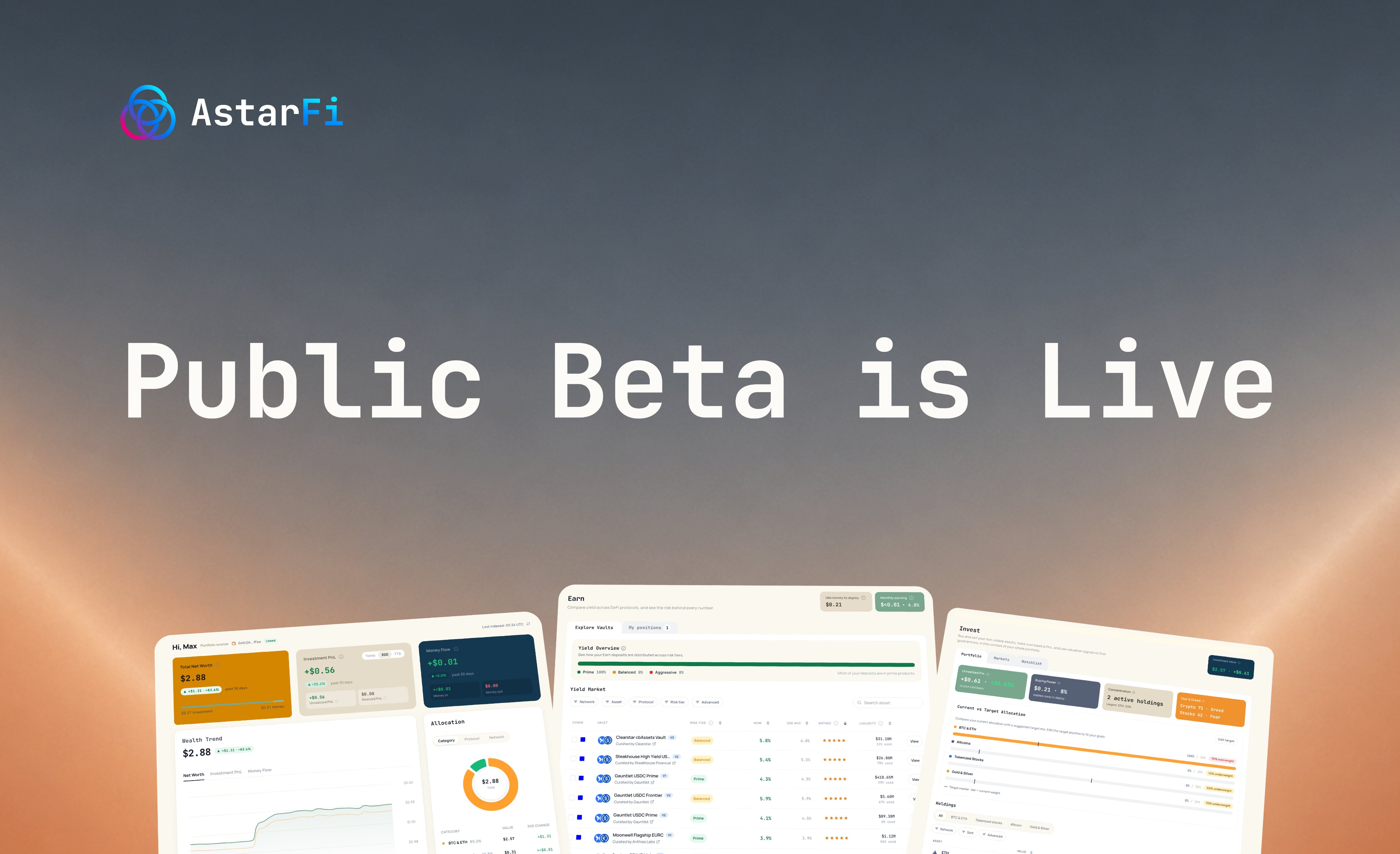
Astar Fi launches public beta for onchain personal finance manager on Ethereum and Base
Architecture: A Web3 Collective Anchored By Astar Network
At the center of the Astar Collective sits Astar Network, the live blockchain infrastructure that hosts core features such as dApp Staking, on‑chain governance, and the smart contracts that power applications and ecosystem products. Astar Network is designed as a multi‑chain smart‑contract platform supporting both EVM and Wasm, which allows Solidity‑based applications to deploy with minimal friction while also enabling more performance‑efficient or custom runtimes via WebAssembly. This dual‑VM architecture is strategically important because it lets Astar tap into the large base of EVM developers accustomed to Ethereum tooling, while still exploring longer‑term innovations that might require Wasm or custom execution environments. For end users, this means that familiar DeFi, NFT, and gaming primitives can coexist with more experimental or high‑performance modules under a single ecosystem umbrella.
However, Astar’s architecture is increasingly less about a single chain and more about a stack of products and networks coordinated through a shared token and governance model. The team refers to this as the Astar Stack, a product framework for on‑chain finance that encompasses infrastructure for stablecoins, tokenized assets, DeFi, and application‑specific networks. Astar Stack is intended to be used both by Astar’s own ecosystem teams and by external enterprises that want to build programmable payments and asset systems, especially within regulated contexts such as Japan’s financial sector. This stack is complemented by the Astar Portal, a unified interface that acts as the primary hub for users to interact with staking, governance, and ecosystem activity, effectively turning the network’s front end into a kind of navigation console for the entire collective. The Portal’s scope has expanded over time, adding dedicated tabs for governance and staking, though that increased power has also raised user‑experience concerns about complexity and discoverability among less technical participants.
A key piece of Astar’s architectural evolution is its embrace of cross‑chain interoperability standards. The network has integrated Chainlink CCIP (Cross‑Chain Interoperability Protocol) as its canonical solution for secure cross‑chain messaging and token transfers. Chainlink markets CCIP as a security‑first standard designed to serve institutional tokenization and global finance use cases, with backing from initiatives involving major firms such as BlackRock, Mastercard, and others in regions like the Middle East and North Africa. By adopting CCIP as its cross‑chain backbone, Astar positions itself to offer a familiar interoperability standard to institutions already experimenting with tokenized assets and stablecoins on other chains. This is particularly relevant if Japanese banks and corporates issuing yen‑backed stablecoins, or foreign institutions working with tokenized treasuries, require cross‑chain connectivity while maintaining a security posture aligned with regulatory expectations.
Another major architectural thread is Astar’s role in the emerging Soneium ecosystem. In collaboration with AltLayer and EigenLayer, Astar is helping to launch a Fast Finality Layer for Soneium, an Ethereum‑aligned environment focused on entertainment, gaming, and consumer applications. This Fast Finality Layer leverages EigenLayer’s restaking model, allowing ASTR holders to restake their tokens to validate Soneium and provide rapid transaction finality for latency‑sensitive use cases in gaming, DeFi, and SocialFi. Strategically, this positions ASTR not just as the native staking asset for Astar Network itself but as a shared security resource that can be exported to other ecosystems. It also places Astar firmly within the broader restaking narrative—alongside Ethereum’s EigenLayer—and ties its token’s value to the security budgets of multiple networks, rather than a single chain. The integration with AltLayer’s modular infrastructure further underscores Astar’s architectural trajectory toward a multi‑network collective coordinated by ASTR, rather than a monolithic sovereign chain.
Through these design choices—dual‑VM smart contracts, Astar Stack as a productized infra layer, Chainlink CCIP for cross‑chain connectivity, and Soneium’s Fast Finality Layer backed by ASTR restaking—Astar is attempting to build an architecture that is both developer‑friendly and institutionally palatable. The next question, however, is how the ASTR token itself is structured to capture value from this architecture while balancing inflation, staking incentives, and long‑term sustainability.
Readers clicked Astar's tokenomics overhaul at 4× the rate of its institutional partnerships and restaking launches combined, revealing that ASTR holders are primarily tracking supply-side risk — whether the deflationary pivot actually holds — rather than ecosystem growth narratives.
ASTR Tokenomics 3.0: From Open‑Ended Inflation To Capped Supply And Value Capture
The ASTR token sits at the heart of Astar’s economics as the unit of account for staking, governance, transaction fees, and value alignment across the collective. From the outset, ASTR has been described as a utility token, a governance token, and a staking asset, meaning it simultaneously pays for gas, secures the network, and represents voting power in on‑chain decision‑making. Early in Astar’s lifecycle, ASTR followed a more traditional inflationary token model, with ongoing emissions used to fund staking rewards, ecosystem incentives, and dApp Staking. However, as macro conditions tightened and investor scrutiny of token dilution intensified, Astar’s community and foundation began re‑evaluating whether that open‑ended inflationary design was aligned with long‑term value creation for holders.
The result of that debate is Tokenomics 3.0, a major overhaul that transitions ASTR from an open‑ended inflationary model to a fixed maximum supply architecture with an embedded emission decay function. Under this design, ASTR emissions per block decrease over time according to the formula \(E(n) = E_0 \times (1 - r)^n\), where \(E_0\) is the initial emission rate, \(n\) is the number of blocks elapsed, and \(r\) is a fixed decay factor set to \(0.000004\%\) per block. This means that with each block, the number of newly minted ASTR falls slightly, creating an exponential decay in emissions rather than a constant inflation rate. In practical terms, this causes total future emissions to converge toward a finite amount rather than continuing indefinitely, allowing the system to define an approximate asymptotic maximum supply.
Tokenomics 3.0 also reduces the maximum annual inflation ceiling from 7 percent to 5.5 percent and restructures reward allocations. Previously, certain bonus reward mechanisms existed as user‑facing incentives; under the new model, those bonus allocations are redirected into base and adjustable staker reward pools, simplifying the reward structure and tightening the link between actual network participation and reward distribution. Over the long term, the combination of a lower inflation ceiling and exponential emission decay causes total ASTR supply to converge toward a theoretical maximum of 10 billion tokens. As of March 2026, total issuance was approximately 8.6 billion ASTR, leaving a finite remaining emission headroom that will be gradually allocated through staking and ecosystem rewards under the decay schedule. This is a significant shift from earlier community proposals that had contemplated slightly higher eventual supply figures, and it reflects a conscious choice to prioritize supply predictability and bounded dilution.
Importantly, Tokenomics 3.0’s 10‑billion figure is described as a theoretical ceiling rather than a hard cap in practice, because Astar also incorporates supply‑reducing mechanisms such as burns. Burn mechanisms include events like the Burndrop, in which a portion of tokens designed for distribution are permanently destroyed, and potential discretionary burns approved by on‑chain governance. For example, developers have proposed a governance measure to burn 350 million ASTR, worth roughly 38 million USD at the time of proposal, as part of an effort to improve token efficiency and reallocate staking rewards. If such proposals pass, the burned tokens are permanently removed from the supply, effectively lowering the realizable maximum below the 10‑billion asymptote dictated by the emission decay function. In a market environment where many investors treat burn events as signals of supply discipline and alignment with tokenholders, these mechanisms can influence perceptions of ASTR’s attractiveness as a long‑term asset.
Beyond supply and emissions, Astar has outlined a value capture framework for ASTR that identifies four main channels through which token value can accrue: tokenomics, products (beginning with Astar Stack), DeFi and asset yields, and burn events. Tokenomics covers the emission decay, capped supply, and reward design described above. Products refer to the demand generated by applications using the Astar Stack, such as stablecoin infrastructure, tokenization services, or on‑chain payment flows, all of which require gas fees and potentially ASTR‑denominated collateral or service payments. DeFi and asset yields involve the use of Astar’s treasury and ecosystem capital to earn returns through lending, liquidity provision, or cross‑chain yield strategies, with the goal of recycling those returns into ASTR‑enhancing activities such as buybacks or strategic incentives. Finally, burn events like Burndrop or future governance‑approved burns serve as direct mechanisms to constrict supply and link network activity—such as transaction fees or distribution programs—to permanent reduction of outstanding ASTR.
This Tokenomics 3.0 pivot has not been without controversy. Some community commentators and external observers have framed the move to a fixed‑supply, decaying‑emission model as “charting risky waters,” particularly in a bearish or sideways market where demand growth is uncertain, and staking yields must be balanced against lower new issuance. The concern is that if too much of the remaining emission is consumed by short‑term incentives, the long‑term sustainability of staking and dApp funding may be compromised. Conversely, advocates argue that bounded supply, lower inflation, and structured burns are necessary to attract long‑horizon capital and to align Astar with the growing emphasis on sound token economics among institutional participants. In either case, the mechanics of Tokenomics 3.0 are now a central part of Astar’s story, and they intersect deeply with how staking and governance operate in practice.
- 01Fixed-supply tokenomics overhaul↗
The proposal to cap ASTR at ~10.5B and execute a $38M burn was the single highest-engagement story, signaling readers are stress-testing whether a hard supply cap is credible and permanent.
- 02ASTR as Soneium restaking backbone↗
The AltLayer/EigenLayer Fast Finality Layer positioned ASTR as infrastructure collateral for Sony's Soneium chain, giving token holders a new yield narrative beyond dApp staking.
- 03Animoca institutional entry↗
Animoca's investment flagged Astar as the leading vehicle for Asian IP-linked Web3 gaming, drawing readers who track where serious capital is betting on Japan-native chains.
- 04Tokenomics 3.0 emission decay mechanics↗
Readers who missed the proposal came back to track the live activation — verifying that emission ceilings and decay schedules had actually been enforced on-chain.
- 05dApp Staking revamp and inflation cuts↗
Cutting inflation to 5.5% and capping supported projects at 16 changed yield economics for stakers, making the mechanics a practical concern for anyone earning ASTR rewards.
- 06Governance centralization risk↗
Community concern over council-driven governance with low participation raised the question of whether ASTR holders retain meaningful influence over the supply decisions driving the top headlines.
Staking, dApp Staking, And Restaking With ASTR
Staking is one of ASTR’s core functions, but on Astar it takes several distinct forms that together illustrate the network’s attempt to align economic incentives between users, developers, and partner chains. At the base layer, ASTR can be staked to secure Astar Network itself, contributing to the integrity and liveness of the chain in exchange for protocol‑level rewards funded by emissions and fees. This is conceptually similar to staking on other proof‑of‑stake chains, in which validators or nominators lock tokens to participate in consensus. However, Astar’s more distinctive innovation is dApp Staking, a mechanism designed not just to secure the chain but to funnel a portion of staking rewards directly to application developers as a form of continuous ecosystem funding.
In Astar’s dApp Staking system, token holders allocate their stake to specific dApps they wish to support, effectively “voting” with their ASTR for projects they believe deliver value to the ecosystem. When users stake ASTR on a given dApp, both the developer and the staker share in the reward stream: developers receive a portion of the staking rewards, which they can use for development, marketing, or operational expenses, while stakers earn passive income for backing successful projects. This arrangement is meant to replace or supplement traditional venture funding and grant programs by tying ongoing developer funding to transparent, on‑chain support from the community. It also encourages developers to build dApps that users actually want to stake on, creating a feedback loop between application quality, user engagement, and funding.
In late 2025 and early 2026, Astar revamped its dApp Staking model to simplify participation and improve capital efficiency. Under the refined design, Astar Network now operates with a defined cap on the number of active projects, organized into two tiers with rank‑based reward allocation. Instead of requiring users to manage multiple granular stakes across many dApps, the new system allows participants to make a single stake that can support up to sixteen projects at once, significantly reducing operational complexity for users. Participation is structured into a single yearly cycle, during which stakers lock in their allocations and earn rewards based on overall network participation and the relative ranking of the projects they support. At the time the new model was discussed publicly, estimated staking yields were on the order of approximately 10 percent annually, though actual yields vary with participation rates and emission parameters.
This redesign also interacts closely with Tokenomics 3.0. Because the maximum inflation ceiling has been reduced to 5.5 percent and emissions decay over time, the share of issuance earmarked for dApp Staking must be carefully calibrated to ensure both attractive yields and sustainable developer funding. The new dApp Staking model aligns with this by introducing more explicit project caps and tiered reward structures, which can be adjusted over time to respond to ecosystem growth or contraction. Meanwhile, the Astar Portal is being rebuilt as a more unified interface for staking activities, integrating dApp discovery, staking allocations, and reward tracking into a single, more approachable UX. Nonetheless, some community members have expressed concerns about the operational overhead of participating in yearly cycles and the risk that the project cap could limit diversity if not expanded as the ecosystem grows.
Beyond Astar Network itself, ASTR is increasingly central to restaking scenarios through its role in Soneium’s Fast Finality Layer. In the collaboration between Astar, AltLayer, and EigenLayer, ASTR can be restaked within EigenLayer’s model to provide finality services to Soneium, effectively exporting Astar’s economic security to a separate network focused on high‑throughput entertainment applications. This means that ASTR holders may be able to earn additional yield streams by participating in both Astar’s own staking mechanisms and cross‑chain restaking, though this also introduces new risk vectors related to slashing, smart‑contract vulnerabilities, and cross‑protocol dependencies. The vision, however, is clear: ASTR should function as a core staking backbone not just for a single chain but for a cluster of interconnected networks, mirroring the broader industry trend toward shared security and modular execution environments.
On the user side, staking remains a multi‑step process that typically involves visiting the Astar Portal, connecting a wallet such as MetaMask on the appropriate network, discovering available dApps or staking options, and then committing ASTR with appropriate confirmations. Minimum stake requirements can vary by dApp—some documentation references examples such as 500 ASTR for particular projects—so users must assess both capital commitment and project risk when allocating stake. Recent network communications have referenced numbered staking cycles, such as “Cycle 007,” reflecting a more gamified or seasonal framing of participation. While these cycles can drive engagement and narrative, they also require clear communication to avoid confusion, particularly as Astar adds more layers of functionality such as governance voting and restaking options within the same Portal environment.

Animoca Brands Invests in Astar Network to pioneer Web3 entertainment and empower Asian IPs
Governance, Community, And The Astar Collective
Governance on Astar is undergoing its own multi‑year evolution from more centralized coordination toward a more formalized on‑chain system that aims to balance efficiency with decentralization. Early in its history, strategic decisions for Astar were made primarily by the core team and aligned organizations, a common pattern for young networks that need to move quickly. However, as the project matured and the Astar Collective concept took shape, the team announced a transition toward on‑chain governance, with ASTR holders empowered to propose and vote on protocol changes, funding decisions, and parameter updates. This governance evolution has been framed as part of a broader journey to transform Astar into a “collective network” where products, contributors, and capital are aligned economically and politically through transparent mechanisms.
The on‑chain governance framework introduces several key components. Proposals typically move through stages that include an initial discussion phase, a formal referendum, and an execution phase if approved. During the referendum stage, ASTR holders can vote on whether a proposal should be adopted, with a conviction voting mechanism that allows voters to increase the weight of their vote by locking tokens for longer periods. This design is intended to reward participants who are willing to commit capital over extended horizons, on the theory that they are more likely to care about the long‑term health of the network. In addition to referenda, the governance system involves treasury management, council‑like bodies or working groups, and a bounty framework where community members can propose specific initiatives with budget requests that, if approved, are funded from the governance treasury. The aim is to move toward a bounty‑based treasury model in which anyone can open an initiative, compete for resources, and be held accountable for deliverables.
Despite this progress, governance on Astar is not without tension. Some in the community and broader crypto press have raised concerns about potential centralization around councils, low participation rates in votes, and the complexity of interacting with governance through the Astar Portal’s dedicated governance tab. The expansion of the Portal into a comprehensive dashboard for staking, governance, and ecosystem activity is intended to make participation more direct and intuitive, but it also risks overwhelming users who may only want to perform simple tasks like staking or claiming rewards. The addition of advanced governance features—proposal browsing, vote delegation, conviction settings—can be powerful tools for power users while simultaneously intimidating for casual participants. This is a common challenge across many on‑chain governance systems, and Astar’s approach will need continual refinement to ensure that its governance does not become a de facto plutocracy dominated by a small set of highly engaged actors.
Concrete governance agendas illustrate how consequential these mechanisms are. Major decisions such as the activation of Tokenomics 3.0, the revamp of dApp Staking, and the proposed 350‑million‑ASTR burn have all either passed through or been slated for on‑chain governance. Similarly, strategic initiatives like the rebuild of the Astar Portal, alignment on Astar Fi (the network’s DeFi direction), and integration strategies for stablecoins and cross‑chain protocols have been topics of community calls and governance roadmaps. The Astar Foundation and aligned contributors often seed these processes with detailed proposals and public calls, but the final outcomes—particularly on tokenomics and burn decisions—are increasingly mediated through ASTR holder voting power. This is especially important in an era where tokenomics shifts can significantly affect the risk–return profile for both stakers and long‑term holders.
Community‑driven initiatives such as the Yoki Community Mini‑Game Challenge also highlight the interplay between grassroots creativity and governance oversight. The Yoki initiative proposes a community‑led mini‑game as part of a broader Yoki Arcade concept, but forum discussions have flagged operational cost concerns and questioned whether a full‑scale game is justified at current resource levels. This kind of debate—balancing experimentation in consumer apps against budget discipline—is precisely the type of problem that a bounty‑based, on‑chain governed treasury is meant to solve. By surfacing such trade‑offs in public, Astar’s governance process can test whether the community prioritizes gaming experiments, DeFi incentives, infrastructure enhancements, or stablecoin integrations at any given moment. Over time, the pattern of these decisions will reveal how the Astar Collective defines its own culture and strategic priorities.
Animoca Brands invests in Astar Network
Fast Finality Layer launched with AltLayer and EigenLayer
Astar Foundation proposes fixed 10.5B ASTR supply cap and $38M burn
Tokenomics 3.0 activated: emission decay live, inflation ceiling reduced
Community Call unpacks Tokenomics 3.0, dApp staking revamp, governance updates
JPYSC launched — Japan's first trust bank-backed digital yen stablecoin via Startale
Q1 2026 recap published; bearish forecasts and token decay risks flagged
Japan, Stablecoins, Payments, And The Role Of Visa
Astar’s most distinctive strategic bet lies at the intersection of Japan’s regulated stablecoin framework and the global shift of major financial firms toward stablecoin‑based settlement and payments. In Japan, lawmakers and regulators have created a path for banks and trust companies to issue fiat‑backed stablecoins as Type III Electronic Payment Instruments, a structure that imposes strict custody, reserve, and compliance requirements but offers clear legal status. Building on this framework, Startale Group and SBI Holdings have launched JPYSC, a trust‑based digital‑yen stablecoin issued by Shinsei Trust & Banking. JPYSC is designed to operate seamlessly across traditional financial systems and blockchain networks, with SBI VC Trade serving as the primary distribution partner and Startale acting as the designated core technical partner. The stablecoin’s branding emphasizes trust, regulatory compliance, and global interoperability, all underpinned by Japanese financial law.
Astar’s role in this landscape is multi‑layered. Startale is not only the core technical partner for JPYSC but also a core contributor to the Astar Collective, positioning Astar’s infrastructure as a natural home for regulated stablecoin activity and programmable yen use cases. Because JPYSC is designed to bridge traditional banking and blockchain networks, it requires on‑chain environments that can support compliant integration with enterprise systems while offering the composability needed for tokenized assets, on‑chain treasury, and programmable payments. Astar’s EVM compatibility, Chainlink CCIP integration, and Japan‑centric ecosystem make it a logical venue for such use cases, especially when combined with its focus on value capture and staking incentives that can reward participants for providing liquidity and infrastructure around yen‑denominated assets.
The global context amplifies this opportunity. Financial firms such as Visa, Mastercard, and Revolut have been moving into stablecoins, either by enabling stablecoin settlement for their card networks, experimenting with tokenized deposits, or supporting crypto cards that allow spending of on‑chain assets in traditional commerce. In Astar’s case, the alignment is particularly direct: Japan‑based exchange bitbank has launched a Visa card that includes ASTR among its supported assets, providing a bridge between ASTR holdings and everyday payments. This integration illustrates how Astar’s token can exist simultaneously as a governance and staking asset on‑chain and as a spendable asset in a familiar card format, at least for users in supported jurisdictions. As stablecoins like JPYSC mature and card networks expand their on‑chain settlement rails, Astar’s positioning as a yen‑centric infrastructure layer could enable scenarios where stablecoin balances and ASTR collateral underpin consumer payments, remittances, and corporate treasury operations.
Chainlink CCIP further ties Astar into the broader tokenization and payments ecosystem. CCIP is emerging as a favored cross‑chain messaging and token standard for institutions exploring tokenized real‑world assets and stablecoins, with pilot projects involving major asset managers and payment companies. By making CCIP natively available on Astar Network, the project ensures that assets issued on Astar—whether JPYSC, other stablecoins, or tokenized securities—can interoperate with tokenization initiatives on other chains without bespoke, potentially insecure bridging solutions. This is particularly crucial in a world where regulated institutions demand robust security assurances and where cross‑chain exploits have repeatedly undermined confidence in multi‑chain DeFi. For stablecoins to become infrastructure for settlement, remittance, payments, and banking, the chains they inhabit must interoperate in ways that meet institutional security and compliance thresholds; Astar’s CCIP integration is an attempt to meet that requirement.
For ASTR holders and crypto‑native users, the emergence of regulated stablecoins like JPYSC on Astar or aligned infrastructure introduces both opportunities and trade‑offs. On the one hand, yen‑denominated stablecoins can provide a low‑volatility base asset for DeFi, enabling lending, automated market‑making, and structured products without exposing users to currency or regulatory uncertainty. On the other hand, strict compliance requirements may limit permissionless composability or restrict certain uses to whitelisted participants, especially in the early stages. Astar’s challenge will be to balance its roots in Japan’s regulated environment with the expectations of global crypto users who value open access and censorship resistance. In practical terms, this likely means hosting a spectrum of assets—from fully regulated bank‑issued stablecoins like JPYSC to more permissionless tokens—while offering tools and governance processes capable of managing this diversity.
The Fast Finality Layer integrates AltLayer and EigenLayer restaking, adding external slashing and cross-system dependency risk on top of Astar's own staking contracts.
Community calls and forum posts flag that governance councils have concentrated decision-making while on-chain participation remains low, meaning tokenomics and staking rule changes can pass with thin legitimacy.
Japan's ruling party has advanced a national AI-and-blockchain financial framework supportive of tokenized assets and stablecoins, giving Astar's home jurisdiction a constructive regulatory posture.
A hard supply cap and active emission decay reduce the inflationary sell pressure that previously dampened price, but the 16-project dApp staking cap concentrates liquidity incentives and may thin secondary-tier pools.
Q1 2026 coverage explicitly characterized the period as 'bearish forecasts' and 'risky waters amid token decay,' with Tokenomics 3.0 yet unproven as a catalyst for price recovery.
ASTR staked as Soneium's Fast Finality Layer collateral is subject to EigenLayer-style slashing conditions that did not exist under the original dApp staking model.
Ecosystem, Use Cases, And Market Position
The Astar ecosystem spans infrastructure, DeFi, gaming, NFTs, and emerging consumer applications, all coordinated under the Astar Collective umbrella. At the base, Astar Network provides smart‑contract execution for EVM and Wasm dApps, while the Astar Portal serves as the front door for end users, aggregating staking, governance, and application interactions in a single interface. The Portal’s role as an “ecosystem hub” has grown as Astar has rebuilt it to support the revised dApp Staking model, governance participation, and ecosystem discovery, reflecting a strategy of consolidating user flows to reduce friction. For developers, Astar Stack offers a modular set of components for building on‑chain finance products, from stablecoin rails to tokenized asset management, with the promise that successful products can tap into ecosystem incentives, dApp Staking support, and cross‑chain connectivity via CCIP.
On the DeFi front, Astar’s roadmap emphasizes using ASTR’s value capture mechanisms and network treasury to bootstrap liquidity and yield opportunities. The Astar Fi direction, referenced in Q1 2026 communications, suggests a coordinated push to make Astar a competitive venue for on‑chain yields, leveraging both native ASTR incentives and external stablecoin flows. With Tokenomics 3.0 capping long‑term supply and focusing emissions on staking and ecosystem rewards, the network’s economic strategy involves channeling as much on‑chain activity as possible—trading, lending, staking, and restaking—through venues that reinforce ASTR’s role. This can take the form of dApp Staking support for DeFi protocols, treasury‑backed liquidity programs, or integrations where ASTR or JPYSC are used as collateral and settlement assets. In theory, these dynamics should create a feedback loop in which more activity leads to more value capture via fees, staking demand, and burns, which in turn supports the token’s economic viability.
Gaming and entertainment represent another pillar of the ecosystem, especially given partnerships with firms like Animoca Brands, which has invested in Astar to pioneer web3 entertainment and support Asian IPs. This focus dovetails with the Soneium initiative, where ASTR’s role as a staking backbone for a Fast Finality Layer is explicitly geared toward latency‑sensitive applications such as real‑time games and interactive experiences. Within Astar’s own ecosystem, projects like the Yoki Arcade and the Yoki Community Mini‑Game Challenge exemplify the experimentation occurring at the intersection of NFTs, mini‑games, and community engagement. While some community members have voiced concerns about the operational costs and limited scope of these mini‑games—especially relative to more scalable DeFi or infrastructure investments—they also demonstrate Astar’s willingness to explore consumer‑facing experiences as a way to bring users on‑chain and test new monetization and incentive patterns.
Astar’s market position must also be understood in relation to other smart‑contract and modular ecosystems. It competes not only with established networks like Ethereum, Solana, and Cosmos‑aligned chains, but also with newer Ethereum L2s, app‑specific chains, and shared‑security platforms. Its differentiators include its deep integration with Japan’s regulatory and financial environment, its explicit targeting of regulated stablecoins like JPYSC, its unique dApp Staking model, and its adoption of CCIP and EigenLayer‑style restaking. At the same time, these differentiators come with trade‑offs: heavy focus on a single jurisdiction’s regulatory regime introduces concentration risk; reliance on external infrastructure like CCIP and EigenLayer adds dependency risk; and complex tokenomics and staking schemes can be harder to explain to mainstream users compared with simpler, single‑chain narratives.
External shocks and operational issues also shape perceptions of Astar’s resilience. In periods of market stress or infrastructure upgrades, some exchanges and service providers have temporarily suspended deposits and withdrawals for Astar and other assets, highlighting the dependence of even on‑chain ecosystems on centralized rails. Although such suspensions are often precautionary and affect multiple assets simultaneously, they underscore the importance of robust infrastructure, diversified liquidity venues, and clear communication. Astar’s Q1 2026 recap frames the network’s strategy as a “consolidated voyage across the fleet,” emphasizing internal alignment, Portal rebuilds, and clear value‑capture logic as buffers against these external “rough seas.” Ultimately, Astar’s success as an ecosystem will depend on whether its combination of regulated‑finance integration, cross‑chain architecture, and innovative tokenomics can attract and retain developers, users, and capital in a crowded field.
Astar Foundation proposes shifting ASTR tokenomics from a dynamic inflationary model to a fixed supply of ~10.5B tokens
Risks, Trade‑Offs, And Open Questions
No evergreen explainer would be complete without a candid assessment of the risks and open questions around Astar. On the tokenomics side, the transition to Tokenomics 3.0 introduces both clarity and new uncertainties. The capped maximum supply of 10 billion ASTR, emission decay function, and reduced inflation ceiling provide a predictable framework that many investors prefer to open‑ended inflation. However, this also means that the margin for error in allocating remaining emissions is smaller: if too much is spent on short‑term incentives that fail to create lasting network effects, Astar could find itself with diminished capacity to subsidize staking or ecosystem growth in the future. Burn events, including the proposed 350‑million‑ASTR burn and ongoing Burndrop‑style reductions, add yet another layer, as they permanently remove tokens that could otherwise have been used for incentives or treasury operations. The challenge lies in calibrating these levers in a way that keeps ASTR attractive while maintaining sufficient fuel for long‑term development and security.
Staking and restaking introduce additional technical and economic risk. dApp Staking’s dual‑sided incentive model means that misaligned or low‑quality dApps could, in theory, attract stake purely for yield, leading to misallocation of funding. The yearly cycle model and project cap mitigate this somewhat by introducing competition and periodic reassessment, but they cannot fully eliminate information asymmetries between developers and stakers. Meanwhile, the extension of ASTR into EigenLayer‑based restaking for Soneium’s Fast Finality Layer compounds risks: if a major slashing event or security incident occurs on a restaked network, ASTR holders could bear losses that originate outside Astar Network itself. These layered staking environments amplify systemic risk even as they promise enhanced yield and multi‑network utility.
On the governance front, questions remain about decentralization, participation, and capture. While Astar’s governance roadmap clearly aims to move toward a more decentralized, on‑chain system, early stages of that journey often feature low voter turnout and heavy influence by core entities. The use of conviction voting and bounty‑based treasuries is innovative, but such mechanisms are only as inclusive as their user base is broad and informed. If governance decisions around tokenomics, burns, and treasury allocations are made primarily by a small subset of whales or institutional players, retail holders and smaller developers may feel disenfranchised. The complexity of the Astar Portal’s governance interface, though powerful, can exacerbate this by discouraging casual participation. Over time, experiments with delegation, simplified voting flows, and clearer documentation will be essential to mitigating these risks.
Regulatory and jurisdictional risk also loom large. Astar’s deep integration with Japan’s regulatory environment and its alignment with regulated stablecoins like JPYSC provide a strong moat in one sense, but they also tether the project’s fortunes to policy decisions and enforcement attitudes in a single country. If regulatory priorities shift, if new restrictions are placed on bank‑issued stablecoins, or if cross‑border regulatory fragmentation intensifies, Astar may need to adapt rapidly to maintain its positioning. At the same time, its ambitions to serve a global user base and to host diverse assets mean it must navigate differences between Japanese law, other Asian jurisdictions, and Western regulatory regimes—especially as stablecoin and tokenization rules evolve in the United States and Europe. Balancing compliance‑friendly infrastructure with permissionless innovation is an ongoing challenge that will require careful governance and product design.
Finally, there is the question of market competition and differentiation. Many other chains are also racing to become the infrastructure layer for stablecoins, tokenized assets, and cross‑chain applications. Ethereum L2s, in particular, benefit from massive developer ecosystems and existing institutional experiments with tokenization. Solana and other high‑throughput chains are courting payments and consumer apps. In this crowded environment, Astar’s differentiators—Japanese regulatory integration, JPYSC alignment, dApp Staking, CCIP adoption, and Soneium restaking—must translate into concrete network effects and liquidity rather than remain primarily narrative advantages. The coming years will reveal whether these features can attract sustained developer and user activity at scale, or whether they will need further iteration to keep pace with the broader market.
Conclusion
Astar represents a distinctive attempt to fuse regulated finance, stablecoins, and consumer web3 applications into a coherent, token‑aligned ecosystem. Anchored by Astar Network, which offers EVM and Wasm smart contracts, and coordinated through the Astar Stack and Astar Portal, the project is evolving into a web3 collective in which multiple products and partner networks are bound together by the ASTR token and shared governance. Its architectural choices—adopting Chainlink CCIP for cross‑chain interoperability and collaborating with AltLayer and EigenLayer to make ASTR a staking backbone for Soneium’s Fast Finality Layer—position it squarely within the emerging modular and restaking paradigm. At the same time, its deep roots in Japan’s regulatory environment, close collaboration with Startale and SBI on JPYSC, and presence on payment rails like bitbank’s Visa card give it a uniquely grounded role in the transition from traditional banking to stablecoin‑based settlement.
Tokenomics 3.0 marks a decisive shift in how ASTR’s economics are framed, moving from open‑ended inflation to a capped supply model with exponential emission decay, a lower inflation ceiling, and a stronger emphasis on value capture through products, DeFi yields, and burns. This redesign is closely intertwined with the network’s staking architecture, including its revamped dApp Staking program that simplifies user participation while channeling funding directly to developers, and its foray into restaking for external networks via Soneium. Governance reforms, including the introduction of on‑chain referenda with conviction voting and bounty‑driven treasury management, are gradually shifting power toward ASTR holders, even as debates continue around centralization risks and user‑experience challenges.
As with any ambitious crypto project, Astar’s path is not without risks. Tokenomics choices, layered staking schemes, complex governance, regulatory dependencies, and intense market competition all present potential obstacles. Yet they also present opportunities: if Astar can successfully manage these trade‑offs, it could emerge as a key piece of infrastructure at the intersection of yen‑denominated stablecoins, modular blockchain architectures, and consumer‑grade web3 applications. For observers and participants in the crypto ecosystem, Astar offers an instructive case study in how a network can attempt to align national‑level regulatory frameworks, institutional partnerships, and on‑chain community mechanisms around a single token and a shared long‑term vision.
Outlook
Looking ahead, several milestones and dynamics will shape Astar’s trajectory. The continued rollout and refinement of Tokenomics 3.0 will determine how well the network can balance attractive staking yields, sustainable developer funding, and controlled supply growth, especially as emission decay gradually tightens the available token budget. The real‑world impact of burn events, including the proposed 350‑million‑ASTR burn, will be closely watched as indicators of governance priorities and the network’s willingness to trade off near‑term flexibility for long‑term supply discipline. Success or failure in these areas will likely influence both market perception and actual on‑chain participation.
On the infrastructure side, the maturation of the Astar Portal as a unified hub for staking, governance, and ecosystem interactions will be critical. Efforts to simplify dApp Staking participation, make governance more approachable, and surface high‑quality applications will directly affect user engagement and retention. The integration of ASTR restaking into Soneium’s Fast Finality Layer will test whether Astar’s security and token can effectively underpin external networks in practice, not just in theory. At the same time, the broader macro trend of stablecoins becoming core infrastructure for settlement, remittance, and payments will intersect increasingly with Astar’s role in Japan’s digital‑finance landscape, especially as JPYSC moves from announcement to actual usage and as card networks expand their stablecoin‑based offerings.
Ultimately, Astar’s long‑term relevance will hinge on whether it can convert its unique advantages—Japanese regulatory integration, institutional partnerships, innovative staking and governance, and cross‑chain capabilities—into durable network effects and real‑world adoption. For now, Astar stands as a notable experiment in aligning national financial policy, institutional interest, and web3 community dynamics through a single multi‑role token. As the stablecoin and tokenization era accelerates, Astar’s progress will be an important bellwether for how jurisdiction‑anchored, regulation‑friendly crypto infrastructure can compete and coexist with more permissionless, global networks.
Latest Astar news
Astar Fi launches public beta for onchain personal finance manager on Ethereum and BaseAnimoca Brands Invests in Astar Network to pioneer Web3 entertainment and empower Asian IPsAstar Foundation proposes shifting ASTR tokenomics from a dynamic inflationary model to a fixed supply of ~10.5B tokensAstar, AltLayer, and EigenLayer unite to launch Fast Finality Layer — Empowering ASTR as Soneium’s staking backboneJapanese blockchain Astar proposes $38M token burnSources
18 records from 8 domains
astar.network
- astar.network
- astar.network· blog / astar-network-s-d-app-staking-how-it-works-and-why-it-matters-175
- astar.network· blog / astar-evolution-expanding-with-the-chainlink-standard-to-enable-cross-chai…
- astar.network· blog / astar-alt-layer-and-eigen-layer-unite-to-launch-fast-finality-layer-empowe…
- astar.network· blog / astr-value-capture-230
- astar.network· blog / astar-onchain-governance-153
- astar.network· blog / d-app-staking-revamp-236
- astar.network· blog / q1-recap-239
docs.astar.network
forum.astar.network
startale.com
x.com
ifcreview.com
coinmarketcap.com
bitget.com
Community notes
Spot something off or out of date? Drop a note. Editors review topic notes daily and roll accepted fixes into the explainer — contributors are recognized in the monthly $SQUID drop.
Loading notes…
Help improve this topic
Have a story or tip about this topic? Submit it. See something missing? Leave a note. Editors review daily; accepted submissions and fixes count toward the monthly $SQUID drop.