
In-depth explainer on automation in crypto, from trading bots and on-chain risk guards to AI agents, self-paying wallets, and agentic banking, plus the security, governance, and social risks of an increasingly automated DeFi stack.
+9 sources across the wider coverage universe
 Blocmates questions whether crypto’s “human layer” is fading as automation, bots, and AI reshape participation, culture, and decision-making across Web3 ecosystems2026-04
 DWF Ventures explores whether AI agents will take over DeFi, highlighting automation, on-chain execution, and the shift toward autonomous financial decision-making2026-04
 Crypto exchange Luno is cutting 20% of its workforce as automation reshapes operations and weaker retail trading volumes pressure the DCG-owned platform2026-07
 Base says AI agents are already spending millions via x402, paying for search, scraping, browser automation, and data services to complete tasks autonomously2026-07
 Rialo proposes unified lending stack onchain, using native data access, private computation, and automation to replace fragmented consumer credit systems and boost scalability2026-04
 CoinGecko unveils guide linking its market data APIs with OpenClaw AI agents for real-time crypto monitoring, automation and custom trading workflows2026-05
Automation in Crypto: From Trading Bots to On‑Chain AI Agents
Automation in crypto refers to any system that executes blockchain or trading actions with minimal human intervention, from simple rebalancing scripts to fully autonomous AI agents that hold wallets, make payments, and interact with smart contracts. In a 24/7 global market, automation is becoming a defining layer of crypto infrastructure, reshaping how capital moves, how protocols are governed, and how humans participate.
Defining Automation in a 24/7 Crypto Market
Automation in crypto is best understood as a continuum rather than a single technology. At one end, there are straightforward trading bots that place buy and sell orders according to predefined rules, often running off-chain and simply sending signed transactions to an exchange or blockchain. At the other end, there are emerging agentic systems that combine AI models, smart contracts, and on-chain data to make context-aware decisions, manage balances, and even self-fund their own operations without ongoing human supervision. This spectrum now includes portfolio rebalancing tools, DeFi-native “programmatic orders,” AI smart contracts, and agents that can open wallets and transact via stablecoins.
The fact that crypto trades around the clock amplifies the value of automation. Human traders and DAO operators cannot watch markets every second, but automated systems can monitor prices, liquidity, and risk parameters continuously and react in seconds or milliseconds. Automated strategies can be time-based, such as weekly portfolio rebalancing, or event-driven, such as liquidating collateral when a loan becomes unsafe or rotating tokens when prices cross a threshold. Over time, the industry has moved from scripting these rules manually to embedding them directly into protocols or delegating them to AI-powered agents, making automation as fundamental as wallets and exchanges themselves.
Automation is not just about trading. It increasingly underpins risk management, governance, compliance, and cross-chain operations. Aave’s emerging four-layer risk framework, for example, explicitly includes “advanced automation capabilities” in how it monitors and responds to risk, using on-chain oracles and automated guardians to freeze reserves or adjust supply and borrow caps when certain conditions are met. Similar dynamics are emerging in agentic banking, where AI systems gain compliant access to capital flows that stretch across traditional finance and crypto rails. As these systems proliferate, automation becomes both a tool for efficiency and a new surface for security, governance, and societal questions.
From Scripts to Self-Executing Strategies
Early crypto automation often took the form of simple scripts: a Python program polling an exchange API, a cron job checking prices every minute, a bot deployed to watch mempools for arbitrage opportunities. Many of these systems relied on centralized exchanges and custodial APIs, while execution logic remained entirely off-chain. Platforms like Cryptohopper popularized this model by offering user-friendly interfaces for rule-based and algorithmic strategies, including dollar-cost averaging (DCA), trailing stops, and copy trading across major exchanges. Users could configure strategies once, and the platform’s infrastructure would execute them continuously, turning manual trading ideas into semi-automated workflows.
As DeFi matured, automation started to be implemented at the portfolio level rather than the single-exchange level. Crypto asset management tools and dashboards emerged to unify positions across chains and protocols, providing better visibility into DeFi-specific holdings than traditional broker-style platforms. Some of these tools integrated with rebalancing and yield strategies, enabling users to maintain target allocations or auto-compound rewards without logging in to multiple interfaces. The ongoing transition from CeFi to DeFi meant that automation increasingly needed to interact with smart contracts directly, not just exchange APIs, paving the way for on-chain execution frameworks.
Today, automation encompasses protocol-native features that live inside smart contracts themselves. CoW Protocol’s Programmatic Order framework exemplifies this trend: a user signs once to define an order that, under certain on-chain conditions, can recursively create new orders, effectively encoding a recurring or conditional strategy into the protocol rather than into an external bot. At the same time, AI smart contracts and AI agents blur the line between static rules and adaptive decision-making, as smart contract logic is augmented with off-chain models that can interpret data, learn from history, and refine behavior over time. This evolution from scripts to self-executing strategies marks a shift from automation as an add-on to automation as a native property of crypto systems.
Why Automation Matters More in Crypto Than in TradFi
The case for automation is particularly strong in crypto because of the market’s speed, fragmentation, and composability. Crypto markets never close, prices can move dramatically in minutes, and liquidity is scattered across dozens of centralized exchanges, hundreds of decentralized exchanges, and multiple L1 and L2 networks. Human traders and DAO treasurers cannot feasibly monitor every pool and every risk parameter at all times. Automated systems, by contrast, can continuously scan DEX prices, lending protocol health factors, and cross-chain bridge statuses, taking actions within seconds of detecting anomalies or opportunities.
Crypto is also uniquely programmable. A smart contract exposes functions that can be called by anyone, including bots and agents, which means automation can be deeply integrated into the financial logic itself. This is different from traditional broker APIs, where access is often gated and functionality is limited. DeFi protocols like Aave, Uniswap, and CoW Protocol are designed from the ground up to be machine-interactive, enabling bots to provide liquidity, execute arbitrage, manage collateral, and vote in governance without any special permissions beyond owning tokens and paying gas. This composability encourages extensive use of automation, from market-making to governance automation to risk monitoring.
Finally, crypto automation is not just a tool for sophisticated trading desks. Retail users and small DAOs can also access automation via user-friendly interfaces or managed services. Rebalancing bots, for example, let non-professional investors define target allocations based on risk tolerance and then automatically buy and sell to maintain those targets as markets move. Similarly, crypto asset management dashboards give individuals institutional-style portfolio views, with the option to toggle on automated rebalancing or yield optimization. In that sense, automation has the potential to democratize advanced financial behavior, even as it introduces new layers of complexity and risk.

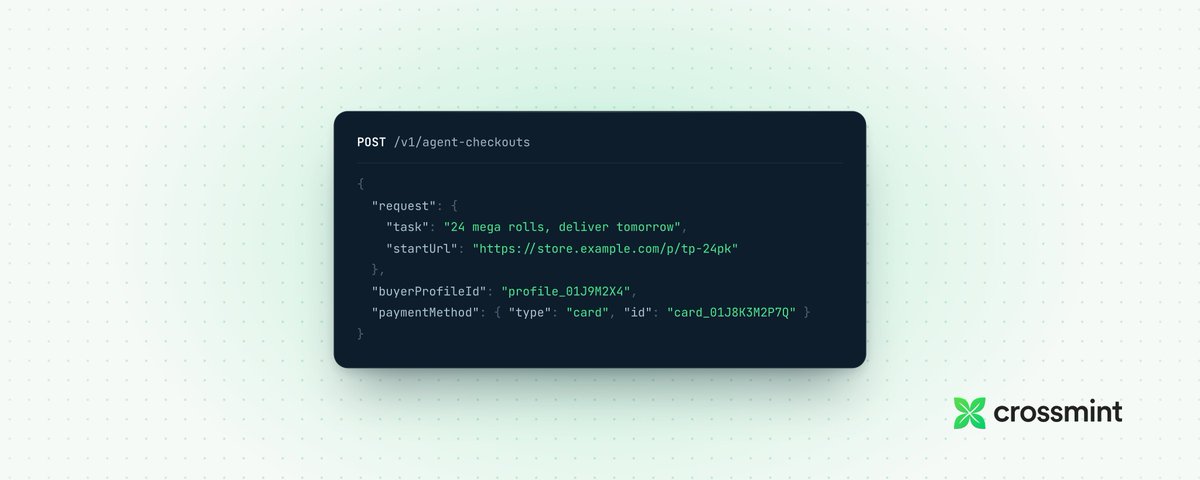
Crossmint launches Agent Checkouts, letting AI agents buy from online stores through one API that handles checkout, payment, and automation
Early Waves: Bots, Rebalancers, and CeFi Automation
Before on-chain agents and AI smart contracts, most crypto automation revolved around trading bots and portfolio tools tied to centralized venues. These systems popularized the basic idea that in a 24/7 market, machines would be better suited than humans to execute repetitive strategies and maintain discipline.
Exchange Trading Bots and Portfolio Tools
Trading bots on centralized exchanges were among the first widely adopted forms of crypto automation. Services like Cryptohopper allowed users to connect their exchange accounts via API keys and configure bots that trade according to technical indicators, DCA schedules, or copy-trading signals. The platform advertises support for major exchanges along with features like trailing stop-loss, trailing buy, and portfolio management, aiming to encapsulate much of what an active trader might do manually into automated workflows. For many retail users, this was their first exposure to the idea that “code can trade for you” in crypto.
These CeFi-oriented bots largely operated off-chain, interacting only with exchange order books rather than smart contracts. Nonetheless, they introduced critical concepts like risk limits, paper trading, and backtesting, giving users tools to experiment with automation before committing real capital. Some services offered marketplaces for strategies or signal providers, hinting at a future where strategy design could be separated from execution, and where bots become a distribution channel for quant expertise. This CeFi bot ecosystem set expectations that crypto trading should be automatable, convenient, and customizable, even if underlying custody and settlement remained centralized.
As users grew more comfortable with automation, demand rose for portfolio-wide tools that could operate across multiple exchanges and wallets. Crypto asset management platforms started integrating both centralized and decentralized holdings, enabling users to see their net exposure and PnL in one place. These platforms often bundled automation features like periodic rebalancing, stop-loss triggers, or alerting systems that could feed into bots. Over time, the line between “dashboard” and “automation engine” blurred, as interfaces became orchestration layers for scripts and bots operating behind the scenes.
Rebalancing and Risk-Based Automation
Rebalancing is a clear example of how automation can encode long-term risk preferences into day-to-day market behavior. In traditional investing, rebalancing means periodically adjusting a portfolio to maintain predefined asset allocation percentages, such as 60% equities and 40% bonds. In crypto, rebalancing bots automate this process across digital assets, buying and selling to keep a portfolio aligned with target weights as volatility causes allocations to drift. These bots can operate on fixed time schedules or threshold-based triggers, for example rebalancing only when an asset deviates more than a set percentage from its target weight.
Rebalancing tools are often marketed as risk management rather than alpha generation. They help investors systematically sell winners and buy losers, counteracting the tendency to chase momentum or panic during drawdowns. Articles comparing crypto rebalancing platforms emphasize steps such as defining target allocations based on risk tolerance and goals, choosing a reliable platform with strong security, connecting via API while disabling withdrawal rights, and monitoring early performance to ensure rules behave as intended. The focus on disabling withdrawal rights is particularly important, since it reduces the potential damage if a platform is compromised or misconfigured. This reflects a broader theme in crypto automation: the need to separate trading authority from custodial authority wherever possible.
Rebalancing automation also foreshadowed more complex, risk-aware automation in DeFi. Once users saw that bots could maintain allocations, it became natural to ask whether similar systems could automatically adjust leverage, rotate between yield strategies, or exit positions based on on-chain risk signals. In many ways, rebalancing bots acted as a bridge between simple, rule-based automation and the more sophisticated risk engines now emerging at the protocol level.
Asset Management Dashboards and DeFi Visibility
As DeFi exploded, users began to hold assets across lending protocols, DEX LP positions, staking contracts, and governance tokens. Traditional portfolio tracking tools struggled to capture this complexity, leading to a new generation of DeFi-focused asset management dashboards. Platforms like Zapper and DeBank emerged as specialized solutions to provide visibility into DeFi-specific assets, often outperforming legacy platforms in tracking LP shares, yield farming positions, and protocol-specific derivatives. These dashboards help users understand where their capital lives across chains and protocols, a prerequisite for meaningful automation.
These tools increasingly integrate automation features or connect to automation platforms. A dashboard might allow users to set alerts on health factors in lending protocols, configure auto-claim and auto-compound functions for farming rewards, or trigger migrations when yields drop below a threshold. Even when they do not execute transactions directly, dashboards often become the control panels through which users configure rules that other bots carry out. Over time, visibility and automation become intertwined: without reliable data across chains and protocols, automation is blind; without automation, dashboards are relegated to passive monitoring.
The interplay between CeFi bots, rebalancing tools, and DeFi dashboards set the stage for a new phase: moving execution on-chain and embedding automation inside protocols and smart contracts themselves. That transition brings new benefits, such as trustless execution and composability, but also introduces new types of risk that arise when automation is no longer merely an external script but an integral part of the financial logic.
Readers click automation stories most heavily when the pitch is 'control without complexity' — zero-setup AI agents, keyless on-chain DCA, and Safe-wallet defaults all outperform generic 'AI will reshape DeFi' think-pieces, revealing that the barrier readers want removed is custody friction, not raw capability.
On-Chain Automation Infrastructure
On-chain automation infrastructure aims to make smart contracts respond automatically to changing conditions without needing a human to manually trigger every state change. This layer is where oracles, keeper networks, and protocol-native automation frameworks come together.
Oracles, Keepers, and Automation Services
At the heart of on-chain automation are networks that feed data and trigger transactions. Oracles like Chainlink deliver external data, such as price feeds, into smart contracts, while automation services—sometimes called keepers—monitor conditions and execute pre-specified functions when thresholds are met. For years, Chainlink Automation (formerly Keepers) served as a generalized service that dApps could use to schedule tasks, perform upkeep, or trigger maintenance functions at predictable intervals or in response to on-chain state changes.
However, automation services themselves evolve, and they can also be deprecated. Chainlink is retiring its Automation service, prompting protocols and users who rely on it for tasks such as veTHE management to cancel their existing automations and withdraw LINK from the system by a specified deadline. This episode underlines a subtle but important reality: delegating automation to a third-party network creates dependencies that must be actively managed over time. When a core automation provider sunsets a product, anyone who fails to migrate could see scheduled tasks stop working or collateral remain unmanaged, with potentially serious financial consequences.
Protocols like Aave are now integrating more specialized automation via the Chainlink Runtime Environment (CRE), creating automated guardians that respond to adverse risk signals. Aave’s framework includes an Automated Freeze Guardian that can halt a reserve when a hard adverse signal is detected, as well as a Supply and Borrow Cap Oracle that automatically tightens exposure by pulling caps down as an asset’s risk surface worsens. These mechanisms, owned by the Aave DAO, are defensive by design: they can autonomously restrict risk, but relaxing those constraints requires human governance review. This balance between automated defense and human-controlled loosening reflects an emerging pattern in on-chain automation design.
Protocol-Native Automation: Aave, CoW Protocol and Beyond
Protocol-native automation embeds logic directly into smart contracts so that certain actions occur automatically under defined conditions. Aave’s proposed new risk framework illustrates how deeply this approach can shape a major DeFi protocol. Prepared by risk firm LlamaRisk, the framework is structured into four layers—Asset Risk, Bridging Risk, Monitoring and Automation, and Chain Risk—and is designed to be binding across Aave V3, V4, and Aave Horizon. Asset Risk includes hard-block conditions such as a minimum bug bounty floor of 50,000 USD-equivalent for critical vulnerabilities, regardless of total value locked. Bridging Risk requires a minimum of three independent verifiers on any bridge route carrying Aave exposure, directly addressing failure modes revealed in a major bridge exploit.
Layers focused on monitoring, automation, and chain risk determine whether Aave should deploy on a given chain at all and how it should dynamically adjust parameters over time. Together, they showcase automation as a central component of protocol risk governance rather than a peripheral convenience. Beyond risk controls, Aave has extended Chainlink-based automation to its DAO governance processes across many chains, reportedly automating certain cross-chain governance actions to ensure that votes and parameter changes propagate reliably in a multi-chain environment. This is automation not just of markets but of governance itself, signaling a future where DAOs increasingly automate their own operational routines.
CoW Protocol’s Programmatic Orders offer another example of protocol-native automation, but oriented toward trading rather than risk management. Programmatic Orders are described as “orders that create more orders,” requiring only a single signature from the user to define a strategy that then executes when on-chain conditions—such as prices, volumes, balances, or timestamps—are met. For instance, a user can create two linked orders such that when one side fills, the acquired tokens automatically move to the opposite side, enabling recurring buy-sell cycles without requiring users to sign every leg. This approach keeps execution logic on-chain and ensures that strategy behavior is transparent and auditable.
Similar ideas are emerging in other DeFi protocols, where recurring payments, streaming yields, or automated re-collateralization are implemented at the contract level rather than offloaded to off-chain bots. When automation is protocol-native, it benefits from the same trust guarantees and composability as the rest of the protocol, but it also makes the protocol more complex and increases the importance of robust audits and risk frameworks.
Programmatic Orders, Recurring Trades, and Treasury Flows
Beyond individual user trading strategies, automation is reshaping how DAOs and treasuries manage funds. Programmatic order frameworks can allow DAOs to define recurring swap patterns—for example, converting a portion of revenue into stablecoins or into a governance token buyback program—without needing to pass and execute a new proposal every time. With a single authorization, a DAO can codify “orders that create more orders,” aligning long-term economic policies with on-chain execution.
Automation is also entering the realm of unified lending stacks and credit systems. Projects like Rialo have proposed on-chain lending architectures that use native data access, private computation, and automation to replace fragmented consumer credit systems. By automating loan underwriting, repayment scheduling, and risk monitoring on-chain, such systems aim to increase scalability and consistency while potentially reducing reliance on traditional credit bureaus. This is another facet of how automation moves beyond trading to remodel the underlying machinery of credit and capital allocation.
CoW Protocol’s recurring orders show how protocol-native automation can reduce the need for third-party services, but it does not eliminate the need for external infrastructure entirely. Many protocols still rely on oracles, keeper networks, and off-chain compute to trigger certain flows. There is an emerging design space in deciding which components should be purely on-chain and which should be handled by off-chain agents or AI models, particularly when complex data or computation is involved. This brings us to the next frontier: the rise of AI agents and agentic finance.
The Rise of AI Agents and Agentic Finance
The latest phase of crypto automation involves AI agents that do more than follow simple rules. These agents can interpret natural language instructions, learn from data, and interact autonomously with on-chain systems, moving crypto from scripted workflows toward adaptive, agentic finance.
From Simple Bots to Autonomous Agents
Traditional bots are deterministic; they implement explicit “if X then Y” logic across predefined data sources. AI agents, by contrast, can bundle large language models, reinforcement learning, and other machine learning techniques to generate actions based on goals rather than fixed rule sets. In crypto, this might mean an agent that monitors a portfolio, reads protocol documentation, interprets governance proposals, and decides when to move funds or vote—all based on high-level objectives specified by a user or organization. Agent-based systems like Sodabot AI, which focuses on task automation and AI-driven execution within the PROM ecosystem, exemplify this trend. PROM describes its role as building the economic layer that enables such agents to transact, coordinate, and exchange value through programmable payments, directly linking automation with native crypto value flows.
CoinGecko’s collaboration with OpenClaw demonstrates how AI agents can be applied to trading and monitoring workflows. By combining CoinGecko’s market data APIs with OpenClaw’s AI crypto trading agent, users can set up fully automated backtesting and live trading workflows. The CoinGecko CLI is highlighted as a tool that is particularly well-suited for automating backtesting, allowing agents to pull historical and real-time data, evaluate strategies, and iterate on them continuously. These integrations hint at a future where agents are not just executing pre-coded strategies but are actively designing, testing, and refining strategies in response to changing markets.
On-chain AI agents go a step further by executing tasks directly on-chain or via verifiable computation layers connected to the blockchain. An on-chain AI agent architecture can ensure that actions are transparent, auditable, and subject to cryptographic guarantees while still leveraging powerful off-chain models. By combining verifiable computation with smart contracts, such systems allow for more complex, adaptive behavior without compromising the core properties of blockchain execution.
Self-Custodial AI with Wallets and Payments
A particularly striking development is the emergence of AI agents that can create wallets, manage their own balances, and pay for infrastructure autonomously. Alchemy has announced a platform where AI agents are able to generate their own wallets, make payments using USDC, and access blockchain data without human intervention. Running on the Base network for low fees and fast confirmation times, this system is designed as a closed loop: when an agent’s credits run low, the platform sends a payment request and the agent itself initiates a USDC payment to top up, enabling continuous, self-funded operation. This model opens up new possibilities for DeFi bots, trading bots, and financial AI that can operate end-to-end without manual human input.
At the institutional end of the spectrum, Anchorage Digital has introduced “Agentic Banking,” which gives AI agents compliant access to capital across both crypto and traditional financial rails. In this framework, AI systems can engage in activities like mortgage lending, on-chain settlement for alternative trading systems, and other capital flows, all within regulatory-compliant structures. This merging of agentic AI with regulated custody and banking infrastructure foreshadows a world where AI not only interacts with DeFi protocols but also with fiat-denominated assets and real-world credit markets.
These developments raise profound questions about agency, liability, and security. An AI agent that can hold and move funds is, in effect, an economically active entity. If such an agent makes a harmful decision, who is responsible: the developer, the user who configured it, or the agent’s training dataset? Similarly, if an agent’s wallet is compromised, or if its self-pay mechanisms interact poorly with volatile markets, the resulting losses could be both rapid and opaque. These risks are already being debated as platforms like Alchemy’s self-paying agents and Anchorage’s agentic banking move from concept to production environments.
AI Smart Contracts and Adaptive DeFi
AI smart contracts are another key piece of the agentic finance puzzle. Traditional smart contracts are static: once deployed, their logic does not change, even if the environment does. AI smart contracts aim to overcome this limitation by integrating machine learning models, AI agents, and real-time data streams into smart contract workflows. In this model, the smart contract remains the arbiter of state changes, but external AI components inform decision-making, evaluate complex conditions, or suggest optimal parameter updates based on data-driven insights.
According to security firm CertiK, AI smart contracts combine standard on-chain logic with AI-driven components that can enable adaptive behavior, automated validation, and outcome optimization. Where a traditional DeFi contract might liquidate a loan based on a simple price threshold, an AI-augmented system could consider volatility patterns, order book depth, and cross-asset correlations before deciding whether and how aggressively to adjust collateral requirements. AI could also help protocols tune parameters like interest rate curves, collateral factors, or incentive distributions based on evolving market conditions.
However, integrating AI into smart contracts introduces new risks. CertiK warns that AI smart contracts expand the attack surface, increase integration complexity between blockchain and AI systems, and depend heavily on data quality and model reliability. Some AI-driven decisions may be difficult to explain, complicating auditability and regulatory oversight. As adoption grows, it becomes essential to validate not only the smart contract code but also the AI models, training data, and data pipelines, as well as to ensure secure integration with oracles and APIs. Continuous monitoring for anomalous behavior becomes crucial, as both on-chain and off-chain components must be watched for manipulation or malfunction.
Despite these challenges, the potential benefits of AI-enhanced automation are significant. AI agents could help detect early signs of market manipulation, identify protocol vulnerabilities through anomaly detection, or optimize gas usage across complex transaction bundles. With models such as Claude Opus 4.7 powering new waves of enterprise automation, and agent templates from companies like Anthropic and OpenAI enabling rapid deployment of specialized financial agents, crypto is well positioned to become a testbed for AI-augmented financial infrastructure.
Dark Factories and the “Dark” Side of Automation
While much of the crypto conversation focuses on financial automation, developments in the broader economy provide a cautionary backdrop. RebuilderAI’s VRING:ON initiative, for example, aims to build a “dark factory” for footwear, where AI handles the entire design-to-manufacturing pipeline and robots operate in largely uncrewed production environments. This concept builds on a trend toward “lights-out” or “dark” factories, where automation and robotics enable near-total automation, allowing production lines to run overnight without human workers present. Such factories illustrate both the power and the societal risks of extreme automation, including job displacement and opaque decision-making in production.
Similar concerns are beginning to surface in digital and creative domains. Tools like Google Stitch, which can design entire app interfaces in seconds from minimal input, raise questions about AI-driven design automation and the future role of human designers. When translated into finance and crypto, these trends suggest a future where not only trading but also protocol design, interface creation, and governance decision-making could be heavily automated. Newsroom coverage has already highlighted AI job automation risks, noting that skilled workers in fields from finance to software development face displacement as AI takes over routine and even complex tasks.
Crypto sits at the intersection of these shifts. On one hand, DeFi’s “dark finance” variant could see uncrewed protocols, agentic DAOs, and autonomous treasuries operating continuously with minimal human oversight. On the other hand, observers such as Blocmates have questioned whether crypto’s “human layer” is fading as bots and AI reshape participation, culture, and decision-making across Web3 ecosystems. Combining this with DWF Ventures’ exploration of whether AI agents will take over DeFi, highlighting automation, on-chain execution, and autonomous financial decision-making, we see a field grappling with the possibility that human traders, voters, and builders might become secondary to code and agents.
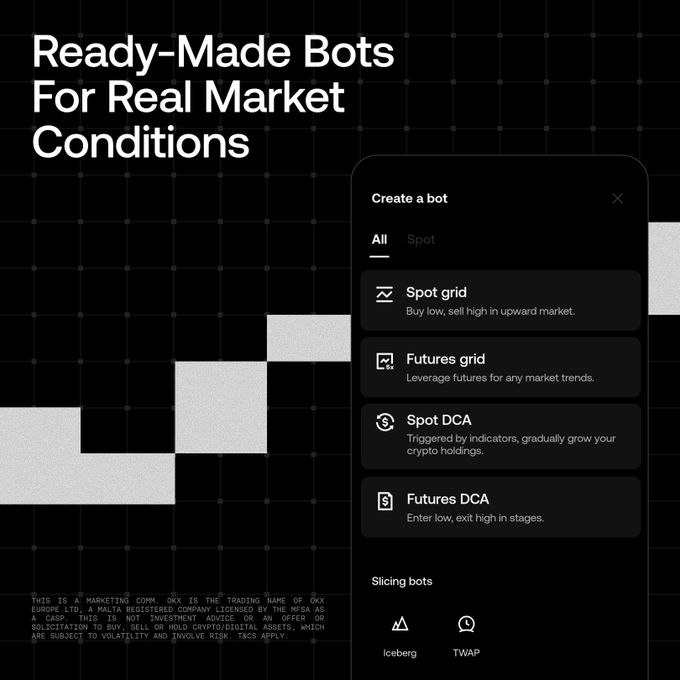
OKX says its trading bots are ready for the next market move, offering 24/7 automation
Benefits of Crypto Automation
Despite the risks, the benefits of automation in crypto are substantial and help explain its rapid adoption. Automation makes markets more efficient, opens access to sophisticated strategies, and can enhance risk management when properly designed.
Efficiency, Composability, and 24/7 Execution
The most immediate benefit of automation is efficiency. Automated bots, agents, and protocol-native routines can react to market changes in milliseconds, far faster than any human. This speed helps reduce arbitrage gaps between exchanges, align prices across fragmented liquidity pools, and keep lending markets closer to equilibrium. In many cases, arbitrage bots are essential to DeFi’s functioning, ensuring that prices on AMMs track those on centralized exchanges and that liquidations occur promptly when loans become undercollateralized.
Automation also enhances composability. When protocols expose clear interfaces and guarantees, bots and agents can chain together multiple protocols—such as DEXs, lending markets, and derivatives platforms—into complex strategies. This “money Lego” phenomenon is amplified by automation, as agents can coordinate multi-step workflows that would be infeasible manually. For example, an agent might borrow against collateral on one protocol, swap assets on a DEX, provide liquidity on another platform, and stake LP tokens for governance rewards, all in response to a single high-level instruction from a user.
The 24/7 nature of crypto markets means that these benefits are not limited to business hours. Automated systems keep functioning during holidays, late nights, and times of extreme volatility, often providing the only reliable response to sudden shocks. As seen in multiple market events, on-chain liquidators and arbitrageurs help maintain protocol solvency and price consistency, sometimes at the cost of concentrated power among those who can build and run the most advanced bots. Nonetheless, the overall system would likely be less stable without these automated actors.
New Products, New Participants, and Financial Inclusion
Automation lowers barriers to sophisticated financial behavior. Retail users, who may lack the time or expertise to trade actively, can use rebalancing bots to maintain long-term allocations aligned with their risk profile. They can also subscribe to recurring investment strategies, automate yield farming position rotations, or delegate trading to algorithmic or AI agents that interpret on-chain data and market conditions for them. In principle, this can democratize access to strategies that resemble those used by professional traders.
Across borders, automation can support new forms of financial inclusion. Payment gateways like Alchemy Pay, which bridges fiat and crypto, rely on automated fraud detection and risk control measures to provide seamless registration and transaction experiences while minimizing abuse. As agentic systems expand, they may allow underserved users to access automated savings, credit, and remittance products that operate on-chain but are mediated through AI-driven interfaces or local fintech partners. Agentic banking innovations, such as Anchorage Digital’s model, show how AI agents can be given compliant access to capital, potentially enabling new credit models and financial services in both developed and emerging markets.
Automation also enables new product categories entirely. Agentic AI platforms like Topia’s Horizon aim to automate complex workflows around global mobility and compliance, showing how smart contracts and on-chain automation can be used outside pure finance. In crypto proper, products such as MoneyFlare’s AI crypto app highlight growing demand for tools that blend portfolio analytics, automation, and AI guidance, particularly amid volatile markets. These products create new revenue streams for builders and new ways for users to interact with crypto, often through natural-language interfaces powered by large language models.
Automation as a Risk Tool, Not Just a Profit Engine
Although many think of bots primarily as profit-seeking trading tools, automation can be just as important for risk management. Aave’s new risk framework is a case in point. By imposing minimum bug bounty levels, bridge verifier requirements, and automated responses to adverse risk signals, Aave uses automation to enforce conservative risk standards across its protocol. The Automated Freeze Guardian and Supply/Borrow Cap Oracle, built on the Chainlink Runtime Environment, are designed specifically to tighten exposure when risk surfaces degrade, allowing the protocol to react quickly to emerging threats.
Automation can also improve risk practices at the user and DAO level. Rebalancing bots help prevent portfolios from becoming accidentally overexposed to a single asset or sector. Automated limit orders and stop-loss mechanisms can reduce downside risk by exiting positions when prices fall beyond preset levels. Programmatic orders in protocols like CoW can encode disciplined trading behaviors, such as dollar-cost averaging into or out of positions, even when users are offline. For treasuries, recurring automated swaps or diversification routines can ensure that DAOs do not leave their entire budget in volatile governance tokens.
Additionally, automation can help detect anomalies and security threats. AI agents trained on blockchain data can monitor for unusual transaction patterns, potential exploits, or suspicious governance proposals. Combining such agents with automated responses, like pausing contracts or adjusting parameters, could provide an early-warning system for DeFi protocols. The key challenge is to design these systems to minimize false positives and avoid situations where an attacker can trigger harmful automated reactions, such as unnecessary freezes or panic sell-offs.
- 01AI agents replacing legacy trading bots↗
The Clawdbot challenger headline and the Stoic/Botty/CryptoHopper roundup together drove the most clicks by framing a concrete generational handoff — readers want to know which tool wins, not how AI works in theory.
- 02Self-custodial on-chain automation
Vultisig's keyless Plugin Marketplace and DeFi Saver's Safe wallet defaults both landed strong clicks by promising DCA, payroll, and strategy automation across 30+ chains without ever exposing private keys — custody without compromise.
- 03Cross-chain BTC entering DeFi via automation
Hashi positioning Sui as the gateway for $1.4T in BTC to access DeFi via smart contracts and cross-chain automation tapped persistent reader hunger for Bitcoin finally becoming a productive yield asset.
- 04Protocol governance automated at scale
Aave automating DAO governance across 18 chains via Chainlink and QiDao's veAERO voting relay showed readers that automation is migrating from trade execution up to the governance layer itself.
- 05Anti-bot backlash and platform degradation
CZ calling for X to ban API bots and Gen Z's 'Clanker' movement against machine-made content drew near-equal clicks, revealing a readers segment worried that automation is hollowing out platform culture.
- 06White-collar automation shock
Anthropic data showing AI can already handle much of white-collar work — framed as a sudden shock for unprepared professionals — attracted clicks from readers assessing their own displacement risk, not just crypto exposure.
Risks, Failure Modes, and Governance Challenges
With greater automation comes greater responsibility. Crypto automation introduces technical, economic, governance, and social risks that must be understood and managed.
Technical and Security Risks in Automated Systems
Technically, automated systems are only as secure as their weakest component. AI smart contracts, as described by CertiK, expand the attack surface because they rely on off-chain models, data pipelines, and integration points in addition to on-chain code. If an attacker can manipulate the data feeding an AI model or exploit a vulnerability in the AI infrastructure, they may influence on-chain decisions in their favor. Poor-quality data can lead to erroneous outputs and misaligned actions, and the limited explainability of some AI models can make it hard to diagnose why a certain decision was made.
Even relatively simple automation introduces security concerns. Rebalancing platforms advise users to connect via API with read and trade permissions only, strictly disabling withdrawal rights to protect funds. This separation of concerns is important because if a bot or platform is compromised, the attacker can at worst mis-execute trades rather than drain the entire account. In decentralized contexts, smart contract bugs in automation logic can cause funds to be stuck, misallocated, or lost. A protocol-native automation framework must receive the same level of audit scrutiny as core financial logic, since it can trigger critical actions like liquidations, cap adjustments, and emergency halts.
Dependencies on external automation providers create additional risks. The retirement of Chainlink Automation demonstrates that even widely used infrastructure can change or be sunset, forcing protocols and users to migrate. Failing to cancel automations or withdraw funding tokens like LINK before a shutdown could leave funds locked or tasks unexecuted. Protocols that encode assumptions about the perpetual availability of a given automation network may face brittle failure modes when those assumptions no longer hold.
Self-funding AI agents, such as those enabled by Alchemy’s self-pay system, raise novel security questions. If an agent can autonomously pay for its own compute and data access, then an attacker who gains partial control over the agent’s decision-making might be able to direct it to exhaust funds on malicious or unnecessary services. Moreover, if the agent’s wallet keys are compromised, an attacker could hijack both the agent’s operations and its funding loop. Ensuring robust key management, circuit breakers, and spending limits for such agents will be crucial.
Economic, Market, and Protocol-Level Risks
Automation does not only fail due to bugs; it can also behave as designed but still cause undesirable economic outcomes. High-frequency arbitrage and liquidation bots can increase market efficiency but also contribute to sudden cascades during stress events. When multiple automated systems respond to the same signals—such as price drops, rising volatility, or oracle updates—they may crowd into similar trades, amplifying volatility and causing slippage or liquidity crunches.
AI-driven strategies introduce additional complexity. If many agents are trained on similar datasets and rewarded for similar performance metrics, they may converge on comparable behaviors, increasing systemic risk. For example, if multiple agents learn that exiting certain long positions rapidly during a downturn historically preserved capital, they might all attempt to exit at once in a future crash, exacerbating the decline. Unlike traditional bots with transparent rules, AI agents may exhibit emergent behaviors that are hard to foresee, complicating risk management at the protocol and ecosystem level.
On the protocol side, automation embedded in risk frameworks must be calibrated carefully. Aave’s Automated Freeze Guardian and cap oracles are defensive, but if their triggers are too sensitive, they could unnecessarily restrict activity, reduce liquidity, or harm user confidence. If triggers are too lax, they may fail to prevent damage during fast-moving exploits. Similarly, automated bridge gating and chain risk assessments can reduce exposure to risky environments, but if they overcorrect, they may slow innovation or fragment liquidity further.
The emergence of automation-focused platforms like B3OS—designed as crypto operations automation systems—introduces their own trade-offs. While B3OS aims to make blockchain the core automation anchor for crypto operations and DAOs, coverage has noted concerns about scalability, security, and high costs. Centralizing critical automation workflows into single platforms or frameworks can create concentration risk: if one automation layer fails or is compromised, the impact could propagate across many protocols or organizations that rely on it.
Social and Labor Implications: Is the Human Layer Fading?
Beyond technical and economic considerations, automation raises fundamental questions about the role of humans in crypto ecosystems. Commentators like Blocmates have raised concerns that crypto’s “human layer” may be fading as bots, MEV searchers, and AI agents increasingly dominate trading, governance participation, and cultural dynamics in Web3. Retail traders can find themselves competing not with other humans but with sophisticated bots that co-locate infrastructure, optimize gas bidding, and exploit arbitrage opportunities unavailable to the average user.
In governance, automation can also change participation patterns. Delegated voting, automated execution of governance-approved actions, and even AI systems that analyze proposals and cast votes on behalf of token holders can reduce the need for humans to read and decide on each item. While this can enhance efficiency and ensure that governance actually takes action, it risks reducing deliberation and turning governance into an automated process driven by a small group of technical operators or AI designers.
The broader economy offers a warning. Studies and news coverage have highlighted that automation and AI are likely to displace millions of jobs in the coming years, with a net loss in certain sectors as machines take over tasks from manual assembly to financial analysis. RebuilderAI’s dark factory initiatives, Google Stitch’s automated design capabilities, and Anthropic’s automation of routine tasks on Wall Street illustrate that both blue-collar and white-collar roles are in scope. Crypto, as both a financial system and a technology sector, is at the center of this shift: its own workforce—traders, developers, analysts, even designers—may find parts of their jobs handled by AI agents.
At the same time, automation can create new roles and opportunities. Agents need to be configured, monitored, and governed. Protocols need security engineers, risk modelers, and governance experts to design and oversee automated systems. Ethical and regulatory roles will grow as policymakers grapple with agentic finance. The challenge for the crypto community is to ensure that automation does not merely concentrate power and wealth among those who control the most advanced bots and agents, but instead expands participation and resilience.
Designing and Using Automation Responsibly
Given the stakes, responsible design and use of automation is not optional. Builders and users alike must adopt best practices for security, governance, and ethics to ensure that automated systems advance crypto’s goals rather than undermine them.
Best Practices for Builders
For builders, a layered approach to risk and security is essential. Aave’s framework provides a concrete example of how to integrate automation into a holistic risk strategy. By defining asset risk criteria, bridge risk requirements, monitoring and automation layers, and chain risk gates, Aave sets clear standards that govern asset onboarding, quarterly due diligence, material-change evaluations, and parameter decisions across versions of the protocol. The inclusion of hard-block conditions, like a minimum bug bounty floor, creates strong incentives for external security research and acknowledges that automation alone cannot prevent all bugs.
Builders of AI smart contracts and agents should follow guidance similar to that outlined by CertiK: conduct comprehensive smart contract audits, validate AI models and training data, implement continuous monitoring for anomalous behavior, and secure integration with oracles and APIs. Maintaining auditability is critical, which may require designing AI components to log decision rationales or to expose simplified, interpretable metrics that can be reviewed by humans. Verifiable computation layers can help ensure that off-chain AI computations are executed as expected, but they also add complexity that must be managed carefully.
Automation frameworks should include robust fail-safes and manual override mechanisms. Aave’s Automated Freeze Guardian, for example, can halt reserves defensively when certain risk signals emerge, but loosening those constraints requires human governance through the DAO or designated risk stewards. Similarly, agentic systems should support circuit breakers that can halt operations if unusual activity is detected, as well as configurable limits on position sizes, leverage, and spending. Builders should treat automation as a tool to enforce conservative defaults and guardrails, not just as a way to intensify risk-taking.
Best Practices for Users and DAO Treasuries
Users and DAOs leveraging automation need to understand both the capabilities and the limitations of the tools they adopt. For centralized platform integrations, best practices include using API keys with minimal permissions, disabling withdrawal rights, and starting with small allocations to observe how automated strategies behave in real conditions. Users should regularly review performance and logs, adjusting parameters as needed to keep strategies aligned with their risk tolerance and investment goals.
For DAO treasuries, automation should be aligned with governance processes. Recurring trades, programmatic orders, and automated diversification routines should be governed by explicit mandates, with on-chain transparency about the rules and parameters in use. DAOs should ensure that key automation workflows are documented, that responsibility for monitoring them is clearly assigned, and that emergency procedures exist in case automated systems misbehave. When adopting external automation platforms or agentic services like B3OS or Alchemy’s self-pay agents, DAOs should carefully evaluate counterparty and platform risk, as well as the cost and scalability implications highlighted by critical coverage.
Users considering AI agents to manage personal portfolios should be especially cautious. While products like MoneyFlare’s AI crypto app and CoinGecko’s OpenClaw-based strategies promise convenience and adaptability, the underlying decision-making may be opaque. Users should treat agents like any other delegated manager: evaluate their track record, understand the broad contours of their strategy, and be prepared for periods of underperformance or unexpected behavior. Multi-agent or supervised setups, where an agent proposes actions but a human must approve them, can serve as a transitional model for users uncomfortable with full autonomy.
Regulatory and Ethical Guardrails for Agentic Finance
As AI agents gain the ability to hold wallets and transact, regulatory and ethical questions become central. Agentic banking models like Anchorage’s, which give AI agents compliant access to capital across traditional and crypto rails, showcase one possible framework: agents operate within regulated structures, with clear accountability and oversight. In such setups, KYC/AML, consumer protection, and capital adequacy rules must be adapted to account for AI intermediaries. Regulators will need to decide whether agents are treated as extensions of their human owners, as distinct entities, or as tools operated by regulated institutions.
Payment and on-ramp providers like Alchemy Pay, which already rely on automated fraud detection and risk controls, will likely see growing regulatory attention as they integrate agentic systems. Ensuring that automated onboarding, fraud detection, and transaction monitoring processes are fair, non-discriminatory, and robust against adversarial tactics will be crucial. Privacy considerations also loom large, as agents may process extensive transactional and behavioral data to optimize decisions, raising questions about data governance and user consent.
Ethically, the crypto community must grapple with the implications of pervasive automation for fairness and inclusion. If DeFi’s “automation sails” move from rigid, chart-based rules to AI agents’ adaptive strategies, as some coverage has framed it, then the risk is that only those with access to the most advanced AI will be competitive in on-chain markets. Compliance “reefs” in on-chain waters also pose a challenge, as agentic systems may inadvertently run afoul of evolving regulations or be used for illicit activities if not properly constrained. Open, transparent debate and collaboration among developers, users, regulators, and ethicists will be necessary to chart a responsible path forward.
- 2023-07launch
Chainlink CCIP mainnet launch establishes cross-chain automation infrastructure
- 2024-11milestone
JPMorgan rebrands Onyx to Kinexys, expanding 24/7 automated cross-border FX payments
- 2025-05launch
OpenAI launches Codex-powered Workspace Agents for enterprise report and code automation
RebuilderAI debuts VRING:ON autonomous dark-factory vision at VivaTech 2026
Outlook
Automation in crypto is moving from peripheral convenience to core infrastructure. Trading bots, rebalancers, and dashboards laid the groundwork by demonstrating the value of rule-based, always-on execution. Protocol-native automation frameworks like Aave’s risk layers and CoW Protocol’s Programmatic Orders show how deep automation can be built into DeFi’s financial logic, while AI smart contracts and on-chain AI agents extend this logic into adaptive, data-driven territory. As agentic systems gain the ability to create wallets, self-pay with stablecoins, and access regulated banking rails, the line between “user” and “agent” will blur further.
In the coming years, crypto automation is likely to become more pervasive, more intelligent, and more entangled with traditional finance. Tools from major AI labs will make it easier for enterprises and DAOs to deploy specialized financial agents, while platforms like B3OS and self-pay infrastructures will provide the operational backbone. At the same time, high-profile deprecations like Chainlink’s Automation service remind us that reliance on third-party automation providers must be managed carefully, with migration paths and contingency plans. Risk frameworks will need to evolve to account for AI-driven behavior, agentic dependencies, and cross-chain automation complexity.
Ultimately, whether automation strengthens or undermines crypto’s founding values will depend on how it is designed and governed. If automation is used primarily to reinforce risk controls, democratize sophisticated strategies, and increase transparency, it can make crypto markets safer and more inclusive. If it is used mainly to concentrate power, obscure decision-making, and displace human agency without accountability, it could erode trust and exacerbate inequality. The choices made by builders, users, and regulators in this decade will shape whether automated, agentic crypto becomes a “dark factory” of finance or a more resilient and accessible financial commons.
Latest Automation news
Sources
19 records from 16 domains
cryptohopper.com
3commas.io
x.com
unchainedcrypto.com
ethglobal.com
morningstar.com
coingecko.com
alchemypay.org
cow.fi
financefeeds.com
instagram.com
certik.com
blog.mexc.com
facebook.com
kucoin.com
youtube.com
Community notes
Spot something off or out of date? Drop a note. Editors review topic notes daily and roll accepted fixes into the explainer — contributors are recognized in the monthly $SQUID drop.
Loading notes…
Help improve this topic
Have a story or tip about this topic? Submit it. See something missing? Leave a note. Editors review daily; accepted submissions and fixes count toward the monthly $SQUID drop.