
Chainlink is the dominant decentralized oracle and cross-chain infrastructure network, powering 70%+ of DeFi with data feeds, Proof of Reserve, and CCIP — and expanding into institutional tokenization and prediction markets.
+20 sources across the wider coverage universe
 Pharos Network raises $44M Series A backed by Sumitomo, Chainlink, and Flow Traders to build financial-grade infrastructure bridging TradFi and DeFi globally2026-04
 $58B inefficiency in corporate actions meets solution as Chainlink and banks use AI plus decentralized oracles to automate, verify, and publish financial data onchain2026-04
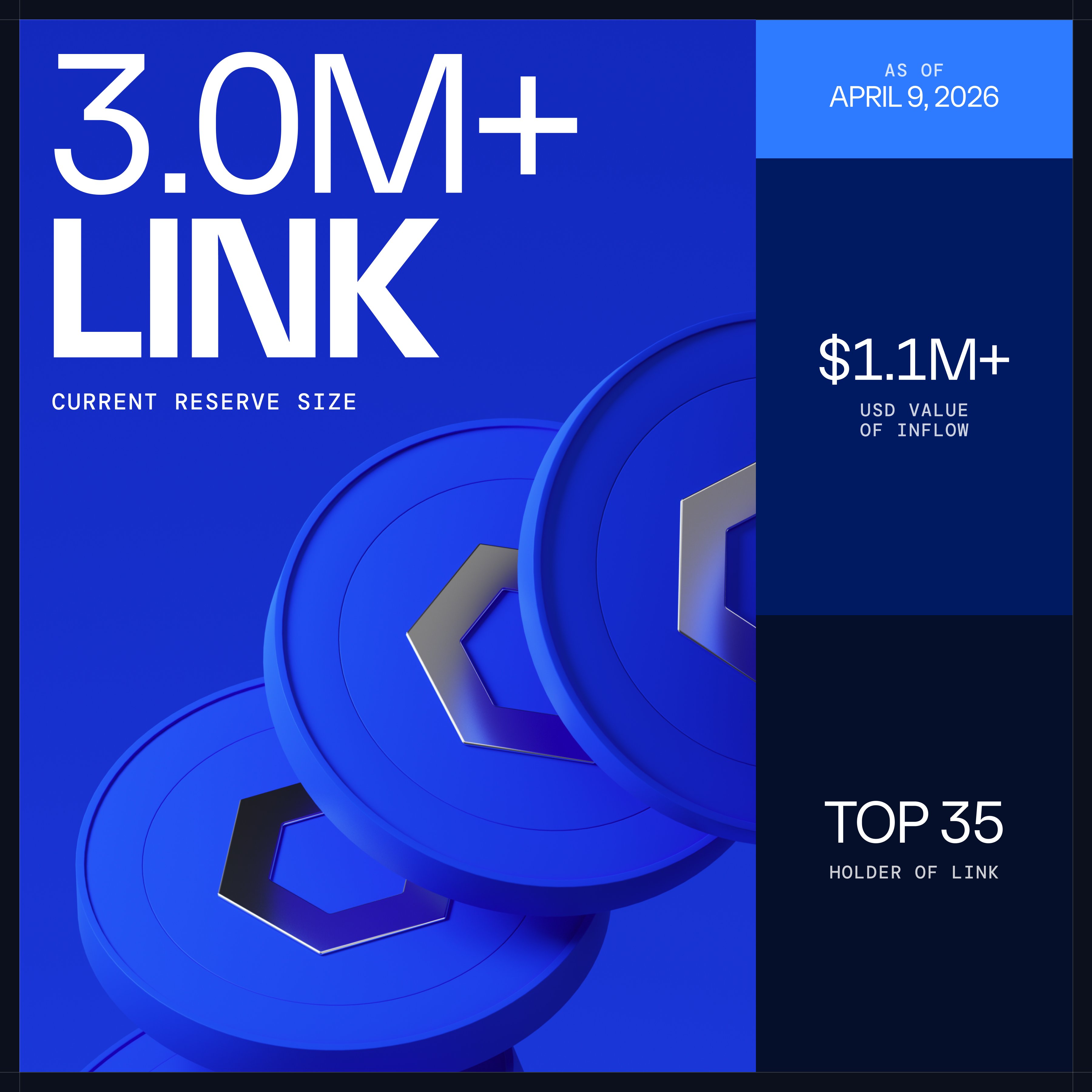 Chainlink Reserve adds 131,656 LINK worth $1.1M+, pushing total holdings above 3M LINK and entering top-35 holders as it accumulates tokens from enterprise and onchain revenue2026-04
 SIX Group taps Chainlink DataLink to bring Swiss and Spanish equity data onchain2026-04
 AWS open-sources architecture bridging SWIFT ISO 20022 financial messaging to onchain settlement via Chainlink2026-04
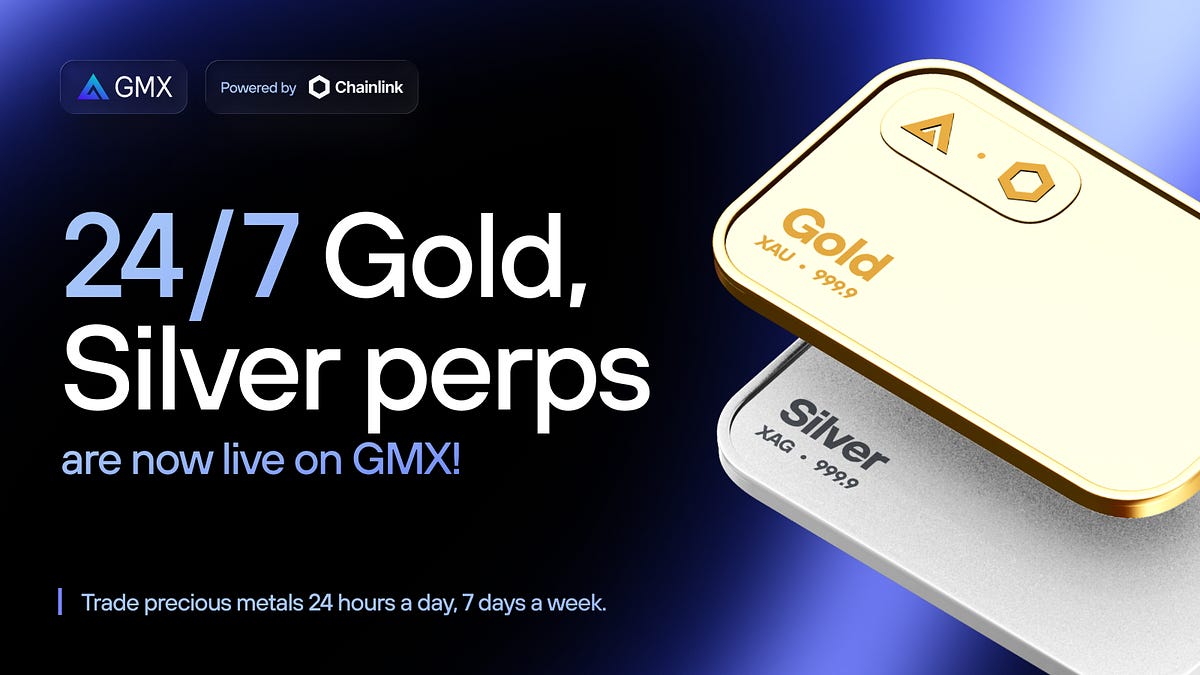 GMX launches 24/7 gold and silver perps with up to 100x leverage, powered by Chainlink2026-04
The decentralized oracle network that connects smart contracts to real-world data, Chainlink has grown from a single price feed into the dominant infrastructure layer linking blockchains to financial markets, institutions, and each other.
What Chainlink Does
Smart contracts are deterministic programs that execute on-chain — they can only read what is already on the blockchain. That creates a fundamental problem: most useful contracts need external information. What is the price of ETH? Has a shipment arrived? Did a sports team win?
Chainlink solves this with a decentralized oracle network: a system of independent node operators that retrieve, aggregate, and deliver external data on-chain in a tamper-resistant way. Rather than trusting a single API, Chainlink aggregates responses from multiple independent sources, stakes the reputation of node operators in LINK tokens, and delivers a consensus answer. If any single source is compromised or manipulated, the aggregate is designed to remain reliable.
Since launching on Ethereum mainnet in May 2019 — starting with a single ETH/USD price feed — Chainlink has expanded to power more than 70% of DeFi protocols across dozens of chains. Seven years in, it is arguably the most critical piece of shared infrastructure in the onchain economy.

DTCC tokenization service for $114 trillion in assets expected to launch in Q4 2026
The Oracle Problem and Why It Matters
The 2020 DeFi boom exposed a dangerous vulnerability: protocols relying on thin or manipulable price feeds were routinely exploited. Attackers would flash-loan large positions, move a price on a low-liquidity DEX, and drain lending protocols that read that single source as ground truth. Tens of millions of dollars were lost.
Chainlink's architecture — aggregating across multiple premium data providers, with cryptographic signatures from each node and economic penalties for bad behavior — became the industry's de facto answer. Adoption accelerated precisely because the alternative was getting hacked.
The same dynamic is now playing out in prediction markets. Monthly prediction market volume grew from roughly $1.2 billion in early 2025 to over $20 billion by January 2026, but resolution infrastructure hasn't kept pace. Bad oracle data means markets can be resolved incorrectly, destroying the trust that makes prediction markets valuable. Chainlink is positioning itself as the resolution layer here, too: its Chainlink Runtime Environment (CRE) is specifically designed for the low-latency, event-driven data needs of prediction markets. Predictstreet, the official prediction market partner of the 2026 FIFA World Cup, runs exclusively on Chainlink oracles — a high-stakes, globally visible test case for the technology.
Readers click Chainlink not for oracle technology itself but for its role as the credentialing layer that legitimizes institutional entry — every high-click story is about a named TradFi giant (Fidelity, JPMorgan, UBS, DTCC, Swift) using LINK infrastructure to cross from legacy finance into onchain rails.
Data Feeds: The Core Product
Chainlink's original and still most widely used product is Data Feeds — aggregated price references for cryptocurrency, forex, commodities, and equities delivered on-chain on a push model (updated whenever price moves beyond a defined threshold or a heartbeat interval passes).
The network now delivers feeds across more than 75 blockchains. SGX FX, Singapore's OTC foreign exchange platform, recently adopted Chainlink DataLink to bring institutional-grade OTC FX rates on-chain, reaching over 2,600 applications across those chains simultaneously. Vayana, India's trade credit platform with over $62 billion in financing volume, uses Chainlink to power tokenized asset distribution across more than 3,000 supply chains. These are not crypto-native use cases — they represent traditional financial infrastructure being moved onchain.
Proof of Reserve (PoR) is a related product: an automated, on-chain attestation of whether a protocol's stated off-chain reserves actually back its on-chain liabilities. IQ and Frax's KRWQ stablecoin — pegged to the Korean won — recently adopted Chainlink PoR for automated reserve checks. The growth of stablecoins and tokenized real-world assets makes this product increasingly critical; without verifiable reserve data, "backed" claims are unauditable.

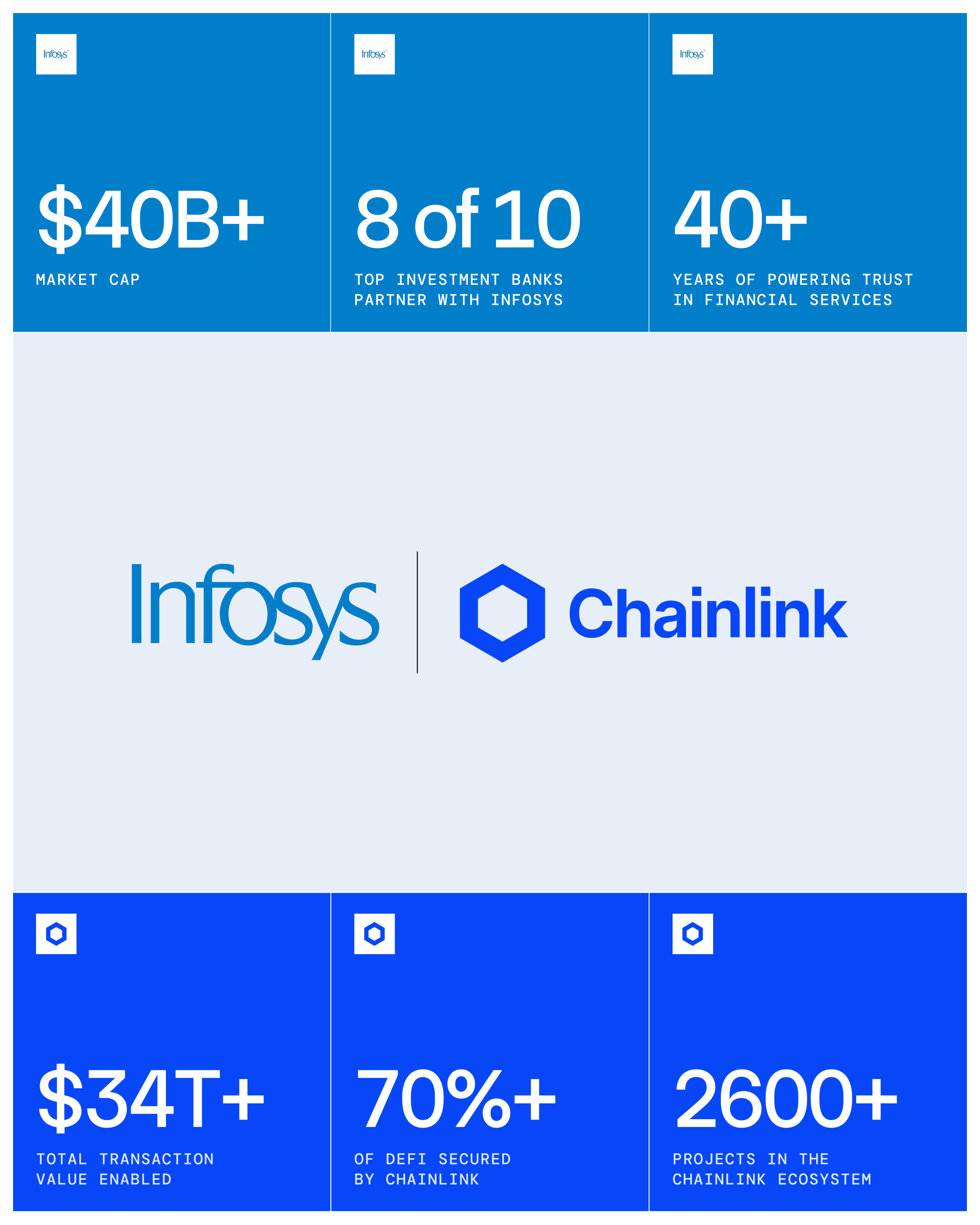
Infosys partners with Chainlink to accelerate institutional onchain finance and standardize adoption of Chainlink’s infrastructure
CCIP: The Cross-Chain Interoperability Layer
The Cross-Chain Interoperability Protocol (CCIP) is Chainlink's answer to the fragmented multichain landscape. Blockchains don't natively communicate with each other — moving assets or messages between Ethereum, Solana, Avalanche, or a bank's private ledger requires a bridge, and bridges have historically been catastrophic failure points (billions lost to exploits).
CCIP provides a standardized messaging and token transfer protocol underpinned by Chainlink's oracle network security model. Unlike point-to-point bridges, CCIP uses a Risk Management Network — a separate set of nodes that independently monitors cross-chain operations and can halt suspicious activity.
The institutional traction here is significant. Mastercard has integrated with Chainlink to route fiat currency directly into on-chain protocols via CCIP — a signal that traditional payment rails are treating cross-chain messaging as a settled infrastructure question, not an experiment. Fidelity International's tokenized fund FILQ, launched with over $1 trillion in client assets under management at Fidelity, uses Chainlink for its data infrastructure. Zest recently used CCIP to bring its ZEST token to Ethereum and Base as weekly upgrade volumes surpassed $1.1 billion.
CCIP expansion continues: Chainlink has deployed to Robinhood Chain's testnet, MegaETH, and Plasma, among other new networks.
Compared to LayerZero — another cross-chain messaging protocol — CCIP distinguishes itself by tying directly into an existing oracle network with its own staking and slashing economics, rather than relying solely on the security assumptions of the chains it connects. Both protocols compete for developer adoption, and the design tradeoffs remain an active debate in the developer community.
- 01TradFi giants adopting Chainlink
Headlines featuring JPMorgan, UBS, Swift, DTCC, Mastercard, and Fidelity using Chainlink for tokenization and settlement drew the highest clicks, signaling readers track institutional validation as the core LINK thesis.
- 02Grayscale LINK premium speculation
A 700% premium on Grayscale's LINK trust surfaced retail demand mechanics around institutional crypto products, pulling readers hunting for price catalysts.
- 03Cross-chain interoperability via CCIP
CCIP integration stories — Aave on ZKsync, GHO stablecoin, Circle USDC, KelpDAO migration after LayerZero hack — showed readers following CCIP as a competitive moat story against bridge rivals.
- 04Whale exit and staking bypass
The 'Oldwhite' whale using 100+ wallets to circumvent staking limits before cashing out $20M attracted readers interested in on-chain forensics and tokenomics stress tests.
- 05Oracle dominance across chains
Chainlink holding 80%+ oracle market share on Ethereum and near-total dominance on Base, Arbitrum, and Optimism drew readers tracking competitive moat and systemic dependency risk.
- 06Regulated stablecoin and tokenized asset infrastructure
Stories linking Chainlink to stablecoin issuance (Fireblocks), tokenized funds (Amundi/Spiko, DTCC pilot), and NAV data (Fidelity, Sygnum) clustered into a thread about LINK as backbone for compliant onchain finance.
The LINK Token
LINK is the native utility token of the Chainlink network. Node operators must stake LINK to participate in data delivery; protocols pay for oracle services in LINK; and the token's value is theoretically tied to demand for Chainlink's infrastructure services.
In practice, LINK's price behavior has followed broader crypto market cycles more than any direct correlation with network usage metrics. Skepticism around some of the token's narratives — including its positioning around ISO 20022 financial messaging standards and as a universal gas token — has grown among some analysts, who argue the connection between network usage growth and token value accrual is not clearly established in the current fee model.
On the supply side, Chainlink's team and investor token allocations have periodically attracted scrutiny. The project has clarified that wallet transfers sometimes flagged as "selling" are pre-scheduled fills of CCIP bridge contracts to provide liquidity for newly launched networks — not insider disposals. That distinction matters, but the recurring need to explain routine operational transfers reflects ongoing community sensitivity around large concentrated holdings.
Bitwise CIO Matt Hougan has identified stablecoins and tokenization as the area generating the most new advisor interest, naming Chainlink as a top beneficiary alongside Ethereum, Solana, and Avalanche — reflecting a view that infrastructure enabling tokenized real-world assets captures value as the sector grows.
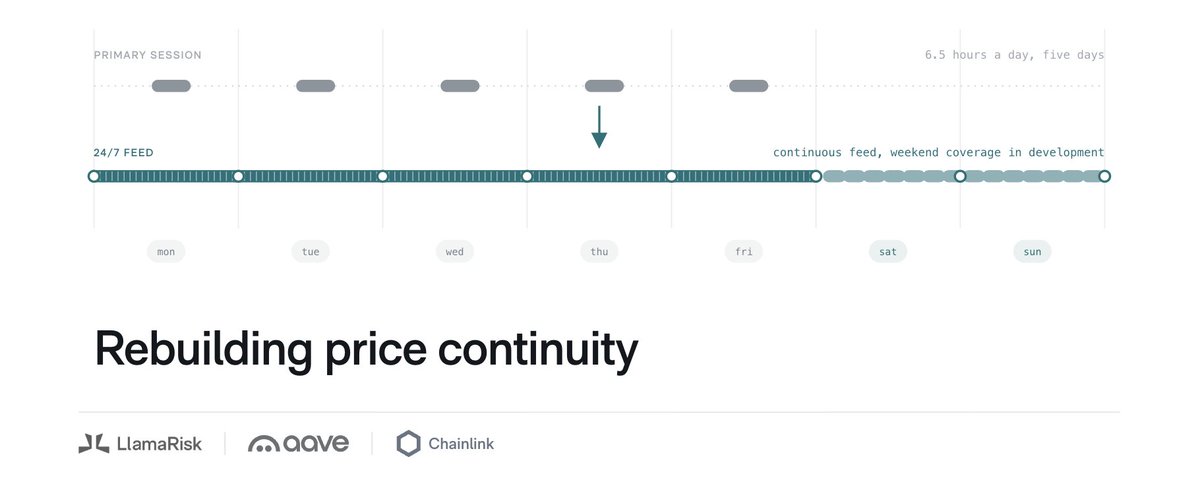
Chainlink and LlamaRisk are rebuilding price continuity for tokenized stocks
Institutional Onboarding and the Tokenization Wave
The clearest long-term thesis for Chainlink is that institutional asset tokenization — putting stocks, bonds, funds, and commodities on blockchains — requires exactly what Chainlink provides: reliable price data, reserve verification, and cross-chain messaging.
The Canton Network, a privacy-preserving institutional blockchain, now involves 55 institutions including Visa, DTCC, Nasdaq, and Circle operating under a shared coordination layer. Chainlink is part of that governance structure. The fact that Nasdaq and DTCC are building on shared infrastructure that includes oracle and cross-chain components underscores how far the institutional conversation has moved from "should we use blockchain" to "which standards do we adopt."
On the tech side, Chainlink has also expanded into the AI infrastructure space, with ChainGPT integrating Chainlink alongside partners including Binance, Google Cloud, and Alibaba Cloud — though this positioning is newer and less proven than its core data and cross-chain work.
The Chainlink Runtime Environment (CRE), still in development, is designed to move beyond passive data delivery into active compute: allowing Chainlink nodes to run arbitrary off-chain logic and return verified results on-chain. For prediction markets, this means an oracle that can fetch, process, and resolve complex event outcomes without relying on a centralized arbitration body.
- 2024-01milestone
Grayscale LINK trust hits 700% premium post-Bitcoin ETF approvals
- 2024-02milestone
JPMorgan settles first public-ledger transaction via Chainlink and Ondo Finance
- 2024-03milestone
DTCC completes fund tokenization pilot with JPMorgan, BNY Mellon, and Franklin Templeton
- 2024-04launch
Chainlink, Swift, Euroclear launch AI-powered corporate actions pilot achieving 100% data consensus
- 2024-06milestone
Visa, ANZ, Fidelity International complete HKMA e-HKD cross-border settlement pilot using Chainlink
- 2024-09milestone
UBS, Swift, Mastercard, JPMorgan, Coinbase standardize tokenization on Chainlink infrastructure
- 2024-11governance
KelpDAO migrates to Chainlink CCIP after DPRK-linked LayerZero infrastructure breach
- 2025-01launch
Amundi and Spiko launch SAFO tokenized mutual fund powered by Chainlink
Infrastructure Deprecation and Network Evolution
Not all of Chainlink's products are moving forward. The network is retiring its Automation service — a product that allowed smart contracts to trigger themselves based on on-chain conditions. Protocols using Automation for tasks like veTHE (vote-escrowed liquidity management) have been instructed to cancel their automation subscriptions and withdraw their LINK before the service ends.
Deprecations like this are normal for maturing infrastructure, but they impose real operational burden on protocols that built dependencies on a specific service. The broader lesson for builders is to account for oracle and infrastructure lifecycle risk in system design — a dependency that seemed permanent can sunset.
Outlook
Chainlink's seven-year arc from a single ETH/USD price feed to the infrastructure layer for institutional tokenization is one of the more consequential buildouts in the industry. The near-term catalyst is clear: as stablecoins scale and tokenized real-world assets move from pilot to production, demand for reliable onchain data and cross-chain messaging should grow in parallel.
The open questions are about value capture. Whether LINK token economics translate network usage into sustainable token demand remains contested. And as competitors in both the oracle space (Pyth, RedStone, API3) and cross-chain messaging (LayerZero, Wormhole) mature, Chainlink's market position will depend on whether its security model and institutional relationships constitute durable moats or temporary first-mover advantages.
For now, the evidence from Mastercard, Fidelity, DTCC, and the FIFA World Cup prediction markets suggests that when reliability is non-negotiable, Chainlink is still the default answer.
Latest Chainlink news
Community notes
Spot something off or out of date? Drop a note. Editors review topic notes daily and roll accepted fixes into the explainer — contributors are recognized in the monthly $SQUID drop.
Loading notes…
Help improve this topic
Have a story or tip about this topic? Submit it. See something missing? Leave a note. Editors review daily; accepted submissions and fixes count toward the monthly $SQUID drop.