
Chainlink's LINK token powers the largest decentralized oracle network, facilitating $30T+ in transactions. Now SEC-designated a commodity and accessible via Grayscale ETF and CME index futures, LINK bridges real-world data to blockchain smart contracts.
+53 sources across the wider coverage universe
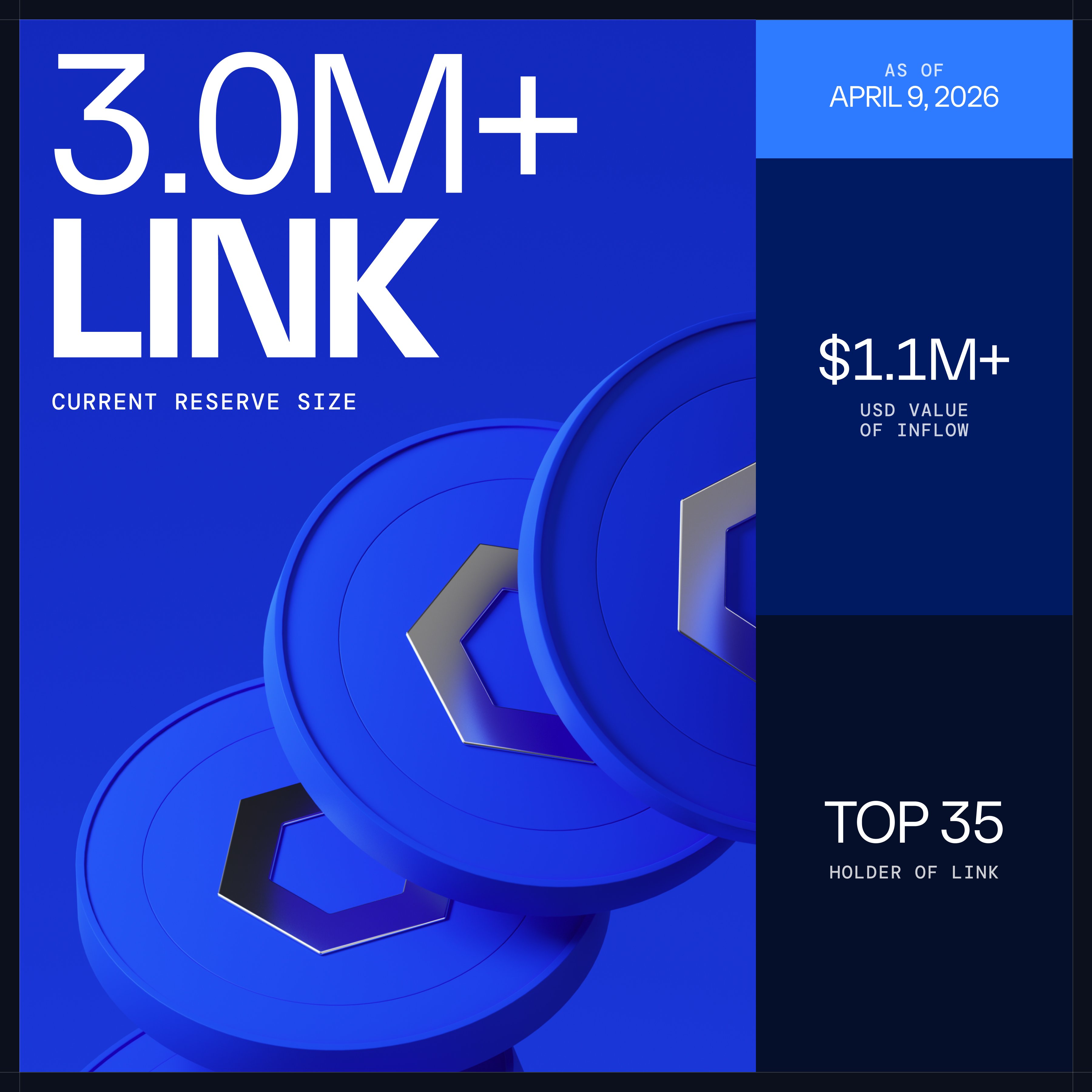 Chainlink Reserve adds 131,656 LINK worth $1.1M+, pushing total holdings above 3M LINK and entering top-35 holders as it accumulates tokens from enterprise and onchain revenue2026-04
 Chainlink’s oracle network has now facilitated over $30T in transaction value while securing nearly $47B in smart contracts, reigniting debate around LINK valuation2026-05
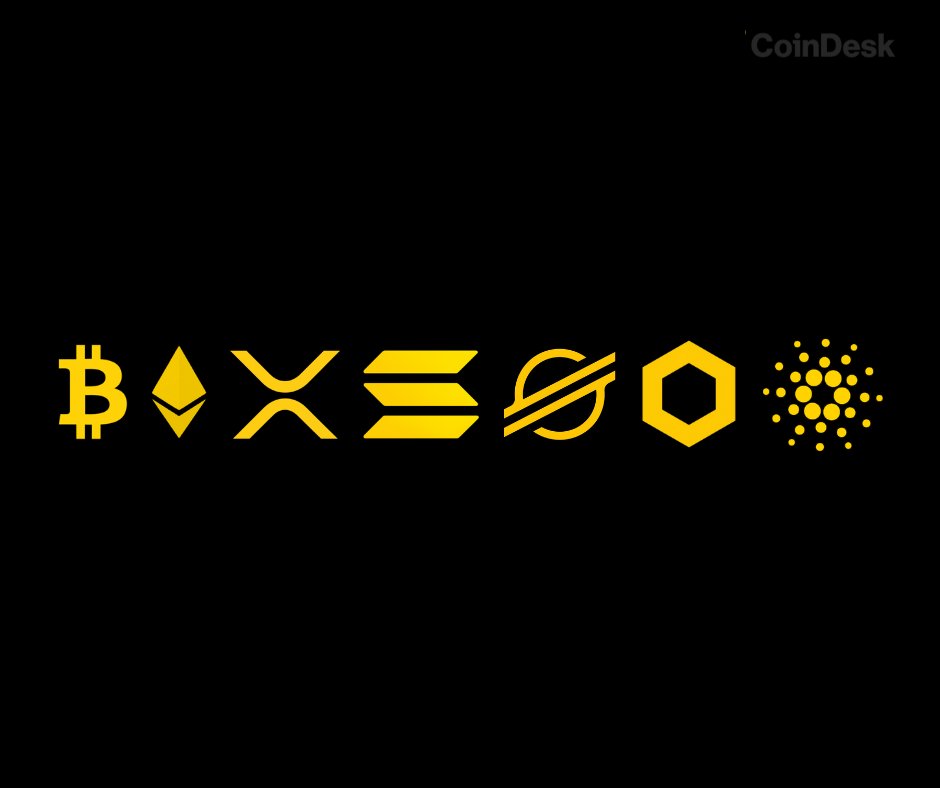 Hashdex expands Nasdaq CME Crypto Index ETF $NCIQ to seven assets, adding $ADA and $LINK alongside $BTC, $ETH, $XRP, $SOL, and $XLM per SEC 10-K filing2026-03
 Kraken and Deutsche Börse formed a major partnership to link traditional markets with crypto, covering trading, custody, derivatives, and tokenization. Phase one brings bank-grade FX liquidity via 360T and expands institutional access across both ecosystems.2025-12
 TradFi giant EquiLend backs Digital Prime to link $40 trillion pool with tokenized markets. The partnership will focus on Tokenet, Digital Prime's institutional lending network, and introduce new features like regulated stablecoin collateral.2025-12
 Chainlink is sliding despite next week’s LINK ETF launch, with price down 53% and exchange reserves collapsing to multi-year lows. A bearish head-and-shoulders pattern now puts $10—and possibly $8—in sight.2025-11
Chainlink's native token, LINK, is the economic backbone of the world's largest decentralized oracle network — a middleware layer that feeds real-world data into blockchain smart contracts across dozens of chains.
What Chainlink Actually Does
Smart contracts are deterministic: they can only process data that already exists on-chain. That creates a fundamental problem for almost every practical financial application, from derivatives that need price feeds to insurance contracts that need weather data. Chainlink solves this with a decentralized network of node operators who retrieve, validate, and deliver off-chain data to on-chain contracts in exchange for LINK token payments.
The network launched on Ethereum mainnet in mid-2019 with a single price feed. Seven years later, Chainlink's oracle infrastructure has facilitated more than $30 trillion in transaction value and secures nearly $47 billion in smart contract value across DeFi protocols, according to figures Chainlink itself has published. By most estimates, Chainlink powers more than 70% of DeFi's external data needs — a market-share position that has made it infrastructure rather than a product competing at the application layer.
The scope has also expanded well beyond price feeds. Chainlink now offers cross-chain interoperability (CCIP), verifiable randomness (VRF), proof-of-reserve attestations, and automation services — though the Automation product is being retired as of late June 2026, with users advised to cancel active automations and withdraw staked LINK before the service winds down.

Chainlink Reserve adds 131,656 LINK worth $1.1M+, pushing total holdings above 3M LINK and entering top-35 holders as it accumulates tokens from enterprise and onchain revenue

130k+ LINK/week flowing into a contract with no planned withdrawals for multiple years is a programmatic supply sink — and Payment Abstraction v2 switching to permissionless dutch auctions (audit kicked off mid-March) makes the conversion pipeline fully trustless. At this accumulation rate the Reserve crosses 5M LINK before year-end, which starts to matter for circulating supply when you factor in the 50% SVR fee split funneling MEV recapture straight into the buy-and-lock cycle. Enterprise revenue being routed through Uniswap V3 for conversion means constant, steady bid pressure that doesn't show up as whale wallets market-buying — it just quietly compresses available float.
How LINK Fits Into the System
LINK is an ERC-20 token that serves two distinct functions: payment and collateral.
Payment: Protocols and developers pay node operators in LINK for delivering data. This creates organic, usage-driven demand that scales with network adoption rather than being purely speculative.
Staking and collateral: Chainlink introduced a staking mechanism that allows LINK holders and node operators to lock tokens as a cryptoeconomic security deposit. If a node acts maliciously or fails to deliver accurate data, its staked LINK can be slashed. This aligns incentives and theoretically strengthens data reliability.
The fee capture loop is evolving. A Payment Abstraction V2 audit — carrying a $65,000 security bounty and running for ten days — recently completed review of a Dutch auction mechanism designed to let enterprise clients pay fees in any token while LINK is automatically purchased on the open market to settle with node operators. If deployed, this would create indirect buy pressure from enterprise usage without requiring clients to hold LINK directly, addressing a longstanding criticism that large institutional users bypassed LINK payments entirely through custom arrangements.
Readers click LINK stories not for price action but for the institutional-retail divergence: Grayscale's 700% premium, ETF filings, and PayPal integration signal institutional demand while a whale bypasses staking limits and the spot price falls 53% — the story is who accumulates and who exits, not where the price goes.
Scale and the Infrastructure Argument
The $30 trillion in facilitated transaction value figure warrants context. This represents the cumulative notional value of transactions where Chainlink data was consulted — not Chainlink's own economic throughput. Nonetheless, it reflects genuine adoption depth. Aave, Compound, dYdX, Synthetix, and most major DeFi lending and derivatives protocols rely on Chainlink price feeds as a critical dependency. An oracle failure or manipulation is an existential risk to those protocols, which is precisely why the decentralization and slashing model matters.
The Chainlink Reserve product — separate from the main oracle network — has been accumulating LINK itself. Recent on-chain data shows the Reserve added 131,656 LINK (roughly $1.1 million at the time), pushing its total holdings above 3 million LINK and placing it among the top 35 holders by balance. The Reserve draws from enterprise relationships and on-chain revenue, functioning as a treasury buffer.
Quarterly token unlocks remain a feature of LINK's supply schedule. A recent unlock event released 19 million LINK (approximately $262 million at then-current prices), with 15 million directed to Binance and the remainder to a multisig wallet. These scheduled unlocks are a persistent source of sell-side pressure that analysts track as part of LINK valuation models.
Chainlink’s oracle network has now facilitated over $30T in transaction value while securing nearly $47B in smart contracts, reigniting debate around LINK valuation
Regulatory Recognition
One development with structural implications for LINK's long-term positioning: U.S. regulators have begun explicitly categorizing it.
The SEC and CFTC jointly released interpretive guidance listing 16 examples of "digital commodities" — assets they consider outside the security classification. LINK appeared on that list alongside BTC, ETH, SOL, ADA, XRP, and several others. Being designated a commodity rather than a security matters enormously for exchange listings, ETF eligibility, custody rules, and institutional product structuring. It reduces the legal uncertainty that has historically kept large asset managers from building LINK-denominated products.
This regulatory clarity arrived at roughly the same time as the Senate confirmed a Fed Governor broadly seen as favorable to the crypto sector, a shift that contributed to renewed institutional interest across the market, with analysts pointing to LINK and ADA as holding technically significant price levels during the period.
Institutional Access: ETFs and Index Products
The clearest downstream effect of LINK's regulatory status has been the proliferation of institutional access vehicles.
Grayscale Chainlink Trust ETF ($GLNK): Grayscale — historically the largest crypto-focused asset manager — launched a publicly traded ETF providing direct exposure to LINK. The product trades under the ticker $GLNK and represents the first single-asset LINK fund from a major institutional manager, a milestone comparable to Grayscale's earlier single-asset Bitcoin and Ethereum trusts.
CME Group / Nasdaq Crypto Index Futures: CME Group launched crypto index futures jointly developed with Nasdaq. The index tracks the top eight cryptocurrencies by market capitalization. LINK is one of the eight, alongside BTC, ETH, SOL, XRP, and ADA. This is meaningful because CME futures are the standard institutional hedging instrument — inclusion means professional traders can now take structured positions that incorporate LINK exposure as part of a diversified crypto index strategy.
Hashdex Nasdaq CME Crypto Index ETF ($NCIQ): Hashdex expanded its CME-based index ETF from five assets to seven, adding ADA and LINK to a basket that already included BTC, ETH, XRP, SOL, and XLM. The expansion was disclosed in a first annual SEC 10-K filing, indicating the product has now operated long enough to enter standard reporting cycles.
Together, these products create regulated, custody-abstracted exposure pathways for pension funds, endowments, and family offices that cannot hold tokens directly. The more venues that include LINK, the lower the friction for institutional allocation.
Maya Protocol exploited for $1.7M in chained six-bug attack, with attacker manipulating pool accounting, gaining 99.93% ownership and draining CACAO and LINK

On-Chain Activity and Whale Behavior
Large-wallet behavior offers a real-time read on conviction. Several notable positions have emerged in recent months.
One identified address (publicly labeled 0x3109) opened long positions on 162,670 LINK (approximately $1.53 million) with additional limit orders to acquire a further 515,120 LINK (approximately $4.73 million). A second wallet (0x5687) held long positions on 108,430 LINK. These are leveraged positions, meaning they involve liquidation risk — but they also signal directional conviction from wallets with demonstrated capital.
Separately, a large wallet reorganization event saw 1.62 million LINK (roughly $14.8 million) withdrawn from exchanges and redistributed across ten newly created wallets alongside 83,000 ETH. On-chain analysis suggested this was not a new purchase but rather a custody reorganization — a common maneuver when large holders restructure cold storage or shift custodians.
On the government side, a wallet identified as holding FTX Alameda seized funds deposited 98,590 LINK (approximately $768,000) to Coinbase Prime. U.S. government token sales tend to create short-term supply pressure, though the amount was modest relative to daily LINK trading volume.
- 01Grayscale premium institutional frenzy
A 700% premium on the Grayscale LINK Trust exposed how institutional demand for regulated LINK exposure dramatically outstripped NAV, making it the sharpest signal of a supply squeeze.
- 02LINK in multi-asset ETF race
LINK's repeated inclusion in Bitwise and Hashdex multi-crypto ETF filings framed it as a tier-one institutional asset, pulling readers tracking which tokens clear the SEC's implicit legitimacy filter.
- 03Whale staking-limit bypass cashout
The 'Oldwhite' whale using 100+ wallets to circumvent staking caps before dumping $20M raised direct questions about protocol fairness and insider exit mechanics.
- 04PayPal and mainstream payment integration
PayPal adding LINK alongside SOL signaled consumer-facing distribution beyond DeFi, drawing readers who track which assets cross into traditional fintech rails.
- 05Chainlink as tokenization infrastructure
Grayscale and Chainlink's own framing of LINK as essential plumbing for on-chain real-world assets attracted readers evaluating long-term utility bets separate from speculative price moves.
- 06ETF launch vs bearish price divergence
A confirmed LINK ETF launch coinciding with a 53% price drop and a head-and-shoulders chart pattern forced readers to reconcile regulatory milestones with deteriorating market structure.
The Competitive and Narrative Context
Chainlink's dominance in the oracle sector is not unchallenged. Pyth Network, Band Protocol, and API3 each compete for market share, particularly on newer chains where Chainlink integration is slower to arrive. Pyth has made meaningful inroads on Solana and some EVM Layer 2 networks by offering low-latency, pull-based data delivery that Chainlink's push model historically struggled to match at equivalent speed.
Chainlink's response has been to broaden the product surface rather than compete purely on price feeds. CCIP (Cross-Chain Interoperability Protocol) positions the network as the canonical messaging layer between blockchains — a much larger addressable market than data delivery alone. Enterprise pilots with financial institutions exploring tokenized assets and cross-chain settlement rely on CCIP as the plumbing.
The "bringing institutions on-chain" narrative is not marketing copy alone. Tokenized money market funds from Franklin Templeton and BlackRock have used Chainlink proof-of-reserve attestations. Swift, the global bank messaging network, completed a pilot using Chainlink CCIP for cross-chain token transfers between financial institutions. These use cases do not generate immediate LINK demand at scale, but they establish the network as compliant infrastructure that regulated entities can reference.
LINK Supply Dynamics
LINK has a fixed maximum supply of 1 billion tokens. As of mid-2026, roughly 600 million tokens are in circulation, with the remainder held in a Chainlink treasury that releases tokens through node operator grants, ecosystem development, and the quarterly unlocks referenced above.
The treasury release schedule has been a recurring point of concern among LINK holders. Critics argue that consistent large-scale releases suppress price appreciation relative to adoption growth. Supporters counter that node operators require LINK to post as stake and fulfill payments, making some ongoing supply distribution structurally necessary rather than dilutive in the traditional venture-unlock sense.
The Payment Abstraction V2 mechanism, if it functions as designed, would route fee revenue from any token type back through LINK purchases — creating a demand offset against unlock-driven supply. How large that offset becomes depends entirely on the volume of enterprise usage that flows through the abstraction layer.
- 2024-01milestone
Grayscale LINK Trust hits 700% premium post-Bitcoin ETF approval
- 2024-02regulatory
Bitwise 10 Crypto Index ETF filed with SEC including LINK
- 2024-03launch
PayPal adds LINK and SOL for buy, hold, sell, and transfer
- 2024-10regulatory
Coinbase Derivatives files CFTC certification for LINK futures
- 2024-11launch
Chainlink Payment Abstraction goes live on mainnet
- 2025-01regulatory
Hashdex adds LINK to Nasdaq CME Crypto Index ETF via SEC 10-K
- 2025-03governance
Chainlink Whale 'Oldwhite' exits $20M LINK via 100+ wallets
- 2025-06milestone
LINK ETF launches as spot price drops 53% with bearish chart structure
Outlook
Chainlink occupies a structurally unusual position in crypto: it is infrastructure with demonstrated network effects rather than a consumer-facing application or speculative asset with limited underlying utility. The $30 trillion facilitated value figure, the SEC commodity designation, inclusion in regulated index products, and ongoing enterprise pilots collectively suggest an asset that has moved past the proof-of-concept phase.
The near-term variables most likely to drive LINK's price and network growth include: adoption velocity for CCIP as a cross-chain standard; the live deployment and uptake of Payment Abstraction V2; the scale of institutional inflows via $GLNK and index ETF vehicles; and broader macro conditions affecting crypto risk appetite, particularly around BTC and ETH as the sector's dominant sentiment drivers.
The quarterly unlock schedule and any further U.S. government asset liquidations represent known supply headwinds. Competition from faster oracle alternatives on emerging chains is a product risk that Chainlink has so far managed through ecosystem breadth rather than matching speed point-for-point.
For a project entering its eighth year of mainnet operation, the open question is less about survival and more about whether its foundational infrastructure role translates into LINK token value in proportion to the economic activity it enables.
Latest LINK news
Chainlink Reserve adds 131,656 LINK worth $1.1M+, pushing total holdings above 3M LINK and entering top-35 holders as it accumulates tokens from enterprise and onchain revenueChainlink’s oracle network has now facilitated over $30T in transaction value while securing nearly $47B in smart contracts, reigniting debate around LINK valuationMaya Protocol exploited for $1.7M in chained six-bug attack, with attacker manipulating pool accounting, gaining 99.93% ownership and draining CACAO and LINKHashdex expands Nasdaq CME Crypto Index ETF $NCIQ to seven assets, adding $ADA and $LINK alongside $BTC, $ETH, $XRP, $SOL, and $XLM per SEC 10-K filingKraken and Deutsche Börse formed a major partnership to link traditional markets with crypto, covering trading, custody, derivatives, and tokenization. Phase one brings bank-grade FX liquidity via 360T and expands institutional access across both ecosystems.TradFi giant EquiLend backs Digital Prime to link $40 trillion pool with tokenized markets. The partnership will focus on Tokenet, Digital Prime's institutional lending network, and introduce new features like regulated stablecoin collateral.Community notes
Spot something off or out of date? Drop a note. Editors review topic notes daily and roll accepted fixes into the explainer — contributors are recognized in the monthly $SQUID drop.
Loading notes…
Help improve this topic
Have a story or tip about this topic? Submit it. See something missing? Leave a note. Editors review daily; accepted submissions and fixes count toward the monthly $SQUID drop.