
ADA is Cardano's proof-of-stake token used for fees, staking, and on-chain governance. Here's how its DRep voting system, U.S. commodity status, spot-ETF push, whale concentration, and real-world payment adoption are shaping its outlook.
+45 sources across the wider coverage universe
 137 SPAR supermarkets in Switzerland accept ADA via DFX.swiss Open Crypto Pay, cutting processing fees by two-thirds2026-04
 Cardano wallet provider SecondFi will shut down after hackers stole $2.4M in ADA by exploiting a transaction-signing flaw that exposed users' private keys2026-07
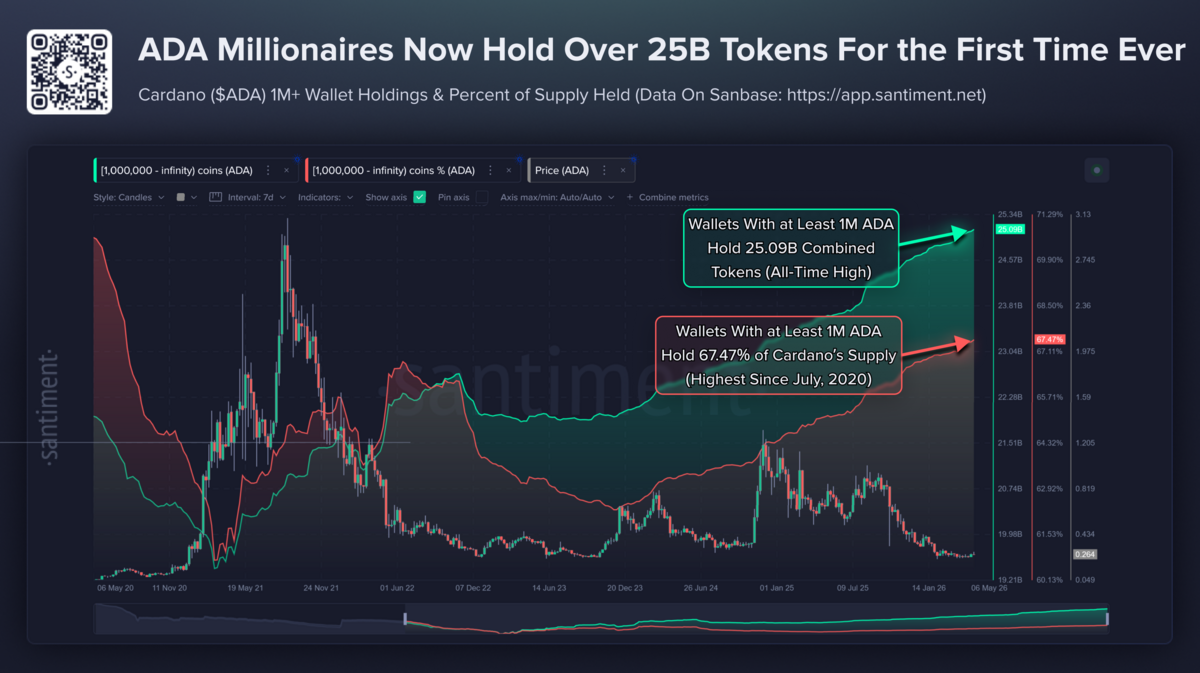 Cardano 1M+ ADA wallets hit 67.47% of supply, their highest share since 20202026-05
 SecondFi losses may exceed $20M as SlowMist founder flags 129M ADA tied to suspected hacker wallets2026-06
 Cardano Foundation cancels 2026 summit after 7.8M ADA treasury ask misses DRep threshold2026-05
 Cardano founder Charles Hoskinson warns Bitcoin could lose its top crypto spot if governance can't adapt to quantum computing, arguing Cardano is better equipped with onchain governance2026-07
ADA explained: Cardano's native asset, governance, and market structure
ADA is the native cryptocurrency of Cardano, a proof-of-stake blockchain that secures its network, pays transaction fees, and—since the 2025–2026 rollout of on-chain treasury voting—confers governance rights to holders. Named after 19th-century mathematician Ada Lovelace, the token sits among the larger crypto assets by market capitalization and has increasingly been treated by U.S. regulators as a commodity rather than a security.

Cardano joins Solana and XRP Ledger in AI agent payments race as x402 kit adds ADA support for apps and agents

What Cardano and ADA actually are
Cardano is a layer-1 blockchain founded in 2017 by Charles Hoskinson, a co-founder of Ethereum, and built by the engineering firm Input Output (formerly IOHK). Its consensus mechanism, Ouroboros, was one of the first peer-reviewed proof-of-stake protocols, meaning validators ("stake pool operators") are selected to produce blocks in proportion to the ADA staked to them rather than through energy-intensive mining as on Bitcoin (BTC).
ADA performs three core jobs. It is the unit used to pay network fees; it is the asset that holders delegate to stake pools to help secure the chain and earn staking rewards; and it is the voting weight in Cardano's governance system. Unlike account-based chains such as Ethereum (ETH), Cardano uses an extended unspent-transaction-output (eUTXO) model—closer in design lineage to Bitcoin—which shapes how its smart contracts, written in the Plutus and Aiken toolchains, are built.
Cardano's development is split across three organizations that recur throughout its news cycle: Input Output (core protocol research and engineering), the Cardano Foundation (a Swiss non-profit overseeing standards and adoption), and EMURGO (commercial and venture activities). This tripartite structure matters because disputes over who controls funding and direction—covered below—run through these entities rather than a single company.
ADA readers are not tracking price or tech — they are tracking legitimacy: every top-clicked story is about whether ADA will be classified as a security, whether its founders can be trusted with treasury funds, or whether it can gain institutional access via ETF inclusion.
Governance: from founder influence to on-chain voting
Cardano's defining theme in 2025–2026 has been the transition to fully on-chain governance under the "Voltage"/Conway-era rules introduced via the chain's hard-fork combinator. Decisions about the network treasury and protocol parameters are now made through Delegated Representatives (DReps), stake pool operators, and a constitutional committee, with ADA holders either voting directly or delegating their voting power to a DRep.
That machinery is being stress-tested in public. Founder Charles Hoskinson announced in 2026 that he was "taking a break" from interviews, videos, and social media, framing the move as a step back from day-to-day spokesmanship rather than an exit—and emphasizing that he holds no special governance key over the network (CryptoSlate). The announcement coincided with a sharp ADA price drop and with broader community friction over how much sway Input Output and other ecosystem institutions should retain over treasury resources.
Two concrete episodes illustrate the new dynamics. The Cardano Foundation's planned 2026 summit was cancelled after a treasury request—reported around 7.8 million ADA—failed to clear the DRep approval threshold, a tangible example of token-holder voting overriding institutional plans. Separately, a CGOV "Vision 2026" proposal seeking tens of millions of ADA for IO Research has faced uncertainty under the same decentralized process (CryptoSlate). Hoskinson has signaled he will register as a DRep and push for reforms to how funding proposals are evaluated. The throughline: Cardano's research-led roadmap now depends on persuading a decentralized electorate, which introduces execution risk that more centrally steered projects do not face.
Regulatory status in the United States
ADA's regulatory footing has firmed up considerably. U.S. agencies have increasingly grouped it with assets treated as commodities rather than securities. The SEC and CFTC, in interpretive guidance distinguishing crypto-asset categories, listed ADA among examples of non-security "digital commodities" alongside BTC, ETH, Chainlink (LINK), XRP, Litecoin, Polkadot, Avalanche, and others. That classification is consequential because it shapes which agency has primary oversight and reduces the legal overhang that has weighed on tokens facing securities-law claims.
This clarity has paved the way for regulated investment products. CME ADA futures launched in February 2026, starting a roughly six-month clock under the SEC's generic listing standards for spot crypto ETFs. Volatility Shares—an SEC-registered manager—brought futures-based and leveraged ADA products to market, and has filed for spot and leveraged Cardano ETFs targeting NYSE Arca listings (CoinNewsSpan). Other issuers, including Grayscale, Bitwise, and Canary Capital, have pursued their own Cardano funds, with analysts pointing to late 2026 as a realistic window for a spot ADA ETF (Crowdfund Insider).
ADA has also entered diversified index products. CME Group and Nasdaq launched crypto index futures tracking the top eight assets by market cap, including BTC, ETH, Solana (SOL), XRP, LINK, and ADA, and Hashdex expanded its Nasdaq–CME Crypto Index ETF to add ADA and LINK alongside the larger names. Inclusion in such baskets matters because it routes passive institutional flows toward ADA without requiring direct conviction in Cardano specifically.
FC Barcelona launches Barça Fan Lab with Andamio on Cardano, giving fans verifiable credentials and new digital community experiences

Market structure and supply concentration
ADA has a capped maximum supply of 45 billion tokens, with a large share already in circulation. Its all-time high of roughly $3.09 was set during the 2021 bull market, a level it has not revisited since.
A recurring concern in coverage is ownership concentration. On-chain data in 2026 showed wallets holding 1 million or more ADA controlling roughly two-thirds of supply—around 67%—the highest "whale" concentration since 2020. High concentration cuts two ways: it can reflect committed long-term holders and staking participation, but it also means a relatively small number of addresses can move significant supply or sway governance votes, which raises questions about how decentralized the token's economic and political power truly is.
Concentration debates periodically focus on the founder. On-chain analysis revived by NFT creator Masato Alexander claimed Hoskinson may have sold roughly 1.5 billion ADA during the 2021 rally near the all-time high. Such claims are contested and difficult to verify definitively from chain data alone, since address attribution is inferential; they are best treated as allegations under analysis rather than settled fact. They nonetheless feed a broader narrative tension between Cardano's decentralization messaging and the visibility of large holders.
- 01SEC securities classification risk
Multiple high-click headlines from SEC suits against Binance and Coinbase explicitly named ADA as a security, creating sustained reader anxiety about regulatory survival.
- 02ETF inclusion prospects
The highest-clicked headline was about the SEC delaying the Bitwise 10 index ETF where ADA is a component, signaling readers see ETF approval as a key price and legitimacy catalyst.
- 03Hoskinson treasury misconduct allegations
Headlines about whether Hoskinson quietly profited from $500–600M in unsold ADA drew strong clicks, reflecting deep distrust of founder-level token control.
- 04Cardano Foundation governance failures
The foundation's account hack promoting a fraudulent token and the cancellation of the 2026 summit after a 7.8M ADA treasury ask failed DRep threshold showed readers tracking on-chain governance dysfunction.
- 05Network security and chain integrity
A confirmed chain fork triggered by legacy node code, combined with an FBI investigation announcement, pulled readers focused on whether the base layer is stable.
- 06DeFi liquidity traps on Cardano
A single trader losing $6.05M swapping 14.4M ADA into a thin stablecoin pool exposed how shallow Cardano's DeFi liquidity remains compared to its market cap.
Ecosystem and real-world usage
Beyond governance drama, Cardano has continued to expand its application layer and payment reach. ADA is now accepted at 137 SPAR supermarkets in Switzerland through DFX.swiss and the Open Crypto Pay system, with the partners citing real-time settlement and processing-fee reductions of about two-thirds versus conventional rails (Cardano Foundation coverage). Retail acceptance of this kind is a useful signal of practical utility, though such pilots remain small relative to total transaction volume and should not be read as mass adoption.
On the infrastructure side, oracle provider Band Protocol added ADA and USDT price feeds on a COTI testnet to support privacy-focused decentralized applications, illustrating the cross-chain plumbing that lets Cardano-linked assets interoperate with other ecosystems. Cardano's treasury also earmarked 50 million ADA for an "Orion Fund" managed in partnership with Draper Dragon to seed ecosystem growth—an example of community-controlled capital being deployed for development rather than held idle.
ADA has additionally appeared as collateral in lending markets. Coinbase's Morpho-powered loan product added ADA, XRP, DOGE, and LTC as collateral options, broadening the token's usefulness within decentralized finance and giving holders a way to borrow against positions without selling.
Risks and open questions
Several risks deserve plain statement. First, governance execution risk: Cardano's shift to DRep-driven funding is novel, and the cancelled summit and contested research budgets show that the new system can produce gridlock or reject initiatives that leadership considers important. Second, leadership and narrative risk: heavy public association with a single founder means that Hoskinson's step-back, and disputes over past token sales, move price and sentiment more than they might for a more anonymized project. Third, concentration risk: with a small set of wallets holding the majority of supply, both market liquidity and voting outcomes are sensitive to a few actors.
Competitive risk is also real. Cardano competes with faster-growing smart-contract platforms for developers and total value locked, and metrics-watchers note that other assets have at times overtaken ADA in market-cap rankings. None of these risks is unique to Cardano, but together they frame why ADA's price and on-chain activity can diverge from the broader Crypto market on any given week.
- 2023-06regulatory
SEC names ADA as unregistered security in Binance suit
- 2023-06regulatory
SEC names ADA as unregistered security in Coinbase suit
- 2024-07exploit
Cardano Foundation X account compromised, $ADAsol scam promoted
- 2025-01exploit
Cardano network briefly forks due to legacy node bug; FBI investigation opened
- 2025-03regulatory
SEC approves Nasdaq Crypto US Settlement Price Index, boosting ADA ETF prospects
- 2025-04milestone
Hashdex expands Nasdaq CME Crypto Index ETF to include ADA and LINK
- 2025-06milestone
137 SPAR supermarkets in Switzerland begin accepting ADA payments via DFX.swiss
- 2026-03governance
Cardano Foundation cancels 2026 summit after 7.8M ADA treasury ask fails DRep vote
Outlook
ADA's near-term trajectory hinges on two forces pulling in different directions. On the institutional side, commodity classification by U.S. regulators, live CME futures, leveraged and futures-based ETFs already trading, and a plausible spot-ETF window later in 2026 all widen the on-ramps for regulated capital. On the protocol side, Cardano is running a live experiment in decentralized treasury governance whose early results—a cancelled summit, contested funding, and a founder stepping back from the spotlight—show both the promise and the friction of removing a central steward. For observers, the questions worth tracking are concrete: whether a U.S. spot ADA ETF is approved and how much it draws, whether DReps can fund the roadmap without stalling it, and whether real-world payment and DeFi integrations grow past pilot scale. The answers will say more about ADA's durability than any single price level.
Latest ADA news
Community notes
Spot something off or out of date? Drop a note. Editors review topic notes daily and roll accepted fixes into the explainer — contributors are recognized in the monthly $SQUID drop.
Loading notes…
Help improve this topic
Have a story or tip about this topic? Submit it. See something missing? Leave a note. Editors review daily; accepted submissions and fixes count toward the monthly $SQUID drop.