
XRP is the native token of the XRP Ledger, built for fast cross-border payments. This explainer covers its technology, Ripple's business model, the SEC lawsuit outcome, ETF adoption, AI agent payments push, and how it compares to BTC, ETH, and SOL.
+25 sources across the wider coverage universe
 XRP Ledger integrates Boundless ZK privacy so banks can transact on-chain without separate L2s2026-04
 Rakuten Wallet integrates XRP for 44M users, enabling spending at 5M merchants across Japan2026-04
 Seoul police arrest three in $19 million XRP staking scam that impersonated Flare and hit 71 victims2026-07
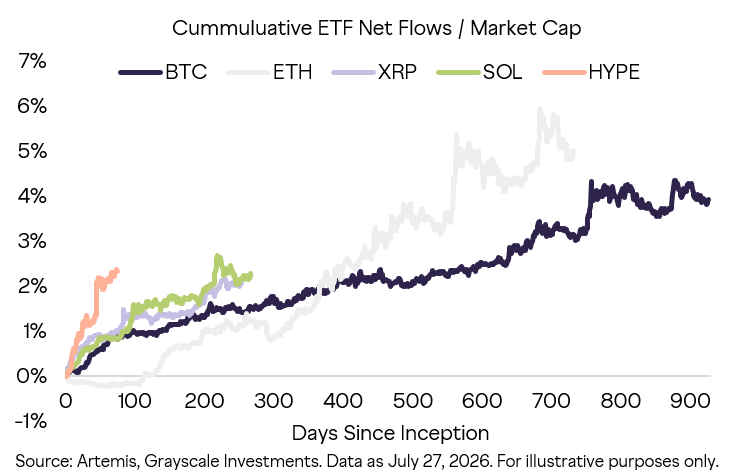 HYPE ETF flows outpace Bitcoin, Solana and XRP launches relative to market cap2026-07
 WhatsApp enables XRP trading after Solana integration via AI bots and noncustodial wallets2026-04
 Ripple leading $1B SPAC raise to launch largest XRP treasury vehicle yet, will seed it with own holdings2026-05
XRP is the native digital asset of the XRP Ledger (XRPL), an open-source, public blockchain designed primarily for fast, low-cost cross-border payments and liquidity settlement.
What XRP Is — and What It Isn't
Confusion about XRP's identity is common, and the distinction matters. XRP is a token; the XRP Ledger is the network it runs on; and Ripple Labs is the private company that created both and continues to develop around them — but does not control the decentralized ledger itself.
The XRP Ledger launched in 2012, predating Ethereum by three years. Unlike Bitcoin's energy-intensive proof-of-work mining or Ethereum's proof-of-stake validator set, the XRPL uses a Federated Byzantine Agreement (FBA) consensus mechanism. Nodes reach agreement by comparing notes with a trusted subset of peers (a "Unique Node List"), allowing the network to finalize transactions in three to five seconds with no mining and negligible energy use. Fees are fractions of a cent, and the network can handle roughly 1,500 transactions per second at current capacity.
Ripple pre-mined all 100 billion XRP at genesis. The company holds a large reserve, a portion of which is released from escrow each month under a publicly verifiable schedule — a structure critics call centralized and supporters call transparent.

Cardano joins Solana and XRP Ledger in AI agent payments race as x402 kit adds ADA support for apps and agents

The SEC Case and Its Aftermath
No single event shaped XRP's modern trajectory more than the U.S. Securities and Exchange Commission's December 2020 lawsuit against Ripple Labs, alleging that XRP sales constituted unregistered securities offerings. The suit triggered immediate delistings from U.S. exchanges and suppressed the token's price relative to peers for years.
In July 2023, Judge Analisa Torres issued a split ruling: XRP sold programmatically on exchanges to retail buyers was not a security under those circumstances, while institutional sales by Ripple were. The decision was widely cited as a partial win for the broader crypto industry because it introduced a context-dependent framework for token classification — a meaningful departure from the SEC's blanket application of the Howey Test.
The case continued through appeals and remedies phases into 2025, but the core finding that secondary-market XRP trading does not constitute a securities transaction gave U.S. exchanges a legal basis to relist the token and gave institutional investors more comfort. The ruling's reasoning has since been referenced in other crypto legal disputes, making the Ripple litigation one of the most consequential regulatory events in the industry's history.
XRP readers are drawn to legitimacy battlegrounds — not price speculation but the specific moments where regulatory rulings, institutional product launches, and security failures either confirm or threaten XRP's bid to become a compliant, institutional-grade asset.
How the XRP Ledger Works
The XRPL is a multi-purpose blockchain that has evolved well beyond its payments-only origins. Key infrastructure includes:
Decentralized Exchange (DEX): A native order-book DEX has been built into the protocol since 2013, allowing peer-to-peer trading of any tokenized asset issued on the ledger without a centralized intermediary.
Issued Currencies and Stablecoins: Any entity can issue tokens on the XRPL. Ripple's own stablecoin, RLUSD (pegged 1:1 to the U.S. dollar), launched in late 2024 and has since expanded to multiple exchanges. In mid-2025, Gate.io listed XRP/RLUSD spot trading pairs, and Bitso brought a peso-backed stablecoin (MXNB) to the ledger via a Ripple partnership — signals of a growing multi-asset ecosystem on-chain.
Single Asset Vaults and Lending Protocol: The XRPL v3.2.0 release — which officially rebranded the core server software from "rippled" to "xrpld" — shipped security patches for Single Asset Vaults and the Lending Protocol, DeFi primitives that allow users to earn yield or borrow against deposited assets. Permissioned DEX functionality, designed for regulated financial institutions that need compliance controls, also received updates in this release.
Hooks (Upcoming): A proposed smart contract layer called Hooks would allow lightweight, on-ledger logic to trigger automatically on transactions. It remains in testnet phases but, if activated, would bring XRP closer to programmable money without the full complexity of the Ethereum Virtual Machine.
Ripple's Business Model and RippleNet
Ripple Labs generates revenue primarily through its enterprise payment product, RippleNet, and through periodic XRP sales from escrow. RippleNet is a messaging and settlement network connecting banks, payment providers, and money-transfer operators across more than 55 countries. XRP can (but is not required to) serve as a bridge currency in RippleNet's On-Demand Liquidity (ODL) product, allowing institutions to source liquidity in real time without pre-funding nostro accounts at destination banks.
The business pitch is straightforward: cross-border wire transfers via the traditional correspondent banking system (SWIFT) can take one to five business days and carry fees of 3–7%. An ODL transaction using XRP as an intermediary asset settles in seconds and can cost a fraction of a cent on the ledger side, with FX spread as the primary remaining cost.
Whether this is a compelling product for regulated financial institutions — given that they can also use SWIFT gpi (which has accelerated meaningfully) or central bank real-time payment rails — remains a live debate. Ripple has announced partnerships with several financial institutions in Southeast Asia, the Middle East, and Latin America, regions where correspondent banking costs tend to be highest.
XRP Ledger retries permission delegation upgrade after flaw drained fees from unsigned transactions

AI Agents and the Next Use-Case Push
Ripple's most visible current strategic bet is positioning XRP and RLUSD as the payment rails for autonomous AI agents. In 2025 and early 2026, Ripple launched a developer toolkit for building "agentic payment apps" on the XRP Ledger, enabling AI systems to initiate and settle transactions programmatically using XRP or RLUSD without human approval for each individual payment.
The thesis is that machine-to-machine commerce — an AI agent paying for API calls, compute, or data subscriptions autonomously — needs a payment layer that is fast, cheap, and programmable. USDC on Ethereum or Solana currently dominates this nascent market, and Ripple has acknowledged the gap: "The market is still mostly USDC," a reality check that reflects both stablecoin incumbency and the developer ecosystems built around Ethereum and Solana. Whether XRPL's tooling can attract the agent-economy builder community away from established ecosystems is an open question.
- 01SEC ETF approval race
Readers tracked every delay and greenlight as proof-of-concept that XRP could achieve the same institutional legitimacy Bitcoin and Ethereum won with their ETFs.
- 02Chris Larsen LastPass hack
A co-founder losing $113M from personal accounts via a password manager breach combined personal accountability, operational security failure, and immediate price impact in one story.
- 03XRP securities ruling fight
The ongoing SEC appeal and amicus briefs kept readers invested in whether the partial legal victory exempting retail XRP sales would survive, setting precedent for the whole industry.
- 04XRP Ledger institutional adoption
Tokenized T-Bills, SBI's onchain yen bond, and Ripple's own money market fund signaled the ledger was being stress-tested for real-world finance, not just crypto trading.
- 05Market cap rank milestones
XRP overtaking USDT and Solana for top-three status gave readers a concrete scoreboard moment validating the post-election rally thesis.
- 06Cross-chain DeFi integration
THORChain adding XRP and Paradigm's block trading facility for XRP options signaled the asset was finally being wired into DeFi infrastructure that previously ignored it.
Market Structure and Price Dynamics
XRP trades at very high volumes relative to most non-Bitcoin, non-Ethereum assets. It is consistently among the top five cryptocurrencies by market capitalization, and it has listed on CME Group's new crypto index futures product — jointly developed with Nasdaq — alongside BTC, ETH, SOL, LINK, and ADA.
Recent price action reflects the broader macro environment rather than XRP-specific catalysts. Hawkish Federal Reserve projections in mid-2026 sent BTC, ETH, SOL, and XRP lower in tandem as investors priced in delayed rate cuts and elevated inflation expectations. XRP briefly rallied past $1.25 on a 10% move before profit-taking pulled it back, and as of recent trading it sits below $1.20, with that level now flipped from support to resistance. Bulls are watching the $1.17–$1.20 zone; bears point to the key level having already broken.
Several on-chain and market metrics are worth understanding in context:
- Exchange outflows: Binance's XRP reserves fell to four-month lows near 2.69 billion tokens, with roughly 110 million XRP withdrawn since May 2026 — a dynamic often interpreted as reduced near-term selling pressure, since coins leaving exchanges are typically moving to cold storage or long-term holding wallets.
- ETF inflows: Spot XRP ETF products (approved in the U.S. following the SEC litigation resolution and subsequent regulatory clarity) recorded $118 million in inflows during May 2026. Analysts at JSeyff note that ETF investors appear to be sizing crypto positions more conservatively than crypto-native traders, which may explain why XRP and Solana have held up relatively better during risk-off periods — diversified ETF buyers tend to be less reactive than leveraged spot traders.
- Open interest: Binance's XRP perpetual futures open interest hit a 2026 high, signaling that speculative positioning is elevated — which cuts both ways. High open interest amplifies both upside squeezes and downside liquidation cascades.
- Sentiment extremes: Social sentiment on XRP hit its weakest reading since October 2025 according to Santiment data, a level that has historically preceded sharp rebounds in the token's price. Contrarian signals of this kind have a mixed track record but are widely watched by on-chain analysts.
- Realized loss ratio: XRP holders were realizing $2.63 in losses for every $1 in profit at one point in the recent drawdown — a ratio that, in historical cycles, has tended to cluster near bear market exhaustion rather than the beginning of a sustained decline.
XRP vs. Bitcoin, Ethereum, and Solana
Understanding XRP requires placing it against its major peers.
Against Bitcoin: XRP and BTC correlate in risk-off and risk-on regimes — both fell on hawkish Fed news, both surged on geopolitical relief (as when markets rallied on reports of a U.S.-Iran peace framework). But their fundamental narratives diverge sharply. Bitcoin is positioned as a scarce, decentralized store of value with no controlling entity. XRP is associated with a company, has a fixed supply managed in part by escrow releases, and is designed for transactional velocity rather than value storage.
Against Ethereum: Ethereum hosts a vastly larger developer ecosystem, the dominant stablecoin market (USDC, USDT), and most of the DeFi and NFT infrastructure. The XRP Ledger's DeFi ambitions — the lending protocol, DEX, permissioned features — are real but smaller by every metric. Ethereum's transition to proof-of-stake and its rollup-centric scaling roadmap give it a different technical trajectory than XRPL's federated consensus.
Against Solana: Solana has arguably become the dominant venue for high-frequency DeFi and memecoin trading, and its developer activity dwarfs the XRPL's. XRP's comparative advantage is in institutional payment infrastructure and regulatory familiarity — particularly after the SEC litigation established more legal clarity for XRP than exists for most tokens.

Clearpool shares video teasing progress on XRP Ledger institutional lending project

Regulatory and Institutional Landscape
The post-SEC landscape has made XRP more institutionally legible in the United States. Spot XRP ETFs trade on regulated U.S. exchanges, a milestone that required both the legal ruling and subsequent SEC posture shifts under the 2025 regulatory environment. Japanese bank SBI Shinsei announced plans to offer BTC, ETH, and XRP vouchers linked to yen deposit interest, reflecting the token's integration into traditional financial products in Asia, where Ripple has its deepest banking relationships.
The XRPL's permissioned DEX feature — allowing financial institutions to operate a compliant trading venue on the public ledger — is designed to attract regulated money without requiring them to commingle with permissionless participants. This is a meaningful differentiator from Ethereum's public mempool, though whether regulated institutions prefer an open blockchain over private settlement rails remains to be tested at scale.
- 2024-01exploit
Chris Larsen personal wallets drained ~$113M XRP, later linked to LastPass breach
- 2024-04launch
Teucrium XXRP 2x leveraged ETF begins trading on NYSE — first XRP ETF in the US
- 2024-11milestone
XRP overtakes USDT to become world's third-largest crypto by market cap
- 2024-12launch
Ripple launches RLUSD stablecoin on XRP Ledger and Ethereum
- 2025-02regulatory
SEC delays wave of XRP ETF filings from Bitwise, Franklin Templeton, and others
- 2025-03regulatory
ProShares receives SEC greenlight for three XRP ETF products
- 2025-05launch
THORChain XRP mainnet integration launches, enabling native cross-chain XRP swaps
- 2025-06launch
OpenEden launches tokenized US T-Bills on XRP Ledger
Risks and Criticism
Centralization concerns: Ripple controls a large share of XRP supply and has historically influenced the default Unique Node List that validators use. Critics argue this makes the network less decentralized than Bitcoin or Ethereum in practice, even if the ledger is technically open.
Company dependency: XRP's narrative and development roadmap are substantially tied to Ripple Labs. If Ripple were to face renewed regulatory action, financial distress, or strategic pivot, the impact on XRP would likely be significant in a way that would not apply to assets with more distributed development.
Escrow releases: The monthly release of XRP from escrow (up to 1 billion per month, with unsold amounts returning to escrow) creates a recurring potential supply headwind, even if the actual market impact depends on how much Ripple sells versus re-escrows.
Competition: SWIFT gpi, central bank digital currencies (CBDCs), and stablecoin-on-public-chain solutions (USDC on Solana, for instance) all compete for the cross-border payment use case that is Ripple's core market.
Outlook
XRP sits at an inflection point shaped by three converging forces: the resolution of its years-long legal uncertainty, a maturing ETF-driven institutional entry point, and Ripple's attempt to stake out early ground in AI-agent payments before that market defines its rails. The XRP Ledger's v3.2.0 infrastructure upgrades — lending, vaults, permissioned DEX — suggest genuine technical development rather than pure marketing.
Near-term price dynamics will continue to track macro conditions, Fed policy, and Bitcoin's broader direction. The $1.20 level has emerged as the key technical threshold the market is watching. Longer term, whether XRP earns a durable institutional role depends on whether RippleNet's ODL product scales meaningfully in high-remittance corridors, and whether XRPL can attract the developer activity needed to make its DeFi and agentic payment ambitions real rather than aspirational.
Latest XRP news
Community notes
Spot something off or out of date? Drop a note. Editors review topic notes daily and roll accepted fixes into the explainer — contributors are recognized in the monthly $SQUID drop.
Loading notes…
Help improve this topic
Have a story or tip about this topic? Submit it. See something missing? Leave a note. Editors review daily; accepted submissions and fixes count toward the monthly $SQUID drop.