
Crosschain infrastructure connects isolated blockchain networks so assets and data can move freely. This explainer covers bridge models, USDC/CCTP, Chainlink, intent protocols, security risks, and the developer tooling shaping multichain DeFi in 2026.
+9 sources across the wider coverage universe
 Kraken adds native USDC deposits and withdrawals on Injective, eliminating extra crosschain hop2026-07
 Kraken replaces LayerZero with Chainlink for kBTC bridging after $292M Kelp exploit, migrating more than $3B in locked crosschain assets2026-05
 Uniswap adds in-app wallet, P&L tracking, and one-click crosschain swaps across 11 networks2026-06
 Espresso Systems joins Linux Foundation Decentralized Trust to advance crosschain interop and institutional digital asset adoption2026-04
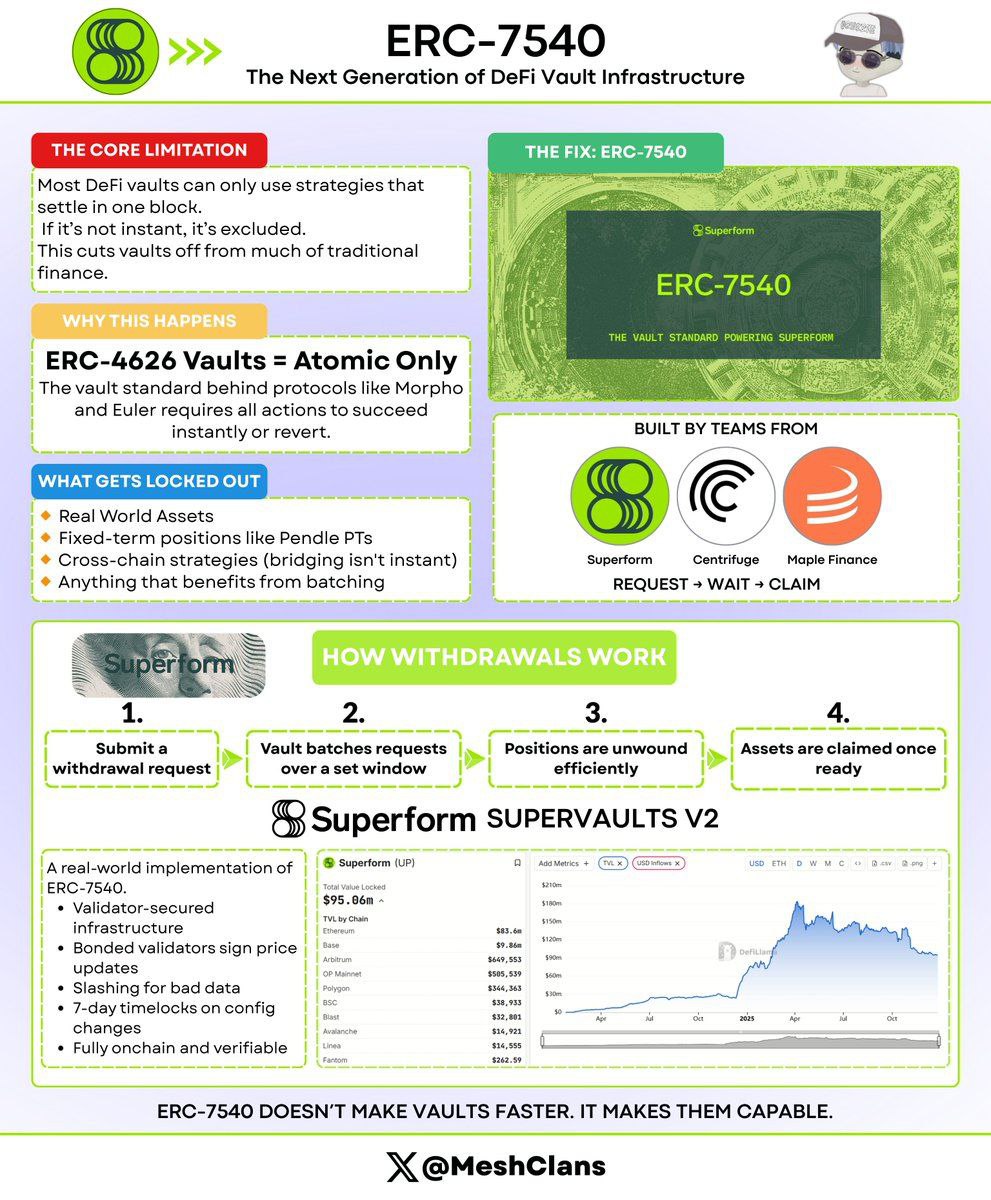 ERC-7540 introduces async vault operations, letting DeFi vaults handle non-instant strategies like RWAs, fixed-term yields, and cross-chain positions through request → wait → claim flows, unlocking new yield sources with 90%+ gas savings via batching.2025-12
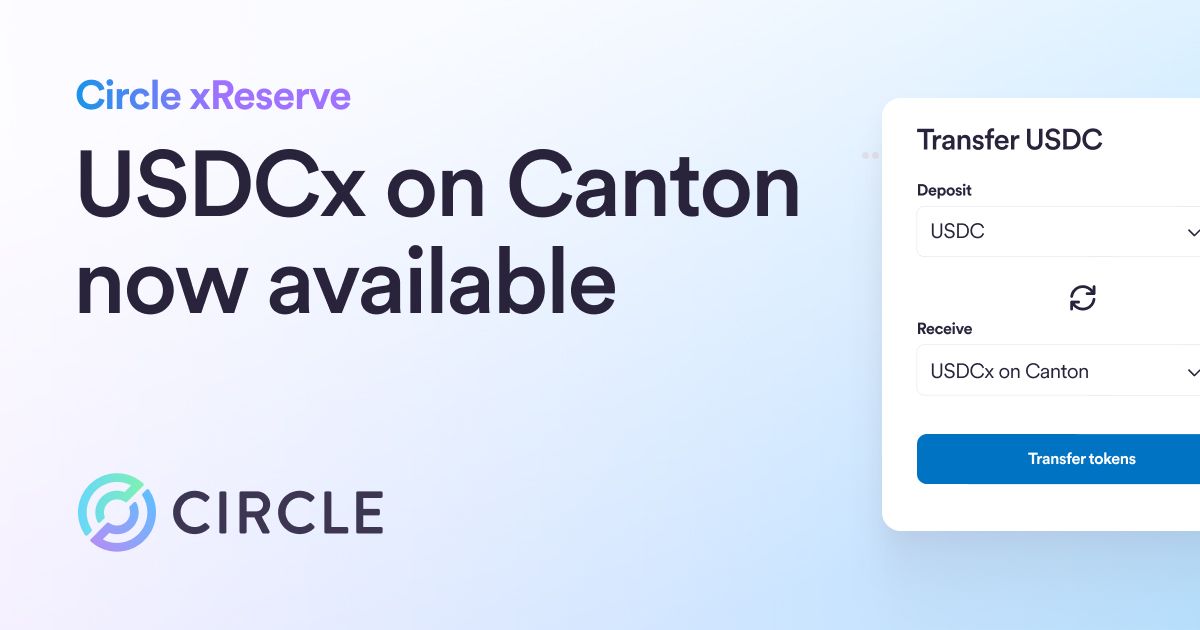 USDCx Launches on Canton: Circle, Digital Asset, and Loop Wallet deliver privacy-first, Cross-Chain USDC Liquidity2025-12
The ability for separate blockchain networks to communicate, transfer assets, and share data without a central intermediary — that is the core problem crosschain infrastructure exists to solve.
Blockchain's foundational design treats each network as sovereign: Ethereum, Solana, and hundreds of other chains each maintain their own state, consensus rules, and token standards. Assets and data created on one chain cannot natively exist on another. Crosschain technology is the engineering discipline — and increasingly the product category — that bridges those gaps, enabling value and information to move between otherwise isolated networks.
Why Interoperability Matters
The proliferation of Layer 2 rollups, application-specific chains, and alternative Layer 1s has made isolation worse, not better. Liquidity fragments across dozens of mainnets; developers must maintain separate deployments on each network; users face friction choosing which chain to hold assets on. By 2026, bridges and routing protocols collectively route hundreds of billions of dollars annually, making crosschain infrastructure one of the most consequential — and most attacked — layers in decentralized finance.
The economic argument is straightforward: a dollar of liquidity accessible across all chains is worth more than a dollar locked on one. Unified liquidity pools reduce slippage, lower borrowing costs, and make yield-bearing instruments more competitive with traditional finance alternatives.

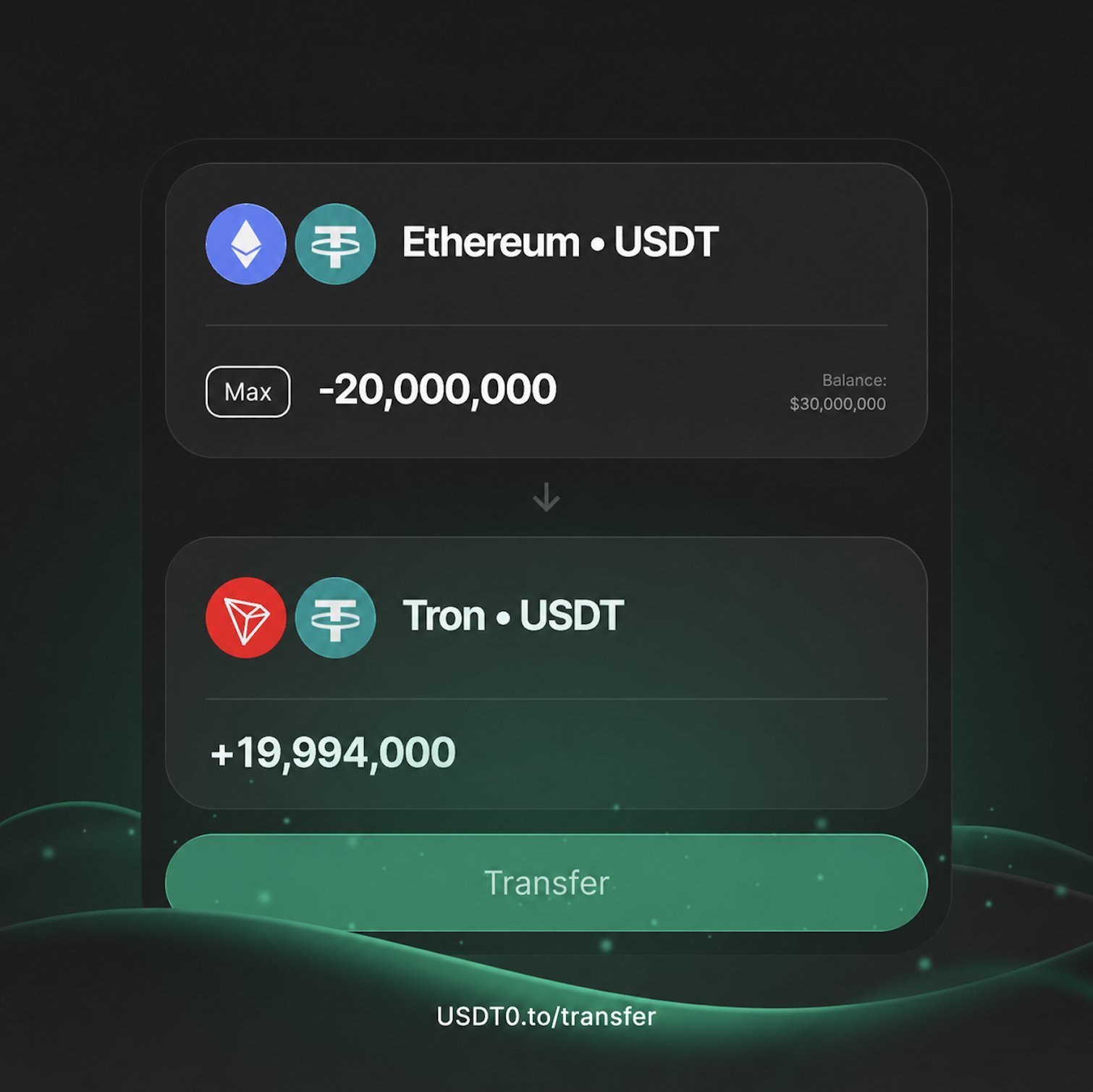
USDT0 boosts Ethereum-Tron liquidity to support single transfers of up to $20M, enabling larger crosschain USDT movements in a few clicks
How Crosschain Transfers Work
At a technical level, crosschain protocols follow one of several trust models:
Lock-and-mint bridges lock a token in a smart contract on the source chain and mint a synthetic "wrapped" equivalent on the destination. The user holds an IOU backed by the locked collateral. This model is simple to implement but concentrates risk: the lock contract becomes a high-value target. The $292 million Kelp exploit — which prompted Kraken to migrate more than $3 billion in locked crosschain assets away from LayerZero and onto Chainlink's infrastructure for kBTC bridging — illustrates how catastrophically this can fail.
Burn-and-mint (native issuance) eliminates the IOU by burning the token on the source chain and minting a canonical version on the destination. Circle's Cross-Chain Transfer Protocol (CCTP) and its successor CCTPv2 use this model for USDC. Because Circle — the issuer — controls minting rights, there is no wrapped intermediary and no lock contract holding reserves. CCTPv2 extends the original by introducing "fast transfers" that allow liquidity providers to front funds on the destination chain and be reimbursed once the burn proof is confirmed, cutting settlement from minutes to seconds.
Intent-based protocols invert the flow: a user states what they want on the destination chain, solvers compete to fulfill the intent using their own capital, and the protocol reimburses them from the source chain after the fact. Across Protocol operates on this model and reports zero exploits and $28 billion in bridged volume in 2026 — a track record that has made it a preferred choice for teams sensitive to smart-contract risk.
Oracle and messaging layers like Chainlink's Cross-Chain Interoperability Protocol (CCIP) focus on passing arbitrary data and token values between chains using decentralized oracle networks as the trust layer. This underpins institutional use cases such as crosschain collateral management systems, where positions on one chain must be repriced against data from another.
Readers click crosschain content most when a major named entity — PayPal, Uniswap, Circle, Wormhole — stakes its brand on a specific bridge or interop standard, signaling that protocol legitimacy and institutional backing matter more to this audience than raw technical capability.
Stablecoins as the Crosschain Unit of Account
Stablecoins have emerged as the dominant asset class in crosschain flows, and USDC in particular has become infrastructure-grade. Circle has systematically expanded CCTP to new networks — Injective and Hedera among the most recent integrations announced — making the burn-and-mint path for dollar-denominated value increasingly ubiquitous.
Circle's Gateway service adds a layer above CCTP: developers can route USDC across chains without managing destination-chain gas or maintaining separate on-chain deployments. The Forwarding Service within Gateway automates destination-chain minting, meaning a developer building a multi-chain application can treat USDC as a single asset that "appears" on whichever chain the user happens to be on. Circle has also released open-source AI skills — compatible with tools like Cursor, Claude Code, and Codex — that let developers and AI agents generate USDC and crosschain integration code directly from natural language prompts.
The expansion of USDT0 (a crosschain-native variant of Tether's USDT) to Hedera follows a similar logic: stablecoin issuers understand that distribution across chains is a competitive moat.
Developer Infrastructure and Routing
For developers building on multiple chains simultaneously, the operational burden historically included deploying separate contracts, managing separate gas wallets, and handling separate token approvals on each network. Routing aggregators have emerged to abstract most of this away.
LI.FI, for example, provides APIs and SDKs that cover swap, bridge, and deposit routing across more than 60 chains. Its recent integration with Somnia — an "Agentic L1" optimized for AI-driven applications — illustrates how new chain entrants increasingly treat multichain routing as table-stakes infrastructure rather than a later-stage addition. Developers building on Somnia gain access to LI.FI's existing liquidity network from mainnet launch rather than bootstrapping their own.
Polygon's Trails module within the Open Money Stack takes a payment-oriented approach: it enables one-click crosschain payments, swaps, and deposits using any input token, routing the conversion internally. More than $250,000 in volume has moved through Trails, with consumer applications like Levr.bet using it to let users fund positions from whichever chain holds their assets.
Uniswap's 2026 product updates reflect the same direction from the consumer side: the addition of one-click crosschain swaps across 11 networks, an in-app wallet, and portfolio P&L tracking moves the DEX from a single-chain trading venue toward a multichain financial interface. Users no longer need to manually bridge before trading; the routing layer handles it.
- 01Wormhole institutional legitimacy
Jump Trading spinning off Wormhole and Uniswap DAO selecting it for governance signaled to readers that crosschain infrastructure was maturing from experiment to institution.
- 02ERC-7683 intents standard
Multiple headlines about Uniswap, Across, and the Ethereum Foundation converging on a shared crosschain intents standard attracted readers tracking whether the industry would finally fragment or coalesce.
- 03Stablecoin crosschain expansion
PayPal pyUSD on LayerZero and Circle USDC on Cosmos IBC showed readers that regulated stablecoin issuers were treating multichain reach as a competitive necessity.
- 04Bridge exploit losses
The HTX/Heco hack and Magpie Protocol attack drew readers who wanted to track whether funds were recoverable and who bore liability.
- 05Native Bitcoin crosschain DeFi
A protocol using Discreet Log Contracts to put self-custodied BTC into DeFi touched the perennial reader interest in unlocking Bitcoin's liquidity without wrapping or custody.
- 06Chain abstraction UX paradigm
Products like Omni Account, Unichain, and CoW Swap's bridgeless swaps attracted readers who believe crosschain UX friction — not security — is the last barrier to mainstream DeFi adoption.
Security: The Persistent Challenge
Crosschain infrastructure has been disproportionately targeted by attackers. Bridge hacks have accounted for a substantial share of total DeFi losses since 2021, for structural reasons: bridges aggregate large sums in lock contracts, rely on complex cross-chain message verification, and often involve off-chain validator sets that can be compromised.
The Kelp/LayerZero incident that led Kraken to switch to Chainlink for kBTC is a recent case study in how even established protocols can fail. Kraken's migration of $3 billion in assets was notable both for its scale and for the explicit attribution to a security decision rather than a feature comparison.
Across Protocol's zero-exploit record through $28 billion in volume has drawn attention to intent-based designs as potentially more resilient: solvers bear the capital risk of fulfilling transfers, and the settlement mechanism is simpler than complex lock contract logic.
DeFi.com's CEO, among others, has raised concerns about crosschain identity unification — the idea that a single identity layer across chains could simplify user experience but simultaneously create a larger attack surface for linking on-chain behavior across networks. The privacy implications of unified crosschain identity remain an open research problem.
Institutional Crosschain Infrastructure
Institutional adoption of blockchain is increasingly crosschain by nature. Traditional financial firms typically operate across multiple custody providers, networks, and settlement venues. A collateral management system that reprices positions in real time must pull data from several chains simultaneously — exactly the use case Espresso Systems demoed at a recent institutional DeFi event, combining their shared sequencer layer with Chainlink's data infrastructure.
Espresso's membership in the Linux Foundation Decentralized Trust consortium signals a deliberate push to meet enterprise governance standards. Institutional infrastructure requires audit trails, defined counterparty relationships, and regulatory clarity — none of which is inherently chain-specific but all of which are complicated when assets span multiple networks.
Chainlink CCIP has become the preferred messaging layer for many institutional integrations precisely because its decentralized oracle network model maps onto familiar concepts of data validation with multiple independent sources, rather than novel cryptographic trust assumptions.
- 2024-02milestone
Jump Trading spins off Wormhole as independent entity
- 2024-03governance
Uniswap DAO selects Wormhole and Axelar for crosschain governance
- 2024-05milestone
Uniswap Labs and Across co-author ERC-7683 crosschain intents standard
- 2024-07launch
PayPal pyUSD expands crosschain via LayerZero integration
- 2024-09exploit
Magpie Protocol crosschain trading platform attacked
- 2025-02launch
Unichain mainnet launches as Superchain L2 with crosschain liquidity focus
- 2025-05milestone
Ethereum Foundation unveils open intents framework and crosschain finality standards
- 2025-07launch
Uniswap Compact v1 launched to address crosschain liquidity fragmentation
The Liquidity Fragmentation Problem
Despite significant infrastructure investment, liquidity fragmentation remains severe. Each new chain launch splits existing capital thinner, and bridge deposits represent capital temporarily removed from productive use on both ends of a transfer. Native yield during in-flight transfers is an active area of research.
USDC's burn-and-mint model partially addresses this: because there is no wrapped intermediary, liquidity providers on the destination chain can operate against canonical USDC rather than a chain-specific synthetic. CCTPv2's fast-transfer mechanism lets LPs earn yield on the capital they front during settlement, turning bridge facilitation into a yield-generating activity.
Across Protocol's integration with Hyperliquid — enabling crosschain deposits into USDC-denominated perpetual futures — is an example of connecting crosschain routing directly to financial products. A user on Arbitrum can open a perpetual position on Hyperliquid without manually moving funds; Across handles the settlement in the background.
Uniswap's crosschain swap feature operates similarly: the user selects input and output tokens across different networks, and the protocol routes the transfer and swap in a single transaction flow from the user's perspective.
Standards and Governance
No single crosschain standard has achieved dominance, which creates integration overhead for developers but also preserves competitive pressure on protocol security and cost. CCTP is close to a de facto standard for USDC specifically, given Circle's role as issuer. For arbitrary messaging, CCIP, LayerZero, and Wormhole each have substantial deployment bases.
The governance question — who decides when a bridge is secure enough to trust — is largely unresolved. Most protocols rely on their own audits and bug bounty programs. Espresso Systems' move toward Linux Foundation governance represents an early attempt to externalize some of that trust, though membership in a foundation does not itself certify security.
Outlook
Crosschain infrastructure is converging toward a set of patterns that were still experimental three years ago: intent-based routing, burn-and-mint for stablecoins, and oracle-secured arbitrary messaging. The remaining frontier is making these mechanisms invisible to end users — the goal being that neither a consumer using a DEX nor a developer building a financial application needs to reason about which chain an asset lives on.
The security track record will continue to be the decisive factor in institutional adoption. Protocols that accumulate years of exploit-free operation while handling meaningful volume — Across's $28 billion figure is the most prominent current benchmark — will attract the capital and integration partnerships that entrench network effects. Meanwhile, Circle's CCTP expansion, Chainlink's institutional partnerships, and routing aggregators like LI.FI commoditizing the developer experience all point toward a near future where crosschain is less a distinct category and more a standard feature of blockchain infrastructure.
Latest Crosschain news
Community notes
Spot something off or out of date? Drop a note. Editors review topic notes daily and roll accepted fixes into the explainer — contributors are recognized in the monthly $SQUID drop.
Loading notes…
Help improve this topic
Have a story or tip about this topic? Submit it. See something missing? Leave a note. Editors review daily; accepted submissions and fixes count toward the monthly $SQUID drop.