
In‑depth explainer on Wormhole, the cross‑chain protocol linking Solana, Ethereum, EVM and non‑EVM networks, covering its Guardian security, NTT token transfers, stablecoin and RWA use cases, W governance token, key integrations and systemic risks.
+7 sources across the wider coverage universe
 Sei to disable inbound IBC in SIP-3 EVM-only transition, warns Wormhole WETH holders to bridge out2026-04
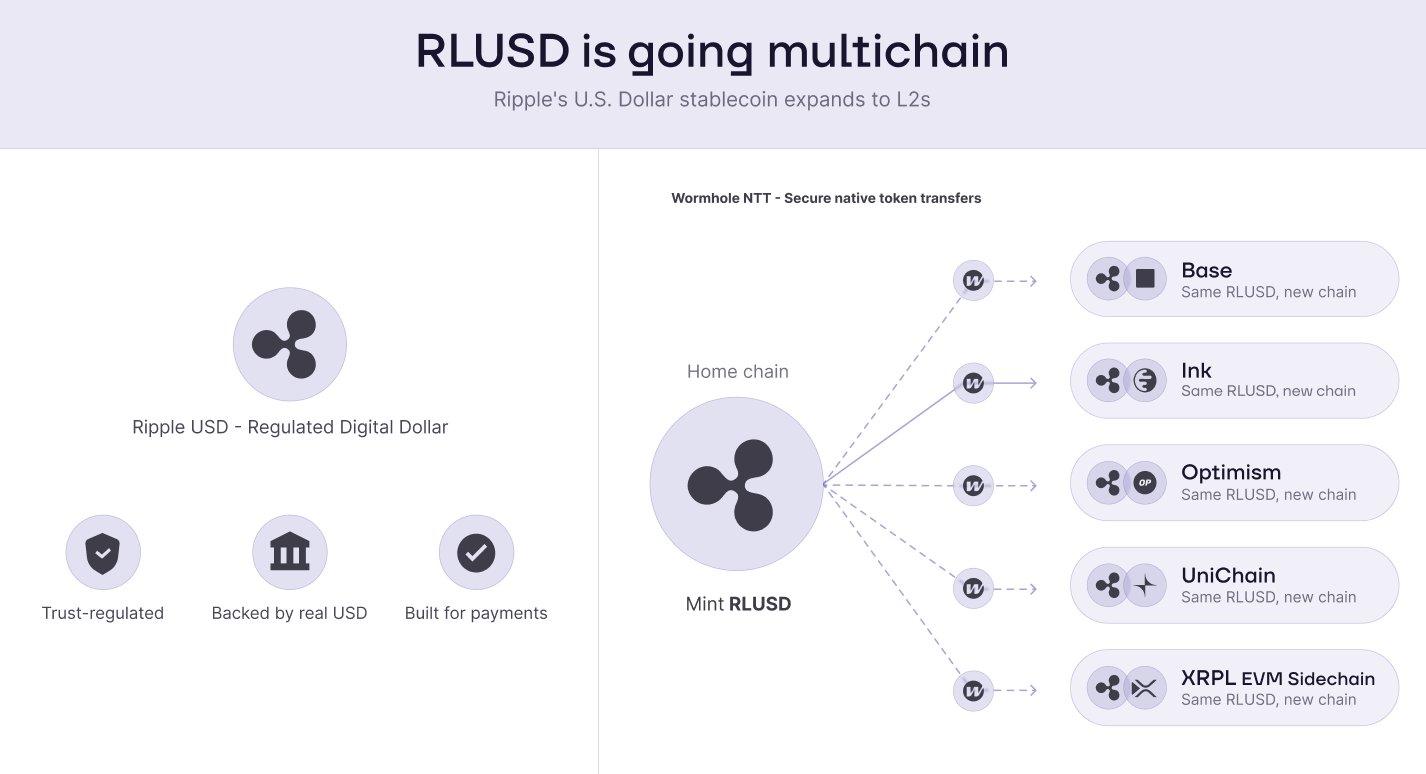 Ripple's RLUSD goes multichain via Wormhole NTT, joining standard used by 100+ assets across 40+ chains2026-06
 Ripple announced plans to expand its $1.3B RLUSD stablecoin to Ethereum layer-2 networks next year, including Optimism, Base, Kraken’s Ink, and Unichain, using Wormhole for interoperability. The move aims to boost DeFi adoption, payments, and on-chain utility as Ripple pushes a multichain strategy, following recent approval to pursue a national trust banking charter.2025-12
 Wormhole introduces native USDT transfers for 7 networks.2024-07
 Live now with Frax + Superstate w Sam Kazemian and Jim Hiltner2025-01
 Lido DAO withdraws support from LayerZero, throws weight behind Wormhole and Axelar for crypto bridge.2024-01
Wormhole is a cross‑chain interoperability protocol that connects dozens of blockchains and applications, allowing tokens and arbitrary data to move between ecosystems like Solana, Ethereum and a wide range of EVM and non‑EVM chains. It powers user‑facing bridges such as Portal Bridge and tooling such as Wormhole Connect, and increasingly underpins multichain stablecoins, real‑world assets and institutional infrastructure.
What Is Wormhole?
Wormhole is best understood as a generalized messaging layer rather than a single bridge. At its core, the protocol allows applications on one chain to emit messages that are observed, validated and signed by a permissionless set of node operators known as Guardians, who then attest to those messages on destination chains. On top of this messaging layer, developers build concrete products such as token bridges, native token transfer systems, cross‑chain governance and interoperability rails for stablecoins or tokenized funds. End users often interact with Wormhole through interfaces like Portal Bridge, which lets them move assets such as USDC, ETH, SOL and other tokens between more than thirty networks, even though they never see the underlying messages or Guardian signatures.
From a design perspective, Wormhole sits between traditional one‑off bridges and tightly coupled interoperability protocols such as IBC in the Cosmos ecosystem. It is not limited to a single consensus framework or stack; instead, it connects heterogeneous environments including Ethereum and other EVM chains, Solana, Sui and newer ecosystems, while aiming to provide a uniform developer experience. This heterogeneous reach is particularly important as DeFi, stablecoins and real‑world assets increasingly span multiple networks, and as institutions seek to avoid being locked into a single chain’s liquidity or regulatory regime. Rather than forcing issuers or applications to choose one “home,” Wormhole’s pitch is to let them be native everywhere their users are.
Over time, Wormhole has evolved from a simple wrapped‑asset bridge into a broader interoperability stack. Early usage centered on moving ERC‑20 and SPL tokens between Ethereum and Solana, but the protocol now supports native token transfer standards, generic application messaging, cross‑chain swaps, multichain staking, and more advanced execution flows using the Executor framework. The emergence of the W governance token, airdrop and staking system has also pushed Wormhole toward a full DAO model, where token holders help steer the protocol’s roadmap, security parameters and treasury. In parallel, integration with institutional platforms such as Securitize and regulated stablecoin issuers like Ripple highlights a deliberate strategy to straddle the boundary between crypto‑native DeFi and traditional finance.

Sei to disable inbound IBC in SIP-3 EVM-only transition, warns Wormhole WETH holders to bridge out
How Wormhole Works: Guardians, Messages and Executors
Cross‑chain Messaging Model
The fundamental primitive in Wormhole is a message that encodes some data and intent on a source chain, such as “lock 10 ETH and mint wrapped ETH on Solana” or “update the state of a cross‑chain RWA fund.” When a contract emits such a message, the Guardian network observes it on the source blockchain, verifies its validity according to protocol rules, and once consensus is reached, produces a signed attestation that can be submitted to target chains. These signed messages, often referred to as VAA (Verified Action Approvals) in developer contexts, form the backbone of the system: they prove that a specific event happened on one chain and has been recognized by a supermajority of Guardians.
This model decouples message observation and validation from execution. Once a VAA exists, any actor can relay it to a destination chain and call the appropriate contract to execute the intent, such as minting a wrapped token or triggering a governance action. The relayer does not need to be trusted in the same way as a bridge multisig, because the critical security assumption lies in the Guardian signatures and smart contract logic that checks them, not in who delivers the message. This separation is one of the conceptual differences between Wormhole and more centralized bridging schemes that rely on a single relay or operator.
The messaging abstraction also allows Wormhole to go beyond simple token transfers. Developers can define arbitrary payloads and custom logic on each chain, making it possible to build applications such as cross‑chain DEX aggregators, lending protocols that accept collateral from multiple networks, multichain DAOs, and bridges for non‑fungible tokens or real‑world asset representations. Stablecoin issuers like Ripple, for example, can use Wormhole’s Native Token Transfers framework to propagate canonical RLUSD balances across several L2s while keeping issuance and redemption rules under their control. This flexibility is central to Wormhole’s attempt to serve as a communication bus for a fragmented crypto ecosystem.
Guardians and Consensus
Security in Wormhole hinges on the Guardian network, a set of nineteen distributed nodes operated by independent entities that monitor state across supported blockchains. Each Guardian independently observes transactions and events on source chains and verifies that they conform to protocol expectations, such as being emitted by a registered Wormhole contract and following the defined message structure. When a valid message is detected, Guardians sign it; once a threshold of signatures is collected, the resulting attestation can be consumed on destination chains by Wormhole‑aware contracts.
The Guardian network is designed to be permissionless at the protocol level, meaning that the system does not rely on a single operator or small multisig in the way some earlier bridges did. Instead, its security model is analogous to that of a light client with an external validator set: as long as a threshold of Guardians behaves honestly and their keys are secure, malicious messages should be rejected. Guardians also contribute to monitoring and governance processes, including on‑chain parameter changes and security upgrades, which adds organizational complexity but is intended to increase resilience over time.
Public communication from Wormhole emphasizes that this Guardian set is complemented by open‑source code, monitoring tools and bug bounty programs to increase transparency and harden the stack. While critics sometimes highlight that a fixed set of nineteen operators is less decentralized than fully permissionless proofs like IBC or zk‑light clients, supporters argue that Guardians can, in principle, be diversified and that their professionalization is a pragmatic compromise for supporting many heterogeneous chains quickly. This trade‑off—between broad chain coverage and cryptographic minimal trust—is one of the central debates in cross‑chain security design.
Executor Framework and Relayers
Historically, many bridges relied on bespoke relayers or application‑specific executors, which complicated developer integrations and sometimes created hidden trust assumptions. Wormhole’s Executor framework attempts to standardize this layer by providing a shared, permissionless system for executing cross‑chain messages using common contracts and quote mechanisms. In this design, executors compete to provide execution services, quoting the gas required to relay and finalize actions on destination chains, and are compensated accordingly from user fees or protocol incentives.
Recent updates to Wormhole highlight that the Executor stack is being extended to support non‑EVM chains such as Solana, Aptos and Sui, while lowering gas costs, reducing delays and enabling the use of untrusted relays. The notion of “untrusted” relays here mirrors the Guardian model: executors should not need to be trusted in the same way as a centralized bridge operator, because the correctness of execution is ultimately determined by Guardian‑signed messages and destination contract logic. By separating quoting, relaying and verification, Wormhole aims to build a more competitive and resilient marketplace for cross‑chain execution, while simplifying the experience for front‑end interfaces and wallets.
For end users, this executor architecture remains mostly invisible. When a user initiates a cross‑chain transfer through a portal like Portal Bridge or a third‑party dapp, the interface routes the request through Wormhole’s contracts, Guardians produce the relevant VAA, and executors or relayers handle the heavy lifting of posting transactions on the destination chain. The user sees a relatively simple flow, while behind the scenes multiple actors coordinate to ensure that funds and messages arrive correctly and within an acceptable time frame.
Wormhole Connect and Portal Bridge
Wormhole’s messaging and execution infrastructure is largely accessed through two types of interfaces: protocol‑owned front ends such as Portal Bridge, and embeddable widgets like Wormhole Connect that dapps can integrate directly. Portal Bridge showcases the protocol’s chain coverage and token support, allowing users to bridge USDC, ETH, SOL and more than one hundred tokens across Ethereum, Solana, Sui, Base, Arbitrum and over thirty networks, all powered by Wormhole’s backend. This portal exemplifies a typical user journey: select a source chain and token, choose a destination, approve the transaction and wait for Wormhole to move the assets.
Wormhole Connect, by contrast, is a product for developers rather than end users. It is a widget that can be embedded into React or JavaScript applications, enabling users to perform multichain asset transfers directly within those apps. Connect aims to hide the complexity of bridging by offering a single, intuitive point of interaction that abstracts away Guardian attestations, executor selection and gas payments. The widget guides users through the bridging process, surfacing the necessary approvals and signatures in a sequence that feels like a normal on‑chain transaction rather than a multi‑network orchestration.
For ecosystems trying to onboard non‑crypto‑native users, this kind of embedded interoperability is crucial. Wallets, DEXs, NFT marketplaces and RWA platforms can integrate Wormhole Connect so that users do not have to leave the application to move funds between chains, reducing friction and the risk of phishing from fake bridge interfaces. In practice, many users may not even be aware that Wormhole is the underlying infrastructure, much as consumers of traditional finance rarely know which banking rails handle their transfers.
Readers' clicks split almost evenly between Wormhole's practical utility launches (native USDT transfers) and DAO endorsement battles (Lido, Uniswap), revealing that Wormhole's market position is being decided by protocol governance votes rather than developer traction or security track record.
Core Products: Bridges, NTT and Application Messaging
Portal Bridge and Wrapped Assets
Portal Bridge remains the most visible Wormhole application for retail users. It supports bridging of USDC, ETH, SOL and numerous other tokens across more than thirty blockchains, including major EVM networks and high‑throughput chains like Solana and Sui, effectively functioning as a multichain liquidity router. When a user bridges an asset that is not natively issued on the destination chain, Portal typically locks that asset on the source chain and mints a wrapped representation on the target, with Wormhole’s Guardian network attesting to the lock event.
Wrapped assets of this kind have been a staple of DeFi for years, enabling cross‑ecosystem liquidity for BTC, ETH and stablecoins. However, they also carry specific risks. Wrapped tokens often rely on the security of both the bridge contracts and the custodied collateral; if either is compromised, users may hold assets that are no longer redeemable one‑to‑one for their underlying. The high‑profile exploit of Wormhole’s Solana‑Ethereum bridge in early 2022, and more recent attacks such as the Verus–Ethereum bridge exploit for over eleven million dollars, illustrate how implementation errors in verification logic can allow attackers to mint unbacked assets or drain bridge reserves.
For Wormhole, this history has informed a pivot toward more robust canonical models like Native Token Transfers, where issuers maintain control and collateralization of their tokens even as they move across networks. Wrapped assets are unlikely to disappear entirely; they still provide a practical solution for non‑native tokens on certain chains and for long‑tail assets that do not warrant native deployments everywhere. But the strategic emphasis is shifting to architectures where the issuer, rather than the bridge, is responsible for supply, redemption and compliance.
Native Token Transfers (NTT) and Canonical Stablecoins
Native Token Transfers, or NTT, is Wormhole’s framework for moving native tokens across chains while preserving a single canonical supply and issuer‑controlled mint/burn logic. Instead of locking tokens and minting unbacked wrapped assets, NTT‑enabled deployments on different chains coordinate through Wormhole messages to manage the total circulating supply. When a user moves a token from Chain A to Chain B, the token is burned on Chain A and minted on Chain B according to rules that the issuer defines, ensuring that the total supply across all networks remains consistent.
This model is particularly attractive for stablecoins and other regulated assets, where issuers must maintain clear control over supply, redemption and compliance processes. Ripple’s RLUSD stablecoin offers a prominent example: the company has announced that RLUSD will expand to additional networks using Wormhole’s NTT standard, allowing the token to exist natively across chains rather than as a patchwork of wrapped versions. Ripple describes RLUSD as a U.S.‑based, trust‑regulated stablecoin that emphasizes transparency and regulation, and plans to launch it on more chains subject to final regulatory approval. By using NTT, RLUSD can implement a unified policy for KYC, blacklisting and reserves while still participating in multichain DeFi.
Wormhole frames NTT as an adaptable framework that token issuers can customize. It supports different fee models, issuance policies and migration paths, enabling both crypto‑native and institutional players to design cross‑chain behaviors that match their compliance and business constraints. As more stablecoins and tokenized assets adopt such standards, the line between “on‑chain” and “cross‑chain” becomes less sharp: from a user’s perspective, RLUSD or another NTT stablecoin should simply work on whichever network their application uses, with Wormhole quietly handling the burning, minting and verification.
Stablecoins, USDC and Treasury‑like Assets
Stablecoins have become one of the most significant use cases for cross‑chain infrastructure, and Wormhole’s integrations reflect this. Portal Bridge supports USDC transfers across multiple networks, including Ethereum, Solana and several EVM chains, providing a bridge for liquidity where Circle has not yet deployed native contracts or where users need to move between different canonical instances. More recently, Fantom’s canonical USDC.e stablecoin has been announced with support from both Circle and Wormhole, underscoring a collaborative model where the issuer and interoperability provider coordinate to deliver a consistent user experience.
The interplay between Circle’s own cross‑chain technologies and external protocols like Wormhole highlights a broader trend in stablecoin infrastructure. Circle has traditionally focused on issuing USDC natively on major chains and managing its own bridges for certain environments, but as the multichain landscape grows more fragmented, external interoperability layers become increasingly important. By working with Wormhole on canonical USDC.e on Fantom, Circle can leverage an existing cross‑chain network while still preserving control over stablecoin issuance and redemption.
Beyond USDC, Wormhole has been used to introduce native transfers for other stablecoins such as USDT across multiple networks, although many of these arrangements involve complex negotiations about who maintains canonical status and how bridged versus native assets are labeled. Stablecoin design touches on regulatory questions as well—especially when tokens like RLUSD are marketed as trust‑regulated and emphasize transparency—and Wormhole must ensure that its tooling supports features such as address blacklisting or freeze controls where required by issuers or regulators. As tokenized treasury bills, money‑market funds and other short‑duration instruments proliferate, the demand for moving “digital cash” between chains, venues and jurisdictions is likely to intensify, and interoperability providers will be central to that workflow.
Real‑World Assets and Institutional Use Cases
Wormhole is increasingly positioning itself as a backbone for institutional real‑world asset (RWA) platforms that need cross‑chain capabilities. Securitize, a regulated tokenization platform, selected Wormhole as its official interoperability provider in September 2024 and now uses it to move tokenized fund shares such as Hamilton Lane’s HLSCOPE private‑credit fund across networks. Cross‑chain transfers for this fund run through Wormhole, allowing institutional investors to hold and trade exposure on different chains without fragmenting the underlying asset. This illustrates a core RWA requirement: one asset, represented coherently wherever its holders are, rather than multiple uncoordinated wrappers.
Such integrations signal that RWAs should not be confined to a single chain. Institutional allocators and asset managers often care more about liquidity, settlement speed and regulatory clarity than about the ideological “home” of an asset. By using Wormhole, Securitize and Hamilton Lane can make HLSCOPE accessible on ecosystems that best serve specific markets—such as Ethereum for deep DeFi liquidity, or alternative chains for lower fees—while maintaining unified cap tables and compliance.
Other RWA‑focused protocols and exchanges are also experimenting with Wormhole to reach broader audiences. Regional platforms like Brazil’s Mercado Bitcoin have looked to Wormhole to bring tokenized products into new ecosystems, leveraging its chain coverage rather than building bespoke bridges to each target network. Meanwhile, projects such as Centrifuge have moved toward unified EVM architectures and use Wormhole to offer cross‑chain access to tokenized credit pools, reflecting a thesis that RWAs will be multichain by default. As more traditional finance players tokenize bonds, credit and equity‑like instruments, the ability to move those claims across DeFi venues, custodial platforms and compliance zones is likely to become a competitive differentiator.
DeFi Integrations and Cross‑Chain Swaps
Beyond static transfers, Wormhole powers more dynamic DeFi experiences such as cross‑chain swaps and aggregators. Mayan Finance, for example, offers so‑called “SWIFT swaps” that let users trade assets across chains with optimized routing for price and execution speed, using Wormhole’s Guardian network to attest each multichain transaction before funds are released. Recent improvements under the banner “Mayan 2.0” have emphasized faster execution—advertised as up to five times faster—while relying on the same Guardian trust layer. This kind of integration demonstrates how Wormhole can serve as an attestation layer while dapps provide user experience, routing and liquidity management.
Other DeFi protocols, such as KyberSwap, have integrated Wormhole‑enabled cross‑chain routing to let users move between liquidity pools on different networks without manually bridging and swapping in multiple steps. By embedding Wormhole Connect or equivalent tooling, DEXs can offer “one click” cross‑chain trades that abstract away the underlying bridge complexity. Liquidity providers and arbitrageurs, in turn, benefit from being able to reposition capital rapidly between EVM chains, Solana or newer ecosystems that may host niche opportunities.
Interoperability is also enabling new patterns of composability. For example, SOL can now be traded on Berachain markets through paths that rely on Wormhole and applications like Kodiak, where users interact directly with Berachain smart contracts to access cross‑chain liquidity. As more chains adopt EVM compatibility or EVM‑like environments, Wormhole becomes a spine connecting them, allowing governance tokens, LP positions, collateral claims and yield‑bearing assets to be ported or mirrored where they are most productive. This trend amplifies both DeFi’s efficiency and its systemic complexity.
Ripple's RLUSD goes multichain via Wormhole NTT, joining standard used by 100+ assets across 40+ chains
Security Model, Risks and Past Incidents
Guardian‑Based Security and Monitoring
Wormhole’s security narrative emphasizes layered defenses. At the protocol level, the Guardian network observes chains, verifies messages and signs attestations, providing a distributed validation layer that should prevent a single compromised key or operator from minting unbacked assets. Guardians also take part in governance and risk management, for instance by coordinating emergency shutdowns or upgrades when critical vulnerabilities are discovered. This governance overlay is important because cross‑chain systems often require rapid reaction to evolving threats, as seen in multiple bridge hacks across the industry.
The protocol’s security documentation highlights practices such as open‑source development, community audits, formal monitoring and bug bounty programs to uncover vulnerabilities before they can be exploited. Wormhole’s team has worked with external security firms and maintains infrastructure for monitoring bridge activity, suspicious VAAs and anomalies across chains. At the same time, the heterogeneous nature of its supported networks—ranging from EVM chains to Solana and others—introduces surface area for subtle bugs in message parsing, signature verification or contract upgrades.
For users and institutions, understanding Wormhole’s security model means appreciating where trust is placed. The Guardian network is a distinct set of entities from the validators or sequencers of any given chain; a failure of Guardians could affect Wormhole‑mediated transfers even if the underlying L1s remain secure. Conversely, if a connected chain suffers a consensus failure or reorg, Guardians must correctly handle rollbacks or censor potential exploits. This complex interplay is one reason why regulators and large institutions often scrutinize bridge architectures carefully before relying on them for significant value flows.
Comparison with Other Interoperability Designs
Cross‑chain interoperability has several competing design patterns. Protocols like IBC in the Cosmos ecosystem use light client–based verification, where each chain runs a client of the other’s consensus to verify headers and proofs, achieving strong security but requiring tight coupling and compatible consensus models. Generalized messaging systems like Wormhole, LayerZero or Hyperlane take a more flexible approach, using external validator sets, oracles or relays to attest to events on heterogeneous chains, trading some trust minimization for broader coverage.
LayerZero, for instance, describes itself as a “global postal service” for messages, relying on an oracle and relayer pair to provide proofs between chains. Hyperlane emphasizes permissionless deployment of “sovereign consensus” modules to different chains. Wormhole’s Guardian model sits somewhere in between: it uses a fixed, professionally operated validator set to monitor many chains at once, and is gradually modularizing its execution layer through the Executor framework. The key questions in comparing these systems revolve around who controls the validator or oracle set, how upgrades are governed, what cryptographic assurances are provided and how failures are handled.
In practice, many applications may integrate multiple interoperability providers, using Wormhole for some flows and alternatives for others, or adopting cross‑chain standards that can be executed by different protocols. This multi‑rail approach can increase redundancy but also complicates security analysis. Governance sagas, such as conflicts over the control of Stargate’s cross‑chain liquidity between LayerZero and external bidders, highlight that interoperability infrastructure can become a contested strategic asset, with significant influence over token flows, liquidity and protocol governance. Wormhole’s own efforts to influence such outcomes underscore how deeply enmeshed interoperability has become in DeFi politics.
Past Exploits and Industry Lessons
The cross‑chain sector has suffered numerous high‑profile hacks, and Wormhole has been both a victim and a reference point in this history. While the documents here focus on security improvements, later incidents such as the Verus–Ethereum bridge exploit echo past Wormhole‑related vulnerabilities. In the Verus case, an attacker stole more than eleven million dollars from a bridge between Verus and Ethereum, with security firm Blockaid noting that the issue resembled earlier exploits like Wormhole and Nomad, stemming from verification logic that failed to ensure source‑chain parameters matched expectations on Ethereum.
The technical details differ between incidents, but the common pattern often involves some mismatch between what is authenticated on the source chain and what is assumed on the destination. If contracts accept a forged or replayed message, or if signature verification is incomplete, attackers can create or unlock assets without corresponding collateral. For Wormhole, addressing such vulnerabilities has meant tightening signature checks, standardizing message formats, improving monitoring and accelerating response playbooks for halting or patching affected contracts.
These episodes have also shaped community perceptions. Bridges are now widely recognized as one of the riskiest components in DeFi, with numerous analyses estimating that a large share of historical DeFi losses stem from cross‑chain exploits. Wormhole and its competitors must therefore not only improve absolute security, but also communicate clearly about residual risks, responsible usage and best practices for downstream applications. This includes encouraging protocols not to treat bridged assets as risk‑free collateral and to consider oracle, bridge and L1 risks in their risk frameworks.
IBC, IBC‑Like Models and the Sei Example
The contrast between Wormhole’s generalized messaging and Cosmos’ IBC offers a useful perspective. IBC is a standardized protocol for secure inter‑chain communication within the Cosmos ecosystem, relying on light clients and on‑chain verification of consensus proofs rather than external validators. This provides strong trust minimization but requires each participating chain to implement the IBC standard and run the necessary light clients, limiting its reach primarily to Cosmos SDK–based networks and compatible chains.
Recent governance decisions on chains like Sei illustrate the trade‑offs involved. As Sei transitions toward a more EVM‑focused architecture, proposals such as SIP‑3 have included plans to disable inbound IBC transfers, effectively closing one interoperability channel for certain assets. In that context, holders of Wormhole‑bridged WETH on Sei were advised to bridge their tokens out before IBC is disabled, highlighting the interplay between different interoperability layers and the importance of timely user communication. The situation also underscores that interoperability is as much about governance and roadmap choices as it is about technical standards; chains may pivot from IBC to EVM‑centric solutions, and cross‑chain providers must adapt.
From a risk standpoint, IBC’s light client model is generally considered more trust‑minimized, but it is also more rigid and slower to extend to novel chain designs. Wormhole’s approach, by contrast, enables rapid onboarding of new ecosystems such as Aptos or Sui, but at the cost of relying on a shared Guardian set and more complex off‑chain infrastructure. Developers and institutions must weigh these differences when choosing how to move value between chains, and some may adopt hybrid strategies that use IBC where available and Wormhole or similar protocols elsewhere.
- 01Native token transfer utility↗
The single highest-clicked story — native USDT across 7 networks — signals readers are watching whether Wormhole can move beyond wrapped-asset bridging into canonical transfer infrastructure.
- 02DAO bridge-wars endorsements
Lido and Uniswap both choosing Wormhole over LayerZero drew combined heavy clicks, framing Wormhole's growth story as institutional legitimacy capture rather than organic usage.
- 03Jump Trading spin-off independence
Readers clicked the corporate separation story sharply, likely tracking whether Wormhole's ties to a distressed trading firm created counterparty risk for the protocol.
- 04Airdrop and exploiter controversy↗
The exploiter receiving the W airdrop nearly matched the airdrop announcement itself in clicks, showing readers were drawn to the accountability angle, not the token distribution mechanics.
- 05Ecosystem grants and RWA expansion↗
Seven-figure grants (Curvance) and RWA integrations (Hamilton Lane, Centrifuge, Ripple RLUSD) pulled readers tracking whether Wormhole is becoming default cross-chain plumbing for institutional DeFi.
- 06Token unlock and staking economics↗
W appearing alongside $900M+ in August unlocks, plus the reserve and staking module launches, attracted readers pricing dilution risk against new yield mechanisms.
Wormhole Governance, W Token and Economics
W Token Design and Distribution
The W token is Wormhole’s governance and incentive asset, designed to align network participants and decentralize control over the protocol. According to token tracking services, a substantial portion of the total W supply has already been unlocked, with over sixty percent—around 6.03 billion tokens—available as of mid‑2026, and further unlocks scheduled in the future. The token’s utility centers on governance, staking and participation in protocol economics, rather than serving as a medium of exchange or gas token on any specific chain.
W is native to Solana, meaning that its canonical representation and minting logic live on the Solana network. However, thanks to Wormhole’s own infrastructure, W can be bridged and used on EVM chains and other supported ecosystems, mirroring the protocol’s multichain ethos. This cross‑chain presence allows governance participants, liquidity providers and integrators across different ecosystems to hold and stake W without being forced into a single chain’s tooling.
The distribution of W has followed a path familiar to many large infrastructure protocols: a combination of airdrops to early users and ecosystem contributors, allocations to core contributors and investors, and reserves earmarked for future incentives, partnerships or community programs. The initial airdrop invited users to check eligibility and claim via a dedicated portal, where they could connect EVM and Solana wallets, verify activity and receive W on a connected Solana address. As with similar token launches, the specifics of vesting, unlocks and governance thresholds are subject to change as the DAO matures.
Airdrop, Staking and DAO Governance
The W airdrop marked a turning point in Wormhole’s governance journey. Eligible users—ranging from cross‑chain bridge users to community members in channels like Discord—could connect their wallets and claim allocations, with the process explicitly requiring wallet signature proofs to establish ownership across different ecosystems. The claim flow emphasized that W is native to Solana and that the same Solana wallet used for verification would receive the tokens, though users could adjust their setup as long as they followed the prescribed signature steps.
Once in circulation, W became the foundation for a governance staking program. The staking rewards program (SRP) is described as an ongoing initiative to reward W holders for their participation and support in shaping Wormhole’s future, effectively turning passive holders into active DAO participants. Through a dedicated W Staking Dashboard, users can stake tokens whether they hold them on Solana or EVM chains, earning rewards and gaining influence in governance processes. The program’s messaging frames staking as a way to “activate” one’s role in the DAO, reflecting the broader trend of infrastructure protocols seeking broad, engaged token‑holder communities rather than purely speculative audiences.
In parallel, Wormhole has introduced a governance staking module designed to give W holders formal channels to propose and vote on protocol upgrades, parameter changes and treasury decisions. This governance layer sits atop the operational roles of Guardians and developers, attempting to align incentives between those who secure the network, those who build on it and those who use it. Instances such as Wormhole’s bid to influence competing interoperability ecosystems’ governance, or its views on stablecoin and RWA integrations, illustrate how DAO‑level decisions can have concrete market consequences.
Protocol Revenue, Reserve and Token Value
Beyond pure governance, Wormhole has taken steps to link protocol economics to the W token more directly. The launch of a protocol reserve that collects revenues and backs W with protocol income is a key development in this regard. According to reporting, this reserve is designed to capture fees and other revenues generated by Wormhole’s products and then use them to support W’s value, for example by accumulating assets that underpin the token or by funding buybacks, staking rewards or ecosystem grants.
Tying protocol revenue to the token reflects a broader shift in tokenomics from purely inflationary or narrative‑driven models toward more cash‑flow‑oriented designs. For Wormhole, this is particularly significant because cross‑chain infrastructure touches many high‑value flows—such as stablecoin transfers, institutional RWAs and large DeFi positions—where even modest fees can accumulate into substantial revenue streams. By routing a portion of that value into a reserve associated with W, the protocol seeks to give token holders a more concrete economic stake in Wormhole’s growth.
At the same time, the presence of large unlock events, including those scheduled around mid‑2026, introduces supply overhang considerations. Token holders and potential investors must balance the long‑term thesis of Wormhole as a core interoperability layer against near‑term dilution from unlocks and the inherent volatility of crypto governance tokens. In an environment of intense competition among interoperability solutions, governance and revenue‑sharing structures may be decisive in attracting developers and liquidity to one protocol over another.

Ripple announced plans to expand its $1.3B RLUSD stablecoin to Ethereum layer-2 networks next year, including Optimism, Base, Kraken’s Ink, and Unichain, using Wormhole for interoperability. The move aims to boost DeFi adoption, payments, and on-chain utility as Ripple pushes a multichain strategy, following recent approval to pursue a national trust banking charter.

Hopefully, it goes well for them
Wormhole in the Multichain Ecosystem
Positioning Versus LayerZero, Hyperlane and Others
The interoperability landscape is crowded. LayerZero, Hyperlane, Axelar, IBC, native L2 bridges and other protocols all compete to move tokens and messages cross‑chain, each with different trust models and economic structures. Wormhole’s differentiation lies in its broad chain coverage, Guardian‑based validation and focus on institutional and RWA integrations alongside DeFi primitives.
Comparative analyses often position LayerZero as a messaging bus that relies on an oracle and relayer pair, Hyperlane as a modular “sovereign consensus” framework and Wormhole as a Guardian‑secured network that aims to connect more than thirty chains with a common security and execution layer. Each approach has trade‑offs. LayerZero’s dual‑entity model can theoretically be made trust‑minimized if oracle and relayer are sufficiently independent, but many deployments use default providers; Hyperlane’s permissionless deployment may foster experimentation but also fragmentation; Wormhole’s fixed Guardian set offers operational consistency but raises questions about decentralization and governance control.
In practice, large ecosystems may hedge by integrating multiple providers. For example, a major DEX might support bridging via Wormhole for certain pairs, use LayerZero messaging for others and still rely on native L1 bridges or IBC for specific flows. This reflects both risk management and strategic bargaining: interoperability providers vie to become the default bridge for key assets like USDC, ETH or dominant RWAs, while protocols seek redundancy and leverage. Wormhole’s role in high‑profile initiatives such as RLUSD’s multichain expansion and Hamilton Lane’s HLSCOPE fund indicates that it has carved out a niche with major issuers and institutions, even as it competes vigorously with peers.
Role in Stablecoin and Payments Infrastructure
Stablecoins and payment‑like flows are increasingly central to Wormhole’s roadmap. RLUSD’s adoption of NTT across multiple chains, Fantom’s USDC.e deployment supported by Circle and Wormhole, and Wormhole’s facilitation of native USDT transfers across several networks all point to an emerging pattern in which stablecoins are treated as multichain utilities from day one. Rather than relying on ad hoc bridges or fragmented liquidity pools, issuers seek standardized, audited frameworks to move balances between chains while maintaining a single canonical ledger.
Wormhole’s role here is both technical and political. Technically, NTT and the underlying messaging system give issuers a way to coordinate burns and mints across heterogeneous chains, while applying consistent rule sets for compliance and risk controls. Politically, Wormhole must navigate relationships with regulators, chain foundations, centralized exchanges and payment companies, ensuring that its infrastructure is perceived as reliable enough to handle billions in stablecoin flows. As Ripple, Circle and other firms pursue banking charters and closer ties to traditional finance, their choice of interoperability partners will influence how regulated stablecoins move through DeFi, exchanges and consumer wallets.
Payments use cases, in turn, depend on latency, cost and reliability. Executor improvements that lower gas costs and reduce delays for non‑EVM chains, as highlighted in Wormhole’s communications, are particularly relevant when considering high‑volume, low‑margin flows like remittances or merchant payments. If moving RLUSD or USDC between chains becomes nearly as seamless as moving balances between accounts in a traditional banking app, cross‑chain payments could shift from speculative narratives to everyday infrastructure.
Role in RWA and Institutional DeFi
Institutional DeFi and RWAs represent another strategic frontier. The Securitize–Hamilton Lane integration shows how Wormhole can underpin cross‑chain distribution for tokenized private credit, allowing funds to tap liquidity and investor bases across multiple chains without maintaining separate, siloed token contracts. As more asset managers tokenized their offerings—ranging from private equity and venture capital to real estate and trade finance—they will need interoperability solutions that satisfy both crypto‑native composability and fiduciary responsibilities.
Wormhole’s Guardian model, DAO governance and tokenomics are not themselves “regulated” in a banking sense, but the protocol can be integrated into regulated platforms as a service layer. The fact that Securitize, a highly regulated entity, designates Wormhole as its official interoperability provider suggests that institutional risk committees view the protocol as acceptable within certain risk thresholds. Future integrations with tokenized treasuries, bank‑issued tokens or central bank digital currency pilots will likely demand even more rigorous security guarantees, monitoring and incident response.
These institutional use cases also feed back into Wormhole’s economics and governance. If a significant share of cross‑chain volume comes from RWAs, stablecoins and other “boring” but high‑value flows, then protocol revenue may become more stable and less correlated with speculative DeFi cycles. At the same time, governance debates may increasingly revolve around issues like compliance features, allowed chain lists, data sharing and risk controls, bringing the DeFi–TradFi tension to the heart of a cross‑chain DAO. Public comments from Wormhole leadership that frame DeFi and TradFi as complementary rather than adversarial reflect an awareness of this convergence.
Regional and Exchange Integrations
Beyond protocols and issuers, Wormhole has been adopted by exchanges and regional platforms seeking to expand the reach of their tokenized products. Brazil’s largest crypto exchange, Mercado Bitcoin, has turned to Wormhole to bring its tokenized offerings to other chains, leveraging the protocol’s chain coverage instead of building individual bridges or relying solely on centralized listings. This kind of integration broadens Wormhole’s user base beyond DeFi native communities to retail investors who may experience cross‑chain transfers primarily through exchange interfaces.
At the same time, wormhole‑enabled assets are finding their way into niche ecosystems and experimental chains. Examples include SOL becoming tradable on Berachain via integrations that rely on Wormhole and applications like Kodiak, where users interact directly with Berachain’s smart contracts and underlying consensus. These kinds of cross‑ecosystem flows can help bootstrap liquidity and user activity on emerging chains, but they also raise concerns about cascading risks if a major bridge or token issuer encounters problems. Interoperability that lowers barriers between ecosystems also couples their risk profiles more tightly.
~$320M bridge exploit via signature verification flaw
- 2023-09milestone
Jump Trading spins off Wormhole as independent entity
W token airdrop launched; exploiter address qualified
- 2024-04governance
Uniswap DAO selects Wormhole for cross-chain governance alongside Axelar
- 2024-07governance
Lido DAO withdraws LayerZero support, backs Wormhole and Axelar
W governance staking module launched for token holders
Wormhole launches reserve tying protocol revenue to W token with new yield schedule
Native USDT transfers go live across 7 networks via NTT standard
Risks, Regulation and Policy Considerations
Stablecoin Regulations and RLUSD’s Model
Regulated stablecoins like RLUSD put Wormhole at the intersection of on‑chain technical standards and off‑chain regulatory regimes. RLUSD is marketed as the first U.S.‑based, trust‑regulated stablecoin to launch, emphasizing principles of transparency and regulation. Its planned multichain expansion using Wormhole’s NTT standard will require coordination not only between smart contracts on different L1s and L2s, but also between legal entities, banking partners and regulators in different jurisdictions.
From a policy standpoint, the use of an external interoperability protocol introduces additional questions. Regulators may ask how Wormhole’s Guardian set is governed, what incident response procedures exist, and how on‑chain controls such as freezing or blacklisting interact with cross‑chain transfers. They may also scrutinize whether cross‑chain movement could be used to circumvent jurisdiction‑specific restrictions, and what data is available to monitor flows for AML and sanctions compliance. Wormhole’s documentation of governance, monitoring and bug bounty programs, as well as its partnerships with regulated entities, will be important in addressing such concerns.
The interplay between Circle’s USDC, Ripple’s RLUSD and other stablecoins across Wormhole‑connected networks also raises systemic considerations. If large volumes of digital dollars move through a small number of interoperability providers, those providers may become critical financial market infrastructures in their own right, even if they are not formally recognized as such. Policy discussions about open‑source bridges, liability and standards for cross‑chain risk sharing are still in early stages, but Wormhole and its peers will likely be central to them.
Interoperability and Systemic Risk
Interoperability offers efficiency and composability, but it also propagates risk. When collateral, stablecoins and derivatives can move freely between chains, a failure in one environment can cascade elsewhere through liquidations, arbitrage flows and governance contagion. Wormhole, by connecting more than thirty chains and supporting high‑value assets like stablecoins and RWAs, acts as a conduit for both opportunity and systemic exposure.
Past bridge failures, including the Wormhole exploit and the Verus–Ethereum hack, demonstrate that vulnerabilities in cross‑chain verification can lead to sudden creation or loss of large amounts of value, with downstream effects on DEX pools, lending markets and even centralized exchanges. As more institutions rely on Wormhole for tokenized funds or stablecoins, the stakes of such incidents rise. This justifies extensive security investments, but it also suggests that protocols building on Wormhole should model bridge risks explicitly, rather than treating cross‑chain exposure as equivalent to holding native assets.
Systemic risk is further complicated by governance. If DAOs that control major stablecoins or RWAs delegate key decisions to cross‑chain governance modules running over Wormhole, and if W token governance itself becomes concentrated or captured, then a governance failure could affect multiple assets and chains simultaneously. This entanglement calls for robust checks and balances, such as multi‑layered approval processes, timelocks and independent monitoring of cross‑chain governance messages. Wormhole’s documentation of its security architecture and governance processes is a starting point, but real‑world resilience will be tested over time.
Compliance, Transparency and User Behavior
Compliance and transparency are not only legal issues but also user‑experience factors. Bridges have historically been prime targets for phishing, front‑end hijacks and social engineering, with users tricked into approving malicious transactions that drain their wallets. By providing standard interfaces like Portal Bridge and embeddable widgets like Wormhole Connect, the Wormhole ecosystem can help standardize user flows and reduce the proliferation of spoofed websites. However, this also means that the protocol must maintain high standards for domain security, front‑end monitoring and wallet integrations.
Transparency extends to how Wormhole communicates about incidents, updates and governance decisions. Clear documentation about Guardian membership, DAO votes, token unlock schedules and reserve operations can help users and institutions assess risk. Moreover, initiatives such as bug bounties and open‑source repositories give external researchers the tools to scrutinize the codebase, though they do not guarantee the absence of bugs.
User behavior is another critical factor. Even a secure interoperability layer cannot protect users who bridge assets without understanding wrapper risks, or who leave large amounts of capital in experimental cross‑chain protocols with limited audits. Educational content from Wormhole, exchanges and media outlets can help users make informed decisions about when and how to use bridges, how to verify official URLs and how to interpret warnings such as Sei’s advisory for Wormhole WETH holders before IBC is disabled. Ultimately, interoperability’s promise depends on a combination of robust protocols, responsible governance and informed users.
Outlook
Wormhole has evolved into a central piece of multichain infrastructure, connecting more than thirty blockchains and supporting use cases that span DeFi, stablecoins, RWAs and institutional platforms. Its Guardian‑secured messaging layer, Executor framework, NTT standard and developer tools such as Wormhole Connect position it as a flexible, chain‑agnostic interoperability solution for both crypto‑native and traditional finance–oriented applications.
The protocol’s future will be shaped by several forces. On the technical side, continued hardening of Guardian validation, executor logic and chain‑specific integrations will be essential to maintaining trust as more value flows through Wormhole. Economically, the W token’s governance, staking and revenue‑backed reserve will determine how sustainable and aligned the protocol’s incentive structures are. Strategically, Wormhole must navigate competition with other interoperability providers, evolving regulatory expectations around stablecoins and RWAs, and the delicate politics of cross‑chain governance.
If Wormhole can balance these pressures—maintaining security, deepening institutional integrations, and preserving credible neutrality in a fragmented ecosystem—it is likely to remain one of the core “roads and bridges” of the crypto economy. Whether moving USDC between Ethereum and Solana, propagating RLUSD across L2s, or carrying attestations for tokenized credit funds, Wormhole’s role as an invisible but critical transport layer will only grow as finance becomes more natively multichain.
Latest Wormhole news
Sei to disable inbound IBC in SIP-3 EVM-only transition, warns Wormhole WETH holders to bridge outRipple's RLUSD goes multichain via Wormhole NTT, joining standard used by 100+ assets across 40+ chainsRipple announced plans to expand its $1.3B RLUSD stablecoin to Ethereum layer-2 networks next year, including Optimism, Base, Kraken’s Ink, and Unichain, using Wormhole for interoperability. The move aims to boost DeFi adoption, payments, and on-chain utility as Ripple pushes a multichain strategy, following recent approval to pursue a national trust banking charter. Wormhole launches reserve tying protocol revenue to token alongside new yield and unlock schedule.
 Wormhole counters rival Layer Zero's $110 million bid to buy Stargate, asks to pause voting period
 Centrifuge has transitioned from its substrate-based chain to a unified EVM-native protocol with the launch of v3, now live across six chains—including ethereum, base, and arbitrum—broadening access to RWA tokenization through wormhole-enabled cross-chain support.
Sources
18 records from 10 domains
portalbridge.com
wormhole.com
- wormhole.com· docs / protocol / infrastructure / guardians
- wormhole.com· docs / products / token-transfers / native-token-transfers / overview
- wormhole.com· docs / products / connect / overview
- wormhole.com· docs / protocol / security
- wormhole.com· blog / w-staking-rewards-program
- wormhole.com· blog / how-to-claim-w-airdrop
coinsbench.com
blockworks.com
ripple.com
thedefiant.io
x.com
blog.sei.io
hub.berachain.com
tokenomist.ai
Community notes
Spot something off or out of date? Drop a note. Editors review topic notes daily and roll accepted fixes into the explainer — contributors are recognized in the monthly $SQUID drop.
Loading notes…
Help improve this topic
Have a story or tip about this topic? Submit it. See something missing? Leave a note. Editors review daily; accepted submissions and fixes count toward the monthly $SQUID drop.