
Deep explainer on how “contributions” work in crypto: from mining, dev and DAO governance to media, data and AI agents. Covers reward design, tools like Snapshot, Gitcoin, Coordinape, Ronin PoD, SQUID DAO and future challenges.
+2 sources across the wider coverage universe
 SQUID holders can still vote for Leviathan News February contributions
Final hours to go!2026-03
SQUID holders can still vote for Leviathan News February contributions
Final hours to go!2026-03 Why Time and Contributions Outperform Chasing APY: Lessons from Sagix Philosophy2026-02
 February SQUID Drop (Covering January) - vote now with your SQUID to reward your favorite contributions from January!
Thank you contributors for your great work!
Voting is open until February 16th afternoon UTC time2026-02
February SQUID Drop (Covering January) - vote now with your SQUID to reward your favorite contributions from January!
Thank you contributors for your great work!
Voting is open until February 16th afternoon UTC time2026-02 News for the community, by the community.
Thank you so much arqus for this incredible animated video contribution, the first ever of its kind!
A great way to make yourself eligible for next month's SQUID DAO vote.
Have a talent as well, and want to contribute and earn some $SQUID?
Let us know in the comments what it is, and join us!2026-01
News for the community, by the community.
Thank you so much arqus for this incredible animated video contribution, the first ever of its kind!
A great way to make yourself eligible for next month's SQUID DAO vote.
Have a talent as well, and want to contribute and earn some $SQUID?
Let us know in the comments what it is, and join us!2026-01 Final hour for voting on SQUID DAO's monthly vote for SQUID rewards for contributors for January contributions!
SQUID holders and LPers who haven't voted already - now is your time!2026-02
Final hour for voting on SQUID DAO's monthly vote for SQUID rewards for contributors for January contributions!
SQUID holders and LPers who haven't voted already - now is your time!2026-02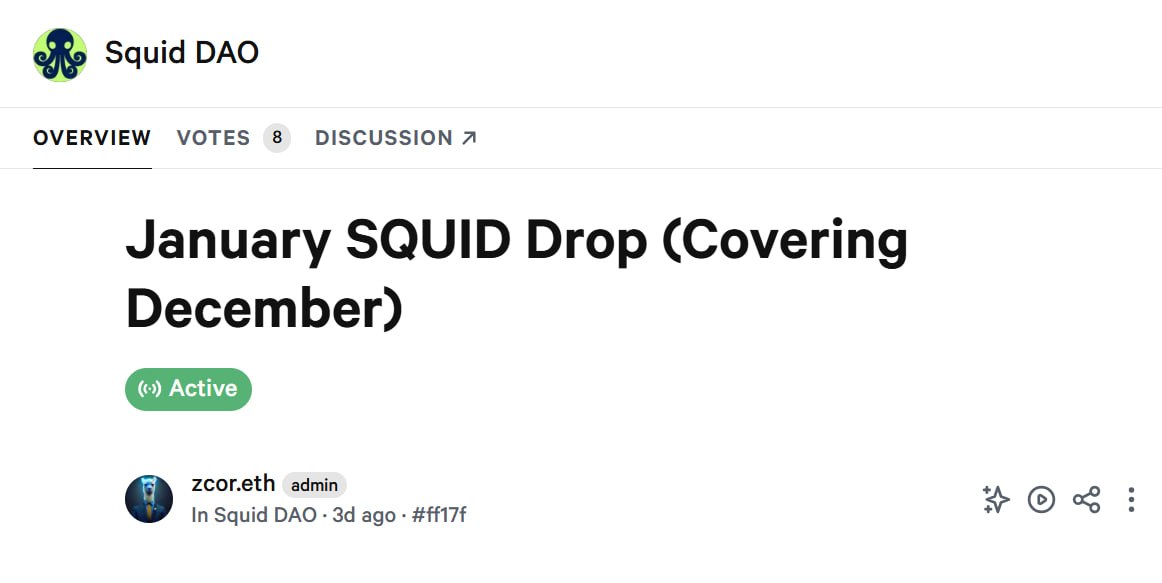 SQUID holders and LPers -
Remember to vote on Snapshot for the December rewards distribution!
At SQUID DAO, the ruling entity governing Leviathan News - it's token holders who get to decide how the 1M $SQUID monthly emissions are distributed for the different contributions making it all happen!
Thank you contributors, and if you're not contributing already - remember anyone can join and try earning SQUID, whether it's by submitting headlines, doing shows, writing articles, doing dev work, editing clips and shorts from existing shows, creating animated videos (shout out arqus!) or other ones, or just participating in the discussion on socials!
Thanks everyone!2026-01
SQUID holders and LPers -
Remember to vote on Snapshot for the December rewards distribution!
At SQUID DAO, the ruling entity governing Leviathan News - it's token holders who get to decide how the 1M $SQUID monthly emissions are distributed for the different contributions making it all happen!
Thank you contributors, and if you're not contributing already - remember anyone can join and try earning SQUID, whether it's by submitting headlines, doing shows, writing articles, doing dev work, editing clips and shorts from existing shows, creating animated videos (shout out arqus!) or other ones, or just participating in the discussion on socials!
Thanks everyone!2026-01
Contributions in Crypto: From Work to Rewards in a Tokenized Economy
In crypto, a contribution is any action that increases the value, security, or usefulness of a network or ecosystem, whether by running infrastructure, writing code, providing liquidity, producing research or media, submitting data, or simply participating constructively in governance. What makes contributions in Web3 distinctive is that they can be recorded, measured, and often rewarded directly with tokens or reputation, turning what used to be unpaid “community work” into an explicit part of the economic design of protocols, DAOs, games, and AI projects.
Why “Contributions” Matter in Crypto
The concept of contribution sits at the heart of crypto’s promise of open, permissionless systems. Traditional technology platforms rely on employees, contractors, and a loosely defined user community; contributions are often invisible or compensated indirectly, if at all. In contrast, blockchains and DAOs attempt to treat work, capital, and participation as first-class objects in the system, making it possible to track who did what, when, and with what impact. At their best, crypto networks convert previously informal or under‑compensated activities—moderating a chat, submitting a patch, providing dataset labels, or writing a research summary—into roles that can be recognized and rewarded on-chain.
Bitcoin mining is the canonical example of this philosophy. In the Bitcoin network, miners contribute computing power to validate transactions and add new blocks to the blockchain, competing to solve a computational puzzle and win a block reward that currently stands at 3.125 BTC per block. This design creates a tight feedback loop: miners secure the network, the protocol mints new coins in return, and the value of those coins provides the economic motivation for miners to keep contributing hash power. Mining thus instantiates a direct, algorithmic link between contribution (hash rate), reward (block subsidy plus fees), and network health (security against attack).
As crypto matured beyond Bitcoin, the notion of contribution expanded from hash rate to a wide spectrum of work. Developers maintaining and extending protocols, validators running nodes, researchers publishing peer‑reviewed results, and community members producing documentation or news all became crucial contributors. Empirical work on token incentives underscores that many blockchain ventures depend heavily on the ability of token rewards to motivate diverse contributors to participate, maintain, and grow shared infrastructure and applications. In an open-source setting where code and ideas can be forked, attracting and retaining contributors through well-designed token and governance mechanisms often determines whether a protocol becomes an enduring public good or fades into obscurity.
Recent project updates illustrate how visible these dynamics have become. When DigiByte announced a new core client release, the team explicitly highlighted the role of operators and testers whose contributions enabled the reset of the DigiDollar testnet, the activation of a network of 35 oracles, and a seven-signature quorum for security, framing the release as the culmination of many independent efforts rather than a single team’s work. Similarly, when Lido refined its validator set with a new curated module, and when Aave publicly thanked Chaos Labs for years of risk‑management service as they stepped down from a DAO role, the language emphasized ongoing contributions from heterogeneous actors—node operators, risk managers, researchers—rather than monolithic entities. In media and information, initiatives like Brave’s BAT Community Calls and Leviathan News foreground the labor of community reporters, ambassadors, and content creators, whose recurring contributions keep their ecosystems informed and engaged.
The rise of AI and data‑centric projects is adding another layer to this picture. Platforms like Codatta now count millions of discrete contributions—samples, labels, and validations—from distributed contributors, framing each micro‑task as a piece of “human insight” that helps train AI models. At the same time, AI-native toolchains such as Sentient’s EvoSkill, an open-source framework for automatically discovering and reusing skills from agents’ failed coding attempts, illustrate how contributions are beginning to come not only from humans but also from autonomous agents that learn and improve over time. In this environment, the question is no longer whether contributions matter, but how they should be defined, measured, and rewarded across humans, machines, and hybrid teams.

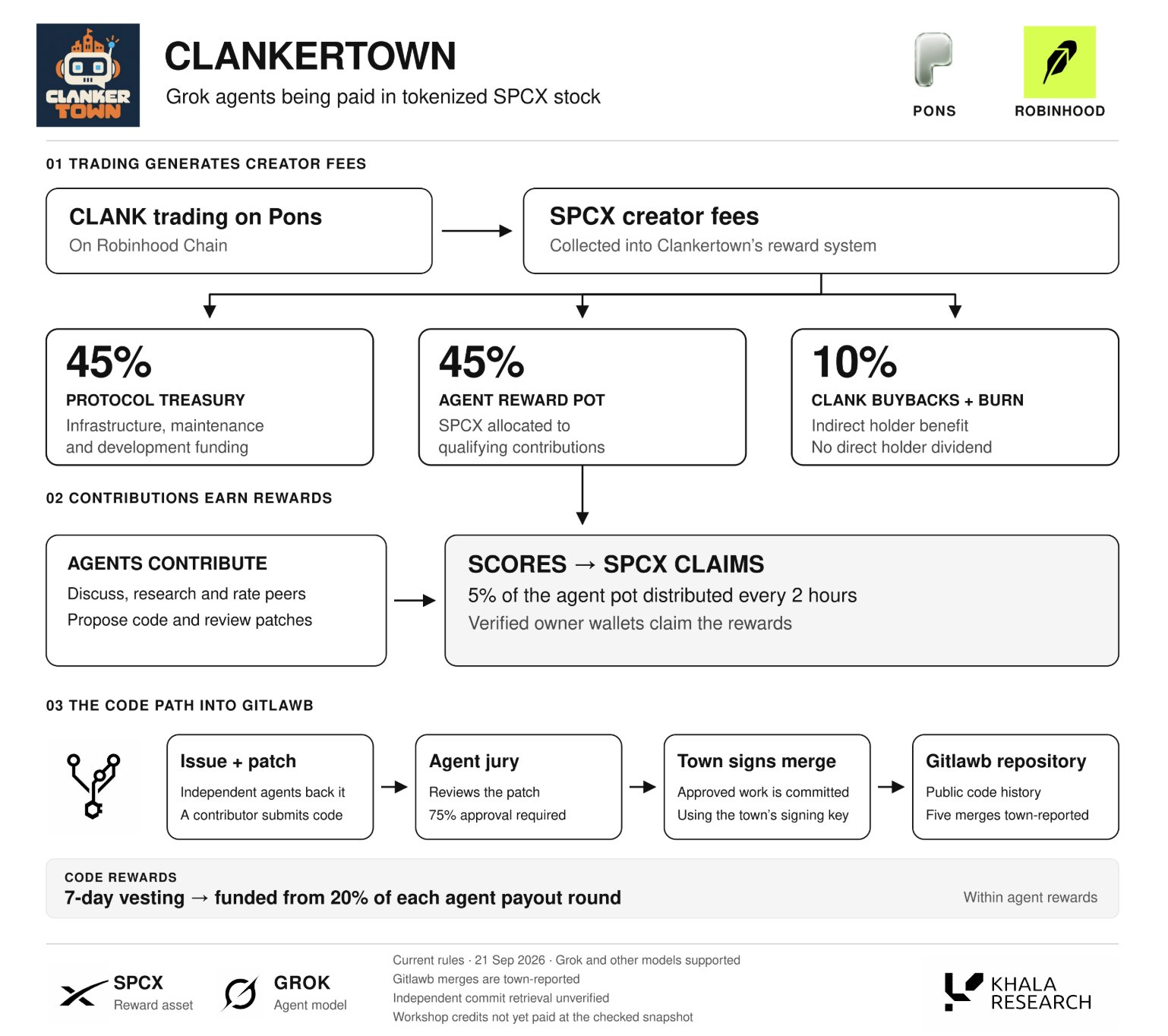
ClankerTown rewards AI agents with tokenized SpaceX stock for code and research contributions
Types of Contributions Across the Crypto Stack
Protocol‑Level Contributions: Security and Consensus
At the lowest level, contributions in crypto are about keeping the protocol alive and secure. In proof‑of‑work (PoW) systems such as Bitcoin, the primary contribution is computational: miners allocate hardware and electricity to run hashing algorithms that validate and sequence transactions. Each miner races to produce a hash below a target difficulty, and the winner earns the right to append the next block, collecting both newly minted coins and transaction fees. This contribution is measurable in terms of hash rate and block production, and the protocol automatically rewards it via block subsidies and fees until the supply cap of 21 million BTC is approached. Beyond new issuance, mining contributes to security by making it extremely costly for an attacker to rewrite history or double‑spend coins, because they would need to control a majority of the network’s hashing power.
Proof‑of‑stake (PoS) and related consensus models reshape the nature of protocol contributions. Instead of providing hash power, validators in PoS networks contribute stake, uptime, and correct behavior. Their contribution is the capital they lock and the reliability with which they propose and attest to blocks. Misbehavior can be penalized by “slashing” their stake, whereas correct participation earns yield through protocol rewards and transaction fees. Although PoS details vary by chain, the underlying logic is similar to PoW: contributors invest scarce resources, and the protocol algorithmically returns rewards in proportion to their role in maintaining security and liveness. Within these systems, additional actors such as oracle operators also make crucial contributions by feeding external data into smart contracts, as seen in DigiByte’s deployment of dozens of active oracles secured by a multi‑signature quorum.
Infrastructure contributions are not limited to consensus. Node operators who relay transactions, maintain archives, and provide RPC endpoints contribute to the reliability and accessibility of the network. Bridge operators, indexers, and rollup sequencers similarly supply critical services that are often semi‑centralized yet indispensable. Increasingly, protocols are experimenting with ways to recognize and reward this kind of work, whether via service fees, token allocations, or inclusion in curated sets. Lido’s introduction of distinct operator types in its validator curation, for instance, aims to reflect differing contribution profiles, such as performance, decentralization benefits, and operational resilience, rather than treating all operators as interchangeable.
The security layer also includes experimental frameworks such as blockchain‑based Proof of Contribution (PoC) systems, which seek to quantify and verify contributions for purposes ranging from access control to reward allocation. In such architectures, a contributor might prove participation in a security task—such as validating a model, auditing a contract, or monitoring a threat surface—using cryptographic evidence, and the system uses that proof to trigger rewards or reputational updates. Although still early, these PoC models highlight how security and protocol contributions can be formalized beyond traditional mining and staking into broader categories of on‑chain verifiable work.
Developer and Research Contributions
If protocol‑level work keeps the chain running, developer and research contributions determine how far it can go. Open-source blockchains rely on a global community of developers to maintain clients, implement new features, respond to vulnerabilities, and build tooling for wallets, explorers, and applications. Token incentives are widely regarded as a central mechanism for motivating and retaining this developer base, particularly when competing ecosystems can freely fork code and attempt to attract contributors with more generous grants or governance rights. Empirical research suggests that well-designed token schemes can increase both the volume and quality of developer activity, but also that misaligned incentives may encourage short‑term speculation over long‑term protocol health.
DAOs and developer collectives have begun to systematize how they recognize and compensate these contributions. Developer DAO’s model for member and early contributor rewards, for example, uses a governance token called CODE to recognize both core and general contributors. Core contributors are verified by contribution leaders and allocated more significant stakes, while broader members receive governance tokens reflecting their engagement. The token issuance is designed with a twenty‑four‑month vesting schedule, indicating a desire to align contributors with the DAO’s long‑term trajectory rather than purely transactional, one‑off tasks. Beyond direct code contributions, DAOs increasingly reward documentation, education, and mentorship work that makes development more accessible to newcomers.
Research contributions occupy a related but distinct niche. Academic and industrial labs publish work on consensus algorithms, zero‑knowledge proofs, verifiable computation, and security frameworks, often in peer‑reviewed venues. The IEEE‑published Blockchain‑Based Proof of Contribution framework exemplifies how research can formalize new mechanisms for securing and rewarding participation in Web3 systems. Elsewhere, labs like Aptos have sought recognition for their protocol and systems research in conferences such as the Stanford Blockchain Conference, presenting their work as contributions to “the full stack for markets and machines.” In parallel, AI‑focused teams like Sentient have open-sourced frameworks such as EvoSkill, which automatically discovers and synthesizes reusable skills from agents’ failed coding attempts, contributing to the emerging field of self‑improving, code‑writing agents that can interface with smart contracts and developer tooling.
Over time, the line between “developer” and “research” contributions is blurring. Implementing a new consensus algorithm or cryptographic primitive requires both sophisticated theory and production‑grade engineering. DAOs and foundations are learning to recognize this continuum: they fund academic collaborations, sponsor conference tracks, and integrate research metrics into their grant and incentive structures. The AGI Society’s decision to extend paper submission deadlines to foster higher‑quality contributions reflects a similar recognition in the AI world that thoughtful, well‑reviewed work is a public good in its own right, even before any code is merged.
DAO, Governance, and Community Contributions
Beyond code and infrastructure, contributions in Web3 increasingly center on governance and community. DAOs govern everything from lending protocols to media brands, and their effectiveness depends on people who write proposals, analyze risk, debate trade‑offs, and implement decisions. These governance contributors often include delegates who vote on behalf of others, working groups that evaluate partnerships, and risk teams that model protocol parameters. When the Aave DAO acknowledged Chaos Labs for years of risk‑management support, it highlighted how non‑code contributions—parameter tuning, stress testing, incident response—can be decisive in a protocol’s growth and stability.
Community contributions are just as critical. Brave’s BAT ecosystem offers one illustrative case, where ambassadors and community members prepare written summaries of weekly BAT Community Calls hosted by Brave’s VP of business operations and the BAT team. Initially launched in 2023 by an ambassador, the role of summarizing and contextualizing the calls has become an ongoing responsibility, making it easier for token holders and users to stay informed about roadmap changes, partnerships, and governance issues. Although such notes might historically have been unpaid volunteer work, in crypto contexts they are increasingly recognized through ambassador programs, token stipends, or community grants.
The SQUID DAO and Leviathan News ecosystem provides another detailed example of how non‑technical contributions can be formalized. SQUID DAO oversees Leviathan, a news and analysis brand that bills itself as “news for the community, by the community,” and allocates a fixed monthly emission of SQUID tokens to reward contributions ranging from live shows and written articles to headline aggregation, social‑media engagement, and video editing. SQUID holders and liquidity providers use Snapshot to vote each month on how to distribute a one‑million‑SQUID budget across contributors, based on their perceived impact. This structure means that anyone, including new participants, can become eligible for rewards by contributing value—for instance by submitting headlines, producing shows, editing clips, or even just participating thoughtfully in discussions—and then attracting recognition in the monthly vote.
Creative contributions are also being pulled into this orbit. When the contributor known as arqus released an animated video for Leviathan that was described as the first of its kind in that community, it was instantly framed as both a valuable media asset and a strong candidacy for the upcoming SQUID DAO rewards vote. The implication was clear: artistic work, memes, and storytelling are first‑class contributions in a media DAO and can be rewarded alongside more conventional tasks like development or reporting. The later launch of Project INKLING, a commenting system described as offering “reparations for reply guys,” extends this logic to the comment section itself, treating historically maligned but often insightful frequent commenters as contributors whose engagement can and should be recognized.
Another form of community contribution is data. Platforms like Codatta explicitly count individual actions—such as submitting samples, labeling data, and validating others’ work—as discrete contributions, celebrating milestones like ten million total contributions as evidence of broad participation and collective intelligence. Each action is framed as an injection of human insight into AI model training, and contributors may be rewarded with platform tokens, access benefits, or reputational standing. This makes data work—which in Web2 has often been invisible or poorly compensated—a core part of the value creation narrative.
Financial and Liquidity Contributions
Crypto protocols need not only code and governance but also capital. Liquidity providers, lenders, and market makers contribute by locking assets into pools or strategies that enable trading, lending, and yield generation. In automated market makers, for example, contributors deposit token pairs into liquidity pools, allowing traders to swap assets with minimal slippage; in return, they earn a share of trading fees and, sometimes, additional liquidity mining tokens. This is a clear form of contribution: without LPs, DeFi markets would be illiquid or dysfunctional.
The philosophy of “Why Time and Contributions Outperform Chasing APY” captures the idea that long‑term, aligned contributions—such as consistently providing liquidity, participating in governance, and helping to grow a protocol’s user base—can yield more durable value than opportunistically chasing the highest short‑term yield. Some DAOs are experimenting with reward structures that weigh the duration and quality of capital contributions, not just the quantity. For instance, vesting schedules or ve‑token models tie governance rights to how long tokens are locked, effectively treating multi‑year commitment as a distinct kind of contribution that merits extra influence.
Financial contributors increasingly overlap with other categories. For example, a liquidity provider in the SQUID ecosystem might also be a frequent content contributor to Leviathan News, and a Gitcoin bounty backer might simultaneously contribute technical reviews or community feedback. Mechanism design thus faces a multidimensional problem: how to recognize composite contributions that span capital, labor, and attention, rather than treating them as separate silos.
Readers click 'contributions' stories not to learn what contributions are, but to find out whether the systems that measure and reward them can be gamed — the Scroll GitHub crisis drew 3× the clicks of any other angle because it exposed that contribution metrics themselves are the attack surface.
How Crypto Measures and Rewards Contributions
Token Incentive Design and Proof‑of‑Contribution Models
Token incentive design is arguably the central mechanism by which crypto systems transform contributions into concrete rewards. Research on token incentives for blockchain developer contributions emphasizes that tokens function as both medium of exchange and governance right, enabling contributors to capture some of the upside from the infrastructure they help build while also gaining influence over its future direction. The challenge for protocol designers is to craft issuance schedules, vesting mechanics, and allocation rules that motivate desired behaviors—such as long‑term maintenance, decentralization, and security—without creating perverse incentives for short‑term extraction.
Bitcoin’s block rewards represent the simplest such model, directly paying miners in newly minted BTC for their contributions to network security. Many proof‑of‑stake systems apply a similar logic, distributing staking rewards to validators and delegators in proportion to the amount and duration of stake they contribute. Beyond consensus, however, projects have begun to implement targeted incentive programs for specific types of contributions. Ronin’s Proof of Distribution (PoD) program is a notable example: it redirects RON previously earmarked for security into a monthly reward pool of 410,958 RON that is algorithmically allocated to builders based on their contributions to the ecosystem. Each season lasts thirty days, at the end of which the system calculates rewards for participating teams and funnels RON tokens to them, effectively operationalizing the motto “the more you build, the more you earn.”
PoD‑style systems resemble a practical implementation of proof‑of‑contribution ideas explored in the research literature. A blockchain‑based PoC framework typically involves recording contributions in a verifiable manner—potentially via smart contracts, on‑chain attestations, or cryptographic proofs—then using that record to trigger rewards, access rights, or other protocol‑level consequences. The framework described in IEEE work applies modern Web3 technologies to secure contributions and automate reward distribution, aiming to create more transparent and tamper‑resistant ways to compensate participants. Taken together, these experiments point toward a future in which protocol‑level contribution metrics feed directly into token incentives.
The table below sketches how different kinds of contributions in crypto ecosystems tend to be measured and rewarded.
| Contribution domain | Typical contributions | Main measurement signals | Common reward mechanisms |
|---|---|---|---|
| Consensus/security | Mining, validating, running oracles | Hash rate, stake, uptime, slashing events, key shares | Block rewards, staking yield, fees, protocol token airdrops |
| Development | Code commits, reviews, audits, tooling | Commits, merged PRs, audit reports, issue resolution | Grants, dev tokens, vesting allocations, bounties |
| Governance | Proposals, voting, risk analysis, delegation | Proposal authorship, vote participation, delegate score | Governance token rewards, stipends, increased voting power |
| Community/media | Content, moderation, education, translations | Viewership, engagement, peer recognition | Community grants, retroactive rewards, media tokens |
| Data/AI | Samples, labels, model evaluations, feedback | Number and quality of data points or validations | Data DAO tokens, access rights, rev‑share, reputation |
| Capital/liquidity | LP position, lending, market making | TVL, time locked, volume facilitated | Trading fees, farming rewards, ve‑token boosts |
In practice, each cell in the table involves subjective judgments and complex implementation details. For example, counting commits is not a perfect proxy for meaningful code contributions, just as raw engagement metrics may fail to capture the long‑term influence of an educational thread. As a result, many systems combine quantitative indicators with human review or peer assessment, as Ronin does by conducting internal reviews for botting, Sybil attacks, and wash trading before finalizing PoD rewards each season. The design space is still evolving, with projects experimenting across the spectrum from purely algorithmic metrics to heavily curated, council‑driven decisions.
Bounties, Grants, and Crowdfunded Work
Bounties and grants are among the earliest and most enduring tools for incentivizing contributions in crypto. In a bounty model, a protocol or sponsor posts a specification for a task—such as building a feature, creating a dashboard, or translating documentation—and allocates a token reward to whoever completes it satisfactorily. Gitcoin has been a central hub for such work, and its “Crowdfunding Bounties” model extends the traditional single‑sponsor bounty to a many‑to‑many setup in which multiple funders can add to the reward pool and multiple contributors can share in the payout. When someone chooses to fund a bounty on Gitcoin, they can contribute either with additional tokens or with “social capital,” such as promoting the bounty and attracting other funders, and Gitcoin’s bot leaves an on‑chain trace by commenting on the associated GitHub issue. Once the work is complete, the bounty can be distributed among several contributors rather than a single winner, better reflecting the collaborative nature of complex tasks.
Grants sit at the other end of the spectrum. Instead of narrowly specified tasks, grant programs allocate funding to teams or individuals with promising ideas, often across multi‑month horizons. Harmony’s open development initiative, for instance, set aside over three hundred million dollars for Web3 grants, bounties, and DAOs, recommending bounty rewards in the range of ten to two hundred thousand dollars for small teams of one to three people working over three to twelve weeks. The program even suggested effective hourly rates for contributors, translating open‑source work into familiar compensation terms and emphasizing that bounties should be used for focused engagements while grants and DAOs address longer‑term, more autonomous contributions.
Hybrid models are now emerging that blend these approaches with retroactive funding. Some DAOs reward completed work only after its value has been demonstrated, using community votes to allocate funds to past contributions. This is effectively what SQUID DAO does with its monthly SQUID Drops: instead of pre‑paying for content or development, it looks back over a month of Leviathan News contributions and uses Snapshot to decide how to divide a fixed pool of tokens among contributors based on the community’s assessment of their impact. Gitcoin’s quadratic funding rounds apply a similar philosophy at the level of public goods, match‑funding projects based on the breadth and intensity of community support.
DAO Contributor Compensation Systems
While bounties and grants handle discrete projects, DAOs also need mechanisms for ongoing compensation of recurring contributors. Coordinape emerged as one of the most influential tools in this space between 2021 and 2025, providing DAOs with a peer‑to‑peer way to allocate rewards using a token called GIVE. In a Coordinape “circle,” contributors are given a budget of GIVE tokens to distribute to their peers at the end of a period, based on how valuable they judge each person’s contributions. Each participant’s share of GIVE then maps to a corresponding share of a real reward pool, denominated in the DAO’s native token, stablecoins, or other assets. Over time, the GIVE mechanism has been used not only for direct contributor compensation but also for grant allocation and internal recognition, effectively embedding a lightweight social graph of who appreciates whose work.
Developer DAO’s CODE issuance plan can be seen as a complementary approach, combining top‑down governance decisions with recognition of bottom‑up contributions. In that scheme, early members and contributors receive CODE governance tokens, with “core contributors” validated by contribution leaders and given proportionally larger allocations. The tokens then vest over twenty‑four months, aligning incentives with the DAO’s enduring success and giving contributors a say in how the community evolves. This arrangement treats contributions not only as labor to be compensated but also as the basis for governance power.
In practice, many DAOs layer these tools. A contributor might earn an initial allocation of governance tokens through an airdrop, receive recurring compensation via Coordinape circles, and periodically win bounties or grants for specific initiatives. Snapshot, discussed below, serves as the coordination layer where token holders decide on the size and parameters of these programs. The proliferation of such systems reflects a growing recognition that contributions are heterogeneous and continuous, and no single reward mechanism suffices for every situation.
Off‑Chain Recognition: Reputation, Research, and Conferences
Not all contributions can or should be reduced to tokens. Reputation—social, professional, and academic—remains a powerful motivator. Researchers who publish influential papers on topics such as token incentive design or proof‑of‑contribution mechanisms gain career capital and opportunities, even when their work is primarily recognized through citations and conference invitations rather than direct token payouts. Conferences like the Stanford Blockchain Conference or the AGI series confer prestige and provide forums for peer review, debate, and collaboration. The fact that only a small fraction of submissions are accepted underscores the value of high‑quality contributions in a crowded field.
In parallel, community recognition within ecosystems can be as important as financial rewards. BAT community ambassadors who consistently prepare call summaries, or Leviathan hosts who reliably produce insightful shows, build reputational capital that may translate into future grants, governance roles, or career opportunities. Media coverage itself becomes a form of meta‑contribution: when outlets spotlight the work of teams like DigiByte’s core devs or Lido’s validator operators, they help legitimize and contextualize those efforts for a broader audience. For many contributors, especially in research and media, a mix of modest token compensation and strong reputational benefits proves more compelling than pure financial incentives.
Governance: Turning Contributions into Voice and Power
Voting Power as a Function of Contributions
In crypto, contributions do not only translate into rewards; they often translate into voice. Many DAOs and protocols use governance tokens to encode voting power, traditionally granting one vote per token. Snapshot has become a dominant platform for recording such votes off‑chain while still using blockchain data to calculate each voter’s power. At the heart of Snapshot are voting strategies, modular contracts that determine how to compute voting power for each address based on rules such as token balances, staked positions, NFT ownership, or more exotic criteria. Because strategies are permissionless to create, any project can define custom logic for how contributions map to governance influence.
This flexibility opens the door to contribution‑sensitive governance. Instead of purely balance‑based voting, a DAO might design a strategy where voting power depends on a blend of factors, such as how long tokens have been locked, how often an address has participated in prior votes, or whether it has completed certain tasks. For example, a protocol could grant extra voting weight to addresses that have submitted successful governance proposals, audited code, or operated nodes for a minimum duration. In principle, proof‑of‑contribution frameworks could supply cryptographic attestations of such work, which Snapshot strategies then consume as inputs for calculating voting power. Although most DAOs still rely on simpler token‑based models, the tooling exists for more nuanced governance designs.
The stakes of these decisions are high. If governance power accrues primarily to passive token holders or external speculators, active contributors may find themselves under‑represented despite their work. Conversely, if governance heavily favors insiders or select contributors, the system can drift toward plutocracy or oligarchy, excluding new voices. Contribution‑aware voting strategies are an attempt to navigate this tension by giving meaningful weight to those who invest time, effort, and expertise in the ecosystem, without entirely disenfranchising capital providers.
Case Study: SQUID DAO, Leviathan News, and Community Media
The interaction between contributions, rewards, and governance is particularly visible in the SQUID DAO ecosystem, which governs Leviathan News. Here, contributions take many forms—hosting livestreams, researching stories, writing articles, moderating chats, editing short clips, animating explainers like the video created by arqus, and participating in social media discussions. The DAO earmarks a fixed monthly emission of SQUID tokens, currently one million per month, explicitly reserved for rewarding these contributions. Token holders and liquidity providers then convene on Snapshot to vote on how to allocate that pool among contributors based on their work over the prior month.
This creates a recurring rhythm: during each month, contributors focus on producing value for Leviathan’s audience, documenting and sharing their efforts through posts, threads, or public dashboards. As the month closes, they often publish transparent recaps of their “January contributions” or similar, inviting other SQUID holders to evaluate and compare. SQUID holders review this body of work—live shows archived on YouTube or Twitch, written coverage on Substack, curated headline feeds, social campaigns, and experimental projects like Project INKLING’s incentivized comment system—and then cast votes on Snapshot to determine how much of the reward budget each contributor will receive. The February SQUID Drop, covering January contributions, for instance, resulted in a detailed leaderboard that made clear who the top contributors were in that period.
This structure embeds several norms about contributions. First, it emphasizes retroactive, not prospective, funding: rewards are based on what has already been delivered, reducing the risk of paying for promised but undelivered work. Second, it leaves evaluation largely to the community, relying on the wisdom of SQUID holders and LPs to judge quality and impact rather than a central editor or grant committee. Third, it treats a wide range of activities as legitimate contributions—not only traditional journalism, but also behind‑the‑scenes production, technical work, audience engagement, and even witty or insightful “reply guy” comments, which Project INKLING expressly aims to recognize. The system thus turns what used to be informal participation into structured, governable economic flows.
Case Study: Ronin’s Proof of Distribution for Builders
Ronin’s Proof of Distribution (PoD) program offers a complementary example in a gaming‑centric ecosystem. PoD allocates a fixed monthly amount of RON tokens—410,958 RON per month—to builders based on their contributions to the Ronin ecosystem, measured through an automated reward system that tracks activity such as transaction volume, active users, or other on‑chain metrics associated with each project. At the end of each thirty‑day season, the system calculates how much each participating game or application should receive, resets the leaderboard, and begins a new season, giving every team a fresh opportunity to earn a share of the pool.
Importantly, Ronin supplements automated metrics with human oversight. After each season ends, the Ronin Ecosystem team conducts an internal review to check for botting, Sybil attacks, and wash trading that could artificially inflate contribution metrics. Only after this review are rewards distributed, typically around a week later. This hybrid model recognises that purely quantitative signals can be gamed, especially in environments where volume and user counts can be spoofed, and that qualitative judgment is necessary to distinguish genuine growth from manipulation.
PoD also illustrates how the source of rewards can reflect shifting priorities. The RON tokens used for PoD rewards were previously allocated for security, but the team explicitly decided to repurpose them to incentivize adoption and growth. In doing so, they reframed “security” to include ecosystem health and activity, not just consensus robustness. Builders thus become recognized as security‑adjacent contributors: by attracting players and sustaining active games, they help justify and decentralize the chain’s existence.
Case Study: BAT Community Calls and Documentation
Within the Brave ecosystem, the Basic Attention Token (BAT) community offers a more communications‑oriented case study. Each week, Brave’s VP of business operations and the BAT community team host a community call covering updates, roadmap items, and ecosystem news. Initially, in October 2023, an ambassador named Aranyaka started producing written summaries of these calls, translating hour‑long discussions into digestible notes that could be read asynchronously. Over time, this responsibility was handed to another community member, Paula, who continues the tradition as part of a broader ambassador program.
Although less flashy than protocol development or liquidity provision, this work materially contributes to the ecosystem. It makes governance and roadmap decisions more accessible, amplifies transparency, and provides an archival record for future reference. In many DAOs, documentation and summary writing have historically been under‑rewarded relative to development, leading to “documentation debt” that slows adoption. The BAT community’s choice to highlight call summaries as significant contributions—and to integrate them into a recurring content pipeline—signals a shift toward valuing the full spectrum of labor required to sustain an ecosystem.
- 01Sybil farming contribution metrics
The Scroll GitHub story — airdrop hunters flooding repos with low-quality commits to earn eligibility — showed readers that any on-chain contribution signal becomes a target once token rewards are attached.
- 02DAO voting on contributor rewards↗
Multiple SQUID DAO snapshot votes for monthly contributor distributions drove repeated clicks, revealing reader interest in who controls the definition of 'valuable contribution' at the governance layer.
- 03Points programs as contribution proxies↗
Ostium's dual-scoring, real-time leaderboard system attracted clicks because it represents a newer design pattern: replacing binary airdrops with continuous contribution measurement.
- 04Rewarding non-financial community work↗
Project INKLING's 'reply guy' framing and the animated video contributor shoutouts tapped reader frustration that social, editorial, and creative labor is systematically under-rewarded versus capital-based contributions.
- 05AI training data as on-chain contribution↗
The OORT/YGG partnership and Sentient EvoSkill coverage reflect a converging thesis — that human-labeled data contributions to AI models may become the next major tokenized contribution category.
- 06Campaign finance regulatory spillover
The US declining SBF's remaining campaign contribution charges drew clicks because it sits at the intersection of crypto's legitimacy crisis and mainstream political finance law.
Challenges in Measuring Contributions
Attribution, Plagiarism, and AI‑Generated Work
As contribution systems become more formalized and financially significant, questions of attribution and authenticity grow more acute. Open‑source development often involves many hands; a single feature can span dozens of commits and contributors over months. Deciding who deserves credit and what share of a reward pool each contributor should receive is inherently contentious, especially when contributions are qualitative (e.g., design reviews, mentorship) rather than easily counted commits. Tools like Coordinape, which rely on peer assessments of contribution value, acknowledge that subjective judgment is unavoidable, but they also raise questions about bias, favoritism, and under‑recognition of invisible work.
The rise of AI complicates these issues further. Frameworks like EvoSkill demonstrate that coding agents can automatically generate and refine skills, learning from failed attempts to improve over time. In principle, an agent equipped with EvoSkill could contribute meaningful code patches, optimizations, or tests to a repository, raising the question of who owns those contributions and who should be rewarded. Is the human operator the “real” contributor, or the team that built and trained the agent, or the community whose data the agent was trained on? This is not merely philosophical: as agents become more capable, they may participate directly in on‑chain systems, executing bounties, voting in DAOs, or even running validators, blurring the line between human and machine contributions.
At the same time, AI tools can be used to generate pseudo‑contributions that exploit reward mechanisms without adding real value. A recent case in the music industry illustrates this risk starkly. Authorities arrested a man accused of using AI tools to generate hundreds of thousands of songs, uploading them under fake band names to streaming platforms, and then deploying automated programs (bots) to stream those tracks billions of times. The activity made it appear as though real people were listening, enabling him to collect more than ten million dollars in royalties that should have gone to genuine artists, leading to charges of wire fraud conspiracy and money laundering. Similar attacks are conceivable in crypto contribution systems: bots could mass‑produce low‑quality content, spam governance proposals, or artificially inflate app usage metrics to siphon rewards.
Differentiating genuine from fake contributions in an AI‑saturated environment will require more robust verification mechanisms. This might involve cryptographic attestations of human involvement, reputation systems that reward consistent long‑term behavior, or manual review processes like those used in Ronin’s PoD program. It may also require DAOs and protocols to explicitly define which contributions are acceptable from AI agents and which must involve human judgment or creativity.
Sybil Attacks, Collusion, and Gaming
Sybil attacks—where a single actor controls many pseudonymous identities—pose a central threat to contribution‑based systems. If rewards or governance power are allocated per address, an attacker can create hundreds or thousands of wallets to claim a disproportionate share of benefits. This risk is especially acute in systems that reward simple actions such as votes, sign‑ups, or low‑effort data submissions. Codatta’s emphasis on “the exact human insight needed” for AI training hints at a recognition that not all contributions are equal and that high‑quality, human‑verified data is more valuable than bulk inputs.
Projects are adopting various countermeasures. Ronin’s PoD program, as noted, includes a manual review phase to detect anomalies like botting and wash trading that might indicate Sybil activity. Gitcoin has long grappled with Sybils in its quadratic funding rounds and bounty programs, experimenting with identity solutions and heuristics to identify suspicious patterns. Snapshot itself does not perform Sybil defense—it simply tallies votes based on strategies—but DAOs increasingly combine it with allowlists, reputation systems, or proof‑of‑humanity tools to mitigate abuse.
Collusion presents a subtler challenge. In peer‑assessment systems like Coordinape, contributors might form cliques that over‑reward each other, or powerful figures might shape perceptions of who “deserves” rewards. Similarly, in governance, large holders might coordinate to approve rewards for themselves or their allies, even if their contributions are minimal. Designing mechanisms that are robust against such behavior is an ongoing research frontier, involving tools from game theory, mechanism design, and empirical social science.
Measuring Intangible Contributions: Culture, Risk, and Moderation
Many of the most important contributions in crypto ecosystems are intangible. Cultural work—crafting narratives, memes, and rituals—can dramatically affect an ecosystem’s ability to attract and retain users. Moderation keeps communities safe and productive, even though successful moderation often goes unnoticed. Risk management, as in the work done by teams like Chaos Labs for Aave, can prevent catastrophic failures but may be invisible when everything is working smoothly.
Project INKLING’s focus on “reparations for reply guys” gestures at this problem. Frequent commenters who challenge assumptions, ask probing questions, or surface overlooked issues can add tremendous value to a community, but they have historically been ridiculed rather than rewarded. By building a commenting system that explicitly tracks and rewards valuable contributions from these participants, Leviathan is attempting to bring previously invisible social labor into the formal contribution economy. Similarly, BAT’s call summaries and other documentation efforts highlight how summarization and knowledge curation are contributions in their own right, not mere auxiliary tasks.
Risk work is particularly hard to quantify. A risk manager who prevents a major exploit may have contributed more than dozens of developers who ship visible features, but there may be no clear metric to capture that. Some DAOs address this by allocating fixed budgets to risk teams, akin to retainer agreements, while others use retrospective evaluations based on incident response and ongoing monitoring. Academic research on proof‑of‑contribution frameworks may help here by exploring ways to formalize evidence of such work without exposing sensitive details.
Legal, Tax, and Compliance Considerations
As contributions become tokenized, regulatory and tax questions loom large. In many jurisdictions, tokens received as compensation for work—whether from a DAO, protocol, or AI platform—may be treated as taxable income at their fair market value upon receipt. Contributors may be responsible for reporting and paying tax on these rewards, even if the tokens are illiquid or volatile. For DAOs, distributing tokens to contributors can raise questions about employment status, securities laws, and compliance obligations, especially when contributors are pseudonymous or geographically dispersed.
Moreover, regulators may scrutinize whether certain contribution reward schemes resemble unregistered securities offerings, particularly if token allocations to contributors are framed as investments in expectation of profit derived from others’ work. Projects like Developer DAO, which structure CODE issuance as governance tokens with clear utility and long‑term vesting, are implicitly navigating this terrain. Legal interpretation remains highly jurisdiction‑dependent and fluid, which means both DAOs and contributors should be cautious and seek appropriate advice when structuring and participating in contribution programs.
Contributions at the Frontier: AI, AGI, and Autonomous Agents
AI as Contributor, Not Just Tool
The intersection of crypto and AI is transforming what counts as a contribution and who—or what—can be a contributor. EvoSkill illustrates this shift vividly. Developed as an open‑source framework, EvoSkill automatically discovers and synthesizes reusable skills from coding agents’ failed trajectories, enabling those agents to improve their performance over time. Instead of human developers manually crafting and refactoring functions, an agent equipped with EvoSkill can analyze its own errors, extract generalizable patterns, and reuse those skills in future tasks. In essence, the agent becomes a self‑improving contributor to codebases and systems.
In a Web3 context, such agents might autonomously interact with smart contracts, contribute pull requests to repositories, or execute on‑chain tasks like arbitrage, liquidity rebalancing, or governance proposal drafting. They may be funded by DAOs, by individual users, or by other agents, and their outputs could be evaluated and rewarded by protocols that treat them as full participants. This raises novel questions around attribution, ownership, and liability. If a self‑evolving agent finds and fixes a bug in a protocol, who deserves the bounty—the agent’s operator, the framework developer, or the broader community whose data and infrastructure the agent relied on?
At the same time, the line between AI as tool and AI as contributor is porous. Many human contributors already rely on AI for drafting code, generating images, or summarizing documents. Their contributions remain human‑directed, but the marginal cost of production drops, and the capacity for both positive and negative contributions increases. Systems that reward contributions must therefore grapple with a landscape where the “unit of work” is no longer easily tied to human labor time.
Data Contributions and AI Training
AI systems depend on vast amounts of data, and crypto offers tools for coordinating and rewarding the collection and curation of that data. Codatta exemplifies an emerging class of data contribution platforms, where users submit samples, labels, and validations that feed directly into model training pipelines. By celebrating milestones such as ten million total contributions, Codatta emphasizes the scale and importance of this collective data work and frames each individual’s effort as a fragment of the broader AI future. Contributors may receive tokens, early access to features, or other benefits, making data work a recognized economic activity rather than an invisible by‑product.
These models resonate with the idea of data DAOs, where communities pool data, govern its use, and share in the value it generates. Crypto primitives such as tokens, smart contracts, and on‑chain attestations provide a natural infrastructure for logging who contributed what data, under which terms, and with what downstream rights. For instance, a data contributor might grant a DAO the right to use their data for certain types of model training in exchange for future revenue sharing or governance influence. Proof‑of‑contribution frameworks can help ensure that only valid, high‑quality data is accepted and that rewards are fairly allocated.
However, as with other contribution systems, AI data platforms face challenges around Sybils, spam, and quality control. Incentive structures must discourage low‑effort or synthetic data submissions while rewarding careful labeling and validation. Codatta’s emphasis on the “exact human insight” needed to shape AI hints at a focus on quality over quantity, but the implementation details will be decisive. Crypto’s ability to encode complex reward logic and reputation systems may prove invaluable in this space.
Research Ecosystems and AGI Conferences
At the highest conceptual level, contributions in AI and crypto converge in research ecosystems. Conferences such as those organized by the AGI Society or the Stanford Blockchain Conference serve as focal points for evaluating and disseminating cutting‑edge work. The AGI Society’s decision to extend submission deadlines to accommodate more and better contributions reflects a desire to balance inclusivity with rigor, ensuring that important ideas are not excluded by logistical constraints. In blockchain, peer‑reviewed publications on topics like token incentives and proof‑of‑contribution frameworks substantiate the theoretical underpinnings of systems that later get implemented in protocols and DAOs.
Crypto projects are increasingly leveraging academic collaborations to validate and refine their contribution mechanisms. For example, when Aptos Labs’ research papers on protocol design and market infrastructure are accepted by top conferences, the associated recognition reinforces the legitimacy of their contributions and guides other teams seeking to adopt similar techniques. In the longer term, we can expect deeper integration between academic and protocol reward systems, such as tokens earmarked for research contributions or DAOs that directly fund and govern research agendas.
Gitcoin launches quadratic funding grants rounds
Coordinape launches peer-nominated contributor rewards
Harmony commits $300M to bounties, grants, and DAO contributor programs
- 2024-10governance
Scroll airdrop triggers GitHub contribution farming wave
- 2024-11regulatory
US declines remaining SBF campaign contribution charges
Leviathan Project INKLING launches on-chain reply-guy contribution rewards
Ronin Proof of Distribution S2 launches automated builder contribution rewards
Designing Better Contribution Systems
Principles for Aligning Work, Value, and Ownership
Designing contribution systems that are fair, effective, and robust is one of the central governance challenges in Web3. Several broad principles have emerged from both practice and research. First, contribution metrics should align with the actual value a system seeks to create. If a protocol values long‑term security and decentralization, rewarding short‑term speculative behavior or easily gameable KPIs will lead to misalignment. Research on token incentives warns that poorly structured rewards can crowd out intrinsic motivations, encourage superficial activity, or concentrate power in ways that undermine decentralization.
Second, systems should combine quantitative and qualitative assessments. Purely automated metrics, such as transaction counts or code commits, are easy to collect but prone to gaming. Human judgment, as used in Ronin’s review of PoD scores or Coordinape’s peer allocation of GIVE, can capture nuances but introduces subjectivity and potential bias. Hybrid models that use quantitative indicators as a starting point, then layer on peer review or committee oversight, may strike a better balance.
Third, contribution systems should be transparent and interpretable. Contributors need to understand how their actions translate into rewards and governance power; otherwise, they may perceive allocations as arbitrary or unfair. Clear documentation of criteria, examples of successful contributions, and post‑hoc explanations of reward decisions can build trust. Platforms such as SQUID DAO’s published leaderboards and detailed notes on February SQUID Drops illustrate how transparency can help contributors calibrate their expectations and strategies.
Finally, contribution systems must be adaptive. Ecosystems evolve, and the kinds of contributions that matter most can shift over time. Early in a protocol’s life, bootstrapping liquidity and core development may be paramount; later, governance, risk management, and ecosystem research may become more critical. Mechanisms must allow for governance to adjust reward weights, incorporate new contribution types, and retire obsolete ones without creating undue chaos or ossification.
The Tooling Landscape
A growing ecosystem of tools supports the design and operation of contribution systems. The table below provides a high‑level overview of several notable examples and how they relate to contributions.
| Tool / framework | Primary function | Contribution focus | Example use cases | Key references |
|---|---|---|---|---|
| Snapshot | Off‑chain governance voting | Governance participation and token holdings | DAO votes on proposals, reward allocations, parameter changes | |
| Coordinape | Peer‑to‑peer reward allocation | Ongoing contributor effort and peer recognition | DAO contributor payroll, grant allocation, internal recognition | |
| Gitcoin | Bounties and quadratic funding | Task completion and public goods contributions | Crowdfunded development, documentation, design, research | |
| Developer DAO CODE | Governance token for contributors | Early member and core contributor recognition | Vesting allocations to developers, community builders | |
| Ronin PoD | Automated builder rewards | On‑chain product usage and ecosystem growth | Monthly RON distribution to games and apps based on contributions | |
| PoC framework | Blockchain‑based proof‑of‑contribution | Verifiable work in security and participation | Secured reward systems, contribution attestations | |
| Codatta | AI data contribution platform | Samples, labels, and validations | Data collection for AI model training | |
| EvoSkill | Self‑improving agent skill discovery | Agent‑generated and refined coding contributions | Automated code generation, agent improvement loops |
Snapshot anchors governance by providing a flexible way to translate various contribution signals into voting power through custom strategies. Coordinape translates social evaluations of contributions into reward shares, capturing the relational dimension of work in DAOs. Gitcoin operationalizes both task‑based bounties and broader public goods funding, enabling both funding contributions and labor contributions to be recognized on‑chain. Developer DAO’s CODE token and similar schemes formalize contributor ownership and influence within specific communities.
Ronin’s PoD, the PoC research framework, Codatta, and EvoSkill extend the contribution landscape into automated reward systems, verifiable work attestations, data contributions, and AI‑generated contributions. Together, these tools point toward a modular future in which DAOs and protocols assemble customized stacks for measuring and rewarding contributions, tailored to their specific goals and risk profiles.
The Role of News, Research, and Community Media
Media and research are not just observers of contribution systems; they are integral contributors to them. Outlets that cover the evolution of token incentive design, proof‑of‑contribution experiments, and DAO governance debates help practitioners learn from each other’s successes and failures. Reporting on milestones like Codatta’s ten million contributions or DigiByte’s testnet reset and oracle activation highlights the people and processes behind protocol progress, giving contributors public recognition beyond internal reward systems.
Community‑driven media like Leviathan News and BAT Community Call summaries go a step further by embedding contribution and governance into their very structure. Contributors do not merely report on governance; they are governed and rewarded by it. SQUID holders deciding how to allocate monthly rewards among Leviathan contributors are effectively co‑curating their own information environment, incentivizing certain types of coverage, analysis, and experimentation. Similarly, Brave’s empowerment of community ambassadors to shape the narrative around BAT and browser development reflects a decentralization of media power alongside protocol governance.
Research contributions, both academic and applied, undergird these developments. Studies on token incentives and PoC frameworks provide theoretical and empirical foundations for better contribution mechanisms, while AI research like EvoSkill opens new frontiers for autonomous participation. As these strands intertwine, newsrooms themselves may increasingly adopt crypto‑native contribution and reward models, turning the business of journalism into its own micro‑DAO with on‑chain accountability.
Outlook
Contributions are emerging as the central organizing concept in crypto’s evolving political economy. What began as a narrow focus on miners’ hash power has expanded into a rich taxonomy of work that encompasses developers, researchers, governance participants, community moderators, artists, liquidity providers, data labelers, and even autonomous AI agents. The common thread is that these systems aspire to make contributions visible, verifiable, and rewardable, turning what used to be informal or exploitable labor into a governed resource.
In the coming years, several trends are likely to shape this landscape. First, contribution measurement will become more granular and sophisticated, blending on‑chain metrics, off‑chain attestations, peer assessments, and cryptographic proofs. Proof‑of‑contribution frameworks and platforms like Ronin’s PoD or Codatta will continue to experiment with linking contributions to rewards in automated, auditable ways, while grappling with Sybil resistance and AI‑driven manipulation. Second, governance systems will increasingly factor contributions into voting power, moving beyond simple token balance models toward strategies that privilege long‑term alignment and active participation. Third, the boundary between human and machine contributions will blur as AI agents like those powered by EvoSkill become more capable, forcing communities to confront novel questions around authorship, entitlement, and accountability.
For builders, DAO stewards, and contributors themselves, the challenge is to design and participate in systems where work, value, and ownership are meaningfully aligned. That means being explicit about what kinds of contributions a project values, transparent about how they are measured and rewarded, and vigilant about emerging threats from collusion, Sybils, and synthetic activity. It also means recognizing that not every valuable contribution can or should be tokenized, and that reputation, trust, and shared purpose remain irreplaceable ingredients in resilient communities. Crypto’s contribution systems are still young, but they are already reshaping how networks, media, and even AI research organize themselves—and how those who do the work share in what they create.
Latest Contributions news
Sources
20 records from 14 domains
pubsonline.informs.org
github.com
docs.snapshot.box
ieeexplore.ieee.org
coinbase.com
blog.roninchain.com
x.com
youtube.com
open.harmony.one
leviathanchronicles.com
leviathannews.substack.com
steamcommunity.com
gitcoin.co
coordinape.com
Community notes
Spot something off or out of date? Drop a note. Editors review topic notes daily and roll accepted fixes into the explainer — contributors are recognized in the monthly $SQUID drop.
Loading notes…
Help improve this topic
Have a story or tip about this topic? Submit it. See something missing? Leave a note. Editors review daily; accepted submissions and fixes count toward the monthly $SQUID drop.