
Deep dive on SEC Commissioner Hester “Crypto Mom” Peirce, her safe harbor and tokenization ideas, crypto enforcement dissents, Coinbase and ETF stance, and how her looming SEC exit could reshape U.S. crypto regulation.
+3 sources across the wider coverage universe
 SEC’s Hester Peirce Says Crypto Clarity Bill Is Still on Track2026-04
 SEC Commissioner Hester Peirce: The US government needs to remember who it represents2023-09
- SEC Commissioners Peirce and Uyeda issue dissent on Stoner Cats ruling, compare NFT to 1970s Star Wars collectibles, and believe legal clarity lies in a galaxy far, far away2023-09
 SEC Commissioner Hester Peirce was just tapped to run the crypto task force at the SEC and zGuz lists three things she predicted would happen under a pro-crypto SEC2025-01
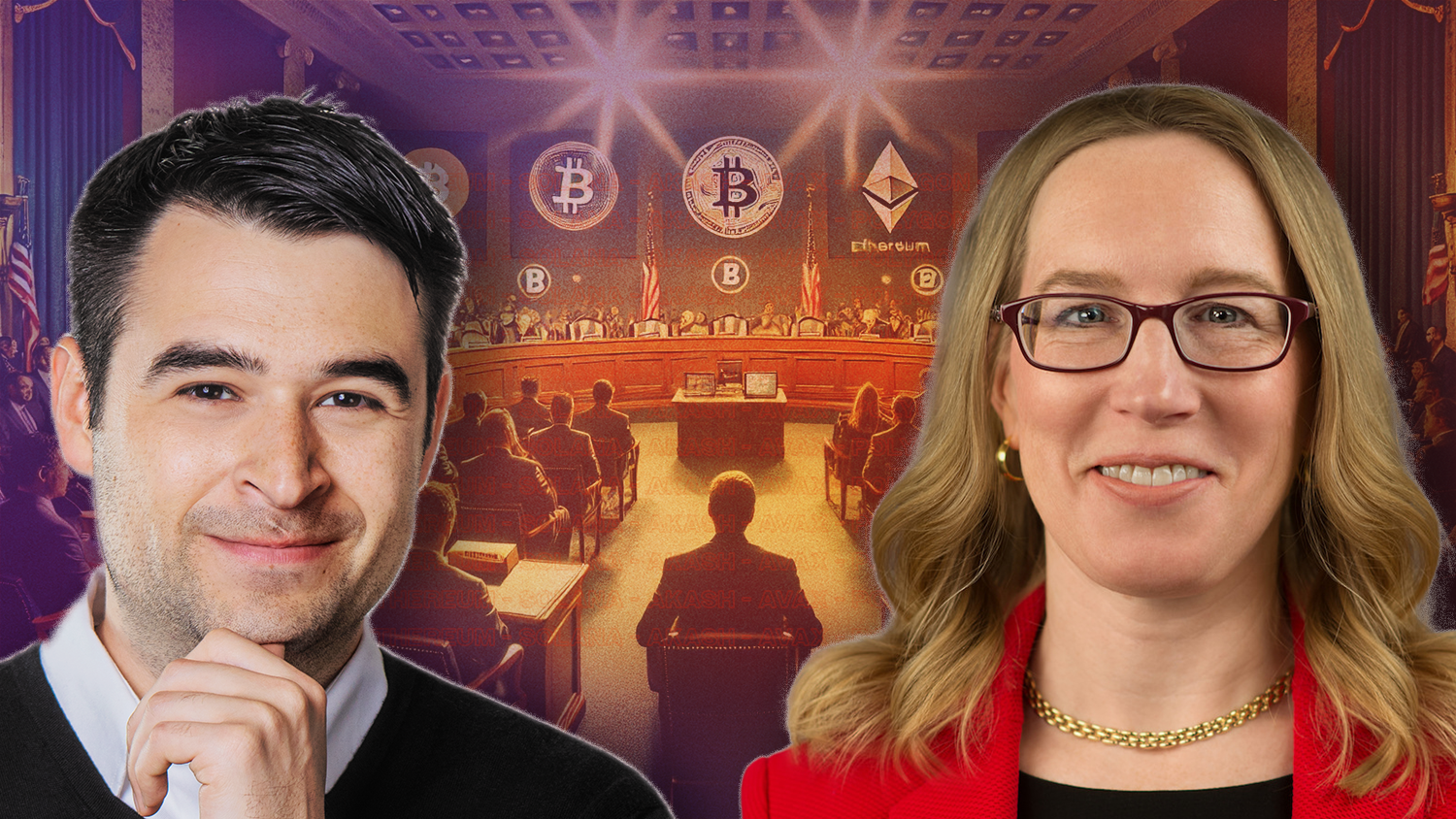 SEC Commissioner Peirce previews pro-crypto changes coming to the SEC.2024-12
- Commissioners Hester Peirce and Uyeda dissent in SEC’s Flyfish club NFT enforcement.2024-09
Hester Peirce and Crypto: Inside the “Crypto Mom” Approach to SEC Regulation
Hester Peirce is a U.S. Securities and Exchange Commission (SEC) Commissioner known in crypto circles as “Crypto Mom” for her unusually open engagement with digital assets, her criticism of regulation-by-enforcement, and her push for clear, innovation‑friendly rules. At the same time, she is a securities lawyer and institutional insider who emphasizes that most tokenized instruments remain securities subject to federal law, and that decentralization claims do not exempt centralized operators from core compliance duties.
Background: From Securities Lawyer to “Crypto Mom”
Hester Peirce’s influence on crypto policy is best understood against the backdrop of her broader securities‑law career and her path into the SEC’s upper ranks. Before becoming a Commissioner, she worked inside and around the SEC, including roles at the agency itself and in the U.S. Senate, building a reputation as a technically adept, market‑friendly lawyer who nonetheless took investor protection seriously. Outside government, she spent time at the Mercatus Center, where she wrote about financial regulation and the appropriate scope of the administrative state, sharpening the limited‑government instincts that later colored her approach to crypto. By the time she returned to the SEC as a Commissioner, she was already known as a skeptic of expansive regulatory power and an advocate for market‑based experimentation.
Her tenure as Commissioner has spanned multiple administrations and sharply different regulatory moods, which partially explains why she became a focal point of crypto’s attention. Under prior SEC chairs, the agency adopted an increasingly aggressive enforcement posture toward initial coin offerings, token projects, trading platforms, and later DeFi protocols and NFT issuers, often shoehorning these into existing securities frameworks drafted long before blockchains existed. Peirce did not dispute that many of these offerings violated the law, but she repeatedly argued that this case‑by‑case approach left markets confused, chilled legitimate innovation, and failed to supply the clear ex ante standards that both builders and investors need. Because she articulated these critiques from inside the Commission—often in sharply worded dissents—crypto audiences began to see her as a rare institutional ally.
The “Crypto Mom” moniker emerged from this unusual combination of insider status and public sympathy for crypto’s complaints about ambiguous rules. Peirce leaned into the nickname with a measure of humor, but she used it to make a serious point: parents do not indulge every whim of their children, and likewise her support for crypto is not unconditional. She has stressed in public remarks that being “pro‑innovation” does not mean suspending securities laws, and she has warned that centralized actors cannot simply invoke decentralization to escape oversight. This balance—sympathetic to crypto’s goals yet insistent on legal compliance—has become one of her defining traits and helps explain why she is taken seriously both by industry and institutional colleagues.
In more recent years, Peirce’s relationship with crypto policy has grown even more formal and central. She serves on the SEC’s Crypto Task Force, a specialized group created to coordinate the agency’s approach to digital assets and related market infrastructure. During the second Donald Trump administration, she was tapped to head that Crypto Task Force as part of a broader deregulatory effort focused on digital assets and market structure, cementing her role as the Commission’s main internal point person on crypto. For the industry, that appointment signaled not just symbolic support but a realistic possibility that the SEC’s default stance toward tokenization, DeFi, and exchange regulation might shift from defensive to more constructive experimentation.
Yet her tenure at the SEC is finite. Recent reporting indicates that Commissioner Peirce, described as a “stalwart crypto backer” and a reliably vocal dissenter during the Biden‑era SEC, plans to leave the agency in November, which will further deplete the Commission’s roster of crypto‑savvy voices and reduce internal debate on digital asset policy. For a crypto ecosystem that has often looked to Peirce as a key internal advocate, her impending departure raises urgent questions about who will carry forward her agenda of clearer rules, greater institutional humility, and more robust financial privacy protections.

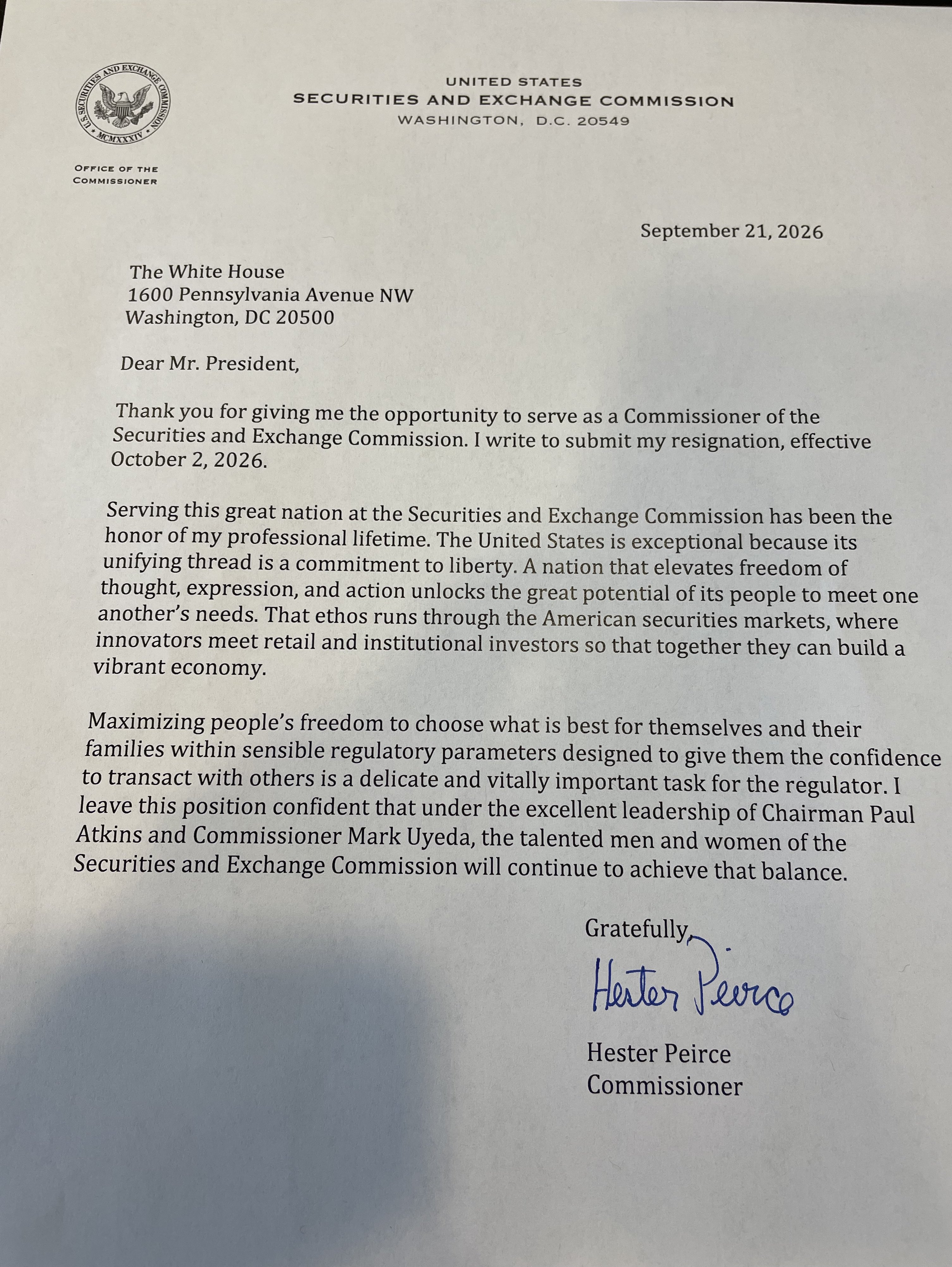
SEC commissioner Hester Peirce submits resignation letter, effective October 2, 2026, after nearly nine years of service. She plans to join Regent University School of Law as an associate professor in November.
Regulatory Philosophy: Clarity, Limits, and Dissent
To understand Peirce’s crypto positions, it is essential to grasp her broader view of the SEC’s proper role in financial markets. She consistently emphasizes that the agency’s mandate is limited and rooted in statute: its task is to protect investors, maintain fair and orderly markets, and facilitate capital formation, not to manage the economy or engineer preferred social outcomes. This framing makes her wary of what she views as mission creep, especially where regulators reinterpret old statutes to cover new technologies without clear congressional authorization. In the crypto context, that wariness translates into skepticism about stretching the definition of “exchange,” “broker‑dealer,” or “investment contract” to reach novel decentralized arrangements without targeted rulemaking.
One of Peirce’s central themes is the distinction between rulemaking and enforcement. She has repeatedly criticized strategies that rely on high‑profile enforcement actions—especially against non‑fraudulent actors—to define the scope of the law. In her dissent in the LBRY case, for example, she described the Commission’s enforcement decision as “especially unsettling” because it took aim at a relatively small blockchain company with an open‑source protocol but offered little guidance for how similar projects might comply going forward. For Peirce, such cases exemplify the problem of “regulation by enforcement”: rather than issuing clear rules tailored to digital assets, the SEC brings lawsuits and then points to those cases as de facto guidance, creating uncertainty and deterring experimentation.
Dissent plays a central role in Peirce’s institutional philosophy. In speeches and interviews, she has argued that visible disagreement within regulatory bodies is healthy, increases accountability, and signals to the public that complex questions are being taken seriously rather than resolved by fiat. Her SEC record reflects this view: she has issued dissents not only on crypto matters but on broader issues such as climate disclosure rules, settlement practices, and the scope of the Commission’s authority. Her dissent from the SEC’s long‑standing policy of requiring settling defendants to agree not to publicly criticize the settlement—the so‑called “gag rule”—is emblematic. In that statement, she argued that prohibiting defendants from speaking undermines regulatory integrity and the public’s ability to scrutinize the agency’s actions, particularly in areas like crypto where the legal ground is contested.
Peirce’s libertarian‑leaning instincts also shape her intense focus on financial privacy. In a widely discussed speech titled “Peanut Butter & Watermelon: Financial Privacy in the Digital Age,” she warned that the growing scope of financial surveillance—by both governments and private intermediaries—risks transforming financial services into a tool for behavioral control. She argued that while anti‑money‑laundering and sanctions policies serve legitimate aims, the expansion of mandatory data collection and monitoring has proceeded with insufficient public debate about costs to autonomy and dissent. In later commentary, she linked these concerns to crypto, observing that blockchains simultaneously enhance transparency and offer new avenues for privacy‑preserving systems, and that regulators must resist the temptation to treat all privacy‑enhancing tools as inherently suspect.
These foundational views—skepticism of mission creep, preference for rulemaking over enforcement, commitment to open dissent, and concern for privacy—form the backbone of Peirce’s crypto agenda. They explain why she has proposed safe harbor regimes for token distributions, why she has pushed for narrower, more tailored exemptions for tokenized securities, and why she repeatedly criticizes enforcement actions that attempt to retrofit traditional securities doctrines onto NFTs, DeFi protocols, or centralized exchanges without addressing the structural differences. They also illuminate why she often finds common ground with the crypto industry’s fundamental suspicion of concentrated power, even when she disagrees with specific projects’ choices or insists on strict compliance for centralized intermediaries.
Readers click Peirce not for crypto advocacy but for institutional dissent — her value to this audience is as an insider who names the SEC's own contradictions on enforcement, NFTs, and DeFi clarity, making her a credibility source for the industry's grievances rather than a cheerleader.
Safe Harbor, Clarity, and the Search for Predictable Rules
One of Peirce’s most influential contributions to crypto policy debates is her proposed “Token Safe Harbor,” an attempt to provide a structured path for token projects to develop without being immediately crushed under securities‑registration requirements. Her “Token Safe Harbor Proposal 2.0,” published through an official SEC statement, lays out a framework under which developers could offer and sell tokens pursuant to an exemption lasting a defined period, provided they met robust disclosure and transparency obligations tailored to token buyers’ needs. The idea is to recognize that some token networks genuinely evolve from centralized startup projects into decentralized protocols and that securities law should account for this dynamic rather than permanently treating every token as an issuer‑backed security.
The safe harbor proposal requires token issuers to provide specific disclosures about the project’s purpose, tokenomics, governance plans, team members, and code, as well as regular progress updates over the life of the exemption. These disclosures aim to give purchasers the information they need to evaluate risks, including smart contract and governance risks, while allowing the network to launch and grow toward a state where the token may no longer resemble a traditional security. Crucially, the safe harbor is not a free pass; it conditions relief on the project’s good‑faith efforts to achieve network maturity and decentralization, and it leaves room for enforcement if issuers engage in fraud or misleading statements. In this sense, Peirce seeks to bridge the gap between crypto’s insistence on experimentation and regulators’ obligation to protect investors from opaque, high‑risk schemes.
Peirce has repeatedly contrasted this safe harbor vision with the SEC’s prevailing reliance on enforcement actions against token issuers. In her LBRY dissent, she noted that the Commission’s lawsuit did not just target clearly fraudulent conduct but instead treated the firm’s ongoing token distributions as unregistered securities offerings without providing a clear compliance roadmap that other projects could follow. Similarly, in her comments on the Commission’s first and second NFT cases, she questioned whether the agency’s application of the Howey test to collectibles like the Stoner Cats NFTs offered any real insight into which digital collectibles should be treated as securities and which should not. In each instance, she returned to the same theme: enforcement may be necessary, but when used as the primary tool for navigating complex new asset classes, it yields piecemeal, inconsistent signals that neither protect investors nor foster responsible innovation.
Over time, that critique has broadened into support for legislative efforts to clarify crypto’s legal status. Peirce has spoken positively about ongoing work on a federal “crypto clarity” bill, emphasizing that momentum behind such legislation is real even when congressional timelines slip. In interviews, she has suggested that Congress—rather than the SEC alone—is best positioned to draw durable lines between securities, commodities, and other categories of digital assets, and to decide whether and how to create bespoke regulatory regimes for stablecoins, decentralized protocols, or tokenized real‑world assets. This legislative focus complements her safe harbor efforts: if Congress sets broad guardrails and definitions, agencies like the SEC can then craft detailed rules and exemptions within a clearer statutory framework.
Her appointment to lead the SEC’s Crypto Task Force in the second Trump administration further institutionalized this work. Observers noted that Peirce used the task force not only to coordinate enforcement but also to explore forward‑looking policy initiatives, including safe harbors, clearer definitions of “exchange” in a DeFi context, and new exemptions tailored to tokenization. Administration officials publicly framed this as part of a push for faster progress on crypto regulation, moving away from the prior era’s often adversarial posture toward something closer to supervised experimentation. For crypto market participants, that shift reinforced the perception that Peirce’s long‑standing calls for clarity were finally being translated into concrete institutional authority.
NFTs, DeFi, and Layer‑2s: Drawing Lines in Grey Zones
Nowhere is Peirce’s insistence on nuance more visible than in her treatment of NFTs, DeFi, and layer‑2 (L2) infrastructure. The SEC’s early NFT enforcement actions have sparked particularly heated debate, because many NFTs resemble collectibles or access passes more than traditional financial instruments. In the Stoner Cats case, the SEC settled charges against the creators of an animated series who had funded production by selling NFTs; Peirce and fellow Commissioner Mark Uyeda issued a joint dissent. They argued that the Commission’s theory—that these NFTs were unregistered securities—blurred the line between speculative investments and fandom‑driven collectibles, likening the NFTs to 1970s Star Wars memorabilia whose resale value depended on a mix of cultural resonance and creative success rather than issuer‑managed profits. The dissent warned that treating such projects as securities offerings without a clear limiting principle risked sweeping enormous swaths of creative and fan culture into the SEC’s jurisdiction.
Peirce and Uyeda raised similar concerns when they dissented from the SEC’s enforcement action involving the Flyfish Club, a private dining concept that sold membership‑linked NFTs. While the details differed, their underlying worry was the same: the SEC was applying the Howey test in ways that did not adequately distinguish between capital‑raising investment contracts and novel forms of membership, access, or collectibles. In their view, this lack of clarity harms not just crypto experimentation but also investors, who cannot easily discern when buying an NFT implicates securities law. By repeatedly highlighting these grey zones in formal dissents, Peirce has pushed the Commission to articulate more precise criteria and has offered courts and Congress an alternative interpretive lens.
Her approach to DeFi and automated market makers (AMMs) follows a similarly fine‑grained logic. On the one hand, Peirce has acknowledged that protocols facilitating trading in securities may fall under the SEC’s remit, especially where centralized actors design and control the core matching logic. She has warned that centralized matching engines operating on a blockchain—whether as part of an L2 or a so‑called decentralized exchange—can resemble traditional exchanges and may need to register or obtain exemptions. In a public interview, she noted that if “a matching engine is controlled by one entity that controls all the pieces of that, then that looks a lot more like an exchange,” implying that technical implementation alone does not determine regulatory status.
On the other hand, Peirce has been explicit that truly decentralized protocols—open‑source code that “nobody owns” in any meaningful legal sense—do not fit neatly into existing registration frameworks. She has cautioned that regulators risk overreach if they attempt to force ownerless, permissionless code to register as an “exchange” or “broker‑dealer,” because there may be no coherent entity to bear legal obligations or implement compliance systems. This perspective aligns with her broader emphasis on tailoring regulation to actual control and centralization: where a company or consortium controls front‑ends, order routing, or key infrastructure and profits from those activities, she expects securities laws to apply; where control is diffuse or absent, she argues for alternative approaches that focus on on‑ramps, disclosures, or targeted guardrails rather than forcing square pegs into round holes.
These distinctions are particularly salient in the context of layer‑2 networks, whose sequencers typically order transactions and submit them to a base layer. Some industry leaders have argued that L2 sequencers are merely infrastructure and should not be treated as exchanges. Peirce has responded that the answer depends on how much centralized control the sequencer exercises and what kinds of transactions it processes. If a sequencer, controlled by a single entity, effectively functions as the exclusive gatekeeper for a market in securities by ordering and propagating transactions, then exchange‑registration requirements may be implicated. At the same time, she has emphasized the need to protect innovation in genuinely decentralized or open‑participation systems where no single actor can impose trading logic or selectively exclude users.
Underlying all these positions is Peirce’s sensitivity to the interaction between crypto and financial surveillance. Her “Peanut Butter & Watermelon” speech framed financial privacy as a civil‑liberties issue, warning that both government and private intermediaries increasingly treat granular transaction data as a default entitlement rather than a carefully constrained tool. She has encouraged policymakers to rethink how much data they demand and to consider technological alternatives—potentially including zero‑knowledge proofs and other privacy‑preserving tools—that can satisfy legitimate regulatory objectives without exposing every user’s financial life to blanket scrutiny. For the DeFi and NFT communities, these remarks have been read as a rare acknowledgment from an SEC Commissioner that privacy itself is a value worth protecting, not merely a barrier to enforcement.
- 01NFT enforcement dissents↗
Back-to-back dissents on Stoner Cats and Flyfish Club showed readers a named commissioner explicitly rejecting her own agency's legal theory on NFTs, giving the industry a quoted authority to cite.
- 02Crypto Task Force leadership↗
Being tapped to run the SEC's Crypto Task Force under Trump made Peirce the single most consequential bureaucratic appointment for near-term US crypto policy, pulling readers tracking regulatory reform.
- 03Government accountability critique↗
Her framing that the SEC has forgotten who it represents recast regulatory overreach as a democratic accountability failure, resonating beyond crypto audiences.
- 04Settlement gag rule integrity↗
Criticizing her own agency's settlement conditions as undermining regulatory integrity gave readers a rare internal legitimacy attack on SEC enforcement mechanics.
- 05AMM and DeFi compliance trap↗
The paraphrased hearing exchange exposed that SEC staff lacked data on AMM users precisely because the rules were unworkable — a concrete process failure readers found damning.
- 06Tokenized securities legal risk↗
Her warnings that tokenized assets may be classified as 'receipts for securities' or 'security-based swaps' introduced specific legal exposure retail participants had not priced in.
Tokenization, Sandboxes, and “Narrower” Exemptions
If Peirce’s safe harbor proposal focuses on native crypto networks, her work on tokenization tackles the convergence of traditional securities and blockchain infrastructure. Tokenization, in this context, refers to the process of converting conventional securities—equities, bonds, funds, or other claims—into digital tokens that can be issued, traded, and settled on a distributed ledger. Peirce has argued that tokenization could enhance market efficiency, improve settlement times, and expand investor access, but only if regulators modernize certain rules and provide conditional relief where existing frameworks make experimentation impractical.
In a May 2025 speech, she endorsed a “regulatory sandbox” concept for tokenized securities, previewing a potential conditional exemptive order under consideration by the SEC’s Crypto Task Force. The envisioned exemption would allow firms to use DLT to issue, trade, and settle securities while temporarily relaxing certain registration requirements, subject to stringent conditions. These conditions might include robust disclosures about the platform’s products, services, operations, conflicts of interest, and smart contract risks; adherence to recordkeeping and reporting obligations; ongoing monitoring and examination by SEC staff; and adequate financial resources to support operations. The idea is to resolve what she has called a “chicken‑and‑egg” problem: firms cannot practically comply with all existing rules while innovating with tokenization, yet regulators are understandably reluctant to rewrite rules without observing real‑world experiments.
Peirce’s sandbox vision is not a deregulation scheme. She has stressed that entities operating within such an exemption would still be subject to market integrity conditions designed to prevent fraud and manipulation, and that there could be limits on the number and types of tokenized securities listed or the trading volume allowed. In her view, these limits serve as circuit breakers, enabling regulators to observe how tokenized markets behave at smaller scale before allowing broader rollouts. Successful firms might see their ceilings raised over time, while those that encounter problems would provide valuable lessons about risk management, custody, and investor protection.
Subsequent commentary from Peirce and SEC staff has indicated that the agency is working on a “narrower” exemption framework for tokenized securities, refining the sandbox concept into a more targeted set of relief mechanisms. She has publicly urged asset managers and crypto firms to engage early with the SEC when developing tokenized products or novel exchange‑traded structures, offering to review proposals and work toward so‑called “innovation exemptions” tailored to specific use cases. At the same time, she has reiterated a critical baseline: tokenized securities remain securities. Wrapping an equity or debt instrument in a token does not remove it from the securities‑regulation perimeter; if anything, it adds layers of technical and custodial risk that regulators must carefully evaluate.
Peirce has also warned about the complexities of tokens backed by custodial assets and issued by third parties. Such instruments, she has noted, may entail significant counterparty risk and face legal uncertainty. Depending on their design, they might be classified as “receipts for securities” or “security‑based swaps,” categories that carry stringent regulatory obligations and, in some cases, limitations on retail trading. This analysis matters for the growing universe of tokenized funds, real‑world asset tokens, and derivatives‑like structures that promise yield or exposure to off‑chain portfolios. Peirce’s message is that innovation is welcome but must be anchored in sober assessments of legal categories and investor protections rather than in marketing language about “onchain” finance.
These developments intersect directly with the tokenomics decisions that projects make. Under Peirce’s vision, a project that tokenizes a basket of securities must think carefully about whether its token represents a claim on underlying assets, a derivative exposure, or membership in an investment scheme, and then design disclosures, governance, and risk controls accordingly. Similarly, a natively crypto protocol seeking to avoid securities classification may use safe harbor‑style transparency, decentralized governance, and non‑promissory token designs to demonstrate that purchasers are not relying on a single managerial team for profit. In both cases, Peirce’s work pushes tokenomics discussions beyond pure game theory and into the domain of regulatory categorizations, making legal design an intrinsic part of protocol architecture.
Coinbase, Bitcoin ETFs, and a Shifting Enforcement Climate
No single case illustrates the tensions in U.S. crypto regulation more vividly than the SEC’s enforcement action against Coinbase and its eventual dismissal. The agency filed its case in June 2023, alleging that Coinbase had operated an unregistered securities exchange and offered unregistered staking services, among other claims. For many in the industry, the suit epitomized regulation by enforcement, given Coinbase’s status as a publicly listed company that had previously gone through the SEC’s own registration processes. Peirce publicly cautioned more generally that SEC rules would not allow firms to “do whatever [they] want” and that some rules impose real compliance costs, but she also questioned the wisdom of using enforcement alone to police ambiguous areas.
The story took a notable turn in February 2025, when Coinbase’s chief legal officer announced that the SEC had “agreed in principle” to dismiss the case, pending approval by the three sitting Commissioners, including Peirce and Acting Chair Mark Uyeda. A few days later, the SEC confirmed that the parties had filed a joint stipulation for dismissal with prejudice, effectively ending the litigation. In an official statement titled “Getting Back on Base,” Peirce explained that she had not supported the original action against Coinbase and welcomed its resolution. She argued that the case had consumed significant resources while failing to provide the broader regulatory clarity that market participants needed and that a more constructive approach would have focused on rulemaking and guidance.
Peirce’s stance on Bitcoin exchange‑traded products (ETPs) similarly reveals her frustration with what she sees as inconsistent regulatory treatment of crypto. For years, the SEC declined to approve spot Bitcoin ETFs while allowing futures‑based products and similar structures tied to other underlying assets. When the Commission finally approved multiple spot Bitcoin ETPs in an omnibus order, Peirce issued a statement welcoming the decision but emphasizing that “today’s order does not undo the many harms created by the disparate treatment of spot bitcoin products.” She highlighted the lost opportunities for investors who had long sought regulated, low‑cost spot exposure and the reputational damage inflicted by the perception that the SEC’s stance on Bitcoin was driven more by discomfort with the asset itself than by neutral application of the Exchange Act.
These high‑profile episodes unfolded alongside a broader rethinking of crypto enforcement at the SEC. Commentary from practitioners and observers noted that the agency had begun withdrawing from some prominent crypto cases amid a regulatory shift, even as it continued to emphasize that centralized actors remained subject to securities rules. Peirce’s role in this shift has been to insist that enforcement be reserved for clear violations—especially fraud and deceptive practices—while rulemaking and exemptive orders handle the structural challenges posed by tokenization, DeFi, and novel exchange models. Her consistent criticism of the SEC’s crypto enforcement agenda, including her expressions of confusion and dissatisfaction with certain cases, has underscored that skepticism from within the Commission is not only possible but may eventually shape policy trajectories.
For the industry, these developments send mixed but meaningful signals. On the one hand, Coinbase’s dismissal and the eventual approval of spot Bitcoin ETPs suggest that persistent legal challenges and public dissent can push the SEC toward more economically coherent positions. On the other hand, the lack of durable rule changes—such as formal safe harbors or revised definitions of “exchange” for decentralized contexts—means that many projects continue to operate in a climate of uncertainty, subject to the risk that future leadership could reverse course. Peirce’s presence has functioned as both a pressure valve and a signaling device; her impending departure therefore raises the stakes of ongoing legislative and rulemaking initiatives aimed at locking in a more stable framework.
Token Safe Harbor Proposal 2.0 published
Dissent on SEC's repeated spot Bitcoin ETF denial
Stoner Cats NFT dissent issued with Commissioner Uyeda
NAND speech: criticized enforcement-first crypto approach
Named to lead SEC Crypto Task Force under Trump administration
Issued statement dissenting on Coinbase enforcement action
Warned L2 centralized sequencers may require exchange registration
Coin Center dinner remarks outlined post-enforcement regulatory vision
How Peirce’s Views Shape Crypto Strategy
Hester Peirce’s influence extends beyond formal rules, because projects, lawyers, and investors treat her speeches and dissents as a de facto roadmap for how a more coherent regulatory regime might look. Teams designing new tokens often study her Token Safe Harbor proposal to anticipate what kinds of disclosures, governance structures, and decentralization milestones could matter in future rulemaking. For example, a protocol might structure its tokenomics to avoid heavy reliance on a single founding team, distribute governance power broadly over time, and make detailed disclosures about token supply, vesting, and smart contract risks, not because the safe harbor is law but because it signals what a sympathetic Commissioner views as fair and transparent.
Similarly, NFT creators and NFT marketplaces have looked to her dissents in Stoner Cats and related cases to understand where she believes the line lies between collectibles and securities. Although other Commissioners may disagree, Peirce’s analysis highlights the importance of marketing language, revenue‑sharing promises, and managerial commitments in determining whether an NFT offering constitutes an investment contract. Projects that emphasize artistic or membership value while avoiding explicit profit‑sharing claims often cite her reasoning when arguing that their NFTs should not fall under securities law. Even where regulators remain unconvinced, Peirce’s framework provides a structured way to think about risk and to adjust product design accordingly.
DeFi and L2 builders face a subtly different calculus. Peirce’s repeated warnings that centralized matching engines and sequencers could trigger exchange‑registration obligations push teams to evaluate where centralization genuinely exists in their architectures. This assessment goes beyond decentralization rhetoric to include practical questions: who controls the sequencer keys, where are critical nodes hosted, who can alter protocol parameters, and who benefits economically from transaction ordering? In practice, many protocols run key infrastructure on cloud providers such as AWS, which can create centralization chokepoints even in the presence of open‑source code and distributed token ownership. Peirce’s focus on functional and governance control encourages teams to address these vulnerabilities through multi‑operator sequencing, open validator sets, or minimized reliance on proprietary front‑ends.
Her work on tokenization and conditional exemptions also influences how traditional financial institutions approach crypto integration. Asset managers exploring tokenized funds or onchain ETFs now know that at least one Commissioner expects them to engage early with the SEC, build comprehensive disclosure frameworks, and treat tokenization as a technological change rather than a regulatory escape hatch. Banks and broker‑dealers considering participation in tokenized markets must grapple with the possibility of sandbox‑style exemptions that offer flexibility in some areas but intensify scrutiny in others, such as cybersecurity, smart contract auditing, and segregation of client assets. By articulating a vision in which tokenized securities remain fully within the securities‑law perimeter, Peirce has nudged incumbents to treat blockchain integration as an extension of existing compliance regimes, not a parallel universe.
Finally, Peirce’s emphasis on financial privacy and skepticism of expansive surveillance resonate with a core philosophical strand in crypto, even among participants who disagree with her on specific legal questions. Her warnings about the unintended consequences of ever‑expanding KYC, transaction reporting, and data‑retention requirements encourage technologists to prioritize privacy‑preserving architectures, including zero‑knowledge systems and selective disclosure mechanisms, that can accommodate regulatory demands without exposing entire transaction histories. At the same time, her institutional role reminds privacy‑minded builders that meaningful change requires engagement with policymakers, not just technical innovation. For developers who might otherwise write off the SEC as monolithically hostile, Peirce’s example demonstrates that there are internal allies who understand crypto’s underlying values, even as they insist on legal discipline.
Conclusion
Hester Peirce occupies a singular position in the story of crypto regulation in the United States. As an SEC Commissioner, she is bound by the agency’s statutory mandate and committed to investor protection, market integrity, and the rule of law. As “Crypto Mom,” she is also unusually attentive to the aspirations and frustrations of the crypto community, sharing its concerns about unclear rules, overbroad enforcement, and creeping financial surveillance. Her speeches, dissents, and policy proposals reveal a coherent regulatory philosophy that seeks to harmonize these commitments rather than choose between them.
Through the Token Safe Harbor proposal, she has offered a structured path for token networks to evolve from centralized startups to decentralized protocols, combining robust disclosure obligations with time‑limited relief from registration. Through her work on tokenization and conditional exemptions, she has pushed the SEC to confront the realities of blockchain‑based market infrastructure while maintaining the fundamental principle that tokenized securities are still securities. And through her dissents in cases like LBRY, Stoner Cats, and the Coinbase enforcement action, she has documented the costs of regulation by enforcement and urged the Commission to replace piecemeal litigation with transparent, predictable rulemaking.
At the same time, Peirce’s record underscores that “pro‑crypto” does not mean “anti‑regulation.” She has cautioned that firms cannot simply ignore securities rules, warned centralized operators that they may resemble exchanges even when they use blockchain rails, and highlighted the legal risks of complex custodial token structures. Her critique is not that crypto should be exempt from oversight, but that oversight must be grounded in clear statutory authority, tailored to actual risks and control structures, and implemented through rules that market participants can realistically follow. This combination of sympathy and rigor is precisely what makes her influence so significant: she articulates a vision of crypto regulation that is neither deregulatory fantasy nor enforcement maximalism.
As she prepares to leave the SEC, the durability of that vision remains an open question. Peirce’s departure will remove a persistent internal voice for clarity, humility, and privacy, and will likely reduce the Commission’s appetite for risk‑tolerant experimentation in areas like DeFi and tokenization, at least in the short term. Whether her ideas become embedded in future legislation, codified in formal rulemaking, or marginalized in favor of more aggressive enforcement will depend on a complex interplay of politics, market developments, and institutional leadership. For now, however, anyone seeking to understand the evolving relationship between crypto and the U.S. securities regime must grapple with the body of work she leaves behind.
Peirce has repeatedly documented that SEC enforcement preceded clear rulemaking, leaving DeFi protocols, NFT issuers, and token projects exposed to retroactive liability under undefined standards.
Peirce warned that layer-2 blockchains with centralized sequencers could trigger exchange registration requirements, creating a compliance cliff for L2 operators who have not decentralized their stack.
Her AMM hearing exchange revealed that SEC staff cannot quantify affected users because protocols cannot comply with rules that were never written for them, leaving AMM liquidity providers in unresolved legal grey space.
Peirce flagged that tokens backed by custodial assets issued by third parties may constitute security-based swaps, potentially barring retail trading and introducing counterparty risk the market has not discounted.
Peirce's planned departure from the SEC removes the most vocal internal check on enforcement overreach, reducing institutional dissent at the commission precisely when major crypto rulemaking is underway.
Outlook
Looking ahead, Peirce’s legacy is likely to shape crypto strategy and policy debates well beyond her tenure. For lawmakers working on crypto‑specific statutes, her proposals and dissents provide a detailed map of which frictions matter most on the ground—uncertainty around token distributions, fuzzy lines between collectibles and securities, and the challenges of applying exchange regulations to code‑based systems. If Congress ultimately enacts a “crypto clarity” bill, many of its core concepts—differentiating decentralized protocols from centralized intermediaries, carving out space for experimentation under disclosure‑heavy safe harbors, and modernizing definitions to accommodate tokenization—will bear her imprint.
For builders, Peirce’s work offers both guidance and a cautionary tale. It shows that articulate, technically informed advocacy can move the needle inside even a cautious regulator, as evidenced by the evolution of the SEC’s stance on spot Bitcoin ETPs and its willingness to contemplate tokenization sandboxes. But it also demonstrates that without durable legislative changes, such progress remains vulnerable to shifts in leadership and political mood. Projects that structure their tokenomics, governance, and infrastructure solely around the expectations of a sympathetic Commissioner risk being exposed if future regulators revert to more expansive interpretations of their powers.
Ultimately, Peirce’s “Crypto Mom” persona may be remembered less as a nickname than as shorthand for a particular regulatory ethos: one that treats innovators as potential partners rather than adversaries, insists on the discipline of law and disclosure, and keeps human autonomy and privacy at the center of financial regulation. Whether that ethos becomes the template for global crypto policy or remains an honorable dissent will help determine not only where crypto companies incorporate but also how the next generation of financial infrastructure—onchain or off—balances innovation, surveillance, and investor protection.
Latest Hester Peirce news
Sources
18 records from 10 domains
en.wikipedia.org
sec.gov
- sec.gov· newsroom / speeches-statements / peirce-statement-token-safe-harbor-proposal-20
- sec.gov· newsroom / speeches-statements / peirce-remarks-coin-center-dinner-092525
- sec.gov· newsroom / speeches-statements / peirce-nand-013024
- sec.gov· newsroom / speeches-statements / peirce-remarks-blockchain-conference-080425
- sec.gov· newsroom / speeches-statements / peirce-statement-lbry-102723
- sec.gov· newsroom / speeches-statements / peirce-statement-spot-bitcoin-011023
- sec.gov· newsroom / speeches-statements / peirce-statement-coinbase-022725
- sec.gov· newsroom / speeches-statements / peirce-uyeda-statement-stonercats-091323
mofo.com
sheppard.com
cryptonews.net
stpis.com
coinage.media
cryptorank.io
mercatus.org
x.com
Community notes
Spot something off or out of date? Drop a note. Editors review topic notes daily and roll accepted fixes into the explainer — contributors are recognized in the monthly $SQUID drop.
Loading notes…
Help improve this topic
Have a story or tip about this topic? Submit it. See something missing? Leave a note. Editors review daily; accepted submissions and fixes count toward the monthly $SQUID drop.