
India's crypto market blends vast opportunity with strict FIU compliance rules, a punitive 30% tax, Coinbase's new INR rails, Polymarket bans, and large-scale blockchain deployment in public infrastructure.
+21 sources across the wider coverage universe
 Coinbase launches IMPS-based INR rails in India to target $3B retail crypto market2026-06
 India's USDT premium tops 8.5% after ED crackdown cuts stablecoin remittance inflows2026-06
 India orders the takedown of Jack Dorsey's Bitcoin-linked Bitchat app as protesters use its offline Bluetooth mesh network to bypass internet shutdowns2026-07
 dtcpay raises US$10M in Series A led by Vertex Ventures Southeast Asia & India to bring compliant stablecoin payments to global scale.2026-03
 Vayana, India’s trade credit giant with $62B+ financing volume, adopts Chainlink to power tokenized asset distribution across 3,000+ supply chains2026-05
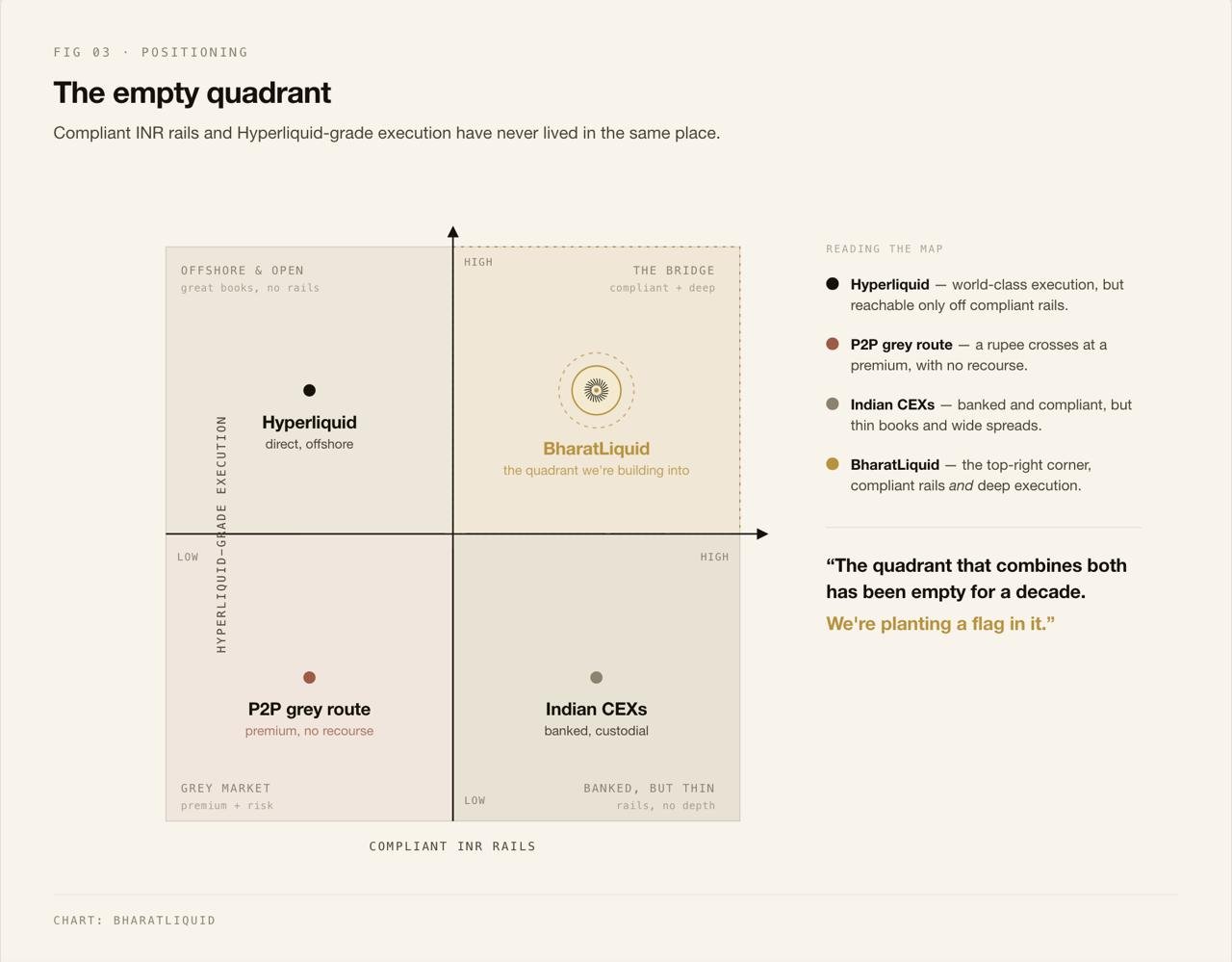 The smuggler’s premium: Why Hyperliquid needs a bridge to India and why BharatLiquid is building it.2026-07
The world's most populous nation is fast becoming one of cryptocurrency's most consequential regulatory and market battlegrounds, shaping how global exchanges, prediction platforms, and blockchain applications reach 1.4 billion potential users.
The Market Opportunity
India's crypto market is large by almost any measure. Estimates put domestic retail crypto trading volume in the range of $3 billion annually, and the country consistently ranks among the top five nations by raw user adoption in Chainalysis's Global Crypto Adoption Index. A young, tech-literate population, deep smartphone penetration, and one of the world's most sophisticated digital payment infrastructures — the Unified Payments Interface (UPI) processed over 130 billion transactions in fiscal year 2024 — give India structural advantages that attract foreign exchanges looking for their next growth engine.
Yet that opportunity has long been bottlenecked by regulatory ambiguity, punitive taxation, and an enforcement environment that can shift quickly. Understanding India's crypto landscape requires holding both realities at once.

India’s financial intelligence unit flags 15 crypto platforms over AML compliance gaps

The Regulatory Framework: FIU Registration and the Compliance Gate
India does not have a standalone crypto law. Instead, Virtual Digital Assets (VDAs) — the government's preferred term — are regulated primarily through the Prevention of Money Laundering Act (PMLA) and overseen by the Financial Intelligence Unit (FIU-IND). Exchanges and intermediaries serving Indian users must register with FIU-IND and comply with Anti-Money Laundering (AML) and Know Your Customer (KYC) rules equivalent to those applied to banks and payment companies.
This framework became consequential in 2023 when the FIU issued show-cause notices to offshore exchanges — including Binance and several others — for operating without registration. Several platforms had their URLs blocked by the Ministry of Electronics and Information Technology (MeitY). The message was clear: compliance is a precondition for market access, not an afterthought.
Binance eventually registered with FIU-IND in mid-2024, reopening access for Indian users. The episode established a template: global players that engage with Indian regulators on local terms can operate; those that do not face ISP-level blocks.
India's Parliamentary Standing Committee on Finance has since taken a more active role, meeting with representatives from Binance, domestic exchange WazirX, and ZebPay to discuss potential VDA legislation. Those consultations signal that a more comprehensive legal framework is under development, though no bill has been tabled as of mid-2026.
Readers click India crypto stories not for market opportunity but for regulatory jeopardy — the dominant pull is watching a large, crypto-active nation simultaneously arrest exchange founders, fine offshore platforms, stall legislation, and warn that stablecoins threaten its own payments backbone.
Coinbase's INR Rails: A Milestone Entry
The clearest sign of India's rising strategic importance to global crypto infrastructure arrived when Coinbase launched direct Indian Rupee (INR) deposit and withdrawal rails in 2026. Users can now move funds via IMPS (Immediate Payment Service) — India's real-time interbank transfer network — and trade spot markets and perpetual futures without converting through a third-party currency. Coinbase confirmed it is registered with FIU-IND and complies with applicable VDA rules.
The significance extends beyond one exchange. INR banking rails are notoriously difficult to secure: domestic banks have historically been cautious about processing crypto transactions, and several exchanges lost banking access during regulatory crackdowns. Coinbase obtaining reliable IMPS connectivity signals that the banking relationship between compliant exchanges and Indian financial institutions has stabilized, at least for FIU-registered entities.
The move targets a retail market estimated at $3 billion and gives Indian traders access to global liquidity and institutional-grade order books without the friction of peer-to-peer workarounds that had become common after domestic rails dried up.
The Tax Regime: 30% Flat Rate and 44,000+ Compliance Notices
India's approach to taxing crypto is among the most aggressive in any major economy. Since April 2022, VDA gains are taxed at a flat 30% rate with no provision for loss offset — meaning a trader cannot deduct losses on one asset against gains on another. A 1% Tax Deducted at Source (TDS) is also withheld on every transaction above a threshold, creating a real-time data trail that flows to the Income Tax Department.
The practical effect was immediate: trading volumes on domestic exchanges collapsed by an estimated 70–90% in the months following the tax change, as traders migrated to offshore platforms or reduced activity. The offshore migration is itself now the subject of enforcement action, with the Income Tax Department issuing more than 44,000 compliance notices to individuals believed to have unreported VDA gains.
Those notices represent a significant escalation. They suggest the government is using TDS data, exchange records obtained via FIU processes, and possibly blockchain analytics to identify gaps between declared income and on-chain activity. For Indian crypto holders, the message is that the informal grace period of the early adoption years is over.

Coinbase launches IMPS-based INR rails in India to target $3B retail crypto market
Polymarket and the Prediction Market Question
India's regulatory posture on prediction markets illustrates how quickly the government can act against platforms it classifies as illegal online gambling. Polymarket — the decentralized prediction market that saw explosive growth during the 2024 U.S. election cycle — was blocked by Indian authorities, making India the second major Asian market after Indonesia to restrict access to the platform.
The ban is legally grounded in India's Public Gambling Act and state-level gambling laws, which broadly prohibit online betting. Regulators drew no distinction between Polymarket's blockchain architecture and conventional offshore betting sites. Kalshi, a U.S.-regulated prediction market, also faces scrutiny in India under the same framework.
Both platforms have continued to operate and are technically accessible to Indian users via VPN, and neither has formally complied with the blocking order. This mirrors the earlier pattern with crypto exchanges: a period of defiance, regulatory escalation, and eventual either compliance or exit. The Polymarket situation also reinforces a broader principle visible across the region — messaging platforms and internet-native financial applications are increasingly treated as regulated infrastructure, with local enforcement and access control as core operating risks.
- 01RBI hostility and policy stalemate
The central bank's repeated systemic-risk warnings and the government's decision to shelve broad crypto legislation left readers tracking whether India would ever move beyond limbo.
- 02FIU enforcement against offshore exchanges
Show-cause notices to nine global platforms followed by Binance's $2.25M fine made readers track whether foreign exchanges would comply or exit India entirely.
- 03Crypto crime arrests and fraud raids
High-profile arrests — a Garantex co-founder on holiday, CoinDCX's own founders, and a decade-long Ponzi sweep — pulled readers seeking accountability behind named individuals.
- 04Stablecoins threatening UPI dominance
A government memo warning that stablecoin growth could undermine India's flagship payments rail framed crypto as a direct threat to national fintech infrastructure.
- 05Exchange compliance wins and FIU registration
Binance and KuCoin earning FIU registration after enforcement pressure showed readers a possible compliance path forward within India's framework.
- 06India retail market entry bets
Coinbase launching IMPS-based INR rails and CoinDCX reaching a $2.45B valuation signaled that global players were betting on India's large retail base despite regulatory uncertainty.
Enforcement Actions: The Coinbase Spoofing Case
India's enforcement apparatus is not limited to domestic regulation. Indian authorities filed charges against eight defendants in connection with an alleged $20 million spoofing scam targeting Coinbase users. The case involved individuals impersonating Coinbase customer support to extract credentials and drain accounts — a form of social engineering fraud that has grown alongside crypto adoption.
The prosecution demonstrates India's capacity and willingness to pursue complex financial crime with a cross-border digital dimension, and it underscores the human cost of crypto's rapid retail expansion into markets where financial literacy around platform security remains uneven.
AI and Blockchain in India's Infrastructure
Separate from crypto markets, India is deploying blockchain and AI at scale across public infrastructure. Indian Railways — the country's largest employer with approximately 1.2 million workers across 7,300 stations and 18 operational zones — has begun deploying TruFace AI facial recognition for worker verification, built on Billions Network infrastructure and implemented by ChainCode Consulting. The scale is extraordinary: this is one of the largest enterprise blockchain and AI identity deployments in any emerging market.
In trade finance, Vayana — a trade credit platform with over $62 billion in financing volume — adopted Chainlink's oracle infrastructure to power tokenized asset distribution across more than 3,000 supply chains. These deployments signal that India's public and private sectors view distributed infrastructure not as speculative technology but as a practical tool for scale problems that legacy systems cannot efficiently solve.
India begins tokenizing its $620B corporate bond market through SEBI’s Demat 2.0, pairing blockchain-based bonds with RBI wholesale digital rupee settlement

Geopolitical Dimensions: India in a Shifting Capital Landscape
India's crypto policy does not exist in isolation. The country is navigating a complex geopolitical moment in which foreign capital flows, technology partnerships, and financial system design are all in flux. India has engaged multilateral forums on crypto regulation, studied frameworks from Singapore, the EU (MiCA), and the UAE, and is building what officials describe as a "defensible" policy architecture — one that enables legitimate use while closing gaps that enable tax evasion, money laundering, and fraud.
Separately, India's role in global capital markets is expanding: U.S. policy shifts under the Trump administration explicitly invited Indian investment in sectors like Venezuelan oil production, reflecting India's emergence as a swing actor in global commodity and capital flows. That geopolitical positioning shapes the context in which Indian regulators think about financial technology — as a sovereign capability question, not just a consumer protection one.
- 2023-12regulatory
FIU IND issues show-cause notices to nine offshore VDA platforms including Binance and KuCoin
- 2024-06regulatory
Binance pays $2.25M fine to FIU India for money laundering violations
- 2024-08milestone
Binance and KuCoin win FIU India registration after compliance remediation
- 2024-10regulatory
India signals it will shelve broad crypto legislation, warns stablecoins could undermine UPI
- 2025-03regulatory
Garantex co-founder arrested by Indian authorities while on holiday
- 2025-07regulatory
CoinDCX co-founders arrested on crypto fraud charges; later granted bail with no prima facie case found
- 2025-09launch
Coinbase launches IMPS-based INR rails targeting India's retail crypto market
- 2026-04regulatory
India confirms OECD CARF adoption effective April 2027 for cross-border crypto transaction reporting
The Telegram Precedent
India's regulatory treatment of Telegram — treated as a regulated communication infrastructure subject to local compliance obligations — has direct implications for crypto. Most Indian crypto communities, trading groups, signal services, and exchange customer support flows operate heavily on Telegram. If messaging platforms are subject to local enforcement in the same way financial platforms are, that creates a secondary compliance surface for the crypto industry beyond exchange registration and tax reporting.
The principle is not unique to India, but India's enforcement capacity and its large user base make it a market where the precedent matters at global scale.
Outlook
India's crypto trajectory points toward regulated integration rather than prohibition or laissez-faire adoption. The evidence: FIU registration requirements that global exchanges are now meeting; Coinbase securing INR banking rails; parliamentary engagement with industry on VDA legislation; and large-scale blockchain deployments in public infrastructure. The friction — punitive tax rates, aggressive compliance notices, prediction market bans — reflects a government that wants the technology on its own terms.
The near-term variables are whether the finance ministry adjusts the 30% VDA tax rate (industry has lobbied for parity with listed securities, taxed at 15% for short-term gains) and whether the parliamentary committee's VDA consultations produce draft legislation. Either development would materially change the calculus for exchanges, traders, and project teams targeting the Indian market. For now, India is neither open nor closed — it is negotiating.
Latest India news
India’s financial intelligence unit flags 15 crypto platforms over AML compliance gapsCoinbase launches IMPS-based INR rails in India to target $3B retail crypto marketIndia begins tokenizing its $620B corporate bond market through SEBI’s Demat 2.0, pairing blockchain-based bonds with RBI wholesale digital rupee settlement ZachXBT says he may reject crypto victim cases from Nigeria, Canada, UK, India and other “low quality” jurisdictions based on past case-handling experiencesIndia's USDT premium tops 8.5% after ED crackdown cuts stablecoin remittance inflowsdtcpay raises US$10M in Series A led by Vertex Ventures Southeast Asia & India to bring compliant stablecoin payments to global scale.
Community notes
Spot something off or out of date? Drop a note. Editors review topic notes daily and roll accepted fixes into the explainer — contributors are recognized in the monthly $SQUID drop.
Loading notes…
Help improve this topic
Have a story or tip about this topic? Submit it. See something missing? Leave a note. Editors review daily; accepted submissions and fixes count toward the monthly $SQUID drop.