
Morgan Stanley has moved from cautious observer to active crypto participant via its 0.14%-fee Bitcoin ETF (MSBT), pending ETH/SOL ETF filings, and E*Trade spot trading at 0.50% — reshaping institutional and retail crypto access.
+21 sources across the wider coverage universe
 Morgan Stanley debuts spot Bitcoin ETF at 0.14% fee, undercutting BlackRock and Fidelity2026-04
 Morgan Stanley says crypto is becoming “daily business” as client demand grows for both direct exposure and ETFs, pushing banks to integrate blockchain with legacy systems2026-04
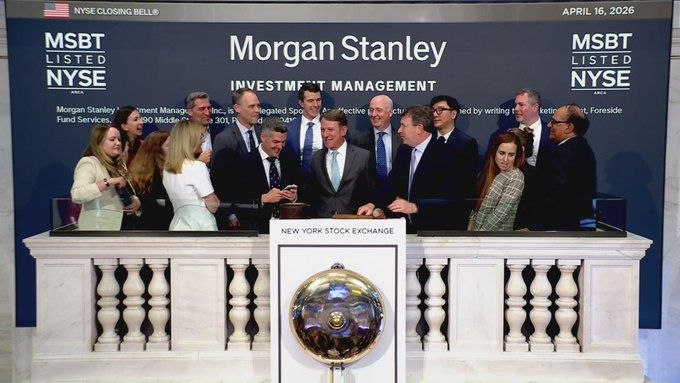 NYSE welcomes Morgan Stanley Investment Management to launch $MSBT, the first spot Bitcoin ETF from a major U.S. bank, marking a milestone in institutional crypto adoption2026-04
 Morgan Stanley eyes tokenization and crypto tax strategies beyond Bitcoin, as exec Amy Oldenburg signals expansion into tokenized funds and digital asset services2026-04
 Morgan Stanley CFO eyes tokenization as the next frontier for its $9.3T wealth platform2026-04
 Morgan Stanley launches staking-enabled ether and Solana ETPs on NYSE Arca with 0.14% fees2026-07
One of Wall Street's most influential investment banks, Morgan Stanley has evolved from a cautious observer of digital assets into an active participant — launching its own spot Bitcoin ETF, filing for Ethereum and Solana products, and rolling out direct crypto trading to millions of retail brokerage clients.
From Skeptic to Structural Participant
For most of the 2010s, Morgan Stanley kept crypto at arm's length while a handful of crypto-native firms — Coinbase chief among them — built the on-ramps retail investors used to buy Bitcoin. That posture began shifting in 2021 when the bank quietly allowed certain wealth-management clients access to Bitcoin funds, and it accelerated sharply after the U.S. Securities and Exchange Commission approved spot Bitcoin ETFs in January 2024.
The pattern since then has been methodical rather than reactive: each move is designed to capture a specific segment of the digital-asset market while keeping fee structures competitive enough to displace incumbents. The firm now touches crypto through at least three distinct channels — its own exchange-traded products, its E*Trade brokerage platform, and its institutional balance-sheet disclosures — making it one of the more comprehensively positioned traditional financial institutions in the space.

Tether discusses USDT on Bitcoin with Morgan Stanley at Washington dinner

The Morgan Stanley Bitcoin Trust (MSBT)
Morgan Stanley's most visible crypto product is the Morgan Stanley Bitcoin Trust, ticker MSBT, which launched on April 8, 2025, and is listed on NYSE. The fund entered an already crowded field that included BlackRock's iShares Bitcoin Trust (IBIT), Fidelity's FBTC, and products from ARK Invest, Invesco, and others, yet it carved out an early niche through disciplined pricing and distribution.
Fee structure: MSBT carries an expense ratio of 0.14%, one of the lowest in the spot Bitcoin ETF category. That price point was not accidental; it undercuts several legacy competitors and signals that Morgan Stanley views the fee race as a long-term customer-acquisition strategy rather than a source of direct revenue.
First-month performance: From launch through May 7, 2025, MSBT recorded $193.6 million in cumulative net inflows and grew to roughly $239.6 million in net assets. The fund logged inflows on 17 of its first 30 trading days, five flat days, and — notably — zero days of net outflows in its inaugural month, a clean record that most newer ETFs cannot claim. By late May the fund held approximately 3,389 BTC worth around $273 million at then-current prices.
Resilience during volatility: In a session on May 27 when Bitcoin spot ETFs as a category recorded a combined net outflow of $733 million, MSBT posted one of the few individual positive inflow figures — roughly $4.3 million — underscoring that its investor base was not the most volatile cohort in the market.
Distribution advantage: Morgan Stanley's registered broker-dealer network gives MSBT an inherent distribution edge. The firm's financial advisors can recommend the product to wealth-management clients who might not independently navigate ETF selection on their own, effectively embedding the product into the existing advisory relationship.
Readers' click pattern reveals they treat Morgan Stanley not as a passive crypto observer but as a institutional permission-granter — each headline they opened marks a moment when Wall Street's largest wealth manager moved a specific product or policy one step closer to mainstream client access, signaling that the TradFi gatekeeping story is more compelling than any price or technology angle.
Expanding to Ethereum and Solana
Bitcoin was the opening act. Morgan Stanley has since filed SEC amendments for both an Ethereum ETF and a Solana ETF, with both products targeting the same 0.14% fee that anchors MSBT. If approved, that fee would represent the lowest expense ratio among competing ETH and SOL ETF products at the time of the filings — a deliberate attempt to establish Morgan Stanley as the low-cost provider in spot crypto ETFs broadly, not just in Bitcoin.
The timing reflects regulatory evolution. The SEC approved spot Ethereum ETFs in May 2024, and the Solana ETF landscape remains unsettled; however, several asset managers have filed or indicated intent to file. By submitting amendments early and advertising a competitive fee in the filings themselves, Morgan Stanley is positioning ahead of what it appears to anticipate will be a second wave of spot crypto ETF approvals.
E*Trade and the Retail Crypto Trading Pivot
Beyond institutional products, Morgan Stanley is extending its crypto footprint directly to retail investors through **ETrade, the online brokerage it acquired in 2020 for $13 billion. In 2026, the firm launched a spot crypto trading pilot on ETrade at a fee of 0.50% per trade** — below Coinbase's standard retail rate and below Charles Schwab's competing 0.75%.
The pilot began with a subset of ETrade's approximately 8.6 million clients, with full rollout expected later in 2026. The product allows clients to buy and sell cryptocurrencies directly within the ETrade interface rather than being redirected to a third-party exchange, reducing friction and keeping the customer relationship inside Morgan Stanley's ecosystem.
The pricing is designed explicitly as a competitive wedge. Coinbase, which built its business on retail crypto brokerage, has historically charged fees in the range of 0.5%–2.5% depending on the transaction method and account tier. Robinhood charges zero commission on crypto but monetizes through payment for order flow and spread. Morgan Stanley's 0.50% flat rate sits below the most common Coinbase tiers while avoiding the opacity associated with zero-commission models.
Why it matters for incumbents: Morgan Stanley's entry into retail spot trading is a structural threat to Coinbase in a way that a standalone ETF is not. ETFs are a separate product class; retail spot trading competes for the same customer dollar in the same modality. If competing traditional brokerages — Schwab, Fidelity, JPMorgan's brokerage — match or undercut Morgan Stanley's move, the industry could see sustained fee compression across retail crypto trading that narrows Coinbase's margin profile.
Morgan Stanley also disclosed it is enabling clients to lend Bitcoin and other assets for in-kind spot crypto ETF conversions, adding a yield-adjacent utility layer to crypto holdings that has historically been available only on crypto-native platforms.
- 01Bitcoin ETF access push
The dominant click cluster tracks Morgan Stanley's progression from urging ETF inclusion to launching its own MSBT product, reflecting reader appetite for each incremental step Wall Street takes toward direct Bitcoin exposure for retail clients.
- 02E*Trade crypto rollout
Readers engaged heavily with the E*Trade crypto trading launch story because it represents the moment a mass-market brokerage platform — not a crypto-native exchange — begins offering spot Bitcoin, Ether, and Solana, reshaping where ordinary investors access digital assets.
- 03Fee war undercutting rivals
Multiple headlines about MSBT launching at 0.14% and E*Trade at 0.50% drew consistent clicks because price competition among institutional entrants signals a commoditization of crypto access that directly benefits retail investors.
- 04Tokenization and stablecoin expansion
Readers clicked on tokenized equities, stablecoin reserves portfolios, and GENIUS Act compliance stories because they reveal Morgan Stanley moving beyond Bitcoin into the broader on-chain finance infrastructure play.
- 05Dollar dominance threat warning
The Bitcoin and CBDC dollar-threat headline from head of digital assets Andrew Peel drew strong engagement because it reframes crypto risk as a macroeconomic sovereignty issue coming from inside one of the institutions most invested in the existing dollar order.
- 06Bank charter and custody ambition
Morgan Stanley's application for a bank charter to custody crypto assets signaled a structural commitment beyond product distribution, drawing readers interested in whether TradFi will own the entire crypto stack.
Holdings Disclosures and Balance-Sheet Exposure
Morgan Stanley has disclosed holdings in Bitcoin, XRP, and SOL across various regulatory filings, reflecting both proprietary exposure and positions held through its wealth-management and prime brokerage businesses. The bank also filed an 8-K related to the Morgan Stanley Bitcoin Trust, consistent with its obligations as an ETF sponsor.
At the institutional level, Morgan Stanley and Goldman Sachs were each reported to have allocated $15 billion in SpaceX IPO shares, illustrating that the firm's appetite for high-risk, high-profile alternative assets extends beyond crypto — context that helps explain why digital assets are a strategic priority rather than a novelty.
Internally, an unnamed Morgan Stanley executive issued a notably bullish public prediction on Bitcoin's trajectory, one of several signals that the firm's internal consensus has shifted meaningfully from the cautious stance it held as recently as 2022.
The Fee War and Competitive Dynamics
The 0.14% expense ratio on MSBT — and the matching fee filed for ETH and SOL products — reflects a broader dynamic playing out across the spot crypto ETF market. BlackRock's IBIT launched at 0.25% (with a promotional period lower), Fidelity's FBTC at 0.25%, and several smaller providers clustered in the 0.19%–0.39% range. Morgan Stanley's entry at 0.14% pressures the entire category.
The practical consequence for investors is positive: the competitive response to Morgan Stanley's pricing has pushed the industry toward a commodity model for crypto ETF fees, similar to what happened in index equity ETFs over the past two decades. The long-term beneficiaries are retail and institutional investors who pay less to hold regulated crypto exposure.
For new entrants, the competitive signal is more sobering. Truth Social's withdrawal of its own spot Bitcoin ETF filing — noted by Bloomberg ETF analyst James Seyffart as potentially reflecting the difficulty of competing against established players like Morgan Stanley — suggests that the ETF market is consolidating around a handful of large distributors with scale advantages.
Morgan Stanley's NYSE listing for MSBT also matters for institutional accessibility: exchange listing enables the full ecosystem of institutional order routing, lending, and options markets that matter to large allocators.
- 2024-01regulatory
Spot Bitcoin ETF approvals — Morgan Stanley signals global perception shift
- 2024-04milestone
Morgan Stanley wealth management forecasts Bitcoin gains post-halving
- 2024-08milestone
Morgan Stanley allows financial advisors to offer Bitcoin ETFs to select clients
- 2025-03regulatory
Morgan Stanley amends SEC filing for MSBT, first bank-issued spot Bitcoin ETF
- 2025-03launch
NYSE lists MSBT at 0.14% fee, undercutting BlackRock and Fidelity
- 2025-06regulatory
Morgan Stanley applies for bank charter to custody crypto assets
- 2025-06launch
Morgan Stanley launches stablecoin reserves portfolio for GENIUS Act compliance
- 2026-01launch
E*Trade crypto trading via Zerohash announced for Bitcoin, Ether, and Solana
Crypto Trading on NYSE and Tokenization Context
Morgan Stanley's E*Trade crypto trading expansion coincides with broader TradFi infrastructure experimentation: the NYSE has separately piloted tokenized securities, and DTCC has advanced tokenization services. These are parallel tracks, but they share the common theme of traditional financial market infrastructure moving to accommodate digital-asset settlement and ownership models.
Morgan Stanley has been monitoring tokenized securities and blockchain-based settlement as part of its broader digital-asset strategy, though its public-facing crypto products remain firmly in the conventional ETF and spot trading categories for now.
Outlook
Morgan Stanley's trajectory in crypto is characterized by competitive pricing, regulated product structures, and distribution through existing client relationships — a combination that suits its core business model and differentiates it from both crypto-native exchanges and more passive institutional participants.
The near-term milestones to watch are SEC action on the ETH and SOL ETF filings, the full rollout of E*Trade crypto trading to all 8.6 million clients, and whether MSBT sustains its clean inflow record through broader market cycles. If the Ethereum and Solana ETFs launch at 0.14%, the fee benchmark for the entire spot crypto ETF industry will likely reset downward again.
The broader significance is structural: Morgan Stanley's participation normalizes digital-asset exposure for a segment of investors — particularly high-net-worth advisory clients — who were previously unlikely to use a crypto-native platform. That normalization has compounding effects on Bitcoin and crypto demand that extend well beyond any single product's net inflow figure.
Latest Morgan Stanley news
Community notes
Spot something off or out of date? Drop a note. Editors review topic notes daily and roll accepted fixes into the explainer — contributors are recognized in the monthly $SQUID drop.
Loading notes…
Help improve this topic
Have a story or tip about this topic? Submit it. See something missing? Leave a note. Editors review daily; accepted submissions and fixes count toward the monthly $SQUID drop.