
In‑depth explainer on Goldman Sachs’ crypto strategy, from Bitcoin ETFs and Ether derivatives to tokenized real estate, money markets and stablecoins, and what its moves mean for Bitcoin, tokenization, DeFi and institutional adoption.
+17 sources across the wider coverage universe
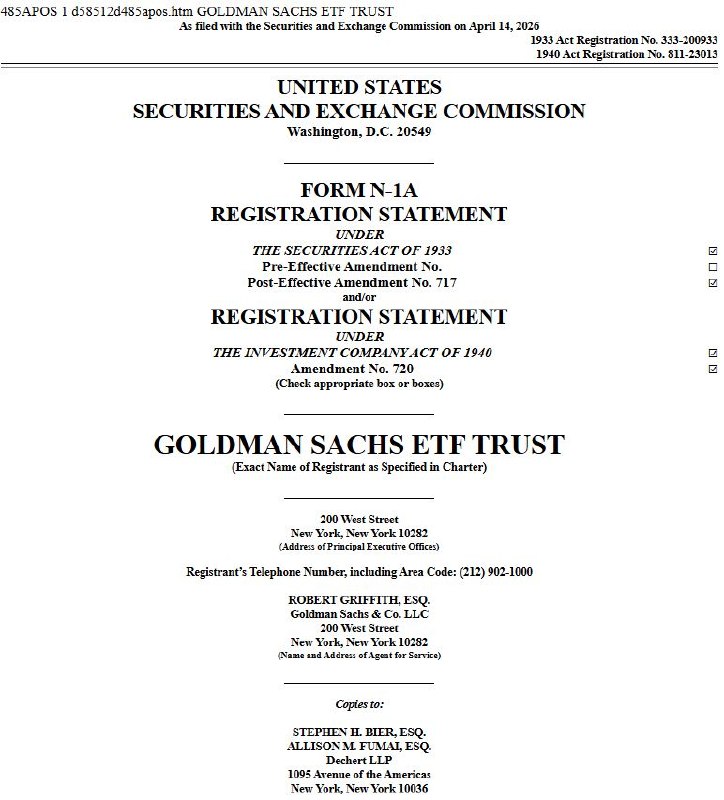 Goldman Sachs files with the SEC for new managed fund, Goldman Sachs Bitcoin Premium Income ETF.2026-04
 BlackRock, Fidelity and Goldman Sachs back Clarity Act as Senate's August recess nears2026-07
 Goldman Sachs tokenizes real estate fund shares on GS DAP with Apex and Archax2026-06
 Taktile charts a course to $110M in Goldman Sachs-led Series C, steering AI transformation for financial institutions2026-06
 Ondo joins DTCC working group to bring $114T U.S. capital markets onchain, collaborating with BlackRock, JPMorgan, and Goldman Sachs on tokenization infrastructure2026-05
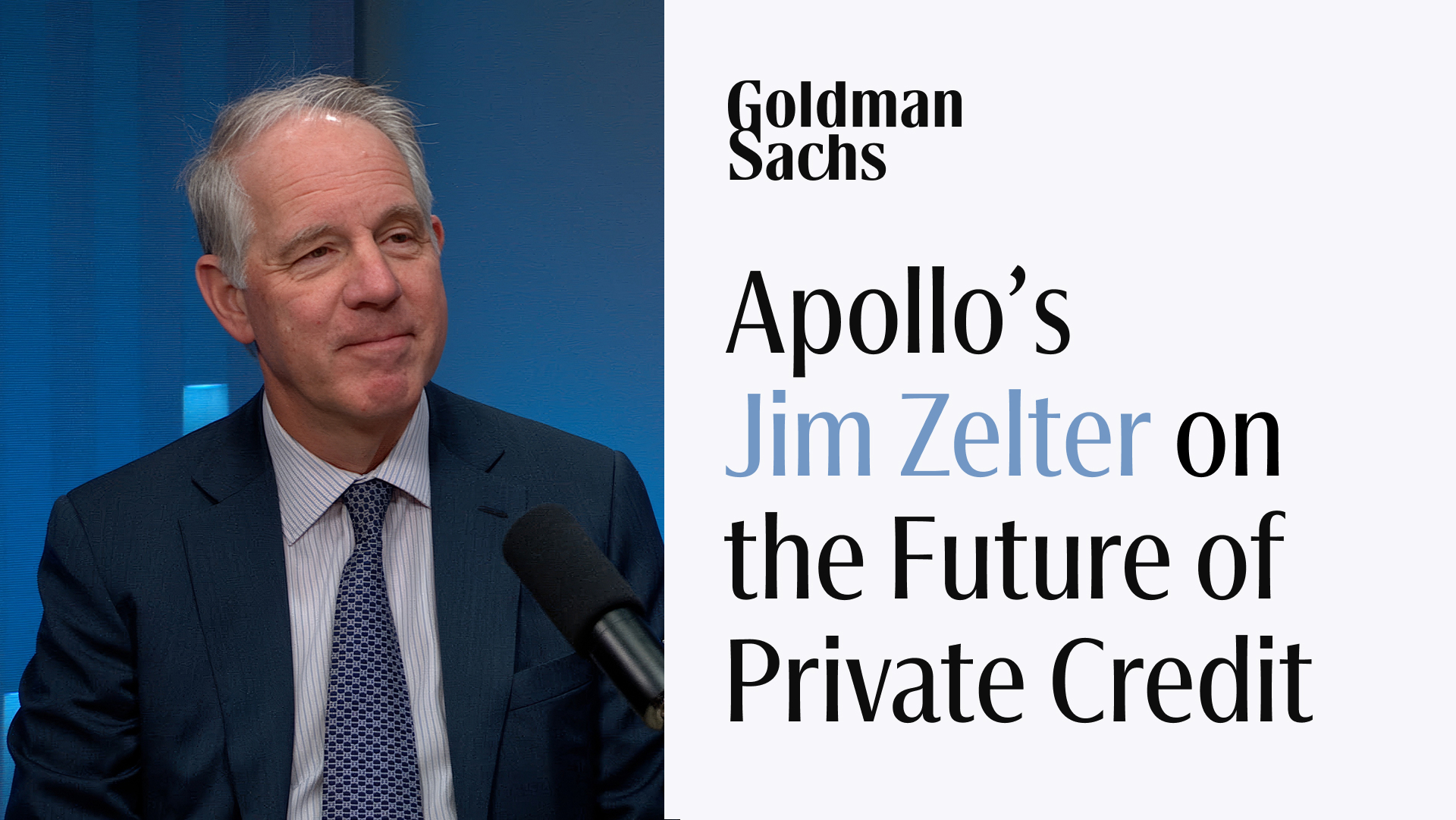 Goldman Sachs hosts Apollo’s Jim Zelter to discuss how AI-driven financing needs and infrastructure expansion will shape global investment trends over the coming decade2026-04
Goldman Sachs and the future of crypto finance
As one of the world’s most influential investment banks, Goldman Sachs has evolved from a 19th‑century commercial paper dealer into a central architect of modern capital markets, and that evolution now firmly includes digital assets, tokenization, and Bitcoin‑linked products. For the crypto ecosystem, the firm’s moves in Bitcoin ETFs, tokenized funds, stablecoin policy, and institutional trading provide an important window into how legacy finance is integrating blockchain technologies and reshaping the way capital will flow onchain in the coming decade.
Goldman Sachs in global finance: why crypto should care
Understanding Goldman Sachs’ role in crypto begins with understanding its stature in the traditional financial system. Founded in 1869 by Marcus Goldman as a commercial paper business in New York, the firm gradually expanded into investment banking, securities underwriting, and asset management, ultimately becoming one of the world’s most prominent universal banks. Over more than 150 years, Goldman has built a reputation for advising governments, corporations, and large investors on some of the largest mergers, public offerings, and restructurings, which in turn has given it outsized influence over how capital markets are designed and regulated. For crypto, this matters because the same institution that helped define the rules of the modern securities markets is now engaging with Bitcoin, tokenized funds, and digital asset classification—effectively bringing crypto inside the established financial architecture rather than treating it as a separate parallel system.
The bank’s core business lines provide a useful lens on why digital assets have become strategically relevant. Investment banking and capital markets activities depend on being able to intermediate between issuers and investors efficiently, and blockchain technology promises new rails for issuance, settlement, and collateral management. Trading and market‑making businesses thrive on volatility, liquidity, and derivatives markets, all of which are abundant in crypto. Asset management is increasingly guided by client demand for diversification and yield, which has translated into growing interest in Bitcoin ETFs, income‑oriented strategies, and exposure to tokenized real‑world assets. Each of these business units sees digital assets not as a single monolithic bet on “crypto,” but as a series of tools and markets that can be selectively integrated into existing workflows.
Goldman’s research and macro strategy teams also play an important role in shaping institutional sentiment toward both traditional and digital assets. When the firm revises its year‑end gold price targets, for example, on the basis of changing expectations for Federal Reserve rate cuts, those calls ripple through macro portfolios that increasingly compare gold and Bitcoin as alternative stores of value. Recent coverage of Goldman lowering its year‑end gold target by several hundred dollars on the view that rate cuts would be more limited than previously expected highlights how its macro views can indirectly influence demand for “digital gold” narratives, particularly when Bitcoin is trading near cycle highs and competing for allocation in inflation‑hedge or risk‑asset buckets. Even without explicitly endorsing Bitcoin as “digital gold,” Goldman’s macro stance can push allocators toward or away from risk assets, including crypto.
The sheer scale of Goldman’s balance sheet and client base also makes its actions informative, even when they are not dominant in absolute market share terms. When a smaller asset manager launches a crypto fund, the event may be important for dedicated digital‑asset investors but relatively marginal for mainstream institutions. By contrast, when Goldman Sachs files for a Bitcoin ETF, expands Ether derivatives offerings, or launches a tokenized real estate fund on its proprietary blockchain platform, those moves are interpreted as a signal that a critical mass of traditional finance is taking these technologies seriously. This signaling effect is particularly strong when Goldman’s decisions are aligned with similar moves by peers like BlackRock and Morgan Stanley, amplifying the perception of an institutional “green light” for specific corners of the crypto market.
Finally, Goldman’s long history of navigating regulatory change makes its approach to crypto especially consequential. The firm has adapted to repeated waves of financial regulation, from Depression‑era securities laws to post‑crisis capital and liquidity rules, and it now applies that experience to new questions around tokenized securities, stablecoins, and digital asset classification. When Goldman participates in designing taxonomies for crypto assets, or when its research arm analyzes the implications of new stablecoin legislation, those efforts can shape how regulators and policymakers understand the space. For builders and investors in crypto, Goldman is therefore not just another large player entering the market; it is one of the institutions helping to translate blockchain concepts into the language of mainstream financial law and market infrastructure.

Goldman Sachs files with the SEC for new managed fund, Goldman Sachs Bitcoin Premium Income ETF.

Goldman filed this under the '40 Act instead of the '33 Act like BlackRock, which forces a Cayman subsidiary structure (Goldman Sachs Bitcoin Premium Income Portfolio CFC) just to hold the spot ETPs with flexible concentration limits — extra complexity that eats into whatever yield the covered calls generate. The 40-100% overwrite range is the real tell: at max overwrite you're selling call options against your entire BTC position, which means in any serious rally these holders get capped while Goldman collects management fees on assets that functionally can't moon. They already disclosed ~13,741 BTC in spot ETF exposure last quarter — this is Goldman repackaging BTC volatility as "income" for wealth management clients who want the word "Bitcoin" on their statement without actually riding the curve.
From Wall Street to Web3: Goldman’s path into digital assets
Goldman’s journey into crypto has been gradual and iterative rather than sudden or linear, reflecting both internal debates and shifting external conditions. In the early years of Bitcoin’s rise, the bank’s public stance was cautious, often emphasizing the speculative nature of cryptocurrencies and the lack of clear regulatory frameworks. That skepticism was in line with many peers and mirrored broader institutional concerns around market manipulation, custody risk, and the difficulty of fitting crypto assets into existing risk‑management and compliance systems. Over time, however, rising client interest, improving infrastructure, and clearer regulatory expectations pushed the firm toward more active engagement.
One of the earliest and most tangible steps was the expansion of crypto trading capabilities for institutional clients. As derivatives markets for Bitcoin and Ether matured on regulated venues such as CME, Goldman began offering its clients access to these markets, initially with a focus on futures and options that could be cleared and risk‑managed within familiar frameworks. The bank’s decision to offer Ether options and futures alongside its existing Bitcoin capabilities signaled that it was prepared to treat major cryptocurrencies as tradeable macro assets, similar to commodities or foreign exchange products, rather than purely speculative curiosities. By building trading infrastructure around these instruments, Goldman created an internal muscle memory for managing digital asset exposure, hedging risks, and dealing with operational issues such as pricing feeds and settlements.
Parallel to trading, Goldman invested in digital asset data and classification infrastructure, recognizing that institutional adoption depends heavily on reliable information and consistent taxonomies. In 2022, the firm announced a collaboration with MSCI and Coin Metrics to launch “datonomy,” a new classification system for the digital asset market that organizes coins and tokens according to their use cases. Delivered as a data service, datonomy aims to provide a shared language for investors, asset managers, and regulators, much as sector and industry classifications do in the equity markets. By helping define categories such as smart‑contract platforms, DeFi tokens, and stablecoins, datonomy reduces ambiguity about what different tokens represent and facilitates the creation of indices, benchmarks, and risk models. For crypto builders, this kind of taxonomy can influence which projects are perceived as comparable and which metrics matter for institutional due diligence.
Goldman’s digital asset strategy has also been shaped by its research and thought leadership, particularly around stablecoins and tokenized money. In its “Stablecoin Summer” report, the firm’s research arm examined the implications of the GENIUS Act, described as the first federal regulatory system for stablecoins in the United States. According to that analysis, the GENIUS Act requires US stablecoin issuers to be supervised by one of the major national bank regulators—the Federal Reserve, the FDIC, the OCC—or a state banking agency, to maintain at least 1:1 reserves in high‑quality, liquid assets, and to disclose reserve composition on a monthly basis. Goldman’s experts argued that this kind of bank‑like supervision and transparency could create a perception of safety around stablecoins, potentially driving mass‑market adoption and enabling them to function as widely accepted means of payment and collateral. For a bank that has historically profited from the movement and transformation of money, engaging with the policy architecture of stablecoins is a natural extension of its business model into programmable digital cash.
The firm’s evolving stance toward crypto is also evident in the diversity of initiatives it pursues: not only trading and data, but also tokenization of real‑world assets, infrastructure collaborations, and eventually Bitcoin ETF products. Each of these steps reflects a calculation about where Goldman can add value without taking on undue risk or conflicting with existing regulations. Rather than launching its own retail crypto exchange or issuing a speculative token, the bank has focused on areas that leverage its strengths in institutional relationships, complex product design, and regulated market infrastructure. For crypto observers, this trajectory is instructive: it shows how a large incumbent can embrace blockchain technology in a measured, compliance‑centric way, while still pushing the boundaries of what is possible within the regulatory perimeter.
Readers click Goldman Sachs crypto stories not for the trading angles but for institutional permission signals — every top headline is really asking whether the most risk-averse name in Wall Street is finally crossing the line from observer to committed participant.
Bitcoin and crypto ETFs: Goldman’s changing strategy
Exchange‑traded funds have become one of the key battlegrounds for institutional adoption of Bitcoin and other digital assets. ETFs package underlying assets into a regulated, exchange‑listed vehicle that traditional investors can hold in brokerage accounts, retirement plans, and institutional portfolios without having to manage private keys or navigate unregulated exchanges. For Bitcoin, the arrival of spot ETFs in the United States marked a turning point, as issuers such as BlackRock, Fidelity, and others launched products that allowed investors to gain direct Bitcoin exposure through familiar wrappers. Although Goldman Sachs did not lead this first wave of spot Bitcoin ETFs, it entered the field with a distinct product design that reflects its view of client demand and risk tolerance.
The core of Goldman’s ETF strategy in crypto is the Goldman Sachs Bitcoin Premium Income ETF, a fund filed with the US Securities and Exchange Commission and structured to seek current income while maintaining prospects for capital appreciation. Unlike a pure spot Bitcoin ETF that simply tracks the price of Bitcoin as closely as possible, this fund is designed as an income‑oriented product that holds Bitcoin exposure and systematically sells options to generate premium income. The approach echoes Goldman’s broader line of Premium Income ETFs, which invest in index portfolios of stocks and write call options against them to collect option premiums on a recurring basis. By adapting this covered‑call style strategy to Bitcoin, Goldman aims to offer investors a way to monetize Bitcoin’s volatility while limiting downside relative to outright long positions, albeit at the cost of capping upside during strong rallies.
From a crypto perspective, this “Bitcoin income ETF” occupies a different niche than the spot ETFs offered by BlackRock and peers. While BlackRock’s flagship Bitcoin ETF is designed primarily as a low‑cost exposure vehicle that closely tracks Bitcoin’s price and relies heavily on crypto‑native partners like Coinbase for custody and market surveillance, Goldman’s product is explicitly tailored to investors who prioritize yield and lower volatility over maximum upside. The fund’s options‑selling strategy means that it will underperform spot Bitcoin in runaway bull markets but may outperform during sideways or mildly bearish conditions by collecting option premiums. This trade‑off has led some commentators to describe it as “boomer candy,” appealing to income‑oriented investors who want exposure to Bitcoin’s risk premium without committing to the full volatility of the asset.
Goldman’s entry into Bitcoin ETFs also coincides with robust inflows into the broader US spot Bitcoin ETF complex. On one recent trading day, spot Bitcoin ETFs listed in the United States recorded approximately \(411.5\) million dollars in net inflows, bringing year‑to‑date flows into positive territory and pushing total assets under management above \(96.5\) billion dollars, the highest level since mid‑March. These flows underscore the scale of institutional and retail demand that has already been unlocked by the ETF wrapper. For Goldman, launching a differentiated Bitcoin ETF in this environment is less about proving that there is interest in Bitcoin exposure and more about capturing a specific segment of that demand—allocators looking for a more conservative, income‑focused profile that can fit into multi‑asset portfolios alongside traditional premium‑income strategies.
Importantly, Goldman’s relationship to Bitcoin ETFs is not limited to issuing its own product; it has also become a major holder of other firms’ crypto ETFs as part of its asset‑management and trading activities. Filings and market commentary have indicated that at one point Goldman had exposures on the order of \(1.1\) billion dollars in Bitcoin ETFs, roughly \(1\) billion dollars in Ether ETFs, and sizable positions in XRP and Solana ETFs as well, reflecting both client demand and proprietary strategies. Subsequent disclosures, however, revealed that the bank significantly rebalanced this exposure, fully exiting its XRP and Solana ETF positions in the first quarter of 2026 and reducing its Ether ETF holdings by roughly 70 percent to around \(114\) million dollars, while retaining approximately \(700\) million dollars in Bitcoin ETFs. These shifts suggest a deliberate move toward concentration in Bitcoin as the core institutional crypto asset, with more cautious or opportunistic treatment of major altcoins.
The changing composition of Goldman’s ETF holdings also reveals how the bank integrates crypto into its broader equity and venture exposures. The same disclosures that showed reductions in XRP, Solana, and Ether ETF positions also indicated increased holdings in shares of Circle, Galaxy Digital, and Coinbase, even as the bank dialed back exposure to listed Bitcoin mining companies. This pattern points to a strategic emphasis on owning pieces of the infrastructure and service ecosystem around digital assets—stablecoin issuers, trading firms, and exchanges—rather than maintaining large directional bets on a wide range of individual tokens. For crypto investors, this provides a useful contrast to many retail‑oriented strategies: where individual traders might focus on token price appreciation, Goldman appears increasingly focused on the equity and structural positions that monetize the growth of the ecosystem as a whole.
Tokenization and GS DAP: bringing real‑world assets onchain
Beyond ETFs and derivatives, one of Goldman’s most significant contributions to digital asset adoption lies in tokenization of traditional financial instruments. Tokenization refers to the process of representing claims on real‑world assets—such as real estate, bonds, or money market fund shares—as digital tokens on a blockchain, potentially enabling faster settlement, fractional ownership, and programmable transfers. Goldman’s flagship platform in this domain is GS DAP, a blockchain‑based system developed to reimagine the transfer of information and value in financial services by placing traditional securities on distributed ledger infrastructure.
GS DAP is designed as a permissioned platform that allows institutional participants to issue, distribute, and manage tokenized versions of conventional financial products under existing regulatory regimes. Rather than replacing securities law or circumventing custodial requirements, the platform aims to embed those requirements into smart contracts and ledger rules, so that transfers and ownership records remain compliant by design. This approach reflects Goldman’s view that the primary value of blockchain technology for large institutions lies not in creating entirely new unregulated instruments, but in upgrading the back‑end plumbing of markets to reduce settlement risk, enhance transparency, and enable new forms of collateralization. The choice of architecture—enterprise‑grade, permissioned, and integrated with existing custody and transfer‑agent systems—underscores the firm’s focus on institutional adoption rather than retail speculation.
One high‑profile application of GS DAP is the tokenization of a real estate fund developed in collaboration with Apex Group, Archax, LRC Group, and Ownera. In this initiative, Apex, a global financial services provider with more than \(3.5\) trillion dollars in assets serviced, worked with Goldman and other partners to launch a blockchain‑native real estate fund whose shares are issued and recorded in tokenized form on the GS DAP platform. LRC Group acts as the fund’s manager, while Archax serves as custodian and digital securities exchange, providing a regulated environment for trading and safekeeping of the tokenized shares. By representing fund shares as tokens, the structure enables more efficient transfers between qualified investors, potentially faster settlement, and the groundwork for future interoperability with other tokenized asset platforms.
Reporting on the launch of this real estate fund emphasized that it marks a significant step forward in the institutional adoption of tokenized fund structures within the global real estate market. Real estate has long been seen as a prime candidate for tokenization because it is capital‑intensive, relatively illiquid, and often difficult to fractionalize for smaller investors. By demonstrating that a mainstream fund structure, managed by established players and custodians, can exist as a tokenized entity on a bank‑backed blockchain, Goldman and its partners are effectively creating a template that can be replicated for other asset classes. For crypto builders, such experiments highlight the potential for traditional fund vehicles to become composable building blocks in a broader onchain financial system, even if the initial implementations are restricted to institutional participants.
Goldman has applied the same tokenization logic to the most conservative corner of the investment universe: money market funds. In a collaboration with BNY Mellon, the bank announced an initiative in which BNY will use blockchain technology developed by Goldman Sachs to maintain a record of customer ownership of select money market funds, with tokens on GS DAP representing the value of shares in those funds. The goal is to enhance the utility and transferability of existing money market fund shares by allowing them to circulate as digital tokens that can be posted as collateral, moved between accounts more quickly, and potentially interfaced with other tokenized systems. Given that money market funds are widely used as cash equivalents and collateral in traditional finance, enabling their tokenized forms to move frictionlessly across blockchain‑based platforms could have far‑reaching implications for repo markets, derivatives margining, and even some aspects of decentralized finance.
These tokenization projects also intersect with broader industry efforts to bring large‑scale capital markets infrastructure onchain. For example, a working group convened by the Depository Trust & Clearing Corporation (DTCC), the dominant US securities clearinghouse, has enlisted firms such as Ondo Finance to help design tokenization services for the more than \(114\) trillion dollars in assets under DTCC custody. While this particular announcement centers on Ondo and DTCC, other reporting has highlighted that traditional giants including BlackRock, JPMorgan, and Goldman Sachs are increasingly involved in similar consortia aimed at standardizing tokenization protocols and interoperability frameworks across multiple institutions. For crypto, the significance of these efforts lies less in any single pilot project and more in the cumulative momentum toward treating blockchain as a core layer of capital markets infrastructure, with Goldman as one of the key architects.
Viewed through a tokenomics lens, Goldman’s tokenization initiatives raise important questions about how rights, risks, and incentives are encoded into tokenized assets. Unlike many crypto‑native tokens, which can embed complex governance mechanisms, self‑executing fee structures, and algorithmic supply schedules, tokenized fund shares typically represent straightforward claims on the underlying assets and cash flows of a traditional fund. Their “tokenomics” are in many cases intentionally simple, reflecting legacy legal structures rather than novel onchain governance. However, the very act of expressing these claims as tokens enables new forms of composability: tokenized money market fund shares could be used as collateral in automated lending protocols; tokenized real estate funds could be sliced into tranches with different risk profiles; and all of these could be linked to onchain prediction markets or derivatives. Goldman’s choice to start with conservative, regulated products suggests a phased approach, in which the basic representation of assets onchain is established first, with more complex tokenomic innovations potentially layered on later.
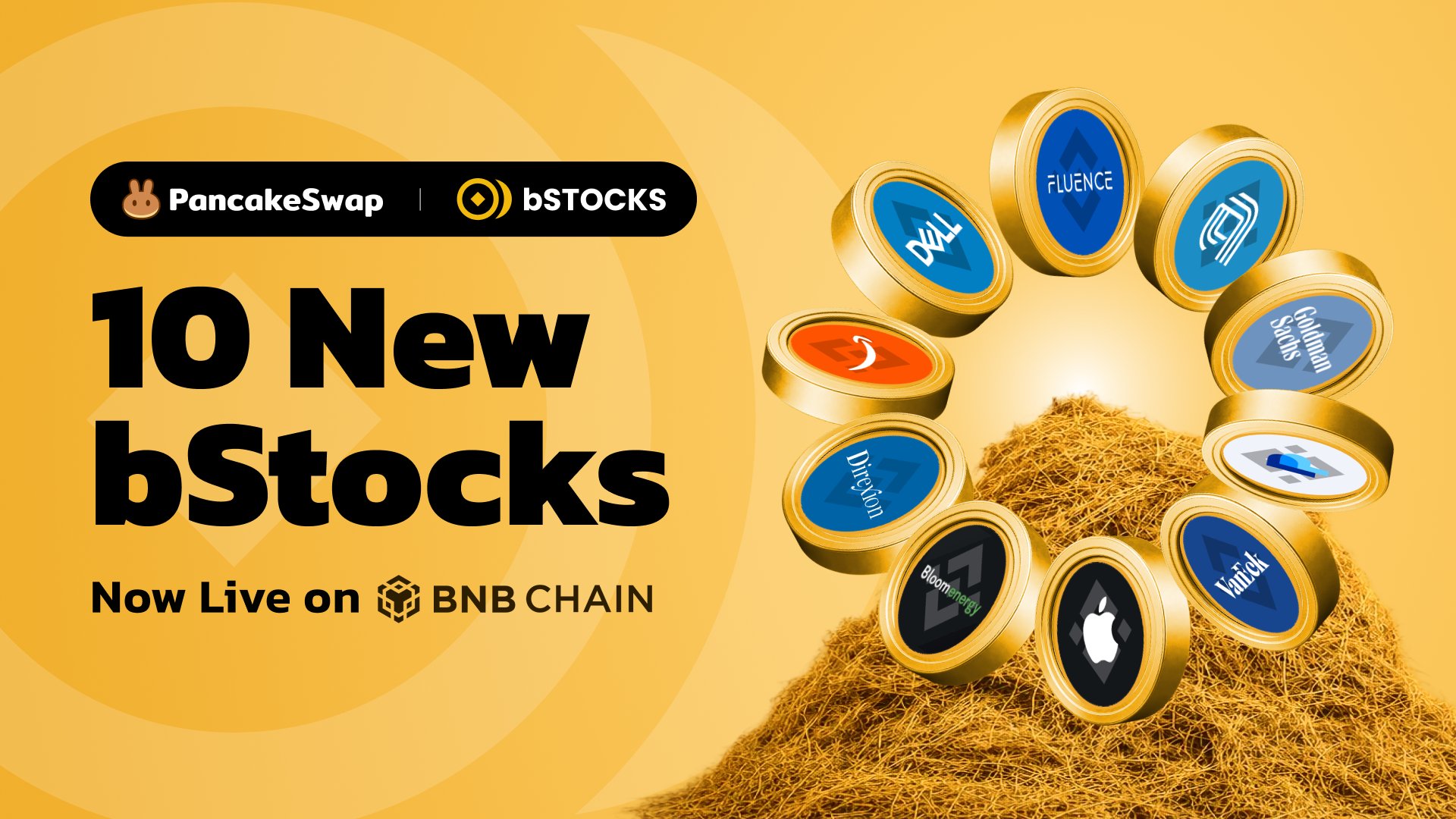
PancakeSwap adds 10 bStocks on BNB Chain, including Apple, Amazon, PayPal and Goldman Sachs
Crypto trading, derivatives, and emerging market structures
While ETFs and tokenization attract headlines, much of Goldman’s day‑to‑day engagement with digital assets occurs in the less visible world of trading, derivatives, and market‑making. For institutional clients, the ability to trade Bitcoin and Ether through a trusted counterparty, within existing legal and operational frameworks, often matters more than the existence of retail‑oriented exchanges or decentralized protocols. By positioning itself as such a counterparty, Goldman extends its core trading franchise into crypto markets and helps shape evolving market structures.
The bank’s decision to offer Ether options and futures to clients illustrates this dynamic. As reported by Business Insider, Goldman expanded its crypto trading business by making Ether derivatives available alongside its Bitcoin offerings, thereby allowing clients to express directional views, hedge exposures, or capture volatility in the second‑largest cryptocurrency by market capitalization. These products are typically structured around regulated futures contracts and exchange‑listed options rather than bespoke over‑the‑counter instruments, which simplifies risk management and regulatory oversight. For institutional investors who are already active in equity, FX, or commodity derivatives, the ability to trade Ether options and futures through the same desks and margin systems lowers the barrier to entry into digital assets.
Derivatives also play a critical role in how Goldman constructs and hedges structured products, such as the Bitcoin Premium Income ETF discussed earlier. By systematically selling call options against Bitcoin exposure within the ETF, the firm creates a stream of option premiums that can be distributed as income, while relying on derivatives markets to adjust hedges and manage risk as underlying prices move. This interplay between ETF structures and derivatives liquidity exemplifies how traditional financial engineering techniques are being applied to digital assets, with Goldman leveraging its expertise in options and volatility to design products that appeal to risk‑conscious investors. For the crypto ecosystem, the growth of such products can deepen derivatives markets, which in turn can influence spot price dynamics, volatility regimes, and arbitrage opportunities.
Beyond plain‑vanilla derivatives, Goldman has signaled interest in more novel market structures that intersect with crypto concepts, including prediction markets. Reporting has highlighted that CEO David Solomon and senior leadership view prediction markets—platforms where participants can trade on the outcome of future events—as a potential new frontier, particularly as AI‑driven financing needs and infrastructure investments reshape global capital flows. While details of specific products remain limited, the bank’s exploration of prediction markets aligns with broader trends in crypto, where decentralized prediction protocols have long used tokens and onchain markets to aggregate information and express views on elections, macro data releases, and other events. If Goldman brings institutional liquidity, regulatory engineering, and complex product design to this space, it could accelerate the convergence between traditional structured products and crypto‑native prediction instruments.
Goldman’s engagement with crypto is also influenced by broader market sentiment and risk appetite, which its leadership has not hesitated to characterize bluntly. In a widely shared comment, CEO David Solomon observed that investors had moved decisively into “greed” mode as markets prepared for an unprecedented wave of fundraising by large artificial intelligence firms, signaling a willingness to take on higher risk in pursuit of growth. When risk appetite swings in this fashion, crypto assets—particularly Bitcoin and high‑beta altcoins—are often among the beneficiaries, as investors seek exposure to the most volatile segments of the market. Conversely, when macro conditions deteriorate or risk aversion rises, Goldman and its peers often reduce exposure to speculative assets, as reflected in the bank’s decision to cut back on altcoin ETF positions and focus more heavily on Bitcoin and infrastructure equities.
The tension between opportunity and risk is particularly evident when Goldman engages in large, complex transactions with crypto exposure. Coverage of the bank’s participation in deals involving crypto‑linked firms, or in portfolios that include both AI‑related equities and Bitcoin, has highlighted the double‑edged nature of such strategies: while they can deliver outsized returns if both themes perform well, they are also vulnerable to sharp drawdowns if macro conditions turn or if regulatory setbacks hit the crypto sector. For investors observing Goldman’s moves, the key takeaway is not to assume that the bank’s involvement guarantees success, but rather to recognize that its risk‑management processes will tend to favor diversification, hedging, and incremental experimentation over all‑in bets on any single token or narrative.
Regulatory perspectives, stablecoins, and policy influence
Given its size and history, Goldman Sachs is deeply intertwined with the regulatory and policy environment that shapes financial innovation, including in digital assets. The firm’s research on stablecoins and the GENIUS Act is a prime example of how it contributes to the intellectual and policy frameworks that govern crypto‑related instruments. By analyzing how new legislation affects the design, backing, and supervision of stablecoins, Goldman not only informs its clients but also sets expectations for how banks, fintech firms, and token issuers might interact under the emerging rules.
According to Goldman’s “Stablecoin Summer” report, the GENIUS Act establishes the first comprehensive federal regulatory system for stablecoins in the United States, requiring issuers to be overseen by either the Federal Reserve, the FDIC, the OCC, or a state banking supervisor. The law mandates that stablecoins be backed at least 1:1 by reserves consisting of high‑quality, liquid assets and that issuers provide monthly disclosures of reserve composition. Goldman’s analysis emphasizes that this bank‑style supervisory regime is critical because it brings stablecoin issuance into a framework that regulators and investors already understand, reducing uncertainty about redemption risk and operational resilience. In the firm’s view, such supervision can foster a sense of safety that is likely to encourage mainstream adoption of stablecoins for payments, savings, and collateral purposes.
For crypto markets, the implications of this regulatory structure are far‑reaching. Stablecoins that comply with such requirements could become more closely integrated with traditional banking and payment systems, enabling them to act as bridges between fiat and onchain markets in a more seamless and regulated manner. At the same time, non‑compliant or offshore stablecoins might face increased scrutiny or reduced access to US financial infrastructure, potentially fragmenting liquidity across compliant and non‑compliant tokens. Goldman’s engagement with these questions indicates that it expects stablecoins to play a durable role in the financial system, but within a framework that aligns with traditional notions of safety, soundness, and disclosure. This, in turn, shapes how the bank might design or support future stablecoin products, whether directly or through partnerships.
Goldman’s regulatory influence extends beyond stablecoins to broader issues of digital asset classification and market integrity. Through its role in launching the datonomy classification system with MSCI and Coin Metrics, the bank has contributed to creating a common taxonomy for digital assets that can be used by regulators, index providers, and institutional investors. Datonomy categorizes coins and tokens based on their primary use cases and functional attributes, which can facilitate more nuanced regulatory treatments—for example, distinguishing between payment tokens, utility tokens, and governance tokens. By offering this as a data service accessible through subscriptions, Goldman positions itself at the center of how large institutions and regulators obtain and interpret information about the crypto asset class.
The firm’s macro and commodities research also indirectly shapes the regulatory and policy discourse by framing crypto in relation to other assets. When Goldman revises its expectations for inflation, interest rates, or commodity prices, those views feed into broader debates about whether Bitcoin should be treated as a store of value, a risk asset, or some hybrid. The bank’s decision to cut its year‑end gold price target, coupled with skepticism about the pace of rate cuts, implicitly affects arguments about whether investors should seek alternative hedges, including Bitcoin, or whether they should remain cautious about duration and risk assets. Policymakers monitoring financial stability pay attention to how large institutions like Goldman describe these dynamics, particularly when crypto assets become significant components of portfolios through ETF holdings and tokenized products.
Ultimately, Goldman’s posture toward regulation in crypto appears to be one of constructive engagement rather than resistance. The firm generally does not seek to circumvent regulatory frameworks; instead, it works within them to design products such as Bitcoin ETFs, tokenized funds, and regulated derivatives that can attract institutional capital without triggering regulatory backlash. For crypto builders and advocates who favor more permissionless, decentralized systems, this approach can seem conservative or limiting. However, it also provides a pathway for large pools of capital that cannot touch unregulated markets to gain exposure to digital assets. The coexistence of Goldman‑style regulated crypto products and open DeFi protocols is likely to be a defining feature of the next phase of digital asset adoption.
- 01CEO Bitcoin stance evolution
Solomon's careful hedging — acknowledging a 'store of value case' while calling BTC speculative — reads as the bellwether statement every institution was waiting to calibrate against, making each nuance shift newsworthy.
- 02Bitcoin ETF authorized participant
Goldman potentially becoming an AP for BlackRock and Grayscale ETFs meant legacy prime-brokerage infrastructure would gate-keep crypto's mainstream liquidity, drawing readers who track structural market access.
- 03Pro-Bitcoin leadership succession
The CEO search foregrounding John Waldron's Bitcoin-positive reputation reframed a routine succession story as a potential policy pivot at the firm that sets the tone for institutional crypto engagement.
- 04Tokenization infrastructure buildout↗
GS DAP, Canton Network production use, and the three-project tokenization roadmap collectively showed Goldman converting rhetoric into live rails, which drew readers tracking real-world-asset momentum.
- 05Stablecoin and bank-money integration↗
Goldman joining Citi and UBS in planning G7-pegged stablecoins, plus the BNY tokenized money-market-fund deal, signaled the beginning of bank-issued digital cash competing with USDC and USDT.
- 06Institutional crypto market signals
Goldman's analyst calls flagging a crypto price bottom and upgrading Coinbase and Robinhood carry outsized weight because the firm's macro credibility functions as a sentiment anchor for risk-on positioning.
Case studies in Goldman’s crypto exposure and tokenization
A closer look at specific episodes in Goldman’s crypto engagement helps illustrate how the firm balances opportunity, risk, and regulatory constraints. Consider, for example, its evolving relationship with Solana and XRP through ETF holdings. At one point, disclosures and market analysis indicated that Goldman held Solana ETFs worth more than \(108\) million dollars, a significant position that attracted attention in both traditional and crypto media. This exposure came alongside large holdings in XRP ETFs, reportedly totaling around \(153\) million dollars, suggesting a willingness to allocate meaningful capital to major altcoins via regulated wrappers rather than direct token purchases. For some market participants, these positions were interpreted as a sign that Goldman was expanding beyond Bitcoin and Ether into a broader basket of crypto assets.
However, subsequent filings told a different story. In its latest 13F report for the first quarter of 2026, Goldman disclosed that it had fully exited its XRP and Solana ETF positions, bringing those exposures down to zero after previously holding roughly \(154\) million dollars in XRP ETFs and more than \(100\) million dollars in Solana ETFs. At the same time, the bank maintained substantial holdings in Bitcoin ETFs, around \(700\) million dollars in value, while sharply reducing its Ether ETF exposure by approximately 70 percent to about \(114\) million dollars. This deliberate pullback from altcoin ETFs, combined with a more moderate but still significant position in Ether and a core allocation to Bitcoin, indicates a prioritization of assets that are perceived as more institutionalized, liquid, and resilient under evolving regulatory scrutiny.
A similar pattern emerges when examining Goldman’s activities in Ethereum markets more broadly. On the one hand, the decision to offer Ether options and futures to clients reflects confidence that Ether has achieved sufficient liquidity, regulatory tolerance, and institutional interest to justify building a derivatives franchise around it. On the other hand, the reduction in Ether ETF holdings suggests that the bank may see more value in acting as a market intermediary and risk manager for client flows than in maintaining large proprietary or balance‑sheet exposures. The presence of spot Ether ETFs, which recently recorded tens of millions of dollars in inflows in a single day, demonstrates that investor demand for Ether exposure is robust, but Goldman appears content to channel that demand through trading and structuring activity rather than maximizing its own directional exposure.
Bitcoin, by contrast, occupies a more central and durable position in Goldman’s crypto strategy. The bank’s continued holding of roughly \(700\) million dollars in Bitcoin ETFs, even after trimming other crypto exposures, underscores its view of Bitcoin as the primary digital asset for institutional portfolios. The launch of the Bitcoin Premium Income ETF further cements this status, signaling that Goldman is willing to commit brand and product‑development resources to Bitcoin‑specific offerings. Moreover, the broader context of strong inflows into US‑listed spot Bitcoin ETFs, with daily net inflows exceeding \(400\) million dollars at times and total ETF AUM surpassing \(96\) billion dollars, suggests that Bitcoin has achieved a scale and liquidity profile that aligns with Goldman’s institutional clientele. In this sense, Goldman’s behavior reflects and reinforces a hierarchy within the crypto asset class, with Bitcoin at the apex.
On the tokenization front, the real estate fund launched on GS DAP provides a concrete example of how Goldman is moving beyond exploratory pilots into live, commercially relevant products. In this case, investors gain exposure to a professionally managed portfolio of real estate assets whose shares are represented as tokens on a permissioned blockchain, with Apex Group providing fund services, LRC Group managing assets, and Archax handling custody and trading infrastructure. The tokens themselves embody conventional shareholder rights—such as claims on income distributions and redemption rights—while benefiting from faster settlement and potentially improved transparency through on‑chain recordkeeping. Importantly, the project does not depend on retail speculation or volatile token prices; instead, it seeks to make existing fund structures more efficient.
The tokenized money market fund solution jointly developed with BNY Mellon extends this logic to the realm of cash and collateral management. By representing shares of selected money market funds as tokens on GS DAP, BNY can maintain accurate, real‑time records of customer ownership while enabling those shares to be used as digital collateral in a variety of financial transactions. This could, for example, allow a corporate treasurer or institutional investor to move tokenized money market fund shares across trading platforms or custodians with greater speed and reduced operational friction, potentially opening the door to more dynamic collateral optimization. In an era where onchain finance seeks to create efficient, programmable collateral systems, Goldman’s work with tokenized money market funds suggests a path for integrating the safest and most regulated cash‑equivalent instruments into that ecosystem.
Taken together, these case studies paint a picture of a firm that is both opportunistic and cautious in its approach to crypto. Goldman is willing to hold substantial ETF positions in major cryptocurrencies when the risk‑reward profile is attractive, but it is equally willing to pare back or exit those positions when conditions change or when regulatory or reputational considerations warrant. It is eager to experiment with tokenized funds and onchain infrastructure, but typically in partnership with established players and within regulatory bounds. For crypto investors and builders, the message is that institutional adoption is not a one‑way, ever‑increasing line; instead, it is a dynamic process in which exposure, product design, and tokenization initiatives are continually recalibrated in response to market, regulatory, and technological developments.

21 major global banks including Bank of America, Citi, Goldman Sachs and UBS commit to launching a joint USD stablecoin company targeting H1 2027
Goldman Sachs versus crypto‑native institutions
Goldman’s entry into crypto naturally invites comparison with crypto‑native companies such as Coinbase, Galaxy Digital, and Circle, some of which appear in the bank’s equity holdings. According to recent 13F filings, Goldman increased its positions in shares of Circle, Galaxy, and Coinbase even as it reduced exposure to certain crypto mining companies, suggesting a strategic preference for entities that provide infrastructure, liquidity, and stablecoin services over those that depend heavily on the economics of Bitcoin mining. This pattern is consistent with Goldman’s broader history of favoring businesses that sit at the center of capital flows—exchanges, market‑makers, and payment networks—rather than those that are purely exposed to commodity‑like price swings.
The relationship with Coinbase is particularly emblematic of the convergence between Wall Street and crypto‑native platforms. While Goldman does not operate a retail crypto exchange, it benefits from Coinbase’s role as a custodian and liquidity provider in the ETF and institutional trading ecosystem. For example, BlackRock’s spot Bitcoin ETF relies on Coinbase for custody and market surveillance, and Goldman’s trading desks interact with these same venues when hedging or facilitating client flows in Bitcoin and other tokens. By holding equity stakes in Coinbase and similar firms, Goldman gains economic exposure to the growth of crypto trading volumes, custody revenues, and staking services, even as it continues to operate primarily within the regulated securities and derivatives domains.
Circle, as the issuer of the USDC stablecoin, represents another strategic focal point. A large, regulated dollar‑backed stablecoin like USDC sits at the intersection of banking, payments, and onchain finance, enabling money to move quickly between centralized exchanges, DeFi protocols, and traditional bank accounts. By owning equity in Circle, Goldman positions itself to benefit from the monetization of stablecoin float, payments services, and enterprise partnerships, particularly if future regulatory frameworks such as the GENIUS Act favor bank‑like supervision and reserve management practices that large institutions understand. This exposure complements Goldman’s own research and policy engagement on stablecoins and suggests that it views the stablecoin issuer business as a key lever in the future of digital money.
Galaxy Digital, for its part, offers Goldman a window into crypto‑native trading, asset management, and venture investing. As a firm that straddles institutional trading and crypto‑native innovation, Galaxy operates closer to the risk frontier than Goldman itself is likely to venture, but equity exposure allows Goldman to participate in the upside of that frontier without building all the capabilities in‑house. This mirrors a pattern seen in other sectors, where large banks take strategic stakes in fintech or market‑structure firms to gain optionality and insight while maintaining their own risk and regulatory profiles.
Culturally, the contrast between Goldman and crypto‑native institutions remains significant. Crypto‑native firms often pride themselves on permissionless systems, open‑source protocols, and global retail access, whereas Goldman operates within a tightly regulated, relationship‑driven environment with a focus on institutional clients. However, over time, convergence is occurring at the level of products and market structures. Both camps are interested in tokenized real‑world assets, decentralized or semi‑centralized exchanges, and programmable money. Goldman’s tokenized real estate and money market funds, for example, resemble some of the tokenized RWA projects in DeFi, albeit with more restrictive access and centralized governance. Conversely, DeFi protocols increasingly consider compliance modules and permissioned pools that can interact with institutions like Goldman, blurring the line between “TradFi” and “DeFi.”
From a tokenomics perspective, the rise of institutional tokenization platforms raises questions about how decentralized or open these new markets will be. Tokens representing shares of Goldman‑originated funds or BNY‑custodied money market funds do not typically confer governance rights over the underlying protocols or platforms; instead, they function primarily as digital wrappers around existing legal claims. This stands in contrast to many crypto‑native tokens, where governance and economic rights are intertwined in protocol treasuries, DAOs, and voting mechanisms. Whether and how these worlds intersect—through bridges, wrapped tokens, or shared collateral frameworks—will be a key determinant of how much of traditional finance’s trillions in assets truly become part of the programmable, composable DeFi universe.
Risks, criticisms, and the limits of institutional crypto
Goldman’s expanding role in crypto and tokenization has not escaped criticism, both from skeptics of digital assets and from decentralization purists. One line of critique focuses on the potential for large institutions like Goldman to centralize control over key chokepoints in tokenized markets, such as custody, settlement, and collateral management. If most tokenized real‑world assets are issued and controlled by a handful of global banks, critics argue, the resulting system may be more efficient in operational terms but no less centralized or vulnerable to systemic risk than the pre‑blockchain status quo. In this view, Goldman’s GS DAP platform and similar enterprise blockchains could entrench existing power structures rather than democratizing access to financial markets.
Another set of concerns revolves around product design and alignment of interests. Income‑oriented Bitcoin ETFs that rely on options strategies, for instance, can be seen as complex products that may not be fully understood by all investors. The selling of call options to generate income inherently caps upside, which could lead to investor disappointment during strong bull markets, even if the product performs as engineered. Some commentators have suggested that such products are tailored to risk‑averse investors who prefer a smoother ride at the expense of potential gains, but others worry that the nuance of this trade‑off may be lost in marketing narratives emphasizing “income” and “lower volatility.” For crypto advocates who see Bitcoin’s asymmetric upside as central to its value proposition, products that systematically dampen that upside can seem misaligned with the asset’s fundamental appeal.
There is also the question of how deeply institutions like Goldman will embrace the more radical aspects of crypto, such as decentralized governance, censorship resistance, and permissionless innovation. To date, Goldman’s initiatives have largely focused on areas that can be reconciled with existing regulatory frameworks: ETFs, regulated derivatives, enterprise tokenization, and classified data services. It has not, for example, launched fully decentralized protocols, permissionless lending markets, or tokens that grant governance control to dispersed communities. For some in the crypto space, this selective adoption amounts to “blockchain without crypto,” leveraging the efficiency of distributed ledgers while sidestepping the more transformative, democratizing potential of open networks.
Regulatory capture is another concern. Given Goldman’s influence and relationships with regulators, there is a risk that emerging rules for tokenized assets and stablecoins could tilt in favor of large incumbents, erecting barriers that smaller or more innovative players struggle to overcome. The GENIUS Act’s requirement that stablecoin issuers be supervised by major bank regulators or state banking agencies, while defensible from a safety perspective, could reinforce the dominance of bank‑affiliated or heavily regulated stablecoin issuers at the expense of more decentralized alternatives. Similarly, tokenization standards developed in consortia that include Goldman, BlackRock, and other giants might prioritize interoperability within a club of large institutions over open access for smaller firms and open‑source protocols.
At the same time, it is important to recognize the limits of what institutions like Goldman can or cannot do in crypto markets. Regulatory capital requirements, risk limits, and fiduciary responsibilities constrain the degree of leverage, concentration, and experimental exposure that banks can take on. This helps explain why Goldman reduced its altcoin ETF positions and focused more on Bitcoin, even as some retail traders chased high‑beta tokens. The bank’s role is not to maximize returns at all costs but to generate risk‑adjusted returns consistent with its obligations and to provide products that fit within risk and suitability frameworks for its clients. For crypto investors observing Goldman, misinterpreting these constraints as a lack of conviction can be misleading; in many cases, they reflect regulatory reality rather than pure market views.
Practical implications for crypto investors and builders
For crypto investors, Goldman Sachs’ actions offer both direct and indirect signals. Directly, the launch of products such as the Bitcoin Premium Income ETF and the provision of Ether derivatives creates new avenues for gaining exposure to digital assets within regulated portfolios. Investors who cannot or prefer not to hold spot crypto assets can use these products to express views on Bitcoin and Ether, albeit with the structural nuances that options‑based strategies entail. The growth in ETF assets and derivatives volumes also deepens market liquidity, potentially leading to tighter spreads and more efficient price discovery, which benefits both ETF and spot market participants.
Indirectly, Goldman’s allocation decisions—such as concentrating on Bitcoin while scaling back altcoin ETF exposures, and increasing equity stakes in infrastructure firms like Coinbase, Galaxy, and Circle—provide clues about where it sees durable value in the crypto ecosystem. While investors should avoid simply copying these positions without regard to their own risk profiles, observing the themes that Goldman leans into—core assets like Bitcoin, institutional infrastructure, regulated stablecoins, and real‑world asset tokenization—can help prioritize research and thematic allocation. Conversely, areas where Goldman is more cautious, such as large directional bets on volatile altcoins, may warrant extra scrutiny from investors.
For builders and protocol teams, Goldman’s initiatives highlight the importance of interoperability with traditional financial systems. Tokenization projects that aim to attract institutional participation may need to consider how their designs align with platforms like GS DAP, regulatory requirements for transfer restrictions, and the needs of custodians and transfer agents. Stablecoin projects may need to evaluate how their reserve management, disclosures, and governance structures would fare under frameworks like the GENIUS Act. DeFi protocols seeking to interact with tokenized real‑world assets must grapple with the fact that many of these tokens will be permissioned, with KYC requirements and legal constraints on who can hold or trade them.
At a higher level, Goldman’s trajectory illustrates that institutional adoption is not monolithic. Different segments of the bank engage with crypto in distinct ways: trading desks focus on derivatives and liquidity provision; asset‑management arms focus on ETFs and equity stakes; research teams focus on macro framing and policy analysis; and innovation units focus on tokenization and infrastructure. Crypto builders trying to engage with Goldman or similar institutions need to tailor their approaches accordingly, recognizing that a pitch that resonates with a tokenization team may not appeal to an ETF structuring desk, and vice versa.
Datonomy digital-asset taxonomy launched with MSCI and Coinbase
- 2023-09milestone
Fnality Series B: Goldman and BNP Paribas lead $95M round
- 2024-01regulatory
Goldman evaluates authorized-participant role for BlackRock and Grayscale Bitcoin ETFs
- 2024-10milestone
Canton Network reports $350B daily repo and $6T tokenized RWA volume from production institutions
Goldman and BNY launch tokenized money-market-fund solution on GS DAP
Goldman tokenizes real estate fund shares on GS DAP with Apex and Archax
Goldman joins Citi and UBS in planning G7-currency stablecoins for institutional settlement
Goldman files SEC registration for Bitcoin Premium Income ETF
Conclusion
Goldman Sachs’ evolving engagement with crypto and digital assets encapsulates the broader institutional journey from skepticism to selective adoption. Starting from a cautious stance on Bitcoin and cryptocurrencies, the firm has incrementally built capabilities in trading, derivatives, data classification, research, and tokenization, each time choosing entry points that align with its strengths in institutional markets and regulatory navigation. The result is a multi‑faceted presence in the digital asset space, ranging from Bitcoin income ETFs and Ether derivatives to tokenized real estate funds and money market fund shares.
For the crypto ecosystem, Goldman’s moves matter not because they validate every aspect of decentralized finance or guarantee price appreciation, but because they help integrate digital assets into the existing financial system in a way that large allocators can access and regulators can supervise. The firm’s emphasis on Bitcoin as the core institutional crypto asset, its cautious approach to altcoin exposure, and its strategic investments in infrastructure firms like Coinbase, Circle, and Galaxy all reflect a view of crypto as an emergent, but still risky, asset class that must be approached with robust risk management and regulatory compliance. At the same time, its tokenization projects with partners such as Apex Group and BNY Mellon demonstrate that blockchain technology can be applied to conservative, regulated products without relying on speculative tokenomics.
The tension between Goldman’s centralized, compliance‑driven approach and crypto’s decentralized aspirations is unlikely to be resolved quickly. Instead, a dual system is emerging: one in which institutions like Goldman operate regulated, permissioned tokenization platforms and ETF products, and another in which open, permissionless protocols continue to innovate at the edges of what is possible. The interplay between these systems—through bridges, wrapped assets, shared collateral structures, and converging standards—will shape the contours of the next generation of finance. For crypto investors and builders, closely watching Goldman Sachs is not about hero worship or contrarian reflex; it is about understanding how one of the world’s most influential financial institutions is helping to define the practical boundaries of institutional crypto adoption.
Outlook
Looking ahead, Goldman Sachs is likely to deepen, not retreat from, its engagement with digital assets, but the nature of that engagement will evolve as markets, technology, and regulation change. The Bitcoin Premium Income ETF may be the first of several crypto‑linked income products, potentially extending to Ether or baskets of digital assets if demand and regulatory clarity allow. Tokenization via GS DAP is poised to expand beyond real estate and money market funds into other asset classes such as private credit, structured products, or even equity portfolios, particularly as consortia like those convened by DTCC and involving firms like Ondo refine cross‑institution tokenization infrastructure.
On the policy front, Goldman’s research and advocacy around stablecoins, the GENIUS Act, and digital asset classification will continue to shape how regulators and other institutions perceive the space. If stablecoins become more widely integrated into payment systems and capital markets under bank‑style regulatory regimes, Goldman may find opportunities to participate more directly in stablecoin issuance, distribution, or collateralization, leveraging its expertise in treasury and cash management. Simultaneously, the firm’s exploration of prediction markets, AI‑driven financing, and new market structures suggests that it views crypto and blockchain less as isolated trends and more as part of a broader transformation in how information, capital, and risk are priced and exchanged.
For crypto, the key question is not whether Goldman Sachs will “go all in” on decentralized finance—it almost certainly will not—but how far and how fast it will incorporate blockchain‑based assets and infrastructures into the heart of global capital markets. As Bitcoin, Ethereum, tokenized real‑world assets, and regulated stablecoins continue to mature, the boundary between “crypto” and “finance” will blur further. In that world, Goldman’s role as both adapter and shaper of new market structures will make it one of the pivotal institutions to watch for anyone interested in how digital assets move from the periphery to the center of the global financial system.
Latest Goldman Sachs news
Goldman Sachs files with the SEC for new managed fund, Goldman Sachs Bitcoin Premium Income ETF.PancakeSwap adds 10 bStocks on BNB Chain, including Apple, Amazon, PayPal and Goldman Sachs21 major global banks including Bank of America, Citi, Goldman Sachs and UBS commit to launching a joint USD stablecoin company targeting H1 2027 Goldman Sachs enters bitcoin income ETFs with a $2.25B acquisition of NEOS, expanding its derivatives platform to $130B in ETF assets and challenging BlackRockGoldman Sachs tokenizes real estate fund shares on GS DAP with Apex and ArchaxTaktile charts a course to $110M in Goldman Sachs-led Series C, steering AI transformation for financial institutions
Sources
17 records from 12 domains
goldmansachs.com
- goldmansachs.com· our-firm / history
- goldmansachs.com· pdfs / insights / goldman-sachs-research / stablecoin-summer / TopOfMind.pdf
- goldmansachs.com· pressroom / press-releases / 2025 / bny-goldman-sachs-launch-tokenized-money-mark…
- goldmansachs.com· pressroom / press-releases / 2022 / introducing-datonomy-11-03-2022
youtube.com
developer.gs.com
sec.gov
bitbo.io
am.gs.com
apexgroup.com
x.com
tradingview.com
instagram.com
marketsmedia.com
facebook.com
Community notes
Spot something off or out of date? Drop a note. Editors review topic notes daily and roll accepted fixes into the explainer — contributors are recognized in the monthly $SQUID drop.
Loading notes…
Help improve this topic
Have a story or tip about this topic? Submit it. See something missing? Leave a note. Editors review daily; accepted submissions and fixes count toward the monthly $SQUID drop.