
Explainer on how narratives drive crypto markets, from Bitcoin’s digital gold story to RWA, ZK privacy, and perp DEXs. Covers narrative economics, trading, regulation, and VC behavior, with an outlook on 2026’s dominant themes.
- x.com10
- blockworks.co2
- leviathannews.substack.com1
- forum.blast.io1
- coindesk.com1
- archive.ph1
- defieducationfund.org1
+10 sources across the wider coverage universe
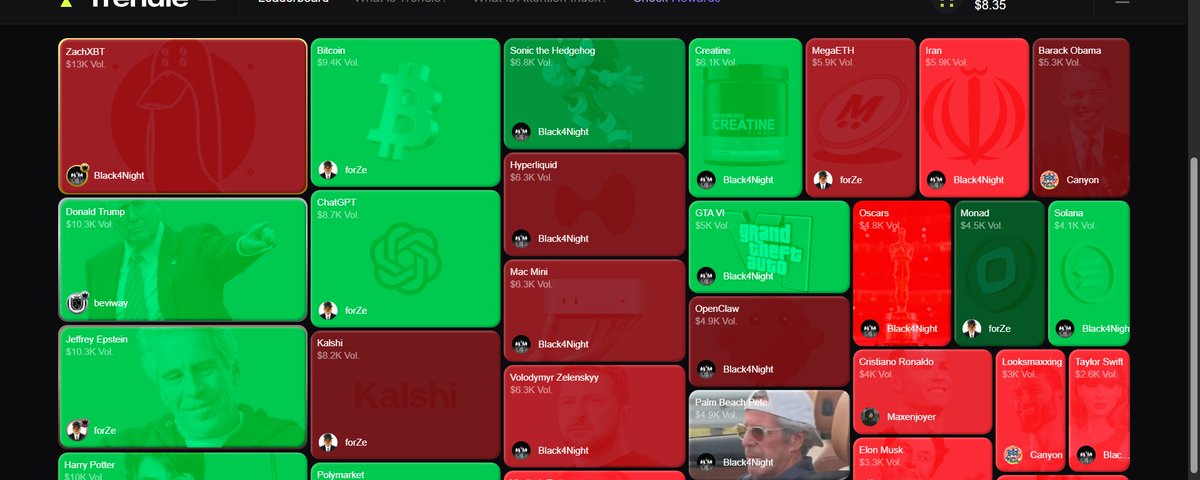 Attention markets reward what you already know, turning everyday scrolling into tradable edge as platforms like TrendleFi monetize narrative timing2026-03
 Crypto VCs are shifting toward FinTech-style investing as token-first exits fade, prioritizing real revenue, payments, trading, and compliance-driven models. Stablecoins and markets now anchor sustainable crypto businesses as fundamentals replace narrative-driven growth.2025-12
 Crypto analyst outlines five narratives to watch in 2026: Consumer DeFi, crypto payments, public token sales, prediction markets, and personalization—arguing the next wave is about usability, access, and real-world adoption.2025-12
 Hitesh parallels the crypto industry with the 1970s counterculture, arguing that while many participants are trapped in a cycle of hype and emotional escapism, the true ethos of the space is about questioning centralized authority and the nature of value. Sharing a personal narrative of early success followed by ego-driven failure, he concludes that lasting wealth is built through skill acquisition and emotional detachment, not just market speculation.2025-12
 Another Crypto Tulip story 🌷🙄
Bitcoin’s Slide Revives ‘Digital Tulip’ Fears as the once–gold narrative falters amid rate jitters, energy concerns, and sharp short-term losses.2025-12
Another Crypto Tulip story 🌷🙄
Bitcoin’s Slide Revives ‘Digital Tulip’ Fears as the once–gold narrative falters amid rate jitters, energy concerns, and sharp short-term losses.2025-12 Data shows grass roots meme coins hitting a six-month low (volumes drop below $1B), while perp DEXs spike in volume2025-09
Narrative in Crypto Markets: How Stories Move Prices
In crypto, a narrative is the shared story market participants tell themselves about why a particular asset, sector, or trend should matter and what it might be worth. Put simply, narratives are the themes—“digital gold,” “restake anything,” “real‑world assets,” “AI agents”—that shape how attention, liquidity, and ultimately prices move across Bitcoin, Ethereum, and the broader crypto ecosystem.
Narratives matter in crypto because this market is still young, reflexive, and driven as much by expectations as by cash flows. Bitcoin’s position as “digital gold,” Ethereum’s role as a decentralized computing layer, the RISE of real-world asset (RWA) protocols, or the HYPE around new perpetual DEXs are not just marketing slogans; they are evolving explanatory frameworks that influence which projects attract capital and which languish. Academic work on “narrative economics” shows that contagious stories help drive major economic outcomes, from stock market booms to the rise of Bitcoin itself, and these same mechanisms are even more visible in 24/7 crypto markets. Recent research on cryptocurrency narratives finds that investor attention to specific themes has a measurable, causal relationship with returns for coins linked to those themes, suggesting that narratives are not just noise but tradable signals—up to a point. At the same time, the industry’s maturation, the entry of institutions, and the evolution of crypto VC behavior are gradually rebalancing the market away from pure narrative-driven speculation toward fundamentals like revenues, user adoption, and regulatory durability. Understanding how narratives form, spread, and decay has therefore become a core skill for crypto traders, builders, and policy-makers alike.
Defining “Narrative” in Crypto
A useful starting point is to distinguish “narrative” from more familiar terms like thesis, meme, or marketing trope. In economic terms, a narrative is a collectively held story about cause and effect: why a new technology will change finance, why a token should accrue value, or why Bitcoin might behave more like gold than like a high-beta tech stock. In practice, crypto narratives blend factual claims, expectations, and emotion. When people talk about the “Bitcoin as digital gold” narrative, they are not just describing Bitcoin’s fixed supply and halving schedule; they are invoking a story about scarcity, inflation hedging, and geopolitical insurance that resonates well beyond the details of the protocol. Likewise, the “Ethereum as world computer” or “ultrasound money” narratives compress a complex set of technical changes—like proof-of-stake, fee burning, and L2 scaling—into a simple story about Ethereum as a programmable, yield-bearing monetary base.
Within the industry, traders often use “narrative” as shorthand for the dominant theme that is currently attracting attention and capital. Platforms like CoinGecko describe “crypto narratives” as the themes or beliefs that shape how investors value different sectors in a given market cycle, influencing which categories attract liquidity at any given time. In one cycle, decentralized exchanges and yield farming dominate; in another, NFTs, metaverse tokens, or AI-related projects capture the spotlight. On social media, “narrative” can also have a more cynical edge, used to describe a talking point pushed by insiders, influencers, or venture capitalists to justify valuations ahead of token unlocks or exit opportunities. This tension between organic narratives and manufactured “spin” is part of what makes the concept so central—and contested—in crypto discourse.
From stories to price action
The intellectual backdrop for this focus on narratives is Nobel laureate Robert Shiller’s framework of narrative economics, which argues that popular stories spread like viruses, interact with economic conditions, and help explain why markets sometimes move in ways that traditional models struggle to capture. Shiller explicitly identifies Bitcoin as a paradigmatic example: early stories about censorship resistance, fixed supply, and freedom from central banks spread through social networks, media, and conferences, contributing to waves of adoption and price appreciation that cannot be fully explained by fundamentals alone. These narratives behave like epidemics, with R0-like “reproduction numbers”: a story becomes contagious when it is easy to retell, emotionally resonant, and adaptable to new contexts, such as financial crises or inflation scares.
In crypto markets, this epidemic model maps cleanly onto the way themes like “DeFi summer,” “play-to-earn,” or “AI tokens” spread. As a story gains traction—whether through social media, influencer threads, or news coverage—more traders pay attention, liquidity floods into related tokens, and rising prices further reinforce the narrative’s credibility. Over time, counter-narratives emerge, often after painful drawdowns: “DeFi is only for ponzis,” “metaverse is dead,” or “AI tokens are just vaporware.” The market thus oscillates between competing narratives, with each cycle leaving behind new infrastructure, hard data, and learned skepticism that shapes the next wave of storytelling. This constant feedback loop between story and price is particularly pronounced in crypto because of its high volatility, 24/7 trading, and the absence of widely accepted valuation anchors.
Narrative, meme, and investment thesis
It is also important to differentiate between narratives, memes, and investment theses. A meme is typically a concise, highly shareable unit of cultural information—an image, catchphrase, or joke—such as “number go up” or “have fun staying poor.” Memes can propagate narratives, but they are not narratives by themselves. A narrative is more structured: “Bitcoin is digital gold,” “crypto will unbundle Wall Street,” or “restaking will be the new yield layer” are narratives because they suggest specific mechanisms and future outcomes. An investment thesis, in contrast, is usually a more formal, testable set of beliefs about how value will accrue and under what conditions it might not. For example, a thesis might spell out why rollups that can settle to both Bitcoin and Ethereum could capture cross-ecosystem flows, rather than merely calling that possibility “the next narrative.”
In practice, the three interact. Memes give narratives cultural energy. Narratives provide a shared language for Crypto VC pitch decks, governance proposals, or analyst research notes. Theses attempt to discipline this storytelling with models, metrics, and scenario analysis. Tensions arise when narratives get ahead of theses, as happened in prior cycles around metaverse tokens or play-to-earn gaming, where the HYPE narrative vastly exceeded what user data or revenue numbers could support. The recent shift of many crypto investors toward fintech-style metrics—recurring revenue, sustainable fees, and regulatory readiness—reflects a growing recognition that narratives must eventually reconcile with reality if they are to support multi-year capital deployment.

Attention markets reward what you already know, turning everyday scrolling into tradable edge as platforms like TrendleFi monetize narrative timing
Attention market was and still is the new oil.
Narrative Economics and Crypto
While practitioners have long intuited that “crypto pumps on narratives, not fundamentals,” academic research over the last decade has begun to systematically test that intuition. One line of work focuses on extracting narratives from news articles, social media posts, or search queries, and then studying how these narrative proxies relate to cryptocurrency prices, volumes, and volatility. Another connects this analysis to broader macro stories, such as “digital gold,” “inflation hedge,” or “risk-on tech asset,” to understand Bitcoin’s co-movement with equities, bonds, and commodities.
A study published in Physica A under the title “Causal inference between cryptocurrency narratives and prices” uses time-series methods to examine whether changes in narrative intensity—measured through text analysis of media coverage and online discussions—help predict price moves in Bitcoin and other major cryptocurrencies. The authors find evidence of Granger causality from narratives to prices in several cases, meaning that past changes in narrative measures improve forecasts of future price movements, even after controlling for other variables. Another recent paper, “Narrative attention and related cryptocurrency returns,” narrows the focus to narrative attention: the amount of investor focus on particular themes, again proxied by search and text metrics. It concludes that increases in attention to specific narratives are linked to higher subsequent returns for the coins associated with those narratives, especially in the short term, and that this effect tends to reverse as narratives fade.
Shiller’s framework applied to Bitcoin and gold
Shiller’s narrative economics provides a useful lens for understanding Bitcoin’s evolving relationship with gold and macro markets. The “digital gold” story posits that Bitcoin’s fixed supply, halving schedule, and global liquidity make it a modern, programmable analogue to physical gold as a store of value. Fidelity has described Bitcoin as an “aspirational store of value,” emphasizing that its role in portfolios remains small but is expanding as institutions gain access through futures, options, custodial platforms, and ETFs. Asset managers like Franklin Templeton frame Bitcoin’s store-of-value narrative alongside other use cases, pointing out that as speculative mania recedes, investor attention often shifts toward “infrastructure and real-world use cases such as stablecoin settlement, derivatives infrastructure, and early-stage tokenization,” even while Bitcoin’s digital gold story remains a central pillar.
At the same time, Bitcoin’s price performance relative to gold has periodically revived counter-narratives. When Bitcoin underperforms gold sharply, critics argue that the “digital tulip” analogy is more apt, echoing centuries-old stories about speculative bubbles detached from intrinsic value. High-profile gold advocates have used episodes where Bitcoin drops significantly against gold to declare the digital gold narrative “failing,” warning that investors could lose confidence if drawdowns persist. These moments highlight a key feature of narrative economics: narratives compete. The same data—Bitcoin falling 40% versus gold, for example—can be woven into two very different stories, one emphasizing temporary volatility within a long-term adoption curve, the other portraying a bubble that is finally bursting.
Recent developments in global resource politics add another layer to this narrative contest. Reports that the U.S. Department of Defense plans to spend up to \(1\) billion USD stockpiling critical minerals like rare earths underscore a new “resource race,” with implications for gold, Bitcoin, and other perceived stores of value. As governments actively accumulate strategic commodities to hedge against supply disruptions and geopolitical risk, Bitcoin proponents argue that a credibly scarce, digitally native asset offers a different kind of hedge—one that is not subject to physical seizure or supply-chain constraints. Critics counter that Bitcoin’s energy usage, regulatory uncertainties, and price volatility make such comparisons premature. In both directions, the narratives draw on real policy moves but embed them in broader stories about sovereignty, scarcity, and the future of money.
Evidence that narratives move crypto prices
The empirical link between narratives and crypto prices is particularly strong because the market is so sensitive to attention shocks. The “Narrative attention and related cryptocurrency returns” study finds that when investor attention to a given narrative rises, returns on coins tied to that narrative tend to increase in the following days, especially in the presence of speculative flows. This effect is stronger for smaller, more narrative-dependent tokens and weaker for established assets like Bitcoin, whose price is influenced by a broader mix of macro factors and institutional flows. When attention subsides, the excess returns often reverse, suggesting that narrative-driven price moves can be transient if not backed by strong fundamentals.
Similar conclusions emerge from the broader “Causal inference between cryptocurrency narratives and prices” work. By analyzing text corpora for narrative themes and mapping those to market data, the authors show that certain narratives, such as “blockchain adoption” or “regulatory crackdown,” have predictive power for future returns and volatility. Interestingly, in some cases, prices move first and narratives follow, as journalists and influencers retrofit stories to explain price action after the fact. This bidirectional causality underscores the reflexive nature of crypto markets. Narrative intensity and price moves are intertwined, each feeding the other in a way that makes simple cause-and-effect stories hazardous.
Leviathan readers click narrative content most when a narrative is visibly rotating or dying — the top clicks cluster around hard volume data exposing meme-coin exhaustion, competing restaking narratives displacing each other, and the conspicuous absence of any consensus narrative at EthCC, revealing an audience that treats narrative identification as a leading rotation signal, not a confirmation of belief.
Narrative Trading: How Traders Use Stories
In practice, many crypto traders explicitly describe their approach as narrative trading. Educational material from major exchanges defines narrative trading as the strategy of making buy or sell decisions based on the stories, news, and events surrounding cryptocurrencies, rather than purely on technical indicators or fundamental analysis. Traders monitor market sentiment, news flows, technological milestones, and social media trends to identify which narratives are gaining momentum and which are fading. Because narratives can spark sharp, short-lived price moves, narrative trading is often associated with high volatility and fast rotations: capital surges into a sector when its story is hot, then exits just as quickly when another theme takes over.
The Gate Learn guide on narrative trading emphasizes that many different factors shape crypto narratives, including market sentiment, macroeconomic news, technological breakthroughs, regulatory developments, and cultural events. It points to the metaverse narrative as a clear example: although virtual worlds were not a new concept, a burst of hype around metaverse tokens from late 2020 through 2021 drove massive price appreciation, only to be followed by steep corrections as user adoption lagged expectations. Likewise, the emergence of liquid staking derivatives after Ethereum’s migration from proof-of-work to proof-of-stake created a new narrative around capital efficiency, enabling stakers to earn staking rewards while using derivative tokens for DeFi activities such as lending and yield farming. Tokens associated with leading liquid staking protocols, like Lido, rallied sharply during the early phase of this narrative before settling into more mature trading ranges.
Mechanics and lifecycle of a crypto narrative
The mechanics of narrative trading hinge on the lifecycle of narratives. Practitioners often describe four informal stages. Educational content and trading commentary break this down into a sequence of inception, excitement, social proof, and distribution. In the inception phase, a new idea emerges—perhaps a novel protocol design, a regulatory shift, or a technological breakthrough—and a small group of insiders and early adopters begins discussing its implications. Prices of related tokens may start to move, but social volume remains relatively low. In the excitement phase, more participants notice; social media mentions rise, early price gains attract momentum traders, and mainstream coverage begins. Social proof comes next, as big-name funds, exchanges, or companies publicly endorse or integrate the narrative, reinforcing its legitimacy. Finally, in the distribution or “bag holder” phase, the narrative saturates; everyone has heard the story, social volume peaks, and early entrants may use the liquidity to exit positions.
Trading strategies built around this lifecycle emphasize timing. Educational content on narrative trading suggests that the “sweet spot” is when price is beginning to rise but social volume and Google Trends data are still moderate, indicating that the narrative is gaining traction but has not yet gone mainstream. Tools like Santiment and LunarCrush track the number of mentions a coin or narrative receives on social platforms, offering quantitative measures of narrative intensity. Analysts warn that when social volume explodes while price momentum stalls, it can be a sign that “everyone who wants to buy has already bought,” increasing the risk of a sharp reversal. This leads to rules of thumb like “buy confusion, sell euphoria,” which encourage traders to enter when the narrative is still being debated and exit when it has become a one-sided consensus.
Attention markets and narrative perpetuals
As narratives have become more central to crypto trading, new platforms have emerged that try to financialize attention itself. Trendle, for example, describes itself as a narrative perpetual market where users can long or short an “attention index” tied to specific topics. Social posts promoting the platform explain that it turns attention into a 24/7 tradable asset, enabling users to express views on whether interest in a particular narrative will rise or fall, rather than trading individual tokens. The idea is that attention moves faster than capital and can sometimes front-run price, so an attention index could offer a purer bet on narrative strength or weakness.
These attention markets dovetail with the broader growth of permissionless perpetual exchanges and synthetic markets, where traders can access not only crypto pairs but increasingly also commodities, indices, and other non-crypto assets. On-chain derivatives platforms like Hyperliquid now offer deep liquidity and sub-second execution, narrowing the gap between decentralized and centralized exchanges. Research from 21Shares notes that Hyperliquid, for instance, has rolled out non-crypto perpetual contracts such as oil and stock indices, attracting traditional traders who want 24/7 markets with crypto-style leverage. In May, CryptoRank data shows that perpetual DEX volume rebounded to approximately \(594\) billion USD, up nearly \(15\%\) from April, signaling renewed demand for on-chain leverage. Together, these trends point toward a future where traders can express narrative views not only by buying or shorting tokens but by trading indices of attention, sector baskets, or permissionless perps tied to real-world and synthetic assets.
Bitcoin, Gold, and Store‑of‑Value Narratives
Bitcoin’s most enduring narrative remains its status as a store of value, often framed against gold and fiat currencies. The “digital gold” story rests on Bitcoin’s capped supply of \(21\) million coins, its predictable issuance schedule, and its resistance to censorship, all of which are contrasted with the discretionary monetary policies of central banks and the physical constraints of mining gold. Reports from traditional financial institutions increasingly treat this narrative as a serious, if still speculative, component of portfolio construction. Fidelity’s research describes Bitcoin as an “aspirational store of value,” arguing that its risk/return profile and low correlation to many traditional assets make it a candidate for a small allocation within diversified portfolios. Franklin Templeton’s commentary similarly notes that while speculative activity in crypto can be extreme, Bitcoin’s store‑of‑value narrative has proven robust across multiple boom-bust cycles.
At the same time, the digital gold narrative is constantly challenged and reinterpreted. When Bitcoin outperforms gold dramatically, advocates highlight its superior scarcity, portability, and verifiability, arguing that it can complement or even supplant gold as a primary non-sovereign store of value. When Bitcoin underperforms, critics invoke the centuries-old story of tulip mania, portraying BTC as a speculative bubble that will ultimately revert to zero once the collective delusion breaks. The Heritage Foundation has pushed back against the tulip analogy, pointing out that Bitcoin has persisted for over fifteen years, through multiple halving cycles and regulatory regimes, and now supports a global market with trillions of dollars in cumulative transaction volume. Online forums where participants debate whether Bitcoin is “digital gold or tulip bulb” illustrate how these competing narratives co-exist, with different communities emphasizing different aspects of the same data.
Resource races and new competitors to gold
Geopolitical developments add fresh texture to the store-of-value conversation. Reporting on the U.S. Defense Department’s plan to spend up to \(1\) billion USD stockpiling critical minerals, including rare earths, frames this as part of a broader resource race aimed at countering China’s dominance in key supply chains. Gold enthusiasts see this as another reason to hold physical bullion, while crypto proponents argue that the very need for such stockpiles underscores the value of a digitally native, location-independent asset like Bitcoin. The narrative expands: Bitcoin is not only digital gold but a hedge against geopolitical fragmentation and resource nationalism, a store of value whose scarcity is secured by mathematics rather than mines or militaries.
This competition among stores of value is no longer limited to gold and Bitcoin. Tokenized real-world assets, including tokenized Treasuries and private credit instruments, have grown rapidly, with on-chain RWA markets expanding from roughly \(5.5\) billion USD in early 2025 to about \(29.2\) billion USD by April 2026. CoinGecko’s analysis notes that RWA tokens were among the most profitable narratives of 2025, with average price returns of around \(185.8\%\) year-to-date in that period, driven by projects like Maple Finance and Zebec Network. As central bank digital currencies (CBDCs) and regulated stablecoins integrate with tokenized asset platforms, a new narrative emerges: rather than replacing gold outright, Bitcoin coexists alongside tokenized securities and digital fiat as part of a more complex, programmable store-of-value and settlement stack. In this narrative, portfolios of the future may hold some combination of gold, Bitcoin, RWA tokens, and stablecoins, each serving different risk and liquidity needs.
Crypto VCs are shifting toward FinTech-style investing as token-first exits fade, prioritizing real revenue, payments, trading, and compliance-driven models. Stablecoins and markets now anchor sustainable crypto businesses as fundamentals replace narrative-driven growth.
Technology Narratives: Ethereum, Scaling, and Infrastructure
Beyond macro store-of-value stories, many of crypto’s most powerful narratives are technological. Ethereum has cycled through several since its launch: from “world computer” to “DeFi base layer” to “ultrasound money” after EIP‑1559 and the transition to proof-of-stake. The current era adds further layers, with narratives around Layer 2 rollups, modular blockchains, and restaking ecosystems that promise to turn Ethereum staking into a generalized security service for other protocols. These stories influence not only ETH’s valuation relative to Bitcoin but also how developers and users allocate time, capital, and trust across the broader ecosystem.
Ethereum’s narrative is also entangled with internal culture and governance debates. When prominent builders publicly question their loyalty to Ethereum or criticize “toxic” community behavior, they are not just airing grievances; they are implicitly contesting the narrative about what Ethereum represents and who it is for. Conferences like ETHCC periodically wrestle with the question of whether the ecosystem “has a narrative” at all, especially in periods where there is no single dominant meme like DeFi summer or NFT mania. In such phases, some commentators argue that the absence of a clear, speculative narrative may be healthy, allowing builders to focus on infrastructure and real adoption rather than chasing HYPE.
Cross-chain scaling and the Starknet narrative
Scaling technology provides fertile ground for new narratives. Starknet, for instance, has introduced a striking story: becoming the first Layer 2 to settle on both Bitcoin and Ethereum, effectively unifying the world’s two largest blockchains on a single execution layer. In its own materials, Starknet describes its goal as becoming Bitcoin’s execution layer, scaling the network from roughly \(13\) transactions per second to thousands, and enabling complex smart contracts that Bitcoin cannot natively support. At the same time, by settling on Ethereum as well, Starknet positions itself as a bridge between Bitcoin’s store-of-value base and Ethereum’s programmable environment, advancing a narrative of convergence rather than competition between the two ecosystems.
This narrative dovetails with others around cross-chain interoperability, modular blockchain design, and the “RISE of the execution layer” as the primary locus of innovation and fee capture. Projects like CROSS, which frame their mainnet upgrades as shifting from a “supply” focus to a “participation” narrative, similarly position themselves as infrastructure that can plug into multiple base layers without being tied to a single chain’s fortunes. The restaking boom—where protocols like EigenLayer, Symbiotic, and others allow staked ETH or synthetic stake assets to secure additional networks—feeds a story of Ethereum as a generalized security and capital base. The question of whether integrations like Ethena give one restaking ecosystem an edge over another (“restake anything”) is thus not purely technical; it is part of a narrative contest over who will own the trust layer of future crypto markets.
Infrastructure, perp DEXs, and the HYPE market
Derivative infrastructure has become another central narrative in this cycle. CoinGecko’s 2026 narrative analysis highlights perpetual DEXs as a key theme, noting that platforms like Hyperliquid and Aster are closing the user experience gap with centralized exchanges by offering deep liquidity and sub-second execution. As of April 2026, Hyperliquid alone was recording approximately \(21.8\) billion USD in 24-hour trading volume and around \(7.3\) billion USD in open interest, underscoring how much leverage and speculative activity has migrated on-chain. CryptoRank’s data for May further shows total perpetual DEX volume rebounding to roughly \(594\) billion USD, a \(14.7\%\) increase from the previous month, reversing a six-month decline.
Within this broader perp DEX story, specific tokens like HYPE have become focal points for narrative trading. Commentary and podcasts featuring figures like Arthur Hayes discuss the bull case for HYPE in the context of permissionless markets that expand beyond crypto to include oil, indices, and other non-crypto perpetuals. Hayes and others argue that if geopolitical tensions remain elevated and commodity trading remains active, platforms that provide 24/7 access to a wide range of assets could see significant growth, and their native tokens might capture meaningful value. Traders flocking to permissionless markets after traditional stock exchanges close are thus not just seeking after-hours exposure; they are expressing a view on a narrative where crypto derivatives infrastructure becomes the always-on backbone of global markets.
- 01meme coin cycle exhaustion↗
Quantified evidence of grassroots speculation collapsing — sub-$1B volumes against surging perp DEX activity — gave readers a data-backed narrative-death signal rather than anecdote.
- 02restaking narrative competition
Ethena's integration with Symbiotic reframing 'restake anything' as a wedge against EigenLayer gave readers a concrete horse-race inside a still-hot meta, combining yield mechanics with narrative positioning.
- 03Bitcoin digital-gold narrative stress↗
Overlapping headlines — Schiff's BTC-vs-gold ratio argument, tulip comparisons revived by rate jitters, and Pentagon rare-earths as new store-of-value rivals — signal readers actively stress-testing Bitcoin's foundational narrative against macro headwinds.
- 04VC pivot from narrative to fundamentals
The shift from token-first exits to stablecoin and real-revenue models reads as a structural bet that narrative-driven cycles are ending, drawing readers tracking where institutional capital is repositioning ahead of retail.
- 05DeFi illicit-finance narrative debunking↗
The DEF rebuttal attacking datasets built on hacks and scams gave readers an evidence-based counter to a regulatory framing with concrete policy consequences.
- 06narrative timing as tradeable edge↗
Platforms monetizing attention-market timing and the academic framing of 'narrative economics' attracted readers who treat narrative identification as alpha-generation rather than commentary.
Sector Narratives in 2025–2026: RWA, Privacy, Payments, Prediction Markets, and More
Narratives in crypto are not limited to individual chains or infrastructure layers; they also encompass broader sectors that cut across multiple protocols. Analysis of top narratives for 2026 identifies several dominant themes, including RWA tokenization, privacy and zero-knowledge proofs, perpetual DEXs and synthetic assets, stablecoins and ETFs, and crypto cards. Independent analysts add further layers, pointing to consumer DeFi, crypto payments, public token sales, prediction markets, and personalization as key areas where the next wave of adoption may occur.
RWA has arguably been the standout sector narrative. As noted earlier, the value of tokenized real-world assets on-chain grew from roughly \(5.5\) billion USD in early 2025 to about \(29.2\) billion USD by April 2026, driven by institutional demand. Early tokenized Treasury products paved the way, but the narrative has since shifted toward private credit—now estimated at roughly \(17\) billion USD in tokenized form—and real estate. In 2025, RWA tokens as a category were among the most profitable, with average price returns of around \(185.8\%\) year-to-date, substantially outperforming many other sectors. This performance, combined with the narrative of “bridging TradFi and DeFi,” has attracted both crypto-native and traditional asset managers, who view tokenization as a way to improve settlement efficiency and broaden investor access while still operating within regulatory boundaries.
Privacy, ZK, and institutional DeFi
Privacy has evolved from a niche concern to a mainstream narrative, especially as institutions and regulators grapple with how to reconcile transparency with confidentiality. Zero-knowledge proofs (ZKPs), originally hailed primarily as a scaling solution via ZK-rollups, are now increasingly used for identity verification and confidential DeFi applications. In this narrative, ZKPs allow users to prove that they satisfy certain criteria—such as being over 18, or having a sufficient credit score—without revealing underlying personal data. This enables compliance-friendly privacy, where participants can interact with on-chain markets while remaining identity-verified but data-private.
The renewed interest in financial privacy is reflected in market performance. Privacy coins like Zcash and Monero experienced significant revivals in late 2025, with Zcash reportedly gaining over \(690\%\) and Monero rallying around \(144\%\) over a defined period, as investors reassessed the role of private transactions in a world of increasing surveillance. At the same time, educational and advocacy groups have pushed back against the narrative that DeFi and privacy tools are primarily used for illicit finance. A study commissioned by the DeFi Education Fund, for example, reviewed data from Chainalysis and TRM Labs and found that illicit activity accounted for only a small fraction of total crypto transaction volume—around \(0.14\%\) or \(0.4\%\) in different measures for 2024—down sharply from prior years. The study also observed that most financial crime still occurs in traditional systems and that losses in CeFi far exceeded those in DeFi in early 2025, challenging the idea that decentralized platforms are uniquely risky. These findings support a counter-narrative: that DeFi and privacy technologies, properly regulated, can enhance integrity and resilience in the financial system rather than undermine it.
Stablecoins, ETFs, DATcos, and payments
The expansion of crypto ETFs and stablecoins has created a new narrative around “crypto as financial plumbing”. By 2025–2026, the number of crypto ETF applications pending with regulators like the SEC surpassed one hundred, covering not only Bitcoin and Ethereum but also major DeFi protocols and even some meme coins. This proliferation reflects institutional demand for regulated, exchange-traded exposure to digital assets, and it reinforces the narrative that Bitcoin’s post-ETF era represents a shift from fringe speculation to mainstream portfolio allocation. Alongside ETFs, the concept of Digital Asset Treasury Companies (DATcos) has emerged: publicly traded firms that hold cryptocurrencies like Bitcoin or Ethereum as strategic treasury assets, similar to how some companies hold large gold reserves. DATcos embody the narrative that holding scarce digital assets can be a corporate strategy for hedging against fiat debasement or signaling technological alignment.
Stablecoins and crypto payments have likewise moved from fringe experiments toward real-world utility. Analysts note that in 2025 and into 2026, both custodial and non-custodial crypto cards have allowed users to spend on-chain assets like USDC or ETH at any Visa or Mastercard terminal globally, with the card smart contracts automatically liquidating just enough crypto at the moment of purchase. This turns crypto from a purely speculative investment into a functional medium of exchange for millions of users, reinforcing narratives around everyday adoption and undercutting the claim that crypto “can’t be used to buy coffee.” Crypto VCs and fintech-style investors increasingly focus on these payments rails, viewing stablecoins as the anchor for sustainable revenue models in remittances, merchant services, and cross-border B2B payments.
Prediction markets, public token sales, and personalization
Prediction markets represent another narrative gaining traction, especially following high-profile events like the 2024 elections. CoinGecko’s analysis notes that prediction markets have become important sources of information in 2026, as traders and observers use market odds to infer collective beliefs about political, economic, and sports outcomes. At the same time, new platforms experiment with public token sales that are more regulated and community-centric than early ICOs, using mechanisms like smart contract escrows and identity checks to emphasize fairness and compliance. Analysts argue that this new wave of public token sales is less about speculative RISE and more about accessible ownership and user participation, consistent with a broader shift toward consumer DeFi and personalization.
Personalization itself is an emerging narrative, with protocols aiming to tailor financial products, risk profiles, and governance rights to individual users based on their preferences and on-chain histories. This can mean personalized vaults, variable fee tiers, or customized index products that reflect user-defined narratives—such as an index of “decentralized physical infrastructure networks” or “climate-aligned crypto.” While still early, these efforts reflect a deeper theme: that as the infrastructure matures, crypto will increasingly compete not just on raw yields but on user experience, relevance, and narrative resonance.
Memecoins, gambling, and attention exhaustion
No discussion of narratives would be complete without memecoins and the gambling narrative. Memecoins remain a cultural staple, with their total market capitalization reaching tens of billions of dollars by mid-decade. Yet data has shown periods where grassroots memecoin volumes fall below \(1\) billion USD over six months, suggesting phases of fatigue or rotation into other narratives. In parallel, crypto gambling platforms like Rollbit have blended casino services with leveraged trading, positioning themselves as “new-age crypto casinos” where users can speculate on both games and markets. Rollbit’s launch of a cryptocurrency trading feature is framed as a way to become a leader in the crypto gambling space, highlighting how blurred the line between trading and gambling can become when high leverage and volatile tokens are involved.
Threads and commentary about the RISE of the gambling narrative—often using Rollbit as a case study—raise questions about whether some segments of crypto are becoming little more than digital casinos. Critics worry that attention and capital are being siphoned away from productive innovation into zero-sum speculation. Supporters argue that gambling-style products serve real demand and can coexist with more utilitarian protocols. Either way, the narrative that “crypto is just a casino” competes directly with narratives around financial inclusion, open access, and censorship resistance, influencing both public perception and regulatory responses.
Narratives, Regulation, and Public Perception
Regulation is itself a narrative contest. Policymakers, industry groups, and media outlets compete to define what crypto “is”—shadow banking, digital tulips, the future of the internet, or all of the above. Narratives about illicit finance play a central role here. For years, critics have claimed that a large portion of crypto activity is driven by money laundering, terrorist financing, or scams. In response, industry advocates have worked to contextualize the data and highlight improvements in security and compliance tooling.
The DeFi Education Fund’s blog on illicit finance is a notable example. It summarizes several studies, including Chainalysis’s “2025 Crypto Crime Trends” report and TRM Labs’ research, to argue that illicit crypto activity represents a declining share of overall transaction volume. Chainalysis estimated that in 2024, crypto crime accounted for about \(0.14\%\) of total on-chain volume, while TRM Labs found that illicit volume was around \(45\) billion USD, or roughly \(0.4\%\) of total crypto volume—down from \(0.9\%\) the prior year. The blog also highlights that CeFi platforms were responsible for the vast majority of successful exploits in early 2025, while DeFi losses declined by nearly \(69\%\) compared with the previous period. Its conclusion is that regulators should recognize that most illicit finance risks remain in traditional finance and CeFi, and should not disproportionately target DeFi.
These data-driven narratives compete with more sensational framings that focus on spectacular hacks or rug pulls. Media stories that frame all of DeFi as a haven for crime risk shaping policy in ways that ignore the nuanced reality. Conversely, industry narratives that paint DeFi as entirely benign can underplay genuine risks. Over time, the most durable regulatory narratives are likely to be those that acknowledge both the potential benefits and the risks of open, programmable financial infrastructure, informed by empirical evidence rather than anecdotes.
Institutional framing and retail sentiment
The entry of large asset managers, banks, and payment companies has introduced a more institutional framing of crypto narratives. BlackRock’s marketing for its Bitcoin products, for example, draws inspiration from “The Bitcoin Standard,” emphasizing long-term store-of-value properties and positioning Bitcoin as a kind of digital analog to the monetary anchors of the past. This contrasts sharply with retail-focused narratives driven by memes, celebrity endorsements, or overnight 10x gains. Franklin Templeton’s embrace of Bitcoin DeFi, framed as enhancing investor utility without compromising Bitcoin’s core store-of-value narrative, further illustrates how institutions try to balance innovation with risk management.
At the same time, episodes where high-profile investors or companies reinforce negative narratives—such as calling Bitcoin “rat poison squared” or equating the entire asset class with tulip bulbs—continue to shape retail sentiment. During sharp drawdowns, these narratives resurface, amplified by critics like Peter Schiff who use short-term price action relative to gold to declare the failure of the digital gold story. The persistence of such criticism underscores that narratives do not simply vanish when prices rise; they remain latent, ready to be reactivated by new data points.
Crypto analyst outlines five narratives to watch in 2026: Consumer DeFi, crypto payments, public token sales, prediction markets, and personalization—arguing the next wave is about usability, access, and real-world adoption.

"1. Consumer DeFi -DeFi is still the best use case crypto has produced so far. -Billions in TVL. Clear PMF. People making real money for 5+ years. -That part is not up for debate. -But now it’s time to make it accessible for everyone. -Yes I know, technically anyone can already access DeFi. But there’s no world where your mom or your normie friend enjoys today’s user experience. -Consumer DeFi is about fixing that. -Dead simple yield apps. Self custody. No need to think. Just: put money in, earn."
How Crypto VCs and Builders Use (and Misuse) Narratives
Crypto venture capital has historically been both a generator and a consumer of narratives. In the 2017 ICO boom, the 2020–2021 DeFi and NFT waves, and various metaverse or Web3 cycles, VCs often helped articulate overarching stories—“open finance,” “ownership economy,” “metaverse”—that then justified rapid capital deployment into loosely related projects. As long as token prices were rising, this narrative-led investing appeared to work; paper returns and on-chain valuations grew quickly.
In recent years, however, many Crypto VCs have shifted toward more fintech-style investing, focusing on businesses with real revenues, payments flows, trading fees, and compliance-friendly models. This shift reflects hard lessons from prior cycles where narrative-driven growth did not translate into sustainable cash flows once token unlocks began and user engagement waned. Today, stablecoins, market infrastructure, and compliant brokerages are increasingly seen as anchor business models, while purely narrative-driven tokens without provable product-market fit face greater skepticism. This does not mean narratives no longer matter for fundraising; rather, VCs are more likely to demand that teams connect their narrative to concrete metrics and milestones.
Narratives as fundraising tools—and legal risks
Narratives remain powerful fundraising tools. Teams frame themselves as “the Coinbase of X,” “the Ethereum of Y,” or “the first Z on Bitcoin” to situate their project within familiar stories. In some cases, this narrative construction spills into controversial territory when disputes arise over whether founders misled investors with overly optimistic or selective storytelling. Lawsuits where VCs accuse founders of “deception,” while founders’ lawyers reply that these are merely “clever narratives,” illustrate how the line between persuasive framing and misrepresentation can blur.
This dynamic may intensify as regulators scrutinize token launches and marketing claims more closely. If a token’s narrative is central to its investment appeal, then false or misleading narrative elements—such as exaggerated partnership claims, misrepresented regulatory status, or unrealistic promises about future yields—could become grounds for enforcement. For sophisticated investors, this reinforces the importance of due diligence that goes beyond narrative alignment to interrogate on-chain data, cap tables, and legal disclosures.
Personal narratives, ethos, and anti-hype positioning
Finally, many participants in crypto markets are increasingly sharing personal narratives about their journey through cycles of HYPE, euphoria, and disillusionment. Commentators who liken the crypto industry to the 1970s counterculture, for instance, argue that while many participants are trapped in patterns of emotional escapism and speculative gambling, the deeper ethos of crypto is about questioning centralized authority and rethinking the nature of value. These stories emphasize that lasting wealth tends to be built through skill acquisition, emotional discipline, and aligned risk-taking, not just by chasing narratives.
This anti-hype positioning is itself a kind of meta-narrative, one that appeals to those who have been burned by prior cycles and now seek more grounded approaches. It feeds into the broader shift toward fundamentals, compliance, and real-world use cases, even as pockets of the market continue to operate like high-stakes casinos. For media and research outlets, acknowledging these personal and philosophical narratives alongside market data helps paint a more accurate picture of what crypto is—and what it wants to be.
U.S. spot Bitcoin ETF approvals institutionalize the store-of-value narrative
- 2024-07milestone
EthCC Brussels: commentators note absence of any dominant conference narrative
- 2024-09governance
Three VCs file suit against Michael Egorov; defense labels case a constructed narrative
Pentagon $1B rare-earth stockpile reframes resource scarcity as store-of-value rival to Bitcoin
DeFi Education Fund publishes dataset rebuttal challenging illicit-finance narrative applied to DeFi
- 2026-01milestone
Analysts publish five-narrative watchlist — Consumer DeFi, payments, prediction markets — declaring usability replaces speculation as the cycle anchor
Grassroots meme-coin volumes fall below $1B six-month low as perp DEX volumes surge, marking narrative rotation in real-time volume data
Measuring Narratives: Data, Indicators, and Tools
Because narratives are intangible, traders and analysts rely on proxies to measure them. Social media volume, news article counts, Google Trends scores, developer commits, and on-chain activity can all serve as indicators of narrative strength or weakness. Some academic work, like the “Narrative attention and related cryptocurrency returns” paper, constructs indices of narrative attention by analyzing text corpora and search data for specific themes, then correlates these indices with price action. Others, like the “Causal inference between cryptocurrency narratives and prices” study, use topic modeling and regression techniques to quantify how often certain narratives appear in public discourse and whether those frequencies help predict returns.
Trading education resources stress the value of combining these narrative indicators with more traditional metrics. For example, the YouTube explainer on crypto narratives highlights social volume tools like Santiment and LunarCrush, which track the number of mentions for coins or narratives across Twitter and other platforms. By comparing the trajectory of social volume with price, traders can look for divergences—such as rising prices with still-muted social attention, which might indicate an early-stage narrative, or spiking social attention with flat or declining price, which might signal exhaustion. Google Trends can provide a similar lens at a broader, non-crypto-native level, showing whether terms like “Bitcoin halving,” “restaking,” or “AI crypto” are gaining mainstream awareness.
On-chain data and venture capital flows can also reinforce or challenge narratives. Rising active addresses, transaction counts, or TVL in protocols tied to a given narrative provide stronger support than price action alone. Likewise, sustained capital commitments from reputable Crypto VCs into a sector—combined with transparent vesting and tokenomics—can signal that the narrative is not merely retail-driven hype. Educational content on narrative trading encourages traders to “follow the money” and to pay particular attention to whether “smart money” wallets—such as those controlled by sophisticated funds or known high-performing traders—are accumulating or distributing tokens tied to a narrative.
Risk management in narrative trading
Despite the appeal of catching the next 10x narrative early, risk management remains paramount. Narrative trading education repeatedly emphasizes position sizing as a “golden rule,” suggesting that traders allocate only a portion of their portfolio to high-risk, narrative-driven plays, while keeping a larger share in blue-chip assets like Bitcoin and Ethereum or in stablecoins. This approach acknowledges that many narratives fail, and that even successful narratives often experience brutal drawdowns.
Another key concept is invalidation. Before entering a narrative trade, traders are encouraged to ask what would prove them wrong: a breakdown below a certain technical level, a sharp decline in developer activity, a collapse in Google Trends interest, or evidence that major smart-money wallets are exiting. When those conditions are met, disciplined traders may exit rather than “marrying their bags.” In narrative trading, this discipline is particularly critical because the same psychological forces that make narratives compelling—hope, FOMO, community belonging—also make it hard to let go when the story turns.
Conclusion
Narratives are not optional in crypto; they are foundational. From Bitcoin’s digital gold framing and Ethereum’s world computer story to the RISE of RWA tokenization, ZK-enabled privacy, and permissionless perps like HYPE, narratives shape which projects get built, which tokens pump, and which sectors fade into the background. Academic work on narrative economics and empirical studies of cryptocurrency narratives reveal that investor attention to specific themes is causally linked to short-term returns, especially for smaller, narrative-dependent tokens. Yet those same studies, along with hard lessons from multiple market cycles, also highlight the dangers of over-reliance on stories that are not ultimately backed by sustainable cash flows, user adoption, or regulatory viability.
As the market matures, a more nuanced balance is emerging. On one side, pure narrative constructs—memecoins, gambling tokens, and ephemeral sector fads—continue to attract speculative flows and attention, often amplified by social media and influencer culture. On the other, institutional investors, regulators, and seasoned builders are increasingly privileging narratives grounded in real-world utility: stablecoin settlement, derivatives infrastructure, tokenized assets, and compliance-friendly privacy. Crypto VCs are evolving from token-first, exit-driven strategies toward fintech-style investing with an emphasis on revenue, regulated products, and durable business models. This does not mean the end of narratives; if anything, it elevates their importance, since the most compelling narratives going forward will be those that align with verifiable data and long-term macro trends.
For traders and readers of crypto news, understanding narratives is therefore less about spotting the next meme and more about cultivating narrative literacy. That means recognizing how stories spread, how they interact with macro conditions, how they can be measured using attention data, and where they cross the line into wishful thinking or deception. It also means situating personal and cultural narratives—about financial freedom, distrust of centralized authority, or the pursuit of life-changing returns—within a broader context of risk, responsibility, and technological change. In that sense, the story of crypto itself is an ongoing narrative, one in which markets, regulators, builders, and users all play active roles.
Capital rotates rapidly between meta-themes as narratives peak and exhaust; lagged entrants absorb outsized drawdowns when cycle turnover occurs, as evidenced by meme-coin volumes collapsing while perp DEX activity surged in the same window.
Regulators and media have repeatedly applied illicit-finance narratives to DeFi using datasets dominated by hacks and scams, creating policy risk systematically disproportionate to on-chain reality.
Within-cycle narrative shifts can strand positions in rapidly illiquid pools, as the simultaneous meme-coin volume collapse and perp DEX surge illustrates.
BlackRock, Franklin Templeton, and large VCs increasingly set dominant narratives — Bitcoin store-of-value, FinTech-style fundamentals — crowding out grassroots price discovery and leaving retail to act on narratives after institutions have positioned.
Platforms that monetize narrative timing create information hierarchies where narrative-aware traders extract rent from slower participants who receive signals only after the dominant framing is already priced in.
Outlook
Looking ahead, crypto’s narrative landscape is likely to be defined by convergence rather than singular themes. Bitcoin’s store-of-value story will continue to evolve alongside new resource races, central bank digital currencies, and tokenized real-world assets, positioning it as one component of a broader digital store-of-value stack rather than a lone competitor to gold. Ethereum and its scaling ecosystems will navigate competing narratives around restaking, modularity, and cross-chain execution layers, with projects like Starknet exemplifying efforts to unify Bitcoin and Ethereum under shared infrastructure.
Sector-wise, RWA, privacy, perpetual DEXs, and payments are poised to remain central narratives, particularly as regulators refine their approaches and institutional participation deepens. Attention markets and narrative perpetuals may add a new layer of financialization, allowing traders to speculate directly on the strength of stories themselves. At the same time, the industry’s internal narrative may shift further away from pure HYPE toward a more grounded ethos that values resilience, skill, and real utility. For a crypto news audience, the challenge will be to track these evolving narratives critically: reporting not just on which stories are driving today’s price action, but on which are likely to matter when the next cycle begins.
Latest Narrative news
Attention markets reward what you already know, turning everyday scrolling into tradable edge as platforms like TrendleFi monetize narrative timingCrypto VCs are shifting toward FinTech-style investing as token-first exits fade, prioritizing real revenue, payments, trading, and compliance-driven models. Stablecoins and markets now anchor sustainable crypto businesses as fundamentals replace narrative-driven growth.Crypto analyst outlines five narratives to watch in 2026: Consumer DeFi, crypto payments, public token sales, prediction markets, and personalization—arguing the next wave is about usability, access, and real-world adoption.Hitesh parallels the crypto industry with the 1970s counterculture, arguing that while many participants are trapped in a cycle of hype and emotional escapism, the true ethos of the space is about questioning centralized authority and the nature of value. Sharing a personal narrative of early success followed by ego-driven failure, he concludes that lasting wealth is built through skill acquisition and emotional detachment, not just market speculation.Another Crypto Tulip story 🌷🙄
Bitcoin’s Slide Revives ‘Digital Tulip’ Fears as the once–gold narrative falters amid rate jitters, energy concerns, and sharp short-term losses. Peter Schiff says Bitcoin’s 40% drop against gold proves the “digital gold” narrative is failing. He warns BTC could keep sliding as investors lose confidence during the ongoing correction.
Sources
20 records from 19 domains
sciencedirect.com
binance.com
forum.valuepickr.com
x.com
newsfilecorp.com
fourminutebooks.com
coingecko.com
gate.com
youtube.com
cryptorank.io
starknet.io
defieducationfund.org
franklintempleton.lu
21shares.com
pod.wave.co
fidelitydigitalassets.com
ideas.repec.org
cryptoslate.com
heritage.org
Community notes
Spot something off or out of date? Drop a note. Editors review topic notes daily and roll accepted fixes into the explainer — contributors are recognized in the monthly $SQUID drop.
Loading notes…
Help improve this topic
Have a story or tip about this topic? Submit it. See something missing? Leave a note. Editors review daily; accepted submissions and fixes count toward the monthly $SQUID drop.