
The OCC grants federal trust charters to banks and crypto firms including Coinbase, Ripple, and Kraken, making it the central U.S. regulator for institutional digital asset custody and stablecoin issuance.
+23 sources across the wider coverage universe
 Citadel, Schwab, and Fidelity-backed EDX Markets files for OCC national trust bank charter2026-04
 Wise plans a fresh OCC charter bid under the GENIUS Act as U.S. stablecoin regulation evolves, while maintaining its blockchain-agnostic payments strategy2026-07
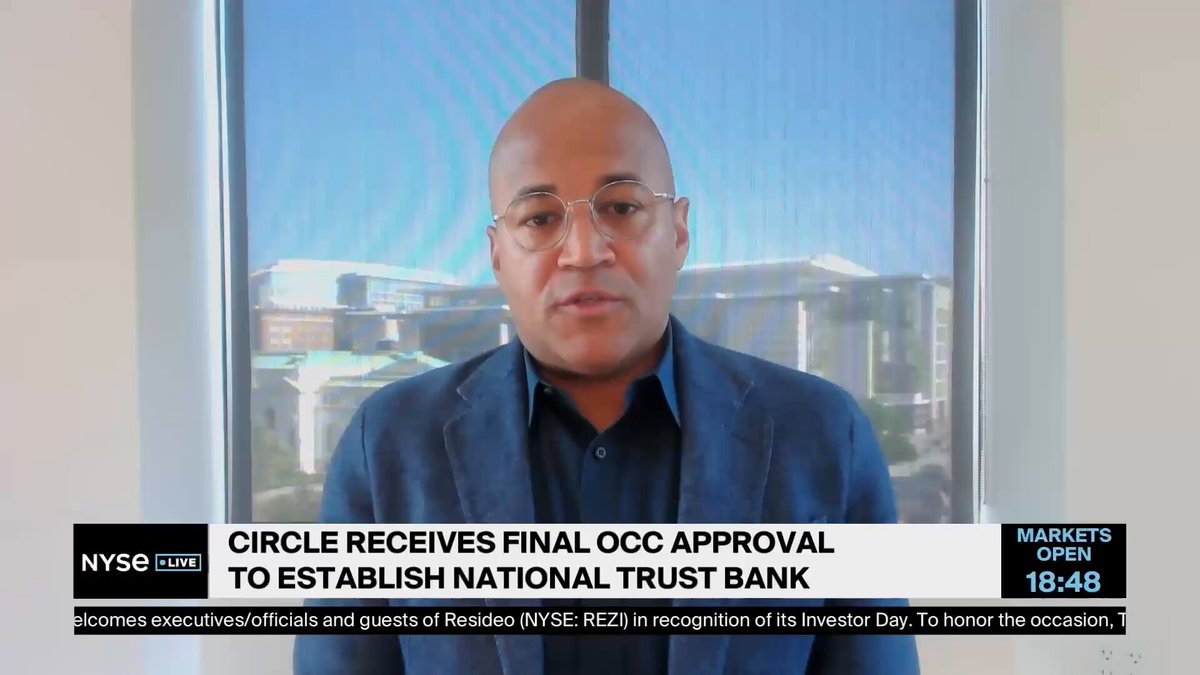 Circle wins final OCC approval to launch Circle National Trust, strengthening USDC infrastructure with federally regulated custody for institutional clients2026-07
 American Bankers Association (ABA) request 60-day extension to review US stablecoin bill, citing need for more time after OCC finalizes key regulatory framework2026-04
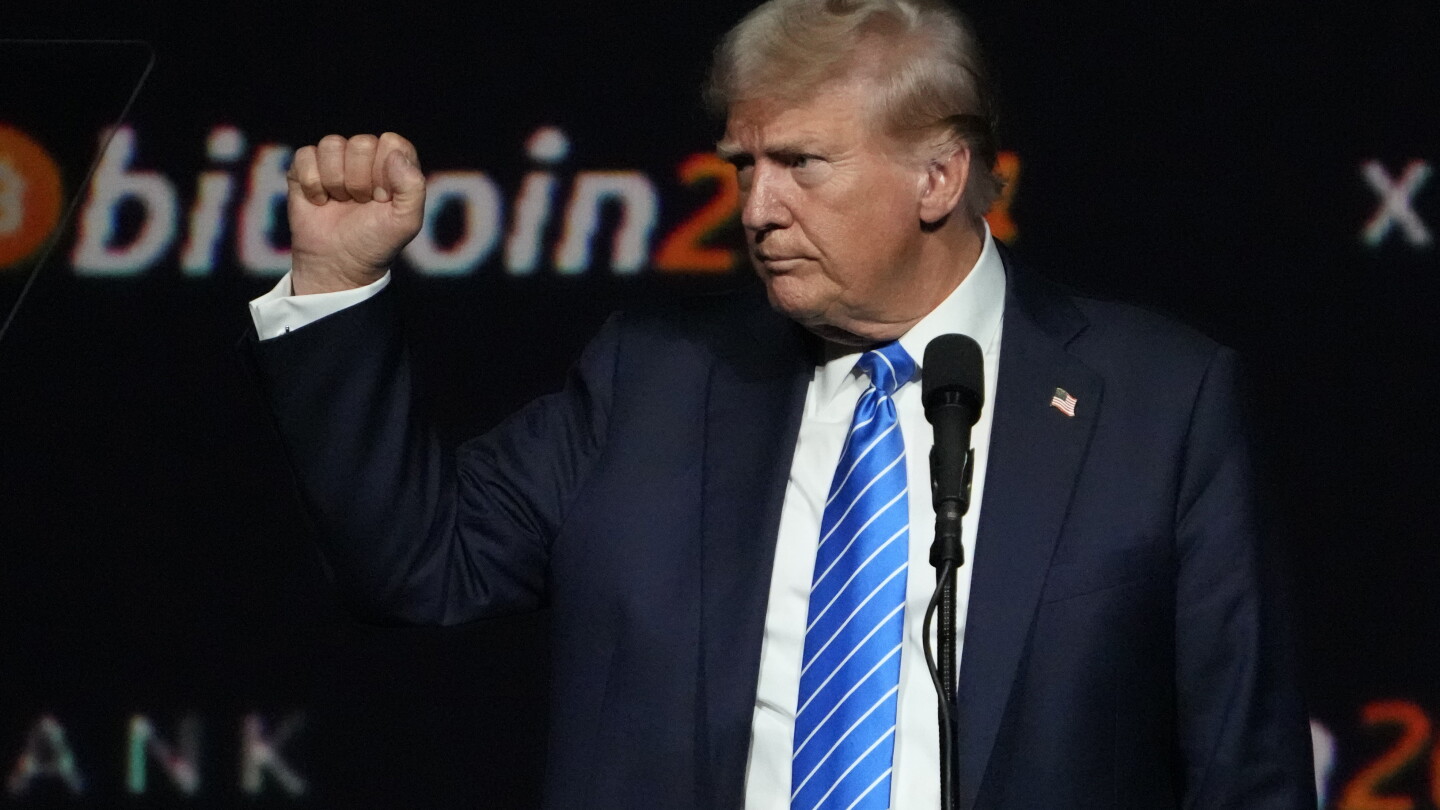 Trump-backed World Liberty Financial nears OCC trust charter to issue USD1 directly2026-06
 Liquid Mercury selects BitGo CaaS to secure Pro, OTC, and RWA trading with OCC-regulated custody2026-06
The Office of the Comptroller of the Currency (OCC) is a U.S. federal banking regulator that charters, supervises, and examines national banks and federal savings associations — and has emerged as the pivotal gateway for crypto firms seeking legitimacy inside the American banking system.
What the OCC Actually Does
Established in 1863 under the National Currency Act, the OCC operates as an independent bureau within the Treasury Department. Its core mandate is ensuring the safety and soundness of the national banking system. The Comptroller — currently Jonathan Gould, a Trump appointee who previously served as chief legal officer at BlackRock — heads the office and sets the supervisory tone for roughly 1,200 federally chartered institutions.
What makes the OCC consequential for digital assets is the power to grant national bank charters and federal trust charters. These are not state licenses that vary by jurisdiction; they are federal instruments that preempt a patchwork of fifty state regimes and, crucially, signal to counterparties and institutional clients that a firm operates under a recognized prudential framework.
For crypto companies that have spent years navigating state-by-state money transmission licensing, the OCC's federal charter represents a structural shortcut and a credibility upgrade — at considerable regulatory cost.

Catena receives preliminary conditional OCC approval to establish a national trust bank focused on custody and programmable financial controls for AI agents

National Trust Charters: The Instrument Everyone Wants
A national trust bank charter authorizes a company to act as a fiduciary — holding assets, managing custody, and conducting trust activities — on a nationwide basis. It does not confer deposit-taking authority (that requires a full commercial bank charter and FDIC membership), but it does place the holder under continuous OCC examination and capital requirements.
For crypto firms, the appeal is straightforward: institutional clients including hedge funds, registered investment advisers, and broker-dealers are often prohibited by their own compliance programs from placing assets with custodians that lack a recognized regulatory home. An OCC trust charter satisfies that requirement in a way that most state trust licenses do not, because it is supervised by a federal examiner with teeth.
The OCC has issued trust charters to crypto-adjacent firms before — Anchorage Digital received a conditional national trust bank charter in January 2021, the first ever granted to a crypto firm — but the pace has accelerated sharply under the current administration.
Readers aren't clicking on OCC policy abstractions — they're tracking a federally chartered banking license as the single most coveted legitimacy stamp in crypto, turning each conditional approval into a scoreboard entry that signals which firms will control institutional custody and stablecoin issuance at scale.
The 2025–2026 Charter Wave
The political environment shifted after the 2024 election. Under Gould's leadership, the OCC signaled openness to crypto applications that would have stalled or been denied under prior guidance. A series of charter grants and applications followed.
Coinbase and Ripple are among nine firms that Senator Elizabeth Warren identified in a letter to the OCC as having received or being in line for national trust charters. Ripple, which operates the XRP Ledger and runs a cross-border payments business, has been building toward banking-grade custody infrastructure for years. Coinbase, the largest U.S. spot crypto exchange and already a publicly listed company, has long sought to deepen its institutional custody capabilities beyond its state trust license in New York.
Kraken's parent company, Payward, filed for a national OCC trust charter in mid-2026, explicitly modeling the move on Ripple and Coinbase's paths. The application is part of a broader strategy to build Kraken into a federally regulated crypto bank, adding institutional credibility at a time when the exchange is competing directly with Coinbase's custody and staking products.
World Liberty Financial, the crypto venture backed by the Trump family, drew significant attention when reports emerged that it was nearing OCC approval for a federal trust charter — specifically to enable it to issue its USD1 stablecoin directly under federal supervision rather than through a third-party banking partner. That development prompted sharp criticism from Democratic lawmakers who argued the approval process raised conflict-of-interest questions given the Trump family's financial stake in the project.
Augustus Bank NA, backed by Peter Thiel, secured a conditional OCC approval for a different kind of institution: an AI-powered stablecoin clearing bank positioned for cross-border settlement and GENIUS Act compliance. The conditional nature of such approvals is typical — the OCC generally requires a firm to meet capital, staffing, and operational benchmarks before converting a conditional charter to a full one.
Catena Labs, focused on AI-agent banking tools, applied for an OCC trust charter and raised $30 million, signaling that the intersection of artificial intelligence and federally chartered banking is becoming its own category.
United Texas Bank took a different path: an existing state-chartered institution, it switched its primary regulator to the OCC, gaining a federal charter and the ability to clear over $10 billion per month for crypto firms. The switch illustrates that charter conversions, not just new applications, are a mechanism for incumbents to reposition in a changing regulatory environment.
OCC Custody Supervision and the BitGo Connection
Beyond charters, the OCC's role in custody is increasingly visible. Liquid Mercury, a platform serving professional OTC and real-world asset (RWA) trading desks, selected BitGo's Custody-as-a-Service (CaaS) product explicitly because it operates under OCC-regulated custody standards. This reflects a broader institutional pattern: when structuring custody arrangements for tokenized assets or large-scale crypto trading, counterparties are actively screening for OCC-supervised infrastructure.
The OCC's 2020–2021 interpretive letters established that national banks may hold cryptocurrency as custodians for customers — a position that has not been reversed and that underpins the custody infrastructure now being built by firms like BitGo and Anchorage Digital. The agency also confirmed in recent guidance that tokenization of bank liabilities (tokenized deposits) is a permissible activity for national banks, which has materially shifted the landscape for deposit-backed stablecoins.
Morgan Stanley and other large broker-dealers are watching OCC charter developments closely because federally chartered crypto custodians can serve as qualified custodians under SEC rules, solving a longstanding compliance problem for registered investment advisers wanting Bitcoin or Ether exposure.

Agora receives preliminary OCC approval to organize as a national trust bank

Stablecoins, the GENIUS Act, and OCC Reserve Supervision
The stablecoin dimension has become inseparable from OCC chartering conversations. The GENIUS Act, the primary U.S. stablecoin legislative vehicle as of mid-2026, would create a federal licensing regime for stablecoin issuers and explicitly recognize OCC-chartered entities as eligible issuers subject to reserve supervision.
Anchorage Digital Bank, already OCC-chartered, moved quickly to capitalize: it partnered with Falcon Finance to issue fUSD, a U.S. dollar payment stablecoin positioned as GENIUS-ready, with OCC reserve supervision providing the regulatory wrapper. The structure is a preview of what post-GENIUS stablecoin issuance could look like at scale — a federally supervised bank holds the reserves, the stablecoin is issued under that supervisory umbrella, and month-end attestations satisfy reserve requirements.
For World Liberty Financial, obtaining an OCC trust charter to issue USD1 directly would eliminate its dependence on partner banking arrangements and give the stablecoin the same supervisory credibility as fUSD. That is why the application is both commercially significant and politically charged.
- 01Trust charter approval race
A wave of conditional OCC approvals for Ripple, Circle, Fidelity, BitGo, Paxos, Bridge, Erebor, Coinbase, Crypto.com, Kraken, and others signals that federal chartering is becoming the defining credential in institutional crypto — readers are tracking who gets in and who gets left out.
- 02OCC crypto policy reversal
The OCC's 180-degree turn — from restricting bank crypto activity to affirmatively permitting custody, stablecoin operations, and node participation without prior approval — is the regulatory pivot readers wanted explained.
- 03Banking lobby pushback
The ABA, community bank associations, and Senator Warren all trying to halt or discredit OCC charter approvals created a live adversarial drama that pulled readers tracking whether incumbents could block crypto's entry into regulated banking.
- 04Stablecoin bank infrastructure
Multiple charter applicants — Erebor, Augustus, Paxos, World Liberty Financial, Sony Bank — are specifically targeting stablecoin issuance and settlement, framing federal charters as the prerequisite for USD-pegged token legitimacy.
- 05Trump-era regulatory reset
Readers wanted a consolidated accounting of how deeply the post-2025 OCC and broader regulatory apparatus reversed prior anti-crypto posture, making the 100-day analysis a high-click reference piece.
- 06De-banking accountability reversal
OCC findings that major banks systematically denied services to lawful crypto businesses — and the Comptroller's public vow to end 'weaponized finance' — gave readers a named villain and a promised remedy to follow.
The Political Friction: Warren vs. Gould
The OCC's crypto-friendly posture has generated direct conflict with Senate Democrats, most visibly Senator Elizabeth Warren. Warren sent a letter to the OCC demanding explanations for trust charters granted to nine crypto firms, arguing the approvals may violate banking law by extending federal banking privileges to companies that do not take deposits and therefore should not benefit from the national bank preemption powers that come with a federal charter.
OCC Chief Gould pushed back directly in testimony, saying: "Your attempts to continue to pressure me are the only political pressure I've felt." The exchange crystallized a fault line in crypto regulation: Democrats who see the OCC's openness as an end-run around Congress's authority over banking law versus the OCC's position that existing statutory authority is broad enough to encompass non-deposit-taking trust activities for digital assets.
The Digital Chamber of Commerce, a crypto advocacy group, formally challenged Warren's characterization, filing comments urging the OCC to defend its charter approvals for Coinbase, Ripple, and others and arguing that the approvals are consistent with the National Bank Act's long history of non-deposit trust chartering.
The dispute matters practically because Warren chairs or sits on committees with oversight authority over banking regulators. Congressional pressure on an independent regulator does not automatically change outcomes, but it can slow the pace of approvals, trigger GAO reviews, or produce legislation that constrains charter authority.
What an OCC Charter Does (and Doesn't) Provide
It is worth being precise about what firms gain and give up:
Gains: Federal preemption of conflicting state laws on interest, branching, and some operational activities. A single federal examination regime rather than fifty state examinations. Recognition as a supervised financial institution by counterparties, clearing firms, and institutional clients. Ability to serve as a qualified custodian in regulatory contexts that require one.
Costs: Continuous OCC examination, including capital adequacy review, anti-money laundering (AML) program audits, and compliance with the Bank Secrecy Act. Management and board requirements including risk committee structures. Ongoing reporting obligations. Potential restrictions on affiliated transactions.
The charter does not automatically confer FDIC deposit insurance (which requires a separate application to the FDIC and the Federal Reserve for membership), access to the Federal Reserve's payment systems, or the ability to make loans funded by deposits. Firms seeking a full commercial banking presence need additional authorizations beyond the trust charter.
- 2021-01regulatory
Anchorage Digital receives first OCC conditional national trust bank charter for a crypto firm
- 2024-11milestone
IBIT options begin trading on the OCC (Options Clearing Corporation), November 19
- 2025-03regulatory
OCC issues Interpretive Letter 1184 affirming national banks may provide crypto custody and execution services, including third-party outsourcing, without prior supervisory approval
- 2025-04regulatory
OCC publicly reverses years of restrictions, permitting banks to engage in crypto custody, stablecoin activities, and blockchain node participation
- 2025-05regulatory
Ripple, Circle, Fidelity, BitGo, and Paxos receive conditional OCC approvals to organize as federally chartered national trust banks
- 2025-06governance
ABA and major banking trade groups formally urge OCC to halt crypto firm charter approvals, citing policy and process concerns
- 2025-06milestone
EDX Markets (backed by Citadel, Schwab, Fidelity) files for OCC national trust bank charter
- 2025-06regulatory
Coinbase receives conditional OCC trust charter; Senator Warren demands OCC explain approvals for nine crypto firms
Outlook
The OCC's emergence as a crypto regulatory hub reflects a structural shift in how the U.S. government is approaching digital asset oversight under the current administration: toward existing federal frameworks, away from the patchwork of state licensing that characterized the prior decade. Whether that reflects durable policy or administration-specific posture remains an open question.
The volume of pending applications — from Kraken, World Liberty Financial, Catena Labs, and others — suggests that the charter is becoming a competitive baseline for serious institutional crypto operations. If the GENIUS Act passes with OCC-supervised issuers recognized as a valid category, the regulatory moat around OCC-chartered stablecoin issuers will deepen further.
Congressional pushback, particularly from Warren and other Democrats, introduces uncertainty but has not yet produced binding legal constraints on the OCC's chartering authority. That authority is likely to be tested in court before it is resolved legislatively.
For crypto firms watching from the sidelines, the calculus is increasingly clear: a federal trust charter is expensive and operationally demanding, but the institutional market that requires one is large enough to justify the cost.
Latest OCC news
Community notes
Spot something off or out of date? Drop a note. Editors review topic notes daily and roll accepted fixes into the explainer — contributors are recognized in the monthly $SQUID drop.
Loading notes…
Help improve this topic
Have a story or tip about this topic? Submit it. See something missing? Leave a note. Editors review daily; accepted submissions and fixes count toward the monthly $SQUID drop.