
OKX is a top-3 global crypto exchange by volume, now expanding into commodities, AI payments, and regional exchange stakes as it bids to become a full-scale financial platform beyond crypto.
+19 sources across the wider coverage universe
 OKX founder Star Xu brands CZ a 'habitual liar' as memoir reignites decade-old contract forgery feud2026-04
- OKX founder Star denies CZ autobiography claim he reported Huobi's Li Lin, implicates Justin Sun probe2026-04
 OKX Ventures, HashKey take equity in VPBank's CAEX to compete for Vietnam's five-slot crypto pilot2026-04
 OKX launches X-Perps across 30 EEA countries, offering MiFID II-regulated crypto derivatives to retail at 10x leverage2026-04
 OKX Wallet becomes official wallet for Pharos Network, enabling users to access ecosystem airdrops and upcoming eligibility checks directly in-app2026-04
 OKX Card data reveals crypto spending in Europe is dominated by groceries and dining, signaling shift from luxury use cases to everyday payments across the EEA2026-05
One of the world's largest cryptocurrency exchanges by trading volume, OKX has evolved from a derivatives-focused platform into a multi-asset financial infrastructure provider serving over 120 million users across more than 100 countries.
What OKX Is
Founded in 2017 by Star Xu under the parent entity OKX Technology Company Limited (formerly OKCoin and later OKEx), OKX operates as a centralized exchange offering spot trading, perpetual and dated futures contracts, options, and staking services. Alongside its core exchange, the company runs OKX Wallet — a self-custody, multi-chain wallet — and the OKB token, which functions as the platform's native utility asset.
The platform's reach is difficult to overstate. On any given day, OKX consistently ranks among the top three global exchanges by derivatives open interest, alongside Binance and Bybit. Its $OKB token has a dedicated ecosystem, and the company has steadily expanded into blockchain infrastructure through its own Ethereum Layer 2 network, X Layer.

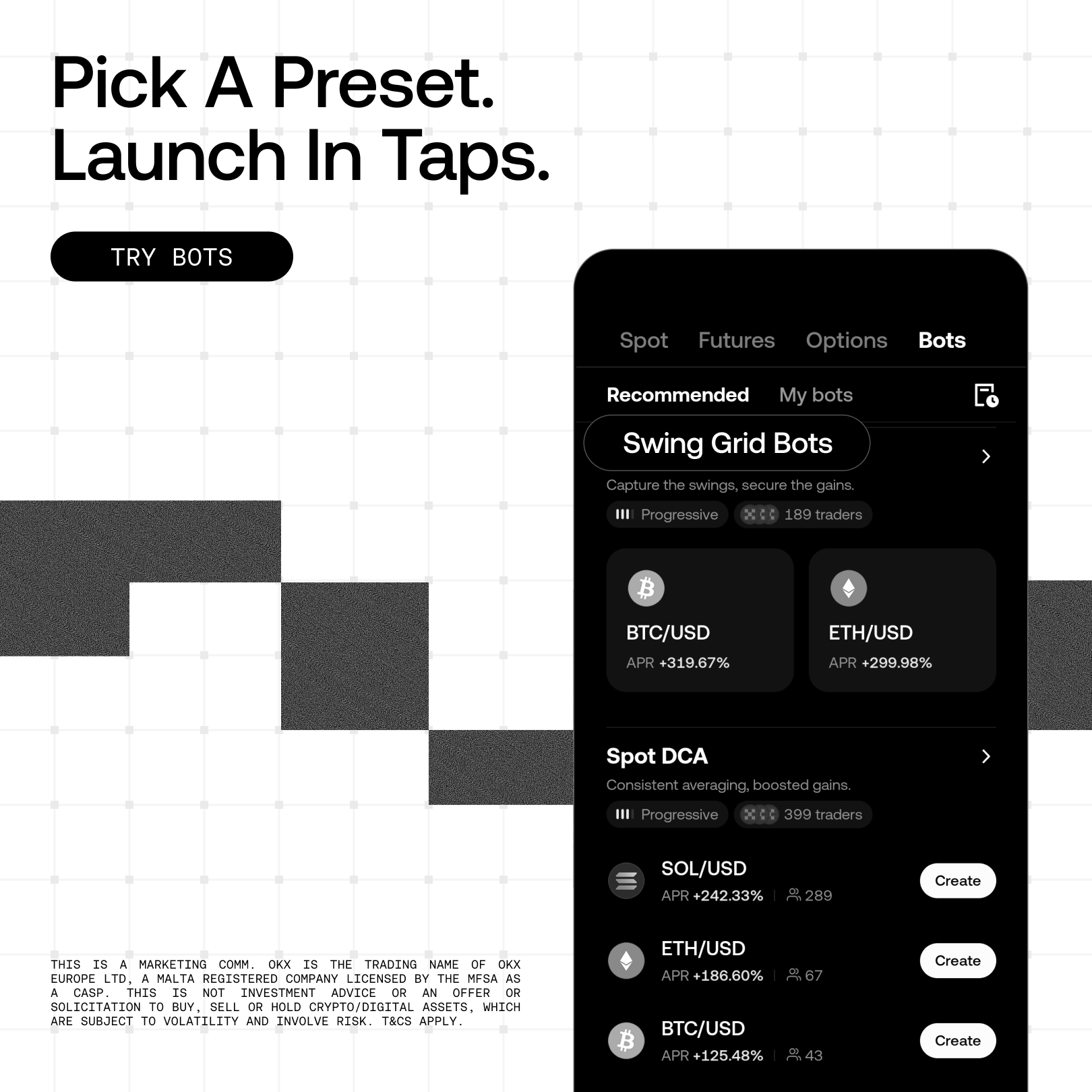
OKX launches new trading bots with ready-made market presets, letting users customise strategies and deploy them in just a few taps
The Exchange's Core Business
At its foundation, OKX provides trading across spot markets for thousands of token pairs and a deep derivatives stack. The exchange is particularly known for its perpetual futures offering — contracts with no expiry that track an underlying asset's price via a funding rate mechanism. This product class, pioneered in crypto by BitMEX, has become the dominant vehicle for leveraged trading in digital assets, and OKX's perpetual markets rival Binance's in depth and liquidity for major pairs.
USDC and USDT serve as the primary settlement currencies across OKX's markets, giving traders access to dollar-denominated exposure without holding fiat in a bank account. This stablecoin-first infrastructure is now standard across tier-1 crypto exchanges but remains a meaningful differentiator for the platform internationally, where dollar banking access is limited.
The exchange charges tiered maker/taker fees, with volume-based discounts and additional reductions for holders of OKB, the native token. This model closely mirrors Binance's BNB discount framework and has become a structural feature of how large exchanges retain high-volume traders.
Readers click OKX stories not to track its product roadmap but to watch the gap between its institutional legitimacy push — NYSE parent investment, Dubai licensing, IPO speculation — and a persistent pattern of compliance failures, security breaches, and regulatory blocks that keep reopening that gap.
Expansion Into Traditional Financial Markets
Perhaps the most significant recent development is OKX's pivot beyond crypto-native products. In 2026, the exchange launched 24/7 trading on US equities, commodities including oil and gold, and extended its X-Perps product line to include futures tied to the Magnificent Seven tech stocks.
The oil futures expansion is particularly notable: OKX partnered with Intercontinental Exchange (ICE) — the parent company of the New York Stock Exchange (NYSE) — to launch perpetual contracts benchmarked to ICE's Brent and WTI crude oil prices. These products give OKX's retail user base access to energy commodity exposure through a regulated benchmark that professionals use in traditional markets. The exchange simultaneously launched X-Perps on gold and European-listed equity indices, broadening the asset class scope further.
Pre-IPO perpetual futures also entered the picture when OKX, alongside Binance, listed SpaceX-linked perpetual contracts ahead of a possible IPO by Elon Musk's space company, according to reporting by the Financial Times. These instruments allow traders to take directional positions on a private company's implied valuation without holding equity — a structurally novel product that blurs the line between public equity markets and crypto derivatives.
Infrastructure: X Layer and Exchange OS
OKX has made substantial investment in its own blockchain infrastructure. X Layer is the company's Ethereum Layer 2 network, built using Polygon's CDK and settling on Ethereum mainnet via ZK-proof validation. The network is designed to provide low-fee, high-throughput execution with native connectivity to OKX's exchange liquidity.
In 2026, OKX launched Exchange OS on X Layer — a framework enabling external developers to deploy their own spot markets, perpetual contracts, and prediction markets using shared liquidity and OKX's matching engine as a foundation. This positions X Layer as an infrastructure layer for the next generation of crypto trading venues, rather than just a settlement chain for OKX's internal products. Projects such as Pharos and Pieverse have already integrated, bringing new asset classes and user flows onto the network.
The Exchange OS launch is strategically analogous to what Binance achieved with BNB Chain: using a proprietary L2 to create a captive ecosystem of dApps that funnel activity back through the parent exchange's liquidity. If successful, X Layer could become a meaningful revenue contributor independent of OKX's centralized exchange business.
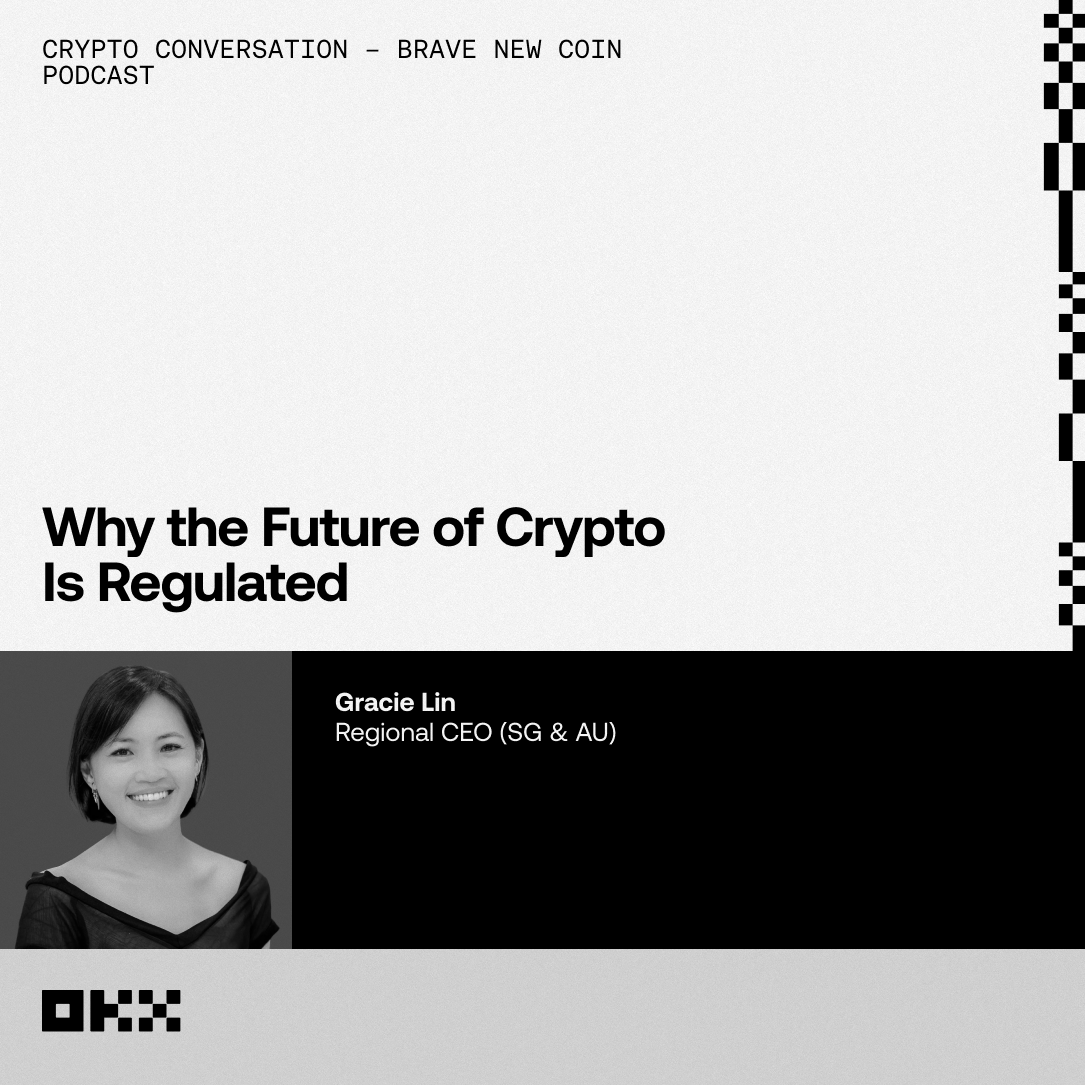
OKX execs discuss regulation, tokenized assets, and stablecoin payments on Brave New Coin podcast
Agent Payments and AI Infrastructure
OKX has moved into the emerging "agentic payments" market — infrastructure that allows AI agents to make autonomous on-chain payments without human authorization at the moment of each transaction. The company's Agent Payments Protocol (APP) went live on X Layer in mid-2026 and attracted early integration partners including Pieverse.
More significantly, OKX was named as one of over 30 partners in Mastercard's Agent Pay initiative, alongside Stripe and Ripple. Mastercard's Agent Pay is designed to allow AI systems to conduct purchases using verified payment credentials, with the exchange's OKX Wallet serving as a Web3-native entry point into this framework.
This is an early-stage market where standards remain unsettled, but OKX's participation alongside traditional financial infrastructure firms signals a deliberate effort to position the company at the intersection of crypto and AI-native commerce.
- 01wallet security and user exploits
Two distinct attack vectors — StilachiRAT malware targeting the OKX Wallet extension and identity-theft account drains — made readers confront that exchange-adjacent wallets carry layered exposure beyond smart-contract risk.
- 02X Layer L2 expansion
The rumor-to-mainnet arc of OKX's ZK rollup, and Aave's subsequent deployment on it, gave readers a concrete on-chain destination to evaluate rather than abstract exchange news.
- 03regulatory blocks and fines
A cascade of enforcement actions — Vietnam and Thailand blocks, Netherlands fine, and an $84M DOJ penalty via an OKX affiliate — framed OKX as the clearest live test of whether a top-five exchange can globalise without regulatory attrition.
- 04IPO valuation and institutional backing
NYSE parent ICE's investment at a $25B valuation, followed immediately by OKX shelving the IPO citing Coinbase's post-listing decline, created an unresolved narrative readers tracked for signals about the broader exchange-listing playbook.
- 05illicit flow and compliance exposure
Being named alongside Binance in a $28B illicit-fund flow report, combined with the DOJ-linked USDT freeze, put OKX's compliance posture under scrutiny in a way that directly implicates token holders and counterparties.
- 06founder drama and leadership credibility
Star Xu's public feud with CZ over a decade-old contract forgery allegation, reignited by CZ's memoir, pulled readers into exchange-founder credibility as a risk factor distinct from the product itself.
Geographic Strategy: Korea and Southeast Asia
OKX has pursued an active investment strategy in regulated regional markets. In 2026, OKX Ventures — the company's investment arm — acquired a $53 million stake representing approximately 20% of Coinone, one of South Korea's largest licensed crypto exchanges. The move mirrors Binance's earlier acquisition of a stake in Gopax, South Korea's smaller licensed exchange, and is a direct response to South Korea's restrictive licensing regime, which effectively prevents foreign exchanges from operating directly in the country.
South Korea is one of the world's most active retail crypto trading markets by volume, with domestic exchanges like Upbit and Bithumb processing volumes that rival global platforms. By acquiring a minority stake in Coinone — rather than pursuing a full acquisition, which would face greater regulatory scrutiny — OKX gains distribution access and strategic optionality in a market that has been largely closed to offshore platforms.
In Southeast Asia, OKX launched its OKX Card in Singapore in partnership with StraitsX, a licensed stablecoin issuer in the region. The card uses Visa's network, is issued by StraitsX, and allows users to spend directly from stablecoin balances at the approximately 175 million merchants worldwide that accept Visa. This follows similar stablecoin-linked card products from Crypto.com and Coinbase and represents OKX's effort to convert exchange balances into daily spending utility.
Regulatory Positioning and MiCA
In Europe, OKX has actively positioned itself around the EU's Markets in Crypto-Assets Regulation (MiCA), which came fully into force in 2026. The company has argued publicly that MiCA-regulated exchanges offer materially stronger protections for users than unregulated venues — specifically citing requirements for asset segregation, licensed custody, and clear legal recourse in the event of exchange insolvency.
This is partly competitive messaging aimed at redirecting European users away from platforms that lack MiCA authorization, but the underlying claims reflect genuine structural differences in how MiCA-compliant exchanges must hold client assets. OKX holds relevant EU licenses and has made compliance infrastructure a selling point in its European marketing.
OKX says security is a full-time job, with Hacken, SlowMist and CertiK conducting regular system checks throughout the year
Reputation and Conduct
OKX's public profile has not been without friction. At the Consensus Miami conference in 2026, the company attracted criticism after its sponsorship became associated with a controversial pole-dancing event at the E11EVEN venue. OKX subsequently reviewed its involvement with that sponsorship, and the episode drew commentary about conduct standards at industry events.
The exchange also operated for years under a cloud related to its history as OKEx, when in 2020 the platform halted all withdrawals for approximately a month after it emerged that a key holder was cooperating with Chinese authorities — an event that remains a reference point in discussions about the risks of centralized exchange custody.
- 2022-01milestone
OKEx rebrands to OKX
- 2023-06regulatory
OKX obtains Dubai VARA VASP licence
- 2023-09milestone
Okcoin absorbed into OKX brand
- 2024-04launch
X Layer ZK rollup launches on mainnet
- 2024-02regulatory
Aux Cayes FinTech pays $84M DOJ penalty for unlicensed money transmission
- 2024-06exploit
OKX confirms account drains via forged judicial identity theft
- 2025-03exploit
Microsoft discloses StilachiRAT targeting OKX Wallet extension
- 2025-06milestone
NYSE parent ICE invests in OKX at $25B valuation; IPO shelved
How OKX Compares to Binance
The most natural competitive comparison is Binance, the world's largest crypto exchange by volume. The two platforms overlap heavily in product offering — spot, perpetuals, options, staking, a native L2 — and compete directly for the same international retail and institutional client base.
OKX has historically differentiated on derivatives sophistication, with a more advanced options interface and a professional trading API that attracts quantitative traders. Binance has a larger retail footprint and a more developed DeFi ecosystem via BNB Chain. The gap in total trading volume has narrowed in recent years as Binance navigated its own regulatory challenges, including the 2023 settlement with the US Department of Justice that resulted in Changpeng Zhao's resignation and a $4.3 billion penalty.
OKX, for its part, has pursued US market access more carefully, operating a separate OKX US entity with a restricted product set for American users. The company's broader international platform remains offshore for US persons.
Tokenomics: OKB
OKB is the exchange's native utility token, used for trading fee discounts, participation in token launches on OKX's Jumpstart platform, and governance participation within the X Layer ecosystem. The token has a deflationary mechanism involving periodic buybacks and burns, funded by a share of exchange revenue — a model originally popularized by Binance with BNB.
OKB's price is correlated with OKX's exchange revenue and the broader crypto market cycle, as is the case with most exchange tokens. It does not grant holders equity or profit-sharing rights in OKX Technology Company Limited itself.
Outlook
OKX is executing a clear strategic thesis: transform from a crypto-native exchange into a full-spectrum financial platform capable of serving both retail traders and institutional participants across digital assets, commodities, and eventually equities. The ICE oil futures partnership and the Mastercard Agent Pay integration suggest the company sees its long-term competitive position as a regulated, multi-asset trading and payments infrastructure provider — not merely a crypto exchange.
Whether that vision succeeds depends on execution across several fronts simultaneously: deepening X Layer's developer ecosystem, expanding licensed geographic footprint in high-value markets like South Korea and Europe, maintaining derivatives market share against Binance and Bybit, and building credibility with regulators in jurisdictions where crypto oversight is tightening. The company's investment pace and the breadth of its 2025-2026 partnership announcements indicate the resources and intent are present; the harder question is whether fragmented expansion across too many verticals dilutes focus at a moment when the competitive landscape is consolidating around a small number of dominant platforms.
Latest OKX news
OKX launches new trading bots with ready-made market presets, letting users customise strategies and deploy them in just a few tapsOKX execs discuss regulation, tokenized assets, and stablecoin payments on Brave New Coin podcastOKX says security is a full-time job, with Hacken, SlowMist and CertiK conducting regular system checks throughout the year OKX launches Shield across Europe with payback protection up to €100,000, or €500,000 for VIPs
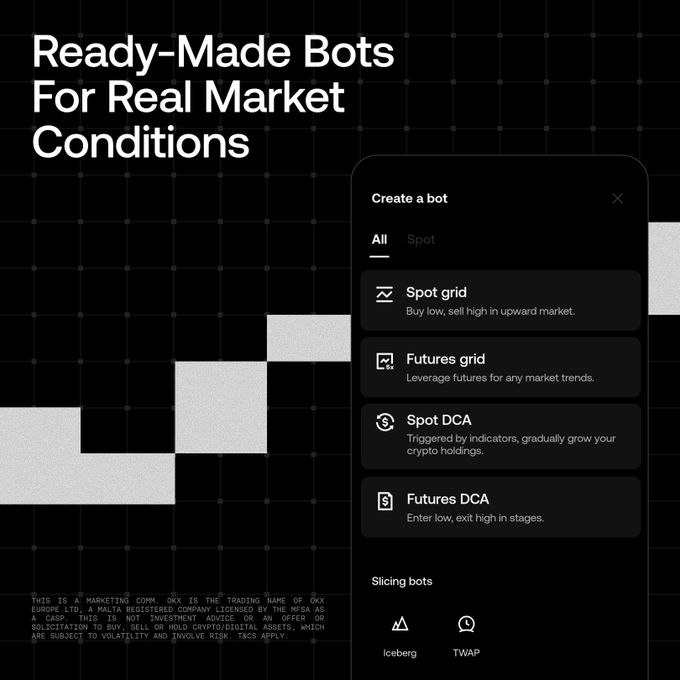 OKX says its trading bots are ready for the next market move, offering 24/7 automation
 Paxos launches PAXGy, bringing tokenized gold lending onchain via OKX, Uniswap, X Layer, 0x and ether.fi
Community notes
Spot something off or out of date? Drop a note. Editors review topic notes daily and roll accepted fixes into the explainer — contributors are recognized in the monthly $SQUID drop.
Loading notes…
Help improve this topic
Have a story or tip about this topic? Submit it. See something missing? Leave a note. Editors review daily; accepted submissions and fixes count toward the monthly $SQUID drop.