
The NYSE and its electronic venue NYSE Arca are central to crypto's institutionalization, serving as the listing hub for Bitcoin ETFs, active crypto funds, and tokenized securities while parent ICE explores on-chain perps markets.
+24 sources across the wider coverage universe
 Tom Lee’s Bitmine uplists to NYSE, revealing 4.8M ETH holdings and expanding share buyback program to $4B in a major crypto-linked corporate treasury move2026-04
 Avalanche gains Wall Street access as Bitwise Asset Management lists AVAX ETF on NYSE, unlocking institutional exposure and staking yields2026-04
 Benchmark says just 0.01% of NYSE’s $44T market could significantly scale Securitize, highlighting massive upside for tokenized assets as institutional adoption grows2026-04
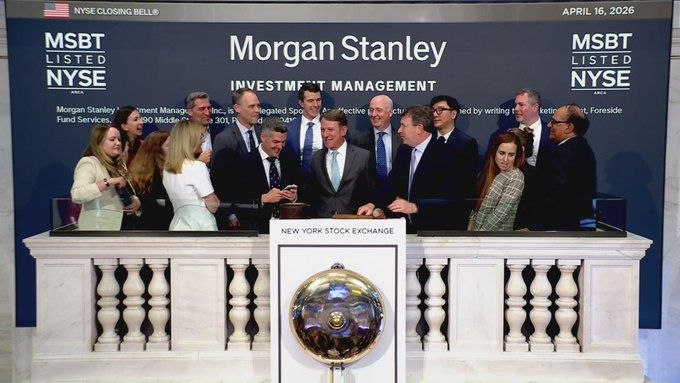 NYSE welcomes Morgan Stanley Investment Management to launch $MSBT, the first spot Bitcoin ETF from a major U.S. bank, marking a milestone in institutional crypto adoption2026-04
 Tether Leads $134M Raise for NYSE-Listed Stablecoin Development Corp Alongside Framework Ventures2026-04
 Morgan Stanley launches staking-enabled ether and Solana ETPs on NYSE Arca with 0.14% fees2026-07
The New York Stock Exchange (NYSE) is the world's largest equities exchange by market capitalization, and it has become an increasingly central venue for the institutionalization of digital assets — from crypto ETF listings to tokenization pilots and partnerships with on-chain trading platforms.
What the NYSE Is and How It Works
Founded in 1792 under a buttonwood tree on Wall Street, the NYSE today operates as part of Intercontinental Exchange (ICE), the Atlanta-based infrastructure conglomerate that acquired it in 2013. The exchange lists roughly 2,400 companies, processes trillions of dollars in daily volume, and sets listing standards that function as a de facto quality benchmark for global capital markets.
The NYSE is not a single market but a family of venues. NYSE Arca — the fully electronic platform spun out of a 2006 merger with the Pacific Exchange — has become the primary listing venue for exchange-traded products (ETPs) including ETFs. Most of the crypto-linked funds now reaching U.S. investors land on NYSE Arca rather than the parent exchange's main floor.
Governance matters here: the NYSE is a self-regulatory organization (SRO), meaning it proposes its own listing rules to the Securities and Exchange Commission, which reviews and approves or rejects them. Every new crypto ETF launch requires a formal rule-change filing, a public comment period, and an SEC order — a process that has shaped the timeline and structure of nearly every digital asset fund approved in the United States.

Blockchain.com partners with NYSE to offer 24/7 access to tokenized U.S. equities and ETFs

NYSE Arca as the Gateway for Crypto ETFs
The approval architecture for crypto ETFs runs through NYSE Arca more than any other U.S. exchange. When the SEC approved spot Bitcoin ETFs in January 2024, the majority of those products — including offerings from BlackRock, Fidelity, and Grayscale — listed on NYSE Arca under Rule 8.201-E, the "Generic Commodity-Based Trust Shares" rule designed for commodity-linked products.
Grayscale's conversion of its Bitcoin Trust (GBTC) to a spot ETF was one of the highest-profile listings, unlocking billions in assets that had previously traded at steep discounts in a closed-end structure. That conversion required its own rule-change approval and set a template for other Grayscale products seeking similar paths.
The pipeline has not stopped. In mid-2025, the SEC granted approval of a proposed rule change — modified through Amendment No. 2 — to list and trade shares of the T. Rowe Price Active Crypto ETF under NYSE Arca Rule 8.201-E. The T. Rowe Price product is notable for being actively managed rather than passively tracking a single asset, reflecting the market's evolution beyond simple spot Bitcoin or Ether exposure. Active crypto funds give portfolio managers discretion to allocate across digital assets, adjust hedges, and respond to market conditions — a structure that appeals to institutional investors who want professional oversight alongside crypto exposure.
Separately, the SEC has opened public comment on an NYSE Arca proposal that would require 85% of a crypto ETF's assets to meet its existing listing standards — a significant structural rule that signals the agency is working toward cleaner definitional guardrails under its current leadership. If adopted, it would affect how product issuers construct future crypto funds and which underlying assets can anchor new ETFs.
Beyond crypto, NYSE Arca's willingness to fast-track rule changes for commodity-linked products — including a recent move opening new opportunities in the United States Copper Index Fund — illustrates how the exchange's regulatory machinery functions as the plumbing beneath a broad range of asset-backed investment products, not just digital assets.
Readers click NYSE/crypto headlines not for market mechanics but for institutional capture signals — the pattern reveals fascination with whether legacy exchange infrastructure (ICE, NYSE Arca, DTCC) is absorbing crypto or being absorbed by it, with ETF approvals and ICE's direct equity bets serving as the scoreboard.
ICE's Strategic Posture on Crypto and DeFi
ICE, NYSE's parent company, has positioned itself as a traditional markets incumbent willing to engage with decentralized finance rather than simply compete against it. CEO Jeffrey Sprecher has been unusually candid: ICE held multiple direct talks with Hyperliquid, the on-chain perpetual futures platform, to evaluate its model. Sprecher has simultaneously lobbied regulators for equal access to the booming on-chain perps market, arguing that U.S. exchanges should be able to compete with offshore and decentralized venues on a level regulatory playing field.
The talks with Hyperliquid were exploratory — Sprecher described the company's approach as learning from, rather than being "freaked out" by, on-chain competitors. This represents a notable shift in tone from traditional exchange executives, who for years treated DeFi as a compliance problem rather than a structural challenge worth understanding. Bitwise has since launched a Hyperliquid ETF (ticker: BHYP) on NYSE, which began trading in mid-2025 and became the first U.S. fund to offer HYPE staking rewards, further bridging regulated markets and on-chain infrastructure.
ICE also partnered with OKX, the global crypto exchange with over 120 million users, to launch Brent and WTI crude oil perpetual futures on OKX's platform in licensed markets. The partnership gives OKX's user base access to ICE's benchmark energy pricing in a derivatives format familiar to crypto traders, while giving ICE a distribution channel into a massive crypto-native audience. It is an early model for what "convergence" between traditional and crypto market infrastructure might look like in practice: regulated benchmarks, crypto-native delivery mechanisms.
Tokenization: NYSE's Emerging Frontier
One of the more consequential long-term developments is NYSE's direct involvement in securities tokenization. The exchange has run pilots of tokenized securities — representing traditional equity or debt instruments as blockchain-based tokens — alongside DTCC (Depository Trust & Clearing Corporation), which has been advancing its own tokenization services in parallel.
Tokenization of securities promises to reduce settlement times, lower friction in secondary markets, and open access to a broader class of investors. But it also introduces new complications. NYSE's own tokenization partners have issued pointed warnings about synthetic stock tokens — products offered on offshore or DeFi platforms that claim to represent U.S. equities but lack direct backing, carry no regulatory authorization, and may use NYSE or company branding without permission. Executives from NYSE, OKX, and Securitize jointly spotlighted these risks at a 2025 industry event, framing genuine tokenization (backed, regulated, on licensed infrastructure) against exploitative imitations that could mislead retail traders.
Securitize, one of the leading regulated platforms for tokenized real-world assets (RWAs), cleared a major SEC hurdle in mid-2025 for its SPAC merger with Cantor Equity Partners II. The deal is set to bring Securitize to the NYSE under ticker SECZ — a significant moment because it would make a major tokenization infrastructure company directly listed and therefore subject to the full disclosure regime of U.S. public markets. The SEC approval was notable given regulatory questions around the SPAC structure and Securitize's business model, suggesting growing comfort from regulators with at least some corners of the RWA sector.
Separately, NYSE-listed Bullish — itself a crypto exchange that went public via a SPAC — allocated treasury assets to Solstice's eUSX yield instrument on Solana, as that protocol crossed $400 million in total value locked (TVL). NYSE-listed companies making on-chain allocations illustrates how the boundary between "listed company" and "crypto participant" is eroding from both directions.
- 01Crypto ETF approvals pipeline
Multiple high-click headlines around Grayscale, Bitwise, and Teucrium filings show readers tracking which assets NYSE Arca will greenlight next as a proxy for institutional legitimacy.
- 02ICE strategic crypto bets
NYSE parent ICE investing in Polymarket, OKX, and pursuing Hyperliquid talks signals to readers that the exchange owner is picking onchain winners rather than waiting for regulation.
- 03Crypto IPOs listing on NYSE
BitGo, Circle, Bullish, and Securitize IPO headlines drew consistent clicks as readers treat NYSE listings as a legitimacy threshold for crypto infrastructure firms.
- 04Tokenized markets infrastructure
DTCC, NYSE, and Tradeweb rolling out tokenized settlement drew readers who see 24/7 onchain clearing as the structural shift that makes crypto rails irreversible in TradFi.
- 05ETF options limits and rule changes
Headlines on removing the 25,000-contract cap and SEC greenlighting multi-crypto trust options show readers following derivative market depth as the next maturation signal.
- 06Bakkt delisting and survival risk
CEO replacement and NYSE delisting threat on a NYSE-backed crypto exchange exposed the gap between institutional parentage and operational viability.
Bitcoin ETF Flows and Market Signals
The NYSE ecosystem has become one of the primary instruments through which institutional Bitcoin demand expresses itself — and the flow data from listed funds functions as a real-time sentiment gauge for the broader market.
In one closely watched period, analysts on NYSE's "Public Keys" program — its crypto market commentary series — broke down $1.7 billion in Bitcoin ETF outflows, a figure that rattled short-term sentiment but was contextualized by market watchers as a rotation rather than a structural exit. The same program hosted analysis of the first U.S. spot BNB ETF launch, and coverage of MicroStrategy (now rebranded as Strategy, ticker MSTR), whose Bitcoin holdings make it effectively a leveraged proxy for BTC price movements. Analyst commentary suggested MSTR remained attractive to certain investors even after significant selloffs — a framing that reflects how NYSE-listed Bitcoin-adjacent equities have become a distinct asset class within portfolio construction.
Flow aggregators tracking NYSE Arca-listed spot Bitcoin ETFs provide some of the most visible real-time data on institutional sentiment in crypto markets, with daily inflow/outflow figures widely cited in financial media as indicators of near-term institutional appetite.
Regulatory Mechanics: Rule Changes, Comment Periods, and Fee Scrutiny
The NYSE's role as an SRO means that every product expansion requires public documentation. Rule-change filings for new ETFs or listing standards are published in the Federal Register, open to public comment, and result in formal SEC orders — creating a paper trail that makes NYSE Arca one of the most legible venues in financial markets for tracking the pace of crypto product development.
Recent rule-change activity has not been limited to new products. NYSE has also proposed price list changes amid ongoing regulatory scrutiny and market risk concerns — reflecting broader pressure on exchanges to justify their fee structures as alternative trading systems and crypto venues compete for order flow.
For crypto market participants, watching the NYSE Arca rule-change docket has become a form of regulatory intelligence. Filings often precede product launches by months, and the content of amendments — like the T. Rowe Price active management structure or the 85% asset composition proposal — reveals both what issuers are attempting and where regulators are drawing new lines.
- 2024-01milestone
Grayscale GBTC uplisted on NYSE Arca
- 2024-11regulatory
NYSE Arca files to allow Bitcoin and Ethereum ETF options
- 2025-02launch
Teucrium 2x leveraged XRP ETF (XXRP) debuts on NYSE
- 2025-06regulatory
Grayscale files for Solana ETF with NYSE Arca
- 2025-10regulatory
SEC greenlights NYSE Arca for multi-crypto trust options without case-by-case approval
- 2025-12milestone
ICE invests $2B in Polymarket at $9B valuation
- 2026-01launch
BitGo prices NYSE IPO at $18, first crypto listing of 2026
- 2026-06launch
NYSE enlists Securitize for 24/7 tokenized securities platform
How NYSE Relates to Crypto Markets Broadly
The NYSE's increasing engagement with digital assets is not incidental. It reflects several structural shifts:
1. Institutional demand channels: Pension funds, sovereign wealth funds, and registered investment advisers that cannot hold crypto directly can access it through NYSE-listed ETFs. The listing infrastructure provides the compliance wrapper these allocators require.
2. Regulatory legitimacy feedback loop: NYSE listing confers a form of legitimacy. A crypto-adjacent company that achieves a NYSE listing — like Securitize under SECZ, or Bullish, or Coinbase on Nasdaq — gains access to institutional capital, index inclusion, and analyst coverage that materially affects its trajectory.
3. Benchmark and data infrastructure: ICE's underlying data businesses — including its work on commodity benchmarks and derivatives pricing — feed directly into crypto-linked products. The OKX oil perps deal is an example of how traditional price discovery infrastructure can be extended into new markets.
4. Competitive pressure from on-chain venues: Hyperliquid's rise, and ICE's decision to study it seriously, signals that exchanges can no longer assume their monopoly on derivatives pricing and liquidity is permanent. The question is whether traditional exchanges adapt their regulatory access advantages into on-chain infrastructure, or whether they simply serve as on-ramps for investors who want indirect exposure.
Outlook
The NYSE's trajectory in crypto is one of deliberate, regulation-compliant expansion rather than disruption. NYSE Arca will continue to be the primary listing venue for new U.S. crypto ETFs as issuers push into altcoins, active strategies, and staking-enabled structures. ICE's engagement with on-chain platforms like Hyperliquid and OKX suggests the parent company is mapping the competitive landscape carefully rather than dismissing it. The Securitize SPAC listing and NYSE's tokenization pilots point toward a medium-term future where the boundary between listed securities and blockchain-native instruments narrows further. For crypto market participants, NYSE is no longer a distant legacy institution — it is increasingly the regulated infrastructure layer through which digital assets enter mainstream portfolios.
Latest NYSE news
Community notes
Spot something off or out of date? Drop a note. Editors review topic notes daily and roll accepted fixes into the explainer — contributors are recognized in the monthly $SQUID drop.
Loading notes…
Help improve this topic
Have a story or tip about this topic? Submit it. See something missing? Leave a note. Editors review daily; accepted submissions and fixes count toward the monthly $SQUID drop.