
Deep explainer on THORChain, a Cosmos-based cross-chain DEX for native BTC and other assets, covering its architecture, RUNE/TCY tokenomics, Monero integration, recent TSS exploit and recovery, security model, regulatory risks, and long-term outlook.
+9 sources across the wider coverage universe
 THORChain pushes native Monero swaps for v3.18 and drafts dynamic fees to reclaim volume lost to aggregators2026-04
 THORChain says recovery is in final stages as KeyVerify checks keyshares before vault churn2026-06
 THORChain traces $10M May 15 vault drain to GG20 zero-day after 864 failed signing rounds2026-07
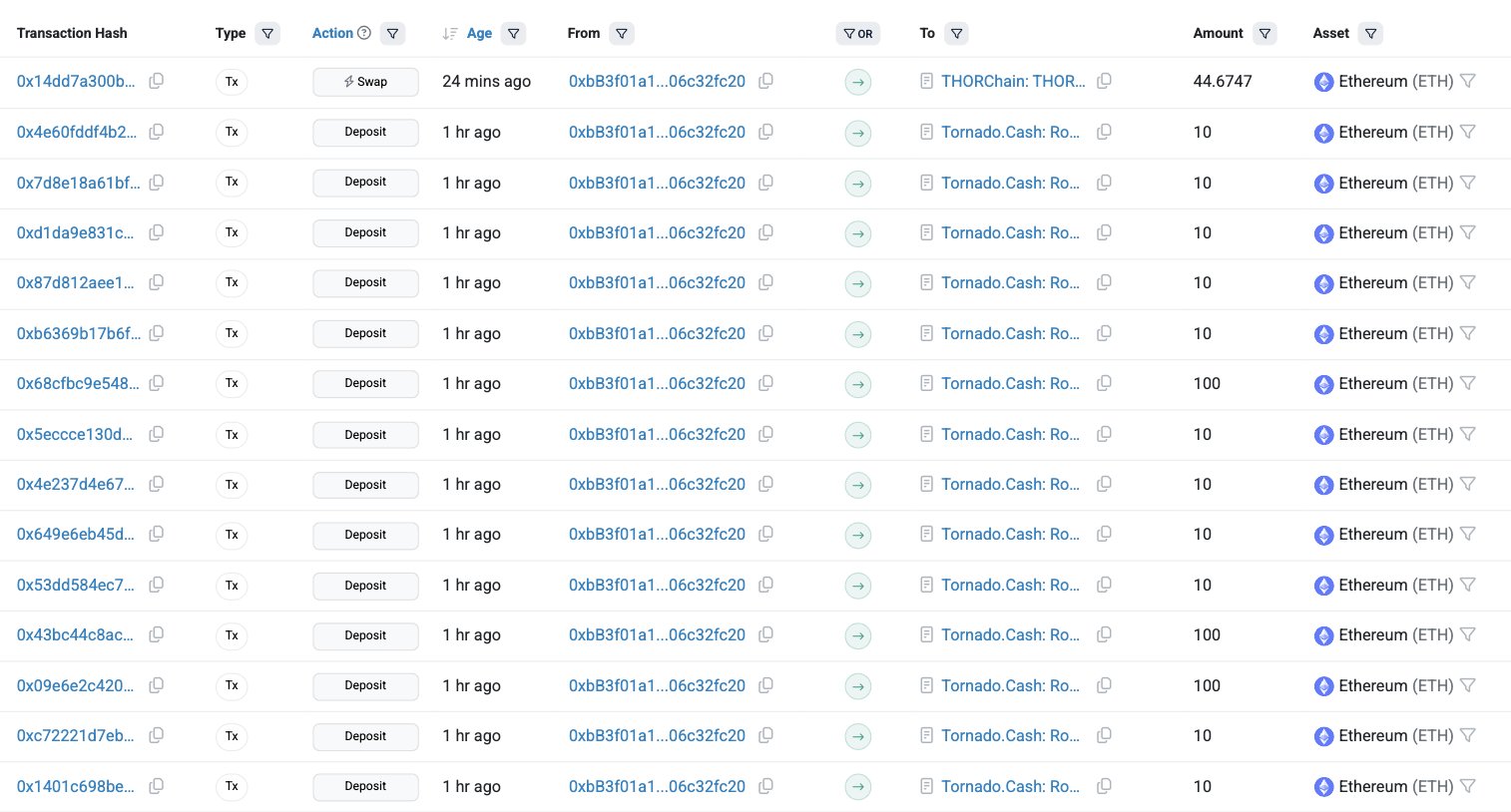 Hinkal exploited for $820K as attacker routes 410 ETH through Tornado Cash and 44.7 ETH via THORChain2026-07
 THORChain resumes trading after a five-week shutdown caused by a $10.7M exploit, restoring swaps, liquidity operations, and cross-chain functionality2026-06
 THORChain halts trading after compromised Asgard vault drains estimated $10.7M from protocol funds2026-05
THORChain: Cross-Chain Liquidity Without Wrapped Tokens
A cross-chain liquidity protocol built as its own layer 1 blockchain, THORChain enables users to swap native assets like Bitcoin, Ethereum, and Monero directly between chains without custodians, wrapped tokens, or KYC. It operates as a decentralized exchange (DEX) focused on Bitcoin and other major assets, using its native token RUNE as the settlement asset at the core of every pool.
THORChain sits at the intersection of some of crypto’s most contentious frontiers: non-custodial Bitcoin trading, cross-chain interoperability, privacy-centric assets like Monero, and the search for “real yield” in decentralized finance. It attempts to solve the long-standing problem of moving value between blockchains without centralized exchanges or synthetic representations, using a network of validators who collectively control cross-chain vaults via threshold signature schemes. Recent years have seen the protocol expand its asset support, integrate stablecoins like Noble USDC, and push toward new chains such as Solana, even as it navigates serious security incidents and regulatory scrutiny. The May 2026 exploit, traced to a vulnerability in THORChain’s GG20 threshold signing implementation and allegedly executed by a newly churned node operator, forced a full network halt, a treasury-backed recovery plan, and a major security overhaul centered on new verification tools and vault churn. At the same time, the launch of native Monero support and a deflationary RUNE supply model, reinforced by large-scale token burns and protocol-owned liquidity, have given supporters fresh narratives around privacy, sound tokenomics, and sustainable revenue sharing. Understanding THORChain today therefore means understanding not just how its cross-chain machinery works in theory, but also how it has responded in practice to operational stress tests, exploits, and regulatory headwinds.
The Problem THORChain Tries To Solve
Cross-chain liquidity and the limits of wrapped tokens
Interoperability has always been one of the hardest problems in crypto. Bitcoin, Ethereum, and newer chains like Solana or Avalanche were designed as self-contained systems with their own consensus, address formats, and transaction rules, making direct asset transfers between them impossible without some intermediary. The most common workaround has been centralized exchanges and wrapped assets, where a custodian holds native coins and issues synthetic representations on a different chain, such as wrapped BTC on Ethereum. While this approach has enabled cross-chain activity, it reintroduces counterparty risk and creates single points of failure, as seen in the collapses and hacks of various custodial platforms and bridge services across the last cycle.
Wrappers and conventional bridges also introduce complex trust assumptions. Users often rely on multisig federations or opaque third parties to guarantee redeemability of their wrapped tokens, and history shows that these arrangements frequently fail under stress. From a design perspective, these systems move crypto away from its trust-minimized roots and toward a model where users are essentially depositing into shadow banks. For Bitcoin in particular, this is problematic: many users hold BTC precisely to avoid custodial risk and regulatory chokepoints, making the idea of depositing into a centralized bridge or exchange to move value between chains somewhat self-defeating.
THORChain emerges directly from this context. Rather than wrapping assets, it aims to build a non-custodial, on-chain foreign-exchange desk for crypto, letting users swap native BTC for native assets on other chains in a single transaction routed through THORChain’s liquidity pools. The protocol’s goal is that at no point should users have to trust a centralized party, rely on IOUs, or relinquish self-custody beyond the time it takes for a transaction to be finalized. The chain itself, plus its validator set and economic incentives, are designed to stand in for both the centralized order book and the bridging infrastructure that historically mediated cross-chain flows.
From experimental Chaosnet to a Bitcoin-focused DEX
THORChain’s early years were centered around what contributors called “Chaosnet,” an extended multichain testnet/mainnet hybrid intended to harden the protocol under real usage before branding it as full mainnet. During this period, the project iteratively expanded support from a few chains to a broader network of major L1s, refined its vault design, and gradually raised caps on liquidity and transaction sizes. Community communications have emphasized that the switch from Chaosnet to mainnet was more of a maturity milestone than a radical technical change; the underlying architecture and economic model evolved continuously rather than flipping overnight.
From the outset, however, one theme has been consistent: priority for native Bitcoin. THORChain’s official materials describe it as the “world’s largest decentralized exchange for trading Bitcoin,” positioning the protocol as an alternative to centralized BTC markets. The network’s architecture assumes that Bitcoin liquidity will act as a central hub asset, paired with RUNE and used as a route to other chains. Over time, support has expanded to numerous L1s, including Ethereum, BNB Chain, Avalanche, Cosmos Hub, Dogecoin, Litecoin, Bitcoin Cash, and new entrants like Base and TRON, creating a broad matrix of native swap routes built around RUNE.
The push toward privacy coins and additional high-throughput chains further underscores THORChain’s ambition. Monero integration adds a unique, and controversial, dimension by enabling direct BTC–XMR swaps without centralized intermediaries, while planned Solana and XRP support aim to cover key ecosystems that previously required centralized bridges or exchanges. The result is a protocol that increasingly aspires to act as a cross-chain liquidity utility for the broader ecosystem, even as its reliance on complex validator coordination and secure key management introduces its own operational risks.

THORChain asks what responsibility Bitcoin, Ethereum, and BNB Chain bear for stolen funds

Core Architecture: How THORChain Works
A Cosmos-based layer 1 with cross-chain connectivity
Architecturally, THORChain is a sovereign layer 1 blockchain built with the Cosmos SDK and using the CometBFT (formerly Tendermint) consensus engine. This means it has its own validator set, block production, and governance processes, rather than being a smart contract application on another chain like Ethereum. Validators stake RUNE, participate in Byzantine fault-tolerant consensus, and collectively control the protocol’s cross-chain vaults via threshold cryptography. The choice of Cosmos provides modularity and fast finality, while also enabling interoperation with other Cosmos-based systems via IBC and related tooling, though THORChain’s primary focus remains on non-Cosmos chains such as Bitcoin and Ethereum.
Cross-chain connectivity is achieved through a combination of “observer” and “signer” logic embedded in validators. Nodes watch connected chains for inbound transactions to THORChain-controlled addresses, interpret these as swap or liquidity operations once confirmed, and then collectively sign outbound transactions on the target chain to complete the operation. This design avoids traditional bridge architectures where a separate relayer network or off-chain federation mediates transfers; instead, the same validator set that runs the chain also manages cross-chain accounting. In effect, THORChain’s consensus layer doubles as a multi-chain coordination engine, reconciling balances across Bitcoin, EVM chains, and others within the chain’s own state machine.
Because THORChain is a DEX at the protocol level, rather than a smart contract front-end, swaps are deeply integrated into its state transitions. When a user sends BTC to a THORChain vault address with appropriate memo data, the chain credits the user with an equivalent claim on RUNE or a target asset in an internal liquidity pool, applies pricing and fee logic based on pool depth and slip, and then queues an outbound transaction to the destination chain. The entire process is governed by deterministic logic in the chain’s code, subject to consensus, which supporters argue reduces surface area for ad hoc custodial behavior compared to centralized exchange operations.
RUNE as settlement asset and pool design
At the heart of THORChain’s design is RUNE, the protocol’s native asset. Every liquidity pool on THORChain is structured as an asset–RUNE pair, meaning that to support a new chain or token, liquidity providers must deposit equal value in the external asset and in RUNE. This architecture gives RUNE three intertwined roles: it acts as the settlement asset connecting every pool, as the staking asset that validators bond, and as the unit in which protocol fees and incentives are denominated. Economically, the design aims to tie the value of RUNE to the value of assets secured and traded by the network: as more external assets are pooled and more volume flows through the protocol, demand for RUNE as bond and liquidity is expected to increase.
Swaps are priced using an automated market maker model similar in spirit to constant-product AMMs, with modifications to account for slip and multi-hop routing. When a user trades BTC for ETH, for example, the protocol actually performs two swaps under the hood: a BTC–RUNE swap and a RUNE–ETH swap, using RUNE as the routing asset. This double-hop structure means RUNE volume scales with overall protocol usage, reinforcing its centrality. To mitigate excessive price impact on large trades, THORChain charges slip-based fees that rise with trade size relative to pool depth, both compensating liquidity providers and discouraging pathological trades that would exhaust pools.
Recent protocol upgrades have refined this fee system. The v3.18 release introduced a dynamic framework that automatically adjusts minimum layer 1 slip fees based on real network activity and revenue, rather than relying on static parameters. This mechanism aims to balance user costs, protocol income, and liquidity provider incentives across varying market conditions. Higher demand and congestion can trigger higher minimum fees, protecting the protocol from underpricing block space or validator effort, while quieter periods can see fees drift down, supporting competitiveness against centralized exchanges and other DEXs.
Vaults, TSS, and the evolution of key management
THORChain’s most distinctive component is its vault architecture. To hold assets on connected chains, the protocol uses special addresses controlled collectively by validators through threshold signature schemes (TSS). Historically, there were two main vault types: Asgard vaults, which were “cold” multisig-style vaults controlled via TSS and used primarily for holding pooled funds, and Yggdrasil vaults, which were “hot” per-node vaults with simpler 1-of-1 control used for fast outbound transactions. In this design, Asgard vaults functioned as the primary reserve, analogous to a secure warehouse truck, while Yggdrasil vaults were like smaller, nimble vehicles used to handle day-to-day swaps quickly.
Security constraints limited how much liquidity could sit in Yggdrasil vaults at any given time. Educational materials from the project emphasized that, in aggregate, Yggdrasil vaults could not hold more than around half of total funds, with a typical target closer to one quarter, leaving the majority in more secure Asgard vaults. This partitioning attempted to balance security against user experience: hot vaults enabled faster outbound transactions without having to move large sums from cold storage constantly, but they also concentrated risk in individual nodes that directly controlled their Yggdrasil addresses.
Over time, THORChain’s architects concluded that the complexity and risk of 1-of-1 hot vaults were not worth the performance gains. An architecture decision record, ADR 002, outlined a plan to remove Yggdrasil vaults and rely instead on Asgard vaults for both inbound and outbound flows, with TSS providing multi-party control in all cases. By collapsing to a single vault model, the protocol reduces the chance that a single compromised node can unilaterally move funds, albeit at the cost of more careful optimization around outbound transaction throughput. This shift sets the stage for the protocol’s later focus on improving TSS implementations and implementing tools like KeyVerify to ensure that validator key shares remain intact and correctly configured.
The TSS layer itself is central to THORChain’s threat model. Validators jointly generate and hold key shares for each Asgard vault using threshold schemes so that a fixed quorum is required to sign transactions on external chains. The protocol’s continuous “churn” process periodically rotates the validator set and, by extension, the vault keys, reducing the window in which any specific group of nodes controls a given address. In theory, an attacker would need to corrupt a large subset of validators within a churn interval to steal funds, and misbehavior can be penalized by slashing bonded RUNE and confiscating node collateral. In practice, as the May 2026 exploit showed, vulnerabilities in TSS implementations or misconfigurations in key generation can create systemic attack vectors even when economic incentives are aligned.
Swaps, settlement, and fee flows
From a user perspective, THORChain attempts to abstract away most of this complexity. A typical swap begins with the user sending an asset, such as BTC, to a THORChain-controlled address with a memo field specifying the desired target asset and recipient. Once the inbound transaction has sufficient confirmations on its native chain, validators recognize it as a valid inbound transaction, and the protocol credits the sender within its internal accounting system. A corresponding outbound transaction is then queued from the relevant vault on the target chain, signed via TSS, and broadcast. The user experiences the operation as a direct BTC–ETH or BTC–XMR swap, even though internally it is routed through RUNE and coordinated by the THORChain blockchain.
Fee flows are an important part of this process. Swaps incur trading fees determined by pool depth and slip, and network fees arising from the underlying L1 chains’ gas costs. A portion of swap fees is distributed to liquidity providers as yield, rewarding them for supplying depth and bearing impermanent loss risk. Another portion may be directed to the protocol’s reserves or to specialized stakeholders such as TCY holders, who receive a share of network revenue in RUNE as part of the ThorFi debt resolution. In addition, part of the fees is systematically burned, gradually reducing RUNE’s supply and giving it a deflationary profile over time.
The combination of AMM-based pricing, slip fees, and dynamic minimums in v3.18 is intended to make THORChain competitive on both price and execution quality while remaining sustainable. Unlike many DeFi protocols that rely heavily on token inflation to subsidize yields, THORChain emphasizes “real yield” funded from actual swap volume, making the underlying economics more legible to institutions and risk-conscious investors. Whether this model can scale through different market cycles without overburdening traders or under-compensating liquidity providers remains one of the key open questions for the protocol.
THORChain readers click not for swap mechanics but for the collision of unstoppable cross-chain infrastructure with state-level adversaries and internal governance paralysis — the protocol's permissionlessness is simultaneously its core value proposition and the reason North Korea laundered billions through it while validators argued.
Assets and Integrations: From Bitcoin to Monero and Solana
Native Bitcoin at the center
Bitcoin sits at the core of THORChain’s value proposition. The protocol describes itself as a leading DEX for Bitcoin, emphasizing that users can swap native BTC directly from self-custody wallets without having to deposit funds into centralized exchanges or mint wrapped tokens on smart contract platforms. This resonates with a subset of Bitcoin holders who are unwilling to accept custodial risk yet want to access altcoin exposure, yield opportunities, or stablecoins. By pairing BTC with RUNE in deep liquidity pools, THORChain effectively turns BTC into a programmable asset for cross-chain activity, while still settling on Bitcoin’s base layer.
Supported Bitcoin-related assets extend beyond BTC itself. Over time, the protocol has integrated Litecoin, Bitcoin Cash, and Dogecoin, reflecting user demand for UTXO-based coins and the historical linkages between those communities. From THORChain’s point of view, these chains are variations on the same connectivity problem: all require secure TSS vaults, reliable chain observers, and careful handling of confirmation times and fee estimation. Successful operation with Bitcoin therefore establishes a technical baseline for integrating other UTXO chains, even if liquidity depth and user demand differ dramatically.
Being Bitcoin-centric also has regulatory and reputational implications. On one hand, positioning as a non-custodial Bitcoin DEX taps into the narrative of Bitcoin as censorship-resistant money and appeals to institutions that may be more comfortable with BTC than with smaller tokens. On the other hand, authorities closely scrutinize Bitcoin flows linked to hacks and sanctions evasion, and reports that THORChain has processed significant DPRK-linked exploit funds show how cross-chain DEXs can become conduits for tainted BTC moving into privacy coins or other ecosystems. This tension between openness and compliance is likely to intensify as volumes grow and privacy-focused integrations mature.
Ethereum, stablecoins, and broader L1 coverage
Beyond Bitcoin, THORChain supports a broad range of L1 networks and tokens. Ethereum integration allows users to swap native ETH and ERC-20s via the protocol’s pools, providing a bridge between Bitcoin liquidity and the large DeFi ecosystem that lives on Ethereum. EVM-compatible chains such as BNB Chain, Avalanche, and Base further extend this reach, enabling routing between various ecosystem tokens without the need for traditional bridges. The protocol’s focus remains on a curated set of major assets rather than long-tail tokens, in part to limit complexity and security exposure on each integrated chain.
Stablecoins are an important piece of this puzzle. The integration of Noble USDC, a version of USDC native to the Cosmos ecosystem and authorized by Circle, has given THORChain a regulated, widely recognized stable asset to pair against RUNE and other tokens. By supporting native USDC on Cosmos via Noble, the protocol can offer BTC–USDC and other trading pairs in a way that aligns with institutional expectations around counterparty risk and regulatory status, while still preserving the non-custodial nature of THORChain’s architecture. This is particularly relevant for institutions exploring “crypto as collateral” or cross-chain treasury operations, as stablecoins often serve as a settlement and accounting base.
Other integrations, such as Dash, expand THORChain’s reach into additional communities. Dash’s integration enables native swaps between DASH and more than thirty other chains supported by the protocol, further positioning THORChain as a cross-chain routing hub for mid-cap assets. Each new integration, however, requires careful evaluation of chain security, transaction finality, and key management, and the cost of supporting additional chains grows with each layer of complexity in the vault system.
Monero integration: privacy, risk, and regulatory tension
Perhaps the most notable recent development on the asset side is Monero integration. For years, community members and external commentators speculated about the impact of a trust-minimized BTC–XMR bridge that did not rely on centralized exchanges or over-the-counter brokers. MEXC’s coverage of early plans noted that native BTC-to-XMR swaps would allow users to move directly from Bitcoin into Monero without exchange accounts, identity checks, or wrapped tokens, though at the time no launch date was confirmed and Monero support had not yet gone live. Subsequent development work, testing, and a staged rollout culminated in the first live RUNE-to-XMR swaps on a seven-node chain with real funds, demonstrating end-to-end functionality before full mainnet activation.
By June 2026, Monero had been integrated as part of the v3.19 restart, and THORChain now positions itself as a primary venue for trustless, non-custodial privacy-coin swaps. This integration allows users to move from BTC to XMR in a single protocol-mediated operation, with RUNE routing in the background, dramatically simplifying a workflow that previously required multiple centralized venues and KYC-friction. For privacy advocates, this is a powerful development: it makes censorship-resistant value flows between Bitcoin and Monero more accessible, potentially strengthening both ecosystems’ resilience to deplatforming.
Regulators and compliance teams, however, view this path with concern. Crypto intelligence researchers have already highlighted large flows of DPRK-linked exploit funds through THORChain, and the combination of those flows with seamless BTC–XMR swaps raises the risk that illicit funds will use the protocol to launder into harder-to-trace assets. This dynamic has sparked commentary that THORChain’s Monero integration “charts risky waters,” promising user privacy but also exposing the protocol and its users to heightened regulatory scrutiny and possible de-banking or delisting by centralized exchanges. The extension of delisting review periods for RUNE by exchanges such as Coinone underscores the practical impact of these concerns on liquidity and market access.
Solana and future integrations
Looking ahead, THORChain’s roadmap includes support for Solana and additional chains such as XRP, expanding its reach into high-throughput and payments-focused ecosystems. Solana integration is technically challenging because it uses the EdDSA signature scheme rather than ECDSA or secp256k1, requiring THORChain’s TSS implementation to support new cryptographic primitives. Official updates have indicated that Solana support, powered by EdDSA signing, was initially targeted for 2025 and remains a priority, though exact timelines can shift given security and testing requirements. Successful integration would give THORChain direct access to the growing Solana DeFi ecosystem and NFT markets without relying on wrapped assets or centralized bridges.
The broader direction is clear: THORChain aims to be an asset-agnostic cross-chain settlement layer connecting Bitcoin, major smart contract platforms, stablecoins, and privacy coins under a single non-custodial umbrella. Each addition, however, increases operational complexity and the attack surface. Integrations must be weighed not only by potential volume, but also by how they interact with the protocol’s evolving TSS, fee, and security architectures. The experience with Monero and the TSS exploit underscores how tightly coupled asset integrations and security considerations are in THORChain’s design.
Economics and Token Design: RUNE and TCY
RUNE’s multi-role utility
RUNE is central to THORChain’s economics. It serves simultaneously as the asset staked by validators, the settlement and routing asset in all liquidity pools, and the unit in which protocol fees and rewards are denominated. Validators must bond RUNE to participate in consensus, and the value of that bond is designed to be larger than the value of external assets they help secure, so that the economic cost of misbehavior exceeds any potential gain from stealing funds. Liquidity providers, meanwhile, supply RUNE alongside external assets in pools, effectively tying the scale of liquidity provision to RUNE’s market capitalization.
This structure produces a tight feedback loop between protocol usage and RUNE demand. As more users trade Bitcoin and other assets via THORChain, deeper pools are needed to keep slippage low, requiring more RUNE to be paired with external assets. At the same time, higher volumes generate more fees, some of which are distributed to liquidity providers and validators in RUNE, reinforcing demand from participants seeking yield. In theory, the equilibrium that emerges is one where RUNE’s price and supply reflect the value and risk of the underlying assets and flows secured by the protocol, though in practice speculative cycles and external market conditions can dominate shorter-term dynamics.
RUNE also acts as the governance and signaling token for the protocol, though formal on-chain governance is narrower than in some DeFi ecosystems. Node operators and key stakeholders participate in protocol architecture decisions via so-called ADRs (architecture decision records) and social consensus, and market pricing of RUNE implicitly reflects confidence or concern around these governance decisions. Recent controversy around leadership, including governance debates involving prominent contributors, shows that RUNE’s social layer is as important as its technical role in the system.
Fee burning and deflationary dynamics
THORChain’s tokenomics include systematic burning of RUNE from protocol fees. According to official documentation, a portion of the fees collected from swaps and other network operations is removed from circulation permanently, gradually reducing the total supply of RUNE over time and giving the token a deflationary character. This mechanism aligns long-term holders and protocol users by ensuring that rising network activity translates into a shrinking supply base, potentially supporting price appreciation if demand remains robust. It also differentiates THORChain from inflation-heavy DeFi protocols that rely on constant token emissions to attract liquidity.
Beyond the ongoing burn from fees, governance processes have also authorized one-time burns to adjust the total RUNE supply. Recent coverage notes that the protocol burned 64.4 million RUNE tokens, reducing total supply to around 360 million, which is only a small margin above the circulating supply. This move significantly narrowed the gap between total and circulating supply, reducing future dilution risk and signaling a commitment to tighter token supply management. Market reactions are mixed: some see the burn as supportive of a “sound money” narrative within the protocol, while skeptics argue that burns alone cannot compensate for security and governance concerns highlighted by recent exploits.
The combination of routine fee burns and strategic supply reductions has nevertheless solidified RUNE’s image as a deflationary or at least non-inflationary asset. This is particularly appealing to institutional allocators and pension funds exploring “real yield” strategies, where payouts are funded from actual economic activity rather than new token issuance. For these actors, the question is whether THORChain’s fee flows and burn schedule can remain resilient across market cycles and security incidents, and whether governance can credibly commit to maintaining conservative supply policies in the face of future shocks.
TCY and the ThorFi debt resolution
TCY is a secondary token introduced to resolve a large protocol debt that arose from the earlier ThorFi crisis, when leveraged products and synthetic asset experiments left THORChain with roughly 210 million dollars’ worth of obligations. Rather than socializing losses arbitrarily or inflating RUNE, the community converted each dollar of debt into one TCY token, distributing these to creditors as a claim on future network revenue. This design effectively securitized the protocol’s future cash flows, transforming immediate insolvency risk into a longer-term revenue-sharing arrangement.
TCY carries explicit economic but not governance rights. Official documentation specifies a total supply of 210 million TCY, with around 176 million in circulation, and notes that TCY holders are entitled to 10 percent of all network revenue, paid in RUNE. Claimed TCY is automatically staked and begins generating daily yield, while unclaimed or unstaked TCY forfeits its yield, which is redirected to expand protocol-owned reserves. A dedicated RUNE–TCY liquidity pool allows TCY to be freely traded, and fees from this pool are used to buy TCY back into the protocol treasury over time.
A useful way to summarize the distinction between RUNE and TCY is in the following table.
| Token | Primary Role | Supply Profile | Revenue Share | Governance Rights |
|---|---|---|---|---|
| RUNE | Settlement, security, liquidity | Deflationary via burns; supply around 360M after burns | Receives majority of protocol value via price exposure and staking rewards | De facto governance and security token |
| TCY | Debt resolution and income instrument | Fixed supply around 210M, partially circulating | Entitled to 10% of network revenue paid in RUNE | No formal governance rights |
This structure allows THORChain to separate its security and governance token (RUNE) from a specialized income token (TCY) designed to compensate legacy creditors and align them with the protocol’s revenue growth. It also clarifies that participating in governance or security requires RUNE, while TCY is an economically focused exposure to future fee flows.
Protocol-owned liquidity and treasury design
A key theme in THORChain’s financial design is protocol-owned liquidity (POL). In contrast to traditional DeFi models where external liquidity providers own most of the pool capital and can withdraw it at will, POL refers to liquidity that the protocol itself owns and controls, often via its treasury. By acquiring and providing its own liquidity, a protocol can ensure baseline depth for key trading pairs, reduce its reliance on mercenary capital, and capture a larger share of fee revenue for long-term sustainability. However, POL also means that the protocol bears the full brunt of impermanent loss and market risk on its liquidity positions.
THORChain has leaned heavily into POL as both a strategic and defensive tool. Recent exploit response plans explicitly rely on protocol-owned liquidity to absorb user losses instead of minting new RUNE or imposing full losses on pools. In the ADR028 recovery plan, the protocol commits to using POL to cover as much of the exploit shortfall as possible, with any remaining losses spread proportionally across liquidity pools rather than concentrated on specific users or newly minted tokens. This approach arguably spreads risk more evenly across the ecosystem and avoids direct dilution of RUNE holders, but it also draws down treasury resources and exposes POL positions to further market volatility.
From an institutional perspective, the use of POL and revenue-sharing instruments like TCY offers a clearer picture of how value accrues within the THORChain ecosystem. Strategies akin to “protocol as LP” can provide more stable liquidity for large trades and reduce slippage for major assets like BTC and USDC, making THORChain more attractive for professional traders or funds looking to route cross-chain flows. At the same time, the concentration of liquidity in protocol hands raises questions about governance, transparency, and risk management of treasury decisions, especially in the wake of large losses or governance disputes.
- 01DPRK laundering via THORChain↗
The Bybit hack aftermath made THORChain the visible on-chain rail for $5.5B+ in North Korean money movement, forcing readers to confront whether decentralization is a feature or a compliance shield
- 02THORFi debt crisis and restructuring↗
RUNE dropping 30% and a forced 90-day halt of THORFi exposed that the protocol had taken on liabilities it couldn't cover, pulling in readers watching for contagion and recovery odds
- 03Governance failure on illicit funds
A validator vote to block North Korean hacks being overturned — and a core dev quitting over it — showed readers that decentralized governance can actively obstruct security responses
- 04Asgard vault exploit and recovery↗
The $10.7M exploit, trading halt, and multi-stage keyshare recovery process drew readers tracking whether THORChain's security model holds under real attack conditions
- 05XRP and Monero chain expansion↗
Adding XRP to mainnet and shipping native XMR swaps signals protocol ambition readers track as volume and legitimacy indicators — especially XMR given its privacy-coin regulatory sensitivity
- 06Co-founder personal wallet hack
JP losing $1.35M to a DPRK Telegram scam while co-founding the very protocol DPRK used to launder Bybit funds was a story readers couldn't ignore for its irony and human stakes
Security Model, Incidents, and Recovery
Threat model and vault churn
THORChain’s security model rests on several core assumptions. First, that economic incentives and RUNE bonding levels will discourage collusion among validators, because any attempt to steal funds from vaults would be met with slashing and loss of bond exceeding the potential gain. Second, that threshold signature schemes and regular churn of vault keys make it operationally difficult for attackers to compromise enough key shares quickly enough to act before detection. Third, that protocol code and cryptographic libraries are robust against exploits that could allow a single node or a minority set to bypass quorum requirements in practice.
The churn process is particularly important. THORChain periodically rotates its validator set, adding new nodes and removing old ones according to on-chain criteria. Each churn event triggers the creation of new Asgard vaults with freshly generated TSS key shares, and assets are migrated from the old vaults to the new ones in controlled steps. The idea is that any given vault only exists for a limited time, narrowing the window in which compromised nodes can act and reducing the payoff of long-term infiltration. Churn also allows the protocol to adapt to changing node participation and to quarantine suspect vaults if vulnerabilities or attacks are detected.
In theory, this model offers strong resilience. In practice, its effectiveness depends on the correctness of the TSS implementation, the reliability of node software, and the ability of monitoring tools to detect anomalies quickly. The May 2026 exploit revealed that even with sound economic incentives, a bug in the cryptographic layer or node orchestration can turn the threshold system into a single point of failure if a malicious participant can exploit the gap.
The May 2026 TSS exploit and trading halt
On May 15, 2026, THORChain suffered a major multi-chain exploit that forced the protocol to halt trading and triggered a comprehensive security review. Blockchain investigators and protocol contributors reported that a malicious actor exploited a vulnerability in the GG20 threshold signing implementation used for TSS, enabling unauthorized control over funds held in certain Asgard vaults. Current evidence pointed toward a newly churned node operator who had entered the network only two days earlier, suggesting that the attacker had prepared specifically to exploit the vulnerability once inside the validator set.
The attack affected assets across multiple chains, including Bitcoin, Ethereum, BNB Chain, and Base, with early estimates putting total losses around 10–11 million dollars’ worth of crypto assets. Reports indicated that one Asgard vault had been compromised and drained, with funds tracked leaving vault addresses and being moved through other services. In response, THORChain executed an emergency safeguard, halting trading across the network and pausing most protocol operations while security teams and external auditors investigated the attack vector. The halt was designed both to stop further bleeding and to prevent users from interacting with potentially insecure vaults.
The market reaction was swift. RUNE’s price dropped double digits in the immediate aftermath of the exploit and trading halt, with some coverage citing declines of 15 to 26 percent over a short window. Liquidity and sentiment weakened as participants reassessed the protocol’s risk profile, especially given THORChain’s history of earlier incidents and the sensitivity of cross-chain vault systems. At the same time, the protocol’s decision to halt trading rather than continue with partial functionality was seen as an acknowledgment that security, rather than uptime, had to be the top priority in the face of uncertain vulnerabilities.
ADR028, recovery funding, and the refund portal
Following the exploit, THORChain’s community and core contributors moved quickly to design a recovery plan. This process was formalized in an architecture decision record known as ADR028, which laid out the economic strategy for addressing the loss. Rather than minting new RUNE, which would dilute existing holders, the plan called for the protocol to absorb the loss first through its protocol-owned liquidity, with any remaining deficit spread proportionally across liquidity pools. Node operators were asked to vote on ADR028, and subsequent updates indicated that it had been approved, setting the stage for implementation alongside security patches.
A notable element of the recovery plan was the use of a treasury-backed refund portal. The portal allowed affected users to claim reimbursements funded by protocol reserves, giving them a direct path to partial or full restitution depending on the final accounting of losses and treasury capacity. The refund process had a defined window, with claims accepted until early June, and was designed to balance fairness to users with the need to preserve sufficient reserves for future operations. This approach reflected lessons from prior DeFi crises, where lack of clear restitution mechanisms eroded trust even when technical fixes were deployed quickly.
ADR028 also introduced a hacker bounty mechanism, offering the attacker a path to return funds in exchange for a negotiated white-hat-style reward. This reflects a broader trend in crypto security, where protocols attempt to turn adversarial incidents into opportunities to improve resilience and recover assets. While there has been no public confirmation that the main attacker accepted such terms, the presence of a formal bounty framework indicates a willingness to explore pragmatic solutions alongside legal and forensic avenues.
v3.18 and v3.19: KeyVerify, TSS patches, and staged restart
The technical response to the exploit unfolded in multiple stages. An initial patch, rolled into v3.18.1, addressed immediate vulnerabilities and restored some ABI compatibility while the network remained largely paused for trading. The more comprehensive response came in the form of v3.19, described as an official restart release that patched the exploited TSS vulnerability, implemented ADR028’s economic logic, and introduced new safeguards such as the KeyVerify protocol.
KeyVerify is a procedure for validating the integrity of every node’s key shares before vault churn resumes. In Incident Updates, THORChain’s team emphasized that the network would not move forward until each node’s key share had been verified, ensuring that no hidden weaknesses remained in the TSS configuration. This verification process is critical because TSS relies on the correct generation and distribution of key shares among participants; if one node can manipulate its share generation or signing, the threshold system can be subverted. By adding explicit verification steps, THORChain aims to strengthen the cryptographic foundations of its vaults.
The v3.19 restart was planned as a careful, multi-step choreography rather than a single switch flip. Validators first had to review and approve the release, then upgrade their nodes and enable a special “compromised vault” setting to quarantine the affected vault. Next, store migrations and data integrity checks were performed, followed by KeyVerify to validate key shares. Once these steps passed, signing was unhalted, and a churn was initiated to rotate the validator set and establish fresh vaults. Only after new vaults were confirmed safe and funds migrated did the protocol begin restoring services, first for secured assets, then for liquidity operations, and finally for trading activity. This staged restart reflects an explicit trade-off: speed of recovery was sacrificed in favor of layered security assurances and observability.
Recent communications from the project have highlighted that the vault churn associated with this process represents a major recovery milestone. Most vaults were confirmed safe via KeyVerify, and the churn retired old vaults that might have been exposed while setting up fresh ones under the new TSS and verification regime. With the completion of key vault churn, the network has been moving through the final stages of recovery, rebuilding user confidence as trading and liquidity operations gradually resume. At the same time, the exploit remains a stark reminder that cross-chain protocols have complex failure modes that cannot be fully hedged by economic incentives alone.
Lessons learned and ongoing risks
The May 2026 incident underscores several lessons for THORChain and similar projects. First, threshold signature schemes, while powerful, introduce significant implementation complexity. Bugs in GG20 or related protocols can turn a theoretically robust system into a fragile one if not caught during testing, and cross-chain contexts amplify the consequences by putting heterogeneous assets at risk simultaneously. Second, node churn and vault rotation are only as safe as the tools that manage key generation and migration. A malicious node that times its entry around churn events can gain disproportionate influence if safeguards are not tightly integrated.
Third, recovery is not just a technical process but also an economic and reputational one. THORChain’s decision to use protocol-owned liquidity and treasury reserves to make users whole, while avoiding new RUNE issuance, reflects a particular philosophy about how to handle failures. It signals that the protocol sees itself as more akin to an infrastructure provider or clearinghouse responsible for system-wide solvency, rather than a purely neutral platform where “code is law” and users bear all risks. This approach may appeal to institutions and long-term participants, but it also raises expectations that future incidents will be met with similarly robust interventions, which might not always be feasible.
Finally, the exploit strengthens regulators’ and compliance teams’ arguments that cross-chain DEXs can be systemic risk points, not just for theft but for laundering and sanctions evasion. Combined with Monero integration and high-profile flows of DPRK-linked funds through THORChain, the incident places the protocol under a brighter regulatory spotlight. Even if THORChain itself remains non-custodial, centralized exchanges that list RUNE or rely on THORChain for routing may face pressure to de-risk their exposure, as suggested by extended delisting reviews by exchanges like Coinone. For THORChain, maintaining user trust now depends as much on proactive security and transparent governance as on raw technical innovation.
Governance, Community, and Institutional Narrative
Governance structure and ADRs
THORChain’s governance is less formalized on-chain than some DAO-based protocols but nonetheless structured through clear processes and documentation. Architecture decision records, or ADRs, serve as the primary vehicle for major protocol changes, ranging from vault design modifications (such as ADR 002’s removal of Yggdrasil vaults) to economic measures like ADR028’s exploit recovery plan. Node operators and core contributors discuss ADRs in public forums and developer channels, then signal approval through node-level upgrades and, where required, explicit votes. Because RUNE-bonded validators secure the network, their participation in ADR approvals acts as a de facto governance mechanism.
This governance model aims to balance agility with decentralization. It avoids the latency and complexity of token-holder voting for every parameter tweak, while providing transparent documentation and community review for major changes. However, it also concentrates effective power among technical contributors and node operators, with limited direct input from ordinary RUNE holders or liquidity providers. Debates around leadership, including controversies involving prominent figures in the ecosystem, highlight how informal social hierarchies and off-chain influence can shape outcomes even in ostensibly decentralized systems.
For institutional participants, the ADR framework offers a relatively clear audit trail of how decisions are made, which is important for risk assessment and due diligence. Detailed ADRs allow investors and partners to understand the rationale behind protocol changes and to evaluate whether governance processes meet their standards for transparency and accountability. At the same time, the absence of formal, binding on-chain votes by broad token-holder constituencies may limit the appeal for organizations that prefer strong shareholder-like protections over technocratic governance.
Community dynamics and RUNE supply management
THORChain’s community encompasses a mix of long-term RUNE holders, liquidity providers, node operators, developers, and newer users attracted by specific features like Monero integration. This heterogeneity produces ongoing debates about priorities: some members emphasize Bitcoin-centric liquidity and sound tokenomics; others prioritize rapid feature expansion, privacy, and aggressive yield opportunities. The protocol’s supply management decisions, such as the burn of 64.4 million RUNE, are focal points for these debates because they directly affect all stakeholders.
The recent large burn was framed as a structural improvement, reducing total supply to around 360 million RUNE and bringing it close to the circulating supply, thereby limiting dilution from previously locked or non-circulating tokens. Supporters argue that this move strengthens RUNE’s investment case, making it more attractive as a long-term store of value within the THORChain ecosystem. Critics, however, note that supply burns do nothing to directly address security vulnerabilities or governance tensions and may even distract from those issues by focusing attention on financial engineering. The true impact of such measures depends on whether they are accompanied by improvements in risk management and protocol robustness.
Community sentiment has been volatile in the wake of the exploit and recovery process. Some participants emphasize the successful completion of vault churn, the introduction of KeyVerify, and the network’s return to operation as evidence of resilience and maturation. Others remain cautious, citing concerns about repeated security incidents, governance controversies, and regulatory headwinds. Social media commentary and market-based indicators like RUNE’s price action suggest a mixed consensus, with bullish narratives around technological upgrades and deflationary tokenomics competing with bearish narratives around security and regulatory risk.
Institutional interest and the “real yield” narrative
One of THORChain’s more intriguing storylines is its potential appeal to institutional investors seeking “real yield.” In contrast to protocols that pay out large token incentives funded by inflation, THORChain distributes yields that derive directly from trading fees and network revenue, with no or minimal new RUNE issuance. This model resembles traditional financial infrastructure, where exchanges and clearinghouses earn revenues from transaction fees, which can then be shared with stakeholders or reinvested in the business. For pension funds or asset managers evaluating digital assets, such cash-flow-producing protocols may be more attractive than purely speculative tokens.
Reports tracking institutional digital asset holdings indicate growing interest in infrastructure-type exposures, including staking, liquidity provision, and revenue-sharing tokens. THORChain’s combination of RUNE as a deflationary, security-linked asset and TCY as a dedicated claim on a portion of protocol revenue fits this narrative. Institutions could, in principle, allocate to RUNE for long-term exposure to cross-chain liquidity infrastructure, while using TCY or LP positions to access income streams from swap fees. The presence of regulated stablecoins like Noble USDC and integration with major chains further supports the case for THORChain as a piece of cross-chain plumbing rather than a niche speculative project.
However, significant hurdles remain. Security incidents like the May 2026 exploit and earlier ThorFi-related losses underscore the operational risks of participating in complex DeFi protocols. Regulatory uncertainty around privacy coins, cross-chain mixers, and non-custodial trading raises questions about how institutions can engage without running afoul of compliance requirements. Furthermore, exchange delisting risks and liquidity fragmentation can make it difficult for large allocators to enter and exit positions efficiently. Whether THORChain ultimately becomes a serious option for institutions and pension funds will depend on its ability to demonstrate a strong security track record and to navigate regulatory developments around cross-chain and privacy technologies.
THORChain halts THORFi; 90-day restructuring begins, RUNE -30%
Bybit hack: Lazarus routes $5.5B+ through THORChain post-breach
- 2025-02governance
Validator vote to block DPRK flows overturned; core dev resigns
Asgard vault exploit drains $10.7M; trading halted
- 2025-06governance
ADR028 recovery plan approved; hacker bounty activated
- 2025-09exploit
THORChain co-founder JP loses $1.35M to DPRK Telegram scam
THORChain v3.18: native Monero swaps drafted; dynamic fees proposed
XRP mainnet integration rollout begins
Use Cases and User Experience
Traders and cross-chain arbitrage
For traders, THORChain offers a unique venue for cross-chain arbitrage and directional positioning. Because the protocol supports native assets across multiple chains, traders can exploit price discrepancies between THORChain pools and centralized exchanges or between different on-chain venues. A trader might, for example, spot a discount on BTC priced in USDC on THORChain relative to a major centralized exchange and execute a swap followed by an off-chain sale, capturing the spread. Over time, such arbitrage activity helps keep THORChain’s pool prices aligned with broader market rates, improving execution quality for all users.
Multi-leg strategies are also possible. A trader could move from BTC on Bitcoin to ETH on Ethereum, then onward to a stablecoin on a Cosmos chain, all via a single THORChain-mediated route rather than stitching together multiple bridges and exchanges. This simplicity reduces operational risk and counterparty dependencies, though trading on THORChain still involves on-chain confirmation times and network fees on the underlying chains. The protocol’s dynamic fee framework seeks to ensure that these trades remain economically viable while compensating liquidity providers and the protocol treasury.
With the integration of Monero and other privacy-oriented assets, THORChain also opens new possibilities for traders seeking to manage their on-chain footprint. For example, a user might convert BTC into XMR via THORChain to transact privately and later exit back into BTC or a stablecoin. While this has legitimate uses, such as financial privacy and censorship resistance, it also complicates the compliance picture for professional traders who must adhere to stringent AML and KYC regimes. Institutional desks, in particular, will need to separate workflows that involve privacy coins from those they can report transparently to regulators.
Liquidity providers and yield strategies
Liquidity providers (LPs) are central to THORChain’s functioning. By depositing equal values of RUNE and external assets into pools, LPs enable swaps and earn a share of trading fees proportional to their contribution. The yield they receive depends on pool depth, trading volume, and fee structures, as well as on the dynamics of impermanent loss. In high-volume pools with relatively stable price movements, LPs may earn attractive net yields funded entirely from swap fees, without relying on subsidized token incentives. This is the basis of THORChain’s “real yield” narrative: rewards are grounded in actual user activity rather than emissions.
However, LPing on THORChain carries non-trivial risks. Beyond impermanent loss and standard market risk, LPs are exposed to protocol-level security risks such as vault exploits, TSS errors, and governance decisions that affect pool parameters or recovery strategies. The May 2026 exploit, for example, involved losses from protocol-controlled vaults that held pooled assets. While ADR028 and the use of protocol-owned liquidity aimed to shield LPs from the full brunt of the loss, the incident highlighted that LP capital is indirectly at risk from failures in the vault and TSS system.
Advanced LP strategies may involve dynamic rebalancing across pools, time-weighted liquidity provision, or strategies that pair TCY and RUNE exposures to balance income and price risk. Institutions considering LP roles on THORChain must evaluate not only expected yields but also the probability and impact of tail events. They may also seek to negotiate bespoke arrangements or risk-sharing frameworks, especially if they provide a significant share of liquidity in core pools like BTC–RUNE or USDC–RUNE.
Developers and composability
Although THORChain is its own layer 1 chain, it is also a programmable platform. The protocol’s official materials describe it as a programmable L1 with capacity to host smart contracts and decentralized applications that can hook into its cross-chain liquidity. This opens the door to a variety of use cases, from wallets that integrate THORChain swaps natively, to cross-chain yield aggregators, to complex derivatives that reference liquidity pool prices. Developer tooling and infrastructure providers like QuickNode have begun offering THORChain-specific endpoints and tools, lowering the barrier for developers to interact with the network.
One area of potential growth is the integration of THORChain into non-custodial wallets and trading interfaces. Users of these wallets might see THORChain-powered swaps as simply another swap route, alongside aggregators on Ethereum or Solana, without needing to understand the underlying vault and TSS machinery. For these front-ends, THORChain acts as a cross-chain backend, enabling asset routing and portfolio rebalancing across chains. This kind of “middleware” positioning can make THORChain more resilient, as users may interact with it indirectly via multiple apps rather than a single branded front-end.
At the same time, composability with other DeFi protocols remains more constrained than within monolithic ecosystems like Ethereum or Solana. Because THORChain is its own chain and focuses on native assets, integrating its functionality into existing protocols often requires custom adapters and off-chain coordination. The development of more robust SDKs, IBC bridges, and cross-chain standards may ease this over time, but for now THORChain occupies a specialized niche as a cross-chain liquidity layer more than a general-purpose smart contract playground.
End-user experience and risk communication
For everyday users, THORChain’s value proposition hinges on user experience and perceived safety. Non-custodial web interfaces and integrated wallets aim to make cross-chain swaps feel as simple as single-chain DEX trades, with clear indications of expected output amounts, fees, and confirmation times. However, the inherent complexity of multi-chain operations—waiting for Bitcoin confirmations, handling gas on different chains, and dealing with potential network halts—requires careful user education. Incidents like the May 2026 exploit and the subsequent pause in trading show how critical it is to communicate risks and status updates transparently.
User-facing messaging around Monero and other privacy assets is particularly delicate. While some users seek precisely the kind of censorship-resistant routing THORChain offers, others may be unaware of the regulatory risks associated with interacting with privacy coins or sanctioned counterparties. Wallets and interfaces integrating THORChain may need to implement region-specific warnings, filters, or opt-in mechanisms to avoid exposing users to unintended compliance risk. Likewise, users must be made aware that even non-custodial protocols can suffer from exploits and that protocol-level recovery plans may involve time delays, partial reimbursements, or changes in parameters.
In this environment, trust is built gradually through consistent, reliable operation, transparent incident reporting, and fair treatment of users when things go wrong. THORChain’s detailed exploit reports, public Incident Updates, and open ADR processes are steps in this direction, but user trust remains fragile and contingent on the protocol’s future security record. How wallets, exchanges, and aggregators choose to present THORChain to their users will play a significant role in shaping its long-term adoption curve.
Regulatory and Competitive Landscape
Competing approaches to cross-chain liquidity
THORChain operates in a crowded and fast-evolving space. Competing approaches to cross-chain liquidity include centralized exchanges, traditional bridges, message-passing protocols, and emerging interoperability layers. Centralized exchanges remain the dominant venue for retail and institutional cross-chain trading, offering deep liquidity and familiar compliance frameworks but requiring full custody and KYC. Bridges and wrapped token systems like wrapped BTC on Ethereum attempt to maintain non-custodial elements but often rely on trusted multisigs or validator sets with opaque governance, and they have suffered numerous high-profile hacks.
Message-passing protocols attempt to decouple liquidity from cross-chain interoperability by allowing applications to trigger actions on one chain based on verified events on another, without necessarily moving tokens directly. These architectures can, in principle, be combined with on-chain AMMs to deliver functionality similar to THORChain’s. However, they often still rely on external relayers or validators who can become focal points for attack or regulation. THORChain’s approach of using its own chain and validator set to manage both state consensus and cross-chain vaults positions it somewhere between a bridge, an exchange, and an interoperability layer.
From a competitive standpoint, THORChain differentiates itself through three key features: native Bitcoin support, avoidance of wrapped assets, and integration of privacy coins like Monero. Many cross-chain DEXs focus primarily on EVM-compatible assets and rely on wrapped BTC, while THORChain insists on dealing with native BTC on the Bitcoin blockchain. This stance provides a unique selling point but also imposes operational burdens, particularly around Bitcoin confirmation times, fee management, and TSS complexity. Whether this trade-off is sustainable as faster L2 ecosystems emerge remains an open question.
Regulatory scrutiny, privacy, and exchange risk
Regulators worldwide are paying increasing attention to cross-chain protocols, particularly those that touch privacy coins or are linked to flows of illicit funds. Reports that THORChain processed substantial amounts of DPRK-linked exploit funds underscore how decentralized liquidity pools can become unintended conduits for laundering, even if the protocol itself has no KYC role. The addition of Monero, whose privacy features render transaction tracing significantly more difficult, heightens concern that THORChain could be used to obfuscate the origin of stolen or sanctioned funds by routing them from traceable assets into XMR and then back out again.
This regulatory pressure often manifests indirectly, through centralized chokepoints. Exchanges listing RUNE or using THORChain as part of their routing or liquidity strategy may face questions from regulators and banking partners about their exposure to privacy-enhancing technologies. The decision by South Korean exchange Coinone to extend its delisting review period for RUNE illustrates how such concerns translate into uncertainty around market access and liquidity. If more exchanges take a cautious stance, RUNE’s liquidity and price discovery could be impaired, potentially impacting THORChain’s overall stability.
Privacy advocates argue that non-custodial protocols like THORChain should not be held responsible for how users choose to route funds, particularly when equivalent or greater risks exist in custodial systems and traditional finance. Regulators, however, are increasingly focused on the entire value chain of crypto transactions, from wallets and interfaces to liquidity pools and validators. This means that even if THORChain itself is resistant to regulation at the protocol level, the ecosystem around it—including node operators in specific jurisdictions, front-end operators, and exchange partners—may face legal and compliance pressures to restrict or monitor usage.
Long-term positioning and systemic relevance
The regulatory and competitive pressures facing THORChain will shape its long-term positioning. If it can maintain secure operations, demonstrate responsible incident handling, and develop cooperative relationships with key ecosystem players, it may solidify itself as an essential piece of cross-chain infrastructure bridging Bitcoin, Ethereum, and other major ecosystems. Features like Noble USDC support, dynamic fees, and a deflationary supply model can help it attract both retail and institutional liquidity, while Monero and other privacy integrations serve a more niche but passionate user base.
On the other hand, repeated security incidents, aggressive regulatory actions against privacy technologies, or widespread exchange delistings could limit THORChain’s reach. In an extreme scenario, the protocol could find itself relegated to more cypherpunk and grey-market use cases, with reduced integration into mainstream wallets and institutional channels. Under such conditions, liquidity might decay, yields could compress, and RUNE’s value proposition as a cross-chain settlement and security asset would be undermined.
Ultimately, THORChain’s fate will depend on execution across multiple dimensions: security engineering, economic design, governance, ecosystem integration, and regulatory navigation. Its core idea—non-custodial, native cross-chain swaps without wrapped tokens—is compelling and addresses a genuine need in the crypto ecosystem. Whether that idea can be sustained at scale, under adversarial and regulatory pressure, is the central question that will define the protocol’s next chapter.
Outlook
THORChain stands at a pivotal moment. On one side, it offers a rare combination of features: native Bitcoin swaps, broad L1 integration, a deflationary token model, and now direct connectivity to privacy coins like Monero. These capabilities, along with a clear emphasis on “real yield” funded from trading fees rather than inflationary emissions, give it a differentiated position among DeFi protocols and a plausible narrative for institutional engagement. On the other side, the May 2026 TSS exploit and the broader regulatory climate surrounding cross-chain and privacy technologies underscore the fragility of that position. The success of the v3.19 restart, KeyVerify, and vault churn has mitigated immediate security concerns, but trust will only be fully rebuilt through an extended period of incident-free operation.
In the near term, the key variables to watch are security performance, liquidity depth in core pools like BTC–RUNE and USDC–RUNE, and institutional signaling in the form of exchange listings, custody support, and adoption by professional traders. The rollout of Solana and other high-demand integrations could expand THORChain’s addressable market, but only if implemented with rigorous security and operational discipline. On the macro level, the trajectory of regulation around non-custodial cross-chain protocols and privacy coins will heavily influence how visible and integrated THORChain can become in mainstream crypto infrastructure. Should regulators adopt a more nuanced stance that distinguishes between protocol-level neutrality and interface-level compliance, THORChain’s architecture may prove robust enough to accommodate both privacy and regulatory requirements via different front-ends.
Longer term, THORChain’s significance may be measured less by its token price and more by its impact on how users move value between chains. If it succeeds, the future of cross-chain activity could look less like a patchwork of custodial exchanges and brittle bridges, and more like a cohesive, non-custodial settlement fabric in which native assets move fluidly and trust-minimized across ecosystems. If it fails, it will likely be due to the twin pressures of security complexity and regulatory resistance outpacing the project’s ability to adapt. For now, THORChain remains one of the most ambitious and closely watched experiments in cross-chain DeFi, offering both substantial potential and substantial risk for those who choose to engage with it.
Latest THORChain news
Sources
18 records from 12 domains
thorchain.org
x.com
mexc.com
cube.exchange
ainvest.com
coinmarketcap.com
changelly.com
youtube.com
dev.thorchain.org
dakota.com
quicknode.com
docs.thorchain.org
Community notes
Spot something off or out of date? Drop a note. Editors review topic notes daily and roll accepted fixes into the explainer — contributors are recognized in the monthly $SQUID drop.
Loading notes…
Help improve this topic
Have a story or tip about this topic? Submit it. See something missing? Leave a note. Editors review daily; accepted submissions and fixes count toward the monthly $SQUID drop.