
A clear, neutral explainer on Monero (XMR): how ring signatures, stealth addresses, RingCT and tail emission work, plus the Qubic 51% scare, AI-assisted audits, THORChain swaps, and regulation.
+8 sources across the wider coverage universe
 THORChain pushes native Monero swaps for v3.18 and drafts dynamic fees to reclaim volume lost to aggregators2026-04
 The researcher who used Anthropic's Opus AI to uncover Zcash's critical counterfeiting flaw is now turning his attention to Monero, raising fresh questions about privacy coin security2026-06
 Tether freezes $72M after $120M USDT swap trail pushes Monero from $330 to $4382026-06
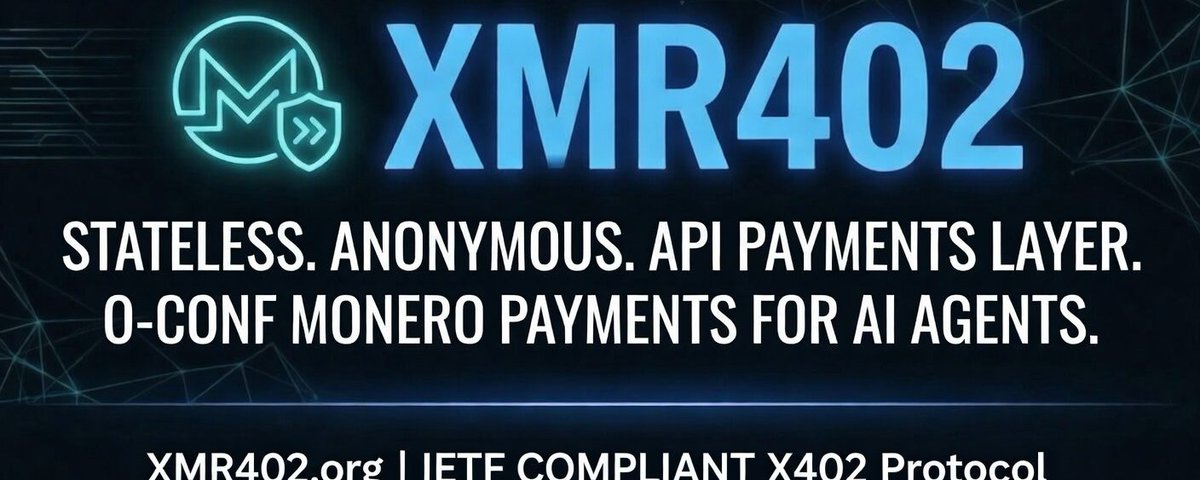 XMR402 is a stateless protocol that lets AI agents pay for APIs using Monero with zero KYC and instant verification2026-03
 Analyst claims governments are racing to eliminate cash via CBDCs by 2030, warning of surveillance risks and pushing Bitcoin, Monero, and gold as alternatives2026-04
 Qubic drops Monero for Dogecoin ASIC mining after capturing 51% of XMR hashrate, dedicates full GPU fleet to AI2026-04
Monero is a privacy-focused cryptocurrency that conceals the sender, receiver, and amount of every transaction by default, making it the most widely used "fungible" digital cash in circulation. First launched in 2014, it has become both a reference point for financial privacy and a recurring flashpoint in debates over surveillance, security, and regulation.
What Monero Is and How It Works
Where Bitcoin records every transaction transparently on a public ledger, Monero (ticker: XMR) hides transaction detail at the protocol level. Its privacy rests on three cryptographic layers that each obscure a different piece of information (monero.how):
- Ring signatures hide the sender. Each spend is bundled with decoy outputs pulled from the blockchain — currently a mandatory ring size of 16, meaning 15 decoys plus the real input — so an observer cannot tell which participant actually authorized the transaction.
- Stealth addresses hide the receiver. The sender generates a one-time address for each payment; only the recipient, using a private view key, can detect and spend the funds. Outside observers cannot link payments to a published address.
- Ring Confidential Transactions (RingCT) hide the amount, while still letting the network verify arithmetically that inputs equal outputs.
Because these protections are mandatory rather than optional, every XMR is treated as interchangeable — a property called fungibility. By contrast, "shielded" privacy coins like Zcash make privacy opt-in, which can leave the majority of transactions transparent.
Monero is mined using RandomX, a proof-of-work algorithm tuned for general-purpose CPUs and intended to resist specialized ASIC hardware, keeping mining comparatively accessible (Monero docs). Its monetary policy is also distinctive: after the main emission curve completed in May 2022, the network entered tail emission, a fixed reward of 0.6 XMR per block that continues indefinitely (getmonero.org). The fixed reward keeps a permanent incentive for miners to secure the chain — addressing a long-term concern Bitcoin may face when its block subsidy eventually disappears — while the percentage inflation rate trends asymptotically toward zero as the supply grows.

Monero now accepted on Epic travel platform for flights and hotels at up to 30% below Booking.com

A Decentralized, Community-Run Project
Monero has no company, foundation treasury sale, or pre-mine. Development is funded largely through the Community Crowdfunding System, where contributors propose work and donors fund it, and protocol changes are coordinated through scheduled network upgrades (hard forks) roughly every six to twelve months. This governance model is slower and more contested than a corporate roadmap, but it reflects the project's cypherpunk roots.
The cadence of releases continues. Recent client updates such as Monero 0.18.5.0 "Fluorine Fermi" — shipped for both the command-line tools and the GUI wallet — bundle bug fixes, performance work, and network-health improvements, and the broader Monero ecosystem regularly publishes coordinated releases of supporting software. Wallet support is also widening: integrations like Cake Wallet's planned Passport Prime hardware support point to a maturing self-custody toolchain for ordinary users.
Readers click Monero not for its privacy-coin thesis but for adversarial stress tests — the Qubic 51% saga, the CCS wallet hack, the $330M BTC-to-XMR laundering event — revealing an audience fixated on whether Monero's guarantees actually hold when attackers, regulators, and criminals actively probe them.
The Qubic Hashrate Episode and the 51% Question
Monero's security model assumes that no single party controls a majority of mining power. In mid-2025 that assumption was tested. Qubic, a project led by former IOTA co-founder Sergey Ivancheglo, paid miners in its own token to point RandomX hashrate at Monero, and by August claimed to control a majority — reportedly peaking above 50% (CoinDesk).
A 51% attack does not let an attacker steal coins or forge signatures, but it can enable chain reorganizations ("reorgs"), in which recently confirmed blocks are replaced, opening the door to double-spends. The network experienced reorgs during this period — including an 18-block reorg in September 2025 that invalidated transactions — and several exchanges responded by sharply raising confirmation requirements, slowing deposits and withdrawals (The Block).
The episode remains contested. Some analysts dispute that Qubic ever held a true, sustained majority, noting that peak measured hashrate fell short of the full network total, and characterize parts of it as a demonstration rather than a clean attack (riat.at). The community response is widely seen as the more important outcome: dispersed CPU miners were urged to move to the decentralized P2Pool and smaller pools, diluting any single operator's share and improving hashrate distribution. Qubic later shifted focus, reportedly redirecting mining effort toward Dogecoin ASICs and dedicating GPU capacity to AI workloads. The takeaway for Monero is durable: CPU-friendly mining lowers barriers to entry but also lets a well-funded actor rent significant hashrate quickly, making decentralized pool participation a live security concern rather than a settled one.

THORChain v3.20 launches Tuesday, advancing Zcash and Monero activation, resuming BNB, Base, and Solana trading
Privacy-Coin Security Under AI-Assisted Scrutiny
Privacy coins depend on advanced cryptography, and that cryptography is now being probed with new tools. In mid-2026, security engineer Taylor Hornby disclosed a critical flaw in Zcash's Orchard shielded pool — an under-constrained elliptic-curve check that, in principle, could have allowed undetectable counterfeiting of shielded ZEC. The bug had existed since Orchard's 2022 activation and was found with the help of an AI model, Anthropic's Claude Opus, before engineers patched it (CoinDesk).
Hornby subsequently said he would add Monero and other privacy projects to his audit queue (Crypto Briefing). No comparable Monero vulnerability has been disclosed, and the announcement of an audit is not evidence of a flaw. But the news weighed on XMR sentiment and underscored a structural reality: complex zero-knowledge and ring-signature constructions can hide latent bugs for years, and AI-assisted review is lowering the cost of finding them — for defenders and potential attackers alike.
Application-layer software around Monero has its own risks. A vulnerability in the Haveno protocol — a peer-to-peer, multisignature decentralized exchange built for XMR — was exploited in a fork project, reportedly resulting in the theft of roughly 7,000 XMR (about $2.7 million), attributed to weak state-machine validation ([GoPlus Security alert]). This is a reminder that the base protocol's privacy guarantees do not extend to every wallet, bridge, or exchange built on top of it, where conventional smart-contract and software bugs remain the larger practical threat.
- 01Qubic 51% attack saga
A $300M AI project's claim to have captured Monero's hashrate — disputed by community sleuths, then abandoned for Dogecoin — played out as a multi-episode drama readers followed across five separate headlines totalling hundreds of clicks.
- 02Monero as criminal money-trail conduit
Back-to-back headlines linking XMR to the $282M hardware wallet theft, the $330M BTC conversion, and Ledger CTO flagging Monero withdrawals as suspicious cemented the read that XMR is the de facto laundering off-ramp — and readers are paying close attention to each data point.
- 03Secure self-custody for XMR holders
The single highest-clicked article was a security expert's multi-coin cold-storage guide featuring Monero, signalling that XMR holders are disproportionately anxious about custody compared to other crypto audiences.
- 04Exchange delistings and regulatory squeeze
Kraken Canada's XMR delisting crystallised a progressive pattern of privacy-coin exclusion that readers recognise as an existential liquidity risk rather than a temporary inconvenience.
- 05Deanonymization attack research
A full analysis of deanonymization vectors and a researcher pivoting from Zcash to audit Monero's cryptography raised genuine doubt about whether ring-signature privacy survives modern traffic analysis and AI-assisted audits.
- 06Macro hedge and 'digital silver' narrative
Peter Brandt's first XMR position and CBDC-surveillance framing attracted readers treating Monero as a hard-privacy macro trade independent of its technical merits.
Cross-Chain Access via THORChain
For years, swapping into and out of Monero meant using centralized exchanges (many of which have delisted it) or instant-swap services. That is changing. THORChain, a decentralized cross-chain liquidity protocol, has been working to add native Monero support alongside Zcash and other assets, enabling direct, non-custodial swaps between native BTC, ETH, USDC, and XMR — without wrapped or synthetic tokens (Bitget News).
Developers have demonstrated live swaps on test infrastructure and small real-fund trials, with mainnet support targeted within a roughly one-to-two-month window from spring 2026 and integration progressing through stagenet testing. THORChain has also discussed dynamic fees to remain competitive with aggregators. For users, native BTC-to-XMR swaps without accounts or identity checks would be a meaningful accessibility gain.
The integration also carries tradeoffs. Independent analysis has cautioned that bridging a private asset through a transparent cross-chain protocol can create traceable on-ramp and off-ramp paths — the swap into XMR may itself be visible even if subsequent Monero activity is not — and that adding no-KYC privacy liquidity invites regulatory scrutiny. Some of the integration work has reportedly leaned on AI-assisted development, drawing additional security and compliance questions.

THORChain pushes native Monero swaps for v3.18 and drafts dynamic fees to reclaim volume lost to aggregators
THORChain's v3.18, cutting in ~1 month, will ship native Monero swaps via single-vault FROST TSS — making it the only XMR DEX listing on CoinGecko. A draft dynamic fee model (MR #4752) adjusts rates per THORName and trading pair to reclaim volume like the wallet doing $307M/month that currently routes just ~1% through THORChain at 10bp flat versus 2-3bp at aggregators. Devs are also debating opt-in chain clients and whether to capture $300K-$3M monthly in arbitrage via a protocol-owned bot using THORChain's proven 18-exchange price oracle.
Market Behavior, Illicit-Use Narratives, and Regulation
Monero's market is comparatively thin and can move sharply on flow-driven events. In June 2026, on-chain investigator ZachXBT traced a roughly $120 million USDT movement on Tron that included large purchases of XMR; the buying coincided with a surge that pushed Monero's price from around $330 to an intraday high near $438 before stablecoin issuer Tether froze about $72 million of the associated funds (The Defiant).
The episode encapsulates Monero's central tension. Its fungibility makes it attractive for legitimate financial privacy — and also for laundering, which fuels the "privacy coin" narrative regulators cite when pressuring exchanges to delist XMR. It also highlights a contrast in censorship resistance: a centralized stablecoin can be frozen by its issuer, whereas Monero itself cannot be blacklisted at the protocol level. Privacy advocates frame XMR (alongside Bitcoin and physical gold) as a hedge against expanding financial surveillance, including proposals for central bank digital currencies. Skeptics counter that privacy coins like XMR and ZEC face delisting pressure, limited merchant adoption, and weak mainstream demand drivers ([analysis coverage]). Both points can be true at once.
- 2014-04launch
Monero mainnet launch as Bytecoin fork
- 2023-09exploit
CCS community crowdfunding wallet drained of 2,675.73 XMR
- 2024-08regulatory
Kraken announces XMR delisting in Canada
- 2025-04milestone
$330.7M in BTC converted to XMR; price surges 50%
- 2025-05governance
Qubic claims 51% Monero hashrate; community disputes figure as ~30%
- 2025-06milestone
Qubic abandons XMR mining, pivots to Dogecoin ASIC fleet
Outlook
Monero's near-term trajectory hinges on three threads visible in current coverage: whether mining stays decentralized enough to keep majority-hashrate scares like the Qubic episode contained; whether AI-assisted audits validate or undermine confidence in its cryptography as Zcash's Orchard flaw did for shielded pools; and whether new rails such as THORChain's native swaps broaden access without amplifying regulatory and traceability risk. The protocol's fundamentals — default privacy, ASIC-resistant mining, and perpetual tail emission — are unusually stable, but Monero will likely remain as much a political and regulatory story as a technical one. For readers, the durable lesson is that protocol-level privacy and real-world fungibility are powerful, but they live inside an ecosystem of wallets, bridges, exchanges, and laws where most practical risk actually resides.
Latest Monero news
Monero now accepted on Epic travel platform for flights and hotels at up to 30% below Booking.comTHORChain v3.20 launches Tuesday, advancing Zcash and Monero activation, resuming BNB, Base, and Solana tradingTHORChain pushes native Monero swaps for v3.18 and drafts dynamic fees to reclaim volume lost to aggregatorsThe researcher who used Anthropic's Opus AI to uncover Zcash's critical counterfeiting flaw is now turning his attention to Monero, raising fresh questions about privacy coin securityTether freezes $72M after $120M USDT swap trail pushes Monero from $330 to $438XMR402 is a stateless protocol that lets AI agents pay for APIs using Monero with zero KYC and instant verificationCommunity notes
Spot something off or out of date? Drop a note. Editors review topic notes daily and roll accepted fixes into the explainer — contributors are recognized in the monthly $SQUID drop.
Loading notes…
Help improve this topic
Have a story or tip about this topic? Submit it. See something missing? Leave a note. Editors review daily; accepted submissions and fixes count toward the monthly $SQUID drop.