
In-depth explainer on crypto privacy: how blockchains balance transparency, DeFi composability, institutional compliance, ZK advances, and AI agents with confidentiality. Covers tech primitives, regulation, Zcash’s bug crisis, and emerging standards like STRK20 and EIP‑8182.
+46 sources across the wider coverage universe
 Zcash roadmap targets global-scale encrypted money with Tachyon scaling to 2,200 TPS and quantum recovery features, aiming to future-proof privacy and network resilience2026-04
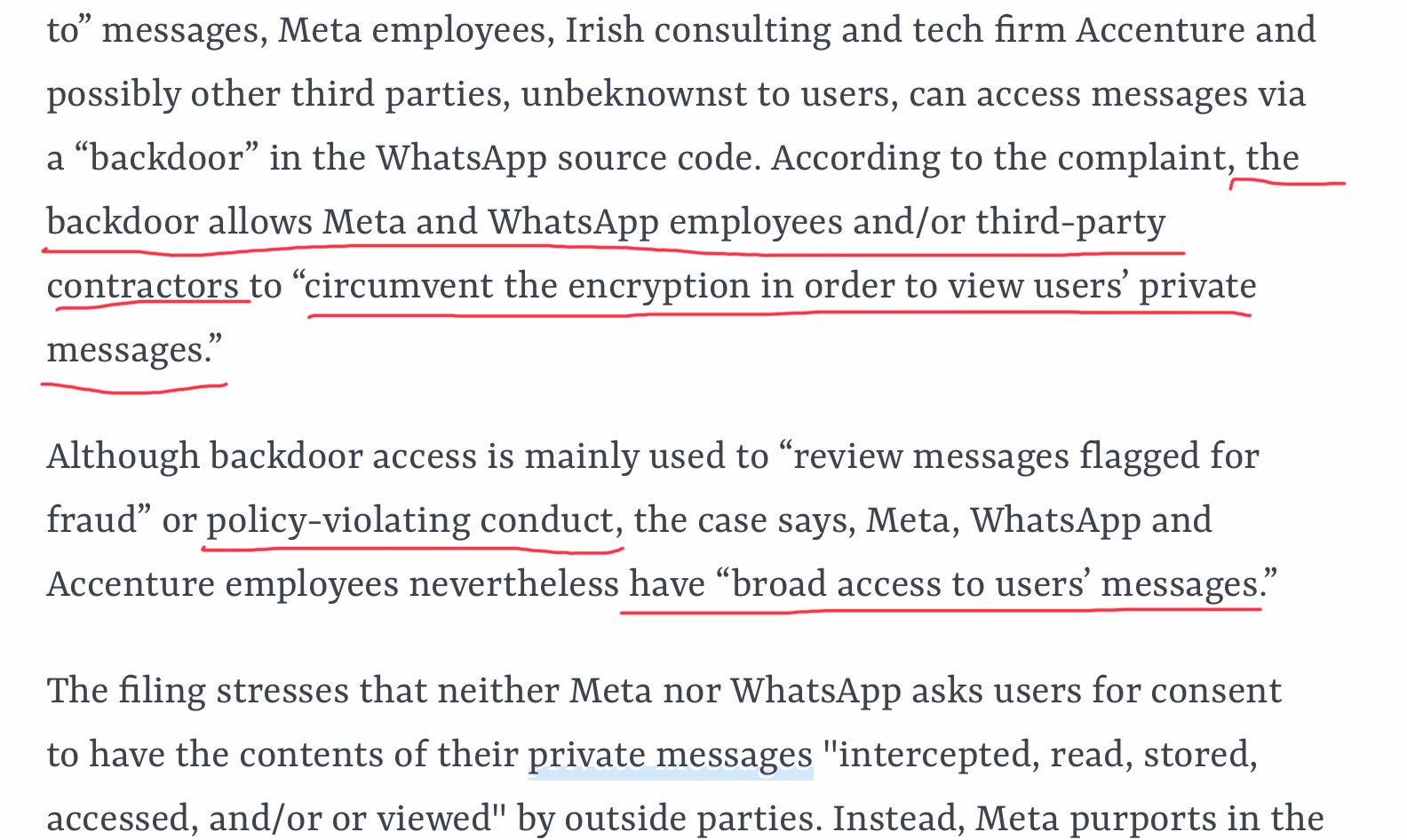 Telegram CEO Pavel Durov claims WhatsApp’s encryption is deceptive, alleging the platform reads user messages and shares data externally, calling it a major consumer fraud while positioning Telegram as a secure alternative2026-04
 DL Research maps Web3 privacy landscape, showing how ZK, FHE, and MPC each solve different problems while exposing trade-offs shaping the future of secure on-chain systems2026-04
 OpenAI releases Privacy Filter model to strip sensitive data like passwords and addresses locally before ChatGPT use, boosting on-device AI privacy protection2026-04
 DefiLlama Research highlights how Starknet is reimagining privacy with the release of the STRK20 privacy token standard.2026-06
 Starknet opens STRK20 Privacy SDK and Wallet API for private transfers, swaps and DeFi integrations2026-07
Privacy in Crypto: How Confidentiality, Compliance, and On-Chain Design Converge
In crypto, privacy means controlling who can see, link, or exploit information about your on-chain activity and identity, rather than making data disappear entirely. It is the evolving discipline of designing blockchains, protocols, and applications that keep sensitive details confidential while still allowing verification, regulation, and composability at scale.
Defining Privacy in Crypto and Web3
When people first encounter cryptocurrencies, they often assume that because addresses look like random strings, activity on public blockchains is anonymous. In reality, most major networks such as Bitcoin and Ethereum are radically transparent ledgers where every transaction is recorded forever, and anyone can inspect addresses, flows, and balances with a block explorer. The primary thin layer of obfuscation is that an address is not intrinsically tied to a real-world name. Once an address is linked to a person or institution through an exchange, KYC provider, leak, or simple reuse, however, it becomes trivial to reconstruct their financial history and counterparties from that point forward. Privacy in crypto is therefore not a simple binary between “anonymous” and “transparent,” but a spectrum defined by how hard it is to link transactions to each other and to human identities, and who is allowed to perform that linkage.
It is useful to distinguish between payment privacy and smart contract privacy. Payment privacy concerns who can see amounts, senders, recipients, and timing of transfers, much as in traditional banking statements. Smart contract privacy, by contrast, governs visibility into application state and logic: what collateral you posted to a lending protocol, how a DAO voted internally, or what parameters govern an institutional portfolio strategy. The same network may offer minimal privacy at the payment level but strong privacy for certain applications, or vice versa. This distinction has become increasingly important as DeFi has matured and as institutions explore on-chain infrastructure, because many regulated workflows require selective confidentiality of business logic rather than simply obscuring payments.
Privacy also operates at different layers of the Web3 stack. At the network layer, metadata such as IP addresses, geolocation, and timing can reveal who is interacting with a blockchain, even if transaction data is encrypted or obfuscated. Tools such as VPNs, Tor, and onion routing can mitigate these leaks, but only if they are consistently and correctly used. At the transaction layer, cryptographic techniques such as mixers, ring signatures, stealth addresses, and zero-knowledge proofs shape how linkable or visible transfers are on-chain. At the application layer, access control, viewing keys, and selective disclosure govern which participants—counterparties, auditors, or regulators—are entitled to see what information and under what conditions. A comprehensive view of crypto privacy must therefore consider all three layers and the interactions between them.
Finally, privacy in Web3 is inherently programmable. New networks and standards are increasingly designed so that privacy is not an all-or-nothing switch, but a set of configurable rules embedded in smart contracts and token standards. Midnight, for example, describes itself as a “fourth generation blockchain” built around programmable privacy, allowing developers to determine where and when privacy applies across both application and transaction layers. Similarly, the STRK20 standard on Starknet makes any ERC‑20 token capable of moving through private flows, with privacy rules implemented at the protocol level rather than bolted on via wrappers or external mixers. This shift from static to programmable privacy underpins many of the developments reshaping DeFi, institutional adoption, and tokenized markets today.

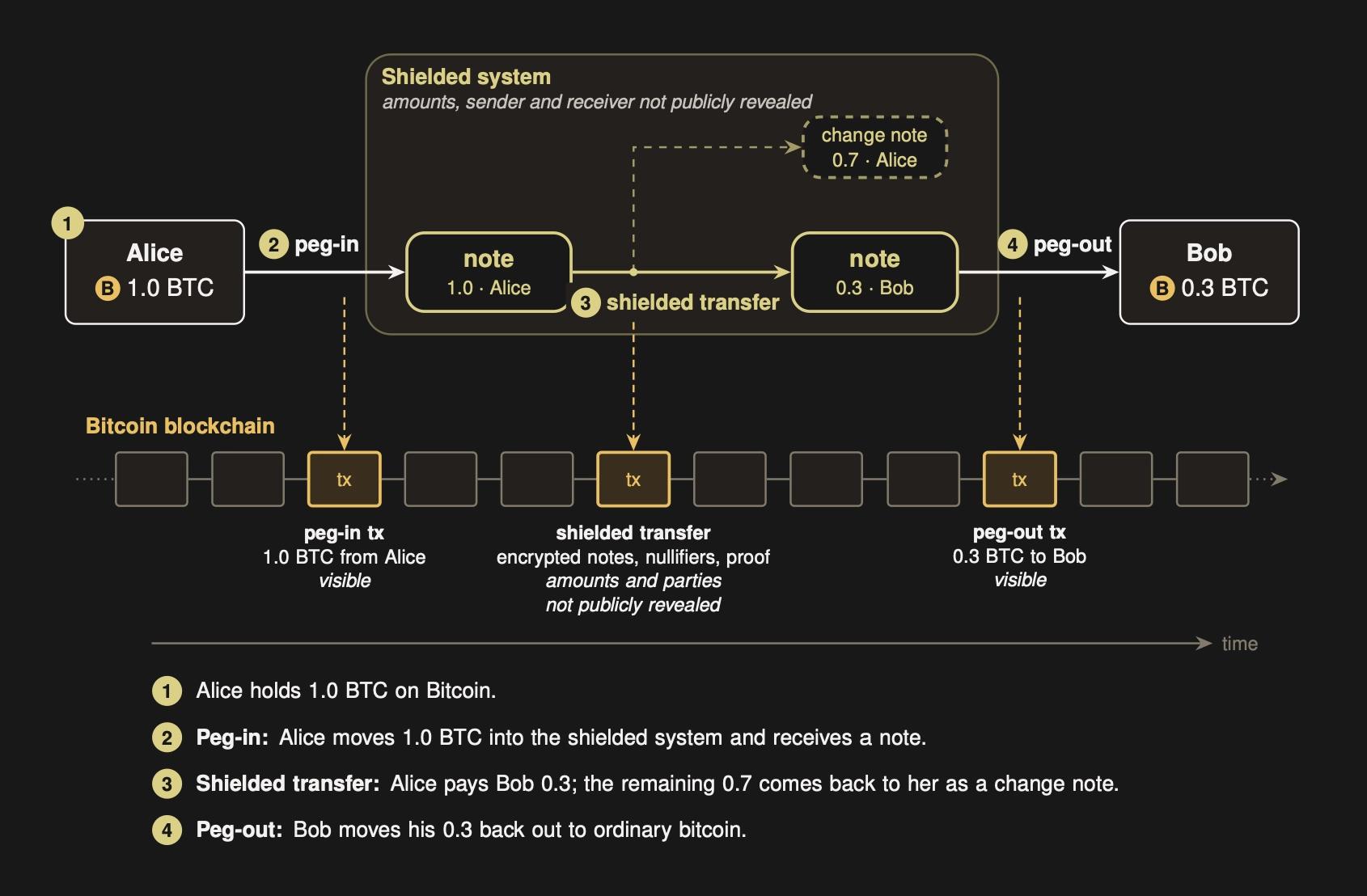
Shielded Bitcoin proposal brings private transfers to Bitcoin's base layer
Why Privacy Matters: Users, Institutions, and Regulators
For individual users, financial privacy is closely tied to personal safety and autonomy. On a transparent blockchain, a single leaked address can reveal salary payments, savings balances, donation patterns, and trading habits to anyone with an internet connection, creating opportunities for targeted phishing, extortion, or even physical threats. Privacy-enhancing mechanisms such as ring signatures, stealth addresses, and dedicated privacy coins were developed in part to shield users from this kind of pervasive surveillance. In systems like Monero, ring signatures blend each spend with a group of decoy inputs, making it difficult to identify the true sender, while stealth addresses generate one-time destinations that cannot be easily linked back to a recipient’s public address. These techniques aim to restore a baseline of confidentiality comparable to cash or traditional banking, where random third parties cannot effortlessly reconstruct your complete financial life.
At the same time, crypto users increasingly interact with smart contracts rather than simple transfers. A DeFi portfolio might include leveraged positions, options, and governance rights that reveal much more about a person’s strategy and risk appetite than a conventional bank account. Exposing all of this in real time on a public ledger can invite front-running, copy trading, or targeted liquidations, especially when sophisticated actors use bots and machine learning to monitor on-chain patterns. This “privacy paradox in DeFi” refers to the tension between the openness that enables composability and trustless verification, and the confidentiality that users need to protect themselves from exploitation. Addressing this paradox requires designs that keep protocol-level parameters transparent while obfuscating individual user positions, a theme that runs through newer privacy layers and institutional products.
For institutions, privacy is not only a matter of competitive secrecy but also a precondition for regulatory compliance and fiduciary duty. Traditional asset managers cannot simply expose every trade, position size, and rebalancing event on a public blockchain without undermining their strategies or violating client confidentiality expectations. Emerging architectures like Unlink’s integration with Euler Finance illustrate one approach: routing capital through a privacy layer that hides the connection between a wallet and the specific vaults it uses, while keeping vault parameters, oracle inputs, and liquidation logic fully public and verifiable. In this model, anyone can underwrite the market’s risk before entering, yet institutional interactions are not trivially traceable on-chain. Research from policy groups has similarly explored how “Privacy Pools” could let banks and other financial institutions participate in DeFi while using cryptographic proofs to demonstrate that their funds do not originate from sanctioned or illicit sources, without revealing their full transaction histories.
Tokenization adds a further dimension. As real-world assets, securities, and payment instruments migrate on-chain, they carry with them legal obligations around data protection and confidentiality. Projects like Kaia have begun to describe their vision in terms of “programmable compliance” and “composable privacy,” signaling that privacy is not an add-on but an integral part of how tokenized markets should function. The Canton Network’s CIP‑0112 token standard similarly focuses on privacy-enhanced batch settlement, committed allocations for pre‑funded trading, multi‑tier custody chains, and streamlined authorization flows, explicitly targeting the requirements of traditional finance institutions bridging into DeFi-style infrastructure. These developments highlight that for businesses, privacy is intertwined with auditability, legal enforceability, and operational reliability, rather than being a purely ideological concern.
Regulators and policymakers approach privacy from yet another angle, balancing the need to detect crime and enforce sanctions against the risks of unchecked financial surveillance. Some have taken a hard line against “anonymity-enhancing cryptocurrencies”: in the Philippines, for instance, recent listing rules explicitly ban privacy coins from being listed or supported by local trading platforms. The guidelines characterize these assets as anonymity-enhancing and treat that property as incompatible with regulated exchange infrastructure. At the same time, other initiatives emphasize “privacy-preserving compliance,” where zero-knowledge proofs and selective disclosure allow institutions to meet Anti‑Money Laundering (AML) and Countering the Financing of Terrorism (CFT) requirements without permanently exposing all underlying data. Networks like Midnight and standards like STRK20 are designed with this balance in mind, building in mechanisms for authorized auditors or regulators to access specific transaction histories when legally required, while giving users strong default privacy.
Taken together, these perspectives show that privacy is not a niche concern for a handful of cypherpunks or privacy coins. It is a structural property of how value moves, contracts execute, and data is governed in crypto and tokenized markets. The central challenge is to design systems that protect individuals and institutions from unnecessary exposure, while preserving enough transparency for markets to function and laws to be enforced.
Readers aren't clicking privacy stories for cryptography tutorials — they're clicking because regulators have made building privacy tools a criminal act, forcing this audience to choose between technical progress and legal survival.
Technical Building Blocks of Crypto Privacy
The starting point for understanding crypto privacy is the baseline transparency model of public blockchains. In most major networks, every transaction is broadcast to a peer-to-peer network, validated, and recorded in a shared ledger that is replicated across thousands of nodes. Each entry specifies the source and destination addresses, the amount transferred, and often additional metadata such as gas fees or method calls for smart contracts. Although addresses are pseudonymous, blockchain analytics firms routinely cluster them based on transaction patterns, shared spending, and linkage to known entities like exchanges, making it increasingly difficult to transact privately on vanilla chains. The immutable nature of the ledger means that even if a user attempts to improve their privacy later, past activity may remain vulnerable to retroactive deanonymization.
One of the earliest techniques to resist this pervasive traceability was the use of mixers and CoinJoin-style transactions. In a mixer, multiple users send funds to a service that returns the same amount (minus fees) from a common pool, ideally breaking the link between incoming and outgoing addresses. CoinJoin refines this idea by allowing multiple users to combine their coins into a single large transaction with many inputs and outputs, obfuscating which coins belong to which user without relying on a centralized operator. These methods increase the size of the anonymity set—the set of possible senders a given output could belong to—making basic heuristics less effective. However, they are not foolproof. Timing correlations, amount matching, and pattern analysis can often reduce uncertainty, and regulators have increasingly targeted mixers used by sanctioned actors. As a result, mixers are now seen as a stopgap rather than a complete solution.
Dedicated privacy coins take a more fundamental approach by redesigning the transaction format itself. In systems that rely on ring signatures, each transaction input is signed using a ring of possible senders, such that an observer cannot tell which member of the ring actually authorized the spend. Stealth addresses, meanwhile, allow recipients to publish a static public key while transactions generate one-time destination addresses derived from it, preventing third parties from associating incoming payments with a known identity. Combined with confidential transaction techniques that hide amounts, these tools offer significantly stronger privacy guarantees than simple mixing. They also create difficulties for compliance and supply auditing, because by design, outsiders cannot readily distinguish between legitimate and illicit flows.
Zcash represents a particularly influential and illustrative case. The network introduced shielded addresses and zk‑SNARK-based transactions that allow users to prove that a transfer is valid—that inputs exist and balances are conserved—without revealing amounts or addresses on-chain. This was a landmark in applying general-purpose zero-knowledge proofs to a live cryptocurrency, demonstrating that full-privacy transactions were practical at scale. However, recent disclosures have underscored how the very strength of Zcash’s privacy can become a liability when something goes wrong. A researcher hired by the Zcash team discovered a critical bug in its privacy protocol that could, in principle, have allowed the creation of unlimited counterfeit ZEC within the shielded pool, without detection. The vulnerability is believed to have existed for roughly two years before being found and patched. Because shielded transactions are opaque, it is extremely difficult to retroactively prove whether such counterfeiting actually occurred, leaving a lingering question mark over supply integrity.
The incident sparked a sharp market reaction, with some high-profile investors, including Arthur Hayes, citing the inability to verify whether extra coins had been minted as a key reason for exiting their positions. Around the same period, the Zcash blockchain experienced an outage in which no new blocks were produced for more than four hours, delaying transaction confirmations and further undermining confidence in the network’s operational resilience. Coverage of the “Zcash bug crisis” highlighted how privacy “cuts both ways”: the same cryptography that protects users from surveillance also prevents the community from easily detecting or quantifying certain classes of bugs, especially those involving hidden inflation. For protocol designers, this episode reinforces the need for extensive audits, formal verification, and conservative engineering when deploying opaque systems, as well as the value of mechanisms that allow at least some form of aggregate supply or state validation.
Modern privacy research has increasingly converged around zero-knowledge proofs as the primary primitive for reconciling confidentiality with verifiability. In a zero-knowledge proof, a prover can convince a verifier that a statement about some secret data is true, without revealing the data itself. Applied to blockchains, this can mean proving that a transaction is balanced, that a user satisfies KYC checks, or that an AI model was evaluated correctly, all without exposing the underlying inputs. Networks like Starknet are built around zk‑STARKs and leverage this native zero-knowledge infrastructure not only to scale execution but also to implement privacy frameworks like STRK20. Every private STRK20 transaction is backed by a zero-knowledge proof generated on the user’s device and verified at the sequencer level, ensuring validity even though no sensitive information is disclosed on-chain. Because Starknet already uses zero-knowledge proofs to attest to the correctness of its own blocks, extending this machinery to privacy does not require an entirely separate proving and verification stack.
Shielded pools and note-based accounting have emerged as flexible abstractions for private assets. In a note-based system like STRK20, when a user “shields” an ERC‑20 token, they deposit it into a global privacy pool and receive an encrypted note representing their claim. Each private action—whether a transfer, swap, or staking operation—consumes one or more existing notes and creates new ones, with zero-knowledge proofs ensuring that no double-spends or invalid state transitions occur. Crucially, all supported ERC‑20 tokens share a single privacy pool on Starknet, rather than each asset maintaining its own isolated pool. This design avoids the fragmentation of anonymity sets that plagues many older privacy schemes, where low usage of a given pool or token could make de‑anonymization much easier. The proposed EIP‑8182 for Ethereum’s Hegotá hard fork takes a similar approach at the L1 level, embedding a single protocol-managed shielded pool into Ethereum to enable native private transfers. By consolidating privacy into one large, shared pool and managing it at the protocol level, EIP‑8182 aims to provide stronger default privacy and simpler integration for wallets and applications.
Hybrid ledger architectures extend this idea beyond pure asset transfers. Midnight, for example, combines public and private data within a single network, so that applications can process and verify sensitive personal, financial, or commercial information without ever broadcasting it to all nodes. Sensitive data remains on the user’s device or within controlled environments, while client-side proof servers generate zero-knowledge proofs that are submitted to the network for validation. Developers can decide what to store publicly, what to keep private, and when to require selective disclosure, such as revealing transaction details to regulators or counterparties under specific conditions. Assets can exist in “shielded” or “unshielded” forms, allowing some flows to be fully transparent while others remain confidential but auditable. Kaia’s vision of “auditable” infrastructure with programmable compliance and composable privacy similarly points toward ecosystems where privacy is woven into the base platform, rather than handled piecemeal at the application edges.
Finally, it is important not to overlook network-level privacy techniques. Even the most sophisticated zero-knowledge protocol can leak identifying information if transactions are consistently broadcast from the same IP address, region, or device fingerprint. Some decentralized exchanges and privacy-focused platforms incorporate onion routing or similar mechanisms to route transaction data through multiple hops, making it harder for observers to correlate messages with specific users. Users can further strengthen their privacy posture by using VPNs or Tor to mask IP addresses and by employing “burner wallets” for one-time interactions, reducing the risk that different activities will be linked together. Yet, as identity management specialists stress, these methods only achieve privacy “to the extent that regulations allow,” since laws can change to restrict certain tools or require additional disclosures, and mistakes or reuse can quickly erode whatever anonymity they provide.
Privacy in DeFi: Protocols, Institutions, and Use Cases
The rise of DeFi has sharpened the contradictions embedded in blockchain transparency. On one hand, open ledgers allow anyone to verify that collateral ratios are sound, that liquidations are executed according to code, and that protocol treasuries are not being misappropriated, all without relying on external auditors. On the other, the same transparency exposes every trade, liquidity position, and governance vote to competitors and adversaries, often in real time. Analyses of the “privacy paradox in DeFi” emphasize that users want both the benefits of transparency and the protections of privacy, but existing designs frequently force them to choose between the two. A liquidity provider who publishes their positions to a public AMM can be targeted by MEV bots or copy traders; a DAO delegate whose voting history is fully public may face social or regulatory pressure that does not acknowledge the complexity of their mandate.
Programmable privacy seeks to resolve this paradox by separating what the market needs to know from what individuals are entitled to keep confidential. Starknet’s STRK20 framework, for instance, allows users to shield any supported ERC‑20 token directly from within their wallets, turning a public balance into a private one with a single action. Once shielded, these balances are hidden from public view, yet the user controls them with the same wallet and can use them in private swaps or other private DeFi flows. Swaps can be routed across existing Starknet liquidity, but executed entirely within the privacy pool, so that no public address is linked to the trade and neither the amount nor the counterparties are visible on-chain. From the protocol’s perspective, each private transaction is simply a zero-knowledge proof that the pool’s state transitioned correctly, preserving total balances and preventing double spends. This design allows DeFi applications like DEXs and staking protocols to offer privacy “natively” rather than treating it as an exotic add-on.
COTI’s Privacy Portal illustrates a complementary direction focused on cross-chain and multi-asset support. Built as the flagship privacy app on the COTI network, the portal provides what its creators describe as “Privacy-on-Demand”: a fast, simple way to make any supported token private on top of COTI, with plans to expand to other chains. Users can wrap tokens such as stablecoins into private versions, hold them under keys that only they control, and switch those tokens back to public form when desired. The user experience is designed to be approachable, with one of the project leads emphasizing personally shaping the UI and UX to make this functionality accessible even to non-experts. Beyond simple transfers, COTI positions its stack as enabling private DeFi on any chain, token, wallet, or use case, including privacy for NFTs and AI agents that run on-chain. The network supports encrypted agent-to-agent messages and confidential smart contracts, and project representatives have described it as the first protocol to offer privacy tailored for on-chain agents in this way. Taken together, these examples show how privacy is being integrated directly into the fabric of DeFi operations rather than confined to specialized privacy coins.
For institutions, these capabilities are not just nice-to-have features but often prerequisites for participation. Large funds and banks cannot expose which vaults they are using, the sizes of their positions, or the timing of their rebalancing decisions to the entire world without undermining their mandates. Euler Finance’s integration of Unlink addresses this by inserting a privacy layer between institutional wallets and Euler’s public vaults. Capital is routed into Euler through Unlink’s smart contract, deployed on the same chains Euler supports, with no need for new networks, bridges, or custody arrangements. From Euler’s perspective, nothing changes: vault parameters, collateral relationships, oracle inputs, and liquidation logic remain fully public, and users can still underwrite market risk based on this information. From the institution’s perspective, however, their balances, transaction histories, and specific vault selections are kept out of the normal public path, while still being recorded in a way that supports internal monitoring, audit, and reporting workflows. This approach exemplifies how privacy can be layered on top of existing DeFi primitives to address institutional requirements without sacrificing protocol transparency.
The Canton Network, which targets real-world financial infrastructure, takes a more permissioned approach while embedding similar ideas. Its newly approved token standard, CIP‑0112 (Token Standard V2), emphasizes privacy-enhanced batch settlement and committed allocations for pre‑funded trading with iterated settlement, along with multi-tier custody chains and simplified single-signature authorization via wallets. The goal is to bridge traditional finance settlement workflows with DeFi-style composability on the same infrastructure, without forcing institutions to split operations across incompatible systems. Here, privacy is not primarily about hiding individual user actions from the public, since participation is permissioned, but about controlling which participants can see which aspects of a transaction, ensuring that commercially sensitive details are not broadcast to the entire network or beyond.
Privacy considerations in DeFi also intersect with concerns about Miner/Maximal Extractable Value (MEV) and transaction ordering. High-throughput chains that pursue aggressive scaling via multi-proposer consensus, such as Sei’s Giga “Autobahn,” can increase the risk of spam and opportunistic behavior because multiple proposers may submit similar or duplicate transactions in parallel. Sei has highlighted this trade-off explicitly, noting that while multi-proposer consensus delivers substantial gains in speed and throughput, it also increases spam via duplicate transactions. Sedna, an upcoming protocol from Sei Labs, aims to address this by removing spam while introducing privacy and MEV resistance to the Giga environment, reshaping how transactions are propagated and ordered. By hiding certain details or re-ordering levers from public mempools, and by introducing cryptographic mechanisms to reduce front-running, such systems can protect users and institutions from some of the most egregious forms of MEV, yet they must do so without undermining liveness or fairness.
The integration of AI and autonomous agents into DeFi adds yet another layer. On-chain agents that execute strategies, rebalance portfolios, or participate in governance need privacy not only for the assets they control but also for the internal logic and data they act upon. COTI’s focus on privacy for on-chain agents—through encrypted agent-to-agent messaging and confidential smart contracts—addresses this niche directly. At the same time, market attention has turned to the broader “AI and ZK” opportunity, where zero-knowledge proofs can be used to attest to properties of AI models or inferences without revealing sensitive training data or proprietary architectures. Coverage highlighting ZKP’s AI tech opportunity, in the context of platforms like Hyperliquid, underscores how investors and builders are increasingly viewing privacy and verifiability as intertwined features for both financial and AI-native applications. As AI agents become more prominent participants in on-chain ecosystems, frameworks that enable them to prove correctness while keeping strategies confidential are likely to become central building blocks of privacy-aware DeFi.
- 01Developer prosecution as existential threat
The DOJ's crackdowns on Tornado Cash and Samourai Wallet, plus the Pertsev/Storm trials, made readers confront whether writing privacy code is itself illegal — a threat with no technical fix.
- 02ZK privacy reaching Ethereum mainnet↗
Aztec, Nocturne, and Ethereum core research all converging on zk-based mainnet privacy signaled that the long-promised 'private Ethereum' was becoming concrete, not theoretical.
- 03Vitalik's public privacy advocacy
Multiple high-click Vitalik posts — his roadmap, a 'why I support privacy' essay, and critiques of ZK-wrapped digital ID — gave readers a credible intellectual anchor for the privacy-as-right argument.
- 04Worldcoin biometric overreach
Hong Kong and Colombia enforcement actions against iris-scan collection crystallized reader fears that Web3 identity projects could become the most invasive surveillance infrastructure ever built.
- 05TEE hardware privacy failures
A headline declaring TEEs 'fully compromised' shattered the premise of an entire category of 'privacy' projects, raising questions about whether any non-ZK hardware enclave solution is trustworthy.
- 06Institutional DeFi privacy stack↗
Canton Network and BIS Project Tourbillon showed TradFi and central banks building their own privacy layers, signaling that institutional money will only enter DeFi under controlled-disclosure conditions.
Regulation, Bans, and Policy Experiments
Legal and regulatory responses to crypto privacy have been uneven and sometimes contradictory. On one extreme, certain jurisdictions have taken steps to effectively exclude privacy coins from regulated markets. In the Philippines, new crypto listing guidelines explicitly ban anonymity-enhancing cryptocurrencies, commonly known as privacy coins, from being listed or supported by local platforms. The rules define these assets in terms of their ability to obscure transaction origins and destinations and treat that property as incompatible with the surveillance and reporting obligations imposed on licensed exchanges. This approach reflects a view that strong, non‑selective privacy tools primarily facilitate money laundering, tax evasion, and sanctions evasion, and that the risks outweigh the benefits for ordinary users.
However, blunt bans create their own problems. They do not eliminate the underlying technologies, which can still be accessed via self-hosted wallets and peer-to-peer channels, and they may drive privacy-seeking users into less regulated, more opaque venues. Moreover, they risk conflating any form of enhanced privacy with illicit intent, ignoring the legitimate need for confidential transactions in contexts ranging from competitive business operations to politically sensitive donations. This tension has pushed parts of the industry and policy community toward the concept of “privacy-preserving compliance,” where cryptography is used to demonstrate adherence to regulatory constraints without requiring permanent, generalized visibility into all user activity.
Programmable privacy frameworks exemplify this trend. Midnight’s architecture includes selective disclosure features that allow compliance logic to be embedded directly into applications. Developers can define exactly when transaction information must be revealed and to whom, granting visibility to specific records for authorized participants such as counterparties, auditors, or regulators, without exposing the underlying data more broadly. Client-side proofs of identity, eligibility, or creditworthiness can be generated on the user’s device and submitted to the network, enabling verification without centralizing sensitive personal data. STRK20 implements a related pattern at the token level: when users join the Starknet Privacy Pool, they register an encrypted viewing key on-chain, which can be decrypted only by a designated third-party auditing entity in response to a regulatory request. This mechanism allows that auditor to trace a specific user’s complete transaction history, forward and backward, while leaving every other user’s privacy intact. The system explicitly emphasizes that this is not a generic backdoor, but a scoped access mechanism that protects the integrity of the privacy pool while addressing legal requirements.
Private DeFi and institutional wrappers further illustrate how compliance and privacy can coexist. The Georgetown policy work on institutional DeFi describes how Privacy Pools could enable financial institutions to maintain customer privacy while still providing regulators with sufficient visibility into the provenance of funds and the structure of transactions. By segmenting “good actor” sets and using zero-knowledge proofs to show that a transaction originates from within these sets, banks might avoid blanket surveillance while still meeting AML standards. Euler’s use of Unlink as a privacy layer maintains full transparency of protocol-level risk parameters, which regulators and market participants care about, while reducing the linkability of individual institutional actions that might expose client information or proprietary strategies. The Canton Network’s token standard goes even further by embedding privacy and governance controls into the core of its permissioned DLT infrastructure, aligning closely with existing financial regulations and workflows.
Yet, the legal status of many privacy tools remains uncertain and fluid. Identity management experts caution that “privacy coins, software, and methods” may become illegal as regulations evolve, and that users must be vigilant about staying within the bounds of applicable laws. Mechanisms such as CoinMixers, CoinJoin transactions, and VPNs can significantly improve privacy but may come under scrutiny if associated with high-profile enforcement actions, even when used for legitimate purposes. The challenge for policymakers is to craft rules that distinguish between technologies that deliberately and irreversibly sever accountability and those that enable accountability under the right conditions. The challenge for builders is to design systems that default to strong privacy while offering well-scoped, auditable pathways for lawful access when truly necessary.
Ethically, debates over crypto privacy often mirror broader conversations about digital rights and surveillance. Advocates argue that in a world of pervasive data collection, financial privacy is a fundamental human right, crucial for free association, political participation, and protection from both state and corporate overreach. Critics worry that untraceable money flows could empower organized crime, terrorism, and systemic tax evasion. Programmable privacy and selective disclosure frameworks represent an attempt to move beyond this stalemate, by giving individuals and institutions strong guarantees against casual surveillance while preserving the ability to investigate and prosecute serious abuses. Whether this middle path will satisfy regulators, markets, and civil society remains an open question, but it is clearly shaping the direction of technical innovation.
Security, UX, and Education: Making Privacy Usable
Even the most elegant cryptographic designs can fail in practice if users cannot understand or operate them safely. One of the enduring challenges in crypto privacy is user experience. Complex concepts such as shielded pools, viewing keys, selective disclosure, and client-side proof generation are unfamiliar to most people, yet mismanaging them can have serious consequences. STRK20’s launch on Starknet explicitly emphasizes that “privacy begins in the wallet,” with integrations into user-facing wallets like Ready X and Xverse that allow one-click shielding of assets. When a user shields a token, the wallet seamlessly converts a public balance into a private one, controlled by the same keys, and exposes private swaps and other flows through the same interface. The underlying note-based accounting and proof generation remain hidden from the user, who only sees that their balance is now private and that certain actions are available in a “private mode.” This reflects a broader trend: successful privacy tools must minimize cognitive overhead and integrate with existing user journeys rather than forcing people into separate, unfamiliar workflows.
COTI’s Privacy Portal follows a similar philosophy, with its designers highlighting how much care went into making it “very simple [and] fast” to make any token private on the network. Users do not need to understand the details of how tokens are wrapped or shielded; they interact with straightforward controls that let them convert between public and private forms and manage their holdings with familiar wallet paradigms. In both cases, the discipline lies in making powerful privacy features feel like normal operations, so that users can benefit from them without having to become cryptographers. But this simplicity also creates potential risks if users misunderstand the scope of their privacy—assuming, for example, that shielding a transaction hides all metadata, when in reality network-layer information or off-chain data leaks may still exist.
The Zcash bug crisis offers a stark lesson in the security side of this equation. The vulnerability that could have allowed unlimited counterfeit ZEC within the shielded pool was subtle and persisted for an extended period before discovery. Because shielded transactions are opaque by design, the community lacks a straightforward way to audit whether the vulnerability was ever exploited, and to what extent. When the bug was disclosed, it triggered sharp market reactions and prompted high-profile exits, with commentators and outlets like Decrypt emphasizing that privacy “cuts both ways,” hiding not only user activity from public view but also potential protocol-level failures. The subsequent four-hour block production halt in the Zcash network further illustrated how operational issues can compound perceptions of fragility in privacy-focused systems. For builders, these events underscore the importance of rigorous testing, external review, and transparent communication about both capabilities and limitations. For users, they highlight the need to understand that privacy features can introduce additional classes of risk, particularly around supply integrity and debuggability.
Privacy is also expanding beyond payments into domains like messaging and identity. Decentralized, privacy-preserving messaging applications such as BChat aim to offer end-to-end encrypted communication anchored in Web3 primitives, sometimes using wallets as identities and leveraging similar cryptographic techniques to those used in private transactions. While such applications can enhance user privacy and censorship resistance, they also raise questions about how identities are managed across contexts. When wallet addresses double as login credentials for dApps, interactions across finance, governance, and communication can become linked in ways that erode anonymity, even if each application individually claims to preserve privacy. Developers are increasingly exploring privacy-preserving identity systems and selective disclosure credentials that allow users to prove membership, age, or other attributes without exposing full identity or unifying all activity under a single public key.
Wallets and interfaces sit at the center of this emerging privacy stack. They are responsible not only for key management and transaction signing, but also for handling viewing keys, consent to selective disclosures, and interactions with privacy hubs or auditors. STRK20’s encrypted viewing key framework, where each user registers a key that can be decrypted only by a designated auditor under legal process, requires careful UI around consent and notifications to avoid misuse and confusion. Midnight’s client-side proof servers, running on user devices to generate zero-knowledge proofs, must be integrated in a way that does not overwhelm system resources or create unpredictable failures. As privacy becomes programmable and conditional, wallets will need to give users clarity over what is being revealed, to whom, and under what conditions, without burying them in incomprehensible dialogs. Education, defaults, and ecosystem norms will matter as much as cryptographic soundness in determining whether privacy works as intended.
To clarify how different approaches compare, it is helpful to juxtapose their core properties:
| Model | Visibility of Data | Verifiability & Auditability | Typical Use Cases |
|---|---|---|---|
| Transparent L1 (e.g., ETH) | All transfers, amounts, and addresses public | Full public audit; easy analytics | DeFi, NFTs, base payments |
| Classic Privacy Coin | Addresses and amounts hidden on-chain | Limited external audit; supply checks more complex | Strong payment privacy, censorship resistance |
| Programmable Privacy (e.g., STRK20, Midnight) | Selective fields hidden; rules encoded in contracts | Zero-knowledge proofs plus scoped disclosure for auditors | Private DeFi, institutional flows, tokenization |
This simplified comparison captures the high-level trade-offs without exhaustively cataloging every system. Transparent chains maximize global observability at the expense of individual privacy. Classic privacy coins maximize confidentiality but can complicate certain forms of audit and regulation. Programmable privacy seeks to occupy a middle ground, using cryptography to shield most activity while enabling selective, rule-based visibility where it is legitimately required.
- 2022-08regulatory
OFAC sanctions Tornado Cash smart contracts
- 2022-08regulatory
Alexey Pertsev arrested by Dutch authorities
- 2023-08regulatory
Roman Storm indicted by DOJ for Tornado Cash
- 2024-01regulatory
Hong Kong PCPD orders Worldcoin to halt biometric collection
- 2024-04regulatory
Samourai Wallet developers arrested by DOJ
- 2024-05regulatory
Pertsev convicted; Nocturne founders quit crypto citing DOJ crackdown
Midnight Network privacy sidechain goes live on mainnet
StarkNet enables native ERC-20 private transfers on mainnet
Conclusion
Privacy in crypto is no longer an afterthought or a niche specialty tied to a small subset of “privacy coins.” It has become a central design dimension of how blockchains, DeFi protocols, tokenized markets, and on-chain AI agents are built and governed. The early model of pseudonymous yet fully transparent ledgers has given way to a richer spectrum of architectures, from mixers and ring-signature-based currencies to advanced zero-knowledge systems, hybrid ledgers, and programmable privacy standards. Each approach reflects different assumptions about who should see what information, when, and under what conditions, and each carries its own security, regulatory, and usability implications.
Recent developments illustrate both the promise and the perils of this evolution. Zcash’s bug crisis demonstrated how strong privacy can obscure not only user activity but also potential protocol failures, complicating supply verification and eroding market confidence. At the same time, projects like Starknet’s STRK20, Midnight, COTI’s Privacy Portal, Euler’s integration of Unlink, the Canton Network’s token standard, and Sei’s Sedna research show how privacy can be engineered to coexist with transparency, auditability, and institutional requirements. These initiatives converge on a vision where assets and applications can move fluidly between public and private modes, where users enjoy meaningful confidentiality by default, and where regulators and auditors can access the information they truly need without subjecting everyone to blanket surveillance.
As AI and autonomous agents become more deeply embedded in on-chain systems, the demand for verifiable yet private computation is likely to grow further. Zero-knowledge proofs are emerging as a shared foundation for scaling, privacy, and AI verification, with platforms like Hyperliquid and Starknet drawing attention to the combined “ZK and AI” opportunity. The challenge for the crypto ecosystem is to translate these technical possibilities into systems that are secure, understandable, and aligned with evolving legal and ethical norms. Doing so will require cooperation between protocol designers, application developers, institutions, regulators, and users, as well as a willingness to learn from missteps and iterate on both code and policy.
Outlook
Looking ahead, the trajectory of crypto privacy points toward increasingly programmable and context-aware systems. Rather than debating privacy versus transparency in the abstract, the conversation is shifting to which actors need which views of which data, and how cryptography can enforce those distinctions reliably. Networks like Midnight, standards such as STRK20 and EIP‑8182, institutional frameworks like Privacy Pools and Unlink, and chain-level experiments on Sei and Kaia all suggest that the next phase of blockchain adoption will hinge on infrastructure that businesses, regulators, and individuals can actually rely on. That means privacy that is strong enough to protect users and strategies, transparent enough to support robust markets, and structured enough to meet regulatory expectations.
Regulatory pressure will almost certainly intensify, with more jurisdictions considering restrictions on anonymity-enhancing assets and tools, following examples such as the Philippines’ ban on privacy coin listings. At the same time, policy conversations around data protection, AI governance, and digital identity may create new incentives for privacy-preserving designs, both in finance and beyond. If the crypto industry can demonstrate that programmable privacy and selective disclosure genuinely reduce systemic risk while protecting individual rights, it may help shift the narrative away from privacy as a synonym for opacity and toward privacy as a cornerstone of trustworthy, scalable digital infrastructure. In that scenario, privacy will not be a niche feature, but a defining characteristic of mature crypto and Web3 ecosystems.
Latest Privacy news
Sources
18 records from 13 domains
identitymanagementinstitute.org
finpolicy.georgetown.edu
youtube.com
blog.kaia.io
x.com
coinmarketcap.com
midnight.network
unchainedcrypto.com
starknet.io
unhashed.aarna.ai
ethdaily.io
instagram.com
binance.com
Community notes
Spot something off or out of date? Drop a note. Editors review topic notes daily and roll accepted fixes into the explainer — contributors are recognized in the monthly $SQUID drop.
Loading notes…
Help improve this topic
Have a story or tip about this topic? Submit it. See something missing? Leave a note. Editors review daily; accepted submissions and fixes count toward the monthly $SQUID drop.