
Deep explainer on zero-knowledge (ZK) in crypto, covering how ZK proofs work, zk-rollups, Ethereum scaling, privacy tokens, zkVMs, hardware and AI, plus key risks and what ZK means for the future of onchain finance and identity.
+25 sources across the wider coverage universe
 XRP Ledger integrates Boundless ZK privacy so banks can transact on-chain without separate L2s2026-04
 DL Research maps Web3 privacy landscape, showing how ZK, FHE, and MPC each solve different problems while exposing trade-offs shaping the future of secure on-chain systems2026-04
 Linea contributes its ZK rollup stack to Linux Foundation’s LFDT, shifting governance to an open-source model while aiming to attract enterprise and institutional adoption2026-05
 Rolly unveils rolly.io, a ZK-powered casino and sportsbook with non-custodial, no-KYC access to Tier-1 games, promising provably fair, trustless onchain betting2026-04
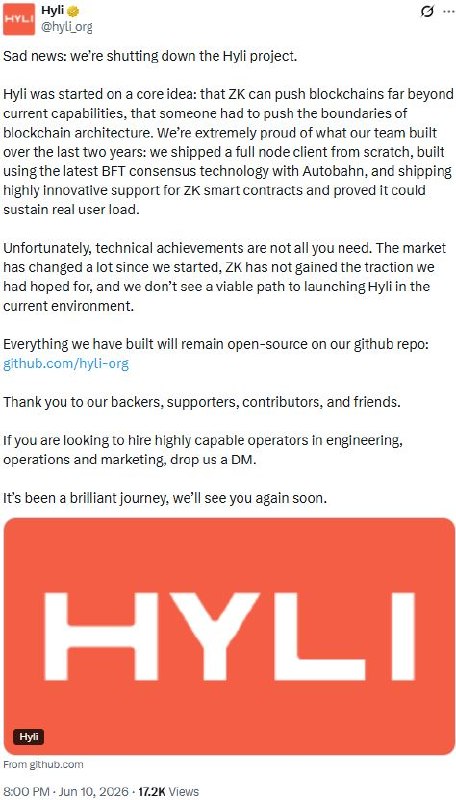 Hyli blockchain shuts down after two years of ZK innovation and raising $3.4 million in funding.2026-06
 Coinbase-backed Base activates Azul mainnet upgrade, introducing multiproof (TEE + ZK) system to push Ethereum L2 toward Stage 2 decentralization and faster withdrawals.2026-05
Zero-Knowledge (ZK) in Crypto: Technology, Use Cases, and the Road Ahead
In crypto, “ZK” is shorthand for a family of cryptographic techniques called zero-knowledge proofs, which let someone prove a statement is true without revealing the underlying data itself. This seemingly simple idea is reshaping how Ethereum and other blockchains scale, how onchain privacy works, and how future AI and payment systems might verify actions without exposing everything about the people or machines behind them.
What “ZK” Means in the Crypto Context
When crypto builders and investors talk about “ZK,” they are almost always referring to zero-knowledge proof systems and the growing ecosystem around them, rather than to a single protocol or coin. A zero-knowledge proof (ZKP) is a protocol between a prover and a verifier where the prover convinces the verifier that some statement is true—such as “I know the secret key for this account” or “this batch of transactions was processed correctly”—without revealing the secret key or the full transaction data. The only information that needs to leak is that the statement was evaluated and found valid, which is why ZKPs are often described as “proving just what’s needed, and nothing more.” In public blockchain settings where every transaction is visible by default, this data minimization unlocks both privacy and efficiency benefits.
Formally, cryptographers characterize zero-knowledge proofs with three core properties: completeness, soundness, and zero-knowledge. Completeness means that if the statement is true and both parties follow the protocol honestly, the verifier will be convinced with high probability. Soundness means that if the statement is false, a cheating prover should not be able to convince the verifier otherwise, except with negligible probability. The zero-knowledge property means that, beyond learning that the statement is true, the verifier gains no additional information about the secret input used to construct the proof. In the blockchain context, this usually translates to proofs that the state transition rules of a protocol were followed, without revealing sensitive inputs like user identities, exact balances, or full transaction history.
Within crypto, the term “ZK” has expanded to cover different proof systems and architectures. Two families dominate discourse today: zk-SNARKs and zk-STARKs, which differ in how they achieve succinctness, what security assumptions they rely on, and whether they require trusted setup ceremonies. On top of those primitives, developers are building zk-rollups, zkEVMs, and zkVMs—layer 2 networks and virtual machines that outsource computation offchain but produce succinct validity proofs that can be verified on Ethereum or other base layers. In practice, when a project advertises itself as “ZK,” it usually means that its core security or privacy guarantees are enforced through one of these zero-knowledge proof systems, rather than through simple signatures or optimistic fraud proofs.
A subtle but important point is that many ZK systems in production today are technically arguments of knowledge rather than proofs in the classical mathematical sense. zk-SNARKs, for example, are often described as Zero-Knowledge Succinct Non-interactive Arguments of Knowledge, emphasizing that they are computationally sound under certain hardness assumptions rather than unconditionally sound like a traditional proof. For users and builders, this distinction rarely changes behavior, but it matters for researchers analyzing long-term security, especially in a future where quantum computers might undermine some of today’s assumptions. All of these nuances underscore that “ZK” is less a single technology than a rapidly evolving stack of protocols, tooling, and design patterns.

XRP Ledger integrates Boundless ZK privacy so banks can transact on-chain without separate L2s
XRPL is integrating Boundless, a zero-knowledge infrastructure provider, to enable confidential-but-compliant transactions for banks and asset managers directly on the public ledger. The setup shields transaction details while letting regulators audit via selective disclosure — the pitch being institutions can "stay where the liquidity is" instead of spinning up isolated L2 environments. The move lands as the tokenized asset market hits $29.25B with 7.9% monthly growth, and follows similar privacy plays from Zama (FHE on T-REX) and zkSync's Prividium.
How Zero-Knowledge Proofs Work in Practice
The Core Cryptographic Idea
At a high level, a zero-knowledge proof protocol works by forcing the prover to respond to cryptographic challenges that can only be answered correctly if they truly know the secret witness or executed the claimed computation. The verifier does not see the witness itself, but can test whether the prover’s responses are consistent with the statement being true. If the prover is only guessing, they will almost certainly fail one of the verifier’s checks, and the protocol is designed so that cheating succeeds only with negligible probability. In interactive protocols, this involves multiple back-and-forth steps, but modern systems like zk-SNARKs compress this interaction into a single non‑interactive proof using techniques like the Fiat–Shamir heuristic.
To make this concrete in a blockchain setting, imagine a rollup operator wants to convince Ethereum that they have applied hundreds of thousands of offchain transactions correctly. Instead of submitting every intermediate state change onchain, the operator encodes the computation as an arithmetic circuit or R1CS (Rank-1 Constraint System), then uses a ZK prover to generate a succinct proof that all constraints were satisfied. Ethereum only needs to verify the proof, which is usually fast and cheap, while the heavy computation happens offchain. The same pattern applies to proving that a user has sufficient balance without revealing the balance, or that a KYC check passed without exposing the user’s identity details.
Completeness, Soundness, and Zero-Knowledge in Blockchain Terms
In a public ledger environment, the completeness property ensures that honest participants can always get their valid transactions or state transitions accepted, assuming they can generate a proof. For layer 2 systems, completeness means that as long as a sequencer or users can produce a valid zero-knowledge proof for the rollup’s state transition, Ethereum will accept the new state root as final once the proof is verified. Without completeness, users might find themselves unable to update the chain even when they follow all the rules, which would be catastrophic for liveness.
Soundness is equally critical, because it guarantees that no adversary can fabricate a proof that would trick Ethereum into accepting an invalid state transition—such as minting ETH out of thin air or double-spending a token. For zk-rollups, soundness is what lets Ethereum treat the rollup’s proof as a compact representation of all offchain activity; if the proof verifies, Ethereum can trust that the underlying transactions obeyed the protocol. This is in sharp contrast to optimistic rollups, which rely on economic incentives and fraud proofs over a challenge window, rather than on succinct validity proofs. ZK systems compress all of that dispute resolution into a single proof that should be either valid or invalid at the moment of verification.
The zero-knowledge property manifests in different ways depending on the application. In pure scalability-focused zk-rollups like many Ethereum L2s, transaction data is still published onchain, and zero-knowledge is used mainly to hide intermediate computation steps while proving correctness. In privacy-oriented designs, the proof hides user identities, balances, and transfer amounts, revealing only that certain consistency rules held. For instance, a privacy coin might prove that the sum of inputs equals the sum of outputs plus fees, without revealing which addresses were involved. New standards like pERC20 extend this approach to fungible tokens on EVM, keeping balances and counterparties private while leaving total supply public for auditability. In all of these patterns, the core benefit is the same: you prove just what is necessary to maintain security and integrity, while minimizing everything else.
zk-SNARKs vs zk-STARKs
Two of the most deployed ZK proof systems in crypto today are zk-SNARKs and zk-STARKs, which differ in efficiency, trust assumptions, and long-term security trade‑offs. zk-SNARKs, introduced in the early 2010s, provide succinct, non‑interactive arguments of knowledge with very small proof sizes and fast verification times. The acronym stands for Zero-Knowledge Succinct Non‑interactive Argument of Knowledge, capturing the fact that proofs can be verified in milliseconds, even for large computations. This efficiency has made SNARKs a popular choice for privacy chains and ZK rollups that need to keep gas costs low on Ethereum.
However, classical SNARK constructions usually require a trusted setup: a one‑time ceremony that generates public parameters for a specific circuit or set of circuits. If the secret randomness used in that ceremony is ever compromised, an attacker could theoretically forge valid-looking proofs for false statements without detection. Modern ceremonies involve elaborate multi-party computation protocols designed to destroy the toxic waste, but the requirement still introduces a governance and trust dimension that some projects wish to avoid. SNARKs also often rely on elliptic-curve pairings and knowledge-of-exponent assumptions, which are efficient but not obviously secure against large-scale quantum computers.
zk-STARKs—Zero-Knowledge Scalable Transparent Arguments of Knowledge—were introduced as an alternative design that is transparent, meaning they avoid trusted setups entirely and rely mainly on publicly verifiable randomness and hash functions. STARKs scale very well to large computations and are considered more amenable to post-quantum security, because they avoid the discrete-log problems that quantum computers can break. The trade-off is that STARK proofs are typically larger than SNARK proofs, which can increase onchain verification costs, although ongoing research continues to narrow this gap. Starknet and its associated tooling are prominent examples of STARK-based systems, and recent innovations like STRK20 tokens show how STARKs can be used for scalable privacy without fragmenting liquidity across incompatible token models.
A third emerging category is hash-based proof systems combined with zero-knowledge compilers like VEIL. Succinct’s VEIL (Verifiable Encapsulation of Interactive proofs with Low overhead) is a compiler that can add zero-knowledge properties to existing hash-based proof systems with around three percent overhead, preserving soundness and succinctness while removing reliance on elliptic-curve cryptography. Today, their SP1 zkVM uses a Groth16 SNARK wrapper for zero-knowledge, inheriting elliptic-curve assumptions, but VEIL shows a path to swap that layer out for a post‑quantum secure hash-based protocol without rewriting the entire stack. This reflects a broader trend: as ZK systems move from academic prototypes into infrastructure securing billions of dollars, design decisions are shifting toward transparency, upgradeability, and long‑term resilience.
The high-level trade-offs between these families can be summarized succinctly:
| System | Trusted setup | Typical proof size | Verification speed | Post-quantum outlook | Example uses |
|---|---|---|---|---|---|
| zk-SNARKs | Yes (usually) | Very small | Very fast | Weaker (EC-based) | zkEVM rollups, privacy pools, SP1 |
| zk-STARKs | No | Larger | Fast | Stronger (hash-based) | Starknet, STRK20s, scalable L2s |
| Hash-based + VEIL | No | Moderate | Fast | Strong (hash-based) | Post-quantum ZK, future SP1 variants |
This is an oversimplification, but for most crypto participants it captures why different projects emphasize different ZK stacks, and why the landscape evolves as hardware and protocol requirements change.
zkVMs, zkEVMs, and the Rise of General-Purpose ZK
Beyond the underlying proof systems, a key trend in the ZK world is the move toward general-purpose zero-knowledge virtual machines. A zkVM is a virtual machine whose execution trace can be efficiently proven in zero-knowledge; a zkEVM is a zkVM specifically designed to be compatible with the Ethereum Virtual Machine. Instead of writing custom circuits for each application, developers can write ordinary smart contracts or offchain programs, and the zkVM handles the translation into circuits and proof generation.
Ethereum-focused zkEVMs such as zkSync Era aim to replicate EVM semantics as closely as possible so that existing Solidity contracts can be deployed with minimal modification while proofs attest that execution followed Ethereum’s rules. zkSync Era, for example, positions itself as a zkEVM Layer 2 designed to scale blockchains “like the internet,” enabling high-speed, low-cost transactions that are still ultimately settled on Ethereum mainnet. zkEVM designs vary in how strictly they adhere to Ethereum’s opcodes and gas model, but the goal is to make ZK-powered scaling accessible to mainstream Ethereum developers rather than a specialized niche.
More general zkVMs such as SP1 aim to prove arbitrary RISC‑V or custom instruction sets, making it possible to verify offchain computations ranging from rollup state transitions to complex bridging logic and even some AI workloads. SP1 is already being used in production contexts, including by Base, which integrates SP1 to secure its Azul upgrade and move toward shorter finality and stronger security guarantees for withdrawals back to mainnet. Other zkVM projects, such as ZisK—originating from Polygon Labs as an experiment to make ZK proving faster, cheaper, and more developer-friendly—signal that the industry sees proving infrastructure itself as a competitive arena, not just the L2s built on top of it.
In practice, zkVMs and zkEVMs abstract away much of the complexity of ZK proof design. Developers target a familiar execution environment; the proving system handles the rest. This abstraction is key to making ZK “boring infrastructure,” integrated into wallets, rollups, and applications without forcing every team to become cryptography experts.
Readers click ZK stories not for the cryptography but for territorial conquest — every top headline is about ZK crossing a new border (Bitcoin, Solana, government ID, undercollateralized DeFi, Ethereum mainnet itself), revealing that the audience tracks ZK as a platform-expansion story rather than an Ethereum scaling footnote.
ZK and Ethereum Scaling
ZK-Rollups: Offchain Computation, Onchain Security
ZK-rollups are Layer 2 scaling solutions that move computation and state storage offchain while keeping Ethereum as the final arbiter of correctness. Instead of every Ethereum node re‑executing every transaction, a ZK-rollup bundles many offchain transactions into a single batch and posts a succinct proof to Ethereum that the state transition from the previous root to the new root is valid. Ethereum verifies the proof and updates a canonical commitment to the rollup’s state, inheriting Ethereum’s security without incurring its full computational cost. Because proofs are succinct, verification can be very efficient even when the underlying computation is large.
The security model of a ZK-rollup rests on two pillars. First, Ethereum must be able to reconstruct user balances or otherwise allow exits even if the rollup operator disappears or behaves maliciously, which typically requires either publishing transaction data or sufficient data to reconstruct state. Second, the zero-knowledge proof must be sound, so that no invalid state transition can be accepted as valid. In many designs, transaction data is kept public on Ethereum (for data availability) while ZK proofs compress the computation; in others, separate data availability solutions may be used, but the ZK proof always serves as a compact validity certificate.
Ethereum.org notes that ZK-rollups significantly increase throughput by offloading work from mainnet and that users benefit from lower fees and faster finality compared with transacting directly on Ethereum. Since proofs can often be verified quickly, users can gain high confidence in the correctness of the rollup’s state as soon as a proof is posted and confirmed onchain. This contrasts with optimistic rollups, where users must often wait through a challenge period of several days before withdrawals are considered final, because the system relies on fraud proofs rather than immediate validity proofs.
Major ZK Rollup Ecosystems: Starknet, zkSync, Linea, and Polygon zkEVM
Several ZK-rollup ecosystems have emerged as major players in Ethereum scaling, each making different trade-offs in their choice of ZK systems, virtual machines, and developer experience.
Starknet is a STARK-based L2 focused on scalability and composability, leveraging zk-STARKs to provide transparent, quantum-resistant validity proofs without trusted setup. Starknet’s recent initiatives, such as STRK20s and strkBTC, demonstrate how STARK-based systems can enable scalable privacy and wrapped assets without fragmenting markets across incompatible token standards. STRK20s are described as the culmination of years of ZK-STARK research, offering “scalable privacy without fragmenting markets,” while the first phase launches with strkBTC, a shielded Bitcoin representation on Starknet. With strkBTC, users can bridge BTC from mainnet into Starknet, optionally shield it for private transfers, and even stake it via protocols like Endur, with privacy capabilities activated through wallets that manage shielded balances. This architecture combines L2 scalability with opt‑in transaction privacy, all anchored by STARK proofs on Ethereum.
zkSync Era is a zkEVM L2 designed to scale Ethereum “like the internet,” emphasizing EVM compatibility so that existing Ethereum projects can deploy with minimal changes. Dune Analytics characterizes zkSync Era as a Layer 2 zkEVM where EVM projects can “easily take advantage of high-speed, low-cost” transactions, with validity proofs providing security guarantees. The ecosystem has experimented with governance and incentives via the $ZK token, including staking and delegation programs; for instance, a staking pilot season saw hundreds of millions of tokens staked and over a billion delegated, underlining both user interest and the governance risks attached to ZK infrastructure tokens. As with other zkEVMs, zkSync’s core challenge is delivering a sufficiently EVM-like environment while maintaining efficient provability.
Linea, developed by Consensys and later stewarded by the Linea Consortium, is another zkEVM rollup emphasizing enterprise adoption and open governance. In a notable move for the open-source ZK ecosystem, the Linea Consortium contributed its ZK rollup stack to the Linux Foundation’s Decentralized Trust (LFDT) initiative, placing the codebase under vendor-neutral governance. This shift aims to foster a broader developer community, encourage institutional adoption, and ensure that the core ZK infrastructure is maintained transparently and collaboratively, rather than being tied to a single company. For enterprises wary of opaque cryptography stacks, such governance moves may be as important as technical features.
Polygon zkEVM launched in 2023 as an Ethereum L2 ZK rollup designed for faster finality and lower fees, but is now being sunset after more than three years of operation. Polygon has shifted its strategic focus, and adoption of the chain remained relatively modest compared with other parts of the Polygon ecosystem, leading to a planned shutdown set for July 1, 2026. This episode highlights a key reality of ZK scaling: not all experiments will achieve lasting traction, even when backed by capable teams. For users and DeFi protocols like QuickSwap that built on Polygon zkEVM, the sunset process involves advising on bridging funds and migrating liquidity to other Polygon or Ethereum networks. The lesson for the broader ZK landscape is that technical sophistication alone does not guarantee network effects; developer and user adoption still decide which solutions endure.
Hybrid Proofs and Faster Finality: Base and SP1
The boundary between optimistic and ZK rollups is also becoming more fluid, as projects blend techniques to balance performance, developer experience, and security. Coinbase-backed Base, built using the Optimism stack, has historically inherited the optimistic rollup model with a roughly seven-day withdrawal period to mainnet. However, with its Azul upgrade, Base is integrating Succinct’s SP1 zkVM and a multiproof system combining both ZK proofs and trusted execution environment (TEE) proofs to speed up withdrawals and strengthen security.
Succinct’s documentation explains that SP1 is used to generate ZK proofs for Base Azul, and that when a withdrawal proposal is backed by both a ZK proof and a TEE proof, Base can drop the finality window from seven days to about one day. The ZK proof certifies that the offchain state transition logic was executed correctly, while the TEE proof adds an additional attestation from a secure enclave, with the combination unlocking faster finality and stronger safety guarantees. As a result, Base moves closer to so‑called “Stage 2” decentralization in the rollup maturity framework, with more robust security and reduced reliance on social trust or centralized operators.
This approach illustrates a broader trend: even rollups designed as “optimistic” are increasingly adopting ZK proofs in their security stack, whether for bridging, fraud proof compression, or eventual migration to full validity rollups. For users, the key takeaway is that ZK is not an all-or-nothing choice; it can be layered into existing architectures to improve specific properties such as withdrawal times, censorship resistance, or trust minimization.
Ethereum’s Path Toward a ZK-Centric Protocol
Beyond individual L2s, Ethereum’s core community increasingly sees zero-knowledge proofs as a foundational technology for the protocol’s long-term roadmap. Ethereum.org highlights that ZKPs are already being used in scaling solutions like ZK-rollups and privacy protocols, and that their ability to compress large computations into succinct proofs makes them critical for Ethereum’s ambition to support “millions of users and transactions per second” without sacrificing decentralization. In research circles, concepts like stateless clients, Verkle trees, and validity-proof-based consensus suggest an Ethereum where client nodes need not store or execute the entire state, but can instead verify ZK proofs about state transitions.
The Ethereum Foundation’s Ecosystem Support Program reflects this emphasis by funding a wide range of ZK and cryptography projects, from core client teams and validator security initiatives to developer tooling and applied research. The ESP catalog lists numerous funded efforts in areas like protocol-level cryptography, zkEVM development, and ZK-enabled privacy tools, indicating an ecosystem-level commitment to maturing ZK infrastructure. In Q1 2026, the Foundation is reported to have doubled down on such grants, directing resources toward teams building the “next generation of Ethereum infrastructure” centered on zero-knowledge and related primitives.
Prominent voices such as Vitalik Buterin have argued that ZK payments and validity proofs will be essential in an “agentic era” where AI agents transact on users’ behalf. In remarks covered by industry outlets, Buterin suggested that ZK‑based payment systems could become the standard for crypto payments, enabling AI and human users alike to transact with robust privacy while preserving verifiability. Combined with the growth of zkEVMs and zkVMs, this points to a future where ZK is not just a scaling add‑on but a lens through which many layers of the Ethereum stack—from consensus to execution to user-facing applications—are designed.

DL Research maps Web3 privacy landscape, showing how ZK, FHE, and MPC each solve different problems while exposing trade-offs shaping the future of secure on-chain systems
ZK for Privacy: Payments, Tokens, and Identity
Why Privacy on Public Blockchains Needs ZK
Public blockchains like Ethereum and Bitcoin offer global transparency by default: anyone can inspect addresses, balances, and transaction histories. While this openness underpins auditability and composability, it also creates privacy and security risks, ranging from transaction surveillance by adversaries to de‑anonymization of individuals through onchain analysis. Zero-knowledge proofs offer a way to reconcile these competing demands by allowing participants to prove that they followed protocol rules without revealing sensitive details. In privacy-preserving payment systems, for example, ZKPs can prove that funds were not double spent and that balance constraints hold, while hiding who paid whom and how much.
In practice, ZK privacy systems often work by encrypting or commitment-binding sensitive data and then providing a proof that the ciphertexts or commitments satisfy certain relations. The verifier checks the proof without learning the underlying plaintexts. For fungible assets, this typically translates to UTXO-like note models or shielded pools where notes represent claims on value; proofs show that notes were created and destroyed consistently. For identity and KYC, ZK credentials can attest that a user has passed an offchain verification or belongs to a given jurisdiction or age group, without revealing their name, ID number, or specific documents. In each case, zero-knowledge is the mechanism that turns “trust me” claims into mathematically verifiable statements.
Shielded Assets and ZK Payments: Starknet’s strkBTC and Beyond
Shielded asset systems like Starknet’s strkBTC show how ZK proofs can be layered into L2 environments to provide opt‑in privacy for familiar assets like Bitcoin. According to Starknet’s user guide, users can bridge BTC from the Bitcoin mainnet into strkBTC on Starknet via supported bridges, requiring a Bitcoin wallet and a Starknet-compatible wallet. Once bridged, strkBTC behaves as a Starknet token that can be kept public, swapped, or shielded for private use through wallets that support Starknet’s privacy capabilities.
Wallet interfaces such as Xverse and Ready allow users to toggle a privacy mode, activate shielded capabilities (which requires holding a small amount of STRK to pay network fees), and then select how much strkBTC to shield. After activation, shielded balances appear alongside unshielded balances, and users can transfer, unshield, or manage these assets within the private mode. The underlying mechanism relies on ZK proofs and a shielded pool architecture, so that transfers between shielded addresses can be validated by the network without publicly revealing amounts or counterparties, while still allowing the total supply and high-level system integrity to be audited.
StarkWare describes STRK20s as the culmination of years of ZK-STARK innovation, delivering scalable privacy “without fragmenting markets.” The aim is to offer privacy-native tokens that remain fungible with their public counterparts and interoperable within the broader Starknet ecosystem, rather than splitting liquidity between separate privacy coins and public tokens. This approach mirrors efforts on Ethereum to design standards where privacy is a property of the token’s transfer mechanism rather than the defining feature of an isolated network.
At the conceptual level, Vitalik Buterin’s advocacy for ZK payments as a probable standard in the crypto and AI agent era underscores the strategic role of privacy-preserving transfers. In an environment where AI agents may manage funds and transact autonomously, the ability to prove correctness and compliance while hiding sensitive metadata may become a necessity rather than a luxury. However, as examples like the shutdown of Hyli—a ZK blockchain project that wound down after two years, citing weak demand for zero-knowledge technology—show, user appetite for fully private chains remains uneven. For now, opt‑in mechanisms layered onto popular L2s and standard tokens may prove more attractive than asking users to move wholesale to separate privacy networks.
Privacy-Native Tokens: The pERC20 Proposal
On the EVM side, a notable development is the pERC20 proposal (EIP‑8287), which defines a standard interface for privacy-native fungible tokens using zero-knowledge proofs. The draft specification describes pERC20 as a token model where balances and transfer amounts are private by default, implemented via encrypted UTXO notes and ZK proofs, while keeping the total supply publicly verifiable. The design borrows from the Orchard protocol used in Zcash, adapting it to Ethereum via Groth16 SNARKs and an Orchard-style shielded note model.
Under pERC20, each token exists as an encrypted note from issuance onward, and transfers involve proving in zero-knowledge that the spender controls the notes, that the sum of inputs equals outputs plus fees, and that no double spends occur. Crucially, the standard introduces a compliance frozen root, a Merkle root maintained by the asset contract that can mark blacklisted notes as unspendable. All pERC20 notes must bind to this root, enabling issuers or regulators (depending on governance) to enforce blacklists while preserving transactional privacy for compliant users. This mechanism aims to bridge the gap between privacy and regulatory requirements, allowing privacy-preserving tokens that still support sanctions enforcement or AML controls.
The pERC20 proposal illustrates a broader pattern in ZK privacy: rather than offering unconditional anonymity, modern designs often bake in configurable compliance hooks. For some privacy advocates, this is an uncomfortable compromise. For institutions and regulated entities considering onchain assets, however, such features may be a prerequisite. As privacy and compliance narratives evolve, ZK frameworks that are flexible enough to support both “max privacy” and “compliant privacy” configurations may find broader adoption.
ZK KYC, Decentralized Identity, and Compliance Tensions
ZK-based KYC and decentralized identity systems sit at the frontier of privacy and regulation. In principle, a user could undergo a traditional KYC process with a trusted provider, then receive a zero-knowledge credential that proves attributes like age, residency, or accreditation status without exposing their name or full documentation. Onchain, the user can present ZK proofs derived from this credential to access services that require KYC, while keeping their personal details off the public ledger. This model promises reduced data exposure for individuals and reduced data storage liabilities for service providers.
However, such systems also raise new compliance questions. Regulators and financial institutions are used to audit trails where identities can be subpoenaed or traced through intermediaries. When ZK KYC is combined with non‑custodial wallets and decentralized protocols, the traditional control points become blurry. If credentials are fully anonymous and unlinkable, supervisory bodies may worry that ZK KYC becomes a fig leaf rather than a robust compliance mechanism. Conversely, if credentials include backdoors for de‑anonymization, privacy promises may erode.
These tensions are already reflected in discussions around ZK KYC and decentralized identity in 2026, with some institutions expressing concern that such tools, if widely adopted without clear regulatory frameworks, could complicate AML and sanctions enforcement. The pERC20 approach, with its compliance frozen root and blacklisting capabilities, is one attempt to square this circle by combining private transfers with regulatory levers. Whether these hybrid models satisfy both privacy advocates and regulators remains an open question, but zero-knowledge cryptography gives protocol designers a richer toolbox for nuanced solutions than the binary choice between full transparency and opaque black-box systems.
- 01ZK rollups reaching Bitcoin↗
The single most-clicked headline — Chainway and Kasar Labs racing to port ZK rollups to Bitcoin — signals readers see ZK as the credible path to making Bitcoin programmable without touching its base layer.
- 02ZK privacy on Ethereum mainnet↗
Research proposing ZK-native privacy directly on Ethereum mainnet (not quarantined to L2) drew the second-highest clicks because it would fundamentally alter Ethereum's default transparency model.
- 03ZKsync token launch and ecosystem politics↗
The 3.6B ZK airdrop, Binance listing, Matter Labs trademark grab, and a transaction spike that collapsed within days formed a single reader thread about who controls ZK infrastructure and who benefits.
- 04ZK enabling undercollateralized DeFi
3Jane using ZK proofs to verify real-world credit scores and issue revolving credit lines without collateral showed readers ZK unlocking a DeFi category that has been structurally impossible for years.
- 05ZK government identity and its risks
Buenos Aires deploying ZK-backed digital ID for 3.6 million citizens drew clicks alongside Vitalik's warnings about coercion risks, framing government ZK identity as simultaneously a breakthrough and a surveillance surface.
- 06ZK compression and bugs on Solana↗
ZK Compression launching on Solana and the ZK ElGamal zero-day (which risked infinite token minting) together showed readers that ZK's spread to non-EVM chains brings both new capabilities and chain-specific attack surfaces.
ZK, Hardware, and the AI Connection
Why Proving Performance Matters
Zero-knowledge proofs are computationally intensive to generate, even if verification is fast. For large rollups or complex applications, generating proofs can be a bottleneck, both in terms of latency and cost. Provers must evaluate large arithmetic circuits or constraint systems, perform multi‑scalar multiplications and FFTs over finite fields, and commit to polynomials or traces with Merkle trees and FRI protocols. While many operations parallelize well, they still demand significant CPU, GPU, or specialized hardware resources. In practice, this means that ZK systems face a constant trade‑off between proof size, proving time, and verification cost.
As ZK rolls out to more use cases—L2 scaling, privacy pools, verifiable AI inference—the demand for efficient proving infrastructure rises sharply. For Ethereum, ZK scalability hinges on the ability of L2s to generate proofs quickly enough to keep up with transaction volume, especially during spikes. For AI, verifiable compute frameworks may need to prove that a large model was executed correctly, which can be orders of magnitude more expensive than the inference itself. Proving performance thus becomes not just an engineering concern but a fundamental limiter on which ZK applications are economically viable.
ZK and AI-Native Hardware: OpenForge, FiLabs, and ComputeFi
Recognizing these constraints, hardware-focused teams are designing chips and accelerator architectures tuned for ZK workloads, often overlapping with AI hardware design. Projects like OpenForge and FiLabs exemplify this convergence, promoting “AI-native chip design” aimed at both ZK and AI hardware acceleration. In social updates, Cysic and others have highlighted collaborations to push “ZK and AI hardware to the next level,” arguing that chips designed with AI-style parallelism and memory hierarchies can also accelerate the polynomial operations and hash computations central to many proof systems.
The idea aligns well with how both ZK proving and modern AI rely on large-scale linear algebra, dense arithmetic, and high-throughput memory access. While the specific operations differ—matrix multiplications for AI versus FFTs and elliptic-curve operations for ZK—the underlying need for parallelism and bandwidth is shared. By co‑designing hardware for both workloads, chip makers hope to amortize development costs and tap into the broader AI hardware market while serving emerging demand from ZK rollups, zkVM providers, and privacy protocols.
The concept of ComputeFi, where computing power (including ZK proving capacity) becomes a financialized resource, further motivates specialized ZK + AI hardware. In such models, provers and AI inference providers could earn fees by contributing compute to decentralized networks, with hardware optimized to maximize proofs or inferences per watt. For ZK in particular, efficient hardware may determine whether certain applications—like per‑transaction proofs for consumer payments or complex AI verification—are feasible within acceptable latency and cost constraints.
zkVMs as Shared Proving Infrastructure: SP1 and ZisK
On the software side, zkVMs like SP1 and ZisK are emerging as shared proving backbones for multiple chains and applications. SP1 is a general-purpose zkVM that executes programs and produces ZK proofs attesting to their correct execution, currently using a Groth16 SNARK wrapper for zero-knowledge. It has been adopted in contexts such as Base’s Azul upgrade, where SP1-generated ZK proofs undergird the multiproof system used for faster withdrawals and improved security. Notably, SP1 was used by Google in generating certain ZK proofs, underscoring its maturity and performance characteristics in high-profile deployments.
ZisK, which started as an internal experiment at Polygon Labs, aims to make ZK proving “faster, cheaper, and worth building on,” positioning itself as a zkVM or proving environment that developers can rely on without reinventing the wheel. By focusing on developer experience and performance, projects like ZisK hope to lower the barrier to entry for teams that want to integrate ZK guarantees into their applications but lack deep cryptographic expertise. Instead of constructing bespoke circuits, developers write code in high-level languages; the zkVM compiles and proves the execution.
The long-term vision is that zkVMs become standardized infrastructure: rollups, bridges, oracles, and AI verification frameworks can all outsource proving to shared zkVM stacks that are heavily optimized and audited. This would mirror how Ethereum itself standardized the execution environment via the EVM, enabling a vast ecosystem of tooling and contracts. In a ZK‑native future, the zkVM layer could be equally central.
Post-Quantum ZK with VEIL
As ZK infrastructure secures more value, concerns about long-term cryptographic assumptions grow. Many popular SNARK constructions depend on elliptic-curve pairings and assumptions that could be broken by large-scale quantum computers, even if such machines remain speculative in the near term. Migrating protocols like Ethereum wholesale to post-quantum security is a “herculean task,” given the number of signatures, handshakes, and proofs that would need to be changed without breaking compatibility.
Succinct’s VEIL project offers one promising path for making ZK systems more post-quantum-ready without rewriting everything from scratch. VEIL is described as a compiler that adds zero-knowledge to existing hash-based proof systems with around three percent overhead, yielding protocols that reveal nothing about the witness while preserving soundness and succinctness. Importantly, hash-based proof systems rely on collision-resistant hash functions rather than elliptic curves, making them more robust against quantum attacks if strong hash functions remain secure.
Today, SP1’s zero-knowledge layer depends on a Groth16 SNARK wrapper, but VEIL shows how that layer could be swapped for a hash-based scheme in the future, helping Ethereum-style rollups adopt post-quantum ZK gradually. For Ethereum and other long-lived chains, such upgrade paths are essential: redeploying all L2 contracts and proof verifiers once quantum attacks become practical would be extremely risky. By investing in post-quantum-compatible ZK infrastructure now, the ecosystem can reduce the future migration burden and ensure that ZK remains a security asset rather than a liability.
ZK for AI Verifiability and the Agentic Era
Beyond scaling and privacy, ZK proofs are increasingly discussed in the context of AI verifiability. As AI models grow more powerful and AI agents become more autonomous, there is a risk that users will have to trust opaque systems without any way to verify that an AI followed prescribed rules or used approved data. ZK proofs offer a way for AI systems to attest that they executed a specific model, used a certain dataset, or adhered to policy constraints, without revealing proprietary model weights or sensitive inputs.
Industry voices such as Leo have argued that decentralized AI should not be judged solely on latency, because verifiability and trustworthiness will matter more than shaving off milliseconds of response time. This logic underpins Cysic’s work on ZK infrastructures tailored for AI and high-performance proving, as well as broader efforts to combine ZK and AI-native chips. In parallel, Vitalik Buterin’s vision of an AI agent economy on Ethereum, where ZK payments and proofs protect user privacy and integrity, positions zero-knowledge as a key bridge between crypto and AI.
Practically, ZK proofs could allow users to verify that an AI agent executed a transaction strategy within defined risk limits, that a content-generation model adhered to copyright rules, or that a recommendation system did not use disallowed features, all without exposing the full decision process. In content authenticity, projects like Brevis’s Vera point toward browser-verifiable ZK proofs attached to media, enabling users to verify provenance via standards like C2PA without exposing unnecessary identity data. While many of these applications are early-stage, they illustrate how “ZK + AI” is more than a buzzword: it is a response to genuine verification problems that will only intensify as AI systems take on more responsibility.
LayerZero unveils Akita, a lattice-based commitment scheme that shrinks ZK proofs by 2-8x while adding post-quantum security
ZK in Practice: Ecosystem Lessons
Ethereum and Foundation Support
Ethereum’s core documentation describes zero-knowledge proofs as a method by which a prover can convince a verifier that something is true without revealing any information beyond the truth of the statement. The Ethereum community has embraced ZK not as an optional add‑on but as a foundational scaling and privacy technology, as evidenced by the proliferation of ZK rollups and privacy research funded through the Ethereum Foundation’s Ecosystem Support Program. ESP-funded projects span core protocol development, client diversity, validator security, and ZK-focused infrastructure and tooling. This ecosystem-level investment signals a long-term bet that ZK will be integral to Ethereum’s future performance and user experience.
Consumer Apps and Wallet UX
ZK technology is also filtering into user-facing applications, often abstracted behind wallet interfaces and simple toggles. Starknet’s strkBTC workflow, for example, requires users to connect Bitcoin and Starknet wallets, bridge BTC into strkBTC, and optionally activate privacy features through wallet UIs like Xverse. Activating shielded capabilities is a one-time action requiring STRK for fees; afterward, users can see shielded and unshielded balances and manage transfers in “private mode.” Behind the scenes, ZK proofs enforce the integrity of shielded transfers, but the user experience is designed to feel as familiar as any token transfer, with privacy as a configurable feature.
Similar patterns appear on Solana, where moves like Helius acquiring Light Protocol aim to make privacy a first-class feature in the ecosystem after the introduction of ZK compression techniques. While technical details and implementations vary, the guiding principle is consistent: hide the complexity of proofs and circuits, present intuitive controls, and ensure that privacy options integrate seamlessly with DeFi and other onchain activities.
DeFi, Staking, and Governance
DeFi protocols are also experimenting with ZK-secured infrastructure and governance. ZKsync Era’s staking pilot, for example, involved hundreds of millions of $ZK tokens staked and over a billion delegated, reflecting both user interest and the governance weight attached to ZK-layer infrastructure tokens. At the same time, such concentrations of stake and delegation raise questions about decentralization, upgrade governance over proving systems, and the risk of economic capture in critical ZK components.
On the infrastructure side, Base’s adoption of ZK finality via SP1 demonstrates how ZK can enhance DeFi security by reducing withdrawal times and strengthening cross-chain guarantees. Faster validity proofs reduce users’ exposure to bridge risk and operator failures, which have historically been a major source of exploits in DeFi. As more L2s and bridges adopt ZK proofs or multiproof designs, users may come to expect proof-backed finality guarantees instead of long challenge periods and implicit trust in operators.
Multi-Chain Privacy Stacks and Enterprise Adoption
Multi-chain privacy stacks like COTI’s dual-privacy architecture illustrate how ZK is being packaged for enterprise and cross-chain use. COTI’s stack combines high-performance garbled circuits with ZK rollup technology (via Nightfall) to provide “privacy on demand” across Ethereum and other L1s and L2s. Garbled circuits are an older but powerful cryptographic tool for secure multi-party computation, and combining them with ZK rollups enables use cases where some logic is computed jointly and privately offchain, while proofs of correctness anchor results onchain. The result is a configurable privacy layer that enterprises can adopt without being locked into a single network or token.
Linea’s decision to contribute its ZK rollup stack to the Linux Foundation’s Decentralized Trust initiative similarly targets enterprise and institutional audiences. By placing the code under vendor-neutral, open governance, Linea aims to reassure potential adopters that the ZK infrastructure they rely on will be maintained transparently, with community input and rigorous open-source processes. For institutions wary of opaque cryptographic implementations or single-vendor dependencies, such governance moves may be as important as technical benchmarks.
Market Realities: Failures and Sunsets
Despite the excitement around ZK, not every project succeeds. The shutdown of Hyli, a ZK blockchain project that operated for two years and raised significant funding, underscores that demand for zero-knowledge technology can lag behind technical promise. Hyli’s team cited weak demand for ZK as a factor in winding down, suggesting that user acquisition and ecosystem growth remain challenging for standalone ZK chains, especially when mainstream networks are adding privacy and ZK features as opt‑in layers.
The planned sunset of Polygon zkEVM after more than three years, driven by Polygon’s strategic pivot and relatively slow adoption of the chain, offers a related lesson. Even technically sound ZK rollups can struggle to achieve critical mass if developer and user attention consolidates around other ecosystems or architectures. For users and protocols, these examples highlight the importance of evaluating not only the cryptographic underpinnings of ZK projects, but also their long-term sustainability, governance, and ecosystem traction.
ZKsync Era mainnet launch
- 2024-04launch
OKX X Layer ZK rollup (built on Polygon CDK) goes live on mainnet
ZKsync airdrop of 3.6B ZK tokens to 695,232 eligible wallets
Binance opens spot trading for ZKsync (ZK)
Matter Labs applies to trademark 'ZK' in 9 countries; StarkWare publicly objects
- 2024-08exploit
Solana ZK ElGamal infinite-mint zero-day quietly patched by validators before exploit
Ethereum Foundation discloses $32.65M Q1 2025 grants, with ZK proofs as a primary category
Risks, Limitations, and Misconceptions
Cryptographic and Implementation Risk
Zero-knowledge systems rely on complex cryptographic constructions, many of which are relatively young compared with classical primitives like signatures or hash functions. SNARKs, for instance, often depend on structured reference strings generated in trusted setups and on algebraic assumptions that could be broken if the setup is compromised or if new attacks are found against the underlying curves. STARKs reduce these risks by using transparent setups and hash-based security, but they still rely on the unproven assumption that the chosen hash functions resist all practical attacks.
Implementation risk is equally serious. Bugs in circuit design, proof verification, or encryption logic can undermine soundness or privacy even if the cryptographic theory is correct. A flaw in a shielded pool’s logic, for instance, could allow undetected inflation or deanonymization of users. Because ZK systems compress a lot of complexity into small artifacts, errors can be hard to detect and may persist unnoticed until exploited. This is why audits, formal verification, and open-source transparency are particularly critical in ZK infrastructure, and why moves like Linea’s contribution to LFDT carry security as well as governance implications.
UX and Fragmentation Challenges
From a user perspective, ZK systems can introduce new UX challenges. Shielded transactions often require additional steps: activating privacy, managing two balances (shielded and unshielded), and paying extra fees for proof generation. When different chains or protocols adopt different ZK stacks and token standards, liquidity can fragment between privacy-enabled and non‑privacy pools. Designs like STRK20s explicitly aim to avoid such fragmentation by ensuring that privacy-native tokens remain fungible and integrated with their broader ecosystems. Similarly, standards like pERC20 aspire to offer a uniform interface for privacy-friendly tokens across EVM chains.
Nevertheless, navigating multiple ZK L2s, each with distinct wallets, bridges, and privacy models, can be confusing for users. Developers face a similar fragmentation: SNARK vs STARK vs zkVM vs zkEVM, each with its own tooling, performance profile, and verification costs. Over time, consolidation around a smaller set of robust, well-supported ZK stacks may alleviate this complexity, but in the near term, fragmentation remains a practical obstacle to mass adoption.
Regulatory and Compliance Uncertainty
ZK-powered privacy and identity solutions inhabit a gray area in many regulatory regimes. While privacy-preserving technologies can enhance security and reduce data exposure, they can also complicate traditional compliance processes. Regulators worry that fully anonymous ZK systems might facilitate illicit finance, while privacy advocates push back against architectures that embed blacklisting or backdoor de‑anonymization. Hybrid designs like pERC20’s compliance frozen root attempt to reconcile these pressures by enabling blacklisting of specific notes while keeping most transactional details private, but their acceptability to regulators is still evolving.
ZK KYC and decentralized identity add further complexity. If credentials are too opaque, regulators may not consider them adequate substitutes for traditional KYC; if they include easily triggered de‑anonymization mechanisms, they may undermine user trust. In addition, the jurisdictional diversity of onchain participants makes it difficult to design one-size-fits-all compliance layers. In this environment, developers need to think carefully about how they position ZK privacy features and which governance models they adopt for compliance primitives like blacklist roots, TEEs, or de‑anonymization keys.
Misconceptions: “ZK = Total Anonymity” and “ZK = Just Scalability”
Two opposite misconceptions often appear in conversations about ZK. The first is that any “ZK” project provides total anonymity. In reality, many ZK rollups use zero-knowledge proofs primarily for scalability, publishing full transaction data onchain and proving only that state transitions are valid. Users of such rollups enjoy lower fees and sometimes faster finality, but their transaction graphs remain publicly visible. Privacy-focused systems like strkBTC or pERC20-based tokens add additional layers—encryption, shielded pools, and ZK range or membership proofs—to hide metadata. It is important for users to distinguish between ZK for scalability and ZK for privacy, and not assume that every ZK-powered platform automatically hides their activity.
The second misconception is that ZK is only about scaling Ethereum and other chains, with privacy as a niche application. While it is true that ZK scalability is currently a primary driver of adoption, the technology’s ability to provide selective disclosure and verifiable compute has broad implications beyond throughput. ZK enables new forms of identity, compliance, AI verification, and cross-domain proofs (such as proving something about offchain data or another chain’s state without revealing the data itself). As AI agents, IoT devices, and enterprises increasingly interact with onchain systems, these verification capabilities may become as important as raw transaction capacity.
Outlook
Zero-knowledge technology has moved from cryptographic theory to production infrastructure securing billions of dollars in value and underpinning some of the most ambitious scaling and privacy efforts in crypto. Ethereum’s embrace of ZK rollups and zkEVMs, coupled with the Ethereum Foundation’s sustained funding of ZK research and tooling, suggests that the protocol’s long-term roadmap will lean heavily on validity proofs at multiple layers. At the same time, the rise of zkVMs like SP1 and ZisK, the push toward post-quantum ZK via VEIL, and the emergence of AI-native ZK hardware all point to a future in which proving systems are as ubiquitous and standardized as digital signatures are today.
In the near term, users can expect to see more L2s integrating ZK either as full validity rollups or as hybrid systems that shorten withdrawal times and strengthen bridge security, as in Base’s multiproof design. Privacy will likely shift from isolated “privacy coins” toward opt‑in features embedded in mainstream ecosystems, exemplified by strkBTC on Starknet, COTI’s privacy-on-demand stack, and EIP‑8287’s pERC20 standard. Compliance-aware ZK primitives like blacklisting roots and ZK KYC attestations will continue to evolve, as regulators and builders negotiate how to balance user privacy with legal obligations.
The intersection of ZK and AI may become one of the most consequential frontiers. As AI agents increasingly transact onchain and generate content or decisions that have financial and reputational stakes, ZK proofs offer a way to make those actions verifiable without exposing proprietary models or sensitive data. Vitalik Buterin’s vision of ZK payments in an AI-driven agent economy captures this shift: ZK is not just making blockchains faster; it is redefining what it means to trust computations and transactions in a digital world.
Yet the journey will not be linear. Projects like Hyli and the sunset of Polygon zkEVM illustrate that not every ZK experiment will succeed in the market, and that user experience, governance, and ecosystem fit are as important as elegant cryptographic constructions. The next phase of ZK’s evolution will likely involve consolidation around a few robust stacks, better UX abstractions that hide proving complexity from end users, and deeper integration with both Ethereum mainnet and adjacent systems like Solana and cross-chain protocols.
For a crypto news audience, the key takeaway is that “ZK” is no longer just a research buzzword. It is a rapidly maturing pillar of the onchain world, reshaping Ethereum’s scaling roadmap, redefining privacy expectations, enabling new identity and compliance models, and laying the groundwork for verifiable AI and agentic systems. Understanding the basics of zero-knowledge proofs, how different ZK stacks trade off trust and performance, and where ZK is being integrated into L1s, L2s, and applications will be increasingly essential for anyone tracking the future of crypto.
Latest ZK news
XRP Ledger integrates Boundless ZK privacy so banks can transact on-chain without separate L2sDL Research maps Web3 privacy landscape, showing how ZK, FHE, and MPC each solve different problems while exposing trade-offs shaping the future of secure on-chain systemsLayerZero unveils Akita, a lattice-based commitment scheme that shrinks ZK proofs by 2-8x while adding post-quantum securityLinea contributes its ZK rollup stack to Linux Foundation’s LFDT, shifting governance to an open-source model while aiming to attract enterprise and institutional adoption Veil launches privacy layer for Base with ZK-powered ETH and USDC pools, private tokenized stocks and non-custodial infrastructure for verified usersRolly unveils rolly.io, a ZK-powered casino and sportsbook with non-custodial, no-KYC access to Tier-1 games, promising provably fair, trustless onchain betting
Sources
20 records from 11 domains
chain.link
ethereum.org
dune.com
starknet.io
lfdecentralizedtrust.org
blog.succinct.xyz
x.com
- x.com· SuccinctLabs / with_replies
- x.com· 0xPolygon / status / 2068034055703351664
- x.com· cysic_xyz / status / 2065109313056903322
- x.com· QuickswapDEX / article / 2059282449062850874
- x.com· COTInetwork / status / 2039743697676374184
- x.com· StarkWareLtd / status / 2054151637325709346
- x.com· zksync / status / 2053895735079518254
thedefiant.io
ethresear.ch
esp.ethereum.foundation
facebook.com
Community notes
Spot something off or out of date? Drop a note. Editors review topic notes daily and roll accepted fixes into the explainer — contributors are recognized in the monthly $SQUID drop.
Loading notes…
Help improve this topic
Have a story or tip about this topic? Submit it. See something missing? Leave a note. Editors review daily; accepted submissions and fixes count toward the monthly $SQUID drop.