
Roman Storm, co‑founder of Ethereum mixer Tornado Cash, faces precedent‑setting U.S. charges over non‑custodial privacy code. This explainer unpacks his trial, Tornado Cash’s design, legal theories, community response, and what it all means for DeFi builders.
- x.com15
- theblock.co4
- dlnews.com4
- coindesk.com2
- coincenter.org1
- section1960.defieducationfund.org1
- governance.aave.com1
+4 sources across the wider coverage universe
 Prosecutors reject Roman Storm's copyright defense as 'outright misdirection,' push for Tornado Cash retrial2026-04
 Judge rebukes Tornado Cash prosecutor at Roman Storm hearing, weighs acquittal on all counts2026-04
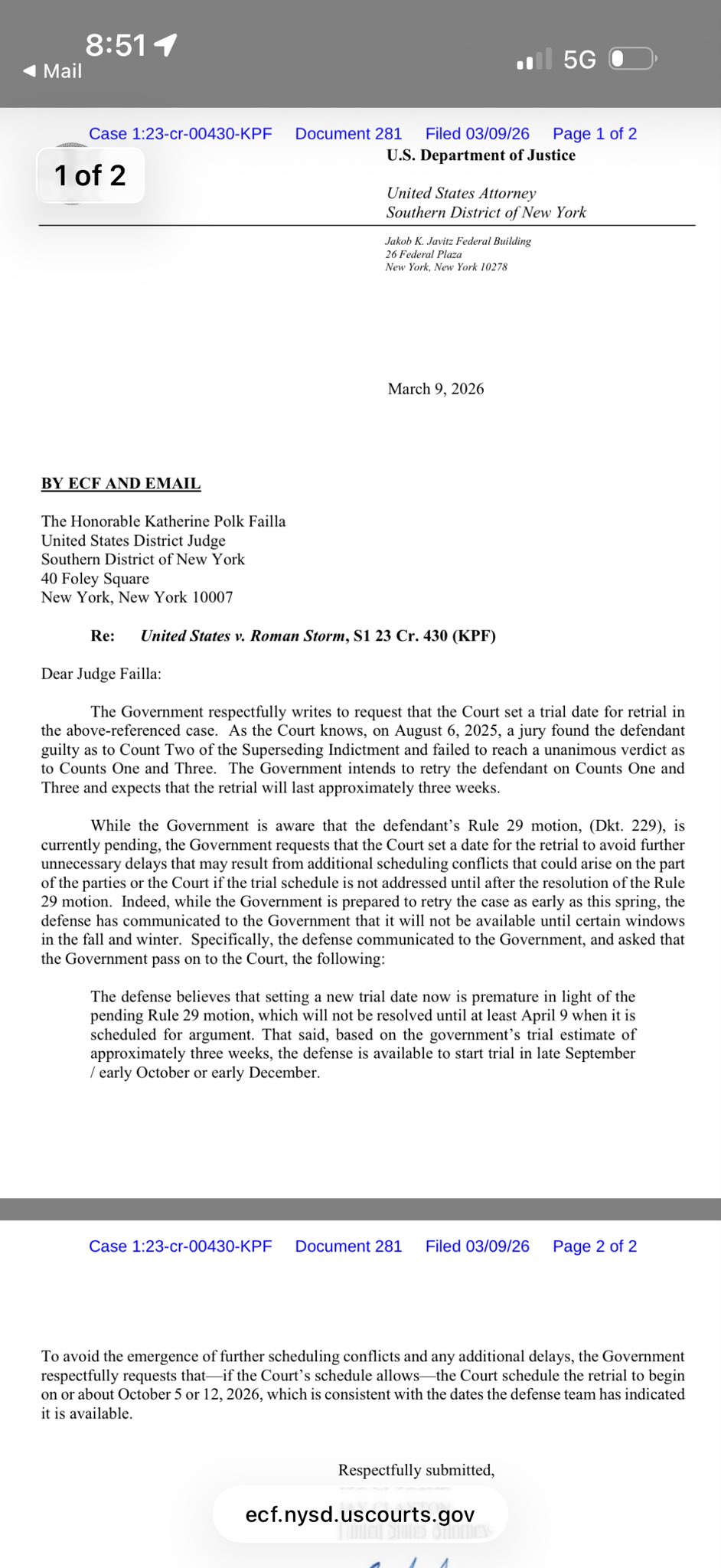 DOJ to retry Roman Storm in the fall on key counts despite prior jury failure and criticized evidence handling, sparking outrage over crypto privacy, mixers, and aggressive prosecution tactics2026-03
 Write a letter for Roman, write a letter for freedom!2026-01
 If you want to, take a few minutes, and write a letter of care and freedom, a letter to Roman Storm2026-01
 Judge grants delay in Tornado Cash Founder Roman Storm’s trial2024-07
Roman Storm: Tornado Cash, Developer Liability, and the Future of Crypto Privacy
Roman Storm is a software developer and co‑founder of Tornado Cash, a non‑custodial Ethereum privacy protocol whose legal treatment has placed him at the center of a landmark U.S. criminal case about how the law applies to open‑source code, crypto mixers, and decentralized finance (DeFi). His prosecution has become a flashpoint in the broader debate over whether building and publishing privacy‑enhancing smart contracts can be criminalized as operating an unlicensed money‑transmitting business or facilitating money laundering and sanctions violations.
Who Is Roman Storm?
Roman Storm is best known in the crypto world as one of the co‑founders of Tornado Cash, a set of smart contracts on Ethereum designed to improve transactional privacy by breaking the on‑chain link between sending and receiving addresses. Public biographical details describe him as a developer deeply embedded in the Ethereum and DeFi ecosystems, where he contributed to open‑source projects long before Tornado Cash became a household name in crypto policy circles. Within that community he has often been presented less as a traditional fintech founder and more as a protocol engineer, emphasizing that Tornado Cash was intended as permissionless infrastructure rather than a custodial financial service. This self‑conception—builder of code rather than operator of a business—is central to the legal arguments now surrounding his case.
Storm’s legal troubles began in earnest in August 2023, when U.S. authorities arrested him and charged him with conspiracy to commit money laundering, conspiracy to violate U.S. economic sanctions, and operating an unlicensed money‑transmitting business. Prosecutors allege that Tornado Cash was used to launder more than \(1\) billion USD in criminal proceeds between 2019 and 2022, including funds associated with the Lazarus Group, a North Korea‑linked cybercrime organization accused of major crypto hacks. For the U.S. government, these facts frame Storm not as a neutral coder but as someone who built, maintained, and promoted a tool that he allegedly knew was being used at scale by sanctioned and criminal actors. For many developers and privacy advocates, however, the case raises the specter of criminal liability for writing and deploying code that others later misuse.
The potential penalties Storm faces underscore how high the stakes are. The initial charges exposed him to a potential sentence of more than forty years in prison if convicted on all counts, a level of punishment more commonly associated with large‑scale fraud or organized crime than with the publication of open‑source software. Even after a jury delivered a mixed verdict, finding Storm guilty on one count while failing to reach unanimity on the more serious allegations, he still faces a five‑year maximum sentence on the unlicensed money‑transmitting conviction and ongoing exposure of up to forty additional years if prosecutors succeed in retrying the hung counts. This combination of novel legal theories and severe penalties has made Storm’s case a bellwether for developers building privacy tools and non‑custodial protocols in the United States.
Within the Ethereum community, Storm has often insisted that he believed he was operating within the boundaries of existing financial regulations, pointing in particular to guidance from the U.S. Treasury’s Financial Crimes Enforcement Network (FinCEN) that software developers are generally not considered money transmitters merely for publishing code. That belief appears to have influenced how openly he participated in conferences and industry events, where he did not hide his identity or involvement with Tornado Cash. The gap between that understanding and the aggressive theory advanced by the U.S. Attorney’s Office for the Southern District of New York—treating the creation and maintenance of Tornado Cash as operating a money‑transmitting business—lies at the heart of the legal and policy tension that his prosecution has brought into view.

Prosecutors reject Roman Storm's copyright defense as 'outright misdirection,' push for Tornado Cash retrial
Tornado Cash and the Rise of On‑Chain Privacy Tools
To understand why Roman Storm’s case resonates far beyond his personal circumstances, it is crucial to understand what Tornado Cash is and how it fits into the evolution of crypto privacy tools. Tornado Cash is an Ethereum‑based protocol that allows users to deposit cryptocurrency into smart contracts and later withdraw it to a different address, thereby severing the public, on‑chain link between the original source of funds and the destination. At a technical level, the protocol uses cryptographic techniques, including zero‑knowledge proofs, to allow users to demonstrate they are entitled to withdraw funds from a pool without revealing which specific deposit they made. The result is a type of mixer or tumbler that operates entirely through smart contracts, without a centralized intermediary taking custody of funds in the traditional sense.
Mixing services are not new; Bitcoin mixers have existed for years, and law enforcement agencies around the world have devoted increasing resources to understanding their operational patterns and forensic weaknesses. Research on Bitcoin mixers has shown that while these services are designed to obfuscate transaction trails, they often exhibit recognizable behavioral patterns, centralization points, or liquidity constraints that can, in some cases, be exploited by investigators. Tornado Cash represented a shift from custodial or semi‑custodial mixers toward a more fully on‑chain, programmatically enforced model, where the code is deployed to a public blockchain and, once live, becomes difficult or impossible for any single actor to alter. That property has been celebrated by privacy advocates as a way to create censorship‑resistant financial privacy, but it has also heightened regulators’ concerns about tools that could be used by sanctioned entities without practical means of shutdown.
In August 2022, those concerns crystallized when the U.S. Treasury’s Office of Foreign Assets Control (OFAC) designated Tornado Cash under its sanctions authority, adding it to the Specially Designated Nationals (SDN) list. In its press release, OFAC asserted that Tornado Cash had been used to launder more than \(7\) billion USD worth of virtual currency since its creation in 2019, including significant amounts connected to the Lazarus Group’s hacks. As a result of the designation, all property and interests in property of Tornado Cash that fell within U.S. jurisdiction were blocked, and U.S. persons were prohibited from engaging in most transactions with the protocol’s associated addresses. This marked one of the first times OFAC had sanctioned open‑source software infrastructure itself rather than a traditional legal entity or identifiable group of individuals, raising immediate questions about how “property” and “person” should be interpreted in the context of autonomous smart contracts.
Those questions eventually led to a major appellate decision in Van Loon v. Department of Treasury, a lawsuit brought by Tornado Cash users challenging OFAC’s authority to sanction the protocol’s immutable smart contracts. In November 2024, the U.S. Court of Appeals for the Fifth Circuit reversed a lower court and held that Tornado Cash’s immutable smart contracts were not “property” under the International Emergency Economic Powers Act (IEEPA), the statute that underpins OFAC’s sanctions regime. Because those contracts lacked an owner with the kind of rights traditionally associated with property, the court concluded that OFAC had exceeded its statutory authority by treating them as sanctionable property interests. While the decision did not strip OFAC of all tools to address Tornado Cash—there remained questions about whether associated entities or upgradeable components could be sanctioned—it significantly narrowed the legal basis for the original designation and was widely seen as a victory for the view that autonomous code is conceptually distinct from property in the IEEPA sense.
At the same time, the Fifth Circuit’s reasoning left open difficult questions about how to treat the human developers who design, deploy, and sometimes continue to interact with such protocols. If immutable smart contracts are not property, that does not automatically resolve whether people who help create or promote them can be held responsible under other statutes, such as those governing money transmission or money laundering. Tornado Cash thus sits at the intersection of technological innovation and legal ambiguity: it is simultaneously a powerful privacy tool, a potential haven for illicit financial flows, and a case study in how existing regulatory frameworks strain to accommodate non‑custodial, decentralized systems. Roman Storm’s prosecution translates those abstract tensions into a concrete test of personal liability for those who build the underlying code.
Readers aren't tracking Roman Storm as a criminal case — they're tracking it as the industry's live stress-test of whether writing non-custodial, open-source privacy code is itself a prosecutable act under U.S. financial law, with every procedural twist revalued as precedent for every DeFi developer still writing code.
The U.S. Legal Case Against Roman Storm
Indictment and Charges
The criminal case against Roman Storm was brought by the U.S. Attorney’s Office for the Southern District of New York in 2023 and centers on three main theories of liability. First, prosecutors charged him with conspiracy to commit money laundering, alleging that Tornado Cash was used to conceal the proceeds of criminal activity, including hacks attributed to the Lazarus Group, and that Storm knowingly facilitated that laundering by creating and operating the mixer. Second, they charged him with conspiracy to violate the International Emergency Economic Powers Act (IEEPA), on the theory that Tornado Cash enabled sanctions‑evading transactions by actors such as North Korea, and that Storm and his co‑defendants willfully conspired to help those sanctioned entities move funds. Third, they accused him of conspiring to operate an unlicensed money‑transmitting business in violation of 18 U.S.C. §1960, arguing that Tornado Cash functioned as a money services business without the required state licenses and FinCEN registration.
Section 1960 is a key statute in the case and merits some unpacking. It criminalizes, among other things, operating a money‑transmitting business that fails to register with FinCEN when required or that transfers funds derived from criminal activity or intended to promote unlawful conduct. Subsection 1960(b)(1)(B) addresses failure to register with FinCEN, while subsection 1960(b)(1)(C) covers businesses that transmit funds known to be criminal proceeds or intended to support illegal activity, regardless of registration status. Traditionally, courts and regulators have understood “money transmitting” to involve accepting funds from one person and transmitting them to another or another location by any means, a definition that historically assumed some degree of custody or control over the assets in question. The government’s theory in Storm’s case pushes that boundary by asserting that Tornado Cash, even as non‑custodial smart contracts, constituted a money‑transmitting business and that Storm conspired to operate it in a way that facilitated criminal fund flows.
Storm and his legal team have argued that this interpretation is inconsistent with FinCEN’s well‑established guidance and with decades of legal understanding of what it means to operate a money‑transmitting business. FinCEN has repeatedly stated that merely developing or publishing software does not, by itself, make a person a money transmitter; rather, the core inquiry is whether the person is engaged as a business in accepting and transmitting value. In 2014, Treasury explicitly explained that the “production and distribution of software, in and of itself, does not constitute acceptance and transmission of value,” a statement that industry participants have long taken as reassurance that open‑source developers are not automatically subject to money‑services‑business obligations simply for writing code. Storm’s defense leans heavily on this guidance, asserting that Tornado Cash’s non‑custodial architecture means he never accepted or transmitted customer funds and therefore cannot be fairly characterized as having operated a money‑transmitting business.
Trial, Mixed Verdict, and Post‑Trial Motions
The first major phase of Storm’s criminal case culminated in a four‑week jury trial in the Southern District of New York in July and August 2025. During trial, prosecutors presented evidence that, in their view, showed Tornado Cash was not merely a passive set of smart contracts but a financial service actively operated and marketed by Storm and his collaborators. They focused on aspects such as the development and maintenance of the user interface, the operation and governance of a decentralized autonomous organization (DAO) associated with the protocol, and communications suggesting that the team was aware of illicit use but did not implement effective controls or exit strategies. The government argued that these facts transformed Tornado Cash from neutral software into an operated business, and that by continuing to maintain and promote the service while knowing it was being used by criminals, Storm consciously joined conspiracies to launder money and violate sanctions.
The defense countered that Tornado Cash’s design deliberately minimized any ongoing human control once the smart contracts were deployed, characterizing it as “published code” rather than an operated platform. They emphasized that the protocol was non‑custodial and permissionless, that users retained direct control over their funds, and that core developers could not selectively block specific addresses from using the contracts once deployed. Storm’s team also stressed his reliance on FinCEN guidance and industry norms regarding non‑custodial tools, arguing that he lacked the requisite intent to join a criminal conspiracy because he reasonably believed he was building lawful privacy infrastructure. The broader crypto community followed the proceedings closely, as reporters such as Matthew Russell Lee of Inner City Press live‑tweeted from the courtroom and legal analysts parsed each evidentiary ruling for signals about how far courts might extend liability for protocol developers.
On August 6, 2025, the jury returned a mixed verdict that underscored the case’s complexity. Jurors convicted Storm on one count of conspiracy to operate an unlicensed money‑transmitting business under §1960, but they were unable to reach a unanimous verdict on the two more serious conspiracy charges: money laundering and sanctions violations under IEEPA. The stalemate on those counts resulted in a partial mistrial, while the single conviction exposed Storm to a maximum sentence of five years’ imprisonment. The hung counts, if retried and resulting in conviction, could carry up to twenty years each, meaning Storm still faced a potential forty additional years beyond the five‑year maximum on the unlicensed money‑transmitting conviction. The split outcome highlighted a key dynamic: jurors appeared more willing to accept the government’s characterization of Tornado Cash as an unlicensed money‑transmitting business than to conclude unanimously that Storm had joined conspiracies to launder money and evade sanctions, suggesting doubts about his intent or about how directly the protocol’s operation could be linked to those crimes.
In the months following the verdict, Storm’s legal team moved for a judgment of acquittal, arguing that the evidence was insufficient as a matter of law to sustain even the §1960 conviction. They contended that the government had failed to prove that Storm operated a money‑transmitting business as properly defined under the statute, particularly given Tornado Cash’s non‑custodial architecture and the absence of traditional acceptance and transmission of funds. Prosecutors opposed that motion in a lengthy brief, defending their theory that Tornado Cash’s design and the team’s activities met the statutory definition, especially in light of the alleged use of the protocol to move criminal proceeds. A hearing on the acquittal motion was scheduled for April 9, 2026, with Judge Katherine Polk Failla signaling that the novel questions presented by the case required careful consideration and that the legal waters remained uncharted in important respects.
DOJ Charging Strategy, the Blanche Memo, and the Retrial Bid
Storm’s case did not unfold in a vacuum; it intersected with a broader shift in the Department of Justice’s approach to digital asset enforcement. In April 2025, Deputy Attorney General Todd Blanche issued a memorandum instructing prosecutors to move away from what critics had called “regulation by prosecution” in the digital asset space. Among other things, the memo directed prosecutors to avoid bringing criminal charges based solely on failure to register as a money services business under §1960’s registration prong unless they could show that defendants knew of the registration requirement and willfully violated it. This policy shift prompted significant re‑evaluation of ongoing cases, including Storm’s, and raised questions about how the government would recalibrate its theories in light of FinCEN’s own skepticism about treating certain non‑custodial services as money transmitters.
In May 2025, prosecutors in United States v. Storm informed Judge Failla that they would not proceed to trial on the allegation that Storm conspired to operate a money‑transmitting business while failing to register with FinCEN under §1960(b)(1)(B). Instead, they elected to move forward under §1960(b)(1)(C), focusing on the theory that Storm conspired to operate an unlicensed money‑transmitting business that “otherwise involves the transportation or transmission of funds that are known to the defendant to have been derived from a criminal offense or are intended to be used to promote or support unlawful activity.” This charging adjustment was widely interpreted as an immediate implementation of the Blanche Memo: it effectively de‑emphasized “pure” registration failures while preserving the government’s ability to pursue cases in which they alleged that digital asset platforms knowingly facilitated criminal fund flows. At the same time, the move signaled that DOJ remained committed to treating even non‑custodial platforms as potential money services businesses when evidence of criminal usage could be tied to developer knowledge.
Despite the mixed verdict and the policy shifts, the Department of Justice did not abandon its effort to hold Storm accountable on the hung counts. On March 9, 2026, prosecutors filed a letter with Judge Failla requesting a retrial on the deadlocked charges of conspiracy to commit money laundering and conspiracy to violate sanctions, proposing an October 2026 trial date. The government estimated that the retrial would last approximately three weeks, essentially replicating the contested portions of the first trial with potential adjustments in strategy informed by juror feedback and post‑trial analysis. For Storm, the prospect of a retrial meant that the legal battle was far from over: even as he awaited a ruling on his motion for acquittal on the §1960 conviction, he faced the possibility of relitigating the most serious allegations with decades of potential imprisonment still at stake.
This insistence on retrial, despite a hung jury and widespread criticism from parts of the crypto community, has been portrayed by advocacy groups as evidence of an aggressive prosecutorial stance toward crypto privacy tools. More than sixty‑five advocacy organizations publicly urged political leaders to intervene and halt the retrial, arguing that open‑source software development should not be criminalized and that continued prosecution would chill innovation in privacy‑preserving technologies. For DOJ, however, the case remains an opportunity to test and perhaps entrench a legal framework in which developers of non‑custodial protocols can be held responsible when those protocols are allegedly used at scale for sanctions evasion or money laundering. The ongoing procedural maneuvering—post‑trial motions, retrial bids, and potential appeals—thus reflects a deeper institutional contest over how the U.S. legal system will treat decentralized technologies.
Judge rebukes Tornado Cash prosecutor at Roman Storm hearing, weighs acquittal on all counts
Key Legal Questions: Is Code Speech, and Are Developers Money Transmitters?
FinCEN Guidance and the Line Between Software and Money Transmission
One of the most contested issues in Roman Storm’s case is the proper interpretation of FinCEN’s guidance on money transmitters and how that guidance applies to open‑source software developers. FinCEN, the bureau of the U.S. Treasury responsible for administering the Bank Secrecy Act (BSA), has repeatedly clarified that the mere production and distribution of software does not, standing alone, constitute money transmission. In 2014, the agency stated that “the production and distribution of software, in and of itself, does not constitute acceptance and transmission of value,” a formulation that has been widely cited by developers as evidence that writing code is distinct from operating a money services business. Under FinCEN’s framework, the critical question is whether an actor is actually engaged “as a business” in accepting and transmitting value, which typically involves some form of control or custody over the funds being moved.
In the context of non‑custodial crypto protocols, FinCEN has suggested that services which do not take control of user funds and that merely provide unhosted wallets or software tools are generally not money transmitters. According to reports cited in legal commentary, FinCEN even told DOJ that a similar non‑custodial privacy‑enhancing service was unlikely to be considered a money transmitter under its standard “control” analysis, although it left open questions about “functional” or constructive control in more complex architectures. This background feeds directly into Storm’s defense strategy: he argues that Tornado Cash, as a set of immutable smart contracts that never took custody of user assets in the traditional sense, falls squarely within the category of software whose developers are not money transmitters under FinCEN’s own rules. If that view is accepted, then his prosecution would represent a departure from the established regulatory framework and, in the eyes of critics, a form of retroactive rulemaking through criminal enforcement.
Prosecutors, for their part, have sought to distinguish Tornado Cash from the archetypal non‑custodial wallet or neutral software tool contemplated in FinCEN guidance. They argue that Tornado Cash was not simply code thrown over the wall, but an integrated service that developers maintained, marketed, and profited from, and that it was designed and promoted in a way that made criminal use both foreseeable and central to its value proposition. In this framing, the relevant question is less whether the smart contracts themselves held custody and more whether the overall enterprise—comprising user interfaces, DAOs, and continued developer involvement—functioned effectively as a business that facilitated the acceptance and transmission of funds. That position implicitly presses for a more expansive reading of what it means to “operate” a money‑transmitting business in the age of decentralized protocols, one that could have far‑reaching implications if adopted by the courts.
Section 1960 and the Definition of Money‑Transmitting Business
The interpretation of 18 U.S.C. §1960 looms large over Storm’s case and over the broader regulatory perimeter for DeFi. As noted earlier, §1960 criminalizes operating an unlicensed money‑transmitting business, defining such a business as one that, among other things, transfers funds on behalf of the public and either fails to comply with state licensing requirements, fails to register with FinCEN when required, or knowingly transmits criminal proceeds or funds intended for unlawful purposes. Historically, courts have applied the statute to entities like unregistered hawalas, underground banking operations, and unlicensed remittance services, where intermediaries plainly accept funds from one person and transmit them to another, often without performing customer due diligence or keeping records.
In Storm’s case, the government’s reliance on §1960(b)(1)(C)—the prong covering the knowing transmission of criminal proceeds or funds intended to promote unlawful activity—signals a focus on the alleged link between Tornado Cash and money laundering, rather than solely on the absence of registration or licenses. Prosecutors contend that Tornado Cash’s architecture and usage meant that it effectively transmitted funds derived from criminal hacks and sanctions‑evading activities, and that Storm was aware of this pattern yet continued to support the protocol. They argue that the statute does not require traditional notions of custody or centralized control, but can extend to decentralized platforms where operators knowingly facilitate the movement of such funds, even if the mechanics differ from conventional remittance services.
The defense counters that this interpretation untethers §1960 from its textual and historical moorings. If any software developer whose code can be used to move value could be deemed to operate a money‑transmitting business whenever criminals use that code, then the boundary between financial intermediaries and software publishers would blur beyond recognition. From this perspective, extending §1960 to someone in Storm’s position risks transforming a statute aimed at clandestine value‑transfer businesses into a de facto tool for imposing criminal liability on open‑source developers whose work touches financial systems, even in the absence of direct customer relationships or custodial control. The outcome of Storm’s post‑trial motions and any subsequent appeals will thus help define how far §1960 can reach into the realm of decentralized, non‑custodial protocols.
Paradigm’s Amicus Brief and Industry Pushback
The implications of Storm’s case for the broader software development community prompted significant industry participation in the legal process, including an amicus curiae brief filed by investment firm Paradigm. Paradigm’s brief in United States v. Storm argues that the government’s position—that mere creation of software enabling peer‑to‑peer cryptocurrency transactions can constitute money transmitting under §1960—conflicts with the statute’s plain text, FinCEN’s guidance, and decades of case law. The brief emphasizes that Congress and regulators have drawn a consistent distinction between those who build tools and those who operate financial services as a business, and that collapsing this distinction in the criminal context would undermine legal certainty for developers.
Paradigm also underscores the Blanche Memo’s repudiation of aggressive “regulation by prosecution” and notes that DOJ has nominally ended efforts to treat pure failure to register as a standalone criminal offense in the crypto context without clear evidence of willful violation. Yet, as the brief points out, prosecutors in Storm’s case have continued to pursue a theory under §1960(b)(1)(C) that, in Paradigm’s view, effectively accomplishes the same goal—expanding the statute’s reach to non‑custodial software developers—through a different doctrinal route. The firm warns that if the court endorses this approach, it will create a chilling effect on innovation in DeFi, as developers will have to consider the possibility that deploying open‑source code could expose them to criminal liability if their tools are later misused.
Industry pushback extends beyond Paradigm. Advocacy groups and civil liberties organizations have framed Storm’s prosecution as part of a broader pattern in which the U.S. government is testing the boundaries of criminal law against privacy technologies. The support is not monolithic—some crypto skeptics and policy analysts argue that Tornado Cash’s design and governance were unusually exposed to illicit use and that the case may be fact‑specific—but even some prominent critics of the industry have expressed discomfort with the notion of imprisoning a developer for publishing code. The debate illustrates how Storm’s case functions not just as a question of individual culpability, but as a referendum on the appropriate legal treatment of code, speech, and decentralized infrastructure.
Developer Liability in Non‑Custodial Systems
At a conceptual level, Roman Storm’s prosecution raises the question of when, if ever, developers of non‑custodial systems should be held criminally responsible for the actions of users. Non‑custodial protocols like Tornado Cash are engineered to minimize trust in human intermediaries by placing core logic on‑chain and making it immutable once deployed. In theory, this reduces systemic risk and censorship potential, but it also means that developers lack the traditional levers—such as freezing accounts or blocking transactions—that regulators often expect from financial intermediaries. If such protocols can be freely used by anyone, including sanctioned or criminal actors, then attributing their conduct to developers requires a legal theory that bridges the gap between initial code publication and subsequent autonomous operation.
Legal systems have long grappled with analogous issues in other domains, such as the liability of firearm manufacturers for shootings or the responsibility of online platforms for user‑generated content. In those contexts, laws typically distinguish between providing a general‑purpose tool and actively participating in or encouraging specific unlawful uses. Storm’s case effectively asks whether building and maintaining a general‑purpose privacy protocol that is foreseeably attractive to criminals, and that is allegedly marketed with an awareness of that attraction, crosses the line into conspiratorial participation in their crimes. The answer will shape not only how developers of mixers and privacy tools assess their risk, but also how architects of decentralized exchanges, lending platforms, and other DeFi protocols evaluate the boundary between neutral infrastructure and regulated financial intermediation.
- 01Developer criminal liability for code↗
The foundational question — can a developer be prosecuted for open-source, non-custodial mixer code they don't control — drove the highest-click headlines and mobilized the EFF, Coin Center, and 65+ advocacy groups to file in support.
- 02DOJ policy shift on mixer prosecution↗
A DOJ memo signaling it would no longer charge mixers for end-user conduct or unwitting regulatory violations directly reframed Storm's case as potentially the last of its kind, spiking reader interest in what the shift meant for his retrial.
- 03Trial verdict and retrial threat↗
The partial verdict — guilty on unlicensed money transmission, acquitted on sanctions evasion, hung jury on money laundering — kept readers returning through each procedural turn: acquittal motions, retrial threats, and prosecutorial rebuttal filings.
- 04Community legal defense funding↗
Paradigm's $1.25M, the Ethereum Foundation's $500K with community match, Alchemix DAO's 15 ETH donation, and crowdfunded campaigns framed Storm's defense as a collective industry obligation rather than one person's legal problem.
- 05Prosecutorial overreach narrative↗
Storm's pretrial motions alleging overreach, a judge's on-record rebuke of prosecutors, and the DOJ's own contested factual portrayal of Tornado Cash operations made the government's conduct a storyline in its own right.
- 06Privacy rights vs. sanctions enforcement↗
The 5th Circuit's ruling that OFAC sanctions on immutable smart contracts were unlawful, combined with trial rulings allowing privacy discussions but barring 'right to privacy' claims, created a layered legal contradiction readers followed closely as it unfolded in real time.
Crypto Privacy, Mixers, and National Security
Mixers as Financial Privacy Technology
Cryptocurrency mixers emerged as a response to the radical transparency of public blockchains, where every transaction is recorded on a ledger visible to anyone. While this transparency aids law enforcement and compliance efforts, it can compromise individual privacy by making it trivial to trace spending patterns, balances, and counterparties over time. Mixers attempt to restore a degree of privacy by pooling funds from multiple users and redistributing them in ways that break the deterministic link between inputs and outputs. Academic studies of Bitcoin mixers have documented a range of operational models, from centralized custodial services to more sophisticated decentralized protocols, each with distinct forensic characteristics and vulnerabilities.
Tornado Cash fits within this broader category but represents a particular design philosophy focused on non‑custodial operation and smart‑contract‑based privacy guarantees. Users deposit funds into a smart contract that maintains a pool of assets; they receive a cryptographic note proving their entitlement to withdraw an equivalent amount later, to a different address, using zero‑knowledge proofs that preserve anonymity. The protocol enforces fixed denomination pools and timing strategies that make it statistically difficult to link deposits and withdrawals, especially when many users participate. From a privacy standpoint, Tornado Cash offers ordinary users a way to avoid broadcasting their entire transaction history to employers, counterparties, or random observers—a goal that many in the crypto space view as legitimate and even fundamental to financial autonomy.
Criminal Abuse: Lazarus Group and Beyond
The very features that make mixers attractive to privacy‑conscious users also make them enticing for criminals seeking to launder funds. Over time, law enforcement and intelligence agencies have documented numerous cases in which mixers were used to obscure the trail of stolen or illicitly obtained crypto assets. In Tornado Cash’s case, U.S. authorities have alleged that the protocol was used to launder more than \(1\) billion USD in criminal proceeds between 2019 and 2022, including a substantial portion of funds stolen in hacks attributed to the Lazarus Group. OFAC’s 2022 sanctions press release specifically cited repeated use of Tornado Cash by Lazarus following high‑profile exploits of DeFi protocols and cross‑chain bridges, characterizing the protocol as a key enabler of North Korea’s efforts to fund its weapons programs through cybercrime.
These allegations play a central role in the narrative surrounding Storm’s prosecution. For policymakers focused on national security, the idea that a publicly accessible protocol could be used repeatedly by sanctioned entities to launder hundreds of millions of dollars in stolen assets is deeply alarming. They argue that developers who build and maintain such protocols, and who are aware of their exploitation by adversaries, have a responsibility to take remedial action or face consequences. For privacy advocates and many developers, however, the issue is more nuanced: they contend that while criminal use is a real and serious problem, the presence of bad actors does not negate the legitimate privacy needs of lawful users, and that technology designers should not be held strictly liable for the misconduct of those they cannot meaningfully exclude.
Law Enforcement Forensics and Tracing Challenges
From the perspective of investigators, mixers complicate blockchain forensics by breaking straightforward transaction chains into probabilistic inferences. Studies of Bitcoin mixers have found that while advanced analytics and auxiliary data can sometimes re‑link mixed transactions, the process is far more resource‑intensive and uncertain than tracing funds directly. Mixers that are centralized or that maintain logs present opportunities for law enforcement to obtain records through warrants or subpoenas, but decentralized, on‑chain mixers like Tornado Cash provide no such centralized point of leverage. This architectural difference has fueled a sense among some regulators that more assertive measures—including sanctions and criminal prosecutions—are necessary to deter the proliferation and use of such tools by criminal networks.
At the same time, the forensic challenges posed by mixers are not insurmountable, and law enforcement capabilities continue to evolve. Analytical firms have developed heuristics for identifying mixer usage patterns, estimating the likely source of funds entering mixers, and flagging suspicious flows to exchanges or other off‑ramps. Regulators can also pressure centralized exchanges to implement stricter controls on deposits linked to mixers, thereby reducing the utility of those tools for criminals seeking to cash out. The question, then, is not whether mixers make law enforcement’s job harder—they clearly do—but whether that difficulty justifies treating the development of mixer technology as a criminal act, especially when the same technology can serve legitimate privacy interests.
Balancing Privacy, Compliance, and Innovation
Roman Storm’s case sits at the intersection of three competing values: financial privacy, compliance with anti‑money‑laundering (AML) and sanctions regimes, and technological innovation. In democratic societies, privacy is often recognized as a fundamental right, and financial privacy in particular can be critical for political dissidents, journalists, and vulnerable communities seeking to avoid surveillance or harassment. At the same time, governments rely on AML and sanctions tools to combat terrorism financing, organized crime, and hostile state activities, and they have invested heavily in frameworks like the BSA and IEEPA to enforce those goals. Crypto technologies disrupt these frameworks by making cross‑border value transfer easier and more programmable, raising the stakes of any perceived enforcement gaps.
The Fifth Circuit’s decision in Van Loon reflects an attempt to recalibrate this balance by limiting OFAC’s ability to sanction immutable smart contracts as “property” while leaving room for regulation of associated actors and services. The court recognized that treating autonomous code itself as property risked stretching IEEPA beyond its intended scope, yet it did not purport to resolve all questions about how sanctions law should apply to decentralized systems. Storm’s prosecution can be seen as a complementary, or competing, attempt by the executive branch to assert authority over crypto privacy tools through a different legal channel—criminal enforcement under §1960 and conspiracy statutes—rather than through sanctions alone. The tension between these approaches illustrates the fragmented and evolving nature of U.S. crypto regulation.
For innovators in DeFi and privacy‑enhancing technologies, the key challenge is navigating this uncertain terrain without freezing progress. Clear, technologically informed guidance from agencies like FinCEN and OFAC can help delineate acceptable design patterns and operational practices, but such guidance is only effective if it is respected by prosecutors and courts. The perception among many developers—reinforced by Storm’s arrest and trial—is that even close adherence to existing guidance may not protect them if political or national security concerns later shift. Resolving that tension will require not only case‑specific outcomes in Storm’s litigation, but also broader policy debates and perhaps legislative updates that more explicitly address the status of non‑custodial protocols and open‑source development in financial regulation.

DOJ to retry Roman Storm in the fall on key counts despite prior jury failure and criticized evidence handling, sparking outrage over crypto privacy, mixers, and aggressive prosecution tactics
Community Response and Support for Roman Storm
Ethereum Ecosystem and Developer Solidarity
Roman Storm’s legal battle has galvanized substantial support from across the Ethereum and broader crypto communities. Organizations and individuals who see his case as a proxy fight over the legality of open‑source privacy tools have mobilized resources to fund his defense and raise awareness. A dedicated campaign site, FreeRomanStorm.com, frames his prosecution as an attack on open‑source development and digital freedom, urging community members to contribute to his legal expenses and to view his case as a stand‑in for the rights of all privacy‑tool developers. The site emphasizes themes of privacy, censorship resistance, and the importance of defending developers who build non‑custodial tools that some regulators may later disfavor.
Institutional actors within the Ethereum ecosystem have also stepped in. The Ethereum Foundation pledged a significant contribution to Storm’s legal defense, donating 500,000 USD and committing to match additional community donations up to a further 750,000 USD. This pledge, reported in crypto media, was framed as an effort to ensure Storm could mount a robust defense in a case with precedent‑setting potential, rather than as an endorsement of any particular legal argument. Storm publicly thanked the Foundation, describing the support as crucial not only for his personal situation but for signaling to developers that the ecosystem would stand behind them when they faced legal risks for building open infrastructure. The donation, combined with grassroots fundraising, has helped offset the substantial costs of protracted federal litigation.
Individual community members have made symbolic contributions as well. An Ethereum researcher known as “Fede’s intern,” who himself was detained in Turkey over allegations related to Ethereum misuse, pledged 500,000 USD to Storm’s defense following his release, citing a shared concern about the criminalization of protocol‑level activity. That donation, widely covered in crypto news outlets, underscored the extent to which developers and researchers perceive Storm’s case as connected to broader patterns of legal scrutiny facing technologists in the crypto space. High‑profile figures such as Ethereum co‑founder Vitalik Buterin have voiced support for Storm, with reports noting that Buterin publicly backed fundraising efforts and expressed concern about the message the prosecution sends to builders of privacy tools. This convergence of institutional and individual support highlights the alignment of interests across the ecosystem on this issue, even amid otherwise diverse political and technical views.
Media Coverage, Public Opinion, and Narrative Battles
Media coverage of Roman Storm’s case spans the spectrum from specialized legal analysis to activist commentary. Legal and policy firms have published detailed briefings dissecting the charges, the mixed verdict, and the implications for developer liability, often emphasizing the novelty of the government’s theories and the potential for appellate courts to reshape the legal landscape. Outlets like DL News and Unchained Crypto have provided ongoing reporting on key procedural milestones, such as the filing of Storm’s motion for acquittal, the DOJ’s rejection of his latest dismissal bid, and the scheduling of hearings and potential retrials. These reports tend to balance technical legal detail with accessible explanations for a broader crypto audience, underscoring how Storm’s case intersects with contemporaneous legal proceedings involving other high‑profile crypto figures.
Real‑time courtroom reporting by journalists such as Matthew Russell Lee of Inner City Press has given the public a granular view of the trial’s dynamics. Lee’s live tweets and subsequent write‑ups describe witness testimony, judicial interventions, and jury behavior, providing color that is often missing from formal legal documents. For example, his reporting notes the jury’s partial verdict—“no unanimity” on the money laundering and sanctions counts, but “guilty” on the conspiracy to operate an unlicensed money‑transmittal business—capturing the mixed nature of the outcome in a terse summary. Such coverage has shaped perceptions of the case among crypto enthusiasts, many of whom rely on social media and niche outlets rather than mainstream press for updates on complex technical prosecutions.
Public opinion within the crypto community has largely coalesced around skepticism of the prosecution, although with varying degrees of intensity. Notably, even some prominent critics of the industry’s excesses have expressed doubts about the fairness or wisdom of Storm’s prosecution. Commentary has highlighted the dissonance between punishing a developer of non‑custodial open‑source software and comparatively lighter consequences in some spectacular fraud cases, suggesting that enforcement priorities may be misaligned. Advocacy campaigns have amplified these concerns, as evidenced by the coalition of more than sixty‑five crypto and digital rights groups urging political leaders to intervene and halt the retrial. They argue that the chilling effect on developers could outweigh any marginal deterrent effect on criminal abuse of mixers, especially when other regulatory tools remain available.
Impact on DeFi Builders and Open‑Source Culture
Beyond Storm’s personal fate, his case is reshaping how DeFi builders and open‑source communities think about legal risk. Developers of non‑custodial protocols have begun to scrutinize design decisions through a regulatory lens, considering questions such as whether to incorporate on‑chain compliance mechanisms, how much governance control to retain, and whether to formalize operations through regulated entities. Some teams are exploring architectures that more clearly separate the publication of core code from any ancillary services that might be deemed money transmission, in an effort to insulate developers from liability while still offering usable products. Others are reconsidering whether to deploy certain types of privacy tools in or from the United States at all, given perceived legal uncertainty.
Open‑source culture, which traditionally prizes permissionless experimentation and global collaboration, faces a new tension as contributors weigh the risk that participation in certain projects could attract regulatory scrutiny or even criminal investigation. The specter of subpoenas, arrests, or asset freezes may deter some developers from contributing publicly to privacy‑enhancing protocols, pushing development underground or fragmenting communities across jurisdictions with different levels of tolerance for such tools. Storm’s prosecution thus raises concerns not only about immediate chilling effects but also about long‑term shifts in where and how critical privacy infrastructure is developed and maintained. For a technology stack that aspires to be borderless and censorship‑resistant, the localization of development in legally permissive jurisdictions may introduce new forms of centralization and vulnerability.
OFAC sanctions Tornado Cash smart contracts and associated addresses
Roman Storm arrested and indicted in SDNY on money laundering, sanctions evasion, and unlicensed money transmission charges
Storm enters not-guilty plea in federal court
5th Circuit rules OFAC sanctions on immutable Tornado Cash smart contracts unlawful
Trial ends in partial verdict: guilty on unlicensed money transmission, acquitted on sanctions evasion, hung jury on money laundering
DOJ announces intent to retry Storm on hung money-laundering counts
Judge weighs acquittal on all counts at post-trial hearing; prosecutors push back
DOJ memo signals policy against charging mixers for end-user conduct or unwitting violations
Implications for Regulation, Policy, and the Future of DeFi
DOJ and Treasury Strategy After Tornado Cash
From a policy standpoint, the Tornado Cash saga and Roman Storm’s case illuminate how U.S. enforcement agencies are experimenting with different tools to address perceived risks in DeFi. OFAC’s 2022 sanctions against Tornado Cash, though partially undercut by the Fifth Circuit’s Van Loon decision, demonstrated a willingness to apply sanctions law to protocol‑level infrastructure when traditional entity‑based designations seemed insufficient. DOJ’s prosecution of Storm represents a complementary approach: instead of targeting code directly as “property,” prosecutors are targeting individuals associated with the protocol under criminal statutes aimed at money transmission and money laundering. Together, these actions suggest an overarching strategy that seeks to assert jurisdiction over decentralized systems by focusing either on associated governance structures or on identifiable human participants.
The Blanche Memo and subsequent adjustments in charging practices indicate an internal recalibration within DOJ about how far to push certain legal theories in the digital asset context. By instructing prosecutors to avoid using §1960’s registration prong as a backdoor way to regulate crypto businesses without clear statutory guidance, DOJ acknowledged criticisms that some prior cases blurred the line between criminal enforcement and regulatory gap‑filling. At the same time, the decision to continue pursuing §1960(b)(1)(C) charges against Storm, focusing on alleged transmission of criminal proceeds, reflects a belief that some conduct in the DeFi space is sufficiently harmful or culpable to warrant aggressive prosecution despite regulatory ambiguity. How courts respond to these strategies will shape the ground rules for future enforcement.
Treasury, for its part, faces the challenge of updating FinCEN and OFAC guidance to account for lessons learned from Tornado Cash and similar cases. FinCEN may need to clarify how its “control” analysis applies to increasingly complex protocol architectures, and whether new categories are needed to capture non‑custodial services that nevertheless play a central role in value transfer. OFAC, constrained by Van Loon’s interpretation of “property,” may focus more on ancillary services such as front‑end websites, hosted relays, or governance tokens that can be linked to identifiable entities, rather than on immutable contracts themselves. The interplay between these administrative choices and high‑profile prosecutions like Storm’s will influence whether the U.S. is perceived as a jurisdiction that provides clear, technology‑neutral rules or as one that relies heavily on case‑by‑case enforcement to define the boundaries of acceptable innovation.
Potential Regulatory Reforms and Clarifications
Storm’s case has intensified calls for legislative and regulatory reforms that more explicitly address the status of open‑source developers and non‑custodial protocols in financial law. One proposal is to codify safe harbors for developers who publish code but do not operate custodial services or exercise ongoing control over user funds, analogous to Section 230 protections for online intermediaries in the content domain. Proponents argue that such safe harbors could preserve space for experimentation in DeFi and privacy technology while still allowing regulators to supervise entities that provide customer‑facing services, fiat on‑ramps, or custodial wallets. Critics worry that too broad a safe harbor might create loopholes for bad actors to hide behind nominal decentralization.
Another avenue for reform is to update money‑service‑business definitions in the BSA and related regulations to reflect the realities of programmatic, non‑custodial systems. Clarifying when smart‑contract developers, governance token holders, or DAO participants are deemed to be “engaged as a business” in money transmission could reduce uncertainty for both innovators and enforcement agencies. Similarly, Congress could consider more targeted statutes addressing sanctions evasion through digital assets, specifying which kinds of activities—operating mixers, running cross‑chain bridges, providing obfuscation services—trigger obligations under IEEPA‑related regimes. Whether such reforms emerge will depend on political appetite and on how salient cases like Storm’s remain in broader public discourse.
Comparing to Other Crypto Enforcement Patterns
Although Roman Storm’s case is distinctive in its focus on open‑source privacy tools, it fits within a larger pattern of escalating U.S. enforcement against high‑impact actors in the crypto ecosystem. Over the past several years, authorities have pursued major centralized exchanges, lending platforms, and token issuers for alleged failures in AML compliance, securities laws, and customer protection. Storm’s prosecution extends this pattern from centralized intermediaries into the realm of decentralized protocol development, signaling that the absence of corporate form or custodial control is not, by itself, an absolute shield. This development has sparked concern that the next frontier of enforcement may target additional DeFi primitives—such as decentralized exchanges or lending markets—if prosecutors conclude that their architects knowingly facilitated large‑scale regulatory evasion or criminal activity.
At the same time, the mixed verdict in Storm’s first trial suggests that juries may be cautious about equating protocol development with intentional participation in downstream crimes. The deadlock on money‑laundering and sanctions‑conspiracy counts indicates that at least some jurors were not convinced that the evidence showed Storm had the requisite mental state to join such conspiracies, even if they accepted aspects of the government’s theory under §1960. This nuance complicates any effort to draw broad conclusions from the case, underscoring the fact‑specific nature of criminal trials and the importance of careful evidentiary presentation. Nonetheless, the very existence of the prosecution sends a clear signal that the perimeter of legal risk for crypto developers is expanding, even if its exact contours remain unsettled.
Storm's partial conviction on unlicensed money transmission established that U.S. prosecutors can hold developers liable for protocol-level transaction flows even without custody of funds, creating direct legal exposure for DeFi builders generally.
The 5th Circuit ruled OFAC's sanctions on immutable Tornado Cash smart contracts exceeded statutory authority, and Storm was acquitted on the sanctions evasion count, substantially undermining that prong of the government's theory.
Tornado Cash's on-chain contracts were never exploited; the entire legal risk arose from the protocol's use by sanctioned parties, not from code vulnerabilities or audit failures.
Prosecutors argued Storm retained meaningful control through admin keys and governance participation; the defense maintained the protocol was fully non-custodial — this factual dispute was central to the hung money-laundering count and the retrial argument.
Developers publicly warned Congress and the Trump administration that prosecuting open-source privacy tooling would drive crypto innovation offshore, and Gusto's deplatforming of Storm demonstrated real-world professional consequences beyond the courtroom.
DOJ's pursuit of a retrial on the hung money-laundering counts, carrying up to 40 years in prison, left Storm's legal exposure unresolved well into 2026 despite acquittal on sanctions charges.
Conclusion
Roman Storm’s story encapsulates many of the core tensions at the heart of crypto’s maturation: the clash between open‑source ethos and regulatory frameworks built for intermediaries, the struggle to reconcile individual financial privacy with national security imperatives, and the difficulty of mapping decades‑old statutes onto decentralized architectures. As co‑founder of Tornado Cash, Storm helped build one of the most prominent non‑custodial privacy protocols on Ethereum, a tool used both by ordinary users seeking discretion and by sophisticated adversaries laundering stolen or sanctioned funds. His subsequent arrest and prosecution transformed him from an engineer into a test case, forcing courts and policymakers to grapple with whether, and under what circumstances, the authors of code should be held criminally responsible for how that code is used.
The mixed verdict in his first trial reflects both the strengths and limits of the government’s approach. Jurors were willing to convict on the theory that Tornado Cash constituted an unlicensed money‑transmitting business, yet they could not reach unanimity on whether Storm had joined conspiracies to launder money and evade sanctions, leaving key questions unresolved. Post‑trial motions and potential retrials ensure that appellate courts will likely have opportunities to weigh in on the correct interpretation of §1960, the relevance of FinCEN guidance, and the proper boundaries of conspiracy liability in the context of decentralized protocols. Parallel developments, such as the Fifth Circuit’s Van Loon decision limiting OFAC’s ability to sanction immutable smart contracts as “property,” add further complexity to the legal landscape.
For developers, regulators, and users, the outcome of Storm’s legal journey will shape expectations about what is permissible and what is risky in building and interacting with privacy‑preserving financial tools. If courts ultimately endorse expansive theories of developer liability, the result may be a chilling effect on the publication of powerful privacy protocols within U.S. jurisdiction, with innovation moving to friendlier environments or into more opaque channels. If, by contrast, courts cabin the reach of statutes like §1960 and reaffirm the distinction between writing code and operating money‑transmitting businesses, regulators may be pushed toward more tailored, prospective rulemaking and away from “regulation by prosecution.” Either path will leave unanswered questions, but Storm’s case ensures that those questions will be confronted rather than quietly deferred.
In the meantime, the crypto community’s response—ranging from substantial financial support for Storm’s defense to robust legal advocacy and public debate—demonstrates a recognition that the stakes extend well beyond a single defendant. Tornado Cash, Roman Storm, and the legal theories surrounding them have become symbols in a broader conversation about the future of financial privacy, the responsibilities of technologists, and the role of open‑source software in an increasingly regulated digital economy. As courts, agencies, and legislators continue to grapple with these issues, the contours of that future will come into sharper focus, with Storm’s case serving as one of its defining reference points.
Outlook
Looking ahead, Roman Storm’s case is likely to remain a central lens through which the crypto industry, regulators, and civil society evaluate the evolving relationship between code, law, and financial privacy. In the near term, attention will focus on judicial rulings on his motion for acquittal, any appellate review of his §1960 conviction, and the possibility and outcome of a retrial on the hung counts. Each procedural step will either reinforce or undercut the government’s theory that non‑custodial protocol developers can be treated as operators of money‑transmitting businesses when their tools are used for illicit purposes.
Over the medium term, the case is likely to catalyze further regulatory clarification, whether through updated FinCEN and OFAC guidance, new enforcement priorities, or legislative proposals aimed at delineating the responsibilities of DeFi builders and privacy‑tool developers. Industry actors will continue to adapt, experimenting with designs that balance privacy with compliance, and weighing the costs and benefits of operating in the U.S. versus other jurisdictions. For crypto news audiences and practitioners alike, understanding Roman Storm’s role, Tornado Cash’s design, and the legal theories at play will remain essential to interpreting future enforcement actions and policy debates at the intersection of privacy, decentralization, and financial regulation.
Latest Roman Storm news
Prosecutors reject Roman Storm's copyright defense as 'outright misdirection,' push for Tornado Cash retrialJudge rebukes Tornado Cash prosecutor at Roman Storm hearing, weighs acquittal on all countsDOJ to retry Roman Storm in the fall on key counts despite prior jury failure and criticized evidence handling, sparking outrage over crypto privacy, mixers, and aggressive prosecution tacticsWrite a letter for Roman, write a letter for freedom!If you want to, take a few minutes, and write a letter of care and freedom, a letter to Roman Storm More than 65 crypto advocacy groups are urging Trump to stop the DOJ retrial of Tornado Cash developer Roman Storm, claiming open-source software isn’t a crime and pushing for clearer, modernized crypto regulations and developer protections.
Sources
18 records from 15 domains
hodder.law
mayerbrown.com
steptoe.com
unchainedcrypto.com
iq.wiki
home.treasury.gov
paradigm.xyz
freeromanstorm.com
facebook.com
innercitypress.com
dlnews.com
thedefiant.io
ca5.uscourts.gov
bakerlaw.com
sciencedirect.com
Community notes
Spot something off or out of date? Drop a note. Editors review topic notes daily and roll accepted fixes into the explainer — contributors are recognized in the monthly $SQUID drop.
Loading notes…
Help improve this topic
Have a story or tip about this topic? Submit it. See something missing? Leave a note. Editors review daily; accepted submissions and fixes count toward the monthly $SQUID drop.