
Upbit is South Korea's largest crypto exchange, operated by Dunamu, offering KRW, BTC, and USDT markets. Recent Samsung and Hana Bank stake acquisitions signal growing institutional confidence in its parent company.
+10 sources across the wider coverage universe
 Naver Financial targets immediate IPO after closing $10.3B Dunamu-Upbit acquisition2026-04
 Samsung SDS explores stablecoin infrastructure and AI payment models with Upbit operator Dunamu2026-07
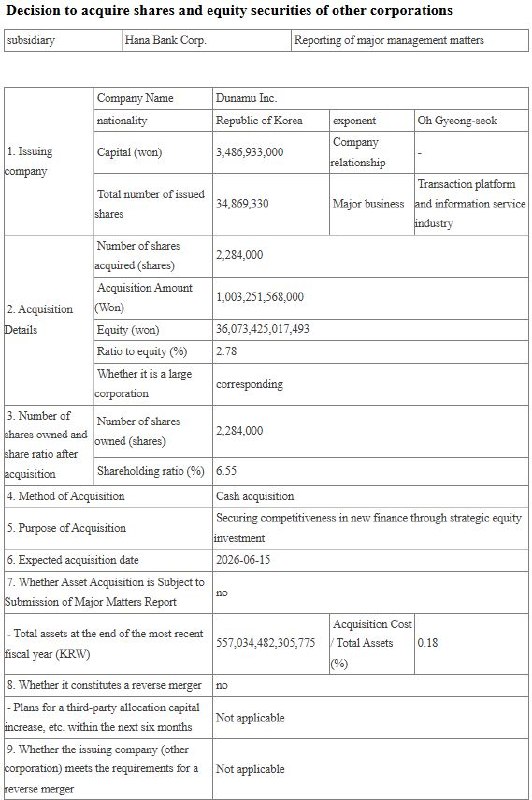 Hana Bank buys 6.55% of Upbit operator Dunamu from Kakao Investment for $700M cash, closing June 152026-05
 South Korea’s KBank partners Ripple to test onchain cross-border remittances, leveraging blockchain rails as part of a proof-of-concept tied to Upbit ecosystem2026-04
 Naver Financial and Upbit parent Dunamu delay stock swap again to Dec. 31 as South Korea weighs Digital Asset Basic Act2026-07
 Samsung Securities buys 2% stake in Upbit operator Dunamu for 306.4B won from Kakao-linked holders2026-05
South Korea's dominant retail crypto trading venue, Upbit is operated by fintech company Dunamu and consistently ranks among the world's highest-volume exchanges by reported spot trading, with a market structure built around Korean won, BTC, and USDT pairs.
What Upbit Is
Upbit launched in October 2017, developed by Seoul-based Dunamu. Dunamu had previously built Kakao Stock, a securities trading product inside the KakaoTalk messaging super-app, giving the founding team deep retail brokerage experience before it entered digital assets. Upbit's early growth was rapid: within months of launch it rivalled global leaders in daily volume, powered by South Korea's unusually high retail appetite for crypto and a domestic KRW on-ramp that competing foreign exchanges could not easily replicate.
The exchange is licensed as a Virtual Asset Service Provider (VASP) under South Korea's Act on Reporting and Using Specified Financial Transaction Information, which requires exchanges to partner with a real-name-verified bank account system. Upbit's banking partner has historically been K Bank, a digital-only bank, giving retail users a direct KRW deposit and withdrawal rail.

South Korea weighs crypto market makers after JPYC stablecoin trades at four times its peg on Upbit
Market Structure: KRW, BTC, and USDT Markets
Upbit organises its listed assets across three distinct quote markets:
- KRW market — Korean won pairs, the highest-liquidity tier and the primary on-ramp for domestic retail investors
- BTC market — bitcoin-denominated pairs for assets that have not yet qualified for the KRW tier
- USDT market — Tether-denominated pairs, used for internationally traded tokens and as a dollarised alternative to the won
This three-tier structure means a newly listed token typically debuts in BTC or USDT markets before graduating to KRW, where liquidity and local attention are deepest. The "Upbit listing effect" — sharp short-term price spikes at announcement — is most pronounced for KRW market additions, because KRW pairs open the asset to direct fiat purchase by South Korean retail without needing to hold BTC or USDT first.
Recent listings illustrate the breadth of the catalogue: in June 2025 Upbit added PEAQ, LIT, KMNO, MORPHO, GRAM, LDO, PAXG, OSMO, and AMP across BTC and USDT markets in a single batch. Tokens like SPX6900, TRAC, Pharos (PROS), Superform (UP2), and Venice Token (VVV) have followed in quick succession, each with scheduled trading windows announced 24–48 hours in advance to allow deposits to clear. Delistings receive comparable formality: the removal of NKN in June 2025 carried a 30-day withdrawal window before the final closure date.
Upbit readers engage far more with regulatory jeopardy and unexplained fund movements than with listing-pump opportunities, revealing that the dominant KRW-market angle is actually a systemic-risk story about whether South Korea's largest exchange can survive its own compliance failures.
Dunamu: The Corporate Parent
Dunamu is the holding entity behind Upbit and, increasingly, a diversified fintech and blockchain infrastructure company. Its shareholding structure has become a bellwether for institutional confidence in South Korean crypto.
Two major stake transactions completed in mid-2025 underline the scale of that confidence:
Samsung investment. Samsung affiliates agreed to acquire a combined 4% stake in Dunamu for approximately $408 million, with Samsung Securities picking up 2% — roughly 306.4 billion won — from Kakao-linked sellers. Samsung's interest reflects both the conglomerate's push into financial technology and the normalisation of crypto exchange equity as an investable asset class in Korea.
Hana Bank investment. South Korean commercial bank Hana Bank, part of Hana Financial Group, acquired a 6.55% stake in Dunamu for approximately $670–700 million (1 trillion won), closing in June 2025. The deal also included a cooperation agreement to build infrastructure for a won-denominated stablecoin ecosystem. Hana's move signals that traditional banking groups see exchange operators as strategic rather than merely speculative bets, and the stablecoin cooperation angle points toward future regulatory integration of digital assets into conventional financial plumbing.
Both transactions drew sellers primarily from Kakao-linked holdings, reflecting a redistribution of early institutional stakes toward financial conglomerates with longer investment horizons.
GIWA: Dunamu's Ethereum Layer 2
Beyond exchange operations, Dunamu is the corporate sponsor behind GIWA, an Ethereum Layer 2 network targeting Korean-market use cases. GIWA positions itself as a compliant, domestic-focused L2 where developers can build applications with won-denominated economics.
Dunamu runs GASOK, a five-month incubation and acceleration programme for teams building on GIWA, running cohorts from idea to mainnet deployment in roughly September–October each cycle. SODAX, one such project, is preparing cross-network execution tooling for GIWA builders. The broader implication is that Dunamu is evolving from a pure exchange operator into a blockchain infrastructure company — using Upbit's liquidity and user base as distribution, and GIWA as the settlement layer for a Korean crypto economy.
- 01Upbit listing price catalyst
The VIRTUAL +28% surge on Upbit listing showed readers treating KRW-market inclusion as a high-impact, front-runnable price event unique to South Korea's retail-dominated order flow.
- 02AML/KYC regulatory survival
A threatened business-license suspension from South Korea's FIU followed by a 3-month new-client ban drew readers tracking existential compliance risk at the exchange that controls the KRW on-ramp.
- 03Unexplained on-chain treasury moves
On-chain watchers flagging 13,000 ETH moved from Upbit wallets without disclosure tapped into reader distrust of opaque exchange fund management following prior hacks.
- 04Dunamu ownership consolidation
The $10.3B Naver merger, Hana Bank's $700M equity buy, and Samsung Securities stake drew readers piecing together who ultimately controls South Korea's largest exchange and what it means for governance.
- 05Investment warning asset designations
Upbit's formal SNX warning notice—triggered by the sUSD depeg—revealed an underappreciated exchange-level risk tool that directly precedes deposit halts, pulling in readers who trade listed tokens.
- 06Binance re-entry into Korean market
Binance's approved acquisition of GOPAX put Upbit's near-monopoly on KRW crypto trading directly in play, attracting readers watching competitive pressure on the dominant domestic venue.
Data and Intelligence Products
Upbit has extended its value proposition beyond order execution through Upbit Datalab, a market analytics subsidiary. In 2025, Datalab launched two strategy indices designed to lower barriers to on-chain data consumption for retail and professional users. It followed this with Upbit Datalab Intelligence, offering real-time market analysis and alert tooling — a product aimed at traders who want data-driven signals rather than raw candlestick feeds.
Separately, Upbit Skills launched as an AI agent investment tool, positioning the exchange to serve algorithmically oriented users and automated portfolio management flows — a segment that has grown sharply across global crypto venues.
Regulatory Context: South Korea's Crypto Framework
South Korea has some of the world's most specific crypto regulation, and Upbit's compliance posture has shaped its competitive position significantly.
The VASP licensing regime requires exchanges to maintain real-name-verified bank partnerships, segregate customer assets, and submit transaction reports above threshold amounts. Upbit's scale gave it leverage to secure and maintain the K Bank partnership; smaller competitors struggled with the banking requirement and several exited the market.
The Financial Services Commission (FSC) and Financial Intelligence Unit (FIU) jointly oversee exchanges. Amendment waves to the VASP framework have progressively tightened AML/KYC obligations while creating a structured pathway for institutional participation — the latter being a prerequisite for deals like the Hana Bank stake.
South Korea also bans domestic crypto derivatives trading for retail, which means Upbit's product surface remains spot-only for Korean residents, a structural constraint that has historically concentrated liquidity into spot pairs and amplified KRW price volatility relative to global benchmarks. The resulting spread between Korean and offshore prices — the so-called "kimchi premium" — periodically expands during domestic demand surges, creating arbitrage dynamics that regulators have monitored closely.
- 2019-11exploit
Upbit ETH hot wallet breach (~$49M stolen)
- 2023-07milestone
Dunamu discloses 159,000 attacks on Upbit in H1 2023
- 2023-10regulatory
South Korea FIU initiates AML/KYC suspension proceedings against Upbit
- 2024-02regulatory
3-month ban on new Upbit clients imposed by South Korean regulators
- 2024-06milestone
Hana Bank acquires 6.55% of Dunamu for $700M, closing June 15
- 2024-07regulatory
South Korea temporarily lifts Upbit 3-month new-client ban
- 2025-09launch
Dunamu unveils Giwa Ethereum L2 testnet on OP Stack at UDC 2025
Competitive Position
Within South Korea, Upbit's principal domestic competitor is Bithumb, the second-largest exchange. The two regularly list tokens in parallel — as with the concurrent SPX6900 listing, where Upbit offered KRW, BTC, and USDT pairs while Bithumb added its own KRW market — but Upbit has maintained a consistent volume lead. Smaller domestic venues (Coinone, Korbit, GOPAX) serve niche segments.
Globally, Upbit competes with Binance, OKX, and Bybit for international listings visibility, though its domestic architecture — won pairs, Korean-language UX, VASP licence — keeps its core user base domestically oriented. International users can access USDT pairs, but the exchange does not actively court non-Korean retail in the way globalised venues do.
How Listings Work
Upbit's listing process is notable for its formality and market impact. The exchange publishes listing notices through its official notice board and social channels, specifying:
- The token name, ticker, and network
- The specific market pairs to be activated (KRW / BTC / USDT)
- The exact time trading opens, down to the minute (e.g., "15:00 KST")
- Any caution notices for tokens with elevated risk profiles
Caution notices — as applied to Venice Token (VVV) in 2025 — flag tokens with limited trading history, high volatility, or unusual distribution structures. They do not block listing but inform users to apply additional scrutiny.
Deposit windows open before trading, allowing users to transfer assets before the market goes live. This pre-deposit period compresses the technical friction of the listing itself but can create price dislocations between Upbit and other exchanges during the run-up to the open.
Outlook
Dunamu's capital raise from Samsung affiliates and Hana Bank positions Upbit with both institutional credibility and a financial sector mandate that extends beyond trading infrastructure. The cooperation agreement with Hana Bank on a won-denominated stablecoin ecosystem is the most structurally significant signal: if a won stablecoin gains regulatory approval, Upbit's existing user base and KRW rails make it a natural distribution point, potentially reshaping how Korean users interact with on-chain DeFi.
The GIWA L2 and GASOK incubator suggest an ambition to anchor a Korean-market blockchain economy rather than simply aggregate assets listed elsewhere. How successfully Dunamu converts exchange market share into developer and user activity on GIWA will be the medium-term indicator of whether Upbit evolves into a broader crypto ecosystem operator or remains primarily a spot venue.
Regulatory clarity in South Korea, particularly around stablecoins and institutional custody, will set the pace for all of this. Upbit's compliance infrastructure and banking relationships give it a structural advantage as that clarity develops — but they also mean it is more exposed than offshore competitors to policy shifts in Seoul.
Latest Upbit news
Community notes
Spot something off or out of date? Drop a note. Editors review topic notes daily and roll accepted fixes into the explainer — contributors are recognized in the monthly $SQUID drop.
Loading notes…
Help improve this topic
Have a story or tip about this topic? Submit it. See something missing? Leave a note. Editors review daily; accepted submissions and fixes count toward the monthly $SQUID drop.