
How the Bank for International Settlements shapes crypto policy—its stablecoin skepticism, shadow-bank warnings, CBDC research, and tokenization projects Agorá and Rialto modernizing cross-border payments with central bank money.
+15 sources across the wider coverage universe
 BIS says stablecoins fall short as money, warns of emerging-market risks in annual report2026-06
 BIS study finds stablecoin flows largely unaffected by capital controls, unlike foreign currency deposits2026-07
 BIS says stablecoins act more like ETFs than money, warns divergent national rules risk fragmenting the market2026-04
 “Blockchain consensus mechanisms and fragmentation” by BIS Bulletin No. 126, dated 06 July 2026, on how consensus design drives blockchain fragmentation and the trade-offs between decentralisation, security, and scalability.2026-07
- BIS Agorá prototype shows tokenized reserves and bank deposits can settle cross-border in seconds2026-05
 BIS Bulletin 125 shows CEX pay stablecoin holders using reserve returns or market income, with reserve-based yields tracking policy rates while activity-based yields are volatile, potentially shaping future macro-financial implications as stablecoins become bank deposit substitutes or funding for exchanges' risky activities.2026-06
The Bank for International Settlements (BIS) is a Basel-based institution owned by central banks that serves as their forum for cooperation, their counterparty for financial operations, and the host of much of the world's frontline research on digital money. For crypto markets, it has become the single most influential official-sector voice shaping how stablecoins, tokenization, and central bank digital currencies (CBDCs) are studied, stress-tested, and ultimately regulated.
What the BIS is and why it matters to crypto
Founded in 1930 and often described as the "central bank for central banks," the BIS provides banking services to roughly 60 member central banks and convenes the committees that write global financial rulebooks. Two of those committees matter directly to digital assets: the Basel Committee on Banking Supervision, which sets capital requirements for banks' crypto exposures, and the Committee on Payments and Market Infrastructures (CPMI), which governs how money moves between institutions.
The BIS does not pass laws. Its power is softer and more durable: it sets the analytical frame and the technical standards that national regulators then adopt. When the BIS publishes a working paper arguing that stablecoins behave more like exchange-traded funds (ETFs) than like money, or that crypto exchanges resemble lightly regulated shadow banks, those framings tend to surface months later in legislation and supervisory guidance. Understanding the BIS is therefore a way of reading the regulatory weather before it arrives.
A practical note on terminology: a central bank is the public authority that issues a national currency and sets monetary policy; CBDC is a digital form of that central bank money; and stablecoins are privately issued tokens that aim to hold a fixed value, usually by claiming to be backed by reserves such as cash and short-term government debt. The BIS's recurring argument is that these three categories are not interchangeable, and that policy should keep public money at the center of the system.

BIS chief warns AI capex arms race could create systemic risks as opaque debt fuels spending disconnected from actual profits, echoing past railway and dot-com bubbles
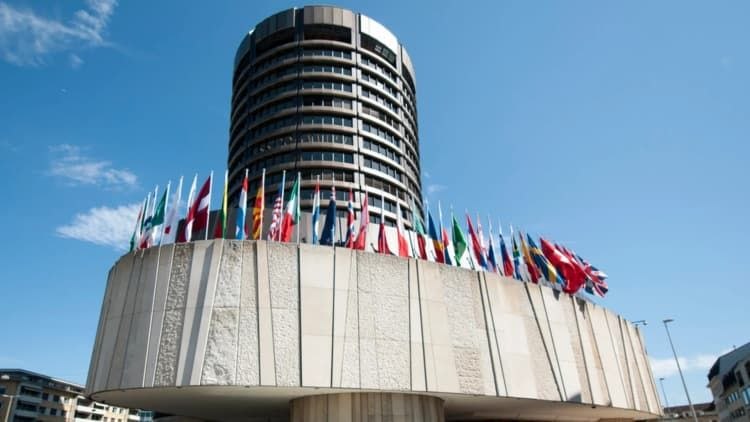
The BIS Innovation Hub
Most of the BIS's hands-on crypto work runs through the Innovation Hub, a network of technology centers spread across financial capitals including Switzerland, Singapore, Hong Kong, London, Stockholm, Toronto, and a Eurosystem center. The Hub builds working prototypes rather than writing theory alone, which gives its conclusions unusual weight: when it reports that a settlement design works or fails, it is reporting from code that ran.
Leadership of this work is changing. The BIS has tapped the International Monetary Fund's Tommaso Mancini-Griffoli to lead the Innovation Hub, overseeing central bank experiments on digital currencies and artificial intelligence. The appointment signals continuity in the Hub's core agenda—payments modernization and tokenization—while widening its remit toward AI in financial supervision.
The Hub's project pipeline is the clearest window into official-sector priorities, and two cross-border payments experiments dominate the current cycle.
Readers click BIS coverage not as passive observers but as participants tracking the institution that will decide whether their assets survive regulation — the click pattern shows acute interest in BIS as crypto's most powerful external arbiter, spanning every layer from CBDC design to DeFi market structure to stablecoin legality.
Project Agorá and cross-border payments
Cross-border payments remain slow, opaque, and expensive because they still ride on correspondent banking—a chain of intermediary banks holding accounts for one another. Project Agorá is the BIS's most ambitious attempt to replace that plumbing with tokenization, the practice of representing assets as programmable tokens on a shared ledger.
In May 2026 the BIS reported that Agorá's prototype showed tokenization could make wholesale cross-border payments faster and safer by combining tokenized central bank reserves with tokenized commercial bank deposits on a single programmable platform (BIS press release). The key technical result was atomic settlement: multi-currency transaction chains complete on an "all-or-nothing" basis across jurisdictions, so a payment either settles fully or not at all, removing the settlement risk that haunts today's system (CoinDesk).
Agorá is large by official-sector standards: eight central banks, including issuers of five major reserve currencies, working alongside more than 40 private financial institutions convened by the Institute of International Finance. Crucially, the design keeps each central bank's money under domestic control rather than pooling reserves in a shared venue, addressing a sovereignty concern that has sunk earlier multi-currency experiments (Ledger Insights). Having validated the concept in simulation, members—among them the New York Fed, the Bank of England, and the Bank of Japan—now plan to move to real-value testing with live money on blockchain rails.
For crypto audiences, Agorá is double-edged. It validates the architectural thesis behind public blockchains—shared ledgers, programmable money, atomic settlement—while routing the benefits through permissioned, central-bank-controlled infrastructure rather than open networks or private stablecoins.
BIS chief says stablecoins lack credibility for large-scale payments

Project Rialto and instant settlement
A parallel experiment, Project Rialto, targets the foreign-exchange leg of payments. Run by the Innovation Hub's Eurosystem and Singapore centers, Rialto pairs a modular FX component with settlement in tokenized wholesale central bank money to enable instant cross-border transfers (BIS). Its proof of concept linked instant payment systems through an FX mechanism using automated market makers—the same constant-function pricing model pioneered by decentralized exchanges—with tokenized central bank money as the safe settlement asset.
That borrowing is notable: a BIS prototype adopting AMM mechanics from DeFi shows how thoroughly the official sector now mines crypto-native designs for ideas, even as it rejects crypto-native money. Rialto frames the problem in concrete terms—the roughly $800 billion in quarterly cross-border crypto flows and the broader payments market both suffer FX and settlement frictions that instant central bank settlement could compress from days to seconds.
Together, Agorá and Rialto express a consistent BIS thesis: the future of cross-border payments is tokenized and instant, but settled in central bank money, not in stablecoins.
The BIS view of stablecoins
Nowhere is the BIS more pointed than on stablecoins, and its skepticism has hardened into a structured argument. In its widely cited framing, the BIS claims stablecoins fail three tests required to anchor the monetary system: singleness (every dollar trading at par with every other dollar), elasticity (the ability to expand supply on demand), and integrity (resistance to illicit use). Because privately issued tokens can trade at varying prices and cannot create credit elastically, the BIS argues they behave more like ETFs than like money—useful instruments, but not a monetary backbone.
The institution layers several stability concerns on top of that classification:
- Bank disintermediation. If stablecoins become substitutes for bank deposits, they could drain funding from banks and reshape how credit is created. BIS Bulletin 125 examined how centralized exchanges pay stablecoin holders yield—either from reserve returns that track policy rates or from volatile activity-based income—warning that this could turn stablecoins into either deposit substitutes or funding for exchanges' riskier activities.
- Market and rate spillovers. The BIS has linked stablecoin reserve flows into short-term government debt to measurable effects on Treasury-bill yields, meaning stablecoin growth is no longer macro-neutral.
- The yield gray zone. The BIS warns that stablecoin yield products blur the line between payments and investments, urging a global framework to close regulatory gaps and protect consumers.
- Monetary sovereignty. In emerging markets and developing economies, dollar stablecoins could either reinforce dollar dominance or accelerate "digital dollarization," eroding local monetary control—a question the BIS treats as central to global policy coordination.
The institution's regulatory instinct is harmonization. As global stablecoin rulemaking has slowed, the BIS has urged international cooperation to avoid a fragmented market where divergent national rules create arbitrage and contagion risk. Some BIS economists have gone further, floating aggressive integrity measures such as barring regulated services from touching any coin that has passed through a no-KYC wallet—an idea meant to spur "self-policing" that drew sharp criticism from the crypto industry as unworkable and surveillance-heavy.
BIS says stablecoins fall short as money, warns of emerging-market risks in annual report
Shadow banking, tokenized funds, and systemic risk
Beyond stablecoins, the BIS has trained attention on the institutions that intermediate crypto. It warns that large cryptoasset platforms now act as lightly regulated shadow banks, bundling exchange, lending, custody, and derivatives under one roof in ways that concentrate risk and lack the safeguards imposed on banks. The policy implication is a push toward full, bank-style prudential regulation for the largest platforms.
The BIS has also flagged tokenized money market funds as a fast-growing bridge between DeFi and traditional finance. These instruments offer yield plus the regulatory protections of registered funds, but the BIS cautions they import new risks: liquidity mismatches, concentrated holders, and potential contagion with stablecoins if redemptions cascade across linked products.
This is the broader pattern in BIS thinking on markets and tokenomics: it treats tokenization of high-quality assets (central bank money, bank deposits, government funds) as promising, while treating tokenization of volatile or opaque instruments as a risk vector. Its working paper showing that Bitcoin and Ether remain predominantly speculative reinforces a hierarchy in which programmable settlement is welcomed but speculative crypto assets are quarantined from the core of the system.
- 01CBDC adoption velocity
Readers are tracking the global race toward central bank digital currencies as a direct threat or complement to crypto, with BIS survey data providing the scoreboard.
- 02Stablecoin regulatory legitimacy
Whether stablecoins can pass BIS's own tests for monetary soundness — singleness, elasticity, integrity — determines their long-term viability in regulated finance.
- 03Tokenization of traditional finance
BIS research framing tokenization as a structural shift in how central banks operate monetary policy drew readers who see this as the bridge between DeFi and legacy systems.
- 04DeFi market structure analysis
BIS findings that Uniswap V3 liquidity and DeFi leverage are dominated by sophisticated actors — not retail — challenged the decentralization narrative readers had staked positions on.
- 05Cross-border payment rewiring
Projects Agorá, Rialto, and Mandala represent BIS-led infrastructure that could displace existing crypto corridors for international settlement, making them strategically significant to track.
- 06Crypto shadow banking systemic risk
BIS warnings that large crypto platforms now bundle exchange, lending, custody, and derivatives like lightly regulated banks triggered readers watching for regulatory crackdown triggers.
Measurement and data
A quieter but consequential strand of BIS work concerns measuring DeFi honestly. The institution has published research introducing the concept of "Verifiable TVL"—an attempt to strip out double-counting and inflated figures from total value locked, a headline metric notorious for overstating DeFi's real economic footprint. In a sign of how seriously it takes on-chain data, the BIS has even praised analytics provider DefiLlama, an unusually direct nod from an official-sector body to a crypto-native data source. The thread connecting these efforts is a belief that better measurement is a precondition for sound regulation: you cannot supervise what you cannot reliably count.
CBDCs and the policy trilemma
The BIS remains the intellectual home of the CBDC movement. Its surveys show that 91% of central banks explored CBDCs in 2024, with wholesale projects running ahead of retail ones, driven by declining cash use, rising tokenization, and—explicitly—the competitive pressure of stablecoins and crypto. More than a third of surveyed central banks said they had accelerated their plans in response.
The Fed's New York Innovation Center and the BIS have tested smart contracts to explore "tokenized monetary policy"—programmable tools that could one day let central banks implement policy directly on ledgers. Yet the BIS is candid about the trade-offs. It frames a policy trilemma for digital payment ledgers: credit enforcement, prevention of rent extraction by dominant platforms, and user privacy cannot all be maximized at once, forcing regulators into uncomfortable choices. That intellectual honesty is part of why BIS research carries weight even with skeptics.
- 2022-12regulatory
BIS Basel III prudential crypto standard published
- 2023-06milestone
BIS annual survey: 94% of central banks in CBDC work
- 2023-09launch
Project Tourbillon retail CBDC with quantum-safe privacy unveiled
- 2024-01regulatory
BIS Basel III 2% crypto reserve cap takes effect
- 2024-07milestone
Project Agorá milestone: 40+ firms and central banks explore tokenized cross-border payments
- 2024-09milestone
Project Mandala Phase 1 completed: compliance embedded in cross-border protocol
- 2024-10launch
Project Rialto launched for instant FX settlement in tokenized wholesale central bank money
- 2025-03milestone
BIS annual survey: 91% of central banks exploring CBDCs, wholesale ahead of retail
Outlook
The BIS has settled into a clear and consistent posture: enthusiastic about tokenization and instant settlement, deeply skeptical of privately issued stablecoins as money, and committed to keeping central bank money at the system's core. The near-term signals to watch are concrete—whether Agorá's real-value testing succeeds with live transactions, whether Rialto's FX design advances toward production, and whether the BIS's push for harmonized stablecoin rules gains traction as national frameworks diverge. New leadership at the Innovation Hub and the institution's growing focus on cross-border payments, data integrity, and AI suggest its influence over the regulatory frame will deepen rather than fade. For crypto markets, the BIS is best read not as a hostile outsider but as the architect of the official-sector alternative: a tokenized financial system built on public money, against which private stablecoins and open networks will have to compete on stability, not just speed.
Latest BIS news
BIS chief warns AI capex arms race could create systemic risks as opaque debt fuels spending disconnected from actual profits, echoing past railway and dot-com bubblesBIS chief says stablecoins lack credibility for large-scale paymentsBIS says stablecoins fall short as money, warns of emerging-market risks in annual reportBIS study finds stablecoin flows largely unaffected by capital controls, unlike foreign currency depositsBIS says stablecoins act more like ETFs than money, warns divergent national rules risk fragmenting the market“Blockchain consensus mechanisms and fragmentation” by BIS Bulletin No. 126, dated 06 July 2026, on how consensus design drives blockchain fragmentation and the trade-offs between decentralisation, security, and scalability.Community notes
Spot something off or out of date? Drop a note. Editors review topic notes daily and roll accepted fixes into the explainer — contributors are recognized in the monthly $SQUID drop.
Loading notes…
Help improve this topic
Have a story or tip about this topic? Submit it. See something missing? Leave a note. Editors review daily; accepted submissions and fixes count toward the monthly $SQUID drop.