
Explainer on how coding powers crypto, from smart contracts to AI‑driven “vibe coding,” no‑code tools, and autonomous agents. Covers Coinbase, OpenAI, security, verification and what faster, automated development means for Web3.
+14 sources across the wider coverage universe
 Cysic Launches CyOps, AI Platform for Autonomous Coding and Code Verification2026-05
 Want to vibe code like Johnnyonline? A practical guide explains how “vibe coding” lets anyone build software by describing ideas to AI tools, iterating fast, and focusing on what to build rather than how to code, dramatically lowering the barrier to creating real apps.2025-12
 Opus 4.5 ushers in agent‑native apps, collapsing months of coding into days by letting non‑developers build production software with English prompts instead of code.2026-01
 2025 wasn’t about one “best” LLM—it was about stacks. Users mixed models by task: Claude for coding, GPT-5.x for agents/chat, DeepSeek/Qwen for cheap scale, Gemini for research, and niche tools for creativity.2025-12
 NoahAI is hosting the first Solana Vibe Coding Hackathon, focused on shipping real products fast using AI. Builders join weekly SuperTeam sprints, deploy live apps, share progress, and compete for prizes, credits, and up to $100K in fundraising.2026-01
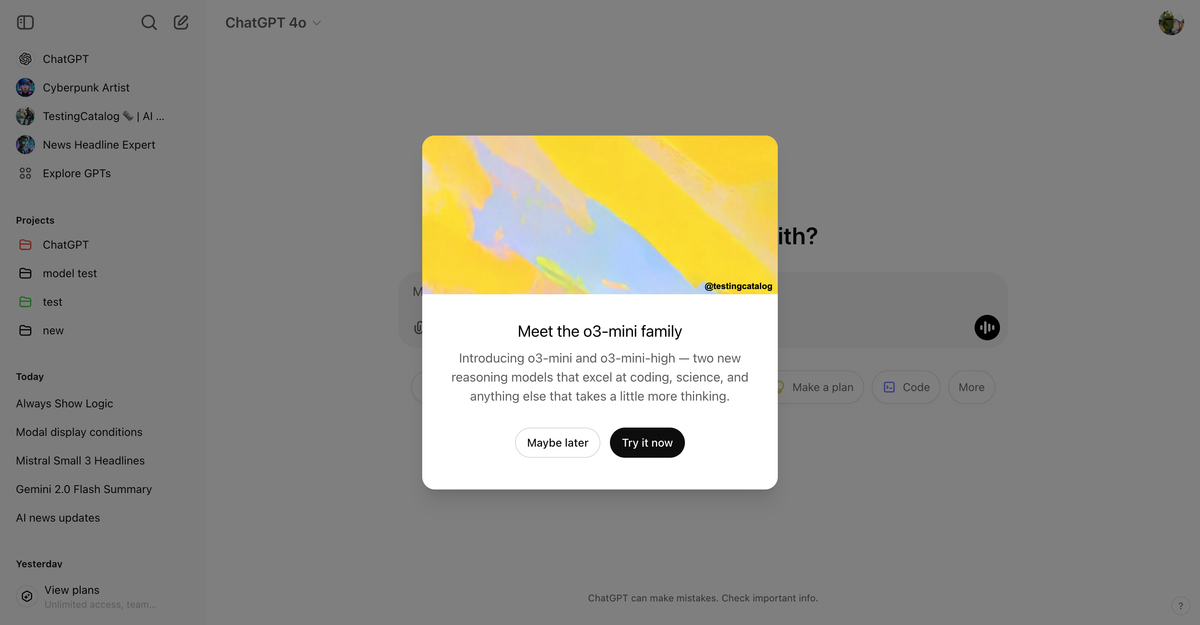 o3-mini and o3-mini-high details leaked before OpenAI’s announcement.
OpenAI set to announce o3-mini AI models, enhancing reasoning in coding, science, and math with faster response times.2025-01
o3-mini and o3-mini-high details leaked before OpenAI’s announcement.
OpenAI set to announce o3-mini AI models, enhancing reasoning in coding, science, and math with faster response times.2025-01
Coding in Crypto: From Hand‑Written Smart Contracts to Vibe‑Coded Agents
Coding in crypto increasingly spans everything from low‑level smart contract engineering to “vibe coding” apps with natural‑language prompts, as AI tools blur the line between developer and end user while raising new questions about security, reliability, and control. In this landscape, code remains the infrastructure of digital money and on‑chain logic, but the ways it is produced—by humans, AI pair programmers, autonomous coding agents, and no‑code platforms—are rapidly diversifying, reshaping how crypto products are built, audited, and governed.
What Coding Means in a Crypto Context
In a conventional software setting, coding is the act of instructing machines through programming languages, but in crypto the stakes are unusually high because code often directly controls real assets on public, immutable ledgers. A smart contract that mishandles access control or arithmetic can lock or leak funds irreversibly, and even small bugs can cascade into protocol‑wide failures. This “code is law” ethos means that coding in crypto is ultimately about encoding economic rules, incentive systems, and governance processes into deterministic logic that anyone can execute and verify. While user interfaces and marketing may change, the underlying contract code often persists for years, making upgradability, governance, and formal correctness core design concerns rather than afterthoughts. As a result, crypto coding blends disciplines from distributed systems and cryptography to game theory and regulatory compliance in ways that traditional web or mobile development rarely demands.
To understand the modern conversation about vibe coding and AI agents, it helps to distinguish the layers of code that make up a typical crypto product. At the base layer are on‑chain contracts, written in languages like Solidity, Vyper, Rust, or Move, which define token logic, lending markets, automated market makers, or privacy mechanisms. Above that sits off‑chain infrastructure, including indexers, relayers, oracles, and matching engines, usually written in mainstream languages such as Go, Rust, or TypeScript, that interface with nodes and external data. Finally, there are user‑facing applications—web dashboards, mobile wallets, bots, and scripts—that abstract away blockchain details and present workflows like swapping, staking, or governance voting. Vibe coding and other AI‑driven approaches typically operate at the upper layers first, where it is safer to generate and iterate on front ends, dashboards, or off‑chain agents before touching security‑critical on‑chain code.
Because these layers interact across networks, time, and multiple execution environments, crypto coding is also inherently concurrent. Transactions arrive in unpredictable orders, miners or validators reorder them for profit, and multiple smart contracts interact with each other in complex ways. This creates a “concurrency storm” of race conditions, reentrancy opportunities, and cross‑chain timing issues that are difficult even for experienced engineers to reason about, and are even harder for AI agents that lack deep protocol context. When AI tools generate code for trading bots, MEV strategies, or bridging logic, they are stepping into this storm, making robust testing, simulation, and formal assurance particularly important for Web3 compared with more controlled Web2 environments.
Despite these complexities, the core act of coding in crypto is converging with broader software trends. Developers increasingly use integrated development environments (IDEs), automated testing, continuous integration pipelines, and containerized deployment, much as any modern web startup would. What makes crypto distinctive is the combination of adversarial incentives, public verifiability, and irreversible consequences, which together mean that any shift in how code is authored—from manual typing to vibe coding prompts—can have outsized impact on user funds, protocol stability, and systemic risk.
Cysic Launches CyOps, AI Platform for Autonomous Coding and Code Verification
The Evolution of Coding: From Manual Development to AI Assistance
For most of the past decade, coding in crypto has looked like traditional open‑source development with a twist: small, security‑sensitive teams iterating on protocol code in public repositories, subject to audits and community scrutiny. Early Bitcoin Core and Ethereum client developers wrote C++, Go, or Rust by hand, reviewing pull requests line by line and relying on human reasoning, unit tests, and careful peer review. As DeFi exploded, frameworks like Hardhat, Truffle, and Anchor standardized many tasks, from contract compilation and deployment to local testing, but humans still wrote the vast bulk of logic. The arrival of large language models changed this equation by turning natural‑language instructions into compilable code, introducing the first generation of AI “pair programmers” that could suggest functions, tests, and refactors inside editors such as VS Code.
This shift is especially visible at large crypto firms relying on sophisticated engineering teams. According to one account of internal practices at Coinbase, CEO Brian Armstrong gave engineers a five‑business‑day window to become proficient with AI‑assisted coding tools like GitHub Copilot and the Cursor editor, warning that those who failed to adapt without a strong justification could face termination. That same discussion notes that roughly a third of the company’s code was already being written with AI assistance, with internal targets to push that figure to around half within a quarter. The message to engineers was clear: AI tooling was no longer optional experimentation but a core part of the company’s productivity strategy. For the broader crypto ecosystem, this kind of mandate is a signal that AI‑augmented coding is becoming normal practice, especially in organizations that must iterate quickly across complex codebases.
Model providers are racing to support this trend with systems that are explicitly optimized for code and reasoning. OpenAI’s o3‑mini model, for example, is presented as a compact reasoning engine with strong capabilities in science, math, and coding, benefiting from advances in prior “o1” series models while offering lower latency and cost. It supports features important for coding workflows such as function calling, structured outputs, and streaming responses, allowing tools and IDEs to programmatically constrain and parse its output into usable code edits. The model is being rolled out both through APIs and directly in ChatGPT, with Plus and Team users given significantly higher rate limits compared with earlier reasoning models, and even free‑tier users gaining limited access via a “Reason” mode. This distribution strategy means that coding‑optimized AI is no longer a niche capability reserved for enterprise customers; it is available to hobbyist smart contract developers, DeFi analysts, and aspiring vibe coders experimenting from a browser.
At the same time, there is a growing recognition that headline benchmark scores for coding models can be misleading. In early 2026, OpenAI’s Frontier Evals team acknowledged that SWE‑bench Verified—the benchmark that had effectively set the scoreboard for autonomous code‑patching agents—had become contaminated because many of its GitHub issues and solutions were present in training data. Scores that seemed to show dramatic progress, like an 80.9 percent success rate on the benchmark, turned out to overstate real‑world generalization, with the team estimating that a stricter, contamination‑resistant variant put the true performance closer to 46 percent. For crypto builders, where secure coding standards must hold up against adversaries rather than friendly test suites, this disclosure serves as an important caution: impressive AI coding demos do not automatically translate into robust, production‑grade code, especially in unfamiliar or high‑risk domains.
The evolving picture, then, is one where coding in crypto sits at the intersection of traditional engineering discipline and rapidly improving AI assistance. Humans continue to design architectures, reason about protocol economics, and shoulder ultimate responsibility for security, while models increasingly handle boilerplate, testing scaffolds, and even substantial chunks of business logic. As AI tools become embedded in everything from IDEs and code review systems to deployment pipelines, the focus of “coding” shifts from keystrokes to higher‑level specification and verification—an evolution that sets the stage for vibe coding and autonomous agents.
Readers click coding stories not for the engineering — they click for the power shift: AI tools that let non-developers ship crypto products (trading bots, stablecoins, apps) are colliding with the security and institutional risks that emerge when production code is written without traditional engineering rigor.
Vibe Coding: Building Apps by Describing the “Vibe”
Vibe coding is emerging as a shorthand for building software by describing what you want in natural language rather than writing traditional code, effectively turning the development environment into a conversational interface. In a popular tutorial, the creator explains that you can “just think of it as having a chat‑style interface where you can type in what you want,” with the AI generating and regenerating code as you refine your idea. Instead of planning classes, functions, and database schemas upfront, you tell the system you want, for instance, a “habit tracker app to help me achieve personal goals for 2026 with a purple theme,” and the underlying AI scaffolds the front end, state management, and data persistence to match. The process is iterative and visual: you watch the app appear in real time, adjust layout or logic through follow‑up prompts, and keep nudging the “vibe” until it aligns with what you had in mind.
In many vibe coding platforms, this conversational workflow is coupled with one‑click deployment and export options that blur the line between prototype and production. The Base44‑backed platform in that tutorial allows a creator to publish a newly generated habit tracker with a single click, making it accessible via a shareable link, while also supporting export to GitHub or as a project archive for those who want to inspect or extend the generated code. Monetization layers on top: once an app is sufficiently polished, a builder can submit it as a template to a marketplace, pricing it at, say, 9.99 dollars, and earning revenue every time another user adopts and customizes it. In this model, vibe coders become both users and suppliers of building blocks, curating and remixing each other’s AI‑generated templates, not unlike how open‑source libraries circulate in traditional ecosystems but mediated by marketplaces and prompts rather than manual imports.
The same paradigm is spreading into interactive 3D and gaming experiences, where vibe coding tools handle much of the scripting. On Nilo’s platform, for example, users can create playable 3D games by issuing high‑level prompts that generate worlds, characters, and mechanics, bypassing most of the manual scripting typically required in engines like Unity or Roblox Studio. The workflow involves opening a browser editor, prompting assets into existence, and then adding game logic via natural language instructions such as “jumping platforms speed up over time” or “collect coins to unlock new areas,” with the system compiling these prompts into working scripts and showing live 3D feedback. Once a world is playable, creators can share a link that lets friends join from desktop or mobile, collaborating on building and testing the environment without installing specialized development tools. Although these examples focus on entertainment rather than finance, they demonstrate how far AI has gone in translating casual language into executable, networked software.
Crypto ecosystems are rapidly adopting vibe coding both as a cultural meme and as a practical way to bootstrap applications, especially around hackathons. 0G’s “Zero Cup,” for instance, positions itself as a global vibe coding tournament where participants turn ideas into working AI apps using prompts, competing in a World Cup‑style knockout bracket with a prize pool of 17,000 dollars. The format emphasizes speed and creativity: teams survive elimination rounds not by shipping meticulously handcrafted code but by coaxing AI tools to assemble functional agents and interfaces within tight time windows. Similar energy animates the iExec Vibe Coding Challenge hosted on DoraHacks, which frames itself as an online builder event backed by ChainGPT, encouraging participants to integrate AI into on‑chain applications and workflows. These events reward people who can think in terms of prompts, data flows, and user experience rather than low‑level syntax.
On the protocol side, COTI has run a Vibe Code Challenge that explicitly invites participants to “vibe code your app” using AI tools or prompt packs, promising that “no coding [is] required.” The challenge guides builders through three phases: picking the AI tools and agents they will use, vibe coding an agentic app, automation, or infrastructure piece, and then launching it live on the COTI network. Winners receive substantial COTI‑denominated prizes, along with support to transform their submissions into real businesses, including liquidity bootstrapping, marketing, and ongoing growth assistance. After one such challenge, the network announced that rewards had been distributed to winners and runner‑ups and teased the next vibe coding challenge as “in the works,” signaling that these events are becoming recurring fixtures rather than one‑off experiments.
Within the Solana ecosystem, tools like NoahAI actively pitch themselves to “vibe coders,” offering roadmaps that start with thinking about an idea, writing a “hero prompt,” and then pasting or describing that prompt into the tool to generate an app. Community media outlets host livestreams such as Leviathan News’ “vibe building with johnnyonline,” where audiences can watch builders converse with AI tools in real time as they assemble apps and bots. Across these examples, vibe coding becomes more than a technical workflow; it is a social practice where building is performative, collaborative, and closely tied to the culture of hackathons, tournaments, and on‑chain experimentation.
Yet even its proponents emphasize that vibe coding is not magic. The “Vibe Coding Reality Check” essay on DEV warns that in hackathon settings, the stakes are low—if a demo breaks, you regenerate—but that this mindset does not carry over to production systems that must handle real users and data. The author recommends planning before you prompt, thinking carefully about scope and data requirements rather than jumping straight into asking an AI to “build everything,” and recognizing that the underlying engineering complexity has not vanished. Similarly, the Base44 tutorial suggests breaking projects into smaller features, incrementally building and testing each one instead of asking the AI to implement ten things at once, and urges builders to treat security as a first‑class concern, ideally involving an experienced developer to review apps that are expected to scale to thousands of users. For crypto builders, whose apps may interact with wallets, tokens, and private keys, that caution is especially urgent.

Want to vibe code like Johnnyonline? A practical guide explains how “vibe coding” lets anyone build software by describing ideas to AI tools, iterating fast, and focusing on what to build rather than how to code, dramatically lowering the barrier to creating real apps.

Not to be confused with Johnny's good vibes while he is coding haha, "you describe what you want. the ai writes code. you test it. you iterate. you repeat until it works. that's vibe coding."
No‑Code, Low‑Code, and Agent‑Native Apps Across Web3
Vibe coding sits within a broader shift toward no‑code, low‑code, and “agent‑native” application architectures in which much of the traditional coding surface area is replaced by configuration, prompting, and orchestration. One vision of this future appears in coverage of Opus 4.5, an AI system described as collapsing six months of development work into a week by letting non‑developers build production software using English prompts instead of code. In this framing, Opus 4.5 functions as a general‑purpose agent that handles not only code generation but also integration, deployment, and feature wiring, effectively turning app development into an exercise in describing desired behaviors and constraints. The resulting applications are called “agent‑native” because they are built around AI agents as first‑class runtime components, with new features added by telling the agent what to do rather than extending a traditional codebase.
Crypto products are natural candidates for this pattern because they often involve orchestrating multiple services—wallets, chain APIs, data providers, compliance checks—that agents can learn to call. Consider how some stablecoin and infrastructure providers position themselves. Bastion, for example, markets itself as a “full stack, trusted stablecoin solution” that allows institutions to issue, custody, move, and convert digital assets under Bastion’s regulatory licenses or their own. Reporting on its 14.6 million dollar funding round led by Coinbase Ventures emphasizes that Bastion effectively offers a white‑label stablecoin system so that companies can provide digital dollar services without building or maintaining that complex infrastructure themselves. The platform’s suite reportedly includes wallets and cash off‑ramps, enabling clients to launch branded stablecoin products with minimal in‑house engineering. While not a vibe coding interface per se, this kind of abstraction means that many “stablecoin issuers” are configuring and integrating pre‑built modules rather than writing low‑level token or custody code.
On the trading side, AI‑powered tools are reshaping how individuals access algorithmic strategies without writing custom bots. Stoic AI, for instance, describes itself as an automated crypto trading platform that gives individual traders access to institutional‑grade trading strategies, framing its service as a way to run sophisticated quantitative approaches without needing coding skills. Users typically connect exchange accounts or wallets, choose among pre‑configured strategies, and let the system execute trades automatically, with AI and automation managing rebalancing and risk parameters behind the scenes. In this model, the “coding” that embodies strategy logic and execution rules is done once by the platform’s designers and then reused by many end users who treat it as configuration rather than a codebase they can modify.
Even outside of core finance functions, no‑code paradigms are gaining traction in Web3 analytics and reporting. Delphi’s Datahub, surfaced in posts by Astrol Labs, is billed as a way to create charts, widgets, and data visualizations of Ethereum and other on‑chain data “without a single line of code,” letting users explore curated datasets and assemble dashboards through graphical interfaces. Instead of crafting SQL queries or writing JavaScript for charts, analysts and community managers can select data sources, choose visual encodings, and embed the resulting widgets into their own sites or reports, all while the underlying system handles the necessary API calls and transformations. As with no‑code trading and stablecoin infrastructure, the technical complexity is centralized in the platform, while a broad audience interacts with it at a higher level of abstraction.
These developments raise important questions about what counts as “coding” in crypto. When a founder spins up a white‑label stablecoin using Bastion, selects AI strategies on Stoic, or assembles a governance dashboard on Delphi Datahub, they may not be typing code, but they are still making design choices that have real economic and security implications. Similarly, when an operator uses a vibe coding platform or agent‑native framework like Opus 4.5, they are, in effect, encoding logic into prompts and configurations that the underlying systems translate into executable behavior. The traditional boundary between developers and non‑developers blurs, and with it the boundary between activities that demand software‑engineering discipline and those that feel like mere “setup.” For the crypto space—where misconfigured bots and mis‑specified contracts can cause large losses—that blur is both an opportunity for broader participation and a risk multiplier.
- 01Vibe coding democratization↗
The idea that anyone can ship real crypto software by describing ideas in English — no syntax, no CS degree — directly threatened and excited a reader base of builders and investors watching the barrier collapse in real time.
- 02AI model coding race↗
Readers tracked which model won the coding crown — o3-mini, Opus 4.5, GPT-5-Codex — because the answer determined which stack actually ships production crypto infrastructure fastest.
- 03No-code crypto infrastructure↗
Stablecoin issuance and automated trading becoming plug-and-play without coding signals a structural shift in who can launch financial products, which carries both opportunity and systemic risk.
- 04Coinbase AI coding mandate↗
An ultimatum from a top-tier exchange CEO to master AI tools or be fired — while AI already writes a third of their codebase — made the abstract adoption debate suddenly concrete and high-stakes.
- 05AI coding security exploits↗
A single malicious prompt turning Cursor into a local shell (CVE-2025-54135) crystallized the fear that AI-accelerated development is outpacing security review, especially for code running inside crypto companies.
- 06Smart contract AI verification↗
Certora's formal verification layer for AI-generated contracts addressed the specific dread that autonomous coding produces contracts that pass tests but fail mathematically — a catastrophic failure mode in DeFi.
Autonomous Coding Agents, Security, and Verification
As AI systems move from suggesting snippets to orchestrating entire coding and deployment workflows, they become autonomous coding agents rather than mere assistants. The Opus 4.5 narrative exemplifies this transition, describing how users specify high‑level requirements and constraints while the agent handles planning, coding, and integration, effectively acting as a self‑driving developer that can ship complex features or even whole applications. In crypto contexts, such agents might be tasked with monitoring on‑chain conditions, generating and deploying strategy updates, or even patching contracts and bots in response to emerging vulnerabilities. The promise is a radical increase in development velocity and responsiveness, but the implication is that a significant fraction of critical infrastructure could be modified by systems that no single human fully understands.
Recognizing these risks, some projects focus on building guardrails around autonomous coding. Cysic’s CyOps platform, for example, is described as using independent AI reviewers to audit autonomous coding sessions, looping automatically until every acceptance criterion is satisfied. In this architecture, one AI system may propose code changes while others act as critics, checking whether tests, invariants, or quality gates are met before permitting a change to proceed. By having multiple models “argue with themselves” in this way, the platform aims to reduce the likelihood that a single hallucination or oversight propagates into production software. For crypto applications, where a faulty update can directly compromise funds, this kind of multi‑agent review could become a crucial pattern, analogous to multi‑signatures for code deployment.
In the smart contract space specifically, teams are combining AI generation with formal verification to bridge the gap between rapid iteration and high assurance. Certora’s AI Composer, for instance, is introduced as an open‑source AI coding platform that composes artificial intelligence with formal verification to make smart contracts safer. The tool is designed to automatically generate or modify contract code while simultaneously checking it against formally specified properties, such as invariants about balances, access controls, or protocol‑specific rules. By integrating with Certora’s existing verification infrastructure, AI Composer aims to ensure that contracts satisfy their specifications before they are ever deployed on‑chain, shifting safety from an after‑the‑fact audit to a built‑in constraint on what AI is allowed to produce. For DeFi protocols and DAOs, this approach aligns well with the “code as law” reality, treating legal and economic obligations as properties that must be upheld by every AI‑generated change.
Not everyone in the security community is optimistic about AI coding agents, however. A Decrypt teaser referencing a famed iPhone and Sony hacker characterizes AI coding agents as a “disaster waiting to happen,” echoing concerns that models lack deep understanding of the systems they modify and are prone to subtle misjudgments that humans might catch. Security researchers worry that agents will happily use insecure libraries, misinterpret protocol documentation, or introduce unsafe patterns like reentrancy vulnerabilities or unchecked external calls, especially in languages and frameworks they have learned only from partial or biased training data. The SWE‑bench contamination revelations reinforce this skepticism by showing that even when models appear strong on controlled benchmarks, their performance in truly novel and adversarial settings may be much weaker than advertised. In crypto, the adversary is often another highly motivated agent—human or algorithmic—looking for exactly those edge‑case mistakes.
Practical failures and near‑misses are already pushing teams toward more conservative deployment practices. Reports of AI coding tools like Cursor being coaxed, via carefully crafted prompts, into effectively acting as local shells—running arbitrary commands on a developer’s machine—highlight how quickly assistance can turn into exposure when models are given powerful tools without strict constraints. In a concurrent setting where many engineers rely on AI agents to modify shared codebases, small misconfigurations or prompt‑injection attacks could ripple into broader code changes, making version control, code review, and automated testing even more critical. For crypto protocols that must manage concurrent activity across chains and sometimes across AI‑controlled bots, the combination of concurrency hazards and opaque agent behavior becomes particularly treacherous.
This is why projects like CyOps and AI Composer are important early experiments in reconciling autonomous coding with crypto’s unforgiving security environment. By embedding AI within frameworks that enforce acceptance criteria, formal properties, and multi‑agent checks, they treat models as probabilistic tools rather than infallible coders. For crypto builders, the implication is that embracing AI for speed must go hand in hand with adopting stronger verification, monitoring, and rollback mechanisms, especially when agents touch on‑chain code or high‑value trading infrastructure.

Opus 4.5 ushers in agent‑native apps, collapsing months of coding into days by letting non‑developers build production software with English prompts instead of code.
This is getting interesting tho I don't really like the idea,
Skills, Roles, and Best Practices for Crypto‑Native Coding
In this evolving landscape, the skill set associated with “coding in crypto” is expanding rather than shrinking. Traditional competencies—such as understanding EVM semantics, mastering gas optimization, reasoning about access control patterns, and interpreting consensus protocols—remain indispensable for those designing and auditing core contracts. No AI model can fully replace the institutional knowledge required to architect a lending protocol that is robust to oracle attacks, governance capture, and liquidity shocks. However, engineers who cling to manual coding as their only tool risk falling behind peers who leverage AI for routine tasks like scaffolding tests, generating documentation, or experimenting with refactorings, freeing more time for higher‑level design and security reviews.
Alongside these classic skills, crypto builders increasingly need fluency in prompt design and orchestration. When using vibe coding platforms or agent‑native frameworks such as Opus 4.5, the quality of the output depends heavily on how well the developer can articulate goals, constraints, and edge cases in natural language. A vague request for “a DeFi dashboard” will yield something generic, whereas a detailed prompt specifying which chains, which protocols, how to handle failed RPC calls, and what safeguards to put around transaction signing will produce a more usable result. Experience with data modeling, UX, and risk analysis becomes critical, even if the developer is not writing every line of code directly, because they still must specify what the system should do under stress, delay, or partial failure.
For vibe coders specifically, the advice emerging from practitioners and critics converges on disciplined planning. The DEV “Reality Check” essay urges builders to define scope and data flows before they open a vibe coding interface, cautioning against the temptation to let the AI dictate architecture by iteratively patching its own mistakes. The Base44 tutorial recommends starting from a real problem you understand and care about, rather than chasing hypothetical market demand, and encourages building something you or your immediate community will actually use. It also stresses that asking the AI to handle one feature at a time, then testing it thoroughly, leads to better outcomes than issuing a single sprawling prompt, and that security considerations—especially authentication and data protection—must be addressed early, ideally with the help of an experienced developer. These practices are familiar from traditional engineering but become even more important when the underlying code is partially opaque to the person “building” the app.
Non‑developers who use no‑code and vibe coding tools to assemble crypto products face an additional responsibility: recognizing the limits of their expertise and the tools’ guarantees. Platforms like Stoic AI, Bastion, or Delphi Datahub can shield users from many low‑level details, but they do not eliminate risk. A trader using automated strategies must still understand volatility, position sizing, and exchange counterparty risk. A fintech launching a white‑label stablecoin remains exposed to regulatory, liquidity, and operational hazards, even if Bastion handles the technical and custody layers. A DAO community manager assembling analytics dashboards must still verify that the underlying data feeds are accurate and that visualizations do not mislead stakeholders. In each case, the user is “coding” in the sense of configuring and deploying logic with real consequences, even if they never see a function definition.
The upshot is that coding in crypto is becoming less about syntax and more about systems thinking. Whether you are writing Solidity by hand, orchestrating Opus 4.5 agents, vibe coding an app for a COTI challenge, or configuring a Stoic AI strategy, you are ultimately responsible for understanding how your choices propagate through on‑chain and off‑chain systems. Security, composability, and user trust remain non‑delegable responsibilities, even as AI and automation handle more of the routine engineering.
Certora AI Composer launched for smart contract formal verification
OpenAI o3-mini released with enhanced coding and reasoning capabilities
Bastion raises $14.6M from Coinbase, Sony, Samsung for no-code stablecoin infrastructure
Coinbase CEO Armstrong mandates AI coding tool mastery or dismissal; one-third of code already AI-written
CVE-2025-54135 patched in Cursor: prompt injection turned AI coding agent into local shell
OpenAI discloses SWE-bench contamination, halts reporting of verified coding benchmark scores
Anthropic Opus 4.5 released, collapsing months of agentic app development into days via English prompts
Implications for Users, Firms, and Regulators
For established crypto firms and fintechs, the new coding landscape presents both strategic opportunities and governance challenges. Coinbase’s internal push toward AI‑assisted coding, including the reported five‑day window for engineers to embrace tools like Copilot and Cursor, illustrates how leadership can use AI as a lever to increase engineering throughput and reduce costs. Its investment in Bastion’s 14.6 million dollar round further signals a belief that much of the future stablecoin stack will be provided as a service, letting partners issue digital dollars “without coding or their own regulatory licenses,” in the words of one report. Together, these moves point toward a model where core infrastructure is built and maintained by a handful of highly capable teams using heavy AI assistance, while a larger ecosystem of clients and partners composes and customizes services at higher abstraction layers.
For individual users and traders, AI‑mediated coding and automation can democratize access to sophisticated tools but also obscure risk. A retail trader connecting to a platform like Stoic AI may enjoy institution‑grade strategies without learning to code, but they must still contend with market cycles, exchange outages, and the possibility that model‑driven strategies fail in unforeseen conditions. Similarly, a power user vibe coding a personal DeFi dashboard or portfolio tracker gains convenience but also increases the attack surface of their setup, particularly if they integrate wallet permissions or private API keys into AI‑generated apps. Education around safe key management, least‑privilege design, and skepticism toward opaque automation remains crucial as these tools spread.
Regulators and policymakers face a different but related challenge: how to oversee systems whose behavior is increasingly mediated by AI code that may be difficult for any human to fully audit. When a stablecoin issuer relies on a white‑label infrastructure provider like Bastion, regulators must decide whether to treat that provider as a critical third party subject to direct oversight or as a mere technical vendor. When DeFi protocols start to integrate autonomous agents that can modify parameters or deploy contract upgrades based on on‑chain signals, questions arise about accountability: who is responsible if an agent makes a harmful decision, the DAO that approved it, the team that built it, or the company that provided the underlying AI model? The SWE‑bench contamination episode suggests that regulators should be cautious about accepting benchmark claims at face value when those claims underpin assurances about safety or robustness in critical financial infrastructure.
At the same time, AI‑assisted coding and verification tools may give regulators and auditors better visibility into complex systems. Platforms like Certora’s AI Composer can, in principle, allow more stakeholders to understand and validate the properties of smart contracts, translating natural‑language requirements into machine‑checkable specifications that are enforced on every code change. Multi‑agent review systems like CyOps could be extended beyond internal development to independent supervisory contexts, where auditors run their own AI agents against a protocol’s codebase to test for vulnerabilities or misalignments with stated policies. In this sense, the same technologies that make coding faster and more accessible can also make oversight more automatable and scalable, provided they are deployed with appropriate transparency and checks.
For the broader public, the convergence of coding, AI, and crypto may simply manifest as smoother user experiences: wallets that explain transactions in plain language, DeFi interfaces that adapt to user preferences, trading tools that rebalance automatically, and cross‑chain interactions that feel instant and safe. Behind the scenes, however, the balance of power between human judgment and automated agents will continue to evolve, making it important for users, journalists, and policymakers to ask not just “what does this app do?” but “who or what is actually writing and maintaining the code that makes it work?”
AI-generated smart contracts can pass unit tests while containing exploitable logical flaws; formal verification tools like Certora AI Composer exist precisely because LLM-produced Solidity is not trustworthy by default.
Coinbase's directive to migrate ~50% of its codebase to AI-generated code concentrates systemic risk: a single flawed model version or supply-chain compromise (e.g., Cursor CVE-2025-54135) could propagate across a dominant exchange's entire infrastructure simultaneously.
No-code stablecoin issuance platforms like Bastion let non-licensed entities issue digital dollars, creating ambiguity about who holds regulatory responsibility when compliance is abstracted away from the issuer.
Plug-and-play AI trading tools remove the coding barrier but not market risk; automated strategies executing at scale on correlated AI-generated logic can amplify volatility cascades rather than dampen them.
OpenAI's disclosure of contaminated AI coding benchmarks means published capability scores for coding models used in production crypto tooling are materially unreliable, obscuring true safety and competence margins.
Outlook
Coding in crypto is moving from a craft practiced by a relatively small group of highly specialized engineers to a layered ecosystem where AI pair programmers, vibe coding platforms, agent‑native frameworks, and no‑code services all play roles in creating and maintaining on‑chain applications. Tools like OpenAI’s o3‑mini and Opus 4.5 promise to collapse development timelines and broaden participation, while initiatives like CyOps and Certora’s AI Composer seek to pair that speed with stronger verification and safety, especially for smart contracts that directly control assets. At the cultural level, vibe coding tournaments from 0G, COTI, and others signal that natural‑language‑driven building is becoming part of crypto’s mainstream builder identity, not just a niche experiment.
Over the next few years, the center of gravity in “coding” is likely to shift from manually writing functions to specifying intent, constraints, and properties that AI systems turn into code, with human developers increasingly focused on system design, security, and governance. The risk is that convenience and abstraction will encourage complacency, leading inexperienced builders to deploy AI‑generated apps that have not been properly tested or audited, and allowing subtle vulnerabilities to slip into critical infrastructure. The counterweight will come from a combination of better tools—formal verification integrated with AI, multi‑agent review, and robust observability—and a culture that treats AI as an accelerant rather than a substitute for engineering discipline. For crypto’s builders and users alike, the challenge is to embrace the productivity gains of AI‑assisted and vibe coding without forgetting that, on the blockchain, code is still law, regardless of whether a human or a model wrote it.
Latest Coding news
Cysic Launches CyOps, AI Platform for Autonomous Coding and Code VerificationWant to vibe code like Johnnyonline? A practical guide explains how “vibe coding” lets anyone build software by describing ideas to AI tools, iterating fast, and focusing on what to build rather than how to code, dramatically lowering the barrier to creating real apps.Opus 4.5 ushers in agent‑native apps, collapsing months of coding into days by letting non‑developers build production software with English prompts instead of code.2025 wasn’t about one “best” LLM—it was about stacks. Users mixed models by task: Claude for coding, GPT-5.x for agents/chat, DeepSeek/Qwen for cheap scale, Gemini for research, and niche tools for creativity.NoahAI is hosting the first Solana Vibe Coding Hackathon, focused on shipping real products fast using AI. Builders join weekly SuperTeam sprints, deploy live apps, share progress, and compete for prizes, credits, and up to $100K in fundraising. Certora has launched AI Composer, an open-source platform combining AI generation with formal verification to ensure smart contracts are safe before execution. The tool aims to make autonomous coding secure by default as it rolls out on Dec. 4.
Sources
20 records from 14 domains
youtube.com
dev.to
x.com
dorahacks.io
nilo.io
stay.coti.io
openai.com
invezz.com
certora.com
fortune.com
every.to
stoic.ai
bastion.com
agentmarketcap.ai
Community notes
Spot something off or out of date? Drop a note. Editors review topic notes daily and roll accepted fixes into the explainer — contributors are recognized in the monthly $SQUID drop.
Loading notes…
Help improve this topic
Have a story or tip about this topic? Submit it. See something missing? Leave a note. Editors review daily; accepted submissions and fixes count toward the monthly $SQUID drop.