
Convex Finance pools vote-escrowed tokens so liquidity providers earn boosted rewards without multi-year locks. How cvxCRV and vlCVX separate yield from voting, the protocol's reach across Curve, Frax, f(x) and Resupply, its five-year operating record, and its real trade-offs.
- x.com29
- vote.convexfinance.com3
- convexfinance.medium.com2
- vxtwitter.com1
- dlnews.com1
- wavey.info1
- curve.convexfinance.com1
+1 sources across the wider coverage universe
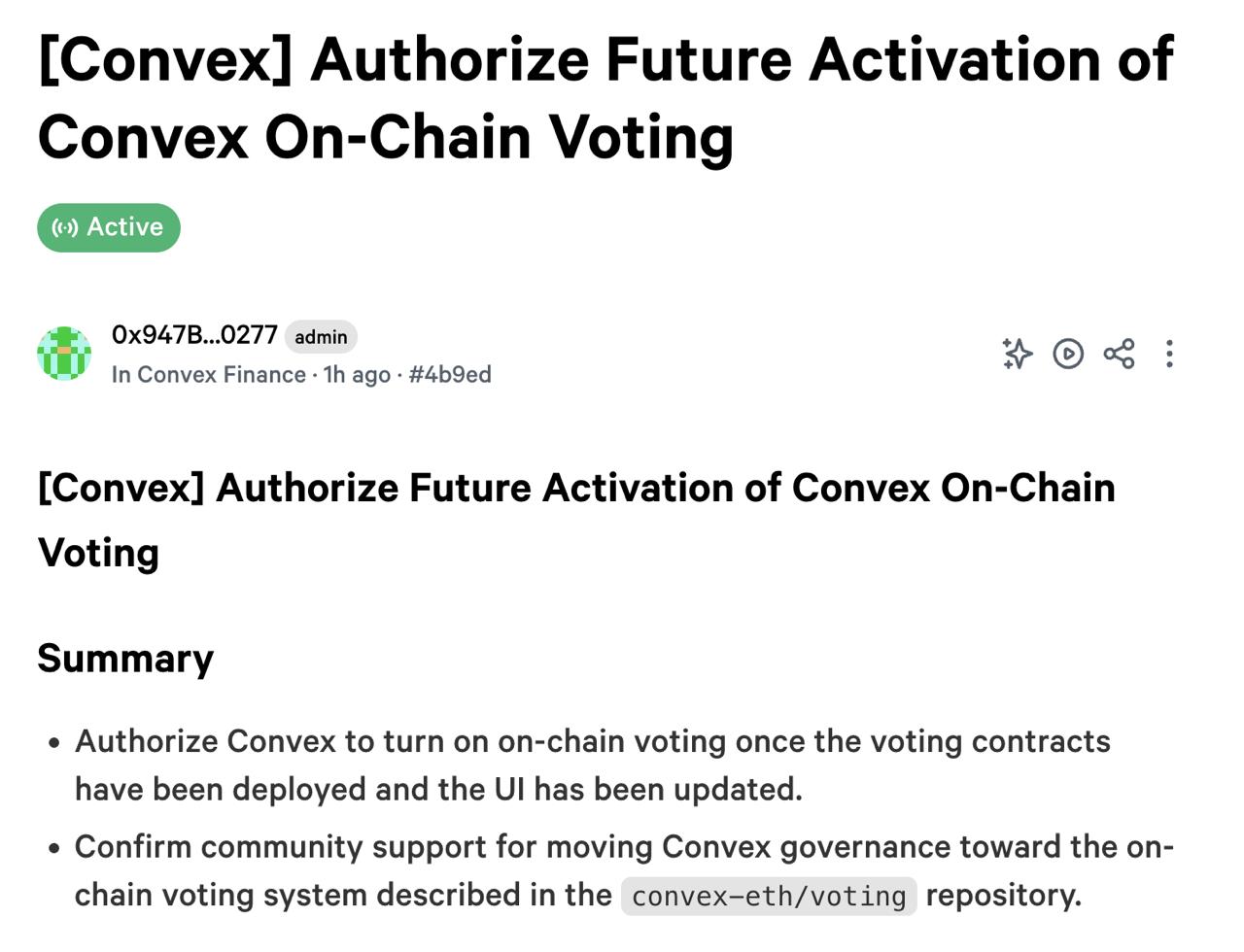 Convex votes to activate onchain DAO voting2026-07
 Convex moved governance on-chain. Voters can now select different delegates for gauge weights and DAO proposals.2026-07
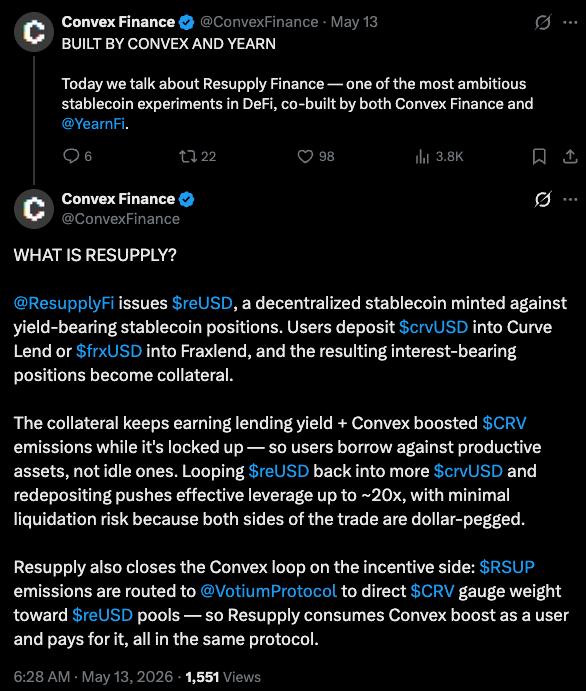 Convex recaps the history of Resupply ($RSUP) and its $reUSD stablecoin backed by yield-bearing positions in Curve Lend and Fraxlend2026-05
 Convex Finance rose from Curve’s vote-escrow model to dominate the Curve Wars, centralizing veCRV power and reshaping DeFi governance.2026-02
 Convex Finance turned DeFi governance’s biggest weaknesses—low participation and concentrated power—into a system advantage by optimizing around liquidity coordination and incentive routing rather than idealized voting. By monetizing governance through bribes and veCRV control, Convex built a durable revenue engine that has survived multiple market cycles.2026-01
 Perry breaks down the Curve War, explaining how veCRV became DeFi’s “Liquidity Stone,” directing emissions, incentives, and power. From StakeDAO and Yearn to Convex’s dominance, control of veCRV ultimately meant control of liquidity flows across Curve.2026-01
Convex Finance is a yield and governance aggregation protocol that pools vote-escrowed governance tokens on behalf of its depositors. Its core idea: the benefits of long-term token locking — higher rewards and voting weight — can be pooled, so individual liquidity providers earn boosted returns without locking anything themselves. Its May 17, 2021 launch announcement traces its start as a layer on top of Curve Finance; it now operates the same model for Frax Finance and f(x) Protocol, co-developed the stablecoin protocol Resupply with Yearn Finance, and underpins a set of downstream DeFi protocols. DefiLlama's July 2026 listing records deployments on Ethereum, Arbitrum, Polygon, and Fraxtal.
Two facts anchor everything else about Convex. First, its boost and its voting are separate systems: the reward boost depositors receive is automatic, a function of the protocol's pooled vote-escrow holdings, while decisions about where token emissions flow are made by holders of its vote-locked governance token, vlCVX. Second, Convex the protocol is distinct from its tokenholders: the aggregate voting position it custodies is directed by a distributed base of vlCVX voters, not by the founding team.
The problem Convex solved
Curve Finance, an automated market maker specializing in low-slippage trades between closely priced assets, distributes its CRV token to liquidity providers as an incentive. Curve's veCRV documentation specifies that CRV holders can lock tokens for between one week and four years in exchange for veCRV; one CRV locked for four years yields one veCRV, with shorter locks yielding proportionally less. Curve's boost guide describes a reward multiplier of up to 2.5x for the holder's liquidity positions; its revenue documentation describes a share of protocol fees, paid in crvUSD since mid-2024; and its governance guide explains the protocol and recurring gauge-weight votes that divide weekly CRV emissions among pools.
The design created a coordination problem. To earn the full boost, a liquidity provider needed a veCRV position sized against their liquidity — which meant locking capital for four years to improve the yield on a position they might want to exit in a month. Few individual LPs could justify that trade. At the same time, protocols that depended on deep Curve liquidity cared intensely about gauge weights, because emissions decide where liquidity accumulates. Beginning in mid-2021, the competition to accumulate veCRV and direct emissions became known as the Curve Wars.
Convex's answer was aggregation. Rather than each depositor locking individually, Convex accepts CRV and Curve LP tokens from thousands of users, locks the CRV as veCRV at the protocol level, and shares the resulting boost across every LP position on the platform. Depositors can withdraw their LP tokens at any time; the long-dated lock exists at the protocol layer, not the user layer.

Convex votes to activate onchain DAO voting
Launch and the Curve Wars
The model scaled quickly. DefiLlama reports that Convex's TVL peaked at $21.17 billion on January 5, 2022, within eight months of its May 2021 launch; most of Curve's own $24.3 billion peak, reached the same day, was staked through it. Unlike participants that bought CRV with treasury funds, Convex assembled its position from user deposits, exchanging a liquid claim for each CRV brought in. On-chain readings from Curve's veCRV contract and Convex's voter proxy show that, as of July 13, 2026, the proxy held about 423 million CRV locked — 49.75% of all locked CRV and about 53.6% of decay-adjusted veCRV voting supply. Convex perpetually re-locks at the maximum duration while individual locks decay.
Convex's fee documentation sets a 17% fee on the CRV revenue its Curve LPs generate: 10% to cvxCRV stakers, 4.5% to staked CVX, 2% to the treasury, and 0.5% to whoever calls the harvest function. Its tokenomics documentation caps CVX at 100 million and describes a pro-rata mint against CRV earned on the platform, at a ratio that stepped down every 100,000 CVX minted. That emission has run its course: the on-chain CVX contract showed 99.98 million of the 100 million cap minted as of July 15, 2026.
Convex readers concentrated on Convex adds support for Curve pools on Fraxtal chain, the third sidechain supported after Arbitrum and Polygon.
The two engines
Click to load the YouTube player. YouTube will set its own cookies once loaded.
Convex runs two systems that are often conflated but do different work.
cvxCRV is the yield side. Depositing CRV into Convex mints cvxCRV 1:1, and the deposited CRV is locked as veCRV permanently. Convex's cvxCRV documentation states plainly that the conversion is one-way: cvxCRV cannot be converted back to CRV inside the protocol. Exit happens on secondary markets, where cvxCRV can trade above or below CRV. The same documentation describes staked cvxCRV earning the Curve admin fees a veCRV staker would receive in crvUSD, a share of Convex's performance fee in CRV, and CVX on top, with stakers able to weight their payout mix. The boost powering these yields is automatic — a function of Convex's pooled veCRV relative to its staked liquidity — and applies to every LP position regardless of how anyone votes.
vlCVX is the voting side. Convex's vote-locking documentation says that CVX holders who lock their tokens for 16-week renewable periods receive vote-locked CVX. vlCVX holders decide how Convex's aggregate vote-escrow positions — Curve, F(x), Frax, Resupply — are cast in gauge-weight votes, DAO votes, and Convex's own governance proposals. The on-chain vlCVX contract showed about 44.6 million CVX vote-locked as of July 15, 2026, roughly 45% of the fully minted supply.
An incentive market immediately grew around Convex gauge votes. A protocol that wants emissions directed toward its pool can offer incentives to vlCVX voters, without acquiring or locking governance tokens itself. Votium's documentation describes biweekly rounds alongside Convex's gauge-weight proposals, with rewards distributed to voters and delegates within a day or two of each close. Votium's July 14, 2026 app record showed about 13.8 million vlCVX — roughly 31% of the 45.2 million eligible for incentives — delegated to the marketplace by mid-July.
One criticism of Convex governance has been its reliance on Snapshot voting to collect vlCVX holder preferences. Multisig signers are still responsible for and maintain administrative control over the on-chain votes that owners of vote-locked CVX desire.
Convex's proposal to authorize future on-chain voting passed on July 4, 2026. The system provides a path toward a more transparent and verifiable governance process: participation and vote aggregation can move on-chain and support both gauge and DAO voting spanning Curve, F(x), Frax, Resupply, and Convex-specific decisions.
The July 2026 authorization shifts administrative control away from multisig signers toward transparent, token-weighted governance. Convex's voting platform is the implementation path for that transition.

Convex moved governance on-chain. Voters can now select different delegates for gauge weights and DAO proposals.
Beyond Curve
Click to load the YouTube player. YouTube will set its own cookies once loaded.
The aggregation model proved portable. Convex's December 2021 expansion announcement opened deposits for FXS, the governance token of Frax Finance, minting cvxFXS and extending the pooled-boost, vote-directed structure to Frax's veFXS system. Its September 2023 f(x) expansion announcement applied the same model to the AladdinDAO-incubated leverage and stablecoin platform, wrapping veFXN as cvxFXN; a September 28 Convex post on X marked conversions opening. By March 2024, Convex reported that vlCVX directed more than 44% of veFXN gauge votes. A Frax governance proposal later renamed FXS to FRAX under the 2025 North Star restructuring.
The pattern in each case is the one built for Curve: wrap the ve-token permanently, give depositors a liquid claim, apply the pooled boost to LP deposits, and let vlCVX direct the aggregate votes. In late 2023, Convex announced a Prisma Finance expansion that minted cvxPRISMA — an integration whose ending proved more instructive than its beginning.
Convex launches as a pooled boost and reward layer for Curve liquidity providers.
Convex patches the pool-manager path later described by OpenZeppelin; no funds were affected.
DefiLlama records Convex's TVL peak at roughly $21.17 billion.
Convex expands its vote-escrow aggregation model to f(x) Protocol and FXN.
Prisma governance approves its wind-down and the introduction of Resupply, including a conversion path for locked-wrapper holders.
Convex acknowledges the Claim-and-Stake conversion issue and says affected users were compensated.
Convex marks its fifth anniversary, five years after launching on May 17, 2021.
Convex deploys on-chain vlCVX voting for gauge allocations and DAO governance across supported protocols.
Built with and on Convex
Resupply is the deepest expression of Convex as infrastructure. Resupply's collateralized-debt documentation describes the sister protocol, co-developed by Convex and Yearn and introduced in December 2024, as issuing reUSD against interest-earning stablecoin lending positions: crvUSD supplied to Curve Lend markets and held via Convex, or frxUSD supplied to Fraxlend. Its insurance-pool guide describes staked reUSD backstopping bad debt in exchange for a share of borrow fees. A Convex anniversary thread describes the demand-side loop: routing RSUP emissions into vote-incentive markets to direct CRV emissions toward reUSD pools.
A broader set of protocols builds on Convex without being built by it. Yearn's Curve vaults route LP tokens through Convex for boosted yield; Abracadabra accepts Convex-staked Curve LP positions as collateral for its MIM stablecoin; Inverse Finance farms its DOLA liquidity through Convex and accepts cvxCRV as lending collateral; AladdinDAO's Concentrator auto-compounds Curve and Convex rewards, and its CLever exists specifically to let CVX holders borrow against future vlCVX incentive income. A Convex anniversary thread identifies those integrations, while the respective protocols document their own implementations. The list is selective; the shape is the point — these protocols treat Convex's reward layer as a dependency.
Convex recaps the history of Resupply ($RSUP) and its $reUSD stablecoin backed by yield-bearing positions in Curve Lend and Fraxlend

33.1m reUSD outstanding against ~$36.5m Resupply TVL is a pretty tight credit loop, especially with collateral skewed almost entirely to crvUSD (~$35.5m vs <$1m frxUSD). That makes RSUP less of a standalone stablecoin bet and more a levered bid on Curve Lend utilization, Votium incentives, and PegKeeper depth. June 2025 already showed the weak spot: a ~$9.8m wstUSR/empty-vault exploit pushed bad debt into the insurance pool, so this thing lives or dies by oracle hygiene and redemption friction more than by classic liquidation risk.
Five years of operation and stewardship
In a self-reported May 2026 anniversary thread, Convex said its users had earned $704 million in CRV over the platform's lifetime. But the operating record is better read through verifiable episodes than through any aggregate.
The 2021 vulnerability. An OpenZeppelin disclosure says its security research team found, in late 2021, a vulnerability that could only have been exercised by Convex's own multisig: if two of its three anonymous signers executed a specific sequence, they would have gained control of staked LP tokens then worth roughly $15 billion. Convex's December 14, 2021 patch commit deployed an immutable pool-manager guard layer that removed the capability; its public acknowledgment followed in April 2022, once the risk was gone. No funds were affected. The notable fact is the direction of the fix: a pseudonymous team voluntarily and permanently removed its own theoretical access to user deposits.
The Prisma wind-down. A Prisma post-mortem records an exploit of roughly $12 million in March 2024; the protocol never recovered. In December 2024, Prisma governance passed PIP-46 — proposed from the Convex/Yearn side alongside Resupply's introduction — to wind the protocol down, as the archived proposal records. Resupply's redemption guide sets a path for holders of PRISMA and its permanently locked wrappers, cvxPRISMA and yPRISMA: 15% of RSUP supply reserved for conversion at a fixed 11.54:1 ratio into five-year-vesting RSUP, with no deadline, plus 2% for Prisma exploit victims not yet made whole. Without that path, wrapper holders — whose underlying PRISMA was locked forever by design — had no exit. Resupply is a new protocol with a new codebase, not a continuation of Prisma's technology; the full disposition of Prisma's contracts and remaining assets under PIP-46 is treated in the Resupply entry.
The Claim-and-Stake compensation. In October 2025, a user publicly documented that Convex's "Claim and Stake" interface had been minting cvxCRV 1:1 from CRV instead of routing through the market swap when that was more favorable — a UI bug whose cost to each affected user was roughly the market discount on the conversion. Convex acknowledged the bug within a day of the public report and said it had compensated all affected users for the missing cvxCRV. A contemporaneous DefiShaka post documented the public report. The handling of the episode is characteristic of Convex: user-reported, acknowledged, and made whole, with Convex saying no additional action was required from users.
Convex's May 2026 anniversary materials summarize five years as "$0 user funds lost." The claim refers to Convex's core platform, where no exploit has been realized in five years — consistent with the public evidence. It should not be stretched over the wider ecosystem: Resupply's insurance-pool depositors absorbed a real haircut in 2025. That is what the mechanism exists for, and it marks the boundary between Convex core and the protocols built alongside it.
Convex adds contracts and pooled administration on top of its host protocols. OpenZeppelin's 2021 disclosure documents a serious multisig-only path that Convex patched before funds were affected.
Convex's fees and boosts depend on activity, emissions, and fee flows in Curve and the other vote-escrow systems it supports; its TVL has moved with those wider liquidity cycles.
CRV converted to cvxCRV cannot be redeemed for CRV inside Convex. Exit depends on secondary-market liquidity, so cvxCRV can trade at a discount or premium.
Convex pools a large vote-escrow position in one protocol. Its direction is set by vlCVX voters rather than the founding team, but decisions by that tokenholder base affect a substantial share of host-protocol voting weight.
Returns from vote incentives depend on protocols continuing to pay for emissions. Votium's round-based market makes that demand observable, but it does not make it permanent.
Risks and trade-offs
Added contract surface. Every Convex deposit stacks Convex's booster and reward contracts on top of Curve's, and downstream integrations stack further layers on Convex. Audits and five years of operation reduce this risk without eliminating it; the 2021 episode shows serious flaws can exist in widely used systems.
Dependence on host protocols. Convex's revenue derives from other protocols' emission schedules and fee flows, mostly Curve's. CRV emissions decline on a fixed schedule, and Convex's scale tracks DeFi's liquidity cycles: DefiLlama put its TVL near $500 million as of July 15, 2026, against the $21.17 billion peak of January 2022. The same dependency extends to Frax and f(x).
One-way conversions, and wrappers without pegs. CRV, FXS, FXN, and PRISMA deposited into Convex are locked permanently. Liquid wrappers restore exit only through secondary markets — and no wrapper, cvxCRV included, is pegged to its underlying. The wrapper's price is simply what the market pays for a liquid claim on locked-token cash flows, and discounts are normal, not failures. The Convex team said in July 2026 that its treasury actively maintains protocol-owned liquidity in wrapper pairs — roughly 15% of the main cvxCRV pool as of mid-2026 — and can direct its 2% treasury fee share into those positions, with staking rewards from the positions compounded back in. That cushions the exchange rate; it does not guarantee it. The Prisma case demonstrates both the tail risk — a host protocol can fail outright — and an observed mitigation, the negotiated redemption into RSUP. That mitigation was discretionary, not contractual.
Cyclical incentive revenue. Vote-incentive income to vlCVX holders depends on protocols' willingness to pay for emissions, which expands and contracts with market conditions. A Convex anniversary thread describes Frax spending $5–7 million per Votium round at the height of the Curve Wars — a historical high-water mark, not a steady state.
Concentrated aggregate voting weight. On-chain data put Convex's proxy at roughly half of all locked CRV — 49.75% as of July 13, 2026. Mechanically, gauge-weight direction for that position is set by vlCVX voters — a distributed set of holders and delegates, not the Convex team — and the position votes only as those holders direct. The aggregation itself remains a structural fact: a single protocol's tokenholder base decides a large share of gauge outcomes, and Convex's locked position also carries weight in Curve's wider governance. Observers differ on whether this concentration is a stabilizer — a permanent, non-churning lock whose interests align with Curve's — or a fragility whose failure would propagate widely. Both readings are consistent with the mechanics.
Sister-protocol and integration exposure, distinct from core. Resupply's 2025 exploit illustrates the boundary: losses were borne within Resupply's own mechanisms — insurance pool, treasuries, a revenue-serviced loan — not by Convex depositors. Users should treat "Convex core" and "protocols built with or on Convex" as separate risk domains that share contributors and a brand.
Outlook
Five years is long enough for the record to speak. The aggregation model Convex built for Curve — permanent pooled locks, a liquid claim, an automatic boost, and a vote-locked governance market — survived a full liquidity cycle, transplanted to two other ve-token systems, and absorbed both the failure of a third (Prisma) and a serious exploit at a sister protocol (Resupply) without either event reaching Convex core depositors. What remains genuinely uncertain is mostly external: the pace of CRV emission decline, Curve's competitive position among AMMs, and protocols' continued willingness to pay for gauge weight all sit outside Convex's control. The history demonstrates that vote-escrow aggregation can be operated durably and, on the evidence of its incident record, conservatively. Whether the economics that made Convex enormous once can make it grow again is a market question, not an engineering one.
Latest Convex news
Convex votes to activate onchain DAO votingConvex moved governance on-chain. Voters can now select different delegates for gauge weights and DAO proposals.Convex recaps the history of Resupply ($RSUP) and its $reUSD stablecoin backed by yield-bearing positions in Curve Lend and FraxlendConvex Finance rose from Curve’s vote-escrow model to dominate the Curve Wars, centralizing veCRV power and reshaping DeFi governance.Convex Finance turned DeFi governance’s biggest weaknesses—low participation and concentrated power—into a system advantage by optimizing around liquidity coordination and incentive routing rather than idealized voting. By monetizing governance through bribes and veCRV control, Convex built a durable revenue engine that has survived multiple market cycles.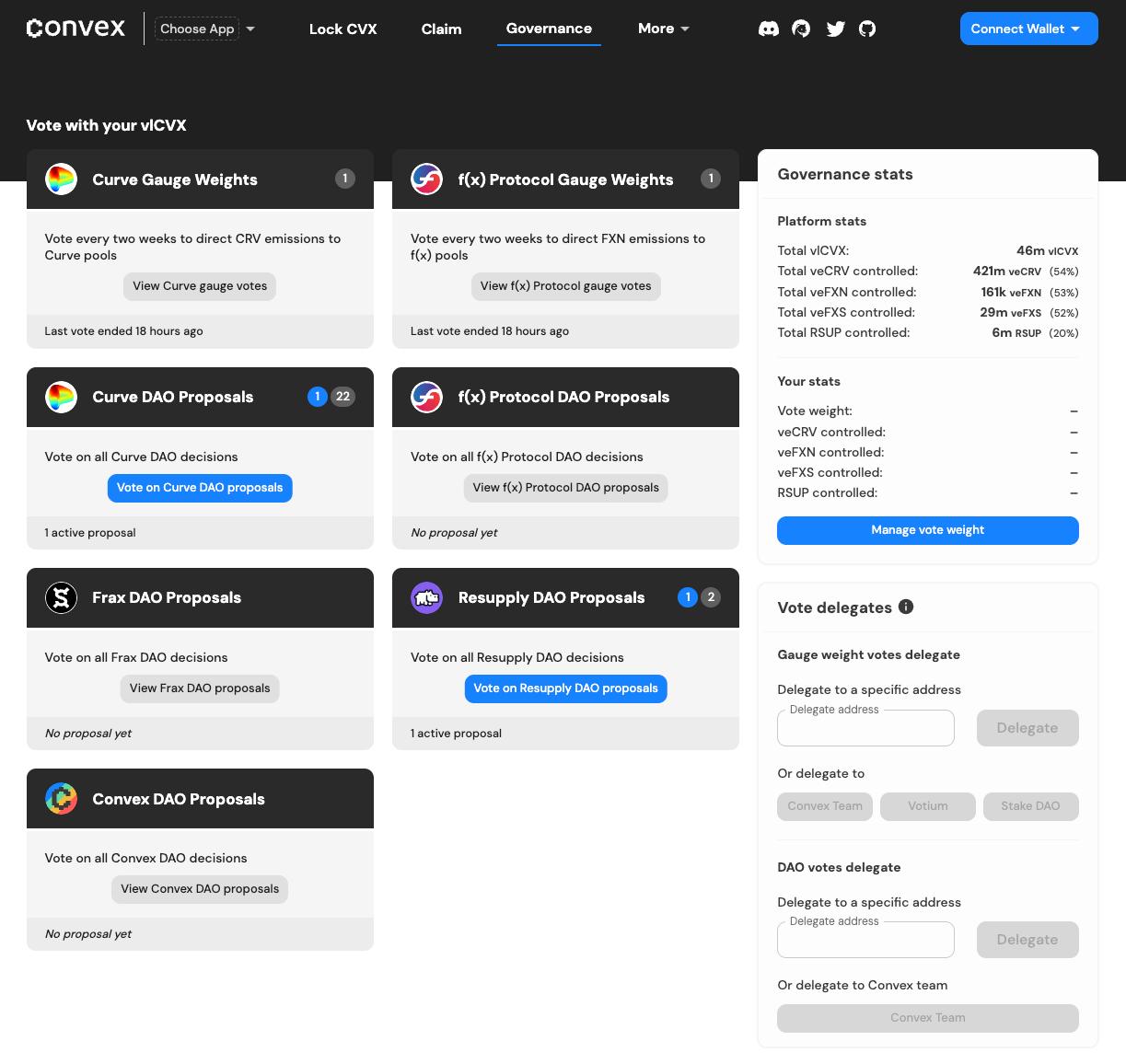 Convex moves all proposal settlements onchain
Sources
45 records from 21 domains
convexfinance.medium.com
defillama.com
docs.curve.finance
etherscan.io
docs.convexfinance.com
docs.votium.app
votium.app
x.com
gov.frax.finance
docs.resupply.finance
openzeppelin.com
github.com
hackmd.io
web.archive.org
blocksecteam.medium.com
gov.resupply.finance
docs.yearn.fi
docs.frax.finance
docs.abracadabra.money
docs.inverse.finance
docs.aladdin.club
Community notes (1)
Spot something off or out of date? Drop a note. Editors review topic notes daily and roll accepted fixes into the explainer — contributors are recognized in the monthly $SQUID drop.
Loading notes…
Help improve this topic
Have a story or tip about this topic? Submit it. See something missing? Leave a note. Editors review daily; accepted submissions and fixes count toward the monthly $SQUID drop.