
Deep dive into FRAX and Frax Finance: how frxUSD, Fraxtal, and the FRAX token form a compliant, fully collateralized stablecoin “operating system” at the intersection of DeFi, regulation, and institutional adoption.
+2 sources across the wider coverage universe
 Stake DAO ships lending beta via Morpho, letting LPs borrow against OnlyBoost positions while yield keeps stacking2026-03
 Brazil advances Bill 4308 banning algo stables like USDe and FrxUSD, requiring segregated reserves and 8-year jail terms for issuers2026-02
 Frax jumps 60% as Binance announces they have completed the FXS to FRAX token swap and enabled FRAX markets for their Earn, Buy Crypto, Convert, Margin & Futures products.2026-01
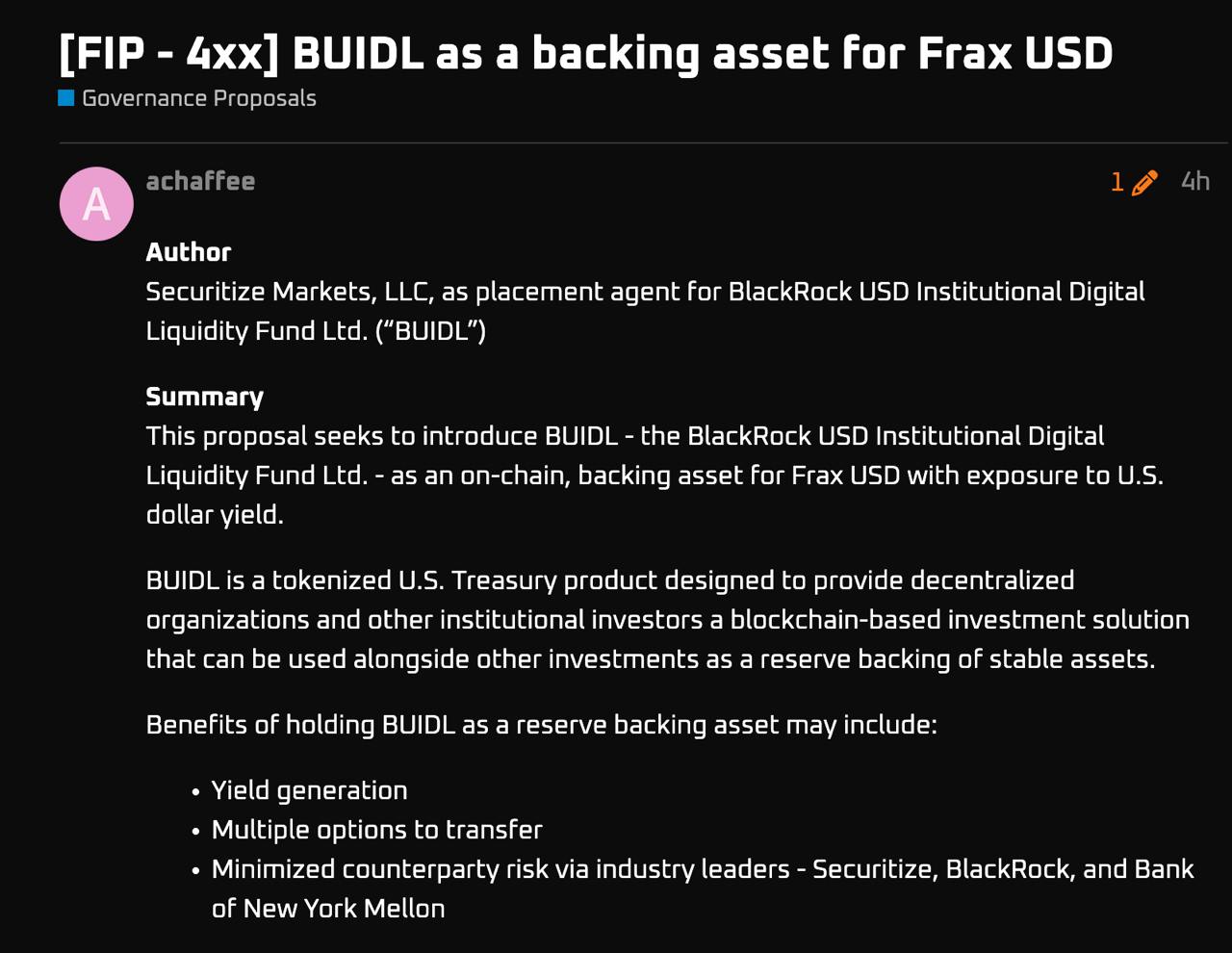 BlackRock has proposed adding its tokenized U.S. Treasury fund, BUIDL, as a reserve asset for Frax's stablecoin treasury.2024-12
 Live now with Frax + Superstate w Sam Kazemian and Jim Hiltner2025-01
 The vote to onboard Blackrock's $BUIDL as the first backing asset for the new Frax USD (frxUSD) stablecoin is live2024-12
FRAX and Frax Finance: An Evergreen Guide to the Stablecoin Operating System
FRAX is the core governance and utility token of the Frax Finance ecosystem, a stablecoin and DeFi protocol that is evolving into a full-stack “stablecoin operating system” built around its fully collateralized dollar stablecoin Frax USD (frxUSD) and its modular rollup chain Fraxtal. Together, these components aim to provide programmable, compliant dollar liquidity and infrastructure for both on-chain DeFi users and traditional institutions integrating tokenized dollars into their own products.
The Frax Thesis: From Algorithmic Stablecoin Experiment to Stablecoin Operating System
The Frax project emerged from a period in crypto when builders were actively experimenting with ways to create decentralized dollars that were not simply custodial IOUs but instead used on-chain collateral and algorithmic mechanisms for stability. The protocol was founded by Sam Kazemian, who remains its public face and CEO, and who has consistently framed Frax as an effort to bridge traditional financial primitives with programmable, crypto-native infrastructure. In its early iterations, Frax explored a fractional-algorithmic design in which part of the backing came from exogenous collateral and part from a governance token, combining elements of overcollateralization with algorithmic supply adjustments. This placed it in the “algorithmic stablecoin” category in the eyes of many regulators and commentators, particularly after the collapse of other algorithmic projects such as Terra, even though Frax’s mechanisms were notably more conservative and overcollateralized in practice.
Over time, however, the Frax team’s vision broadened beyond the single-token question of how to keep a dollar peg. In its current form, Frax positions itself as a “stablecoin operating system,” an end-to-end stack that includes the stablecoin itself, the on-chain infrastructure where that stablecoin is native, and an array of subprotocols and integrations that make it usable as collateral, settlement medium, and yield-bearing asset. In public essays and social media threads, the team has drawn explicit analogies between Linux as the operating system of the internet age, Ethereum as the operating system for trustless computation, and stablecoin operating systems as the infrastructure layer for on-chain dollars and tokenized real-world assets. The goal is not only to issue a stablecoin but to create the neutral, programmable rails on which a broad range of financial applications and institutional products can be built.
This shift in framing is reflected in how Frax’s product suite has evolved. The protocol still emphasizes on-chain programmability and automated market operations, but it now pairs these with fully collateralized reserves, regulated custodians, and compliance-oriented structures that can satisfy the demands of new legislation such as the GENIUS Act in the United States. The move from the legacy FRAX stablecoin design toward Frax USD (frxUSD), a fiat-redeemable stablecoin backed one-to-one by tokenized U.S. Treasuries and cash equivalents, marks a decisive pivot from experimental algorithmic design to a model closer in spirit to USDC while retaining the modularity and composability that made Frax a DeFi-native project. At the same time, the launch of Fraxtal as a modular rollup and the development of FraxNet as an account-based multi-chain platform show that Frax now sees its competitive edge not merely in its token but in the broader infrastructure it can offer to users, developers, and institutional partners.
In parallel with this technical and regulatory evolution, Frax has remained deeply embedded in the DeFi ecosystem. It has long-standing relationships with protocols such as Curve, Convex, Alchemix, and Yearn, and continues to be a key participant in the “money lego” stack that underpins much of on-chain stablecoin liquidity and lending. This combination of DeFi-native integrations, fully collateralized reserves, and purpose-built infrastructure like Fraxtal is what distinguishes Frax in an increasingly crowded stablecoin landscape where regulatory scrutiny and institutional expectations are rapidly rising.

Frax teases next frxUSD integration with Gearbox in first-of-its-kind unlock for leveraging RWA

Core Architecture: Tokens, Stablecoins, and Governance
The Frax ecosystem can be understood as a layered architecture of tokens, protocols, and governance structures. At its base is the Frax protocol itself, a set of smart contracts governing the issuance and redemption of stablecoins and the operation of various subprotocols such as automated market operations, lending, and yield strategies. On top of this protocol, Frax issues several key assets, each serving a distinct role in the system’s economics and governance.
The most central of these assets today is Frax USD (frxUSD), the protocol’s flagship fully collateralized U.S. dollar stablecoin. According to Frax documentation, each unit of frxUSD is backed one-to-one by “permitted cash-equivalent reserves,” such as tokenized U.S. Treasury funds, including vehicles like BUIDL, USTB, JTRSY, WTGXX, and AUSD. These reserves are held with regulated custodians and managed by Frax Inc, a legal entity that operates under delegation from the Frax DAO, effectively bridging on-chain governance and off-chain asset management. The design objective is to make frxUSD both fiat-redeemable and fully collateralized while maintaining the programmability and composability that DeFi users expect from an on-chain stablecoin.
In addition to frxUSD, the ecosystem also includes yield-bearing variants such as staked or “s” versions of Frax assets, most notably sfrxUSD and similar wrappers. These tokens typically represent claims on underlying frxUSD deposits that are deployed into conservative yield strategies, often involving the same tokenized Treasury and cash-equivalent instruments that back the base stablecoin. For users, these yield-bearing versions function similarly to on-chain money market shares: they allow dollar holders to earn a yield that reflects the underlying T-bill and cash-equivalent returns, less protocol fees and risk buffers, while still being transferable and composable within DeFi. The existence of these variants underscores Frax’s dual ambition to offer both a settlement asset and a programmable yield-bearing store of value within its stablecoin stack.
The FRAX token itself, which resulted from a rebranding and mainnet swap from the earlier Frax Share (FXS) governance token, now serves as the base-layer governance and utility token for the entire Frax ecosystem. Binance, for example, has completed the FXS-to-FRAX mainnet swap and now supports FRAX across its Earn, Buy Crypto, Convert, Margin, and Futures products, illustrating how the token has migrated from a niche governance asset to one integrated into mainstream centralized exchange infrastructure. Governance documentation describes this token as accruing fees, revenue, and excess collateral value from the Frax protocol, functionally aligning it with the residual claim on the system’s cash flows and growth. In addition, FRAX is the native gas token of Fraxtal, the Frax rollup chain, further anchoring its role in securing and governing the expanding Frax infrastructure.
Governance itself is coordinated through the Frax DAO, which uses token-weighted voting to decide on key parameters such as collateral whitelist updates, AMO configurations, new product launches, and partnerships. Importantly, the DAO delegates specific operational roles to entities like Frax Inc for reserve management and to various protocol-maintainer contracts for on-chain operations, creating a hybrid governance model that combines decentralized decision-making with legally accountable operators. This structure is particularly important in a regulatory environment where laws such as the GENIUS Act explicitly contemplate issuer obligations and reserve management standards, making it insufficient to rely solely on in-protocol governance without any real-world legal counterpart.
Beyond these core assets and governance processes, the Frax ecosystem includes a range of subprotocols and ancillary products. These have historically included lending markets, automated market operations that deploy protocol-owned liquidity to stabilize pegs, and yield strategies that utilize both DeFi-native and tokenized real-world assets. While not all of these subprotocols remain in the same form in the current v3 architecture, the underlying principle persists: Frax aims to use algorithmic and programmatic tools to manage liquidity and stability, but always anchored to robust collateral and institutional-grade reserve management. This is the technical expression of its “stablecoin operating system” thesis, where tokens, governance, and infrastructure form a coherent whole rather than a collection of disconnected products.
Readers' clicks reveal they are tracking Frax not as a stablecoin project but as an institutional pivot story — the BlackRock BUIDL headline drew 3× more clicks than any other, showing readers want to know whether a DeFi-native protocol can credibly absorb TradFi reserve infrastructure without losing its on-chain identity.
Fraxtal and FraxNet: Infrastructure for a Stablecoin Operating System
One of the most distinctive aspects of Frax’s recent evolution is its move from being “just” a protocol deployed on third-party chains to operating its own rollup infrastructure in the form of Fraxtal. Fraxtal is described in the documentation as a modular rollup blockchain, effectively a Layer 2 network, with a “fractal scaling” roadmap. It is EVM-equivalent, meaning it is fully compatible with Ethereum’s virtual machine and tooling, and it is designed to be fast, secure, and inexpensive to use for both developers and end users. Crucially, the native gas token on Fraxtal is FRAX, tightly coupling the governance token’s value to the activity and adoption of the chain itself.
The concept of “fractal scaling” refers to Fraxtal’s aspiration to support nested or interoperable rollups and sub-chains, enabling the network to scale horizontally as demand for stablecoin-based applications grows. In practice, this means Fraxtal is not merely positioning itself as yet another EVM chain but as the canonical environment for Frax’s stablecoins and subprotocols, with the potential to host specialized instances or child rollups focused on specific use cases such as institutional stablecoin issuance, high-frequency trading, or real-world asset tokenization. In this way, Fraxtal serves as the infrastructural backbone of the Frax stablecoin operating system, providing deterministic execution and settlement for protocol-native logic while remaining interoperable with the broader Ethereum ecosystem.
Adoption metrics from analytics platforms such as Token Terminal show that Fraxtal has seen meaningful usage, with daily active addresses on the chain reaching yearly highs, indicative of growing developer and user engagement. While daily active addresses are an imperfect proxy for economic activity, sustained growth in this metric supports the view that Fraxtal is not merely a vanity chain but is increasingly being used as a venue for stablecoin transfers, DeFi activity, and protocol-native experiments. As more of the Frax stack and associated applications move to Fraxtal, the chain’s gas token, FRAX, becomes directly linked to the throughput and success of this stablecoin-centric ecosystem.
Complementing Fraxtal is FraxNet, an account-based platform designed to abstract away the complexity of interacting with frxUSD across multiple networks. FraxNet’s public materials describe it as a system that allows users to mint, redeem, and earn yield on frxUSD across more than twenty supported chains through a unified account interface. Rather than forcing users to manually bridge assets or manage separate wallet instances on each chain, FraxNet aims to provide a single logical account from which cross-chain actions can be initiated, with the protocol handling the underlying routing and settlement. This aligns with Frax’s broader vision of creating infrastructure where stablecoins are treated as network-native money rather than as wrapped or bridged representations with fragmented liquidity.
In effect, Fraxtal and FraxNet address two complementary problems in the stablecoin ecosystem. Fraxtal provides a high-throughput, EVM-equivalent execution environment that can host Frax-native applications and liquidity, while FraxNet provides the user-facing abstraction layer that makes those applications and the frxUSD stablecoin accessible across the wider multi-chain DeFi universe. Together, they embody the idea of a stablecoin operating system: a combination of execution layer, settlement asset, governance, and cross-chain routing that can support everything from retail DeFi users to institutional stablecoin-as-a-service offerings.
This infrastructure orientation dovetails with Frax’s messaging in essays such as “Linux, Ethereum, and the Rise of Stablecoin Operating Systems,” where the team argues that the next stage of crypto will be dominated by neutral, programmable financial operating systems rather than isolated applications or static tokens. By controlling both the base-chain environment through Fraxtal and the multi-chain account abstraction layer via FraxNet, Frax is positioning itself not simply as a stablecoin issuer competing with USDC or USDT but as a platform on which other issuers, protocols, and institutions can build their own products on top of a robust, compliant dollar stack.
Stablecoin Design in Detail: FRAX v3, frxUSD, and AMOs
At the heart of the Frax ecosystem is its approach to stablecoin design, which has evolved significantly across successive versions of the protocol. The current architecture, often referred to as Frax v3, centers on the idea of a dollar-pegged stablecoin whose stability is maintained by a combination of fully collateralized reserves and algorithmic market operations, rather than by purely algorithmic mechanisms or fractional collateral ratios. This hybrid approach aims to preserve the scalability and capital efficiency associated with algorithmic stabilization while grounding the system in verifiable, segregated collateral held with regulated custodians.
The flagship stablecoin under this model is Frax USD (frxUSD). According to the Fraxtal documentation, frxUSD is a fiat-redeemable, fully collateralized stablecoin, with each unit backed one-to-one by cash-equivalent reserves. These reserves are primarily tokenized U.S. Treasury and money market instruments, including products such as BUIDL, USTB, JTRSY, WTGXX, and AUSD, each of which represents exposure to short-term U.S. government securities or similar high-quality liquid assets. The backing assets are held with regulated custodians and are managed by Frax Inc under delegation from the Frax DAO, creating a clear governance and accountability structure around reserve management. In practical terms, this means that users can redeem frxUSD for fiat dollars and that the protocol’s solvency is anchored in highly liquid, low-risk instruments, aligning it with regulatory expectations such as those laid out in the GENIUS Act.
Chaos Labs, which has published an independent token review of frxUSD, emphasizes that the stablecoin is designed to function as a fully collateralized, fiat-redeemable asset with seamless cross-chain interoperability and integrated support for on-chain liquidity strategies. Their analysis highlights the protocol’s focus on maintaining high-quality reserves, minimizing counterparty risk through the use of regulated custodians, and enabling efficient issuance and redemption across multiple chains. They also note that frxUSD’s design directly addresses many of the criticisms historically leveled at algorithmic and undercollateralized stablecoins, particularly in light of regulatory moves such as Brazil’s Bill 4,308/2024, which seeks to ban unbacked models and impose strict reserve requirements.
The AMO, or Algorithmic Market Operation, contracts remain a key part of Frax’s stabilization toolkit in v3. Rather than adjusting the collateral ratio in a way that directly impacts solvency, these AMOs are permissionless, non-custodial subprotocols that automate specific market interventions, such as deploying liquidity into stablecoin pools, rebalancing collateral, or arbitraging price discrepancies across venues. For example, AMOs may be used to provide protocol-owned liquidity in Curve pools, helping to deepen frxUSD’s trading markets and maintain a tight peg without relying solely on external liquidity providers. Because the AMOs are governed by transparent smart contracts and operate within predefined risk limits, they aim to achieve the benefits of active market-making and liquidity management while preserving the underlying fully collateralized backing of frxUSD.
One concrete expression of this strategy is Frax’s use of PegKeeper pools, particularly in partnership with DeFi protocols such as Alchemix. A recent update from the ecosystem announced a new PegKeeper pool in which Alchemix is migrating its alUSD pools away from the legacy FRAX stablecoin and into frxUSD, with the stated goal of unlocking more sustainable and stable liquidity. By directing liquidity and incentives toward frxUSD and away from the older FRAX design, Frax is consolidating its stablecoin liquidity around the fully collateralized, fiat-redeemable asset that better fits current regulatory and market expectations. This migration also demonstrates how AMO-style mechanisms and protocol-level coordination can be used to reshape liquidity landscapes and effectively “upgrade” circulating stablecoins in DeFi without forcing abrupt user migrations.
The relationship between frxUSD and legacy FRAX is particularly important in regulatory contexts. Brazilian lawmakers, for example, have advanced Bill 4,308/2024, which would require all stablecoins to be fully backed by segregated reserves and would prohibit “unbacked” or algorithmic models such as Ethena’s USDe and Frax’s earlier configurations. The bill even introduces criminal penalties of up to eight years in prison for issuing unbacked stablecoins and extends compliance and risk-management obligations to exchanges offering foreign stablecoins like USDT and USDC. In this environment, Frax’s move to emphasize frxUSD as a fully collateralized, fiat-redeemable stablecoin backed by tokenized Treasuries is more than a technical upgrade; it is a strategic response to a global shift in how regulators view acceptable stablecoin designs.
In practice, frxUSD competes most directly with fully collateralized stablecoins such as USDC and, increasingly, tokenized Treasury funds that offer direct exposure to underlying yields. What differentiates Frax’s approach is the tight integration of the stablecoin with protocol-native infrastructure like Fraxtal and FraxNet, as well as with DeFi-native liquidity strategies such as PegKeeper pools and AMOs. Users can treat frxUSD both as a dollar substitute and as a programmable asset that can be easily deployed into yield-bearing wrappers, liquidity pools, and lending protocols, often with protocol-level support designed to maintain stability and deep liquidity.
- 01BlackRock BUIDL reserve backing↗
The proposal to make a tokenized Treasury fund the primary reserve asset for frxUSD collapsed the gap between TradFi and DeFi stablecoins in a single governance vote, which readers treated as a watershed moment.
- 02frxUSD institutional stablecoin build-out↗
Readers followed the full arc from v3 product leak to Superstate partnership to full 1:1 fiat redeemability, treating each step as evidence of whether Frax's institutional pivot would actually close.
- 03BAMM oracle-free lending mechanics↗
The promise of borrowing inside an AMM without price oracles or liquidation events attracted readers looking for a structural DeFi primitive change, not just a yield play.
- 04sFRAX yield instrument launch↗
A zero-duration DSR-like product promising 10% APY at launch pulled in readers comparing it directly to MakerDAO's sDAI and hunting for the highest risk-adjusted stablecoin yield.
- 05Fraxtal L2 ecosystem expansion↗
Readers tracked Fraxtal as Frax's move from a stablecoin issuer to a full-stack L2 operator, with Fjord Foundry and NEAR partnerships confirming the breadth of the bet.
- 06Governance tokenomics overhaul↗
Proposals to swap revenue distribution from FXS to protocol-issued bonds and to re-enable the fee switch signaled a fundamental rethink of how value accrues to holders, which governance-watchers clicked heavily.
Regulatory Positioning: The GENIUS Act, Brazil’s Bill 4308, and Global Trends
Stablecoins now sit at the center of both crypto’s growth and its regulatory debates, and Frax is explicitly positioning itself at the intersection of these trends. The GENIUS Act in the United States has been framed by many as a turning point for stablecoin regulation, creating clearer rules for fiat-redeemable, fully backed dollar tokens issued under defined governance and reserve management standards. Within this emerging framework, frxUSD is described by third parties as a GENIUS Act–compliant stablecoin, built to meet its requirements for full collateralization, segregated reserves, and transparent redemption mechanisms. Frax’s choice to structure its reserves around highly liquid tokenized Treasury funds and to delegate their management to a legally accountable entity, Frax Inc, under DAO oversight, is closely aligned with the kinds of structures envisioned by the legislation.
This regulatory alignment is not merely a matter of legal compliance; it is also a competitive strategy. By designing frxUSD as a fiat-redeemable stablecoin that fits within the GENIUS Act’s parameters, Frax seeks to make its stablecoin attractive not only to DeFi users but also to institutional partners and enterprises that require clarity on issuer obligations, redemption rights, and reserve quality. The rise of stablecoin-as-a-service platforms such as Stably, which offers custom stablecoin development and advisory services for institutions and enterprises, further underscores the demand for compliant, modular stablecoin infrastructure that can be integrated into traditional financial products. Frax’s positioning as a stablecoin operating system—rather than a single-token issuer—makes it a natural candidate to serve as underlying infrastructure for such services, allowing third parties to build their own branded stablecoins or tokenized dollar products on top of frxUSD, Fraxtal, and FraxNet.
Outside the United States, regulatory pressure has often focused on algorithmic and undercollateralized stablecoins. Brazil’s Bill 4,308/2024 offers a concrete example: it moves to require all stablecoins to be fully backed by segregated reserves and explicitly targets unbacked or algorithmic models like Ethena’s USDe and earlier iterations of Frax. The bill not only prohibits such models but also introduces criminal penalties of up to eight years in prison for issuers of unbacked stablecoins and extends compliance and risk-management obligations to domestic exchanges listing foreign stablecoins. Regardless of how precisely the Brazilian authorities classify specific designs, the direction of travel is clear: regulators are skeptical of stablecoins that rely heavily on algorithmic mechanisms or derivatives rather than on transparent, segregated reserves.
In this environment, the Frax team’s pivot from a fractional-algorithmic FRAX design toward the fully collateralized and fiat-redeemable frxUSD can be seen as anticipatory compliance with the emerging global consensus. While the protocol still uses algorithmic market operations to manage liquidity and peg stability, these mechanisms are now layered on top of a fully collateralized reserve base rather than substituting for it. This distinction is crucial in jurisdictions like Brazil that are concerned about “unbacked” stablecoins; by holding tokenized Treasuries and money market instruments one-to-one against outstanding frxUSD, Frax can credibly claim that its stablecoin is backed by segregated, high-quality assets even if it retains DeFi-native tools for liquidity management.
At the same time, regulatory clarity can create new opportunities. The GENIUS Act’s passage has been accompanied by increased interest from traditional financial institutions in issuing their own branded stablecoins or tokenized deposit products, often through partnerships with crypto-native infrastructure providers. Platforms like Stably explicitly market stablecoin development and advisory services to institutions and enterprises, including integration support with underlying infrastructure providers. Frax’s suite of products—frxUSD, Fraxtal, FraxNet, and various DeFi integrations—makes it well-suited to serve as such an infrastructure provider, offering both the regulatory alignment and the composability needed to support institutional use cases that range from on-chain payments to tokenized fund shares.
However, regulatory alignment also introduces new forms of risk. The reliance on regulated custodians for reserve management, while necessary for compliance and fiat redeemability, creates dependencies on off-chain institutions and legal regimes. Changes in banking regulations, sanctions policies, or securities law interpretations could affect the availability or treatment of the tokenized Treasury instruments that back frxUSD, forcing the protocol to adjust its collateral portfolio or redemption mechanisms. Frax’s hybrid governance structure, combining on-chain DAO voting with off-chain legal entities, is designed to navigate these challenges, but it also means that the system’s risk profile includes both smart contract and traditional financial risks. For users and builders, understanding this dual exposure is essential when assessing the relative safety and resilience of frxUSD compared to purely on-chain, overcollateralized stablecoins or fully custodial centralized offerings.
DeFi Integrations: Curve, Alchemix, Yearn, Morpho, and Beyond
Frax’s identity has always been deeply intertwined with DeFi, and its current stablecoin operating system thesis is informed by years of active participation in on-chain liquidity games, governance battles, and protocol integrations. One of the most enduring relationships in this ecosystem is with Curve Finance, the dominant automated market maker for stablecoins and other low-volatility assets. Curve powers a vast DeFi ecosystem, with integrations spanning Convex, Yearn, Frax, and others, offering stablecoin liquidity pools, lending markets through Curve Lend, and automated yield strategies. Frax has historically been one of the largest participants in Curve’s stablecoin pools, using both protocol-owned liquidity and incentive frameworks to deepen FRAX and, increasingly, frxUSD liquidity.
The PegKeeper concept exemplifies Frax’s approach to Curve-based liquidity management. By deploying protocol-owned liquidity into Curve pools and dynamically adjusting positions through AMOs, Frax can help maintain a tight peg for its stablecoins while also earning trading fees and governance tokens that accrue to its treasury. The recent announcement of a fresh PegKeeper pool with Alchemix, in which the Alchemix team is migrating alUSD pools from the legacy FRAX stablecoin to frxUSD, reflects both the deep integration between these protocols and the strategic shift toward consolidating liquidity around frxUSD. Alchemix, known for pioneering self-repaying loans, benefits from tapping into a larger and more sustainable frxUSD liquidity base, while Frax gains an additional venue where its fully collateralized stablecoin is central to a high-profile DeFi use case.
Yearn Finance, another long-standing DeFi protocol, has likewise integrated with Frax stablecoins across various vault strategies, enabling users to deposit FRAX or frxUSD into automated yield strategies that deploy capital across Curve, Convex, and other venues. Public events and panels, such as those at Rare Evo featuring Frax, Alchemix, and Yearn, have showcased how these protocols collaborate not just at the integration level but also in shaping broader narratives about on-chain credit, self-repaying loans, and stablecoin risk management. By positioning frxUSD as a high-quality, yield-generating dollar asset backed by tokenized Treasuries, Frax offers these protocols a stable, composable base asset for their strategies while benefiting from the demand and liquidity they generate.
Newer DeFi platforms are also integrating with Frax’s ecosystem. Stake DAO, for example, has launched a lending platform on Morpho that allows users to borrow against OnlyBoost LP positions while continuing to earn underlying yield. While this particular integration is not exclusively focused on Frax assets, it exemplifies the kind of composable leverage and yield strategies that increasingly involve stablecoins like frxUSD as collateral or settlement assets. Frax’s presence in these sorts of cross-protocol strategies underscores its role as part of the broader DeFi “money stack,” where stablecoins are used both as borrowing collateral and as base assets for yield farming.
The integration of Frax with decentralized exchanges and liquidity venues continues to expand. Frax’s stablecoins are live on platforms such as Katana, where users can earn native rewards by providing liquidity in frxUSD and its yield-bearing variants. These deployments extend frxUSD’s reach into different ecosystems and chains, reinforcing FraxNet’s role in providing account-based access to frxUSD across multiple venues. As more DeFi protocols seek compliant, yield-bearing dollar assets that can be easily deployed into cross-chain strategies, frxUSD’s combination of fully collateralized backing and high composability positions it as a natural choice.
Moreover, Frax’s ecosystem extends beyond purely DeFi-native protocols to include infrastructure and service providers such as Stably. Stably’s stablecoin-as-a-service platform is designed to help financial institutions and enterprises issue their own branded stablecoins and integrates with underlying infrastructure providers. Frax’s stablecoin operating system—combining frxUSD, Fraxtal, and FraxNet—offers precisely the kind of programmable, compliant dollar stack that such platforms can leverage to deliver institutional-grade tokenized payment or savings products. By serving both DeFi protocols and enterprise-focused platforms, Frax aims to situate itself at the confluence of open finance and regulated institutional adoption.
Revenue sharing to veFXS holders disabled
Frax v3 100% collateral ratio direction announced
sFRAX launched as DSR-like yield instrument at ~10% APY
Fraxtal L2 mainnet launched
BAMM oracle-free lending primitive launched
BlackRock BUIDL proposed as frxUSD primary reserve asset
frxUSD achieves full 1:1 fiat redeemability via Superstate and BlackRock
Tokenomics and Value Accrual: FRAX as a Governance and Infrastructure Asset
The FRAX token sits at the center of the protocol’s tokenomics, serving as the primary vehicle for governance, value accrual, and, on Fraxtal, gas payments. In its earlier guise as FXS, the token represented a claim on the protocol’s future growth and fee revenues, with value largely tied to the adoption of the FRAX stablecoin and associated DeFi integrations. The mainnet swap and rebranding to FRAX, completed on major exchanges such as Binance on a one-to-one basis, did not fundamentally alter these economic properties but did align token branding more closely with the protocol’s overall identity. By enabling FRAX in Earn, Convert, Margin, and Futures products, Binance has also increased avenues for liquidity, hedging, and speculative participation, broadening the token’s market footprint.
Governance documentation describes FRAX as the base-layer governance token for the entire Frax ecosystem of smart contracts, accruing fees, revenue, and excess collateral value from protocol operations. These cash flows can come from several sources, including the yield on tokenized Treasury reserves backing frxUSD, fees on minting and redemption, trading fees and incentive rewards from DeFi integrations, and potential revenues from subprotocols deployed on Fraxtal. In essence, the token functions similarly to an equity-like instrument in a traditional financial system, representing residual claim on the protocol’s net revenues and a governance stake in its strategic direction.
Academic and practitioner discussions of tokenomics often emphasize the “blur” between utility and investment value in crypto tokens, noting that many tokens provide both functional utility (such as gas or governance) and implicit exposure to future protocol growth. In one such discussion, commentators highlight how tokens can be used to “pre-commit” to specific monetary or issuance policies that are enforced by code rather than by centralized issuers, distinguishing them from traditional equities where future issuance is largely discretionary. The FRAX token embodies this duality: it is required for governance and for paying gas on Fraxtal, giving it immediate functional value, but its long-term value proposition is tied to Frax’s success in capturing stablecoin and DeFi market share and in monetizing its stablecoin operating system infrastructure.
The integration of FRAX as the native gas token on Fraxtal further reinforces its role as an infrastructure asset. As more activity migrates to Fraxtal, demand for FRAX as gas increases, and a portion of that demand may translate into fee revenues or burn mechanisms that benefit token holders, depending on governance decisions. This model echoes the way in which Ethereum’s ETH accrues value from network usage, albeit within a more specialized domain focused on stablecoins and DeFi. By tightly coupling governance, gas, and protocol revenues into a single token, Frax aligns the incentives of token holders with the health and adoption of its infrastructure stack.
At the same time, Frax’s tokenomics must balance incentives with regulatory considerations. The token’s economic design cannot be so explicitly profit-like as to trigger securities law concerns in jurisdictions with strict interpretations, yet it must provide enough value accrual to justify holding it as a long-term governance asset. The use of protocol fees to support development, liquidity incentives, and ecosystem grants, rather than direct dividend-like payouts, is one way protocols like Frax navigate this tension. However, as stablecoin-focused legislation such as the GENIUS Act evolves, and as regulators develop more nuanced frameworks for token classifications, Frax’s tokenomics may need to adapt to ensure that FRAX remains both economically compelling and compliant.
For users and investors, understanding FRAX’s tokenomics means appreciating that its value is not solely a function of speculative narratives about “DeFi blue chips” but is grounded in the real economics of stablecoin issuance, reserve management, and DeFi infrastructure usage. As more of the global financial system experiments with 24/7 tokenized markets and on-chain Treasury yields, the revenue streams associated with running a stablecoin operating system—spanning reserve yields, infrastructure fees, and DeFi integrations—could become significant. FRAX is the primary instrument through which those economics are priced and governed.
Risks and Considerations: Smart Contracts, Liquidity, Custodians, and Governance
Despite its careful design and regulatory alignment, the Frax ecosystem faces a spectrum of risks that users, developers, and institutions must consider. At the smart contract level, Frax’s core protocols, AMOs, and cross-chain infrastructure all depend on complex code deployed across multiple chains. While these contracts are subject to audits and community scrutiny, no smart contract is entirely free of bug risk, and the introduction of new components such as Fraxtal and FraxNet adds additional attack surfaces. Exploits in DeFi protocols that integrate with Frax stablecoins, such as lending markets or liquidity pools, can also indirectly affect frxUSD holders, particularly if those protocols are significant holders or venues for trading the stablecoin.
Liquidity and peg stability are another critical dimension of risk. While frxUSD is fully collateralized by tokenized Treasuries and cash equivalents, its on-chain trading liquidity is spread across multiple pools and chains, including Curve, decentralized exchanges such as Katana, and various lending markets. A sudden loss of liquidity in major pools, perhaps due to a smart contract exploit or a large-scale withdrawal of liquidity providers, could temporarily widen spreads and impact users’ ability to exit positions at par, even if the underlying reserves remain intact. Frax’s use of protocol-owned liquidity and PegKeeper pools is designed to mitigate such scenarios by ensuring that the protocol itself can step in as a stabilizing market participant, but this approach is not immune to extreme market conditions.
Custodial and regulatory risks arise from the reliance on off-chain entities to manage the reserves that back frxUSD. Frax Inc, acting under delegation from the Frax DAO, is responsible for holding and managing reserves in regulated custodial accounts that contain tokenized Treasury and money market funds. This arrangement introduces counterparty risk: if a custodian were to face insolvency, regulatory intervention, or operational failures, access to reserves could be impaired, potentially affecting redemption processes. Additionally, changes in securities or banking law could alter the treatment of tokenized Treasuries, affecting their liquidity or the ability to hold them in specific account structures. While these risks are mitigated by using high-quality, short-duration government securities and reputable custodians, they remain part of the system’s overall risk profile.
Governance risk is also nontrivial. The Frax DAO, governed by FRAX token holders, has broad authority to adjust protocol parameters, change collateral compositions, and modify AMO strategies. Concentration of voting power in a small number of large holders or aligned entities could lead to decisions that prioritize short-term gains over long-term stability, such as aggressively increasing yield by shifting reserves into riskier assets or reducing conservative buffers. Moreover, in the event of a contentious decision—such as how to respond to a sudden change in regulatory posture or a major market dislocation—the governance process may be stress-tested in ways that are difficult to predict ex ante. Hybrid DAO–corporate structures like Frax’s, involving both on-chain voting and off-chain legal entities, can be an asset in such situations by enabling quick off-chain action, but they also require clear alignment between token holders and legal stewards.
Finally, reputational and regulatory perception risks should not be underestimated. Frax’s historical association with algorithmic stablecoin designs, as evidenced by its inclusion in discussions of unbacked models in legislative debates such as Brazil’s Bill 4,308/2024, means that it will continue to be scrutinized more closely than some purely custodial stablecoins. Even though frxUSD is fully collateralized and fiat-redeemable, regulators or policymakers who are less familiar with the nuances of its design may still lump it together with more speculative projects. Frax’s strategy of proactive engagement—through public essays, participation in policy discussions, and appearances at industry events—aims to shape this perception and differentiate its current design from earlier algorithmic experiments, but this remains an ongoing process.
For builders and users considering integrating Frax stablecoins or deploying on Fraxtal, these risks underscore the importance of due diligence. Evaluating Frax’s documentation, third-party reviews like those from Chaos Labs, and the design of specific integrations is essential. While no stablecoin or DeFi protocol is risk-free, understanding the specific tradeoffs in Frax’s model—between on-chain and off-chain risk, between algorithmic liquidity management and fully collateralized reserves, and between decentralized governance and legal entities—can help participants decide whether and how to engage with its stablecoin operating system.
Frax operates across a multi-product surface — stablecoin AMOs, BAMM oracle-free lending, Fraxtal L2, and sFRAX — each introducing distinct attack vectors beyond a single stablecoin contract.
frxUSD's shift to full 1:1 fiat redeemability through BlackRock BUIDL and Superstate concentrates reserve counterparty risk in two institutional entities whose access could be revoked or frozen under regulatory pressure.
Frax is actively pursuing a US payment stablecoin charter and hired an ex-Mastercard executive for institutional outreach, placing it squarely in the path of forthcoming US stablecoin legislation that could mandate reserve composition or redemption rules.
Deep integration with Curve, Convex, and multiple DeFi protocols provides thick on-chain liquidity, but a coordinated exit from sFRAX or a Curve pool collapse could stress redemption paths for frxUSD.
FXS-to-FXB tokenomics changes and the proposed fee switch re-enable introduce governance uncertainty that can reprice FXS sharply, which in turn affects protocol revenue assumptions backing sFRAX yields.
Comparative Perspective: frxUSD Versus Other Major Stablecoins
To situate Frax’s ecosystem in the broader stablecoin landscape, it is useful to compare frxUSD with other widely used stablecoins such as USDC, DAI, and USDe. While each of these assets has its own nuances, a high-level comparison illustrates the distinctive combination of features that Frax brings to the table.
| Aspect | Frax USD (frxUSD) | USDC | DAI | USDe (Ethena) |
|---|---|---|---|---|
| Issuer model | Protocol plus Frax Inc under DAO delegation | Centralized issuer (Circle) | DAO-governed protocol (MakerDAO) | Protocol with synthetic dollar design |
| Collateral type | Tokenized U.S. Treasuries and cash-equivalent funds (e.g., BUIDL, USTB, JTRSY, WTGXX, AUSD) | Cash and short-term Treasuries | Overcollateralized crypto plus real-world assets | Derivative positions and delta-neutral strategies |
| Collateralization | Fully collateralized, 1:1 backing | Fully collateralized, 1:1 backing | Overcollateralized | Economically hedged but not traditional 1:1 reserves |
| Redeemability | Fiat-redeemable via Frax Inc and integrated partners | Fiat-redeemable via Circle | Redeemable for collateral through Maker protocols | Redeemability linked to protocol mechanics |
| Regulatory alignment | Designed to comply with GENIUS Act-type frameworks; segregated reserves and regulated custodians | Regulated money transmission and payment laws | Decentralized governance with increasing RWA compliance | Often cited as example in “unbacked” stablecoin debates |
| Native infrastructure | Fraxtal rollup chain and FraxNet multi-chain account platform | Primarily Ethereum and major L1/L2s | Ethereum and various L2s | Deployed on Ethereum and other EVM chains |
| Liquidity strategy | AMOs, PegKeeper pools, protocol-owned liquidity (e.g., on Curve, Alchemix-integrated pools) | Market-maker driven with some issuer support | Incentivized pools, lending integrations, on-chain auctions | Exchange and protocol-driven liquidity |
| Governance | Token-weighted DAO (FRAX) plus Frax Inc operational delegation | Corporate governance | Token-weighted DAO (MKR) | Protocol governance |
frxUSD’s design most closely resembles that of USDC in terms of full collateralization and fiat redeemability, but it is distinguished by its on-chain-first architecture and the tight integration with Fraxtal and FraxNet. In contrast to DAI, which grew out of a purely on-chain, overcollateralized model and only later added real-world assets, Frax started from a DeFi-native, algorithmic mindset and has since embraced fully collateralized, fiat-redeemable structures while retaining advanced liquidity management via AMOs. Compared to emergent synthetic models such as Ethena’s USDe, which are built around delta-neutral derivatives rather than traditional reserves and have been singled out in regulatory debates as “unbacked,” frxUSD is firmly on the conservative end of the design spectrum.
What sets Frax apart conceptually is its insistence that a stablecoin should not be seen in isolation but as part of a broader operating system that includes execution infrastructure (Fraxtal), multi-chain account abstraction (FraxNet), and integrated DeFi liquidity strategies (PegKeeper, AMOs, partnerships with Curve, Alchemix, Yearn, and others). This holistic approach positions Frax not just as another issuer competing in a commodity stablecoin market but as a platform on which other protocols, institutions, and enterprises can build their own financial products, leveraging frxUSD as the core programmable dollar.
Outlook
The trajectory of Frax and FRAX over the coming years will be shaped by the interplay of three forces: regulatory consolidation, institutional adoption, and the continued evolution of DeFi. On the regulatory front, frameworks like the GENIUS Act and Brazil’s Bill 4,308/2024 suggest that policymakers are converging on a view that fully backed, segregated-reserve stablecoins are acceptable, while undercollateralized or algorithmic models face increasing constraints. Frax’s decision to anchor its ecosystem around frxUSD, a fully collateralized stablecoin backed by tokenized Treasuries and managed by a regulated entity under DAO oversight, appears well aligned with this direction. The challenge will be to maintain sufficient decentralization, composability, and innovation within these constraints, ensuring that the protocol does not simply replicate the limitations of traditional financial infrastructure in on-chain form.
On the institutional side, growing interest in tokenized Treasuries, 24/7 markets, and stablecoin-as-a-service platforms suggests a fertile environment for infrastructure providers like Frax. As enterprises and financial institutions explore issuing their own branded stablecoins or embedding tokenized dollars into products, they will need reliable, compliant, and programmable backends. Frax’s combination of frxUSD, Fraxtal, and FraxNet is expressly designed to meet this need, providing a vertically integrated stack that can handle issuance, redemption, cross-chain routing, and on-chain liquidity management. Whether Frax becomes a standard backend for such products will depend on its ability to maintain trust in its reserves and governance, offer competitive economics, and provide seamless integration experiences for both DeFi-native and traditional developers.
Within DeFi, the role of Frax is likely to expand as protocols seek robust, yield-bearing dollar assets that satisfy both users’ risk appetites and regulators’ expectations. Partnerships like the migration of Alchemix’s alUSD pools from legacy FRAX to frxUSD, ongoing integrations with Curve and Yearn, and deployment on emerging platforms such as Katana and Morpho-based lending markets, all point toward an ecosystem where frxUSD is both a core collateral asset and a base layer for sophisticated credit and yield strategies. The continued growth of Fraxtal, as reflected in rising daily active addresses, and the rollout of FraxNet’s multi-chain account abstraction, will further embed Frax’s stablecoins into the fabric of on-chain finance.
The FRAX token itself will track the success of this strategy. As a governance and infrastructure asset, its long-term value will depend on Frax’s ability to monetize its stablecoin operating system through reserve yields, protocol fees, and infrastructure usage, while navigating the complex regulatory landscape for governance tokens. For observers and participants alike, Frax offers a useful lens through which to watch the broader evolution of stablecoins: from experimental monetary games to regulated, programmable dollar platforms underpinning both DeFi and institutional finance. How well it executes on this transition will determine whether FRAX and frxUSD become enduring pillars of the crypto monetary system or remain one ambitious chapter in the ongoing story of digital assets.
Conclusion
FRAX and the Frax Finance ecosystem represent one of the most ambitious attempts to define what a mature, regulated, yet still-programmable stablecoin platform can look like. Evolving from its origins as a fractional-algorithmic stablecoin experiment, Frax has repositioned itself around Frax USD (frxUSD), a fully collateralized, fiat-redeemable dollar stablecoin backed by tokenized Treasuries and managed by a regulated entity under DAO oversight. This shift aligns the protocol with emerging regulatory frameworks such as the GENIUS Act and with global moves to restrict unbacked or undercollateralized stablecoins, as exemplified by Brazil’s Bill 4,308/2024. At the same time, Frax retains its DeFi-native character through AMO-based liquidity management, PegKeeper pools, and deep integrations with protocols like Curve, Alchemix, and Yearn.
The launch of Fraxtal as a modular, EVM-equivalent rollup and FraxNet as a multi-chain account-based platform extends Frax’s ambitions beyond token issuance into full-stack infrastructure, embodying its vision of a stablecoin operating system. In this model, frxUSD is not simply a stablecoin but the core settlement asset of a broader ecosystem of applications, institutional products, and cross-chain financial flows. The FRAX token, rebranded from FXS and integrated into major exchanges’ product suites, serves as the governance and infrastructure asset tying together protocol revenues, reserve yields, and network usage.
For users, developers, and institutions evaluating Frax, the key considerations revolve around its hybrid risk profile, combining smart contract complexity, DeFi liquidity dynamics, and off-chain custodial dependencies, but also offering a rare combination of regulatory alignment and on-chain composability. As stablecoins become central to both DeFi and traditional finance, Frax’s success or failure in delivering a robust, programmable, and compliant stablecoin operating system will offer important lessons about how digital dollars can be integrated into the global financial system without losing the openness and innovation that define crypto.
Latest FRAX news
Sources
17 records from 9 domains
docs.frax.finance
chaoslabs.xyz
youtube.com
docs.frax.com
x.com
binance.com
frax.com
tokenterminal.com
stably.io
Community notes
Spot something off or out of date? Drop a note. Editors review topic notes daily and roll accepted fixes into the explainer — contributors are recognized in the monthly $SQUID drop.
Loading notes…
Help improve this topic
Have a story or tip about this topic? Submit it. See something missing? Leave a note. Editors review daily; accepted submissions and fixes count toward the monthly $SQUID drop.