
Deep explainer on GPUs for a crypto audience: how parallel chips power AI, DePIN and rollups, why GPU clouds and GPU-backed credit are booming, and what decentralized compute and stablecoin lenders mean for Web3 builders and investors.
+13 sources across the wider coverage universe
 Allbirds stock soars 400% after shocking pivot to AI compute, as footwear brand rebrands to NewBird AI and enters GPU-as-a-service market with $50M backing2026-04
 Bitcoin miner HIVE plans $75M zero-coupon note offering to fund GPU and AI data center expansion2026-04
 Boundless expands its 4,000-GPU decentralized network from zero-knowledge proving to AI inference, repurposing crypto infrastructure for distributed compute2026-07
 a16z leads Ornn's $33M seed round to build financial markets for AI compute, introducing GPU price indices, futures, and capital products for data center investors2026-06
 AlphaTON Capital inks $43M NVIDIA B300 GPU deal with Vertical Data to power Telegram's Cocoon AI2026-04
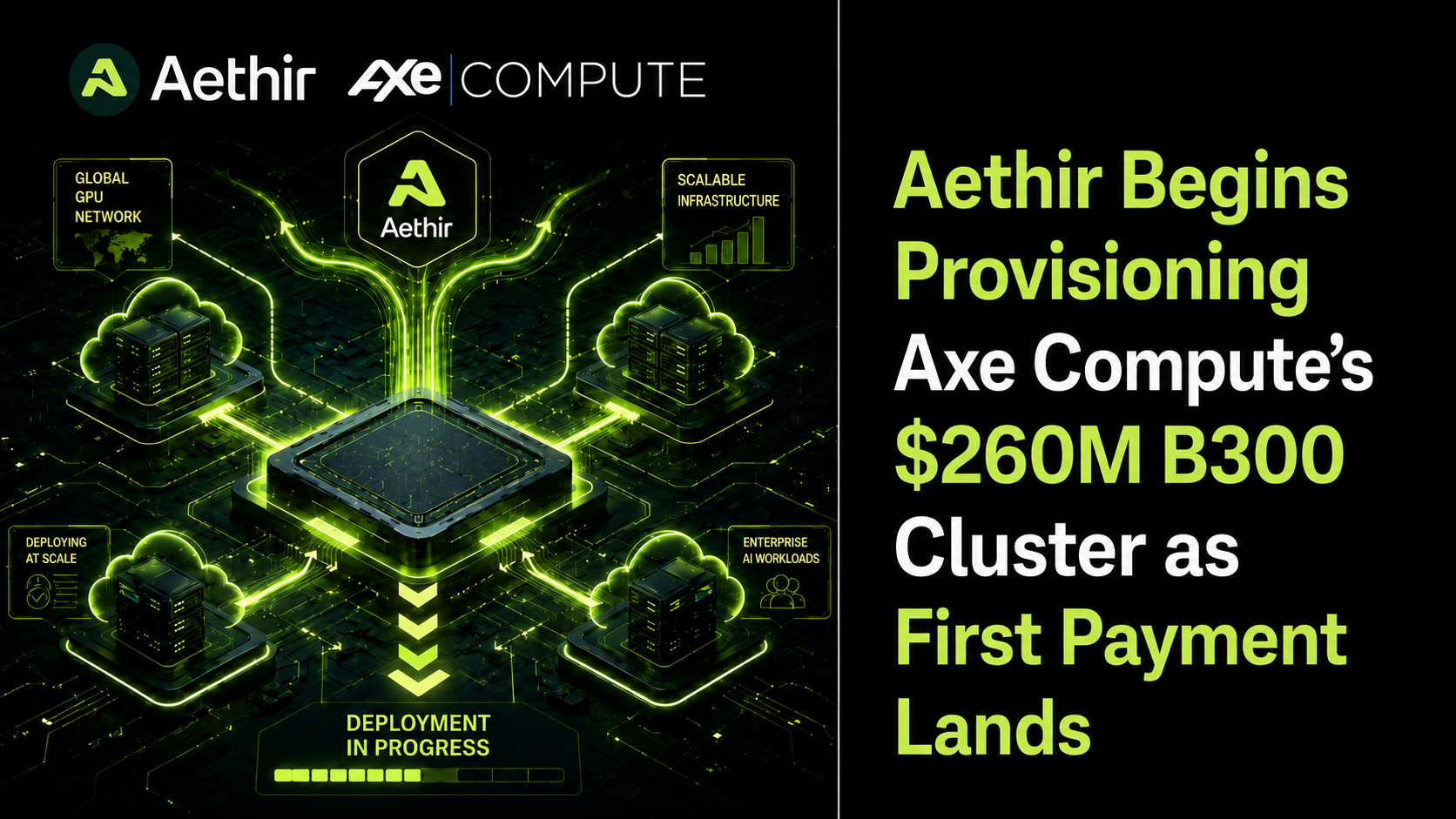 Aethir starts provisioning Axe Compute's 2,304-GPU B300 cluster after first $43M customer payment2026-05
The GPU: From Graphics Chip to Crypto-AI Infrastructure Primitive
In modern computing and crypto markets, the graphics processing unit (GPU) is a parallel compute engine originally designed to render 3D graphics, now repurposed as the backbone of artificial intelligence and high-performance workloads. As AI, cloud infrastructure, and decentralized finance (DeFi) converge, GPUs are no longer just components on gaming rigs; they have become scarce infrastructure assets, collateral for on-chain credit, and the hardware substrate for a new generation of crypto-native compute networks. This explainer traces how GPUs work, why they matter so much for AI, how they are being financialized in crypto, and what that means for builders, investors, and protocols. Along the way, it connects hardware to concepts like GPU-as-a-Service, decentralized compute, GPU-backed stablecoins, and open-source AI models, providing a guide to navigating this fast-evolving corner of the market. The aim is evergreen: to give a durable mental model of GPUs as both technology and asset class, even as individual chips, networks, and tokens change.
What Is a GPU?
At the simplest level, a GPU is a specialized processor built to perform many small operations in parallel, particularly the linear algebra that underpins both 3D graphics and modern machine learning. Where a traditional central processing unit (CPU) is optimized for general-purpose tasks, branching logic, and low-latency response, a GPU is optimized for throughput, with thousands of lightweight cores executing the same instruction across large batches of data. This architectural difference allows GPUs to render frames in a video game, compress and decode high-resolution video, or perform the massive matrix multiplications needed for neural networks far more efficiently than a CPU alone. In practice, most systems combine both: the CPU orchestrates, while the GPU does the heavy lifting on suitable workloads.
Historically, GPUs began life as application-specific integrated circuits (ASICs) dedicated to accelerating graphics and 3D rendering, particularly for gaming and professional visualization. Over time, they evolved into more general-purpose parallel processors, exposing programmable interfaces like CUDA and OpenCL so developers could offload arbitrary workloads that fit the GPU’s parallel execution model. That evolution from fixed-function graphics pipelines to programmable compute engines is what made GPUs central to AI, scientific computing, and cryptography. Once developers could treat a GPU as a massively parallel math engine rather than just a graphics card, it became natural to use it to train neural networks, simulate physics, or accelerate cryptographic proving systems.
It is helpful to contrast CPUs and GPUs side by side, because the difference informs everything from protocol design to DeFi risk models. A CPU might have a small number of powerful cores with large caches and sophisticated branch predictors, ideal for running operating systems, handling I/O, and coordinating diverse tasks. A GPU, by contrast, has many more cores but with simpler control logic, arranged in groups that execute in lockstep to maximize utilization when performing the same operation on many elements. The trade-off is that GPUs are less efficient on highly serialized workloads, but dramatically more efficient when there is ample data-level parallelism.
A conceptual comparison is summarized in the following table.
| Attribute | CPU | GPU |
|---|---|---|
| Core count | Few, complex cores | Many, simpler cores |
| Strength | General-purpose, low-latency tasks | Highly parallel, throughput-oriented tasks |
| Typical workloads | OS, logic, coordination, light compute | Graphics, video, AI, simulations, parallel cryptography |
| Programming model | Scalar, branch-intensive | Vectorized, SIMT/SIMD style parallelism |
| Role in AI and crypto | Orchestrates, handles control and I/O | Trains and runs models, accelerates proofs and heavy math |
This division of labor means that in AI and crypto infrastructure, CPUs and GPUs are complements rather than substitutes. A rollup prover, for example, may use CPUs for scheduling and networking while pushing the inner loops of polynomial arithmetic and FFTs to GPUs. An AI application may use CPUs to serve API requests and handle business logic, with GPUs executing the core inference step. As GPUs become financialized, understanding what they actually do at the hardware level is essential to assessing both their value and their risk.

Kamino launches USDai market on Solana with $280M GPU-backed loan book

Understanding GPU Performance and Naming
While “GPU” is a generic term, not all GPUs are created equal. Performance depends on many interlocking factors: core count, clock speeds, memory bandwidth, on-board memory capacity (VRAM), interconnects, and specialized accelerators like tensor cores or ray-tracing units. For AI workloads, the availability of high-bandwidth memory and specialized matrix-multiply units often matters more than raw gaming benchmarks. Enterprise-class AI GPUs such as NVIDIA’s H100 or AMD’s MI300X are designed around these needs, offering large memory footprints and high interconnect bandwidth to scale across multi-GPU clusters.
Consumer GPUs, especially from NVIDIA, follow a naming scheme that can be confusing until you know the pattern. In cards like the RTX 4060 or RTX 5090, the first digit denotes the generation, while the last two digits encode the performance tier within that generation. Models ending in 50 are considered baseline entry-level cards, adequate for basic gaming or light workloads but requiring lower settings in modern titles. The 60-tier is designed as the mainstream 1080p gaming workhorse, 70-class cards are often considered the “sweet spot” between performance and cost, and 80/90 tiers represent high-end and extreme performance respectively. Suffixes like “Ti” or “Super” signal incremental upgrades within a tier, typically adding cores or speed to fill gaps between mainline models.
An important nuance, especially for crypto and AI builders provisioning mixed fleets, is that laptop GPUs often share names with their desktop counterparts but do not share the same performance characteristics. Thermal and power constraints in thin-and-light devices often reduce clocks, core counts, or memory bandwidth, so an “RTX 4080” in a laptop may significantly underperform a desktop 4080 in sustained workloads. This matters when evaluating whether a given GPU asset or cluster is truly suitable for 24/7 inference, proving, or mining. In decentralized GPU networks that aggregate heterogeneous hardware, variability in performance across devices with similar branding can complicate scheduling and pricing.
At the data center level, GPU performance is as much about systems engineering as about the chip itself. High-end AI GPUs are typically deployed in server nodes that pack multiple accelerators together, connect them via high-speed fabrics, and integrate them into racks drawing tens or even hundreds of kilowatts. Guides to building GPU clusters for AI emphasize not just choice between H100 and MI300X, but also the importance of networking, storage, and total cost of ownership (TCO) planning across a deployment’s lifecycle. As new generations such as NVIDIA’s Blackwell architecture push rack power densities into ranges where air cooling is no longer sufficient, operators must invest in direct-to-chip liquid cooling and specialized data center designs, raising the capital intensity of GPU infrastructure even further.
For AI workloads, the most relevant performance metrics are often floating-point operations per second (FLOPs) for key precisions, memory bandwidth, and the ratio of VRAM to model size. A 35-billion-parameter mixture-of-experts model such as 0G’s 0GM-1.0-35B-A3B can run with only a fraction of its weights active per token, which shapes how much GPU memory is needed for inference and how efficiently the model can be sharded across devices. As model architectures and precision formats evolve, GPUs that can flexibly support mixed-precision arithmetic and efficient memory access patterns become more valuable. Understanding these factors is critical not only for system architects, but also for DeFi protocols that must value GPU collateral and assess its useful life.
Readers click GPU stories not for hardware specs but for sector-crossing power grabs — miners abandoning proof-of-work, shoe brands becoming compute landlords, and Wall Street building futures markets on GPU capacity — revealing that GPU is the new prime real estate and readers want to know who is seizing it.
Why GPUs Matter in Crypto and Web3
Long before AI dominated headlines, GPUs were already central to crypto. In Bitcoin’s early years, GPUs replaced CPUs for mining once participants discovered that the hash functions used in proof-of-work could be computed much more efficiently on GPU architectures. This GPU mining era did not last once ASICs arrived, but it established a template: whenever a blockchain workload is massively parallel and math-heavy, GPUs will likely play a role. Even today, many altcoins and proof-of-work networks remain GPU-minable by design, seeking to avoid ASIC centralization by choosing algorithms that map better to general-purpose parallel hardware.
Over time, the locus of GPU demand in crypto has shifted from mining to a broader range of infrastructure tasks. Zero-knowledge (ZK) proofs, which underpin privacy protocols and increasingly power rollups and validity proofs for scaling, rely on intensive polynomial arithmetic, FFTs, and elliptic curve operations that are highly parallelizable. ZK teams have invested heavily in GPU acceleration, with some reporting several percent reductions in proving time on Ethereum mainnet workloads after optimizing GPU scheduling, proof ordering, and memory usage. These seemingly modest improvements translate directly into lower costs, higher throughput, and better user experience for rollups that rely on timely proof generation.
Beyond ZK, GPUs are becoming the engine behind AI-infused crypto applications. DeFi risk engines that simulate cascades of liquidations, on-chain games that stream high-fidelity visuals, and autonomous agents that interact with smart contracts all benefit from local or cloud-based GPUs. Open-source AI models, such as the 0GM-1.0-35B-A3B mixture-of-experts model released under Apache 2.0 by 0G and trained on its own decentralized GPU network, exemplify how crypto-native infrastructure and AI can reinforce one another. In that case, the same network that provides decentralized compute also hosts and serves the model, offering developers a path to build agentic coding tools and long-context reasoning systems without relying solely on centralized hyperscalers.
This synergy gives rise to the idea of “sovereign AI,” where communities, DAOs, or protocols own both the models and the compute fabric they run on, rather than renting black-box services. Sovereign AI is not just a governance slogan; it has concrete hardware requirements. A protocol that wants to operate its own open-source models must secure reliable access to GPUs for training and inference, whether by purchasing them outright, leasing capacity on decentralized networks, or tapping into GPU-backed credit lines. In each case, the GPU becomes both a technical and economic primitive, shaping protocol design and token economics.
For crypto audiences, it is therefore helpful to think of GPUs in three overlapping roles. First, as raw infrastructure that powers mining, proving, AI inference, and rich client experiences. Second, as yield-generating assets whose utilization can be tokenized, leased, or used to back debt. Third, as governance levers, where control over GPU clusters (for example via DePIN tokens or staked access rights) translates into influence over who can deploy models or run heavy workloads. All three roles are visible today across decentralized GPU networks, GPU-backed stablecoins, and AI-integrated protocols.
Centralized vs Decentralized GPU Clouds
The recent AI wave has led to an explosion of GPU demand, much of it captured by centralized cloud providers. Hyperscalers like the major public clouds offer on-demand access to high-end GPUs, integrated with managed services for training, serving, and data management. This model offers convenience, but it also creates concentration: a small number of firms control large fractions of global GPU supply, set prices, and can unilaterally change terms or restrict usage. Crypto teams that rely exclusively on such providers inherit their counterparty risk, political exposure, and potential for lock-in.
In response, a parallel ecosystem of decentralized GPU clouds has emerged, collectively known as DePIN (decentralized physical infrastructure networks). These networks aggregate GPUs from independent operators—data centers, mining farms, and individuals—and expose them through blockchain-governed marketplaces. Aethir, for example, has built a decentralized GPU cloud infrastructure with more than 430,000 GPU containers distributed across 95 countries, targeting enterprise clients with low-latency game streaming, large-scale game QA, Web3 gaming infrastructure, and AI inference workloads. By distributing GPU resources geographically and organizationally, Aethir aims to eliminate traditional cloud bottlenecks while offering cost-efficient rental services to developers.
A key concept in this ecosystem is GPU-as-a-Service (GPUaaS), which flips the financial model from capital expenditure (CapEx) to operational expenditure (OpEx) for compute consumers. Instead of buying GPUs outright and bearing the full cost of acquisition, maintenance, and obsolescence, organizations pay for the capacity they use, when they use it. Aethir’s own analysis frames GPUaaS as a fundamental financial shift for AI scaling: converting massive upfront hardware investments into flexible, consumption-based infrastructure where buyers can scale up or down in response to actual demand. For fast-moving AI and crypto projects whose workloads and revenue can be volatile, this flexibility can be more valuable than theoretical savings from owning hardware outright.
Alongside Aethir, networks like Akash and io.net are carving out their own niches in decentralized GPU markets. Akash positions itself as a permissionless decentralized compute marketplace where users can rent high-performance GPUs for machine learning workloads, launching pre-configured environments for training, fine-tuning, and inference without traditional cloud contracts. Io.net, by contrast, emphasizes AI-specific workloads and price-performance, claiming the lowest pricing, largest GPU inventory, and fastest deployment among decentralized GPU providers for training and inference workloads. Benchmark comparisons show io.net offering RTX 4090 clusters at hourly rates substantially below those of specialized rendering nodes on other networks, while still undercutting Akash on many AI-centric configurations.
These claims are not just marketing; they are backed by case studies. Leonardo.Ai, a generative media platform, reported scaling from 14,000 to 19 million users while cutting GPU costs by more than half by shifting workloads to io.net’s decentralized GPU network. According to io.net, this allowed Leonardo.Ai to access sufficient GPU capacity at rates less than half the on-demand prices of competing providers, maintaining reliability and quality of service even as user numbers grew by orders of magnitude. For AI-heavy Web3 applications—think NFT art generators, gaming platforms, or on-chain creation tools—such cost savings can meaningfully extend runway and reduce the burn rate associated with GPU-heavy operations.
Io.net’s own content underscores how building a purpose-built GPU cluster for AI is a holistic process, requiring vendor-agnostic benchmarks, hardware selection (e.g., H100 versus MI300X), and a rollout plan that accounts for networking, storage, and data locality. Another of its analyses compares IO against Google Cloud Platform and alternatives, examining GPU cloud pricing and feature sets to help buyers choose architectures that fit their needs. These guides illustrate a broader trend: as GPUs become a larger share of infrastructure spend, operators publish detailed playbooks to help teams avoid burning thousands of dollars debugging clusters or choosing the wrong configuration. For crypto builders, these resources are increasingly relevant because the same GPUs used for AI can also be used for on-chain proving, simulation, and high-intensity workloads.
To help abstract away the fragmentation in decentralized GPU supply, aggregation layers and gateways are emerging. Projects such as Respan Gateway, for which crypto teams have acted as launch partners, promise a single interface through which developers can access multiple decentralized GPU clouds to train, run, and scale AI workloads without relying on hyperscalers. This gateway model mirrors earlier trends in DeFi, where liquidity aggregators unified fragmented pools, but applied to physical infrastructure. For builders, it means they can launch AI features, manage GPU fleets, and hedge vendor risk through a single integration, while still benefiting from the decentralization and competitive pricing of underlying networks.
- 01Mining-to-AI compute pivot
Qubic capturing 51% of Monero hashrate then immediately abandoning it for AI GPU workloads dramatized how proof-of-work economics are losing to inference demand.
- 02Decentralized GPU marketplaces↗
DEPINfer on Solana and Aethir's B300 cluster provisioning showed readers a credible alternative to AWS/Azure with on-chain settlement and token incentives.
- 03Corporate pivot GPU-as-a-service
Allbirds rebranding to NewBird AI and gaining 400% stock appreciation made the GPU cloud land-grab legible to readers tracking speculative narratives.
- 04GPU infrastructure debt financing↗
HIVE's $75M zero-coupon note and AlphaTON's $43M NVIDIA B300 deal signaled that crypto-native firms are using capital markets to stack physical AI hardware, not tokens.
- 05Financialization of compute capacity
Ornn's $33M a16z seed to build GPU price indices and futures markets indicated that GPU capacity is becoming a tradeable commodity asset class with derivative infrastructure.
- 06GPU passive income narratives
AI GPU Rental's framing of supercomputing as a Bitcoin passive earnings layer recycled familiar crypto yield marketing into the AI infrastructure story.
Financing the GPU Boom: From CapEx to On-Chain Credit
The surge in AI demand has triggered what many analysts describe as an AI infrastructure supercycle, with data center operators, national champions, and cloud providers committing tens or hundreds of billions of dollars to new GPU facilities. Industry reports highlight how operators like IREN have announced massive expansions of AI data centers, reflecting a shift from incremental cloud growth to full industrial-scale capital expenditure programs. In parallel, corporate groups like SK and NVIDIA have announced plans to build large “AI factories” comprising tens of thousands of GPUs for specialized uses such as robotic fabs, underscoring how compute is becoming a strategic national and corporate asset. The result is a significant financing need: even for well-capitalized firms, owning and operating thousands of high-end GPUs is capital intensive and risky.
Within this context, GPUs are increasingly treated as financeable hard assets, not unlike aircraft or industrial machinery. Law firms are already issuing client alerts about emerging litigation risks in financing AI data centers, noting that GPU-collateralized credit structures are proliferating alongside more traditional forms of project and equipment finance. These alerts draw attention to the intense heat generated by GPU clusters, the technical complexity of AI data centers, and the billions of dollars being deployed into facilities that may be difficult to repurpose if AI demand were to slow or hardware generations were to shift abruptly. For lenders, the challenge lies in valuing GPU collateral, understanding its secondary market, and structuring agreements that can withstand technological and market volatility.
Crypto and DeFi have begun to intersect with this financing need by offering on-chain credit mechanisms tailored to GPU infrastructure. USD.AI is a prominent example: a specialized decentralized finance platform that originates non-recourse loans secured by GPU infrastructure and the cashflows those assets generate. Borrowers—typically AI infrastructure operators—apply for financing facilities secured by their GPU fleets, with eligibility and loan-to-value parameters set at the asset level by the protocol. These facilities are structured as non-recourse loans, meaning recourse is limited to the collateral itself rather than the borrower’s broader balance sheet, although springing recourse can activate in cases of fraud or malicious behavior. For operators, this structure offers strategic, non-dilutive financing that can scale with their deployments.
On the capital provider side, USD.AI allows depositors to bring stablecoins into the system and mint USDai, a fully backed synthetic dollar that serves as the entry point for capital. USDai is itself collateralized by PYUSD, which in turn is backed by U.S. Treasuries and cash equivalents, meaning that base capital in the protocol is anchored to traditional safe assets rather than volatile crypto tokens. USDai does not accrue yield; instead, yield-seeking users stake USDai to mint sUSDai, a yield-bearing instrument that captures yield from GPU loans and short-term Treasury bill investments. The yield generated by interest on GPU credit facilities and T-bill returns is reflected in the evolving exchange ratio between USDai and sUSDai, accruing automatically and continuously. This design attempts to align depositor returns with the actual economics of AI infrastructure rather than token subsidies or trading fees.
The scale of these operations is growing quickly. In one transaction, USD.AI provided approximately $98.1 million in debt financing to support an edge AI GPU deployment managed by Hydra Host for Duos Technologies, illustrating that on-chain credit is funding real-world GPU projects rather than purely crypto-native experiments. Marketing material around the protocol emphasizes that its loans are over-collateralized, senior secured positions in GPU infrastructure, with risk management frameworks calibrated to enterprise-grade operators. From a DeFi perspective, this is a significant departure from earlier eras of yield farming, representing a move toward asset-backed, cashflow-based credit where on-chain instruments are claims on physical infrastructure revenue.
The existence of GPU-backed stablecoins and yield-bearing derivatives raises important questions about risk and regulation. Unlike fully fiat-backed stablecoins, these instruments have layered risk: the risk of underlying GPU borrowers, the operational risk of data centers, the market risk of secondary GPU prices, and the macro risk of AI demand cycles. Legal commentaries warn that if AI valuations or GPU demand were to fall sharply, lenders holding GPU-collateralized loans could find themselves competing in a crowded secondary market for specialized hardware, with uncertain recovery values. In such scenarios, token holders in GPU-backed stablecoins or yield products would be exposed to credit events that differ qualitatively from fiat-reserve bank runs.
At the same time, this emerging credit category underscores how crypto infrastructures can respond to novel financing gaps. Stablecoin rails allow global capital to flow quickly into specialized asset-backed credit facilities, while on-chain transparency can, in principle, offer better insight into the composition and performance of GPU loan books than traditional securitizations. For AI infrastructure operators, this offers a non-traditional route to raise large sums without equity dilution. For DeFi users, it introduces a new flavor of real-world asset (RWA) exposure, with yield linked to the economics of GPU usage rather than purely to DeFi leverage cycles.
Risks, Concentration, and Systemic Questions
The GPU boom brings not only opportunity but also a complex web of risks that crypto participants must understand. At the technical level, GPUs are power-hungry, heat-intensive devices that push data centers to physical limits. Operators of AI data centers routinely deal with racks that draw tens of kilowatts, and with next-generation GPU servers that push densities even higher, requiring direct-to-chip liquid cooling and meticulous thermal engineering. Legal analyses of AI data center finance emphasize that the intense heat and electromechanical stresses associated with GPU clusters can increase failure rates, complicate maintenance, and create operational risks with financial implications for lenders and investors. A GPU that overheats and fails prematurely is not just a hardware issue; it is an impairment of collateral.
Beyond hardware failure, there is the risk of misconfiguration and underutilization. GPU deployment guides stress that cluster design is a systems problem: choosing between H100 and A100 or MI300X is only the beginning. Teams must configure networking, storage, scheduler parameters, and container orchestration so that GPUs are kept busy with work that matches their strengths. Poorly designed clusters can leave expensive GPUs idle or bottlenecked by I/O, effectively burning thousands of dollars in opportunity cost as the hardware waits on data, code, or network throughput. For AI and crypto teams operating on tight budgets, this kind of invisible burn can be just as damaging as an outright outage.
On the financial side, the shift from SaaS cashflow-backed lending to GPU-collateralized credit introduces new systemic dynamics. SaaS lending models typically underwrite recurring revenue streams with diversified customer bases and relatively predictable churn, allowing lenders to model cashflows and losses with some confidence. GPU-backed lending, by contrast, hinges on the ability of borrowers to keep their GPU fleets productively employed, which ties directly to the broader AI and compute markets. If AI inference demand softens or competition drives down prices, operators may struggle to service debt, even if their hardware remains technically sound. Legal commentators warn that these structures could face stress if secondary markets for GPUs fail to absorb distressed assets at expected valuations, leading to litigation over collateral disposition and lender rights.
Regulatory and jurisdictional risk compounds these challenges. GPU assets and data centers are physical and local, subject to zoning laws, environmental regulations, export controls, and national security considerations. AI data center operators may find their facilities subject to new rules about energy usage, cooling technologies, or model training restrictions. Lenders and token holders with claims on GPU-backed credit may therefore face political risk that goes beyond usual financial regulation. If a jurisdiction imposes sudden constraints on high-density compute, the value of local GPU collateral could drop sharply, impacting DeFi instruments linked to those assets.
At the macro level, concentration of GPU supply in a small set of firms and countries raises concerns about “GPU gatekeepers.” Analyses of AI’s economic impact suggest that the lion’s share of gains currently accrue to a minority of firms that control key inputs, including access to cutting-edge GPUs and the capital to finance large training runs. This concentration risks creating a two-tier ecosystem: one in which large incumbents book multi-year GPU capacity, locking in favorable pricing and priority access, and another in which startups and decentralized projects compete in volatile spot markets. Data points such as SK Group’s 50,000-GPU AI factory plans with NVIDIA illustrate how national and corporate strategies are converging around owning large GPU estates, potentially exacerbating global disparities in compute access.
Decentralized compute networks offer one partial counterweight to these gatekeeping dynamics. By aggregating GPUs from a wide range of operators—including smaller data centers and repurposed mining rigs—networks like Aethir, Akash, io.net, and 0G aim to expand the global supply of accessible compute. Io.net’s ability to help Leonardo.Ai scale to millions of users, or 0G’s training and deployment of its own open-source 35B-parameter model on its decentralized GPU network, show that serious AI workloads can be run outside hyperscaler environments. However, decentralization does not eliminate scarcity; it changes how scarcity is mediated and who can capture the associated rents. Participants in these networks must still grapple with hardware lifecycles, energy costs, regional regulation, and business cycles in AI demand.
Aethir crosses 430,000 GPU containers across 94 countries
Aethir publishes 2025 DePIN GPU cloud milestone wrap-up
Leonardo.Ai cuts GPU costs 50%+ via io.net, scaling from 14K to 19M users
CoreWeave $8.5B AI loan draws scrutiny over customer concentration and GPU collateral risk
- 2026-02launch
a16z leads Ornn $33M seed to build GPU price indices and compute futures markets
- 2026-04milestone
AlphaTON Capital closes $43M NVIDIA B300 GPU deal with Vertical Data for Telegram Cocoon AI
Aethir begins provisioning Axe Compute 2,304-GPU B300 cluster after $43M payment
- 2026-06governance
Qubic abandons Monero mining after 51% hashrate capture, redirects GPU fleet to AI inference
Practical Guide: Navigating GPUs as a Crypto Builder or Investor
For crypto builders, GPUs are no longer a niche concern delegated to infrastructure teams; they directly influence product design, time-to-market, and unit economics. A protocol planning to integrate AI agents or on-chain inference, for example, must decide whether to run its own GPU cluster, rely on centralized cloud providers, or tap into decentralized GPU networks via gateways. Running a proprietary cluster offers maximum control and potentially lower marginal costs over the long term, but requires substantial upfront CapEx, ongoing operations expertise, and careful management of demand volatility. Relying on hyperscalers offers ease of use and deep integrations, but exposes the project to pricing power and potential policy changes by centralized providers.
Decentralized GPU clouds and GPU-as-a-Service offerings represent a middle path, especially for workloads with variable intensity. Aethir’s framing of GPUaaS as a shift from CapEx to OpEx highlights the appeal for AI-heavy teams that cannot justify owning hardware for peak capacity but still need to handle spikes in usage. Io.net’s focus on AI-specific workloads and competitive pricing, as evidenced in its comparison with Akash and its case study with Leonardo.Ai, suggests that specialized DePIN providers can undercut both hyperscalers and general-purpose decentralized clouds on price-performance for certain tasks. For a crypto team, this makes it feasible to launch AI features with lower upfront capital and to adjust GPU spending in line with adoption, managing burn more dynamically.
When evaluating GPU providers, teams should look beyond headline hourly rates and consider total cost and operational friction. Guides to building GPU clusters emphasize the importance of vendor-agnostic benchmarks, networking latency, failure domains, and the maturity of software tooling. Similarly, DePIN networks differ in how they handle provisioning, isolation, security, and data locality. A project that handles sensitive financial or identity data may require stricter controls over where GPUs are located and how workloads are scheduled, while a generative art project may prioritize low cost and burst capacity. Crypto-native concerns, such as integration with on-chain payment systems or incentive structures for node operators, also matter when choosing where to anchor critical workloads.
For DeFi participants and token holders, GPUs introduce a new category of exposure that sits between traditional RWAs and pure crypto assets. Tokens representing claims on decentralized GPU networks, yield-bearing instruments like sUSDai backed by GPU loans, or GPU-backed stablecoins like USDai each carry different risk profiles. Investors should analyze how yield is generated—whether from genuine GPU usage and T-bill income or from token emissions and leverage—and how robust the underlying risk management frameworks are. USD.AI’s documentation, for example, emphasizes asset-level underwriting, non-recourse loan structuring with springing recourse for fraud, and over-collateralization of GPU loans. These details matter, because in stress scenarios they determine whether risks are absorbed by equity-like tranches, by protocol treasuries, or by token holders.
Open-source transparency can help here. Networks that publish detailed statistics on GPU utilization, node distribution, failure rates, and revenue by workload type offer investors a clearer view of economic sustainability. Similarly, protocols that open-source their risk models, collateral valuation methodologies, and liquidation processes enable more informed scrutiny and community governance. The release of open-source AI models like 0GM-1.0 under Apache 2.0 hints at an emerging pattern where both software and infrastructure become more transparent and composable, enabling developers to build richer products and investors to reason more clearly about underlying fundamentals.
GPU owners—whether former miners, small data centers, or specialized hosts—face their own strategic choices. They can join decentralized GPU networks as supply-side participants, earning fees in tokens or fiat for contributing capacity, or they can seek financing against their hardware via GPU-backed credit protocols. In the first case, key variables include uptime, geographic location, energy costs, and the ability to meet service-level requirements imposed by networks like Aethir, Akash, or io.net. In the second, owners need to assess whether borrowing against GPU collateral at a given loan-to-value ratio makes sense relative to expected utilization, depreciation, and alternative uses of capital. Over-optimistic assumptions about demand can lead to over-leverage, leaving operators vulnerable if workloads or prices shift.
Conclusion
The ascent of the GPU from a specialized graphics accelerator to a central pillar of AI and crypto infrastructure is one of the defining shifts of the current computing era. Architecturally, GPUs complement CPUs by providing massive data-parallel throughput, enabling everything from 3D rendering to large-scale neural network training and zero-knowledge proof generation. Economically, they have become scarce and strategically important resources, with demand fueled by AI models, high-fidelity media, and advanced cryptographic systems. This has created an AI infrastructure supercycle in which data centers, corporates, and national actors invest heavily in GPU capacity, and where financing structures treat GPUs as financeable hard assets akin to industrial equipment.
Crypto sits at the intersection of these trends. On one hand, blockchains and rollups rely on GPU-accelerated systems for proof generation, simulations, and AI-enhanced user experiences. On the other, DeFi protocols are building credit and yield products directly backed by GPU infrastructure and its cashflows, as seen in platforms like USD.AI and GPU-as-a-Service networks such as Aethir, Akash, and io.net. These developments give crypto markets direct exposure to the economics of compute, blurring the line between digital assets and physical infrastructure. They also open the door to new forms of sovereign AI, where communities control both open-source models and the GPU networks that run them.
The risks are as novel as the opportunities. Technical and operational challenges in running dense GPU clusters, combined with the capital intensity of AI data centers, create new failure modes and potential for litigation in GPU-collateralized finance. Concentration of GPU supply among a small number of firms and countries raises concerns about gatekeeping and unequal access to the gains of AI. DePIN networks and GPU-backed stablecoins offer partial counterweights, but they introduce their own layers of smart contract, market, and regulatory risk. For crypto participants, navigating this landscape requires fluency in both hardware realities and DeFi mechanics, recognizing that yield backed by GPUs is neither risk-free nor purely speculative.
Yet the direction of travel is clear. GPUs are no longer peripheral to crypto; they are becoming a core infrastructure primitive, much like block space or liquidity. As AI, cloud, and decentralized finance continue to intertwine, the projects that understand GPUs as both technical tools and economic building blocks will be best positioned to launch durable products, manage burn intelligently, and contribute to a more decentralized, open-source future for compute.
DePIN GPU marketplaces like DEPINfer and io.net rely on on-chain job settlement and token payments; a pricing oracle failure or contract exploit can freeze compute capacity mid-job.
NVIDIA's B300 GPU supply concentration means a handful of deals (AlphaTON $43M, Aethir/Axe $43M) control scarce hardware, giving NVIDIA and large buyers structural pricing power over the entire decentralized compute sector.
GPU-backed loans at 80% LTV and GPU-collateralized stablecoins like USDai face severe liquidation risk if GPU spot prices fall sharply, as occurred when crypto mining demand collapsed post-merge.
GPU debt financing structures and tokenized GPU futures are novel instruments that lack established regulatory classification in the US and EU, creating enforcement uncertainty for issuers and investors.
GPU-as-a-service pricing is highly sensitive to AI training cycle cadence; a shift toward inference-optimized ASICs or model efficiency gains could rapidly deflate spot GPU rental rates and impair collateral values.
Customer concentration risk is material — CoreWeave's $8.5B AI loan depends on a small number of hyperscaler commitments, and similar dependency exists in smaller DePIN GPU clusters funded by single anchor clients.
Outlook
Looking ahead, GPUs are likely to remain scarce and politically salient, even as manufacturing capacity expands and new architectures arrive. The capital expenditure cycle in AI infrastructure shows little sign of slowing, suggesting that GPU-backed credit will grow into a distinct asset class, with on-chain protocols competing alongside traditional lenders to finance data centers and edge deployments. At the same time, decentralized GPU networks will continue to broaden access, offering builders alternatives to hyperscalers and embedding compute markets more deeply into crypto’s fabric. For crypto audiences, the key will be discerning which GPU-linked projects are grounded in real utilization and robust risk management, and which are merely riding the narrative. As open-source AI models proliferate and sovereign AI ideals gain traction, GPUs will sit at the heart of a new negotiation between centralization and decentralization, with crypto’s infrastructure and capital markets playing an increasingly important role in how that balance is struck.
Latest GPU news
Sources
17 records from 12 domains
youtube.com
intel.com
quinnemanuel.com
usd.ai
aethir.com
io.net
akash.network
docs.usd.ai
ecosystem.aethir.com
0g.ai
blog.gaib.ai
barchart.com
Community notes
Spot something off or out of date? Drop a note. Editors review topic notes daily and roll accepted fixes into the explainer — contributors are recognized in the monthly $SQUID drop.
Loading notes…
Help improve this topic
Have a story or tip about this topic? Submit it. See something missing? Leave a note. Editors review daily; accepted submissions and fixes count toward the monthly $SQUID drop.