
JPMorgan is both crypto's loudest institutional critic and one of its most consequential infrastructure builders — fighting stablecoin regulation while deploying Kinexys and a 2027 tokenized deposit network.
+19 sources across the wider coverage universe
 Tether poaches JPMorgan exec to bolster US stablecoin expansion2026-04
 Securitize appoints former SEC and JPMorgan executive Brett Redfearn as president and board member, strengthening leadership as tokenization and digital asset markets expand2026-04
 JPMorgan CFO warns stablecoins risk becoming 'giant arbitrage backdoor' around banking regulation2026-04
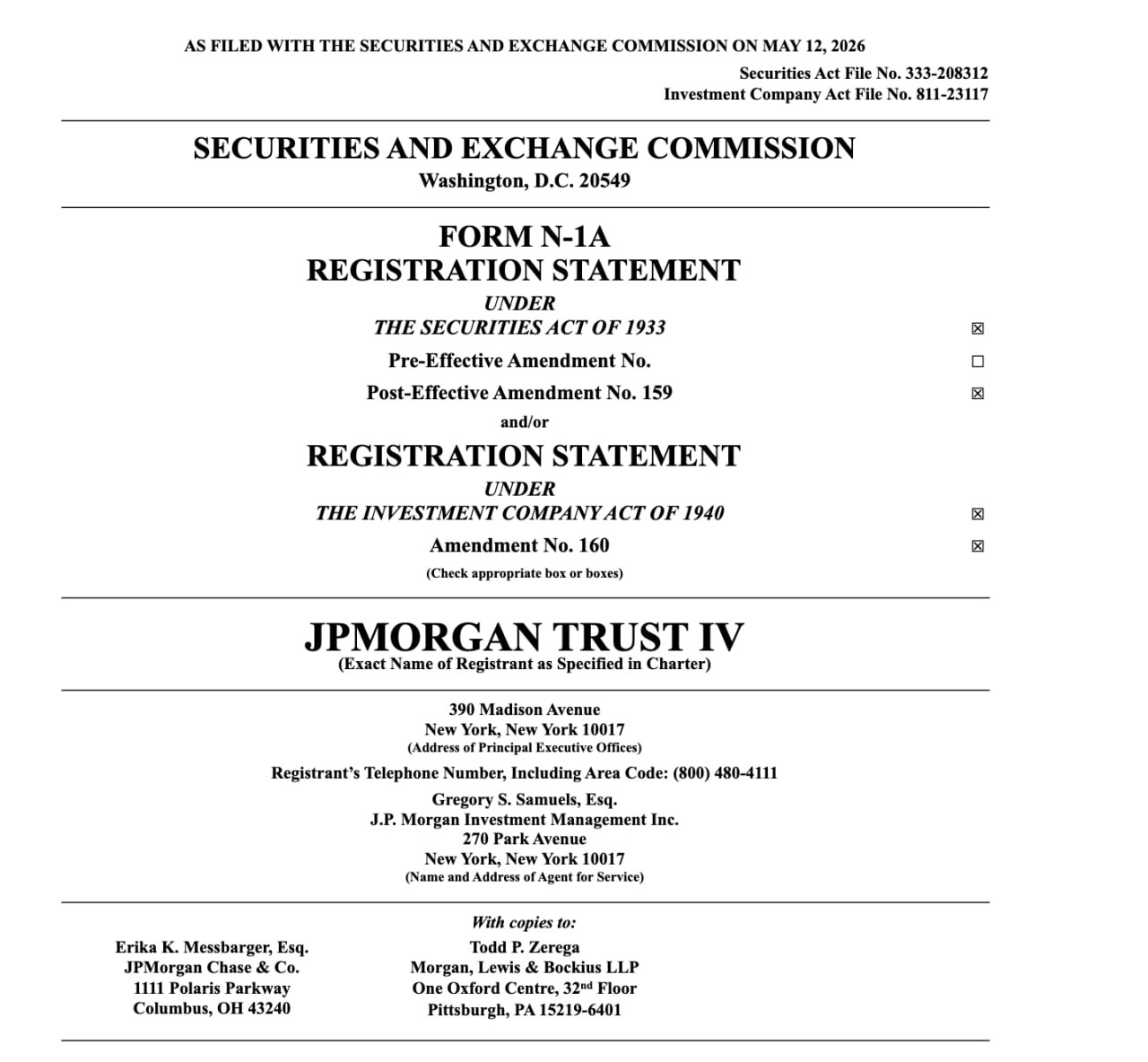 JPMorgan files to launch new tokenized fund as Wall Street tokenization race heats up.2026-05
 KB Kookmin Bank taps JPMorgan’s Kinexys blockchain rail for cross-border USD payments across 10 countries2026-07
 JPMorgan says institutional appetite for perpetual futures remains limited, arguing the products are better suited for speculation than risk managements2026-06
The world's largest bank by market capitalization, JPMorgan Chase has become one of the most consequential — and contradictory — forces shaping how Wall Street engages with digital assets.
From Skeptic to Infrastructure Builder
For most of the past decade, JPMorgan was easy to caricature as crypto's chief antagonist. CEO Jamie Dimon called Bitcoin a "fraud" in 2017 and later likened it to a "pet rock." The bank's public posture was dismissive at best, hostile at worst. What has since emerged tells a more complicated story.
Behind that skepticism, JPMorgan was quietly building. The bank launched JPM Coin in 2019 — a permissioned digital token for interbank settlements — and has steadily expanded its blockchain infrastructure ever since. That infrastructure now operates under the name Kinexys, JPMorgan's enterprise blockchain and digital payments platform. Kinexys processed more than $1.5 trillion in transactions in 2024 and has been tapped by institutions including KBank and Ant International for cross-border payment flows where traditional correspondent banking creates friction and delay.
The institution's trajectory illustrates a pattern common among large financial incumbents: public skepticism toward decentralized crypto markets, combined with aggressive internal investment in the underlying technology. JPMorgan has effectively decided that blockchain rails are valuable — it simply intends to control them.

Tether poaches JPMorgan exec to bolster US stablecoin expansion
Tether has hired an executive from JPMorgan as it deepens its push into the US stablecoin market, per The Information. The hire adds TradFi institutional firepower to Tether's growing US operation, which already includes former White House crypto advisor Bo Hines leading the USAT stablecoin launched in January through Anchorage Digital Bank. Tether has been on a hiring and compliance spree — bringing on KPMG for a full USDT reserve audit and PwC for internal prep — signaling it's serious about meeting US regulatory standards as the GENIUS Act takes shape.
The Tokenized Deposit Network: A Direct Challenge to Stablecoins
The most consequential news out of JPMorgan's digital asset division in mid-2026 is not about Bitcoin or Ethereum directly. It is about the plumbing beneath the banking system.
JPMorgan, Citigroup, Bank of America, Wells Fargo, and more than a dozen other U.S. banks are building a shared tokenized deposit network through The Clearing House — the industry utility that currently processes over $2 trillion in transactions daily. The project, targeting a first-half 2027 launch, would allow bank deposits to move with the speed and programmability typically associated with crypto stablecoins, while keeping those assets inside the regulated banking perimeter.
The intent is explicit: this is a direct competitive response to the rise of stablecoins. By making tokenized bank deposits functionally equivalent to stablecoins for payments and settlement, the consortium aims to foreclose the need for customers and businesses to move value onto unregulated or lightly regulated networks. A tokenized deposit remains a bank liability, covered by FDIC insurance frameworks and subject to existing prudential regulation. A stablecoin issued by a non-bank does not carry those guarantees — a distinction Jamie Dimon has emphasized repeatedly in public statements.
Parallel to this, JPMorgan has joined DTCC and UBS in outlining a five-stage roadmap for tokenized collateral adoption — a framework designed to move the industry past what participants describe as an "experimentation phase" and toward genuine market infrastructure. Hong Kong regulators have also enlisted JPMorgan and HSBC for an expert group focused on scaling tokenized bond issuance, suggesting the bank's blockchain ambitions are global in scope.
Readers are drawn to the structural contradiction at JPMorgan's core: Jamie Dimon publicly ridicules Bitcoin while the bank quietly builds the largest institutional blockchain payments network in traditional finance — the hypocrisy itself is the story.
Jamie Dimon, the Clarity Act, and the Coinbase Fight
While the bank's technical work has proceeded methodically, Dimon himself has become a vocal and increasingly combative presence in the U.S. crypto policy debate.
The flashpoint is the CLARITY Act, the bipartisan legislation that would establish a comprehensive regulatory framework for digital assets in the United States. The bill is widely seen in the crypto industry as essential infrastructure — a legal foundation that would allow exchanges, token issuers, and other market participants to operate with regulatory certainty. Coinbase CEO Brian Armstrong has been among its loudest advocates.
Dimon's opposition is pointed. In a May 2026 Fox Business interview, he argued that the CLARITY Act would allow crypto platforms to effectively pay interest on stablecoin deposits, competing directly with banks on terms banks consider unfair. "The banks will not accept it," he said. He has framed the issue as one of regulatory equity: if crypto companies want to act like banks — accepting deposits, paying yield, facilitating payments — they should be regulated like banks.
The confrontation with Armstrong escalated publicly when Dimon, at Davos, told the Coinbase CEO directly that he was "full of s–t" regarding the bill's framing. Armstrong fired back. The exchange crystallized a genuine policy disagreement that has moved beyond rhetoric: JPMorgan and the broader banking lobby are actively working to amend or block CLARITY Act provisions they see as permitting interest-bearing stablecoins issued outside the banking system.
The Ripple CEO has weighed in as well, warning that JPMorgan's stance risks protecting incumbent profits rather than advancing coherent regulation — a charge that tracks with how crypto advocates broadly characterize bank opposition to the bill.
JPMorgan's own analysts have flagged the CLARITY Act's passage as uncertain given midterm election pressures, noting that its fate is now one of two variables likely to define crypto market performance in the second half of 2026.

Securitize appoints former SEC and JPMorgan executive Brett Redfearn as president and board member, strengthening leadership as tokenization and digital asset markets expand
Redfearn ran the SEC's Division of Trading and Markets from 2017-2020 — the exact office that governs ATS and NMS frameworks for how securities actually trade in the US. Securitize is bringing him on right as they're filing to go public via Cantor SPAC at a $1.25B valuation, projecting $9B AUM by year-end (up from ~$4B now). With BUIDL already near $3B and live on UniswapX, they need someone who's sat across the table from the SEC when these tokenized fund structures inevitably get scrutinized at scale.
JPMorgan as Market Analyst: The Strategy Watch
Separate from its policy posturing and infrastructure building, JPMorgan has emerged as a closely watched voice in crypto market analysis — particularly around Bitcoin and the institutional vehicles that hold it.
The bank's research desk has focused significant attention on Strategy (formerly MicroStrategy), the software company turned Bitcoin treasury vehicle that holds more than 555,000 BTC as of mid-2026. JPMorgan analysts have flagged a set of structural concerns that bear on both Strategy's financial health and broader Bitcoin market dynamics.
The core issue: Strategy's preferred stock program generates approximately $1.7 billion in annual dividend obligations. JPMorgan analysts calculate the company holds roughly a 6.3-month cash buffer to service those obligations. Strategy's recent sale of 32 BTC — small in absolute terms — was flagged by JPMorgan as a potential early signal that the company may be turning to Bitcoin liquidation to fund preferred stock dividends. If that pattern were to scale, it would represent a significant change in Strategy's previously consistent accumulation posture.
JPMorgan's note added that Strategy may need to rebuild dollar reserves to restore investor confidence — a message that, if internalized by markets, could dampen enthusiasm for Bitcoin corporate treasury strategies more broadly. The bank's H2 crypto outlook statement identified Strategy's funding trajectory as one of two key variables (alongside the CLARITY Act) that will shape digital asset market performance through year-end.
Separately, JPMorgan analysts have noted that Bitcoin and gold ETF outflows suggest some cooling in the "debasement trade" — the thesis that hard assets serve as a hedge against currency debasement and fiscal expansion. Hopes around a potential Iran-U.S. diplomatic deal have reduced safe-haven demand at the margin, per the bank's read.
- 01Dimon contradiction: critic vs builder
The spectacle of a CEO calling Bitcoin 'like smoking' while his bank processes $1B daily in blockchain payments and accepts BTC/ETH as collateral creates irresistible cognitive dissonance for readers.
- 02JPM Coin / Kinexys payments buildout
Concrete operational milestones — $1B daily volume, euro and GBP expansion, QNB adoption — signal that JPMorgan's blockchain payments infrastructure is already live at scale, not vaporware.
- 03Operation Chokepoint de-banking
Shutting down Strike CEO Jack Mallers' accounts and accusations of hidden de-banking tactics frames JPMorgan as an active adversary to crypto founders, not merely a skeptical observer.
- 04Tokenization institutional partnerships
Joint ventures with Apollo, Chainlink, DTCC, and Franklin Templeton position JPMorgan as the backbone of Wall Street's tokenization layer, pulling readers tracking institutional DeFi adoption.
- 05Stablecoin regulatory positioning
JPMorgan analysts attacking Tether's transparency while Dimon demands bank-equivalent rules for yield-bearing stablecoins reveals the bank actively lobbying the regulatory perimeter to its advantage.
- 06Bearish macro crypto analysis
Repeated JPMorgan research notes casting doubt on Bitcoin as digital gold, flagging Ethereum centralization, and citing cratering Q1 crypto flows make the bank a key bellwether for institutional sentiment shifts.
JPMorgan and Ethereum: The Institutional Rails Question
JPMorgan's relationship with Ethereum is less public than its Bitcoin commentary but arguably more structurally significant. Kinexys, the bank's blockchain platform, operates on private and permissioned chains, not the Ethereum mainnet. But the tokenized collateral and deposit work described above draws heavily on Ethereum-compatible tooling — smart contract standards, token interfaces, and interoperability layers that were pioneered on public Ethereum.
The DTCC-JPMorgan-UBS collateral roadmap specifically contemplates interoperability between private bank chains and public or semi-public settlement layers. This is a technically demanding problem. It requires solving for atomic settlement across trust boundaries, which is precisely the problem Ethereum and related L2 networks were built to address. Whether the ultimate infrastructure ends up on permissioned forks, on Ethereum mainnet, or on some hybrid architecture remains open — but JPMorgan's engineers are working in an ecosystem whose vocabulary and tooling are largely Ethereum-native.
JPMorgan CFO warns stablecoins risk becoming 'giant arbitrage backdoor' around banking regulation
JPMorgan CFO Jeremy Barnum used the bank's Q1 2026 earnings call to escalate his campaign against yield-bearing stablecoins, warning they risk becoming "regulatory arbitrage so that you can run a bank without being subject to the important regulatory protections." He pushed for consistent rules — same product, same regulation — to prevent stablecoin issuers from dodging prudential safeguards. JPMorgan itself is simultaneously expanding its own digital payments footprint through Kinexys's "programmable money" platform, making the call for stricter stablecoin rules look as much about competitive positioning as consumer protection.
Regulatory Leverage and Market Power
Understanding JPMorgan's crypto positioning requires understanding its structural position in U.S. financial regulation. As the largest U.S. bank by assets, JPMorgan has direct relationships with every major regulatory body — the Fed, OCC, FDIC, and Treasury — and its lobbying capacity is substantial. When Dimon says "banks will not accept" a regulatory outcome, this is not empty posturing. The bank has the institutional weight to shape legislative outcomes.
This is precisely why Ripple and Coinbase view JPMorgan's CLARITY Act opposition as existential rather than procedural. If the stablecoin provisions are amended to require bank charters for interest-bearing stablecoin issuers, the addressable market for non-bank stablecoin operators narrows dramatically. Circle, Paxos, Tether, and similar entities would face a structural disadvantage relative to bank-issued tokenized deposits — which is, from JPMorgan's perspective, the correct regulatory outcome.
The tokenomics of this contest are straightforward: JPMorgan wants deposit dollars to stay in the banking system, where they generate net interest income, where they are subject to reserve requirements, and where incumbent institutions maintain pricing power. Crypto stablecoins threaten that model by offering dollar-denominated liquidity outside that system.
- 2022-10milestone
Onyx division expands from 100 to 300 employees
- 2023-06milestone
JPM Coin reaches $1B in daily transaction volume
- 2023-11launch
JPM Coin launches euro-denominated blockchain payment for corporate clients
- 2023-11milestone
DTCC and Chainlink complete fund tokenization pilot with JPMorgan participating
- 2024-05regulatory
JPMorgan predicts SEC will approve spot Ethereum ETFs or face litigation
- 2024-09launch
JPMorgan and Apollo announce enterprise mainnet tokenization initiative
- 2025-01governance
Jamie Dimon clashes with Coinbase CEO Armstrong at Davos over crypto debanking
- 2025-03milestone
JPMorgan begins accepting Bitcoin and Ethereum as institutional collateral
Kinexys and the Global Payments Footprint
Beyond U.S. domestic policy, JPMorgan's blockchain infrastructure is extending into cross-border payments — a market where friction, cost, and settlement lag have long been vulnerabilities for traditional banking.
The Kinexys platform's integration with KBank (Thailand's Kasikornbank) and Ant International represents an expansion into the Asia-Pacific corridor, where remittance flows and trade finance generate significant demand for faster, cheaper settlement. These are precisely the use cases that crypto advocates cite when arguing for stablecoin adoption. By building programmable, near-instant settlement into its existing bank relationships, JPMorgan is attempting to offer a regulated alternative that doesn't require customers to leave the banking system.
Hong Kong's move to tap JPMorgan for its tokenized bond expert group reflects a broader pattern: regulators in markets with active digital asset frameworks are choosing to build with established institutions rather than around them. This gives JPMorgan access to the regulatory design process itself, not merely to the markets that emerge from it.
Outlook
JPMorgan's trajectory in crypto and digital assets is unlikely to become simpler in the near term. The bank is simultaneously a market analyst warning about Bitcoin's institutional risks, a policy combatant fighting to limit non-bank stablecoin competition, and a technology builder constructing the tokenized deposit infrastructure that could redefine how bank money moves.
The CLARITY Act's fate in the current legislative session will matter significantly. If the bill passes with interest-bearing stablecoin provisions intact, JPMorgan's defensive posture will have failed and the competitive landscape shifts. If it passes with bank-friendly amendments or stalls entirely, the tokenized deposit network — targeting a mid-2027 launch — gains more runway as the de facto settlement alternative.
Dimon is not a crypto convert. But JPMorgan's institutional commitment to blockchain-based financial infrastructure is now deep enough that the bank's influence over how that infrastructure develops — technically, regulatorily, and commercially — will shape the digital asset market for years regardless of what any individual CEO says about Bitcoin.
Latest JPMorgan news
Tether poaches JPMorgan exec to bolster US stablecoin expansionSecuritize appoints former SEC and JPMorgan executive Brett Redfearn as president and board member, strengthening leadership as tokenization and digital asset markets expandJPMorgan CFO warns stablecoins risk becoming 'giant arbitrage backdoor' around banking regulationJPMorgan files to launch new tokenized fund as Wall Street tokenization race heats up.JPMorgan says institutional appetite for perpetual futures remains limited, arguing the products are better suited for speculation than risk managements JPMorgan flags Strategy's 6.3-month cash buffer as $1.7B dividend bill raises BTC sale fears
Community notes
Spot something off or out of date? Drop a note. Editors review topic notes daily and roll accepted fixes into the explainer — contributors are recognized in the monthly $SQUID drop.
Loading notes…
Help improve this topic
Have a story or tip about this topic? Submit it. See something missing? Leave a note. Editors review daily; accepted submissions and fixes count toward the monthly $SQUID drop.