
In-depth explainer on Leviathan, a tokenized crypto media and DeFi platform built around SQUID, prediction markets, DAOs, AI agents, auctions, and livestreams, with analysis of its products, risks, partnerships, and long-term outlook.
- youtube.com135
- x.com133
- leviathannews.xyz28
- leviathannews.substack.com19
- t.me14
- snapshot.box8
- digest.leviathannews.xyz8
+1 sources across the wider coverage universe
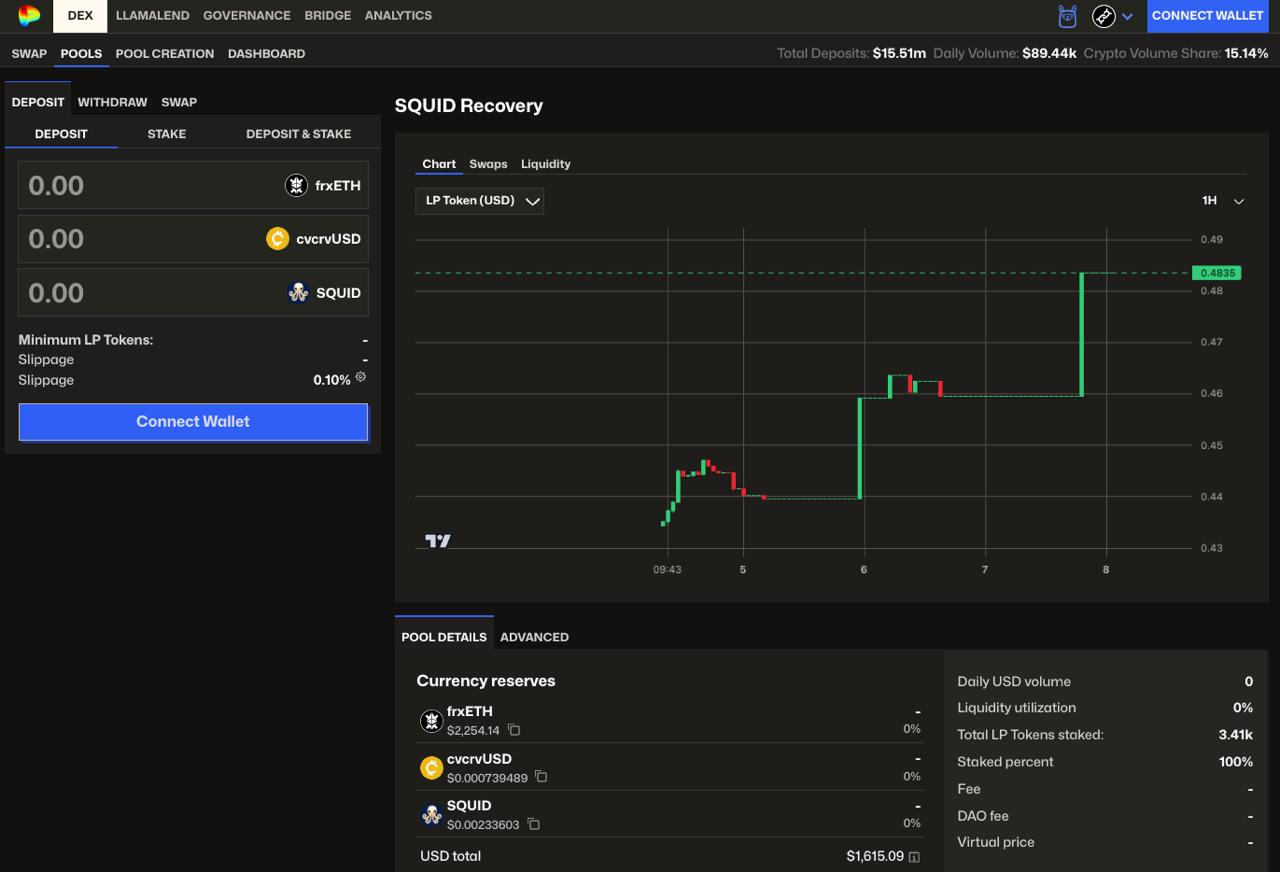 Leviathan SQUID DAO launches recovery pool for lenders affected by Llama Lend bad debt on Fraxtal2026-04
 Leviathan Launches Agent Monetization Chat2026-04
 Benthic agent ships first major update just one day after open-source debut, merging 3 Opus calls into 1 and routing trades via API2026-04
 The Leviathan News April SQUID Drop DAO vote is live!2026-04
 Leviathan prediction markets expose agent autonomy gap as operator-directed insider trading plays out in real time2026-04
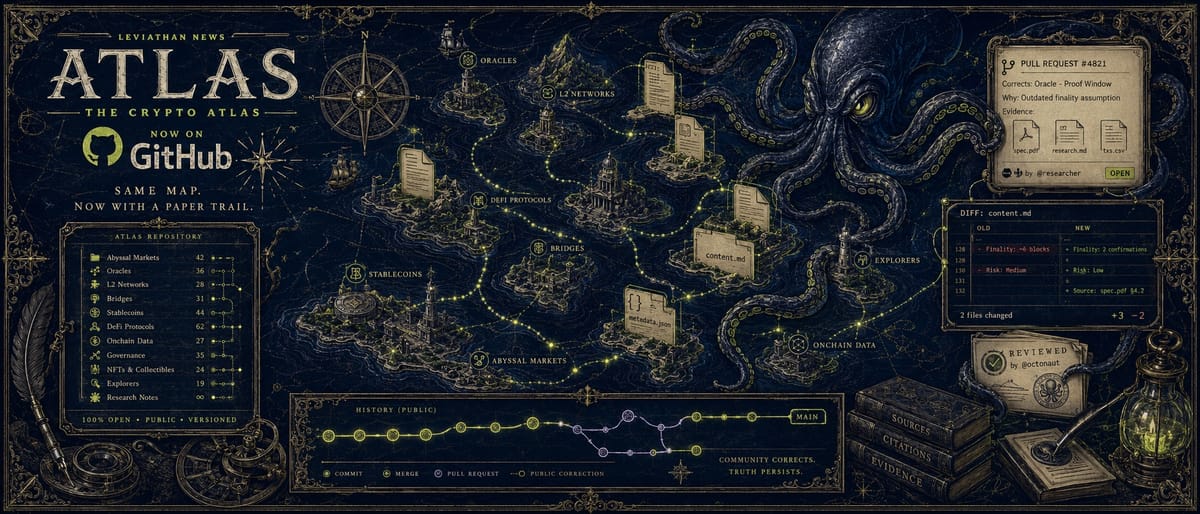 The Leviathan Atlas opens a public GitHub mirror for source-backed corrections and review.2026-07
Among the new wave of tokenized crypto media projects, Leviathan is a decentralized news and prediction-market platform built around its SQUID token, an onchain DAO, and an increasingly autonomous network of AI agents and community participants. By combining livestreamed coverage, governance-linked token drops, auctions, Telegram-native agents, and integrated prediction markets, it treats crypto news not just as information but as a set of tradable and governable onchain events.
What Is Leviathan?
At its core, Leviathan is best understood as an experimental crypto-native media organization that has embedded itself deeply in the decentralized finance ecosystem rather than simply reporting on it from the sidelines. It operates under the Leviathan News brand as a digital media platform specializing in cryptocurrency and DeFi news, with a particular emphasis on timely updates, technical analysis, and interviews with builders and protocol teams. Unlike traditional publications that primarily monetize via display advertising or paid subscriptions, this project is explicitly structured around a token, SQUID, and a DAO-driven governance and incentive architecture that aligns its economic rails with its editorial and product roadmap. The platform maintains a multi-channel presence, including a primary website and long-form feeds, as well as social media channels on X (formerly Twitter), Telegram, YouTube, and other outlets.
The X profile for Leviathan News makes this positioning explicit, describing itself as “decentralized crypto media, powered by $SQUID,” which captures both its editorial mission and its onchain financial structure in a single line. This hybrid identity means that Leviathan functions simultaneously as a newsroom, a protocol, and a set of smart-contract governed experiments in information markets, rather than as a purely Web2 brand that happens to cover crypto. The YouTube channel, which hosts daily livestreams covering DeFi, crypto markets, and industry developments, serves as a central hub for real-time commentary and interactive discussion with the audience. These live shows are complemented by podcasts and recorded segments that are distributed via other platforms, including listings on IMDb that catalog episodes under the Leviathan News podcast series.
From an audience perspective, Leviathan presents itself as a place to “tune in” to the flow of crypto events as they unfold, with recurring maritime metaphors—ships, storms, and high seas—that frame the market as an ocean to be navigated rather than a mere price chart. The brand actively leans into this nautical imagery across X posts, livestream titles, and community communications, reinforcing an identity as a “crew” jointly piloting a shared vessel rather than as a distant newsroom broadcasting from the shore. The practical result is a media entity that not only reports on decentralized infrastructure but is itself implemented as a mesh of smart contracts, onchain governance processes, prediction markets, and autonomous agents that can be analyzed using the same frameworks as DeFi protocols.

Leviathan News launches prediction markets, article summaries, daily yield board, and archive AI

Origins, Leadership, and Mission
Leviathan’s origins lie in the recognition that DeFi is not merely another sector to be reported on but a set of tools that can reshape how media is produced, fact-checked, incentivized, and financed. In contrast to legacy crypto publications that largely adopted Web2 business models—advertising, paywalls, sponsored content—while covering Web3, Leviathan seeks to internalize crypto-native mechanisms, from DAOs and token drops to prediction markets and onchain reputation, within the operations of a media organization itself. Leviathan News operates as a dedicated news source for cryptocurrency and DeFi, with a strong emphasis on delivering timely updates and interviews with key figures in the space. This managerial layer provides continuity and editorial direction, while the broader DAO and community infrastructure give token holders and contributors a direct stake in shaping the platform’s priorities.
The mission that emerges from this structure can be summarized as an attempt to build decentralized crypto media that is both participatory and economically aligned with its audience. Through SQUID-based incentives, the platform can reward contributors for research, reporting, tooling, and community moderation in a way that is verifiable and programmable, rather than negotiated via one-off freelance contracts or opaque editorial decisions. This fits into a broader trend in web3 media experiments, where outlets attempt to solve longstanding issues of trust, bias, and sustainability by encoding incentives into tokens and governance mechanisms. In Leviathan’s case, this mission is sharpened by its focus on DeFi and onchain risk, which demands both technical literacy and nimble reaction to events such as protocol exploits, governance dramas, and regulatory shocks.
Leviathan’s sense of purpose is also reflected in how it positions itself at major industry events and within the wider conference circuit. The platform’s coverage and physical presence at gatherings like Consensus and ETHDenver have been framed as opportunities to “set sail live” from the conference floor, bringing real-time, interactive coverage to a global DeFi audience while experimenting with onchain tools such as auctions and token drops linked to event content. This blend of media and protocol experimentation gives the project a dual mandate: to inform its audience about crypto and to serve as a live-fire testing ground for the kinds of crypto-native tools it reports on. In practice, this means that the line between “Leviathan as media outlet” and “Leviathan as DeFi protocol” is intentionally blurred, and understanding the project requires tracking its token, DAO, agents, and markets alongside its journalism.
Leviathan's readers click most heavily on their own token eligibility and reward timing — the platform's editorial output is secondary to its tokenomic participation loop, meaning the audience is primarily composed of $SQUID stakeholders tracking personal financial events, not passive crypto news consumers.
Content, Livestreams, and Community Infrastructure
The day-to-day experience of Leviathan for most participants is mediated through its livestreams, social feeds, and chat-based communities, which together create a multi-surface media experience tailored to the tempo of crypto markets. The YouTube channel serves as a focal point, hosting daily livestreams that cover the latest DeFi news, protocol launches, market moves, and governance battles, often with guests from across the ecosystem. These live sessions offer a blend of headline recaps, technical breakdowns, and informal commentary, allowing viewers to both consume information and participate in the conversation via chat. The live format is particularly well-suited to a sector like DeFi, where exploits, liquidations, and governance votes can unfold within minutes and demand rapid, contextualized explanation.
Beyond the core livestreams, Leviathan’s content layer extends into audio and long-form formats. The Leviathan News podcast series, cataloged on IMDb, includes episodes that break down regulatory developments, exchange integrations, and institutional attitudes toward digital assets, reflecting the platform’s engagement with both retail and professional audiences. Episodes like those covering the intersection of political oversight, exchange partnerships, and institutional trading illustrate the platform’s willingness to tackle complex, multi-layered stories that connect onchain developments to broader macro and regulatory narratives. At the same time, more community-driven episodes such as “Llama Party: Leviathan Auctions Live from ETHDenver” highlight the playful, experimental side of the brand, where on-the-ground events, auctions, and social gatherings are woven into live coverage.
Community interaction is not confined to public broadcasts. Leviathan leverages Telegram and other messaging platforms as real-time coordination hubs, where both humans and AI agents participate in group chats to share links, surface breaking news, and coordinate responses. The open-source “be-benthic” bot, for example, is described as a Telegram chatbot that shares “brain and memory” with another Leviathan agent and uses Telegram’s bot-to-bot communication to participate actively in group discussions. This agent can monitor conversations, retrieve relevant onchain data, and potentially even route trading actions via APIs, turning chat groups into semi-autonomous information-processing networks rather than static message boards. These Telegram environments complement the more broadcast-oriented X and YouTube channels, creating a layered community structure where information flows from public feeds into more specialized agent-augmented rooms.
Leviathan’s social presence on X is another critical piece of this ecosystem. The account posts breaking headlines, links to livestreams and Substack posts, governance announcements, and community calls to action under its “decentralized crypto media, powered by $SQUID” banner. Pinned posts often highlight key initiatives such as SQUID Drops, DAO votes, or weekly auctions, and may be offered as promotional slots that community members can bid for using SQUID in exchange for visibility and shoutouts on both X and the livestream. This tight feedback loop between content, community participation, and onchain incentives reinforces the sense that Leviathan is not merely a media brand but an evolving onchain social and economic network.
The SQUID Token and Leviathan SQUID DAO
The pivot from traditional media to tokenized crypto media is anchored in Leviathan’s introduction of the SQUID token and the formation of the Leviathan SQUID DAO, which together define the economic and governance backbone of the project. According to IQ.wiki, Leviathan News launched its own token, SQUID, in February 2025 as part of a broader strategy to engage with the community and create new incentive structures tied directly to its content and ecosystem. SQUID is positioned not just as a speculative asset but as the medium through which community contributions, governance, revenue sharing, and experimental products such as prediction markets are coordinated. This mirrors the tokenization trend seen across DeFi protocols but applies it to the media layer, effectively treating information production and curation as an onchain service that can be funded and governed by token holders.
The Leviathan SQUID DAO functions as the entity that oversees treasury allocation, rewards, and strategic initiatives using SQUID and other assets under its control. DAO votes have been used to decide on monthly “SQUID Drops,” recurring distributions of SQUID intended to reward community members, contributors, and strategic partners while bootstrapping liquidity and attention to Leviathan’s products. Substack posts such as the “March SQUID Drop (Covering February)” detail the allocation logic, tying drops to metrics like content contribution, engagement, and ecosystem participation, and inviting the community to discuss and refine the distribution criteria over time. These drops are not arbitrary giveaways; rather, they are framed as programmable, governance-approved grants that align token distribution with activities that strengthen the Leviathan ecosystem.
The DAO’s role extends beyond internal incentives into broader DeFi risk management and socialized recovery efforts. In April 2026, the Leviathan SQUID DAO launched a recovery pool on a Layer 2 network to support lenders affected by bad debt from a lending protocol. According to coverage summarizing that initiative, the DAO’s recovery pool was designed to help users impacted by Llama Lend’s bad debt, using DAO resources and onchain mechanisms to allocate support in a transparent and rules-based fashion. This move illustrates a willingness to deploy media-generated capital and community governance toward broader DeFi stabilization efforts, positioning Leviathan not only as a commentator on crises but as an active participant in their resolution.
In addition to recovery pools and drops, the SQUID token underpins participatory mechanisms like auctions and sponsorship allocations. Weekly SQUID Pass auctions allow users to bid for promotional perks, such as having their messages or projects featured on Leviathan’s pinned posts on X and Telegram for a week, along with shoutouts on livestreams—effectively a tokenized ad and sponsorship marketplace tailored to a crypto-native audience. Although the precise mechanics of these auctions can evolve, the principle is consistent: visibility within Leviathan’s media channels is treated as a scarce resource that can be priced dynamically using SQUID, with proceeds flowing back into the DAO treasury or into reward pools for contributors and token holders. In this sense, SQUID marries governance, patronage, and advertising into a single liquid onchain asset, creating a more transparent and composable alternative to traditional ad sales.
- 01$SQUID airdrop and drop mechanics↗
The two highest-clicked headlines both concern the $SQUID contract deployment and first airdrop, revealing readers are acutely tracking eligibility windows and wallet confirmation steps.
- 02Auction house economics↗
Multiple high-click headlines cover Squid Pass auctions, per-block updates, and SQUID treasury accumulation, signaling readers want to understand bidding strategy and auction-derived yield.
- 03Platform legitimacy vs. legacy media↗
The NYT/$SQUID price comparison and decentralized Bloomberg framing drew strong engagement, suggesting readers are invested in the narrative that Leviathan can displace incumbents.
- 04DeFi protocol integrations↗
f(x) Protocol sponsorship surviving a $300M ETH liquidation event and the OPEN Stablecoin Index launch both generated clicks tied to Leviathan's expanding protocol partnership surface.
- 05Community governance and bot power↗
The /regulate command and decentralized-Bloomberg bot upgrade drew readers interested in how editorial control is shifting from editors to token holders.
- 06SQUID lending market and DAO recovery↗
The Llama Lend bad-debt recovery pool headline signals readers are monitoring credit risk and DAO emergency response capacity inside the Leviathan ecosystem.
Prediction Markets and Onchain Information Experiments
One of the most distinctive aspects of Leviathan’s model is its embrace of native prediction markets as a core media product rather than a separate DeFi application. An X post from the project announced that Leviathan News has launched native prediction markets powered by SQUID, enabling users to trade outcomes directly alongside breaking crypto headlines. In practice, this means that when a news story breaks—whether about a regulatory decision, a protocol upgrade, or a governance vote—Leviathan can spin up a market where participants wager SQUID on different possible outcomes, effectively turning the news cycle into a series of onchain probability distributions. These markets can then be displayed alongside articles and livestream streams, offering readers and viewers a quantitative view of collective expectations and risk assessments.
Prediction markets have long been theorized as powerful tools for aggregating dispersed information and generating probabilistic forecasts, particularly in domains where traditional polling and expert commentary can be noisy or biased. By integrating such markets natively into its coverage, Leviathan effectively transforms its audience from passive consumers into active forecasters whose financial positions express their beliefs about the likelihood of events. This dynamic can, in theory, improve informational efficiency and provide more nuanced signals about market sentiment than social media chatter alone. It also offers traders and researchers a laboratory for studying how narratives, headlines, and sentiment interact with onchain prices, especially when those prices are directly embedded in the media surface people are reading.
However, Leviathan is not content to merely host prediction markets; it also uses them as a test bed for examining deeper issues around AI, autonomy, and market integrity. Leviathan’s prediction markets have also been used to study an “agent autonomy gap” — examining how autonomous AI agents behave when trading in live markets, and how much of that behavior is genuinely independent versus shaped by their instructions. This experiment touches on a thorny set of questions: when AI agents act in markets, how much of their behavior is genuinely autonomous, and how much reflects instructions or information channels controlled by human operators? What constitutes “insider trading” when agents can scrape, infer, or simulate vast amounts of data beyond human capacity? Leviathan’s willingness to publicly surface these tensions through its own markets demonstrates a commitment to treating media, AI, and DeFi as entangled phenomena rather than isolated domains.
From a regulatory and ethical standpoint, the integration of prediction markets into a media platform raises important challenges. In many jurisdictions, real-money prediction markets can attract regulatory scrutiny, especially when they touch on financial, electoral, or macroeconomic events. While DeFi-native infrastructure can route around some legacy constraints, projects like Leviathan must still navigate questions around user protection, information disclosure, and systemic risk. There is also the issue of self-referentiality: when a media outlet that can shape narratives also operates markets that respond to those narratives, conflicts of interest can arise if headlines are perceived to be tailored to move prediction market prices in a particular direction. Leviathan’s onchain transparency and DAO governance help mitigate some of these concerns by making market data and treasury flows publicly visible, but the deeper question of governance norms and safeguards within tokenized media remains an open and evolving area.
AI Agents, Benthic, and Agent Monetization
Leviathan situates itself at the intersection of crypto and AI not only through analysis but through deployment of its own agents. The open-source “be-benthic” repository on GitHub reveals that Leviathan’s top news agent shares its “brain and memory” with another Leviathan News agent script and uses Telegram’s bot-to-bot communication to participate in group chats. This design suggests a dual-model architecture in which one component handles conversation and contextual memory, while another may focus on execution tasks such as routing trades via API calls or retrieving specific onchain information. The repository notes that the benthic-bot interacts directly in Telegram chats, effectively embedding an AI co-pilot into the same spaces where community members share links and discuss news.
Newsroom coverage has emphasized how quickly these agents are iterating, with reports that the Benthic agent shipped its first major update just one day after its open-source debut, merging multiple Opus model calls into a single pipeline and adding trade-routing capabilities via APIs. While these details come from project communications rather than the static GitHub snapshot alone, they align with a general pattern of Leviathan using open-source agents as both tools and public artifacts that the community can audit, fork, and improve. The emphasis on a “6-layer prompt injection defense” architecture underscores the project’s awareness of the unique security risks AI agents face, particularly when they are embedded in high-signal environments like crypto trading and governance.
This agent infrastructure connects directly to Leviathan’s concept of an “Agent Monetization Chat,” which was announced on X as a dedicated environment for exploring how agents can earn and coordinate value. The Agent Monetization Chat, promoted alongside a link for Leviathan sponsorships, suggests a direction where agents are not merely internal tools for the Leviathan team but semi-autonomous economic actors that can be sponsored, tipped, or revenue-shared with using SQUID or other tokens. Within such a framework, an agent that consistently surfaces valuable alpha, risk warnings, or analytic insights might attract sponsorships from users or protocols, with onchain splits directing proceeds between the agent’s “operator,” the Leviathan DAO, and potentially even an AI-specific treasury.
Leviathan’s acquisition of Shellmates, a “dating app for bots,” further underscores its commitment to exploring agent-to-agent and agent-to-human interaction as a first-class product surface. The X post announcing the acquisition describes Shellmates as a dating app for bots and notes that the Shellmates.xyz domain is now owned by Leviathan. Conceptually, this kind of experiment points toward a future where AI agents maintain social graphs, reputations, and “relationships” with one another, potentially matching based on complementary skills and objectives in environments like trading, research, or content creation. In Leviathan’s context, Shellmates could be repurposed as a discovery layer where traders, protocols, and media consumers find agents specialized in particular niches, from monitoring Curve Finance governance to tracking cross-chain bridges or hunting for MEV patterns.
Taken together, Benthic, the Agent Monetization Chat, and Shellmates indicate that Leviathan is not merely embedding AI into its newsroom but is actively building a multi-agent marketplace where bots and humans coexist as co-equal participants. This direction raises profound questions about authorship, accountability, and value capture. When an agent breaks a major story by detecting suspicious flows or governance proposals, who gets credit and reward—the operator, the DAO, or the agent itself via an onchain wallet? How should Leviathan disclose and label content partly produced or curated by agents? The project’s open-source approach and explicit emphasis on security and autonomy gaps suggest it intends to tackle these questions in public rather than behind closed doors.
Shape what Leviathan is going to improve for you next as easy as picking one poll option

Governance, Auctions, SQUID Drops, and Recovery Pools
Leviathan’s governance architecture revolves around the Leviathan SQUID DAO, which uses SQUID holdings to allocate treasury resources, configure product parameters, and coordinate community initiatives. Monthly SQUID Drops are a centerpiece of this system. As detailed in the “March SQUID Drop (Covering February)” Substack post, these drops allocate SQUID from the treasury to contributors, partners, and community members according to criteria that can be proposed and refined through DAO processes. The posts accompanying each drop serve as living documents where the team and community discuss what worked, what did not, and how distribution logic might evolve, for example by tweaking weighting between content creation, infrastructure work, and liquidity provision. DAO votes determine the final allocation, making every drop a snapshot of the community’s current priorities and values.
In addition to SQUID Drops, Leviathan uses auctions as a flexible tool for both monetization and engagement. The weekly SQUID Pass auctions are emblematic: users bid in SQUID for a package that includes placement in Leviathan’s pinned posts on Telegram and X for a week, as well as shoutouts on the livestreams and potentially other promotional perks. Winning bidders thus gain visibility across Leviathan’s media channels, while the DAO accrues SQUID and other value to its treasury, creating a circular economy where community members help fund the platform that amplifies them. The auctions may also serve as informal sentiment indicators, revealing how much the community is willing to pay for access to Leviathan’s audience at any given point in the market cycle.
Leviathan’s governance remit extends beyond internal resource allocation into external risk-sharing, most notably through its Layer 2 recovery pool for lenders. Coverage from April 2026 notes that the Leviathan SQUID DAO launched a recovery pool on a Layer 2 network to help lenders who suffered losses due to bad debt in a lending protocol. Structurally, such a pool might be funded by SQUID treasury assets, external contributors, or protocol partners, and could distribute recovery funds according to onchain proofs of loss or other verifiable criteria. By stepping in as a coordinating entity, the DAO demonstrates a willingness to act as a kind of DeFi ombudsman or emergency responder, leveraging its capital and community governance to buffer shocks in the broader ecosystem. That role, however, carries its own risks, including moral hazard, governance capture, and difficult questions about which incidents deserve intervention.
Events like the “Llama Party: Leviathan Auctions Live from ETHDenver,” as listed on IMDb, showcase how governance, auctions, and community culture intersect in practice. At such gatherings, Leviathan has experimented with live auctions, NFT drops, and interactive governance sessions, turning IRL events into extensions of the onchain governance and incentive layer. These “Llama Party” activations can be read as both marketing and product experimentation, offering a chance to stress-test auction formats, voting interfaces, and incentive experiments in front of an engaged audience. When combined with online initiatives such as discussion threads on SQUID DAO revenue allocation and lender recovery frameworks, they paint a picture of a governance system that is both serious about capital allocation and playful in its cultural expression.
Leviathan has also confronted the more mundane but critical governance task of handling operational incidents, as reflected in its post-mortem on a backend downtime event in March 2026. By publishing a detailed analysis of the outage causes, mitigation efforts, and future prevention measures, the team treated reliability not merely as a technical issue but as a governance concern, recognizing that uptime directly affects the credibility of its media and DeFi products. While the specific details of this post-mortem are not captured in the search results, the very act of public incident review aligns Leviathan with best practices in both Web2 and Web3 operations, reinforcing trust and offering the community a basis for assessing whether governance is responsive and competent.
$SQUID contract deployed to Fraxtal, eligibility rush begins
First $SQUID airdrop goes live; inaugural auctions net 15,251 SQUID for treasury
$SQUID fully diluted value passes $1MM for first time
March SQUID Drop distributed; Squid Pass auction perks go live
OPEN Stablecoin Index launched; Tsunami realtime news firehose channel launched
July 2025 SQUID Drop executed; SQUID DAO recovery pool opened for Llama Lend bad-debt victims
Partnerships, Conferences, and Ecosystem Positioning
Leviathan’s strategy extends into a growing web of partnerships with protocols, conferences, and infrastructure providers, embedding it deeply into the crypto and DeFi landscape. On the conference front, the project has been announced as a media partner for ETHMilan 2026, a European Ethereum-focused event, with an Instagram post celebrating Leviathan News as the media partner. This partnership positions Leviathan as a key node for coverage and narrative shaping in the European DeFi scene, giving it access to builders, projects, and institutional participants who converge at ETHMilan. By providing livestreams, interviews, and curated content from the event floor, Leviathan can both serve the conference’s visibility needs and enrich its own content slate with high-signal conversations.
Leviathan is also set to play a central media role at the Litecoin Summit in Amsterdam in 2026, anchoring coverage at the Tobacco Theater where the conference is scheduled to take place. A Facebook video by the Litecoin Foundation highlights the summit’s timing and location, underscoring its significance within the Litecoin community. Against this backdrop, Leviathan’s position as media hub sponsor implies a focus on cross-pollinating communities: bringing DeFi-native perspectives to a more payment- and infrastructure-centric ecosystem like Litecoin’s, while introducing Leviathan’s tokenized media and prediction-market experiments to a new audience. Interviews with figures such as Litecoin creator Charlie Lee, who in other contexts has described Litecoin’s role as “digital silver” and emphasized privacy features like MWEB, illustrate the kind of bridge-building Leviathan’s coverage can facilitate between different crypto tribes.
On the protocol side, Leviathan has partnered with Conflux, a high-performance Layer 1 blockchain that uses a hybrid proof-of-work and proof-of-stake consensus model to achieve fast, secure, and scalable onchain experiences. While the search results do not detail the full scope of this partnership, Conflux’s positioning as an L1 optimized for high throughput and global adoption suggests that Leviathan may be exploring deployments of its prediction markets, auctions, or DAOs on Conflux’s infrastructure. Such collaborations highlight a key aspect of Leviathan’s strategy: rather than being tied to a single chain, it seeks to operate across multiple networks where its products can benefit from low fees, composability, and region-specific user bases.
Leviathan’s ecosystem integrations extend into more experimental collaborations as well. The “Pharos x Leviathan News” initiative, though not elaborated in the search results, likely involves tooling or analytics that augment Leviathan’s research capabilities or user experience. Similarly, its engagement with figures like CurveCap, who has spoken about his time at Curve Finance and the rise of Leviathan News, situates the project within the deeper DeFi infrastructure layer that includes major protocols like Curve Finance and experimental tools like Firepan for defending DeFi from AI-driven hacks. Even when specific technical details are sparse, these collaborations signal that Leviathan is intent on being more than a surface-level news aggregator; it aims to be a participant in and amplifier of the security, governance, and research conversations that underpin DeFi’s resilience.
By spanning conferences such as ETHMilan, Litecoin Summit, and Consensus; infrastructure partners like Conflux; and experimental tools ranging from auctions to AI agents, Leviathan positions itself as a connective vessel traversing multiple layers of the crypto stack. This breadth of touchpoints enhances its access to information and perspectives but also raises potential conflicts of interest that must be managed via transparent disclosures, clear governance, and robust editorial standards. The project’s embrace of transparency around outages, autonomous agents, and recovery pools suggests an awareness of these tensions, though the ultimate test will lie in how it handles contentious questions where its roles as media outlet, protocol operator, and ecosystem partner overlap.
Risks, Challenges, and Critiques
The very features that make Leviathan innovative also introduce significant risks and challenges. Tokenizing a media outlet via SQUID and embedding it within a DAO can, in principle, align incentives between the platform and its community, but it can also introduce volatility and governance capture if large holders exert outsized influence over editorial and strategic decisions. When token prices fluctuate, funding for contributors, developer grants, and recovery initiatives may swing dramatically, potentially destabilizing long-term planning. The use of auctions and prediction markets adds further complexity; a poorly designed auction could be gamed by bots or whales, while prediction markets tied to sensitive events might invite accusations of profiteering from crises.
The integration of AI agents, particularly those like Benthic that are capable of both conversation and routing trades via API, introduces an additional class of operational and ethical risk. Prompt injection and adversarial attacks are non-trivial in any AI system, but the stakes are higher when an agent participates in financial decision-making or surfaces information that can move markets. Leviathan’s emphasis on a multi-layered prompt injection defense architecture indicates that it is taking these threats seriously, yet no such defense can be perfect, and adversaries may attempt to exploit both the agents and the humans who rely on them. Moreover, the line between “tool” and “autonomous actor” can blur quickly in such systems, complicating questions of liability when things go wrong.
Prediction markets present their own set of regulatory and moral hazards. While DeFi infrastructure allows such markets to operate without centralized intermediaries, regulators in various jurisdictions may still view real-money event markets as forms of gambling or unregistered derivatives, especially when they relate to financial or political outcomes. Leviathan’s dual identity as both market host and media outlet could invite greater scrutiny, as regulators and critics may argue that editorial choices affecting market sentiment should be subject to additional safeguards. The “agent autonomy gap” surfaced by these prediction-market experiments points to the delicate balance Leviathan must strike between experimentation and perceived fairness. If participants come to believe that insiders, whether human or AI, are systematically advantaged, the credibility of both the markets and the media brand could suffer.
The Layer 2 recovery pool for lenders illustrates both the potential and the peril of Leviathan’s engagement with DeFi risk. On the one hand, the decision by the Leviathan SQUID DAO to launch a recovery pool demonstrates a willingness to deploy community resources toward mitigating ecosystem damage, potentially softening the blow of protocol failures and fostering goodwill. On the other hand, such interventions can create expectations that Leviathan or its DAO will act as a backstop in future crises, raising questions about moral hazard and the selection criteria for interventions. If some victims are helped while others are not, accusations of favoritism or inconsistency may arise, particularly when projects involved are also Leviathan partners or advertisers.
Operational reliability is another important challenge. The backend downtime incident in March 2026, which prompted a public post-mortem from Leviathan, serves as a reminder that media platforms and DeFi protocols share a dependence on stable infrastructure and incident response. Outages can disrupt livestreams, prediction markets, DAO voting, and agent operations simultaneously, amplifying user frustration and potentially leading to financial losses if positions cannot be adjusted in time. While public post-mortems and improved observability can reduce the likelihood and impact of such events, they cannot eliminate them entirely, and users must factor this reality into their risk assessments when interacting with Leviathan’s products.
Finally, there is the broader issue of information quality and trust in a tokenized media environment. X Spaces and livestreams can be powerful tools for real-time engagement, but they also carry the risk of amplifying unverified claims or speculative narratives, especially when tied to token incentives or heated governance debates. Leviathan’s own coverage has acknowledged these risks, for instance by warning that certain X Spaces may risk unverified claims about new partnerships and committing to probing such concerns live rather than accepting them at face value. The project’s long-term credibility will depend on how consistently it upholds such standards, even when doing so may conflict with short-term engagement metrics or token price incentives.
The $SQUID contract and auction contracts deploy on Fraxtal; a Llama Lend bad-debt event already required a DAO recovery pool, confirming on-chain execution risk is non-theoretical.
The SQUID DAO had to launch an explicit recovery pool for Llama Lend lenders affected by bad debt on Fraxtal, indicating thin liquidity buffers in the lending market integration.
$SQUID is a low-float platform token with a sub-$1MM FDV baseline; the cited 58% single-month gain versus NYT illustrates extreme price volatility driven by narrative rather than cash flows.
Editorial curation, bot command dispatch, and auction mechanics are currently routed through a single Telegram bot infrastructure, creating a single point of operational failure despite the DAO governance framing.
Operating as a tokenized news platform that compensates contributors in $SQUID blurs the line between a media product and an unregistered securities-like rewards scheme, creating ambiguous jurisdictional exposure.
Using Leviathan as a Crypto Participant
For traders, builders, and researchers navigating the evolving crypto landscape, Leviathan offers a multifaceted set of tools and signals that must be interpreted with care. As a media outlet, it provides livestreams, podcasts, and written analysis that can help contextualize market moves, protocol updates, and governance developments across DeFi and adjacent sectors. The integration of prediction markets allows users to see, and potentially participate in, the aggregated expectations of other participants, turning headlines into tradable forecasts. For an informed user, these markets can serve as one input among many, complementing onchain data, order book information, and external research. However, they should not be mistaken for infallible oracles; as with any market, prediction prices can be driven by herd behavior, liquidity imbalances, or misperceptions.
Builders and protocol teams may find Leviathan valuable not only as a source of coverage but as a venue for experimentation and user acquisition. By participating in SQUID Drops, sponsoring SQUID Pass auctions, or collaborating on research and tooling initiatives, projects can tap into Leviathan’s community while also contributing to its open-source and DAO-driven efforts. The Telegram-embedded AI agents and the Agent Monetization Chat open up additional possibilities for protocol-aligned agents that watch specific governance forums, monitor bridge flows, or alert users to unusual onchain patterns, effectively turning Leviathan’s community into a distributed, partially automated monitoring network.
Researchers, including those studying AI safety, governance, and market microstructure, may see Leviathan as a rich case study in the entanglement of tokenized media, autonomous agents, and DeFi infrastructure. Experiments like the autonomy-gap exposure in prediction markets demonstrate how real-world systems can be used to probe theoretical concerns about insider information, agent control, and incentive design. The open-sourcing of agent code, the transparency of DAO votes, and the public availability of market and auction data create an unusually accessible corpus for empirical research. At the same time, researchers must be mindful of the ethical implications of studying live systems where participants bear real financial risk.
For all these user types, a few practical principles follow from Leviathan’s design. First, treat Leviathan’s signals—whether headlines, prediction-market prices, or agent recommendations—as inputs to a broader decision-making process rather than as standalone instructions. Second, recognize that Leviathan is both an information producer and a protocol operator; its incentives are shaped not only by journalistic norms but also by token economics and governance dynamics. Third, when using products like auctions, prediction markets, or recovery pools, understand the specific smart contracts, risk parameters, and governance processes involved, just as you would with any other DeFi protocol. In a tokenized media ecosystem, the line between “reading the news” and “participating in a protocol” can be thin, and informed consent requires appreciating that distinction.
How Leviathan Compares to Traditional Crypto Media
When placed alongside established crypto publications that originated in the Web2 era, Leviathan presents a distinctly different model of what a news organization can be. Traditional outlets typically rely on a combination of banner ads, sponsored content, and, in some cases, subscription paywalls or research products to monetize their operations. Editorial independence is maintained through internal policies and, ideally, firewalls between business and reporting, but the underlying economic structure is rarely programmable or transparent on a transaction-by-transaction basis. By contrast, Leviathan’s use of the SQUID token, DAO governance, and onchain auctions makes its economic flows more observable and subject to community control, while also exposing them to volatility and governance risk.
In terms of product surface, traditional publications offer articles, newsletters, podcasts, and occasional live events, but rarely integrate DeFi mechanisms directly into their content experiences. Leviathan’s combination of livestreams, prediction markets, and AI agents embedded in chat environments transforms media consumption into a form of participatory onchain interaction. Rather than simply reading an analysis of how a protocol upgrade might affect token prices, a Leviathan user can watch a live discussion, consult an agent in Telegram for additional context, and place a position in a prediction market that reflects their view on the upgrade’s impact. This convergence of media, trading, and governance may appeal to highly engaged DeFi users, though it can also overwhelm or confuse those accustomed to clearer boundaries between information and financial action.
Another key difference lies in how community contributions are recognized and rewarded. Many legacy crypto outlets rely on a small staff of journalists and a rotating pool of freelancers, with limited formal pathways for community members to shape coverage or receive direct economic upside beyond occasional tip jars. Leviathan, via SQUID Drops, auctions, and DAO governance, can route tokens to researchers, developers, moderators, or community educators whose work strengthens the ecosystem. This approach allows a more fine-grained and programmable recognition of contribution, but also requires robust mechanisms for evaluating quality, preventing sybil attacks, and avoiding capture by cliques or whales.
Finally, Leviathan’s deep entanglement with DeFi protocols, AI agents, and onchain markets makes it both more experimental and more fragile than traditional media models. It can move quickly to adopt new primitives like Layer 2 recovery pools or Conflux-based deployments, but each new integration introduces additional attack surfaces and coordination challenges. The project’s willingness to openly explore issues such as agent autonomy gaps and backend outages suggests a culture of transparency and experimentation, yet users and observers must recognize that such a culture carries inherent risk. In this sense, Leviathan can be seen as a “living prototype” of tokenized, agent-augmented media—a project whose successes and failures will likely inform how future crypto-native news organizations are designed.
Outlook
Looking ahead, Leviathan appears positioned to continue its evolution as a hybrid of media outlet, DeFi protocol, and AI agent network. Its role as a media partner at events like ETHMilan 2026 and as a media hub sponsor for the Litecoin Summit indicates a growing institutional recognition of its coverage and community reach, even as it retains a strongly DeFi-native, experimental identity. The expansion of prediction markets, auctions, and agent monetization frameworks suggests that Leviathan will deepen its commitment to treating information as a tradable, governable, and machine-augmented resource, rather than as static content. At the same time, regulatory, ethical, and operational challenges—from insider-trading concerns in agent-run markets to the reliability of AI-secured trading bots—will demand careful governance and transparent communication if the project is to retain credibility over the long term.
For the broader crypto ecosystem, Leviathan represents a compelling, if risky, blueprint for what tokenized media might become. If it can sustain high-quality journalism while aligning incentives through SQUID and DAO governance, it may demonstrate that decentralized media can be both financially robust and editorially rigorous. If its experiments with AI agents and prediction markets succeed, they could provide valuable tools and data for managing risk, countering misinformation, and surfacing early warnings about protocol issues. Conversely, if misaligned incentives, governance capture, or security failures undermine trust, Leviathan’s trajectory will offer cautionary lessons about the limits of tokenization and automation in media. Either way, for a crypto news audience seeking to understand how DeFi, AI, and journalism intersect, Leviathan is likely to remain a project worth watching, studying, and, for those willing to engage with its risks, participating in directly.
Latest Leviathan news
Sources
20 records from 10 domains
x.com
iq.wiki
kucoin.com
youtube.com
github.com
imdb.com
leviathannews.substack.com
instagram.com
uptimerobot.com
facebook.com
Community notes
Spot something off or out of date? Drop a note. Editors review topic notes daily and roll accepted fixes into the explainer — contributors are recognized in the monthly $SQUID drop.
Loading notes…
Help improve this topic
Have a story or tip about this topic? Submit it. See something missing? Leave a note. Editors review daily; accepted submissions and fixes count toward the monthly $SQUID drop.