
Longform explainer on how advertising works and how crypto, onchain markets, AI agents, and platforms like Leviathan, Arbitrum, and ChatGPT are reshaping ad economics, risks, and opportunities for Bitcoin, DeFi, and Web3 projects.
- x.com3
- leviathannews.xyz2
- decrypt.co2
- support.google.com1
- opensea.io1
- auction.leviathannews.xyz1
- serendb.com1
+8 sources across the wider coverage universe
 The NFL urged the CFTC to tighten oversight of sports prediction markets, calling for stricter rules on game integrity, insider trading, advertising and age restrictions2026-07
 OpenAI launches pay-per-click ads inside ChatGPT, entering digital advertising and challenging Google and Meta for ad spend in AI-driven search2026-04
 Leviathan News launches first AI-native advertising network with SerenAI x402 on Base2025-12
 Pudgy Penguins successfully wrapped the Las Vegas Sphere with its cartoon characters by positioning the activation around physical products—merch, toys, and animations—rather than crypto, allowing it to bypass the venue’s strict crypto advertising rules that previously blocked Dogwifhat’s $700K community-led attempt.2025-12
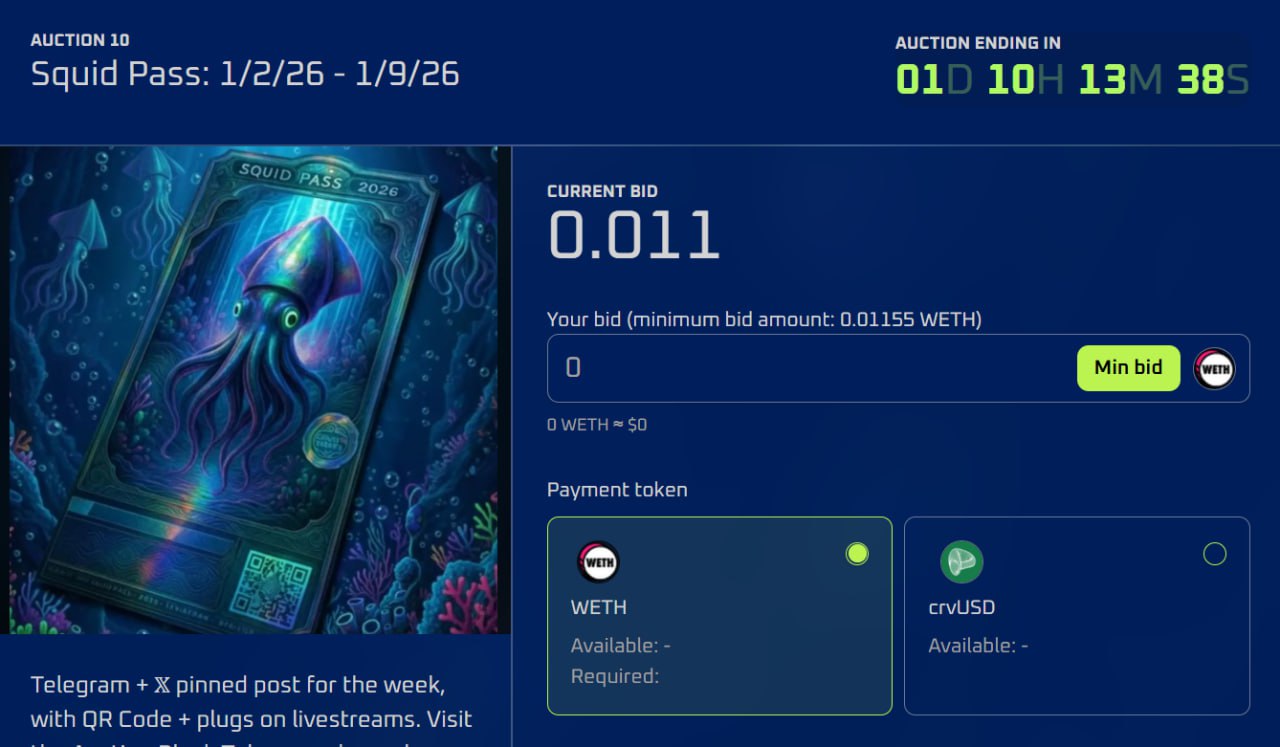 The SQUID Pass auction for next week is live - who will get the best deal in DeFi advertising on the market, with our pinned posts on Telegram and X for the entire week?
Bid now on our app, much more conveniently than before, on Mainnet, with either WETH or crvUSD2026-01
The SQUID Pass auction for next week is live - who will get the best deal in DeFi advertising on the market, with our pinned posts on Telegram and X for the entire week?
Bid now on our app, much more conveniently than before, on Mainnet, with either WETH or crvUSD2026-01 The SQUID Pass auction for next week is live - and for longer than usual, so you have the whole weekend basically to try and get the best deal in DeFi advertising!
Get the pinned posts on our Leviathan News X and Telegram accounts for the entire week, to share your message with our savvy community, consisted of active DeFi users, with real funds onchain.
Bidding this week starts at 0.014 WETH, bid here now:2026-01
The SQUID Pass auction for next week is live - and for longer than usual, so you have the whole weekend basically to try and get the best deal in DeFi advertising!
Get the pinned posts on our Leviathan News X and Telegram accounts for the entire week, to share your message with our savvy community, consisted of active DeFi users, with real funds onchain.
Bidding this week starts at 0.014 WETH, bid here now:2026-01
Advertising in Crypto: How Web3 Is Rewiring the Business of Attention
Advertising is the practice of paying to deliver targeted messages across media in order to shape awareness, perception, and behavior, and in digital markets it increasingly runs on real‑time auctions and granular data. In crypto, that familiar machinery is colliding with programmable money, onchain data, autonomous AI agents, and new forms of community-owned media, creating an experimental laboratory for what next‑generation advertising might look like.
The convergence of advertising and crypto is not happening in isolation but against the backdrop of a much broader shift in both industries. On the legacy side, global ad spend still flows predominantly through a handful of Web2 giants such as Google and Meta, while newer platforms like X and vertical networks in gaming and automotive carve out their own walled gardens, and political and commercial campaigns invest heavily in precision targeting tools like Nexxen and L2’s new VoterMatch product for U.S. elections. On the crypto side, brands and protocols increasingly rely on X, Telegram, Discord, and crypto‑native media outlets to reach users, while experiments such as Leviathan’s SQUID Pass auctions for pinned posts, Alkimi’s “AdFi” stack on Sui, LG’s onchain advertising pilot on Arbitrum, and Leviathan’s AI‑native network with SerenAI on Base explore how to price and allocate attention using smart contracts rather than opaque intermediaries. At the same time, AI reshapes the landscape: OpenAI has introduced cost‑per‑click ads inside ChatGPT, directly challenging search‑based advertising models, while entrepreneurs like Billions Network’s Evin McMullen argue that autonomous agents will bypass traditional search and ad funnels altogether unless a new identity and trust layer is built for both humans and AI.
This explainer surveys how advertising works today, how it is evolving in and around crypto, and what it means for projects deciding where to spend scarce marketing budgets. It uses recent examples ranging from BlackRock’s Bitcoin ETF campaigns on mainstream media to Pudgy Penguins wrapping the Las Vegas Sphere, from Gunzilla’s GI Advertising Network to Trump‑branded memecoins, to make sense of a market where Bitcoin is both an advertised product and a treasury asset for adtech firms, where Leviathan sells attention via DeFi auctions, and where Google’s search monopoly is increasingly contested by AI‑driven interfaces. Throughout, the focus is on evergreen structures—economics, incentives, and mechanisms—rather than hype cycles, with the goal of giving a crypto‑native audience a durable mental model for how advertising is being rebuilt on and around blockchains.
What Advertising Actually Is (And Why Crypto Cares)
Advertising, in its simplest definition, is paid communication designed to influence an audience at scale. In classical marketing theory it sits alongside product, price, and distribution as one of the core levers a firm can pull to drive growth, but in practice it has become the most data‑intensive and algorithmically optimized part of that stack, especially since the rise of digital programmatic media. For a crypto protocol, NFT project, exchange, or memecoin, advertising serves the same fundamental goals—acquiring users, encouraging them to trade or stake, building brand equity—but it is overlaid on top of a uniquely volatile and financialized environment where every campaign is immediately reflected in onchain price charts and social sentiment. That feedback loop can be brutal, but it also makes crypto an unusually transparent test bed for how advertising works.
Another way to frame advertising is as a market for attention. Publishers supply audience segments; advertisers demand them; intermediaries match the two and set clearing prices via auctions. In Web2, that market is dominated by a few large platforms and an intricate adtech supply chain that handles targeting, bidding, verification, and measurement, usually in milliseconds. Crypto slots into this picture in several ways. First, many crypto entities are buyers of ads on mainstream platforms, as illustrated by BlackRock’s use of high‑visibility placements like Bloomberg’s homepage to promote its Bitcoin investment products. Second, crypto actors are themselves building ad infrastructure, from gaming‑focused networks like Gunzilla’s GI Advertising Network to experimental onchain systems like those piloted by LG on Arbitrum and Alkimi on Sui. Third, crypto communities and media properties—Leviathan News among them—are selling their own inventory to projects through mechanisms that more closely resemble DeFi auctions than traditional media buys, as seen in the SQUID Pass auctions for pinned posts on X and Telegram.
The reason this matters to a crypto audience is that the same qualities that make blockchains attractive for financial use cases—composability, transparency, global access, and programmable incentives—also make them promising substrates for advertising markets. They offer the possibility of verifiable delivery and fairer revenue splits for publishers, programmable pay‑for‑performance models for advertisers, and new ways to share value with users who typically endure ads without participating in the upside. At the same time, they bring new risks: mechanisms can be exploited by bots and AI agents, political targeting can be amplified without proper safeguards, and speculators can use ad announcements themselves as trading signals, as seen when QMMM Holdings’ stock soared after it announced a $100 million digital assets treasury plan centered on Bitcoin, Ethereum, and Solana. Understanding these dynamics requires first unpacking how advertising works today in the non‑crypto world.
From Billboards to Blockchains: A Short History
The history of advertising is essentially the history of mass media. In the late nineteenth and early twentieth centuries, newspapers and magazines monetized circulation by selling display ads, which were bought and sold through personal relationships and relatively crude audience proxies such as geographic distribution or gendered readership. Radio and television made those audiences more immediately accessible and gave rise to the “Mad Men” era, where brands like McDonald’s and Burger King became household names through catchy jingles and televised campaigns that embedded themselves in popular culture. Even in that era, crypto’s eventual future footprint can be glimpsed in the way advertising converged with finance: televised sports, for instance, were funded in large part by beer, automotive, and fast‑food advertising, just as contemporary crypto events are often underwritten by exchanges and DeFi protocols.
The rise of the internet in the 1990s and early 2000s added a new layer: banner ads, email marketing, and simple performance metrics like click‑through rate. Yet the true inflection point came with search advertising and later with social platforms. Google’s AdWords (now Google Ads) showed that matching ads to intent—people searching for “buy Bitcoin,” “DeFi yield,” or “best hardware wallet”—could be extraordinarily lucrative, while Meta’s Facebook and Instagram perfected behaviorally targeted ads based on social graphs and engagement data. These platforms turned advertising into something measurable and optimizable at scale, and their auction‑based systems made it possible for even small crypto projects to buy targeted traffic. However, they also introduced fragility: when Google and Facebook restricted crypto‑related advertising during earlier ICO and exchange boom‑bust cycles, entire marketing strategies evaporated overnight, revealing how dependent many projects had become on centralized gatekeepers.
Over time, digital advertising evolved into a real‑time, auction‑driven marketplace in which publishers like news sites and apps sold impressions to advertisers through automated exchanges. The industry coined terms such as real‑time bidding (RTB), demand‑side platforms (DSPs), supply‑side platforms (SSPs), and data management platforms (DMPs), and invested heavily in tracking users across sites and devices. For crypto, this meant that even when large platforms lifted outright bans, projects were still subject to opaque review processes, inconsistent policies, and occasional deplatforming, particularly when dealing with products like leveraged trading, privacy coins, or politically sensitive topics. These frictions set the stage for crypto‑native alternatives and for experiments in moving parts of the ad supply chain onchain, where rule sets could be codified in smart contracts rather than enforced by corporate policy teams.
How Digital Advertising Works Today
In contemporary digital advertising, most inventory is sold either directly—through negotiated deals between large brands and publishers—or programmatically, through automated auctions where thousands of advertisers bid in real time for millions of impressions. When a user loads a web page or opens an app, the publisher typically sends a bid request to an ad exchange, containing information such as device type, approximate location, contextual page data, and sometimes pseudonymous identifiers. Demand‑side platforms representing advertisers evaluate that request against their targeting criteria and decide how much to bid; the exchange runs an auction, and the winning creative is served to the user, often in less than 100 milliseconds. Pricing is usually based on cost per mille (CPM, the cost per thousand impressions) but increasingly incorporates cost per click (CPC) and cost per action or acquisition (CPA) in performance‑based campaigns.
The recent move by OpenAI to introduce cost‑per‑click ads inside ChatGPT illustrates how these mechanics are being adapted for AI‑driven interfaces. Rather than serving display ads alongside search results as Google does, ChatGPT weaves promotional links and sponsored answers into conversational responses and charges advertisers only when users click on them. According to reporting from Digiday, marketers can set bids between roughly \(3\) and \(5\) U.S. dollars per click, creating a familiar auction dynamic in a radically new context where “search results” are blended with natural language answers rather than displayed as a list of links. As AI chat and agents become more central gateways to information, the economics of CPC, CPM, and CPA will increasingly intersect with questions of model alignment, prompt design, and even the ethics of mixing advertising with generative answers.
The Web2 ad stack is powerful but also notoriously complex and opaque. Numerous intermediaries take a cut of each media dollar, sometimes leaving publishers with only a small fraction of the advertiser’s spend, while advertisers struggle to verify that their ads were actually seen by humans rather than bots. Fraudulent impressions, brand‑unsafe placements, and dubious attribution models have prompted sustained criticism, and regulators in multiple jurisdictions have probed whether the largest platforms abuse their dominance in both buying and selling ad inventory. It is precisely this combination of economic importance and structural dysfunction that crypto projects like Alkimi are targeting when they talk about “fixing the broken ad ecosystem” through blockchain‑based media platforms that combine transparent ledgers, smart contracts, and AI‑driven optimization.

Kalshi becomes the US Open’s exclusive prediction market partner, reportedly barring rivals from advertising at the tournament and on ESPN
The Fractured Economics of Legacy AdTech
The contemporary adtech ecosystem is often described as a “black box” because of how difficult it can be for advertisers and publishers to see where money flows and how decisions are made. A single display ad impression might pass through half a dozen intermediaries—SSPs, DSPs, data brokers, verification vendors—each taking fees and adding technical overhead. For a crypto project with a finite marketing budget, this means that a significant share of spend may never reach the publishers or audiences it intends to support, instead being captured by intermediaries that provide limited incremental value. It also makes it hard to compare the true cost‑effectiveness of different channels, encouraging a reliance on high‑level metrics and platform dashboards that may not reflect deeper performance.
Alkimi, which styles itself as the world’s first “agentic media platform,” explicitly targets these pain points by proposing a new ad infrastructure built on blockchain, AI, and smart contracts to support a transparent, high‑performance advertising ecosystem. According to its own framing, legacy online advertising is “opaque,” with misaligned incentives and limited accountability, whereas an onchain ad exchange can encode fee structures, revenue shares, and verification logic in publicly auditable smart contracts, reducing opportunities for hidden markups or fraud. By combining blockchain for settlement, AI for optimization, and code‑enforced rules for data access, platforms like Alkimi aim to realign incentives such that publishers are paid fairly for real human attention, advertisers pay only for verifiable outcomes, and users potentially share in the value their data and attention create.
Opaqueness, Rent Extraction, and the Crypto Response
The problem of opacity in advertising is not only technical but also political. Many of the best data sources and most valuable inventory segments are locked inside walled gardens controlled by a handful of companies, which sit on both the buy‑side and the sell‑side of the market. This vertical integration makes it difficult for regulators, auditors, or even large brand advertisers to scrutinize the mechanics of auctions, the allocation of impressions, or the impact of policy changes such as sudden bans on certain categories of advertisers. For crypto firms, that opaqueness has often manifested as inconsistent enforcement, with ads for regulated products or educational content being rejected while more speculative or risky offers slip through unchallenged, depending on how automated classifiers interpret language around Bitcoin, tokens, or DeFi.
In response, some crypto‑native media organizations and protocols have tried to keep their monetization models simpler and more transparent, even if it means sacrificing some of the scale and automation of Web2 adtech. Leviathan News, for example, effectively sells a clearly defined block of attention—pinned posts on its X and Telegram channels for an entire week—to the highest bidder via the SQUID Pass auction, a mechanism that runs onchain and denominates bids in tokens such as WETH and crvUSD. Instead of routing spend through opaque intermediaries, advertisers in this model send funds directly to a smart contract or platform, receive verifiable rights to a piece of inventory, and can observe the bidding history, final clearing price, and allocation outcome on a public ledger. While this does not address all the complexities of modern ad measurement, it does demonstrate one way that crypto can strip advertising down to its essentials and rebuild parts of it around DeFi‑style auction primitives.
Data, Surveillance, and the Political Ad Question
Another fault line in the legacy advertising system lies in its dependence on pervasive tracking and behavioral profiling. Political campaigns have increasingly used commercial adtech infrastructure to micro‑target voters based on demographics, past behavior, and inferred preferences, raising concerns about manipulation and misinformation. Nexxen’s partnership with voter data firm L2 to launch VoterMatch exemplifies the current state of the art in this domain: the product promises “greater precision, transparency and performance” in political advertising by combining rich voter datasets with a cross‑screen media platform that can deliver tailored messaging across television, digital, and streaming environments. In principle, this kind of system can help campaigns reach relevant audiences more efficiently and make reporting on spend and reach more transparent; in practice, it intensifies debates over where to draw the line between legitimate persuasion and invasive targeting.
For crypto, political advertising is both a subject and an object. On one hand, crypto‑related policy proposals and candidates supportive of digital assets may benefit from tools like VoterMatch to reach likely supporters and mobilize them. On the other, the same infrastructure can be weaponized against crypto communities, for example by funding targeted messaging that frames Bitcoin mining as environmentally catastrophic or DeFi as inherently criminal. Trump‑branded memecoins and NFT drops that offer chances to meet the former president at Mar‑a‑Lago show how political figures can use crypto‑native assets as both campaign messaging vehicles and fundraising instruments, blurring the line between financial speculation and political advertising in ways regulators have yet to fully address. The intersection of programmable money, addressable media, and partisan politics is likely to get more complex, not less, as the 2020s progress.
Platform Dependence: Google, Meta, X, And Vertical Plays
Even as new adtech tools proliferate, the gravitational pull of large platforms remains immense. Google still commands a dominant share of search advertising; Meta remains central to social display and performance campaigns; and X has emerged as a critical channel for discourse‑driven communities, including crypto. The fact that mainstream brands like McDonald’s and Burger King allocate significant budget to X illustrates how deeply entrenched these platforms are. McDonald’s recently ran a campaign that literally flipped its ads sideways to target “couch‑bound” fans recovering from the Super Bowl, using X’s mobile feed as a culturally relevant canvas for promoting its breakfast offerings. Burger King’s “There’s A New King And It’s You” campaign likewise leans heavily into social and digital channels, positioning guests themselves at the center of the narrative while deploying a mix of in‑restaurant and online creative. These examples underscore that for many marketers, X has become as important a touchpoint as television once was, and crypto brands compete in the same crowded feeds.
At the same time, industry‑specific players are building their own mini‑walled gardens. General Motors, for instance, has designated Dealer.com as a preferred website and digital marketing provider, effectively creating a vertically integrated digital advertising stack for its dealer network. This allows GM to standardize data collection, inventory listing formats, and campaign analytics across its ecosystem, offering dealers a one‑stop solution for websites and digital marketing while preserving some central oversight over brand presentation and lead generation. In gaming, Gunzilla’s GI Advertising Network takes a similar approach by offering a self‑serve platform that connects brands with one of the most engaged gaming audiences in the world, leveraging Game Informer’s decades of brand equity and integrating the network tightly with Gunzilla’s game ecosystem. Both GM and Gunzilla’s strategies echo what many crypto protocols are attempting: to create vertically integrated, context‑rich ad environments where they control both the content and the pipes, rather than relying entirely on Google, Meta, or X.
Leviathan readers engage with crypto advertising most when they are potential buyers of attention, not observers of it — the highest-clicked stories are all about acquiring ad slots or disrupting who controls them, revealing a readership that sees advertising as an investable market position, not a media category.
Advertising Meets Crypto: From ICO Banners to DeFi Auctions
Crypto’s relationship with advertising has always been ambivalent. On one hand, the ethos of decentralization and “number go up” storytelling has encouraged communities to believe that strong technology and aligned incentives can create organic growth without conventional marketing spend. On the other hand, virtually every major boom in crypto adoption—from early Bitcoin exchanges to ICOs, NFT seasons, and memecoin waves—has been accompanied by intensive advertising campaigns, both paid and “earned,” across social networks, search, and niche publications. The difference now is that many of those campaigns are not just about crypto but are executed using crypto‑native tools, and in some cases sell advertising as a financialized asset in its own right.
Early Crypto Advertising: Forums, Faucets, and Referrals
In Bitcoin’s early years, advertising was informal and often indistinguishable from community outreach. Enthusiasts promoted exchanges, wallets, and mining pools on forums like Bitcointalk, IRC channels, and personal blogs. Faucets—sites that gave away small amounts of BTC in exchange for viewing ads or completing captchas—doubled as early user acquisition tools and as experiments in web monetization. Referral links, particularly for exchanges and cloud mining services, became a major vector of promotion, with some early adopters earning substantial sums by directing others to these platforms. None of this resembled the programmatic adtech stack of today, but the underlying logic was the same: attention was scarce, and entities willing to pay (in Bitcoin or fiat) for that attention could steer user flows.
As the ecosystem grew, more sophisticated marketing appeared. Exchanges bought banner ads on crypto news sites and niche blogs; wallet providers sponsored podcasts and meetups; altcoin projects paid for listings on ranking sites that promised visibility to investors. Because mainstream platforms were initially skeptical or hostile to crypto, much of this advertising took place in a parallel media universe, one that many crypto users still inhabit. Yet as Bitcoin and later Ethereum entered broader public consciousness, and as speculation intensified around ICOs and bull markets, crypto advertisers sought access to the much larger audiences available through Google, Facebook, and Twitter, setting up the collision with Web2 ad policies that would define the late 2010s.
Exchange Wars, ICO Mania, And The Ad Bans
During the ICO boom, projects raised billions of dollars by selling tokens directly to the public, often under weak regulatory oversight. Advertising was a key accelerant of that boom: flashy banners promising outsized returns, influencer campaigns hyping pre‑sales, and aggressive search ads targeted users searching for “best ICOs” or “new altcoins.” As scams proliferated and regulators signaled greater scrutiny, major platforms reacted. Google and Facebook temporarily banned or severely restricted crypto‑related advertising on their properties, citing concerns about fraud and consumer harm. While these policies were eventually softened and made more nuanced, the episode highlighted how dependent crypto marketers had become on centralized platforms and how blunt those platforms’ policy tools could be when they decided a vertical was too risky.
For legitimate projects, the ad bans forced a return to crypto‑native channels and a renewed focus on earned media, community building, and partnerships. Exchanges and DeFi protocols leaned more heavily on affiliate marketing, content sponsorships with trusted media outlets, and appearances at conferences. Yet even there, advertising was never entirely banished; it simply took different forms. A sponsored research report, a branded content series, or an educational campaign about staking could serve both community and marketing purposes. This duality is still present in debates over whether, say, a news outlet’s coverage of CZ’s memoir “Freedom of Money” constitutes critical journalism, thinly veiled PR, or—as CZ himself put it somewhat tongue‑in‑cheek—free advertising for his book.
Crypto‑Native Media, Telegram, And Auctioned Attention
As the industry matured, a robust ecosystem of crypto‑specific media, influencer networks, newsletters, and social channels emerged. Telegram became the de facto hub for many communities, from liquid staking DAOs to NFT projects, while X (formerly Twitter) emerged as the main public square for crypto discourse. For advertisers, these channels offered a mix of advantages and challenges. On the one hand, audiences were highly targeted: a DeFi project advertising in a DeFi‑focused Telegram channel or X feed was likely to reach users with wallet experience and risk appetite. On the other, these audiences were skeptical, information‑rich, and quick to punish campaigns perceived as low‑effort or misleading.
Leviathan News exemplifies how crypto‑native media can structure advertising in ways that feel more aligned with the ethos of transparency and market pricing. Rather than selling impressions in bulk or running opaque pricing tiers, Leviathan packages some of its most valuable inventory—the pinned posts on its X and Telegram accounts, which sit at the top of feeds seen by an audience of active DeFi users—as discrete weekly slots and sells them via the SQUID Pass auction. Bidding can start as low as 0.014 WETH, and participants can use different tokens depending on the week, including WETH, crvUSD, or the platform’s own SQUID token, with auctions often running over a weekend to allow broad participation. Winners gain the right to pin their message for a week, effectively renting the community’s attention in a transparent, onchain way that resembles a DeFi liquidity auction more than a conventional media buy.
This approach offers several advantages. It provides price discovery for a scarce asset—top‑of‑feed visibility to a targeted DeFi audience—without the need for manual negotiation or opaque rate cards. It aligns with crypto users’ familiarity with auctions, from NFT drops to protocol governance. And it creates an onchain record of who paid what for which slot, which can be important for both compliance and historical analysis. The same logic can be extended beyond pinned posts: NFT collections such as the MAcci sale, which Leviathan playfully promoted with quips about even an orca “liking” the drop, can bundle advertising rights into token ownership, turning ad inventory into something that can be traded or collateralized. In doing so, they blur the line between “ad space” and “financial asset” in a way that is uniquely crypto‑native.
OpenAI launches pay-per-click ads inside ChatGPT, entering digital advertising and challenging Google and Meta for ad spend in AI-driven search
Onchain Advertising: Programmable Markets for Attention
The phrase “onchain advertising” can mean many things, from simply paying for ads with tokens to fully encoding ad delivery and verification in smart contracts. At the core, however, is the idea that advertising can benefit from the same properties that make DeFi attractive: deterministic outcomes, transparent rules, composable interfaces, and permissionless participation. Instead of trusting a centralized ad server to count impressions and clicks, participants can rely on shared infrastructure that enforces deals and settles payments according to verifiable events.
LG Electronics and Arbitrum: Ad Campaigns as Smart Contracts
One of the clearest signals that onchain advertising is being taken seriously by large enterprises comes from LG Electronics’ pilot of an onchain advertising network on Arbitrum. According to Arbitrum’s public communications, LG is using the L2 network to test a programmable model in which advertising campaigns and their associated economics are encoded in smart contracts, enabling greater transparency and potentially new forms of performance‑based pricing. The experiment is framed as part of a broader thesis that the global economy is becoming programmable and that advertising, as a major contributor to GDP and a key lever of consumer behavior, is a natural candidate for such treatment.
In such a model, an advertiser might commit a budget to a smart contract that escrows funds and releases them only when certain conditions are met—say, a threshold number of verified views or clicks, or onchain events such as NFT mints or token swaps attributable to an ad campaign. Publishers or platforms participating in the network could likewise register their inventory and earn payouts based on verifiable contributions to campaign goals, rather than opaque impression counts. For users, an onchain advertising network might open the door to opt‑in reward structures where viewing or interacting with ads could yield tokenized benefits, though such models must be carefully designed to avoid encouraging click fraud or low‑quality engagement. LG’s involvement suggests that the appeal of such systems extends beyond crypto‑native companies to mainstream electronics giants seeking more accountable media spend.
AdFi and Alkimi: Rebuilding the Ad Stack with Blockchain and AI
While LG’s pilot focuses on one large advertiser’s experiments with programmable campaigns, Alkimi’s AdFi architecture aims to rebuild the ad stack itself as a blockchain‑native network. Alkimi describes itself as the world’s first “agentic media platform,” explicitly combining blockchain, AI, and smart contracts to power a transparent, high‑performance advertising marketplace. It argues that current adtech is riddled with inefficiencies, fraud, and misaligned incentives, and that a decentralized protocol can enforce fairer, more efficient rules for buying and selling attention. In practical terms, this could mean that every ad impression, bid, and settlement is recorded on a ledger, enabling independent audit and reducing disputes over discrepancies between buyer and seller reports.
AI plays a dual role in this vision. On the one hand, it can optimize matching between campaigns and inventory, predicting which placements are likely to yield desired outcomes and adjusting bids accordingly in real time. On the other, AI agents can act on behalf of advertisers or publishers, participating in the marketplace directly, as “agentic” entities that interface with smart contracts and adapt strategies based on feedback. If those agents themselves have onchain identities and reputations, the system can potentially form a more robust defense against fraud than the current patchwork of device IDs, cookies, and heuristic filters. By building on Sui, a high‑performance blockchain, Alkimi positions AdFi as an infrastructure that can handle the low‑latency, high‑throughput demands of programmatic media while still offering cryptographic guarantees and open access.
Leviathan + SerenAI: AI Agents Buying Ads Onchain
The collaboration between Leviathan News and SerenAI’s x402 gateway illustrates a more focused application of the agentic advertising concept. According to Seren’s blog, the Leviathan team has brought online ad inventory—such as placements in its media products—into the x402 gateway, enabling autonomous AI agents to buy advertising placements directly. This allows agents, rather than human media buyers, to evaluate inventory, bid for slots, and execute campaigns based on their own objectives and access to onchain data. For example, an AI agent tasked with maximizing awareness for a new DeFi protocol could scan past campaign performance, onchain engagement metrics, and current prices for SQUID Pass auctions, then decide whether bidding for a pinned post on Leviathan’s Telegram and X accounts represents good value compared to other options.
This model raises interesting questions about identity and accountability. If AI agents are transacting onchain to buy ads, what ensures that they are acting within the bounds of campaign guidelines, legal regulations, or platform policies? Here, the work of identity projects like Billions Network becomes relevant. In a recent discussion, CEO Evin McMullen emphasized that as bots and AI agents proliferate, the internet needs a new trust layer that can distinguish between humans, bots, and “verified agents,” providing an audit trail to mitigate fraud, disinformation, and financial abuse. Without such a layer, she warned, agents can commit fraud, spread disinformation, or drain funds with “zero recourse” and no clear entity to hold responsible. In an AI‑native advertising network like Leviathan + SerenAI’s, integrating such an identity layer could be crucial to ensuring that autonomous media buying remains compliant, fair, and aligned with human oversight.
Gaming and Contextual Networks: Gunzilla’s GI Advertising Network
Onchain and AI‑native experiments are not the only frontier. Vertical, context‑rich networks are another. Gunzilla Games recently announced the launch of the GI Advertising Network, a self‑serve advertising platform that connects brands with one of the most engaged gaming audiences in the world. Built atop Gunzilla’s broader gaming ecosystem and backed by Game Informer’s 34 years of brand trust, the network is designed to leverage the deep engagement and demographic clarity of gaming communities to offer advertisers targeted yet contextually relevant inventory. For crypto projects, especially those in GameFi, NFTs, or digital collectibles, such a network represents a natural habitat: audiences are comfortable with virtual economies, digital ownership, and in‑game monetization, making them more receptive to messaging around tokens and onchain items.
The GI network also exemplifies how “Web3‑adjacent” platforms can integrate with crypto without necessarily being fully onchain themselves. Brands buying inventory in the network may initially transact in fiat and engage with standard ad metrics, but the network can gradually introduce token‑based rewards, NFT‑gated experiences, or onchain proof‑of‑play credentials. In doing so, it blurs the line between traditional ad networks and crypto‑native ones, and it offers a template for other verticals—such as automotive, where GM’s Dealer.com partnership plays a role—to adopt tokenization and onchain measurement over time. For advertisers, this means more opportunities to reach crypto‑savvy audiences in environments that feel native rather than intrusive.
Tokens, Treasuries, and the Financialization of Attention
Advertising has always been tied to financial markets in the sense that ad spend tracks business cycles and brand valuations reflect in part the effectiveness of advertising campaigns. In the crypto era, that relationship is becoming more direct. Decrypt recently reported that shares in QMMM Holdings, a digital advertising firm, skyrocketed more than 2,300% after it announced plans to create a $100 million digital assets treasury focused on Bitcoin, Ethereum, and Solana. The market reaction suggests that investors see strategic value in adtech firms holding crypto assets, whether as balance sheet diversification, a hedge against fiat inflation, or a signal of alignment with the digital asset economy. It also points to a broader thesis: if attention is a form of capital, then ad firms managing large flows of attention might benefit from storing some of their financial capital in the same assets that underpin the digital ecosystems they help grow.
On the other side of the equation, tokens themselves increasingly encode claims on advertising rights. Projects like Leviathan’s SQUID Pass turn ad slots into tokenized objects that can be auctioned, traded, and potentially used as collateral. NFT collections can incorporate guaranteed promotional placements or co‑branded campaigns into the utility of specific tokens, effectively securitizing future ad inventory. Protocols offering “ad mining” or user rewards for viewing or promoting content share ad revenue directly with users, sometimes in native tokens that accrue additional financial value. All of these mechanisms reflect a broader financialization of attention, in which advertising is not just a cost center on a brand’s P&L but a set of programmable cash flows and rights packaged into tokens that DeFi and NFT markets can price, trade, and leverage.
AI, Search, and the Battle for the Next Trillion in Ad Spend
While onchain experiments reshape the mechanics of ad markets, AI is challenging their interfaces and business models. Search advertising, in particular, has long been the crown jewel of digital advertising, with Google’s text ads against search queries generating hundreds of billions of dollars in revenue. That model assumes that users will continue to type queries into search boxes and scroll through ranked lists of links, where ads can be clearly marked and priced. AI chat interfaces and agents threaten to upend that assumption by offering direct answers, task completion, and multi‑step reasoning that bypass the conventional “search results page” entirely.
OpenAI’s CPC Ads and the Threat to Google
OpenAI’s decision to turn on cost‑per‑click ads inside ChatGPT is one of the clearest signals that AI chat interfaces are entering the advertising market in earnest. According to Digiday’s reporting, OpenAI initially offered advertisers cost‑per‑impression models but has now added CPC options that allow marketers to pay only when users click on sponsored content embedded in ChatGPT’s responses. Advertisers can set bids between approximately \(3\) and \(5\) dollars per click, and OpenAI’s ad manager resembles, in many respects, the tools marketers are used to from Google and Meta. The difference is that ads may be interwoven with natural language answers, recommended products, or code snippets generated by the model, rather than appearing in clearly separated ad units.
For crypto, this shift has several implications. First, it creates a new channel for advertising crypto products—wallets, exchanges, NFTs, DeFi protocols—within conversational interfaces that many users are starting to rely on as a primary source of information. Second, it puts pressure on Google’s core franchise, potentially accelerating experimentation with new ad formats in search and pushing more ad budgets into AI‑driven channels where conversational context matters as much as keywords. Third, it raises novel compliance and bias questions: if ChatGPT recommends a particular crypto exchange in response to a question about “how to buy Bitcoin,” and that recommendation is influenced by ad spend, how should that be disclosed, and what liability might arise if users suffer losses? These are uncharted waters, but they underline why AI advertising is not just a technical shift but a regulatory and ethical one as well.
Big Tech’s Scramble and the Limits of Search
The insertion of ads into ChatGPT can also be seen as part of a broader scramble among Big Tech firms to find sustainable revenue models in an AI‑dominated landscape. In conversation with The Index Podcast, Billions Network CEO Evin McMullen argued that AI agents threaten to bypass not only traditional search but also many of the advertising models built on top of it, because agents can query APIs directly and act autonomously on users’ behalf without ever seeing or clicking on ads. If more of users’ online behavior is mediated by such agents, she suggested, existing ad‑funded platforms may find their business models undermined and may respond by embedding advertising more deeply into the infrastructure of AI agents and the data they consume.
This perspective helps explain why firms like Google and OpenAI are experimenting with integrating ads at the model level, not just at the interface level. For Google, that might mean blending sponsored responses into AI‑augmented search results; for OpenAI, it might mean training models on advertiser catalogs and allowing agents to transact directly with merchant APIs. For crypto, it suggests an environment in which AI agents might manage user portfolios, move funds across DeFi protocols, and even participate in token launches or auctions like Leviathan’s SQUID Pass, all without the user explicitly directing each step. In such an environment, advertising may shift from persuading humans to persuading agents—convincing them to route flows through particular protocols or to prefer certain assets—raising a cascade of issues around agent alignment, disclosure, and control.
Identity, Agents, and the New Trust Layer
If AI agents become major economic actors, identity and trust become central. Billions Network’s work on identity infrastructure for humans and AI agents starts from the premise that the current web is not equipped to distinguish between bots, humans, and verified agents in a way that allows for accountability. McMullen notes that without a verification layer, agents can commit fraud, spread disinformation, or drain funds with “zero recourse” and no audit trail, making it difficult to prevent or remediate harm. Her proposed solution is to create a category of “verified agents”—entities with cryptographically anchored identities tied to accountable human or organizational controllers, whose actions can be audited and, if necessary, sanctioned.
In advertising, such a trust layer could play multiple roles. On the demand side, verified agents could be authorized to manage ad budgets, ensuring that AI‑driven media buying remains within corporate or regulatory guidelines. On the supply side, publishers and ad exchanges could require that bidders be verified agents, reducing the risk of bots flooding auctions with fake bids or engaging in malicious behavior. For users, verifiable identities could underpin consent and privacy mechanisms, allowing them to see which agents are targeting them and under what criteria. Combined with onchain logs of ad delivery and payment, this could create an advertising environment that is more transparent and accountable than the status quo, even as it becomes more automated and agent‑driven.
AI‑Native Crypto Advertising: From Recommendations to Autonomous Media Buying
The interplay of AI and crypto advertising is not purely speculative; it is already visible in the formation of dedicated AI recommendations and advertising engineering teams at both Web2 and Web3 firms, tasked with building recommendation engines that can personalize feeds, optimize creative, and allocate spend across channels in near real time. In the crypto context, these teams can draw on rich onchain data—wallet histories, governance participation, NFT holdings, DeFi positions—to segment audiences and tailor messaging in ways that were previously impossible. An AI system might identify users who frequently bridge assets to Layer 2s as prime candidates for a new rollup’s incentive program, or address‑cluster users who hold yield‑bearing stablecoins as likely prospects for an interest‑rate derivatives protocol.
When such AI systems are connected to programmable ad inventory, as in Leviathan’s collaboration with SerenAI’s x402 gateway, the loop can be closed: agents not only recommend where to advertise but also execute purchases and monitor performance autonomously. Over time, these agents can be given increasingly broad mandates, such as “maximize long‑term adoption in the Latin American retail segment” or “raise awareness of protocol X among NFT traders without raising regulatory red flags,” and can experiment with multiple channels, creatives, and timing strategies. The result is a form of autonomous media buying that, while powerful, demands robust governance. Projects will need clear policies on what agents are allowed to do, how they should treat user data, how conflicts of interest are managed, and how failures are detected and corrected. Smart contracts can codify some of these constraints; identity layers like Billions’ can enforce others. But the interplay of AI, crypto, and advertising will likely remain a moving target for years.
The NFL urged the CFTC to tighten oversight of sports prediction markets, calling for stricter rules on game integrity, insider trading, advertising and age restrictions
Case Studies at the Crypto–Mainstream Boundary
To make these trends more concrete, it is useful to examine a few illustrative campaigns and episodes where crypto, mainstream advertising, and emerging technologies intersect.
Bitcoin, ETFs, and Wall Street’s Advertising Blitz
The launch of spot Bitcoin ETFs in the United States has been accompanied by substantial advertising campaigns from issuers vying for investor attention. BlackRock’s Bitcoin Income ETF, for example, has been promoted through high‑impact placements such as advertising on Bloomberg’s homepage and coverage in flagship financial programs like “Bloomberg Crypto,” where Robert Mitchnick, BlackRock’s global head of digital assets, has appeared to explain the product’s design and role in investor portfolios. These campaigns are notable not only for their scale but also for their normalization of Bitcoin as an asset class, positioning it alongside bonds and equities in the repertoire of mainstream portfolio construction.
From an advertising perspective, such campaigns mark a feedback loop: crypto assets that once lived on the margins, promoted mainly through crypto‑native channels, are now the subject of glossy, regulated campaigns targeted at financial advisors and retail investors in traditional media. At the same time, firms like QMMM Holdings are going in the other direction, using crypto assets as a strategic differentiator in the adtech space, with their plan to create a \$100 million treasury of Bitcoin, Ethereum, and Solana acting as a marketing signal as much as an investment decision. Together, these moves underscore how deeply intertwined crypto and advertising have become at the institutional level.
Memecoins, Presidents, and Political Spectacle
At the more chaotic end of the spectrum sit memecoin campaigns tied to political figures. Trump‑branded tokens and NFTs that offer perks such as dinners at Mar‑a‑Lago or photo opportunities with the former president exemplify a hybrid between fundraising, merchandising, and speculative trading. These campaigns often rely heavily on social media advertising, influencer amplification, and the free media generated by controversy. For platforms and regulators, they pose thorny questions: is a promoted tweet about a Trump memecoin a political ad, a financial promotion, or both? Should it be subject to campaign finance rules, securities regulations, or consumer protection standards?
Tools like Nexxen and L2’s VoterMatch add another layer by enabling campaigns to micro‑target likely supporters or swing voters with tailored messages, including those that incorporate or reference crypto‑related themes. At a time when crypto policy debates—over taxation, stablecoin regulation, and the treatment of DeFi—are politically salient, the ability to weave crypto into political advertising narratives and vice versa is a powerful tool. It also underscores why many observers argue for stricter transparency requirements around the funding, targeting, and content of political ads, whether or not they explicitly reference digital assets.
Pudgy Penguins, Dogwifhat, and the Politics of Venues
Not all crypto‑adjacent advertising is obviously about tokens. Pudgy Penguins’ activation on the Las Vegas Sphere is a case in point. The campaign wrapped the Sphere’s massive LED exterior with Pudgy’s cartoon penguin characters but carefully positioned the activation around physical products—merchandise, toys, and animations—rather than NFTs, tokens, or crypto messaging. By doing so, Pudgy Penguins was able to bypass the venue’s strict rules against crypto advertising, rules that had previously led Sphere to block a $700,000 community‑led attempt by supporters of the memecoin Dogwifhat (WIF) to put its mascot on the building.
This episode illustrates how the semantics and framing of a campaign can determine whether it is considered “crypto advertising” for the purposes of venue policies. By emphasizing its role as a consumer brand selling toys rather than as an NFT project, Pudgy Penguins could access a piece of iconic real‑world inventory that remained closed to more explicitly token‑centric campaigns. For crypto marketers, the lesson is twofold. First, real‑world venues may treat crypto‑related content differently depending on whether it is framed as financial promotion or entertainment/IP branding. Second, as more Web3 brands build physical products and experiences, they may find ways to slip past general‑purpose bans on “crypto ads” by emphasizing the non‑financial aspects of their ecosystems.
Fast Food, Social Platforms, and X as a Battleground
Fast‑food chains are not inherently crypto‑related, but their advertising strategies on social platforms like X offer a blueprint that many crypto projects emulate. McDonald’s “flips its ads sideways” campaign, run on X in the wake of the Super Bowl, played on the idea of viewers lying on their couches and scrolling their feeds the morning after the big game, with creative tailored to the vertical mobile experience and messaging pitched as a cure for “Big Game recovery.” Burger King’s “There’s A New King And It’s You” campaign similarly centers the customer in playful ways, using digital and social channels to distribute content that rewards fans’ sense of identity and participation.
Crypto campaigns on X often borrow these techniques, using memes, conversational tone, and vertical video to make protocols or NFT projects feel like part of the culture rather than remote technical systems. At the same time, crypto marketers tend to push further into interactivity—polls, airdrops, token‑gated access—than mainstream brands, leveraging the ability to issue tokens or NFTs as engagement rewards. When combined with paid promotion on X, including the purchase of pinned posts via auctions like Leviathan’s SQUID Pass, this mix can create powerful flywheels of attention. The challenge is to sustain that attention beyond initial hype and to translate it into lasting usage and community engagement.
Automotive, Vertical Platforms, and Web3 Parallels
GM’s decision to add Dealer.com as a preferred website and digital marketing provider demonstrates how incumbents in traditional industries are building vertical ad platforms tailored to their specific needs. Dealer.com not only offers website templates and hosting for dealerships but also integrates digital marketing solutions, allowing dealers to run coordinated campaigns across search, display, and social, with centralized analytics and compliance support. This is analogous, in some respects, to how major DeFi protocols or gaming ecosystems are starting to build their own mini‑platforms for partner projects, offering co‑marketing, cross‑promotion, and shared analytics within a controlled technical and brand environment.
For crypto, such verticalization suggests that general‑purpose ad networks may not be enough. GameFi protocols may prefer to advertise within gaming‑specific networks like Gunzilla’s GI or within game launchers that integrate wallets and marketplaces. DeFi projects might focus on specialized aggregators, analytics platforms, or institutional gateways rather than broad social networks. As more Web3 verticals mature—real‑world assets, decentralized physical infrastructure, identity, and more—we can expect to see analogous vertical ad platforms emerge, built on top of onchain data but tailored to the unique rhythms of each sector.
Earned Media and the CZ–NYT Episode
Finally, the episode in which The New York Times published coverage based on an early draft of Binance founder Changpeng “CZ” Zhao’s memoir, prompting him to quip that the paper was effectively “advertising” his upcoming book for free, highlights the blurred boundary between journalism, criticism, and promotion. CZ’s tweet noted that the Times was publicizing “Freedom of Money,” which he framed as one of the year’s most anticipated books, even though the paper had obtained and written about a draft copy without his permission. His characterization of this coverage as “free advertising” reflects a familiar tension: for public figures and brands, even unflattering media attention can raise awareness and drive interest.
In the crypto context, this dynamic plays out constantly. Investigative reports, regulatory actions, and social media controversies can all function as de facto advertising, driving curiosity and traffic to projects that might otherwise have remained niche. For advertisers and media outlets alike, it raises ethical questions about how much to exploit or amplify controversy. For readers and users, it underscores the importance of media literacy: recognizing when attention is being steered, even indirectly, by actors with something to sell.
- 01SQUID Pass pinned-post auctions
Four separate auction-cycle headlines drew a combined ~320 clicks, revealing that Leviathan's own on-chain ad product is the single most compelling advertising story for this audience — readers track live bidding and treat pinned-post slots as a tradeable asset.
- 02BlackRock ETF ad campaign↗
133 clicks for a single headline shows readers treat institutional ad spend on mainstream financial media (Bloomberg homepage) as a signal of Bitcoin legitimacy, not just a marketing note.
- 03AI-native ad infrastructure↗
The SerenAI x402 launch drew 123 clicks because it combined three reader magnets at once: AI, Base L2, and a novel payment rail for advertising, positioning on-chain micropayments as the infrastructure layer replacing display-ad networks.
- 04Crypto venue restriction bypass↗
Pudgy Penguins routing around the Las Vegas Sphere's crypto ad ban by framing the activation as consumer products (toys, merch) rather than crypto drew 50 clicks — readers are interested in the regulatory arbitrage tactic, not the NFT brand itself.
- 05OpenAI entering pay-per-click↗
OpenAI's CPC ads inside ChatGPT pulled 31 clicks alongside a separate AI-agents-vs-Google angle (26 clicks), indicating readers see AI search as a live threat to the Google/Meta ad duopoly that matters to crypto projects dependent on those platforms.
- 06Regulatory crypto ad policy shifts
Google's policy update permitting US crypto trust advertising drew 24 clicks specifically because it was timed to ETF approval — readers use ad-policy changes as a leading indicator of institutional access opening up.
The Economics and Mechanics of Crypto Advertising
Beneath the narrative and the case studies lies a set of economic and technical mechanics that govern how crypto advertising actually functions.
Pricing Models: CPM, CPC, CPA, and Hybrid Mechanisms
Crypto advertising uses the same basic pricing models as broader digital advertising—CPM, CPC, and CPA—often layered together. CPM is useful for brand awareness campaigns, such as a new Bitcoin ETF seeking to establish itself in investors’ minds or a Layer 2 network like Arbitrum wanting to communicate its role in LG’s onchain advertising pilot. CPC is more performance‑oriented, focusing on driving clicks to a DEX, a wallet download, or a token sale page. OpenAI’s adoption of CPC for ads inside ChatGPT is instructive here, as it reflects advertisers’ desire to pay only when users take an actionable step, especially in an unfamiliar environment where impression metrics may not be directly comparable to traditional display ads.
CPA and more complex outcome‑based models are particularly appealing in crypto, where onchain events are easily measurable. An advertiser might pay a bounty for each wallet that connects to a dApp, each user that completes a swap, or each address that locks liquidity in a pool. Smart contracts can escrow funds and release them when these events occur, reducing disputes over attribution. Hybrid models are also common. A campaign might guarantee a baseline number of impressions (CPM) but offer bonuses for exceeding certain click‑through or conversion thresholds (CPC/CPA). For crypto projects, understanding these models and negotiating them carefully is critical, as misaligned incentives can lead to superficial engagement metrics that fail to translate into real adoption.
Auctions Everywhere: From RTB to SQUID Pass
Auctions sit at the heart of modern advertising, and crypto has both inherited and extended that logic. In programmatic RTB systems, each ad impression triggers an auction among bidders, with the highest bidder winning the slot and paying either their own bid (first‑price auction) or slightly more than the second‑highest bid (second‑price auction), depending on the exchange’s rules. These auctions aim to allocate inventory efficiently while extracting maximum revenue for publishers, subject to floor prices and other constraints. In practice, they can be distorted by asymmetric information and opaque fee structures, but the basic mechanism is clear.
Crypto‑native auctions like Leviathan’s SQUID Pass apply similar principles but with different constraints and affordances. Instead of millions of micro‑auctions per second for individual impressions, the SQUID Pass auction sells a discrete weekly asset: the right to the pinned posts on Leviathan’s X and Telegram channels. Bidders place incremental bids in tokens such as WETH or crvUSD over a defined time window, with the highest bid at the close winning the asset. This resembles the English auction format often used for NFT drops and allows human or agentic bidders to adapt their strategies over time, perhaps in response to market conditions or competing campaigns. For advertisers, this creates a straightforward decision: how much is a week of top‑of‑feed presence worth, given their goals, the audience size, and alternative uses of capital?
More broadly, auctions are used in crypto advertising to allocate banner slots on niche sites, sponsored segments in newsletters, and even co‑sponsorships of protocol launches or governance proposals. In some cases, ad slots are pre‑tokenized—represented as NFTs with time‑based metadata—which makes them easier to trade and integrate into DeFi constructs, such as collateralized lending or revenue‑sharing pools. This is part of a larger trend of turning previously illiquid or manually traded assets (like ad placements) into liquid, programmatically tradable tokens.
Tokenized Incentives: Loyalty, Yield, and Ad‑Funded DeFi
Tokenization allows advertising incentives to be shared more widely and flexibly than in traditional systems. In Web2, users might receive loyalty points or discounts for engaging with ads or making purchases, but these points are often siloed within a single brand’s ecosystem and lack broader utility. In crypto, tokens used to reward engagement can be traded on DEXs, staked in yield farms, or used to participate in governance. This opens up possibilities for ad‑funded DeFi models where ad revenue flows into liquidity pools, staking rewards, or protocol treasuries that are controlled by token holders rather than corporate boards.
For instance, a DeFi protocol might allocate a portion of its ad budget to buying back and distributing its own native token to users who complete certain actions, effectively turning advertising into a yield mechanism. Alternatively, a media platform could issue a token that accrues a share of ad revenue, turning all token holders into mini‑shareholders of the advertising business. While such models can align incentives and foster community buy‑in, they also risk speculative bubbles disconnected from underlying ad revenue if not handled prudently. As with QMMM’s digital assets treasury announcement, markets may react strongly to perceived alignment or divergence between adtech and crypto, sometimes overshooting the fundamentals.
Measurement, Attribution, and Onchain Analytics
Measuring the effectiveness of advertising is notoriously tricky, even in Web2. Attribution models range from simplistic “last‑click” approaches to more sophisticated multi‑touch models that assign fractional credit to various touchpoints along a user’s journey. In crypto, the presence of onchain data makes some aspects of measurement easier: it is trivial to see whether a particular address interacted with a contract after clicking an ad, for instance, if the appropriate tracking links and wallet connections are set up. However, challenges remain. Users may have multiple wallets; privacy‑preserving tools may obscure links between addresses and identities; and cross‑chain interactions can complicate tracking.
Onchain analytics can help by providing aggregate patterns—such as how many new addresses interacted with a protocol after a campaign or how liquidity and trading volume changed—but translating these into reliable ROI metrics requires careful modeling. AI systems can assist by identifying correlations and patterns across large datasets, but without robust experimental design (such as A/B tests or geo‑split campaigns), it is easy to mistake noise for signal. This is an area where onchain ad networks like Alkimi and LG’s Arbitrum pilot may eventually shine, by standardizing measurement at the protocol level and enabling verifiable, interoperable attribution standards across participants.
Risks, Regulation, and Ethics
No discussion of advertising—particularly in crypto—would be complete without acknowledging the risks and ethical challenges.
Political Microtargeting and VoterMatch
Nexxen and L2’s VoterMatch exemplifies how sophisticated political microtargeting has become, promising campaigns “greater precision, transparency and performance” by fusing voter files with cross‑screen media capabilities. On one level, this can be seen as a positive development: campaigns waste less money on irrelevant impressions and can tailor messages to the concerns of specific communities, including crypto voters who care deeply about digital asset policy. On another level, it raises the specter of segmentation so fine that voters are effectively given personalized realities, with little transparency into how messages differ between groups.
For crypto, political microtargeting intersects with advertising in two ways. First, crypto may be used as a theme or wedge issue in targeted political messaging, potentially inflaming polarization or spreading misinformation. Second, crypto infrastructure—wallets, DAOs, onchain identity systems—could itself become a tool for organizing and mobilizing voters, blurring the line between political advertising and community coordination. Policymakers are already grappling with how to regulate political ads on social platforms; the addition of onchain, token‑mediated mechanisms will complicate that task further. A key challenge will be balancing transparency and privacy: citizens may demand to know who funded which messages targeted at which groups, while individuals and DAOs may assert rights to pseudonymous participation.
Fraud, Bots, and the Need for Verifiable Identities
Advertising fraud is a multibillion‑dollar problem in Web2, with bots generating fake impressions and clicks that siphon money from advertisers to unscrupulous intermediaries. In an AI‑rich environment, the barrier to creating sophisticated bots drops even further. Generative models can produce realistic browsing behavior, text, and even onchain transactions that mimic genuine users, making it harder to distinguish real engagement from synthetic. Billions Network’s emphasis on a verification layer for agents speaks directly to this problem, warning that without verifiable identities and audit trails, AI agents can commit fraud and drain funds with little recourse.
In crypto advertising, the risk is amplified by the ease with which tokens can be created and promoted. A malicious actor could deploy an AI agent network that buys ad inventory through onchain auctions, promotes scam tokens, and then uses other bots to interact with those tokens in ways that mimic legitimate grassroots interest, all while laundering proceeds through mixers. Mitigating this requires a combination of technological and governance responses: identity infrastructure that can vouch for agents and humans; onchain analytics capable of spotting unusual patterns; and platform policies that penalize or blacklist bad actors. DeFi‑style transparency can help, by making flows visible, but visibility alone is not enough without interpretation and enforcement.
Venue Rules, Bans, and Jurisdictional Arbitrage
The Las Vegas Sphere’s strict rules against crypto advertising, which blocked the Dogwifhat community’s $700,000 attempt but allowed Pudgy Penguins’ merch‑focused campaign, highlight another facet of advertising regulation: venue‑specific policies and their interplay with broader legal frameworks. Sporting leagues, stadiums, broadcast networks, and urban authorities all have their own rules about what can be advertised and where. Crypto projects must navigate a patchwork of such rules, which may treat tokens differently from NFTs, NFTs differently from physical merch, and political fundraising differently from commercial promotion.
Crypto’s borderless nature encourages jurisdictional arbitrage: projects may target audiences in one country from servers in another, using ad inventory served by platforms in a third. Regulators have responded unevenly, sometimes focusing on the platforms (as when authorities pressure X or Google to restrict certain ads), sometimes on the advertisers, and sometimes on intermediaries like influencers. Onchain advertising networks add further complexity by decoupling ad delivery from centralized hosting locations. A smart contract on Arbitrum or Sui may be used to coordinate campaigns whose content is served via IPFS or other decentralized storage, making enforcement difficult without broad‑based international cooperation.
Consumer Protection and Disclosure in Crypto Ads
Crypto advertising faces heightened scrutiny from regulators concerned about retail investors being misled into speculative products. Guidelines in many jurisdictions now require risk disclosures, prohibitions on certain claims (such as guaranteed returns), and restrictions on promoting unlicensed securities. Yet enforcement is uneven, especially across social media and influencer‑driven channels. Projects must balance the desire for catchy, meme‑able messaging—especially in contexts like Leviathan’s SQUID Pass pinned posts or Telegram channel promos—with the need to communicate risks clearly and avoid overpromising.
Disclosure is also crucial in AI‑mediated environments. If ChatGPT recommends a token or protocol partly because it is being paid to do so, users have a right to know that. Similarly, if an AI agent acting on a user’s behalf is subject to incentives from certain protocols (such as token rewards for routing flow), those conflicts of interest should be transparent. Crypto’s programmability offers tools to encode disclosures and constraints into smart contracts and interfaces, but human‑centered design and regulation will still play a key role in ensuring that users understand when and how they are being advertised to.
- 2024-01regulatory
Google updates policy to permit US crypto trust advertising ahead of spot Bitcoin ETF approval
Dogwifhat community $700K Las Vegas Sphere crypto ad attempt blocked by venue rules
Pudgy Penguins wraps Las Vegas Sphere by reframing activation as consumer merch, bypassing crypto ad ban
BlackRock launches Bitcoin ETF advertising campaign on Bloomberg homepage
OpenAI launches cost-per-click ads inside ChatGPT, entering the digital advertising market
Leviathan News and SerenAI launch first AI-native advertising network using x402 on Base
LG Electronics pilots onchain advertising network on Arbitrum
Outlook
Advertising in and around crypto is entering a phase of rapid experimentation, shaped by three reinforcing forces: the programmability of money and media, the rise of AI agents, and the maturation of crypto as both an asset class and a cultural phenomenon. Onchain advertising pilots like LG’s on Arbitrum, agentic media platforms like Alkimi, AI‑native networks like Leviathan’s integration with SerenAI, and vertical offerings like Gunzilla’s GI Advertising Network hint at a future where much of the ad supply chain—from budgeting and bidding to delivery and settlement—runs on open, composable infrastructure. At the same time, mainstream giants from Google to OpenAI are retooling their monetization strategies around AI, with ChatGPT’s CPC ads signaling a new front in the battle for search‑adjacent ad spend.
For crypto projects, this evolving landscape presents both opportunities and responsibilities. On the opportunity side, advertisers can leverage onchain auctions like Leviathan’s SQUID Pass to buy highly targeted, transparently priced inventory; tap into AI‑driven recommendation systems that understand onchain behavior; and design tokenized incentive schemes that reward users for engagement while sharing in the value created. They can position their brands alongside institutional players like BlackRock, which are normalizing Bitcoin and other digital assets through large‑scale campaigns, and experiment with boundary‑pushing activations like Pudgy Penguins’ Sphere wrap that navigate venue rules creatively. On the responsibility side, they must contend with political and regulatory scrutiny, design campaigns that respect consumer protection norms, and anticipate the risks of AI‑driven fraud and manipulation identified by identity pioneers like Billions Network.
Looking ahead, several trajectories seem plausible. Advertising markets are likely to become more programmable, with smart contracts encoding increasingly granular performance‑based deals and sharing value among advertisers, publishers, and users. AI agents will take on more of the work of planning, executing, and optimizing campaigns, making identity and trust layers essential to prevent abuse. Crypto itself will remain both a subject and a substrate of advertising: Bitcoin will be advertised to mainstream investors even as it appears on corporate treasuries like QMMM’s; DeFi and NFT projects will market themselves through both traditional and onchain channels; and tokens representing ad rights or revenue shares will blur the lines between marketing cost and financial asset.
In that environment, the most resilient strategies will likely be those that embrace transparency and alignment. Projects that treat advertising not as superficial hype but as a way to fairly compensate publishers, respect users’ attention, and communicate honestly about risks may find that their campaigns compound over time, building durable trust rather than short‑lived spikes. Conversely, those that weaponize onchain programmability solely to extract value—through opaque token incentives, manipulative political messaging, or AI‑driven fraud—may trigger regulatory backlash that constrains the entire ecosystem. For a crypto audience navigating this terrain, the key is to understand advertising not just as a budget line or a creative exercise, but as a set of programmable, economic relationships that can either reinforce or undermine the broader project of building an open, trustworthy internet of value.
Latest Advertising news
Kalshi becomes the US Open’s exclusive prediction market partner, reportedly barring rivals from advertising at the tournament and on ESPNOpenAI launches pay-per-click ads inside ChatGPT, entering digital advertising and challenging Google and Meta for ad spend in AI-driven searchThe NFL urged the CFTC to tighten oversight of sports prediction markets, calling for stricter rules on game integrity, insider trading, advertising and age restrictionsLeviathan News launches first AI-native advertising network with SerenAI x402 on BasePudgy Penguins successfully wrapped the Las Vegas Sphere with its cartoon characters by positioning the activation around physical products—merch, toys, and animations—rather than crypto, allowing it to bypass the venue’s strict crypto advertising rules that previously blocked Dogwifhat’s $700K community-led attempt.The SQUID Pass auction for next week is live - who will get the best deal in DeFi advertising on the market, with our pinned posts on Telegram and X for the entire week?
Bid now on our app, much more conveniently than before, on Mainnet, with either WETH or crvUSDSources
16 records from 10 domains
x.com
investors.nexxen.com
alkimi.org
serendb.com
youtube.com
digiday.com
bloomberg.com
autodealertodaymagazine.com
adweek.com
news.bk.com
Community notes
Spot something off or out of date? Drop a note. Editors review topic notes daily and roll accepted fixes into the explainer — contributors are recognized in the monthly $SQUID drop.
Loading notes…
Help improve this topic
Have a story or tip about this topic? Submit it. See something missing? Leave a note. Editors review daily; accepted submissions and fixes count toward the monthly $SQUID drop.