
Deep dive into Libra’s twin histories: Facebook’s abandoned stablecoin and Argentina’s Milei‑linked $LIBRA memecoin rug pull, explaining tech, politics, on‑chain forensics, legal fallout and what it all means for future crypto and political tokens.
+18 sources across the wider coverage universe
 Libra Case: Confidential agreement between President Milei and Hayden Adams revealed.2026-02
 Influencer accused of LIBRA insider trading flees country over death threats2025-02
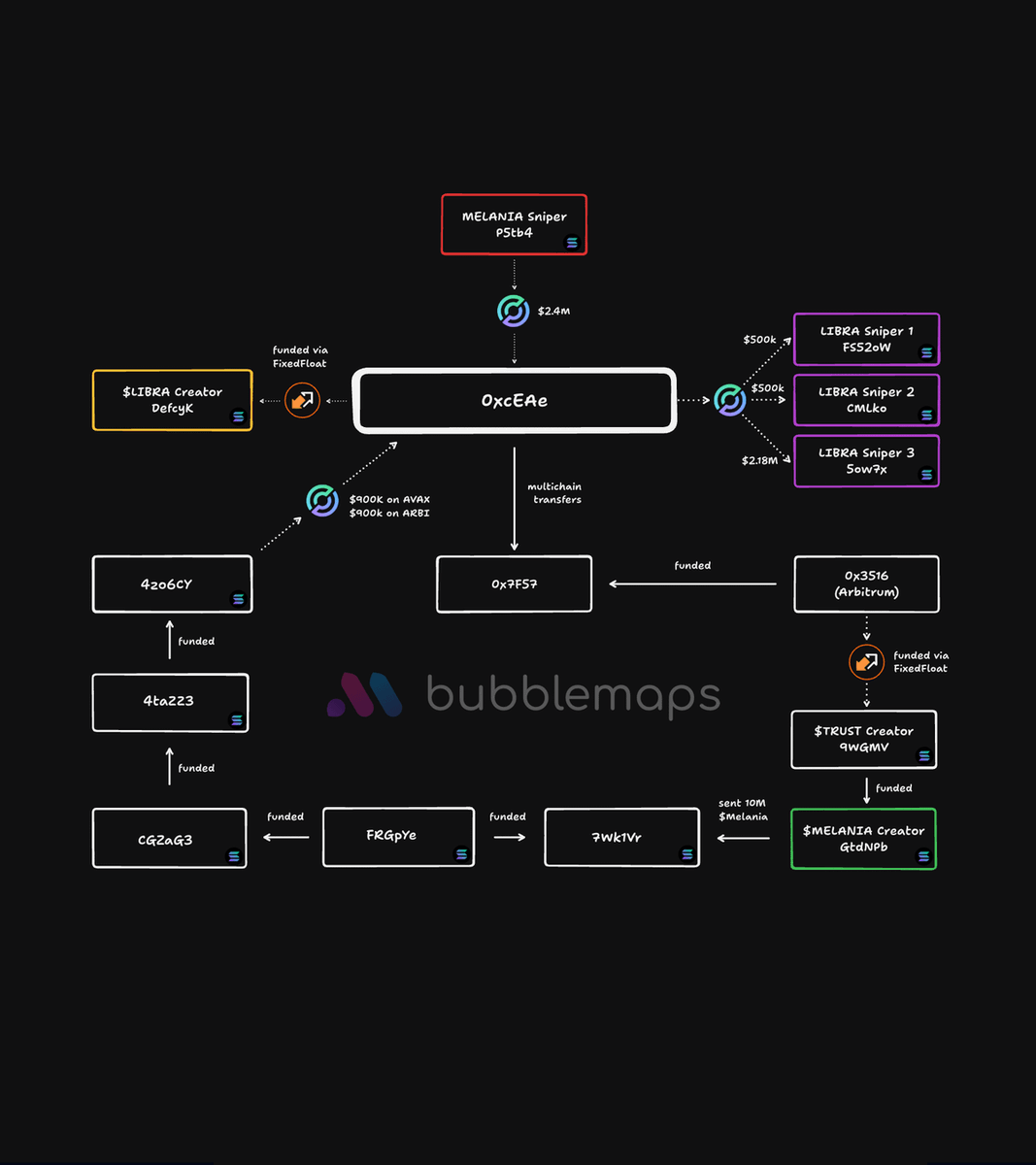 Kelsier Ventures CEO Hayden Davis admits to insider role in MELANIA coin, revealing LIBRA and MELANIA share the same team — backed by fresh onchain evidence.2025-02
 Great article from our friends at Rekt.Even by the standards of crypto's political meme coins, this weekend's LIBRA launch redefined what's possible in the art of the rug pull.2025-02
 Argentina’s opposition threatens President Milei with impeachment after promoting and retracting support for LIBRA token.2025-02
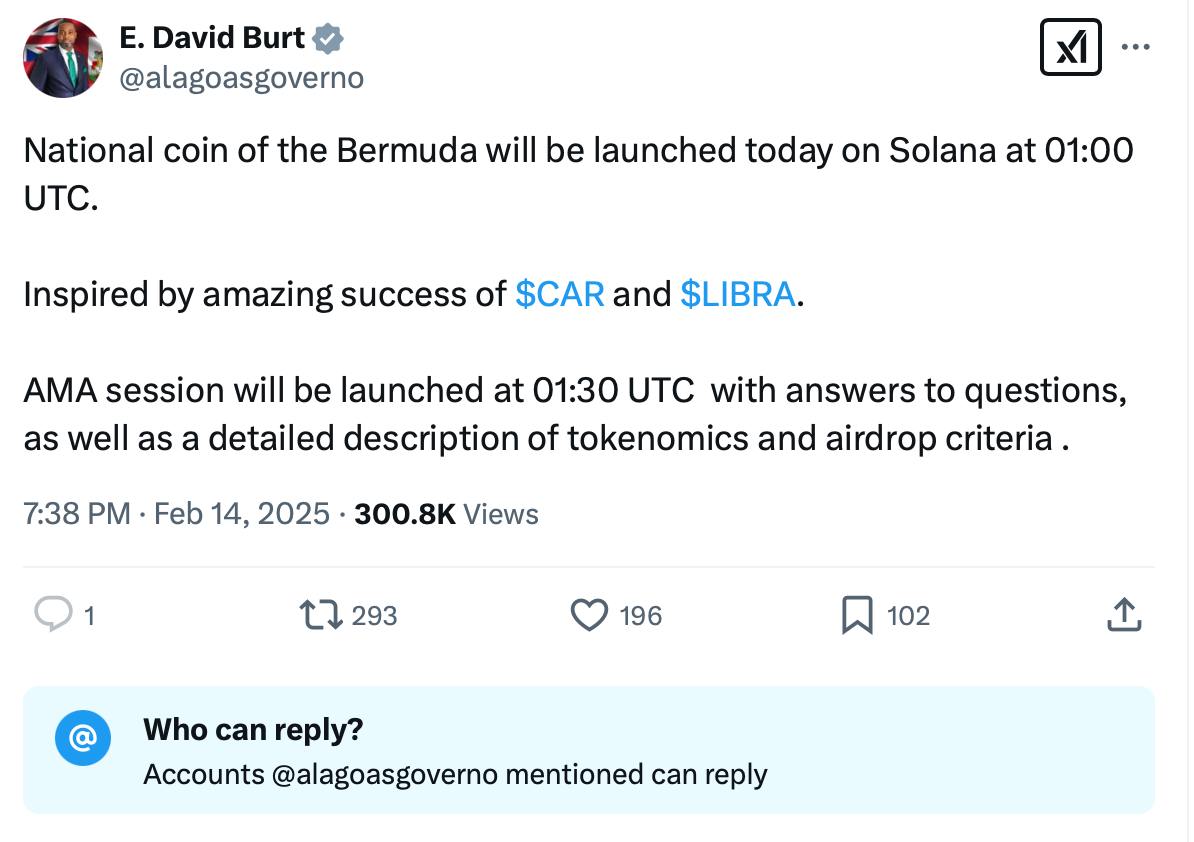 Seeing the criminal success of LIBRA and CAR, the Premier of Bermuda announced the launch of an official "National coin" at 14:00 UTC.
Replies turned off....2025-02
Seeing the criminal success of LIBRA and CAR, the Premier of Bermuda announced the launch of an official "National coin" at 14:00 UTC.
Replies turned off....2025-02
Few names in crypto carry as much baggage as “Libra”, a label shared by Facebook’s abandoned global stablecoin project and an Argentine political memecoin now synonymous with one of the most spectacular rug pulls in recent history. This explainer unpacks both stories, the technology and politics behind them, and what the Libra saga tells us about the future of memecoins, regulation, and power in crypto.
Understanding Libra: From Big Tech Stablecoin to Political Memecoin Scandal
The Many Faces of “Libra” in Crypto
The term Libra has migrated across very different corners of the crypto landscape. It first entered the conversation through Facebook’s 2019 proposal for a global digital currency backed by a basket of fiat reserves, a project that was eventually rebranded as Diem and then wound down after intense political and regulatory pushback. Years later, the same name reappeared in a very different context on Solana, this time attached to a high‑risk memecoin promoted by Argentina’s president Javier Milei and later denounced as a massive rug pull. The reuse of the brand has created persistent confusion for investors and the public, with “Libra” now standing as a cautionary label for two distinct but related debates about how money, platforms and politics intersect.
In the original Facebook context, Libra was framed as financial infrastructure: a consortium‑governed stablecoin that would sit atop a new payments network and provide low‑cost cross‑border transfers to billions of users. In the Argentine case, by contrast, $LIBRA was openly marketed as a memecoin, a speculative token whose value depended less on cash flows or utility than on viral attention, political symbolism and the online persona of a sitting head of state. Both projects, however, promised some form of democratization: one through cheaper payments and financial inclusion, the other through claims of fundraising for small businesses and a “government‑aligned” crypto wave in Argentina. In practice, both encountered skepticism about governance, transparency and the alignment of incentives between insiders and ordinary users.
The dual use of the name matters because it illustrates how branding, narrative and perceived legitimacy can drive crypto adoption or magnify harm. When Facebook chose “Libra,” it invoked both the astrological sign and the Latin word for scales, signaling balance and stability. The Solana memecoin inherited some of that rhetorical aura while inhabiting the opposite end of the risk spectrum, where smart‑contract launches, liquidity “sniping,” and rapid pump‑and‑dump cycles are the norm. For traders, regulators and even casual observers, understanding which Libra is in view—Big Tech stablecoin or Argentine meme token—is the first step in assessing risk and making sense of the headlines.
Terminology and Origins
Before crypto, “libra” was a unit of weight in ancient Rome and, linguistically, a root of the modern “pound”; it is also the name of a zodiac sign associated with scales and balance. Those connotations of equilibrium and fairness made it attractive branding for Facebook’s proposed global currency, which the company pitched as a neutral, rules‑based medium of exchange insulated from any single nation’s monetary policy. The Libra Association, later the Diem Association, was initially marketed as an independent consortium of major firms such as Visa, Uber and Vodafone, meant to reassure policymakers that Facebook would not control the network unilaterally. The project’s stablecoin design—backed by a basket of fiat currencies and short‑term government securities—was likewise chosen to emphasize predictability over speculation.
On Solana, the reuse of the name was less about stability and more about borrowing eyeballs. By the time the $LIBRA token launched in February 2025, the crypto market had already seen a surge in politically branded memecoins, including tokens tied to Donald and Melania Trump, which reached multibillion‑dollar market capitalizations despite having no intrinsic economic value. The Argentine version of Libra leaned into that trend, combining memes and nationalist rhetoric with the reputation of President Javier Milei, a libertarian economist who had campaigned on a platform of radical economic reform and pro‑crypto rhetoric. The choice of name invited an implicit comparison to Facebook’s global project while operating in the far looser, retail‑driven world of decentralized exchanges.
Why Libra Matters for Crypto
The Libra story matters less because of any single token and more because it exposes recurring fault lines in crypto’s evolution. Facebook’s Libra put questions of monetary sovereignty, Big Tech power and global stablecoins on the front pages of mainstream newspapers and in the hearing rooms of Congress and European parliaments. It forced regulators to think seriously about what happens when a platform with billions of users issues its own quasi‑currency, and it accelerated broader efforts to design legal regimes for stablecoins and digital assets. Even in its failure, it reshaped the regulatory conversation.
The Argentine $LIBRA memecoin, for its part, has become a reference point for the dangers of political memecoins and unregulated retail speculation. After Milei endorsed the token on X (formerly Twitter), its market value briefly surged above \(4.5\) billion dollars before collapsing by more than \(99\%\), with on‑chain analysts documenting large insider sales and liquidity withdrawals consistent with a classic rug pull. Academic work now cites LIBRA as a case study in how political tokens can be used to circumvent campaign finance rules, channel funds to insiders, and erode trust in both crypto markets and democratic institutions. Together, the two Libras trace the arc from corporate overreach to populist speculation, offering a compressed history of how crypto experiments collide with real‑world power.

Libra Case: Confidential agreement between President Milei and Hayden Adams revealed.

TL;DR A leaked January 2025 agreement shows Argentine President Javier Milei formally appointed Hayden Davis (Kelsier Ventures CEO) as a blockchain and AI advisor two weeks before the Libra token launch, contradicting earlier claims of no connection. Lawmakers say this proves Libra wasn’t an isolated project and could strengthen misconduct cases against Milei. Separately, Bitcoin broke key support near $78K, slid to around $75K, and triggered ~$347M in liquidations (mostly longs), with selling pressure confirmed by rising volume and weak bounce attempts.
Facebook’s Original Libra Stablecoin Vision
The first Libra project emerged from Facebook’s attempt to reinvent itself as a payments and fintech powerhouse. Announced in 2019, the initiative imagined a permissioned blockchain governed by a consortium of major corporations and nonprofits, with a native stablecoin designed to serve as a low‑friction medium of exchange across Facebook, WhatsApp and Instagram. By backing the coin with a diversified reserve of fiat currencies and short‑term debt, the project aimed to minimize volatility and provide a neutral “internet of money” that could, in theory, be used anywhere and by anyone with a smartphone. For billions of users in emerging markets, this was pitched as a path to cheaper remittances and access to digital payments without a traditional bank account.
At a technical level, Libra emphasized throughput and predictability over decentralization. The initial white paper described a permissioned system in which only authorized validators—primarily consortium members—could propose and confirm blocks, an architecture closer to a federated payment network than to open systems like Bitcoin or Ethereum. This design was intended to achieve high transaction speeds and regulatory comfort, but it also raised concerns that Libra would create a private monetary standard effectively controlled by a handful of multinational firms. Central bankers worried that, if widely adopted, such a coin could undermine domestic currencies, disrupt the transmission of monetary policy, and create new systemic risks in times of crisis.
From Libra to Diem: Regulatory Backlash and Retreat
The political reaction to Facebook’s Libra was swift and intense. Lawmakers in the United States and Europe held hearings in which they questioned whether a company facing antitrust investigations and data‑privacy scandals should be trusted with a new global currency system. Financial regulators raised red flags about money laundering, consumer protection, and the possibility that Libra could function like an unregulated money‑market fund, subject to runs and contagion. As a result, the project faced a barrage of policy demands, from strict licensing and capital requirements to expectations that it limit itself to a single‑currency stablecoin rather than a multi‑currency basket.
Under that pressure, Facebook and its partners rebranded Libra as Diem and scaled back their ambitions, emphasizing compliance and narrower use cases. Some early high‑profile partners left the consortium, reducing its perceived neutrality, and the initiative increasingly looked like a regulated dollar‑stablecoin project competing with emerging incumbents such as Circle and Coinbase’s USDC. At the same time, the broader stablecoin market matured: tokens like USDC became a routine part of corporate treasuries and crypto markets, and new proposals like Stripe’s Tempo payments network invoked Libra mainly as a historical reference point and regulatory cautionary tale. Eventually, the Diem Association sold its assets, and Facebook’s first foray into issuing money ended without a public launch.
This failure did not mean that the underlying ideas disappeared. Stablecoins backed by fiat reserves are now deeply embedded in crypto’s plumbing and in some cross‑border payment flows, but they are issued by specialized firms rather than social‑media giants. Policymakers, meanwhile, continue to debate the role of private stablecoins versus central bank digital currencies, often citing Libra as the project that crystallized their concerns. For crypto investors, the episode demonstrated that even well‑funded projects with household‑name sponsors can be derailed when they collide with regulatory red lines.
Lessons from Big Tech’s Libra
The Big Tech Libra experiment offered several lessons that echo in the later Argentine memecoin saga. First, scale and trust do not guarantee regulatory acceptance. Facebook’s reach made Libra systemically important from day one, triggering scrutiny that smaller issuers of stablecoins escaped for years. Second, governance structures—who controls the validators, how reserves are managed, how decisions are made—matter as much as code when regulators decide whether to tolerate a new form of money. Third, narrative and branding can cut both ways: invoking balance and inclusion helped Libra attract attention but also raised expectations that the project would meet higher standards than a typical crypto startup.
These lessons are relevant not only for stablecoin issuers but also for exchanges and publicly traded crypto companies such as Coinbase (ticker: COIN), which must navigate similar trade‑offs between innovation and regulatory risk. While Facebook’s Libra never launched, it succeeded in accelerating regulatory thinking and in popularizing the concept of corporate‑backed digital currencies, from fintech‑issued stablecoins to “national coins” being explored by jurisdictions like Bermuda. This legacy forms the backdrop against which the $LIBRA memecoin scandal unfolded: a world in which regulators are attuned to the systemic implications of digital money, but retail traders still chase high‑risk tokens launched with minimal oversight.
Readers ignored the rug-pull mechanics almost entirely — they clicked obsessively on the insider-access power structure: who had the deals before launch, who shared the same team across multiple political memecoins, and whether the president himself was bought.
The Argentine $LIBRA Memecoin: Anatomy of a Political Token
If Facebook’s Libra was about building a new payment rail, Argentina’s $LIBRA was about capturing attention. Launched on Solana and listed on decentralized exchanges in February 2025, LIBRA presented itself as a memecoin tied to President Javier Milei’s libertarian agenda and to a narrative of empowering small businesses through crypto. Within hours of launch, the token’s price exploded after Milei posted on X directing his followers to a site associated with the project, helping to propel LIBRA’s market capitalization past \(1\) billion dollars, then \(2\) billion, and eventually above \(4\) billion. For a brief window, it appeared to be one of the most successful political tokens ever created.
Behind the scenes, however, blockchain analytics firms were already sounding alarms. Bubblemaps, a firm that visualizes token ownership, reported that roughly \(82\%\) of the LIBRA supply was held in wallets controlled by insiders and was immediately sellable, a concentration pattern that strongly deviates from healthier distributions in more established projects. This structure is a classic ingredient for a rug pull: when insiders control a large fraction of supply and liquidity, they can dump tokens on the market once public demand peaks, crashing the price and extracting value from latecomers. In the case of LIBRA, these risk factors were compounded by the highly political branding, which led some retail buyers to assume, wrongly, that the token might enjoy special protections or implicit backing from the Argentine government.
Launch, Jupiter Exchange, and Early Trading
The technical launch of LIBRA took place on Solana, using automated market makers and decentralized exchanges rather than a centralized listing. Jupiter Exchange, a prominent Solana DEX aggregator, emerged as a key venue where traders discovered and swapped Libra during its first hours of trading. In later statements, Jupiter said that the upcoming launch of a politically themed token tied to Milei had been an “open secret” in memecoin circles for at least two weeks, based on conversations with Kelsier Ventures, one of the entities behind the project. However, the exchange insisted that it had no specific information about the exact launch timing or contract details and denied that its employees engaged in insider trading.
Despite those assurances, the combination of advance knowledge among certain market participants and a sudden, high‑profile endorsement from a sitting president created fertile ground for volatility. On‑chain data shows that some wallets accumulated sizeable LIBRA positions before Milei’s tweet and then sold aggressively into the post‑tweet rally, locking in large profits while late buyers chased the spike. The decentralized nature of Solana’s DEX ecosystem meant that there was no centralized order book or halt mechanism to temper this surge; instead, price discovery happened block by block, with automated pools adjusting ratios as liquidity was added and removed. For traders, this environment offered both opportunity and danger: those who moved early and exited quickly could make life‑changing sums; those who arrived later faced near‑total losses.
Milei’s Endorsement and Peak Valuation
Javier Milei’s role in catalyzing LIBRA’s ascent is central to understanding why this particular token became a national political scandal rather than just another failed memecoin. Late on a Friday night, the president published a post on X directing his followers to a site that framed the project as raising money for small Argentine businesses using crypto. Within minutes, trading volumes surged, liquidity pools deepened, and LIBRA’s market capitalization skyrocketed from tens of millions to more than \(4.5\) billion dollars at its peak. That kind of move is extraordinary even in the hyper‑volatile world of memecoins and underscored the power of political endorsements to move markets.
Yet the very speed of the rise raised questions about whether the market was responding purely to retail enthusiasm or whether insiders had structured the launch to profit from the predictable frenzy. Subsequent analysis by media outlets and blockchain sleuths documented patterns of large‑scale selling by wallets that had received tokens before the presidential tweet, behavior consistent with premeditated profit‑taking. When the dust settled, LIBRA’s value had fallen by more than \(99\%\) from its peak, leaving a market capitalization around \(18\) million dollars and enormous paper losses for late buyers. For many Argentines already grappling with inflation and economic uncertainty, the episode felt less like a speculative opportunity gone wrong and more like a betrayal by a leader who had campaigned on economic integrity.
- 01Insider flight and death threats↗
A named influencer fleeing the country over death threats made the scandal viscerally personal and dangerous, not just financial.
- 02Kelsier / Hayden Davis insider network↗
Onchain evidence linking LIBRA and MELANIA to the same team exposed a repeating insider playbook, not a one-off incident.
- 03Milei impeachment threat↗
A sitting president facing removal for a memecoin tweet gave the story stakes far beyond typical crypto fraud.
- 04Rug pull anatomy and scale↗
The clean $17M-in-24h recap and Rekt.news breakdown satisfied readers who wanted the mechanics after the political headlines broke.
- 05Copycat national coin contagion↗
Bermuda's announcement within days of LIBRA signaled to readers that state-backed memecoins were becoming a replicable corruption template.
- 06Legal and regulatory aftermath↗
Interpol red notice requests, Circle's USDC freeze, and a judge releasing bank records kept readers returning to track accountability over months.
From Moonshot to Meltdown: How the $LIBRA Rug Pull Unfolded
The LIBRA debacle is frequently described as a textbook rug pull, a term that has entered mainstream crypto vocabulary over the past several years. In decentralized finance (DeFi), a rug pull typically refers to a situation where token creators or major holders abruptly withdraw liquidity or dump their holdings after attracting outside capital, causing the price to collapse and leaving other investors with little or no recourse. Rug pulls can be purely technical—such as contracts with hidden functions that allow the creator to drain funds—or primarily market‑based, relying on concentrated token holdings and aggressive selling rather than direct theft. LIBRA appears to fit the latter model, with insiders using their control over a large pool of tokens and liquidity to extract value as hype peaked.
Academic research highlights how common such schemes have become. A study on rug pulls in decentralized exchanges cites data from Chainalysis indicating that fraudulent schemes, hacks and exploits caused crypto users to lose around \(4.2\) billion dollars in 2022 alone, with rug pulls constituting a significant share of that total. Memecoins, which are often launched quickly with minimal disclosures and aimed at retail traders, are a particularly fertile environment for such behavior. LIBRA’s combination of political branding, concentrated insider ownership and rapid liquidity cycling made it a near‑perfect case study, amplified by the fact that the token’s face was not an anonymous developer but a sitting head of state.
On‑Chain Evidence of Insider Profits
Investigative reporting and blockchain analysis have shed light on how insiders allegedly profited from LIBRA’s brief ascent. A detailed report by Rekt News described how eight insider wallets worked in apparent coordination, adding and removing liquidity from Solana pools and claiming fees in a pattern that extracted around \(57.6\) million USDC and \(249{,}671\) SOL within a short window after launch. These wallets benefited from both price appreciation and the mechanics of automated market makers: by providing and then withdrawing large amounts of liquidity, they could capture a disproportionate share of trading fees and exit their positions before markets fully adjusted. The concentration of supply—roughly \(82\%\) in insider hands—meant that these actors had enormous leverage over price dynamics.
Additional analysis from CoinMarketCap’s Academy and other data providers corroborated the broad outlines of this picture. They documented how wallets linked to insiders received large allocations of LIBRA before the token became widely tradable, then sold a significant portion of their holdings within hours of Milei’s tweet. Such behavior does not, on its own, prove criminal intent, but it strongly suggests advance planning and an asymmetric information environment in which insiders knew more about the token’s prospects and political backing than ordinary traders. When combined with later evidence of draft compensation agreements and private communications between political figures and project promoters, the on‑chain data reinforced perceptions that LIBRA had been structured from the outset to enrich a small circle at the expense of the broader public.
Circle’s USDC Freeze and Asset Tracing
One of the more remarkable aspects of the LIBRA case is how quickly traditional legal tools intersected with on‑chain enforcement mechanisms. In response to a court order issued by Argentine judge Sandra Arroyo Salgado at the request of victim‑investor Martín Romeo, Circle—the issuer of the USDC stablecoin—froze around \(57\) million USDC held in two Solana wallets tagged as “Libra” and “Libra Deployer,” which contained approximately \(44\) million and \(13\) million USDC respectively. In total, Circle has blacklisted more than \(98.3\) million USDC across 292 wallet addresses, according to data compiled on Dune Analytics, though not all of that amount is specific to LIBRA. By adding these addresses to a blacklist, Circle ensured that the tokens held there could not be transferred or redeemed, effectively immobilizing a significant portion of the suspected proceeds.
This intervention illustrates the hybrid nature of modern crypto markets, where ostensibly decentralized activity depends on centralized issuers and service providers. While SOL and other native assets remain beyond the direct control of any single company, dollar‑denominated stablecoins like USDC can be frozen at the smart‑contract level by the issuer, enabling a kind of programmable legal compliance. For LIBRA victims, this offered some hope that funds might eventually be recovered or used to compensate those harmed, depending on how courts resolve questions of ownership and liability. For privacy advocates and DeFi purists, it highlighted the degree to which stablecoin‑based trading is subject to off‑chain legal authority, even when conducted on non‑custodial platforms.
Comparing LIBRA to Other Political Memecoins
The LIBRA scandal did not occur in isolation; it emerged in the midst of a broader boom in political memecoins. Tokens like $TRUMP and $MELANIA, launched around the inauguration of Donald Trump as U.S. president, quickly attracted billions of dollars in speculative capital, despite their issuers openly describing them as purely expressive “digital collectibles.” As of one point shortly after launch, the Trump meme coin had a market capitalization of approximately \(8.3\) billion dollars, while Melania Trump’s coin was valued around \(1.2\) billion, even though both websites emphasized that the tokens were not intended as investment opportunities or securities. Prices for these coins swung wildly, with Trump’s token gaining more than \(400\%\) from its initial price before retracing around \(45\%\), and Melania’s coin dropping more than \(20\%\) on one trading day.
Hayden Davis, the U.S. entrepreneur at the center of the LIBRA scandal, has claimed involvement in both LIBRA and Melania’s coin, and on‑chain evidence suggests that the same team or affiliated entities were active in trading around both launches. In an interview about these projects, Davis described memecoin markets in blunt terms, arguing that insiders by definition move earlier and structure deals to their advantage. Academic analysis of political memecoins notes that such tokens blur the line between fandom and finance, creating new avenues for political fundraising, influence operations and potential foreign interference. LIBRA stands out in this ecosystem because of the scale of the losses, the direct involvement of a sitting president, and the subsequent criminal investigations into alleged fraud and bribery.
A wallet funded with $20k. A tweet from Milei. $17M created out of thin air. The $LIBRA rug pull is now complete. A full and easy recap of the last 24h.
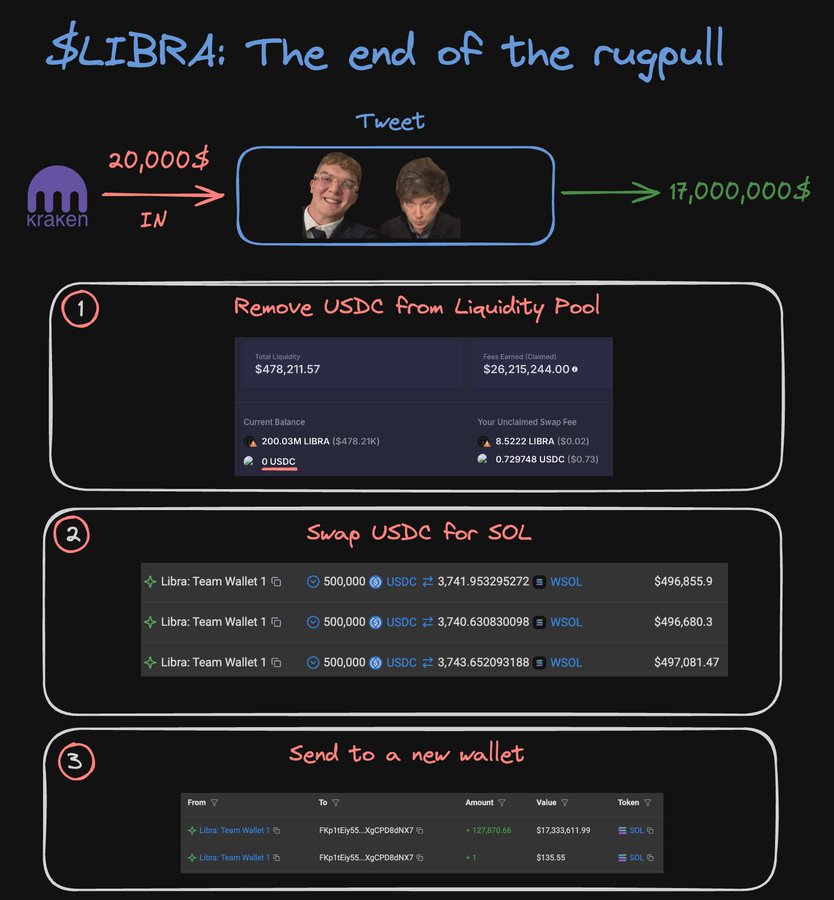

"4) Conclusion What I find extremely interesting about this scam are two aspects: 1. The complete lack of consequences for all the actors involved: they literally walk away with 17M (only considering this wallet) with no consequences 2. We can estimate the economic value of a tweet from Javier Milei at ~17M. I hope he got paid a similar amount, otherwise he got scammed by Hayden."
The Milei Connection: Politics, Phone Logs, and a $5 Million Draft Deal
What elevates LIBRA from a large memecoin scam to a constitutional issue in Argentina is the alleged involvement of President Javier Milei and his inner circle. Following the token’s collapse, Argentina’s opposition parties accused the president of abusing his office by promoting a speculative asset from which insiders—and possibly Milei himself—stood to benefit financially. Some lawmakers went so far as to threaten impeachment, arguing that the president had misled citizens and tarnished the country’s international reputation by associating with a pump‑and‑dump scheme. International media began framing the incident as a stark test of Argentina’s institutional resilience and the ethical boundaries of political engagement with crypto.
Milei initially responded by deleting his LIBRA post and requesting that Argentina’s Anti‑Corruption Office investigate whether any government officials, including himself, had engaged in wrongdoing. His office maintained that he had no direct involvement in the token’s development and that he had been introduced to the project by KIP Protocol, a technology group. However, as more information came to light about private communications and draft agreements involving the president, public confidence in that narrative eroded. The question shifted from whether Milei had merely been naïve in amplifying a risky memecoin to whether he or his associates had established a financial relationship with LIBRA’s promoters before the tweet went out.
Phone Records, Draft Agreements, and Alleged Compensation
A key turning point in the public understanding of the LIBRA affair came from forensic analysis of a mobile phone belonging to Mauricio Novelli, an Argentine crypto entrepreneur and lobbyist linked to the token’s launch. According to reporting by Buenos Aires Times, investigators reconstructed a timeline of calls and text messages showing that Milei exchanged at least five phone calls and several messages with Novelli in the minutes leading up to his LIBRA post on X. The records also indicate that more than twenty calls and messages took place between Novelli, the president and Milei’s sister, presidential chief‑of‑staff Karina Milei, in the hours immediately following the launch, a pattern that appeared inconsistent with claims that the president had only casual awareness of the project.
More explosive still was the discovery of a draft agreement stored in the Notes app on Novelli’s iPhone, written in English and believed to have been created on February 11, 2025—three days before the LIBRA endorsement. The document outlined a proposed deal totaling \(5\) million U.S. dollars in tokens or cash, structured as three payments: \(1.5\) million as an upfront payment, \(1.5\) million contingent on Milei announcing a relationship with U.S. businessman Hayden Davis as an adviser, and a final \(2\) million tied to a contract for blockchain and AI advisory services allegedly to be signed in person by Milei. The note began, “Hi guys. This is the final agreement as discussed with H,” a phrasing investigators believe refers to Hayden Davis, and described Davis as one of the promoters of the crypto project who had met the president prior to the token’s launch.
In addition to this English‑language draft, investigators reportedly found a Spanish‑language note that appeared to be a draft public statement intended to manage the fallout from the scandal. The text suggested that the author wanted the president to emphasize his support for Libra’s vision while insisting that he had no financial interest in the project and was not well versed in memecoins, and to frame criticism as politically motivated attacks from opponents. The existence of such a draft reinforced suspicions that LIBRA’s backers were actively shaping not only the token’s market strategy but also the president’s public messaging, blurring the line between political communication and private business deals.
Separately, additional reporting has highlighted a confidential agreement allegedly signed in January 2025 between Milei and Hayden Davis, in which Davis was appointed as a blockchain and AI adviser to the Argentine president. According to sources cited in that coverage, the agreement was reached roughly two weeks before the Libra launch, suggesting that a formal advisory relationship may have existed before the public learned of Davis’s role. While the legal status and precise terms of this agreement remain contested, its existence, taken together with the Novelli notes and phone logs, has fueled concerns that the president’s endorsement of LIBRA was not simply an informal gesture but part of a broader financial arrangement with the token’s promoters.
Investigations, Task Forces, and Institutional Response
In the wake of the LIBRA collapse, Argentine authorities initiated multiple investigations into the token, its promoters and the possible involvement of public officials. A federal judge opened a criminal probe just days after the launch, focusing on potential offenses including fraud, bribery and abuse of power. The case expanded to include not only President Milei but also Hayden Davis, Mauricio Novelli and other figures linked to the creation and marketing of LIBRA, with prosecutors examining bank records, blockchain data and communications retrieved from seized devices. Civil suits by aggrieved investors added further layers of legal complexity, as courts were asked to determine whether the token’s organizers had misrepresented its nature or misused investor funds.
To coordinate these efforts, the Argentine government created an Investigative Task Force (Unidad de Tareas de Investigación, UTI) specifically tasked with uncovering irregularities related to the Libra scandal and clarifying the roles of Milei and his sister Karina. However, in a move that critics described as politically motivated, the government dismantled the UTI just three months later, via a decree signed by Milei and Justice Minister Mariano Cúneo Libarona. The official rationale for the shutdown emphasized efficiency and the consolidation of investigative functions, but opposition lawmakers argued that it undermined the independence of the probe and signaled an attempt to contain political damage. The dissolution of the UTI has itself become a subject of legal and political debate, with some calling for its reinstatement or for an independent commission to take over its work.
At the same time, Argentine lawyer Gregorio Dalbón moved to internationalize the case by asking a judge to request an Interpol “Red Notice” for the arrest of Hayden Davis. In court filings, Dalbón described Davis as one of the principal actors behind the LIBRA launch and argued that his role in the alleged rug pull and in another token tied to Melania Trump justified urgent detention. While Interpol notices are not arrest warrants per se, they signal that a member state is seeking the location and provisional arrest of a person pending extradition, adding diplomatic and political stakes to the case. The fact that Davis is a U.S. citizen with claimed ties to multiple political tokens has further complicated the cross‑border dimensions of law enforcement.
Legal Risks for Key Players
The potential legal exposure for the main actors in the LIBRA saga spans both criminal and civil domains. For Milei, the most severe threat is impeachment and removal from office, a process that would require a political judgment about whether his conduct in promoting LIBRA and dealing with its promoters amounts to “serious misconduct” or a violation of constitutional duties. Even if impeachment does not materialize, he faces ongoing criminal and civil investigations that could result in charges of fraud, bribery or abuse of power, depending on what prosecutors can prove about the existence and execution of any compensation agreements. The presence of draft contracts and phone records is politically damaging, but criminal liability will ultimately hinge on whether funds were actually transferred, whether disclosures were made, and how the president’s actions are interpreted under Argentine law.
For Hayden Davis, the legal risks are more straightforwardly financial and criminal. Prosecutors accuse him of being one of the principal architects of the LIBRA token and of orchestrating or benefiting from insider trading and market manipulation around its launch. His admitted involvement in both LIBRA and the Melania Trump memecoin, along with reports linking him to aggressive trading tactics such as “sniping” his own token’s initial liquidity, strengthen the narrative that he was not a passive adviser but an active strategist. If an Interpol Red Notice is issued and Davis is detained, courts will have to weigh the evidence of his involvement against defenses that memecoin markets are inherently speculative and that participants were adequately warned of the risks.
Mauricio Novelli faces his own exposure as an alleged intermediary between LIBRA’s promoters and the president’s inner circle. Court documents describe him as a central link connecting Davis, Kelsier‑affiliated entities and the presidential office, and his phone has become a crucial evidentiary trove for investigators. Depending on how the notes and communications are interpreted, he could be implicated in conspiracy, bribery or fraud, particularly if prosecutors argue that he played a role in structuring or negotiating the proposed \(5\) million dollar arrangement. Beyond these individuals, the case may also draw in influencers, market makers and other intermediaries who helped promote or trade LIBRA, raising broader questions about how far liability can extend along the memecoin value chain.
Milei tweets LIBRA; token launches on Solana
Milei deletes tweet, disavows project within hours
$17M extracted by insider wallets; rug pull complete within 24h
Argentina opposition files impeachment threat against Milei
Hayden Davis admits insider role in Coffeezilla interview
Argentine prosecutor requests Interpol red notice for Hayden Davis
Circle freezes USDC on Solana linked to LIBRA proceeds
Milei shuts down Argentine unit investigating LIBRA scandal
LIBRA and the Politics of Memecoins
The LIBRA affair has catalyzed a broader discussion about political memecoins—tokens explicitly tied to politicians, parties or ideological movements. Scholars analyzing this phenomenon argue that such coins represent a fusion of speculative finance and political branding, in which tokens act simultaneously as community badges, fundraising tools and vehicles for market manipulation. Unlike traditional campaign donations, memecoin purchases can be made pseudonymously from anywhere in the world, complicating efforts to enforce contribution limits or prevent foreign interference. At the same time, the volatile nature of these assets means that supporters who buy in as an expression of loyalty may end up losing money, with little clarity about where their funds ultimately flow.
In this environment, LIBRA stands as an extreme example of how political memecoins can be abused. The token’s branding leveraged the persona of a sitting president and the rhetoric of national economic revival, while its technical design favored insiders and facilitated rapid value extraction. When the project collapsed, it did more than burn speculative traders; it damaged trust in both crypto and politics, feeding narratives that crypto is a playground for elites and that political leaders may see their followers as liquidity rather than citizens. The scandal has also prompted calls within Argentina and beyond for clearer rules governing how public officials engage with crypto projects, including transparency requirements for any financial relationships or endorsements.
What Makes a Memecoin “Political”?
Not every token that references a politician is necessarily a political memecoin in the full sense. Researchers suggest that political memecoins typically share several features: explicit branding around a political figure or symbol; promotion channels that overlap with political communication (such as campaign‑adjacent social media); and narratives that tie token ownership to ideological alignment or support for a cause. In the case of TRUMP and MELANIA, the coins were launched around Donald Trump’s inauguration, featured his and his wife’s names and images prominently, and were marketed as ways for supporters to express enthusiasm. Official websites described the tokens as “not intended” to be investment contracts, framing them as digital collectibles rather than financial products.
LIBRA fit this template but went further by involving a sitting president of a country facing acute economic stress, with messaging that touched on national development and aid to small businesses. Milei’s tweet lent the project an aura of quasi‑official status, even though no formal government decree or law backed the token, and his previously cultivated image as a pro‑crypto reformer made it plausible to many that he might support an experimental fundraising mechanism. This blurred the line between personal endorsement and state involvement, making it harder for ordinary investors to distinguish between a speculative meme token and a policy initiative. The fact that LIBRA’s backers reportedly considered drafting statements to deny financial interest while affirming ideological support underscores how carefully this line was being managed.
Campaign Finance, Influence, and Loopholes
From a governance perspective, political memecoins expose gaps in traditional campaign finance and anti‑corruption frameworks. In many jurisdictions, including Argentina and the United States, campaign contributions are subject to strict disclosure rules, caps and prohibitions on foreign funding. However, when money flows through token purchases rather than direct donations, and when issuers position the tokens as collectibles or memetic expressions rather than investments, it becomes harder to fit these flows into existing legal categories. Tokens can appreciate or depreciate dramatically, making it difficult to assess the “value” of support, and secondary market trading can obfuscate original sources of funds.
Academic work on LIBRA and similar projects warns that political memecoins can be used to launder influence, enabling wealthy individuals or foreign actors to provide financial support without triggering the same reporting obligations as traditional donations. They can also serve as tools for market manipulation tied to political events, such as debates, elections or policy announcements, creating incentives to shape public discourse in ways that benefit token prices rather than democratic deliberation. The LIBRA scandal, with its alleged \(5\) million dollar side deals and insider trading, demonstrates how quickly such structures can morph from symbolic support into quasi‑investment schemes with significant corruption risks.
Public Perception and Media Framing
The way LIBRA has been covered in media and discussed on social platforms has shaped public understanding of both the token and the broader memecoin phenomenon. Outlets like CoinMarketCap’s Academy and Rekt News have described LIBRA as a “redefined” rug pull whose speed and scale surpassed even earlier political tokens, emphasizing the insider‑heavy supply distribution and coordinated liquidity maneuvers. International publications have framed the scandal as a test of Argentina’s institutions and an example of how blockchain forensics can illuminate financial misconduct at the highest levels. Within Argentina, coverage has often highlighted the contrast between the president’s libertarian, anti‑corruption rhetoric and the perception that LIBRA enriched a small circle at the expense of ordinary citizens.
For the crypto industry, LIBRA has become a reference point in debates about reputational risk. Commentators have noted that the memecoin craze, amplified by projects like LIBRA and CAR, has led to billions of dollars in losses and damaged the sector’s image, prompting calls for exchanges and influencers to adopt higher due‑diligence standards before promoting politically charged tokens. Stablecoin issuers like Circle, by freezing funds associated with LIBRA, have sought to position themselves as responsible actors cooperating with law enforcement, contrasting their behavior with the opaque practices of memecoin creators. The cumulative effect is a more polarized perception of crypto: on one hand, as a tool for real‑time transparency and accountability; on the other, as a vehicle for sophisticated yet socially corrosive frauds.
A small insider group at Kelsier Ventures controlled liquidity and launch allocation across both LIBRA and MELANIA, enabling coordinated extraction invisible to public buyers.
The scandal triggered impeachment proceedings against a sitting president, an Interpol red-notice request, and a Circle USDC freeze — spanning three jurisdictions simultaneously.
Approximately $17M was extracted within 24 hours of launch via insider wallet offloads before most retail buyers could exit.
Peak market cap reached roughly $4 billion before collapsing; Jupiter Exchange noted the launch was an open secret in memecoin circles weeks before public promotion.
No contract exploit occurred; the fraud was entirely social and economic — a celebrity endorsement driving retail into pre-allocated insider supply.
Milei subsequently shut down the Argentine government unit investigating the scandal, raising concerns about executive interference in fraud oversight.
Technology, Trading Venues, and On‑Chain Forensics
Behind the headlines, the LIBRA story is also a tale about infrastructure—about how blockchains like Solana, DEX aggregators like Jupiter, and stablecoins like USDC create both new opportunities and new forms of risk. Solana’s high throughput and low fees have made it a favored chain for memecoin trading, enabling rapid‑fire speculation that would be prohibitively expensive on more congested networks. Jupiter and similar routing protocols aggregate liquidity across multiple decentralized exchanges, helping traders find the best price for a given swap but also concentrating early discovery of new tokens in a handful of interfaces. This combination has given rise to a specialized ecosystem of “launch snipers” and liquidity providers who aim to exploit the microstructure of memecoin markets.
LIBRA’s launch on Solana followed a pattern now familiar to seasoned traders. A liquidity pool was created with an initial allocation of tokens and a base asset, such as SOL or USDC, and set live on a DEX; bots and human speculators monitored new pools and contract deployments, seeking to buy as early as possible. When Milei’s tweet went out, demand surged, and the automated pricing formulas used by constant‑product market makers drove up LIBRA’s price as buyers pushed the token side of the pool higher relative to the base asset. Insiders who had seeded the pool or held large balances could then add or remove liquidity, adjusting their exposure and capturing fees, while also selling tokens directly into the rising market.
How Investigators Reconstruct a Rug Pull
One of the striking aspects of the LIBRA case is the level of detail available to both amateur and professional investigators. Every transaction on Solana is recorded on a public ledger, allowing analysts to trace the flow of LIBRA, SOL and USDC across wallets over time. Tools like Bubblemaps and Dune Analytics visualize these relationships, highlighting clusters of addresses that interact heavily with each other or exhibit similar trading behavior. In LIBRA’s case, this kind of analysis exposed the concentration of supply and the synchronized liquidity moves by eight insider wallets, information that would have been difficult or impossible to obtain in traditional markets.
Academic research on detecting rug pulls uses statistical methods to flag tokens with suspicious features, such as extreme concentration of ownership, rapidly decreasing developer balances, or sudden and sustained liquidity withdrawals. These models often draw on large datasets of historical token launches and collapses to identify patterns that distinguish legitimate projects from scams. Applying such techniques to LIBRA, researchers and journalists were able to show that its characteristics—particularly the \(82\%\) insider‑controlled supply and rapid post‑launch liquidity extraction—placed it firmly in the high‑risk category even before considering the political overlay. Combined with phone logs, draft agreements and public statements, on‑chain forensics thus provided a crucial independent check on competing narratives about what had happened.
Role of Stablecoin Issuers and Exchanges
The LIBRA saga highlights the complex responsibilities of intermediaries in an ostensibly decentralized environment. Stablecoin issuers like Circle occupy a unique position: they are centralized entities that provide assets essential to DeFi, and they can enforce legal rulings by freezing funds at the protocol level. In LIBRA’s case, Circle’s decision to blacklist wallets associated with the project demonstrates how such issuers can act as choke points for law enforcement, but it also raises questions about due process and the criteria used to decide when to intervene. For users, the episode is a reminder that holding USDC on a self‑custodial wallet does not make it immune to sanctions or court orders if an address is linked to illicit activity.
Exchanges and DEX aggregators face their own trade‑offs. Jupiter, which routed a significant share of LIBRA trades, has argued that it neither created the token nor controlled its design, and that its team had no specific inside information about the timing or parameters of the launch. Yet the fact that the exchange knew weeks in advance that a politically linked token was coming, and that memecoin insiders viewed it as an “open secret,” has led some observers to question whether higher disclosure standards or listing policies should apply to such projects. For centralized exchanges, the LIBRA affair reinforces the rationale for strict listing reviews, legal vetting and, in some cases, outright bans on explicitly political coins. For DeFi protocols, which prize permissionless access, the challenge is to balance openness with mechanisms that help users assess risk.
Stripe's Tempo and the ghost of Facebook’s Libra’s past.
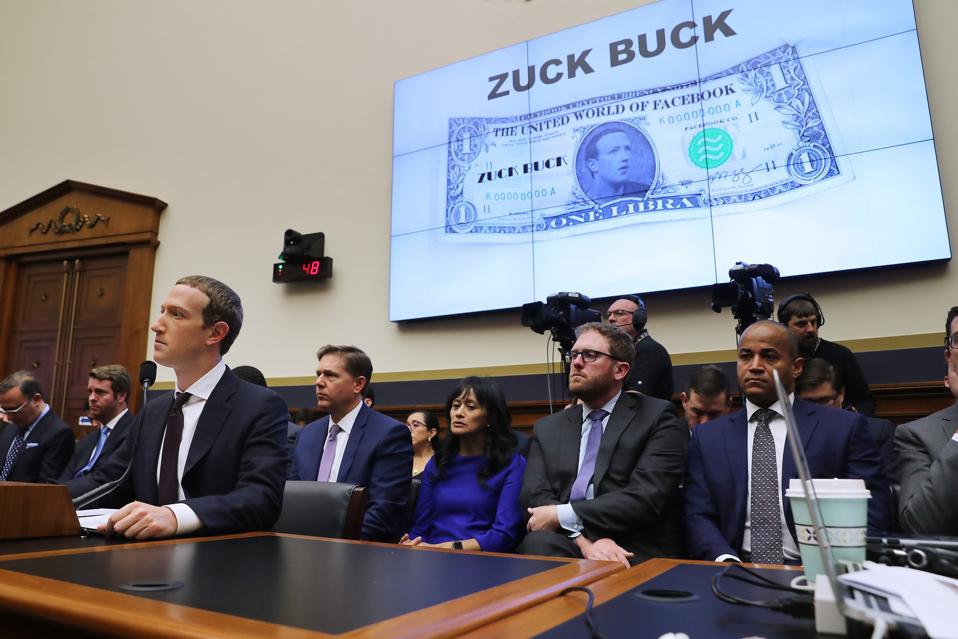
Regulating Libra‑Style Projects: From Meta to Milei
Taken together, the two Libras—Facebook’s stablecoin and Argentina’s memecoin—bookend a period of intense regulatory learning. The first forced governments to consider the systemic implications of a global corporate stablecoin; the second has prompted debates about how to treat political tokens and the financial activities of public officials. Both have left their mark on policy discussions about stablecoins, securities law, anti‑corruption rules and the boundaries between public and private power in digital finance.
One way to clarify the regulatory stakes is to compare the core features of the two projects.
| Feature | Facebook’s Libra (Diem) | Argentina’s $LIBRA Memecoin |
|---|---|---|
| Primary goal | Global payment system and stablecoin for everyday transactions | High‑risk political memecoin tied to Milei’s brand |
| Backing | Basket of fiat currencies and government debt | No asset backing; purely speculative token |
| Governance | Consortium of corporations and nonprofits | Small group of private promoters and insiders |
| Chain / Tech | Permissioned blockchain | Solana, decentralized exchanges (Jupiter etc.) |
| Regulatory posture | Sought licenses, engaged regulators | Launched without clear regulatory framework |
| Political linkage | Indirect (concerns about Big Tech power) | Direct endorsement by sitting president |
| Outcome | Rebranded, then shut down before public launch | Massive rug pull, ongoing criminal probes |
Facebook’s Libra raised concerns about global monetary stability and competition with central bank money, leading to extensive hearings and regulatory demands that ultimately forced it to scale back and then wind down. Argentina’s LIBRA, by contrast, has led to targeted criminal and civil investigations focused on fraud, corruption and investor protection. In both cases, the projects’ high‑profile sponsors made them early targets for scrutiny, illustrating that regulatory risk increases with visibility.
National Policy Reactions: Argentina, the U.S., and Bermuda
Argentina’s response to LIBRA has been fragmented, reflecting both the novelty of the issues and the political sensitivity of investigating a sitting president. The creation and subsequent dismantling of the UTI task force signaled a willingness to treat the scandal as a distinct policy problem, but the abrupt shutdown raised doubts about the government’s commitment to a thorough and independent inquiry. Opposition politicians have called for stronger rules governing officials’ involvement in crypto projects, including disclosure of any token holdings or advisory relationships and restrictions on promoting high‑risk assets to the public. Whether such reforms materialize will depend on how the ongoing investigations unfold and how the electorate responds to the scandal.
In the United States and Europe, the Libra episode is remembered primarily through the lens of Facebook’s abandoned stablecoin. Policymakers often cite that project when explaining why they support stricter regulation of stablecoins or central bank digital currencies, emphasizing the risks of allowing private companies to issue large‑scale quasi‑currencies without robust oversight. Meta’s more recent, lower‑key exploration of stablecoin products—in partnership with payment firms like Stripe—has been met with relative indifference compared to the earlier firestorm, in part because stablecoins like USDC are now well established and because regulators have clearer frameworks. The “ghost of Libra,” as one analysis put it, lingers in the background as a reminder of the limits of corporate monetary experiments.
Smaller jurisdictions, meanwhile, are exploring more controlled approaches. Bermuda, for example, has positioned itself as a digital asset hub by licensing one‑to‑one U.S. dollar‑backed digital currencies through its monetary authority and hosting forums on stablecoins, blockchain identity and related technologies. In such environments, the failure of projects like Libra—whether corporate or political—is interpreted less as a reason to avoid digital currencies altogether and more as evidence that careful, prudential regulation is needed. Some political leaders have even floated the idea of official “national coins,” with explicit legal frameworks and backing, as a safer alternative to unofficial political memecoins that can be launched overnight without oversight.
Implications for Investors, Builders, and Public Officials
For investors, the main lesson of Libra‑style projects is that branding, especially political branding, is not a substitute for due diligence. Whether the sponsor is a social‑media giant or a charismatic president, the underlying questions remain the same: How is the token structured? Who holds the supply? What rights or claims, if any, do holders have? And what recourse exists if things go wrong? The fact that LIBRA could move from launch to \(4.5\) billion dollars in market cap to a \(99\%\) drawdown within days underscores the risks of chasing narrative‑driven pumps, especially in thinly regulated corners of DeFi.
For builders and entrepreneurs, Libra’s dual history is a warning about the importance of governance, transparency and regulatory engagement. Facebook’s experience shows that large‑scale projects touching on payments and money are political from day one and must be designed with regulatory expectations in mind. The LIBRA memecoin demonstrates that attempting to leverage political capital without robust structure and disclosure can lead not only to reputational damage but also to criminal investigations and asset freezes. Those contemplating new political or community‑branded tokens must weigh the short‑term marketing benefits against long‑term legal and ethical risks.
For public officials, the scandal has sharpened debates about ethical boundaries in the digital age. Traditional rules governing conflicts of interest, outside income and endorsements did not anticipate a world in which a single tweet about a token could create or destroy billions of dollars in market value. LIBRA has prompted questions about whether politicians should be barred from promoting crypto assets in which they or their associates hold stakes, or whether they should be required to disclose any such positions in real time, much as some jurisdictions require disclosures of stock trades. As more politicians globally flirt with crypto narratives—whether through supportive tweets, NFT drops or memecoins—the need for clear guidelines will only grow.
How to Assess Any Future “Libra” You Encounter
Given the name’s checkered history, any future project calling itself Libra—or invoking similar imagery of balance and justice—deserves particular scrutiny. From an investor’s standpoint, the first task is to distinguish whether a token is intended as a stablecoin, a governance asset, a utility token or a pure memecoin. Stablecoins like the original Facebook Libra or regulated dollar‑pegged tokens aim to maintain price stability through reserves and are typically issued under some regulatory regime. Memecoins like Argentina’s $LIBRA, by contrast, are explicitly speculative, with prices driven by sentiment and social media rather than fundamentals.
Checking Token Design and Ownership
The LIBRA rug pull illustrates how critical tokenomics are to risk assessment. A token where \(80\%\) or more of the supply is controlled by a small cluster of wallets, especially if those wallets are newly created or tightly interconnected, poses obvious dangers. Concentrated ownership gives insiders enormous influence over price and liquidity and makes it easier to orchestrate coordinated selling or liquidity withdrawal. Similarly, contracts that allow developers to pause trading, change fees unilaterally or mint new tokens at will introduce additional centralization risks that can be exploited in bad faith. While not every project with such features is malicious, their presence should trigger heightened caution.
Tools available to retail traders have improved significantly, and LIBRA has helped popularize their use. Platforms like Bubblemaps and block explorers on Solana and other chains make it possible to see, within minutes of a launch, how token supply is distributed and how early holders behave. Academic work on rug‑pull detection provides additional heuristic indicators, such as sudden drops in developer balances or sharp declines in liquidity without corresponding news. Applying these tools before entering a position—rather than after a crash—can dramatically improve a trader’s ability to avoid the most obvious traps.
Evaluating Narratives, “Advisers,” and Political Branding
Narrative is a powerful driver of memecoin valuations, especially when tied to political figures or cultural icons. LIBRA shows how quickly a compelling story—supporting small businesses, aligning with a reformist president, riding a wave of national pride—can attract capital even in the absence of clear disclosures or governance structures. For risk‑aware participants, this means treating political branding as a red flag rather than a comfort. Questions worth asking include whether the politician or public figure has any formal contractual relationship with the token’s promoters; whether they receive compensation, directly or indirectly; and whether they or their staff stand to benefit financially from price movements.
The presence of “advisers” with high social capital but limited technical or financial expertise is another warning sign. In LIBRA’s case, the alleged appointment of Hayden Davis as a blockchain and AI adviser to Milei, combined with his central role in token launches and insider trading strategies, created a potentially toxic mix of influence and asymmetry. Investors should be skeptical of advisory labels that are not accompanied by transparent terms and credible governance structures, and should resist the temptation to conflate social proximity to power with meaningful oversight or accountability.
Practical Risk Management in Memecoin Trading
Even the most sophisticated analysis cannot eliminate the inherent volatility of memecoins. Prices can move by double or triple digits in minutes, liquidity can evaporate without warning, and information asymmetries between insiders and the broader market are endemic. The LIBRA case adds a layer of political risk on top of these baseline factors, showing how regulatory intervention, asset freezes and criminal investigations can further disrupt markets. For participants who nonetheless choose to trade memecoins, risk management practices—such as limiting position sizes, using stop‑loss orders where possible, and avoiding leverage—become crucial.
From a portfolio perspective, treating political memecoins as entertainment or highly speculative side bets rather than core holdings can help contain potential damage. LIBRA’s trajectory from launch to collapse underscores how quickly paper gains can evaporate in this segment, especially when driven by one‑off events like presidential tweets. For builders and community organizers who believe in the expressive potential of memecoins, the challenge is to design structures that align incentives, minimize opportunities for insider abuse, and communicate risks clearly to participants. The alternative is a cycle of hype and disillusionment that harms both individual investors and the broader reputation of crypto.
Outlook
The name Libra will likely remain a byword for ambition and overreach in crypto for years to come. Facebook’s original vision of a global, corporate‑backed stablecoin has given way to a more pluralistic landscape of regulated stablecoins, central bank digital currency experiments and fintech‑led payments networks, with Libra remembered as the project that alerted regulators to the stakes of private monetary innovation. Argentina’s $LIBRA, in turn, is poised to become a staple case study in how political memecoins can morph into vehicles for alleged corruption, insider enrichment and institutional stress. Together, they encapsulate the promise and peril of tying code to power.
For the industry, the Libra episodes underscore that legitimacy is as much about governance and ethics as about technology. Stablecoins now form part of everyday crypto and fintech infrastructure, but they flourish best within clear regulatory frameworks and transparent reserve practices. Memecoins will likely continue to attract waves of speculative interest, yet projects that lean too heavily on political branding or insider‑friendly structures may face growing resistance from exchanges, regulators and increasingly sophisticated retail traders. In this environment, publicly traded crypto companies, from exchanges to on‑chain analytics firms, have an opportunity to differentiate themselves by emphasizing investor protection and rigorous disclosure, even when dealing with the most speculative corners of the market.
For policymakers and the public, Libra’s legacy lies in the recognition that digital assets are now woven into the fabric of political communication and financial life. Tweets can move markets; memecoins can become international incidents; and the lines between fandom, investment and influence are increasingly blurred. The challenge in the coming years will be to craft rules that preserve the openness and innovation that make crypto attractive while curbing the most predatory uses of tokens as political and financial weapons. Whether future projects bearing names like Libra will embody balance or exploitation will depend less on branding than on the hard, unglamorous work of building resilient institutions—on‑chain and off.
Latest Libra news
Libra Case: Confidential agreement between President Milei and Hayden Adams revealed.A wallet funded with $20k. A tweet from Milei. $17M created out of thin air. The $LIBRA rug pull is now complete. A full and easy recap of the last 24h.Stripe's Tempo and the ghost of Facebook’s Libra’s past. Circle freezes USDC on Solana connected to $LIBRA rug.
 President Milei shuts down Argentina unit investigating $LIBRA crypto scandal
 LIBRA case judge releases bank records as President Javier Milei skips civil mediation, raising risk of further legal action.
Sources
20 records from 16 domains
en.wikipedia.org
batimes.com.ar
x.com
unchainedcrypto.com
papers.ssrn.com
youtube.com
mexc.com
bloomberg.com
fortune.com
coinmarketcap.com
facebook.com
rekt.news
news.ycombinator.com
irreview.org
cbsnews.com
sciencedirect.com
Community notes
Spot something off or out of date? Drop a note. Editors review topic notes daily and roll accepted fixes into the explainer — contributors are recognized in the monthly $SQUID drop.
Loading notes…
Help improve this topic
Have a story or tip about this topic? Submit it. See something missing? Leave a note. Editors review daily; accepted submissions and fixes count toward the monthly $SQUID drop.