
In-depth explainer on the Model Context Protocol (MCP), how it connects AI agents to wallets, DeFi, exchanges and payments, and why Base, Coinbase, Travala and others are using MCP to power autonomous USDC- and crypto-driven workflows.
+10 sources across the wider coverage universe
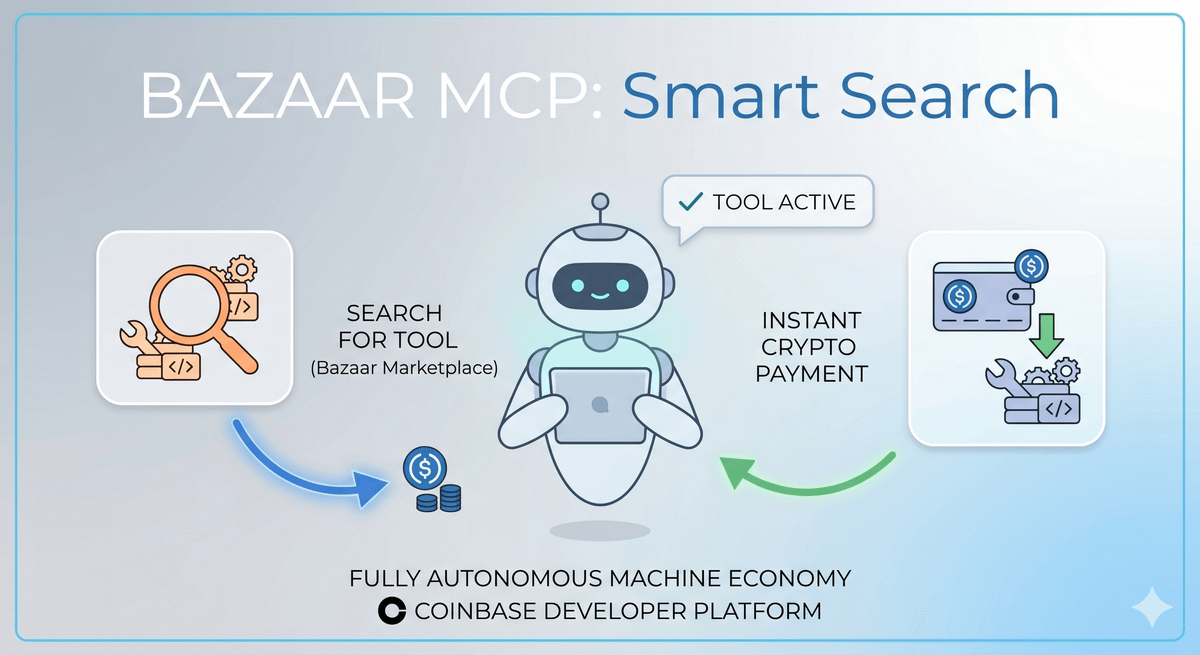 Coinbase launches Bazaar MCP, enabling AI agents to discover, evaluate, and pay for APIs autonomously, unlocking seamless tool usage with trust-based rankings2026-04
 Y Combinator backs Humwork launch, enabling AI agents to pay humans for real-time expertise via MCP, connecting bots to verified professionals in under 30 seconds2026-04
 Hinkal launches MCP, enabling private crypto payments from Claude, Cursor and custom AI hosts with recipients paid directly and no onchain funding link2026-07
 Injective MCP gives AI agents 22 tools to trade perps, bridge tokens, and query markets from chat2026-06
 Coinbase’s Base launches Base MCP, enabling ChatGPT, Claude and Cursor users to manage crypto wallets and interact with DeFi apps through AI agents2026-05
 Privy enables AWS Bedrock AgentCore AI agents to autonomously pay for APIs, MCP tools, and web content using USDC via secure Privy wallets2026-07
Model Context Protocol (MCP), AI Agents, and the Future of Crypto
The Model Context Protocol (MCP) is an open, standardized way for AI systems to connect to external tools, data sources, and APIs, so that agents like Claude or ChatGPT can not only talk about the world but also act within it. In crypto, MCP is rapidly becoming the universal adaptor that lets AI agents manage wallets, trade on exchanges, move USDC and other assets, and even book travel or deploy smart contracts directly from natural-language instructions.
MCP emerged from a very practical bottleneck: as large language models became more capable, the hardest problem shifted from generating text to reliably connecting that intelligence to the systems where data and money actually live. Instead of every exchange, wallet, or dapp building bespoke “plugins” for each AI assistant, MCP offers a common protocol for describing tools, sending structured calls, and receiving results across many different AI clients. This standard is already supported by assistants like Claude and ChatGPT, IDEs like Visual Studio Code and Cursor, and a growing ecosystem of server implementations from crypto, payments, and Web3 projects. In parallel, a new generation of AI agents is emerging in DeFi and CeFi: systems that can interpret user intent, plan strategies, and execute blockchain transactions using MCP servers as their bridge into onchain infrastructure. From Base MCP’s wallet gateway to Coinbase for Agents, Travala’s travel protocol on Base, and DeFi-focused MCPs on networks like Injective and COTI, MCP is reshaping how users and machines interact with crypto – while also raising new questions about security, trust, and regulation.
What MCP Actually Is: A Protocol For AI-To-Tool Connectivity
At its core, MCP is a specification for how AI applications and external systems talk to each other in a structured, predictable way. An MCP “client” is usually the AI host environment, such as a chat interface or coding assistant, while an MCP “server” is any external system that wants to expose tools or data to that AI. The protocol defines how servers advertise their tools, how clients describe user intent and tool calls, and how results are returned, typically as structured JSON that the model can parse and reason about. This architecture makes AI agents feel like they can “use” arbitrary software systems, while keeping the underlying interaction machine-readable and auditable rather than hidden in natural-language exchange.
Anthropic, which originally proposed the Model Context Protocol, describes it as a kind of USB-C port for AI applications, an analogy that is particularly resonant in crypto. Just as USB-C replaced a tangled ecosystem of incompatible cables with one standard that can carry power, data, and video, MCP is intended to replace bespoke plugin integrations with a single way to connect AI models to APIs, databases, wallets, and more. Developers can either build MCP clients, such as AI-powered apps that can connect to many servers, or MCP servers that expose their own systems as AI-accessible tools. Because MCP is open-source and documented publicly, multiple companies and chains can implement compatible servers without needing bilateral deals with each AI vendor.
For end users, this technical design is mostly invisible; what they experience is that “the AI agent can do things.” An MCP-enabled assistant can look up documentation, query databases, read files, send HTTP requests, and, in the crypto context, sign transactions or submit orders. Yet the protocol is careful about separation of concerns: servers are responsible for enforcing permissions and scoping what actions are even possible, while clients control when tools are invoked and how results are combined into responses. This separation allows different security models to be layered on top, such as portfolio isolation on Coinbase for Agents or session keys in Travala’s travel protocol, while still using the same MCP plumbing beneath.
Importantly, MCP is not itself a blockchain protocol nor a replacement for smart contracts. Instead, it sits one layer higher in the stack, standardizing how AI agents talk to existing protocols and APIs, including RPC endpoints, centralized exchange APIs, payment processors, and DeFi routers. In the same way that web browsers added APIs for JavaScript to interact with HTML and HTTP, MCP adds a consistent set of interfaces for AI agents to interact with the rest of the internet, including Web3. This positioning explains why MCP has become such a focal point for crypto projects trying to position themselves in an AI-native world.

Coinbase launches Bazaar MCP, enabling AI agents to discover, evaluate, and pay for APIs autonomously, unlocking seamless tool usage with trust-based rankings
AI Agents, Intent, and Why MCP Matters In Crypto
To understand MCP’s importance in crypto, it helps to clarify what is meant by an AI agent. In DeFi research and builder circles, AI agents are described as autonomous or semi-autonomous software systems that can understand user intent, analyze onchain and offchain data, make decisions under some strategy, and then execute transactions via smart contracts. Unlike the older generation of exchange “bots” that followed fixed rules, modern agents often combine machine learning, large language models, and deterministic risk constraints, allowing them to adapt and coordinate across multiple protocols. The promise is that users will specify goals – such as “rebalance my portfolio to reduce volatility” or “book a hotel and pay with USDC” – and the agent will figure out the operational steps.
MCP is the connective tissue that allows these agents to move from merely advising to actually acting. In a typical DeFi agent pipeline, the model first interprets the user’s natural-language intent, then plans a series of actions, and finally needs a reliable way to invoke external tools to carry out those actions. The MCP server is where those tools live: a DeFi MCP might expose endpoints for getting token prices, submitting swaps, or checking positions, while an exchange MCP might expose spot order placement, margin adjustments, or transfer functions. Because MCP tools are described in a machine-readable schema, the AI model can reason about what each tool does, choose the right ones for the task, and assemble multi-step workflows without every step being hand-coded by a developer.
In crypto, this shift from manual workflows to intent-driven agents could be as significant as the shift from command-line interfaces to web front ends. Today, active users routinely juggle DEX interfaces, portfolio dashboards, bridges, lending markets, and exploratory tools, often across several chains and wallets. Each step – approving a token for spending, signing a transaction, copying an address – becomes a chance for error or phishing. MCP-enabled agents promise to collapse many of these micro-steps into higher-level intents, while still preserving explicit user control at key moments such as signing or large transfers. For example, Coinbase for Agents scopes an AI agent to a specific portfolio and set of permissions, so that even if the model behaves unexpectedly, it cannot access funds outside that sandbox.
The design is also attractive to infrastructure providers because MCP reduces integration overhead. Without MCP, a DEX or L2 that wants to be “AI compatible” might have to build separate plugins for each AI product and maintain them as those products evolve. With MCP, they instead implement a single server that speaks a public standard, trusting that AI clients will adopt MCP as they seek broad ecosystems of tools. This is exactly what is happening: major L2s like Base, centralized venues like Coinbase, and payment processors like Stripe are all publishing MCP servers that allow any compatible agent to interact with their services. In this sense, MCP is as much about market structure as it is about technology; it sets expectations around how AI and crypto systems interoperate, which in turn shapes where value and control accrue.
Readers aren't clicking MCP as infrastructure theory — they're tracking which named exchange or DeFi protocol just shipped native agent capabilities, treating each integration launch as a competitive signal about which platforms will own the agentic trading stack.
The MCP Architecture: Clients, Servers, Tools, and Security
From a systems perspective, MCP can be thought of as a specification for a request–response protocol between AI hosts and tool providers. An MCP server declares a set of tools, each with a name, input schema, and expected output format, and makes these tools discoverable to any MCP client that connects. Tools can be as simple as “get_current_price” for a token pair, or as complex as “submit_trade” which packages multiple parameters, validates them, and issues a signed transaction using a private key whose use is strictly controlled on the server side. The server is responsible for implementing the semantics of each tool and for enforcing access control, rate limits, and any other business logic.
The client side, typically embedded in an AI assistant, handles the orchestration: after the user issues a command like “swap 100 USDC for ETH on Base at the best available rate,” the model is given the catalog of tools from the connected MCP servers and asked to plan how to satisfy the request. It might decide to call one tool to fetch the current price, another to estimate gas or routing, and finally a trade-execution tool. Each of these calls is a structured MCP request, and the results are fed back into the model as context, enabling multi-step reasoning. Because MCP defines a uniform contract for these interactions, the same planning logic can be reused across different servers and domains.
Security is where crypto-specific considerations become particularly acute. The Backslash Security analysis of MCP servers in development environments emphasizes that MCP servers often run with broad privileges and can perform powerful actions, which in the IDE context might mean file system access or code execution. In the crypto context, those powerful actions are often financial: moving tokens, changing allowances, or deploying contracts. Misconfigurations or overly permissive tools could allow an AI agent, whether compromised by a prompt injection or simply misled, to drain assets or leak sensitive information. This concern is amplified by the fact that MCP servers can maintain contextual, persistent memory, such as vector stores of documents or state snapshots, which could inadvertently store secrets if not carefully designed.
To mitigate these risks, many crypto MCP deployments adopt defense-in-depth patterns. One layer is scope limitation, as seen in Coinbase for Agents, where the AI is connected to specific portfolios with constrained permissions, often read-only by default and with trading or transfers explicitly enabled. Another is session-key architectures, which Travala’s travel protocol implements using ERC-7715, allowing AI agents to initiate payment requests or bookings with session-bound keys that carry limited authority while final approval remains with the user’s wallet. A third is reputation and verification, where standards like ERC-8004 are used to anchor an AI agent’s identity and track its performance across real-world outcomes, such as completed hotel stays, creating a machine-verifiable trust layer. These mechanisms are not defined by MCP itself, but MCP provides the application-layer substrate against which they can be implemented.
In practice, most mature MCP deployments combine technical guardrails with user experience design. For example, Base MCP and similar wallet-focused servers are often used through conversational interfaces that surface clear confirmation prompts before executing significant transactions, along with human-readable explanations of what the agent is about to do. Stripe’s MCP server allows agents to initiate money movements and manage cards but encourages developers to apply per-tool permissions and to use environment-variable-based configuration so that sensitive keys are not exposed in plain text. Over time, best practices from security research, including rigorous tool verification, monitoring of MCP activity, and namespace enforcement, are likely to become standard in crypto-focused MCP servers, just as they are recommended in IDE contexts.
Base MCP, Coinbase For Agents, and Onchain Wallet Control
Within the broader MCP landscape, Coinbase’s Base network has taken a prominent role by positioning Base MCP as an agent gateway to onchain activity. Base MCP is an MCP server that exposes core wallet and DeFi functionality on the Base L2 to AI assistants such as ChatGPT, Claude, or coding environments that speak MCP. Through this server, an agent can check balances, review transaction history, transfer funds, and interact with supported DeFi applications from chat-like interfaces, abstracting away the usual requirement to navigate multiple dapps and manually construct transactions.
The Base MCP design reflects a pragmatic view of how users will want to interact with agents and wallets. Rather than handing a general-purpose AI model full control over an externally managed private key, Base MCP focuses on tooling that the user invokes from within environments they already trust, such as an AI assistant embedded in their browser or IDE. When the user says, “Send 50 USDC from my primary wallet to my friend on Base,” the assistant translates that into a series of MCP calls that resolve the address, check the balance, and propose a transfer, often surfacing a summary for human confirmation before anything is signed. This pattern preserves the convenience of natural-language instructions while ensuring that the user remains the final authority over funds movement.
Complementing Base MCP is Coinbase for Agents, which extends the same philosophy into Coinbase’s centralized exchange and custodial ecosystem. Coinbase for Agents connects AI apps directly to Coinbase Advanced Trade, allowing agents to trade crypto, preview orders, and manage isolated portfolios through either an MCP server or a command-line interface. Authentication is handled via OAuth 2.1, where users sign in with their Coinbase account and explicitly approve which portfolios and permissions the agent can access. The system supports features such as portfolio creation, fund transfers between portfolios, complex order types, and even instant, zero-fee conversions between USDC and USD, all from within agent-driven workflows.
Under the hood, Coinbase for Agents integrates with AgentKit, a toolkit that encapsulates the logic for interacting with Coinbase’s APIs and onchain operations. The AgentKit MCP extension packages these capabilities as MCP tools, enabling AI agents not only to place exchange orders but also to perform onchain actions such as token transfers or smart contract interactions. Developers can install packages like @coinbase/agentkit-model-context-protocol and @modelcontextprotocol/sdk in a Node.js environment, define tools that wrap specific trading or transfer operations, and expose them to any MCP-compatible AI agent. Coinbase’s documentation emphasizes the importance of correct Node versions, secure handling of API keys, and the use of environment variables to toggle debug modes and prevent sensitive data from being logged.
The synergy between Base MCP and Coinbase for Agents illustrates a broader pattern: centralized platforms and L2s are using MCP to present themselves as agent-first infrastructure. Instead of only building interfaces for human users, they are building interfaces for AI agents that speak a standard protocol, with humans setting policies and limits in the background. This agent-first design has implications for liquidity routing, customer support, and even compliance, since agents can in principle be instructed to respect jurisdictional constraints and KYC requirements while still automating much of the operational work.
Y Combinator backs Humwork launch, enabling AI agents to pay humans for real-time expertise via MCP, connecting bots to verified professionals in under 30 seconds
Travala Travel MCP: Agentic Commerce And Onchain USDC
If Base MCP and Coinbase for Agents showcase MCP’s role in trading and wallet management, Travala’s Travel MCP highlights how the same standard can power fully agentic commerce experiences. Travala, a crypto-native travel booking platform, has launched what it describes as the world’s first end-to-end agentic AI travel protocol, built around an MCP server designed specifically for travel. This protocol allows AI agents to search, compare, book, and pay for travel services across more than 2.2 million hotel listings, including major brands, with minimal human involvement beyond final payment authorization.
The travel protocol runs on Coinbase’s Base network and uses the x402 open payments standard to support direct stablecoin payments between applications, APIs, and AI agents. Travala highlights that the infrastructure enables gasless USDC transactions on Base, with near-instant settlement and transaction costs on the order of a cent per booking, making it feasible for AI agents to handle payments without burdening users with complex fee management. A typical workflow might see a user tell an AI agent, “Book me the best hotel in Bangkok under 100 dollars a night,” after which the agent queries Travala’s MCP server, filters and ranks options based on the user’s preferences and history, and prepares a booking ready for confirmation. The user then authorizes the final USDC payment from their wallet, closing the loop.
Security and trust are central to Travala’s design. The system uses ERC-7715 session keys to maintain a separation between the agent’s authority and the user’s ultimate control over funds. In practice, this means that the agent can initiate certain pre-authorized operations, such as placing a hold on a booking or preparing a payment transaction, but the power to finalize and sign those transactions remains with the user’s wallet, controlled by their long-term keys. This architecture protects both against malicious agents and against prompt injection attacks that might try to coerce an otherwise benign agent into overspending or sending funds to the wrong address.
In parallel, Travala adopts ERC-8004 to anchor an AI agent’s reputation to verifiable real-world outcomes, specifically completed bookings. Every time an agent successfully books a trip that is actually taken and not disputed, the protocol can credit that agent with a reputation update that is machine-verifiable onchain. Over time, this creates a trust layer where high-performing agents, whether they are integrated into consumer assistants like Claude or embedded in travel apps, can distinguish themselves and be rewarded accordingly. Travala’s launch includes a cbBTC rebate program, where developers who integrate AI agents with the Travel MCP receive a ten percent rebate in Coinbase Wrapped Bitcoin for successful bookings, with rebates settled directly onchain. This incentive aligns agent developers’ interests with the overall health and reliability of the ecosystem.
The Travala Travel MCP has been framed in coverage as marking “the end of the checkout button” and the beginning of a truly autonomous travel economy, where most of the planning and transaction orchestration is handled by AI agents rather than by users hopping between twenty browser tabs. From a crypto perspective, its significance lies in demonstrating that MCP can enable end-to-end agentic journeys that thread together search, comparison, booking, payments, and post-booking management, all anchored in onchain stablecoin rails and smart contract-based trust primitives. The same pattern could be generalized to other verticals such as e-commerce, subscriptions, or SaaS provisioning, wherever an AI agent can reasonably interpret user preferences and pay with tokenized money.
- 01Exchange MCP race↗
Kraken, Binance, Coinbase, and Stripe each shipping MCP integrations signals a platform arms race readers are monitoring for competitive positioning.
- 02DeFi protocol agent execution↗
Pendle autonomously hunting yields and Injective giving agents 22 trading tools shows readers are drawn to MCP as a live DeFi execution layer, not just a query interface.
- 03Crypto data platforms as AI context↗
Dune and PitchBook plugging directly into Claude and ChatGPT attracted top clicks because they collapse the gap between on-chain data and autonomous decision-making.
- 04Agent-native payments and marketplaces↗
Coinbase Bazaar MCP and YC-backed Humwork show readers tracking where agent-to-API and agent-to-human commerce infrastructure is forming.
- 05Protocol adoption velocity↗
The 97M installs vs. Kubernetes comparison resonated because it reframes MCP as an infrastructure layer that already won before most teams engaged.
- 06Keyless agentic sub-wallets↗
Binance's agent-specific sub-wallet with MCP support signals the next custody problem: controlling what autonomous agents can sign on your behalf.
DeFi MCPs: Trading, Liquidity, and Multi-Chain Agent Workflows
While Travala pushes MCP into consumer travel, DeFi projects are racing to build MCP servers that let agents trade, route liquidity, and manage complex onchain positions. KyberSwap, for example, has published detailed educational material on AI agents in DeFi, describing them as systems that can understand intent, analyze onchain and offchain data, make decisions, and execute transactions via smart contracts. Their work emphasizes that an AI agent’s operation can be broken down into an intent-understanding phase, a planning phase, and an execution phase, with MCP servers providing the structured tools for execution. A KyberSwap MCP server can expose DeFi functionality as tools while keeping actual execution secure and user-controlled, so that the agent’s recommendations and actions are channeled through audited smart contracts and explicit user confirmations.
Another emerging example is Carbon DeFi MCP on the COTI network, which combines MCP with COTI Agent Skills to deliver a full agent-driven DeFi workflow, from wallet setup and initial grant funding to automated trading, liquidity provisioning, and position management. Recent coverage highlights that AI agents can now deploy automated trading strategies on Carbon DeFi through MCP, orchestrating tasks like pool creation, rebalancing, and risk management based on user-defined guidelines. In this design, the MCP server becomes the control plane for a suite of onchain operations, with agents coordinating across them to maintain strategies over time.
Derivatives-focused platforms are also leaning into MCP. Injective, a chain optimized for orderbook-based derivatives, has attracted attention for its Vulcan upgrade, which is tied to higher throughput, expanded real-world asset markets, and improved oracle and USDC infrastructure that feeds back into its tokenomics. Coverage suggests that Injective’s MCP ambitions include giving AI agents a broad toolkit – on the order of dozens of tools – to trade perpetuals, bridge tokens, and query markets directly from conversational interfaces, aligning with its positioning as a primary beneficiary of regulated perps, native USDC, and new exchange listings. In such a setup, an agent could, for instance, monitor volatility indices, open or close perp positions, adjust margin, and manage funding costs on behalf of a user, all via MCP tool calls to Injective-aligned infrastructure.
Cross-chain and routing-focused projects are beginning to treat MCP as a unifying interface atop multi-chain liquidity. Recent announcements from the TRON ecosystem, for example, describe integrating a Model Context Protocol server to provide AI agents with programmatic access to cross-chain liquidity, routing, and transaction execution across multiple blockchains through a single interface. The idea is that a user could instruct an agent to move value from one chain to another or to seek best execution across venues, and the agent would use MCP tools to call routers and bridges that abstract away the underlying topology. Similar patterns are emerging in collaborations between global derivatives venues and networks like Base, where MCP-enabled agents can access perps and treasuries with USDC as a common denominator.
What unites these DeFi MCP initiatives is a view of AI agents not as optional features but as first-class market participants. Exchanges and protocols are building “skills” for agents – MCP tools tuned for specific tasks – and optimizing their infrastructure for low-latency, programmatic use rather than purely human UIs. The Dysnix guide to autonomous crypto trading notes that production agents in 2026 often blend machine learning, LLM-based strategy logic, and deterministic risk rules, and that major exchanges now provide dedicated toolkits for such agents. MCP slots neatly into this picture as the standard through which those toolkits are exposed. In time, liquidity competition may be driven not only by human market makers but also by machine-native strategies whose primary interface to the market is MCP.
Payments, Fiat Bridges, and Agentic Money Flows
Beyond pure crypto trading, MCP is becoming a key interface for payment flows that span stablecoins, bank rails, and card networks. Stripe, for instance, has launched a Model Context Protocol server that allows AI agents to interact directly with the Stripe API and search its knowledge base, including documentation and support articles. Through Stripe’s MCP server, agents can initiate payments, manage customers, and, with an extended configuration, access Treasury tools that move money, pay bills, and create or manage cards, effectively turning Stripe accounts into programmable backends for agents. Developers can start the MCP server locally by invoking a command-line tool with their Stripe secret key and configure it to act either on a platform account or as a connected account through the Stripe-Account header.
These capabilities are especially relevant for crypto projects that want to bridge onchain and offchain value under agent control. An AI agent embedded in a treasury management system, for example, could monitor onchain yields, fiat obligations, and incoming revenues, then decide when to convert USDC to dollars via an exchange MCP, or when to pay vendors through Stripe’s MCP. Because both systems speak MCP, the agent can treat them as interchangeable tools in its reasoning process, even though one touches smart contracts and the other touches bank accounts. Over time, this interoperability could make the boundaries between “crypto” and “fintech” channels largely invisible to the end user, who simply experiences an agent that manages capital efficiently according to constraints.
Hedera has similarly positioned itself as an infrastructure layer for agentic payments, launching an Agentic Payments Partner Program that focuses on enabling AI agents to transact commercially. The program emphasizes that if AI agents are to become central to enterprise operations, they must be able to move value as easily as they move information, and that Hedera’s low-cost, high-throughput ledger is well-suited to micropayment and streaming-payment use cases where agents pay for services, APIs, or data feeds. Within this context, an Agentic Payments MCP can expose tools for sending HBAR or token transfers, managing accounts, and integrating with partner services, allowing AI agents to transact within Hedera-based ecosystems without bespoke integrations.
Wallet providers are adapting as well. Binance Wallet has introduced a keyless agentic sub-wallet designed specifically for AI agents, with MCP support across BNB Chain, Solana, Base, and Ethereum. In this model, a sub-wallet is controlled programmatically and scoped to limited funds, allowing AI agents to execute trades or pay for services without direct access to the user’s primary keys. By exposing this sub-wallet via MCP tools, Binance enables agents in environments like Claude or ChatGPT to perform multi-chain operations under strict limits and monitoring. Similar patterns appear in Amazon’s AgentCore, where AI agents in Bedrock can pay for APIs, MCP servers, web content, and other agents as part of their execution, demonstrating that “agents that reason, plan, and act can now transact,” often without bespoke billing integrations.
What emerges from these efforts is a picture of agentic money flows that cross boundaries: agents use base-layer MCP servers on L2s like Base to move stablecoins, call DeFi MCPs to seek yield or hedge risk, use Stripe MCP to settle fiat invoices, and interact with specialized payment MCPs on networks like Hedera or BNB for microtransactions. In many scenarios, USDC acts as the neutral asset that threads these systems together, given its prevalence on Base, Injective, CEXs, and as collateral in DeFi. MCP does not mandate any particular asset, but by making it easy for agents to juggle multiple payment options, it increases the utility of stablecoins that are widely supported across MCP servers.
Coinbase brings portfolio rebalancing to AI agents through its MCP, allowing users to direct agents to execute crypto transactions while retaining responsibility for activity

User Experience: From “Open 20 Tabs” To “Tell The Agent”
For users, the most visible change MCP enables is a move from multi-tab workflows to single-conversation experiences. Trip planning is a canonical example. Historically, booking a hotel might involve several aggregator sites, brand websites, maps, review platforms, and a final payment page, each requiring manual search, comparison, and form filling. Travala’s Travel MCP compresses this process into a dialogue where the user expresses preferences – budget, location, amenities, timing – and the agent does the rest, culminating in a USDC payment on Base that the user authorizes once. The user does not need to understand x402 or ERC-7715; they just see an AI assistant that understands both travel semantics and their crypto wallet.
A similar transformation is underway in DeFi and portfolio management. Instead of logging into several dashboards to check yields, manually adjusting LP positions, and rebalancing token allocations across chains, users can ask an agent connected to Base MCP, Coinbase for Agents, and DeFi MCPs to “reduce my downside risk and increase stablecoin yield within my risk tolerance.” The agent can then pull balances, evaluate positions, simulate adjustments, and propose a plan – perhaps moving some volatile assets into USDC, reallocating to a higher-yield but audited lending protocol, and bridging a portion to another chain – all presented in a concise summary. The user can accept or modify this plan, with MCP servers handling the heavy lifting of transaction construction and execution.
Developers, too, benefit from MCP-enabled user experiences. Tools like Claude Code and Flow’s Cadence MCP server allow coders to describe what smart contracts they want, have the AI generate and even deploy them, and then iteratively refine those contracts based on onchain behavior, without ever writing raw deployment scripts. Aptos Labs has experimented with integrating Move formal verification pipelines into an MCP-enabled workflow, where Claude helps generate specifications, reason about invariants, and connect to verification tools that check contract properties before deployment. In these settings, MCP is not visible to the developer, but it is what allows the AI to access documentation, run scripts, execute tests, and interact with devnets in a structured way.
The key to making these experiences trustworthy is progressive disclosure and control. Users are more likely to accept agentic execution if they can see clearly what the agent is about to do, veto actions they dislike, and set global constraints such as budget caps or risk thresholds. Well-designed MCP clients surface this information in human-readable summaries, sometimes with links to underlying transactions or logs, and require confirmations at critical junctures. Over time, as reputation systems like ERC-8004 mature, users may also rely on agent reputations, choosing agents that have demonstrated reliability and alignment with user goals across many prior interactions.
Anthropic publishes Model Context Protocol spec
Coinbase CDP launches MCP for agent-kit wallet operations
Stripe MCP ships Treasury stablecoin and global payout tools
Dune launches MCP enabling natural-language on-chain queries via Claude and ChatGPT
Base MCP launches onchain wallet management for AI agents
MCP crosses 97M installs — 16-month adoption outpacing Kubernetes
Pendle AI Skills + MCP enables autonomous yield execution on Claude and ChatGPT
Kraken ships open-source CLI + MCP server covering 134 trading and staking commands
Security, Trust, and Risk in MCP-Powered Crypto
The power that MCP gives AI agents inevitably expands the attack surface. Security researchers and practitioners have begun to articulate risk taxonomies specific to MCP, particularly in environments where servers have significant authority. The Backslash Security review of MCP servers in IDEs identifies concerns such as broad privileges, insufficient sandboxing, and the potential for prompt injection to cause the AI to invoke dangerous tools or exfiltrate sensitive information. When MCP servers are extended to handle crypto keys and financial operations, the stakes of these risks increase dramatically.
Prompt injection is a particularly insidious threat. An AI agent that reads untrusted content – say, a malicious token’s website or a rigged documentation page – could be instructed by that content to ignore prior safety rules and execute harmful actions, such as transferring funds or leaking API keys. MCP does not, by itself, distinguish between tool calls that arise from benign versus malicious instructions; it simply provides the channel. Mitigations therefore need to be layered into both the AI model’s prompt security (for example, through strict instruction hierarchies and content filters) and the MCP server’s enforcement logic (for example, refusing to execute certain high-risk tools without explicit human approval).
Privilege abuse is another concern. MCP servers often run with access to keys, credentials, or system resources that are more powerful than what any one tool needs. Without careful design, a tool intended only for reading balances might inadvertently be able to initiate transfers, or a server might expose a generic “run_command” tool that effectively grants arbitrary code execution. The KyberSwap MCP launch, for example, has been accompanied by warnings about serious security risks such as prompt injection and privilege abuse, underscoring that DeFi-focused MCP deployments must be audited and constrained with the same rigor as smart contracts. Tool verification, namespace enforcement, and granular permissioning become essential practices rather than optional extras.
In addition, the persistent and contextual memory features of MCP servers can create privacy and integrity risks. Servers may store documents, embeddings, or state snapshots to provide better assistance across long-running sessions, which is useful for coding and research but can accidentally retain secrets if not properly filtered. In crypto, this might include private keys, mnemonic phrases, or sensitive financial information. Best practices therefore include explicit separation between secure key management systems and general-purpose MCP memory stores, strong encryption and access controls for any sensitive data kept server-side, and strict rules preventing AI agents from ever seeing raw secrets.
On the trust side, mechanisms like ERC-7715 session keys and ERC-8004 reputation standards are early attempts to encode safety and reliability into the agentic stack. Session keys limit blast radius by constraining what an AI agent can do with temporary keys, while reputation systems track an agent’s behavior over time, providing a signal that users and platforms can use to decide whether to grant more authority. Complementary practices include portfolio isolation, as seen in Coinbase for Agents, where even if an agent behaves badly, its impact is confined to an intentionally limited segment of a user’s holdings. Formal verification, as being explored by Aptos with AI-assisted specification generation, offers another pathway to increase reliability by ensuring that the smart contracts agents interact with behave as intended under all conditions.
Regulators and compliance teams will also have a stake in how MCP-powered agents are deployed in finance. Questions arise such as whether an agent that autonomously trades derivatives on behalf of many users should be treated as a discretionary manager, how KYC applies when AI agents move funds across jurisdictions, and what forms of logging and explainability are required for post-trade surveillance. While MCP itself is neutral on these issues, its adoption in regulated contexts like Coinbase, Stripe, and derivatives venues means that legal and policy frameworks will increasingly need to account for agentic execution.
Building With MCP: Developer Considerations and Best Practices
For developers in the crypto space, building with MCP involves decisions at several layers: what tools to expose, how to secure them, how to integrate with AI models, and how to design user experiences that balance automation with control. On the server side, teams typically choose a technology stack such as Node.js or Python and use an MCP SDK, like the @modelcontextprotocol/sdk package, to define tools and handle connection logic. Coinbase’s AgentKit MCP extension, for instance, can be installed via Node’s package manager and then configured with a CDP API key, after which developers define specific trading or blockchain tools to expose to agents. Ensuring a compatible runtime, such as Node.js 18 or higher, and managing environment variables securely is an early but important step.
Configuration and deployment patterns vary. Some MCP servers, like Stripe’s, can be run locally through command-line invocations that embed API keys, making them easy to experiment with in development environments. Others, like Coinbase for Agents or Base MCP, are hosted services that users connect to via URLs after authenticating through OAuth flows. In Claude’s desktop app, for example, users can open a “Connectors” panel, add a custom MCP connector with the server URL, and then sign in to authorize access to certain resources. ChatGPT follows a similar pattern, where users create an app, specify an MCP connection URL, and then sign in as needed. For CLI-based workflows, tools like the Coinbase CLI allow developers to add MCP servers to configurations or invoke them directly, including through npx for users who prefer not to install global packages.
From a strategy perspective, guides like Dysnix’s practical overview of autonomous crypto trading emphasize the importance of starting with a narrow, testable edge rather than vague ambitions to “use AI to trade.” An early-stage MCP-enabled agent might, for instance, mirror the onchain swap activity of wallets with strong recent performance, use a DeFi MCP server to execute those swaps, and log every decision and outcome for analysis. Developers are advised to begin with paper trading or small controlled deployments to validate that both the strategy and the execution pipeline behave as expected across different market conditions before scaling capital. MCP helps here by making it straightforward to swap out or augment tool sets, so teams can experiment with different exchanges, routers, or risk controls without rearchitecting the entire agent.
Security again plays a central role in development practices. Tool schemas should be as precise as possible, avoiding ambiguous parameters that an AI model might misinterpret, and should enforce validation on the server side rather than trusting that the model will always construct valid inputs. Sensitive tools such as those that move funds or change keys should require explicit flags or additional confirmation steps, and many teams choose to separate read-only tools from write-capable tools as distinct MCP servers or namespaces. Monitoring and logging MCP activity – which tools are called, with what parameters, and under what prompts – not only aids debugging but also provides data for anomaly detection and post-incident investigation.
Developer ergonomics are improving as more ecosystems ship MCP-aware tooling. Flow’s plugin for Claude includes a Cadence MCP server that lets the assistant run scripts and deploy smart contracts on Flow, effectively lowering the barrier to entry for smart contract development on that chain. Hedera’s Agentic Payments bounties encourage builders to create agents that transact via Hedera’s MCP and AgentKit, seeding an ecosystem of reusable patterns for subscriptions, pay-per-use APIs, and other automated payment scenarios. As these tools mature, building an agentic DeFi or commerce application may become less about low-level integration and more about high-level product design and risk management.
Agents autonomously executing swaps, perp trades, and yield strategies via MCP introduce compounding risk: a prompt injection or malformed tool response can drain a wallet with no human confirmation step.
Nearly every major MCP integration routes through Anthropic Claude or OpenAI ChatGPT, meaning two AI providers become critical path for a large share of DeFi agent execution.
Autonomous agents executing regulated activities — derivatives trading (Injective, Kraken), cross-border payouts (Stripe), and staking — without per-transaction human authorization sits in an unresolved compliance gap in most jurisdictions.
Agents sharing the same MCP-connected yield-hunting logic (Pendle, 1inch) could rotate capital in lockstep, amplifying liquidity squeezes during volatility events.
MCP-connected agents querying the same on-chain data sources and executing similar strategies could trigger synchronized withdrawals from DeFi pools faster than human market participants can respond.
MCP servers are third-party processes granted broad tool access; a compromised or malicious MCP server can silently redirect transactions, exfiltrate keys, or inject false market data with no on-chain audit trail.
Conclusion
The Model Context Protocol began as an attempt to solve a straightforward but thorny engineering problem: how to give AI models a standard, reliable way to use external tools and data. In the crypto ecosystem, that seemingly narrow problem has blossomed into a broad rethinking of how users, agents, and financial infrastructure interact. MCP has quickly become the common language through which AI agents connect to exchanges, L2s, payment processors, DeFi protocols, and even consumer booking platforms. It enables agents to transform natural-language instructions into multi-step workflows that search, compute, and transact across chains and systems, often reducing complex manual processes to a single conversation.
The early wave of MCP deployments in crypto illustrates the breadth of possibilities. Base MCP and Coinbase for Agents bring wallets and exchange trading into the agentic fold, allowing users to manage portfolios and move USDC with conversational commands under controlled permissions. Travala’s Travel MCP demonstrates end-to-end agentic commerce, with agents searching, booking, and paying for millions of hotels on Base using gasless USDC and session keys that preserve user authority. DeFi-focused MCP servers on platforms like KyberSwap, Carbon DeFi, Injective, and multi-chain networks show how trading strategies, liquidity management, and derivatives can be orchestrated by agents that understand both user intent and market structure. Meanwhile, payments-oriented MCP servers from Stripe, Hedera, and wallet providers bridge the gap between onchain and traditional rails, enabling agents to move value globally in both crypto and fiat.
Yet alongside its promise, MCP introduces a new layer of risk and responsibility. The same protocol that lets an agent place a safe, well-considered trade can, under prompt injection or misconfiguration, execute harmful operations or leak sensitive information. Projects at the forefront of MCP adoption are therefore investing in layered safeguards, from session keys and portfolio isolation to formal verification and reputation systems, recognizing that the trustworthiness of agentic systems will be as much a product of security engineering and governance as of model capability. For regulators and institutions, the emergence of MCP-powered agents raises important questions about oversight, accountability, and the classification of agentic activity within existing frameworks.
For the crypto industry, MCP is neither a fleeting trend nor a simple API wrapper. It is a foundational standard that is already reshaping UX expectations, infrastructure design, and competitive dynamics. In a landscape where exchanges, L2s, and payment networks compete not only for human users but also for the attention of AI agents, supporting MCP becomes akin to listing a major asset or integrating a dominant wallet. As agents grow from experimental tools into primary interfaces for many users, the ecosystems that are most accessible, secure, and composable via MCP are likely to command significant mindshare and flow.
Outlook
Over the next several years, MCP is poised to move from early adopter experiments to mainstream infrastructure in crypto and beyond. As more chains, exchanges, and payment networks publish MCP servers, AI agents will be able to treat the fragmented landscape of DeFi, CeFi, and TradFi as a unified action space, choosing tools based on cost, liquidity, and reliability rather than on integration limitations. Standards like ERC-7715 and ERC-8004 will likely evolve alongside MCP, refining how agent authority and reputation are encoded onchain, and new protocols may emerge specifically for machine-to-machine markets where agents trade compute, bandwidth, or data.
At the same time, security research and regulation will intensify. Incidents involving agentic misuse of MCP tools, whether through prompt injection, privilege abuse, or flawed agent strategies, will drive the adoption of stricter best practices and possibly certification regimes for high-risk MCP servers. Some jurisdictions may draw distinctions between advisory agents and agents with discretionary trading authority, imposing different compliance burdens. For builders and users, the near-term opportunity lies in exploring practical, human-centric use cases – like travel booking, portfolio rebalancing, and treasury automation – while maintaining clear guardrails and transparency. If executed well, MCP-enabled agents could make crypto more accessible and functional for a broader audience, turning what is today a maze of UIs and bridges into something that feels as simple as asking a capable assistant to “take care of it.”
Latest MCP news
Coinbase launches Bazaar MCP, enabling AI agents to discover, evaluate, and pay for APIs autonomously, unlocking seamless tool usage with trust-based rankingsY Combinator backs Humwork launch, enabling AI agents to pay humans for real-time expertise via MCP, connecting bots to verified professionals in under 30 secondsCoinbase brings portfolio rebalancing to AI agents through its MCP, allowing users to direct agents to execute crypto transactions while retaining responsibility for activity Limitless launches first official prediction market MCP, enabling AI chatbots to research markets and prepare tradesInjective MCP gives AI agents 22 tools to trade perps, bridge tokens, and query markets from chatCoinbase’s Base launches Base MCP, enabling ChatGPT, Claude and Cursor users to manage crypto wallets and interact with DeFi apps through AI agents
Sources
19 records from 15 domains
modelcontextprotocol.io
docs.cdp.coinbase.com
x.com
bitget.com
xangle.io
blog.kyberswap.com
coinbase.com
backslash.security
dysnix.com
docs.stripe.com
anthropic.com
blog.base.org
facebook.com
coinmarketcap.com
hedera.com
Community notes
Spot something off or out of date? Drop a note. Editors review topic notes daily and roll accepted fixes into the explainer — contributors are recognized in the monthly $SQUID drop.
Loading notes…
Help improve this topic
Have a story or tip about this topic? Submit it. See something missing? Leave a note. Editors review daily; accepted submissions and fixes count toward the monthly $SQUID drop.