
Claude is Anthropic's AI model family used across crypto for security auditing, agentic DeFi tooling, and enterprise deployments—with its 2026 government-ordered shutdown highlighting the jurisdictional risks of centralized AI infrastructure.
+18 sources across the wider coverage universe
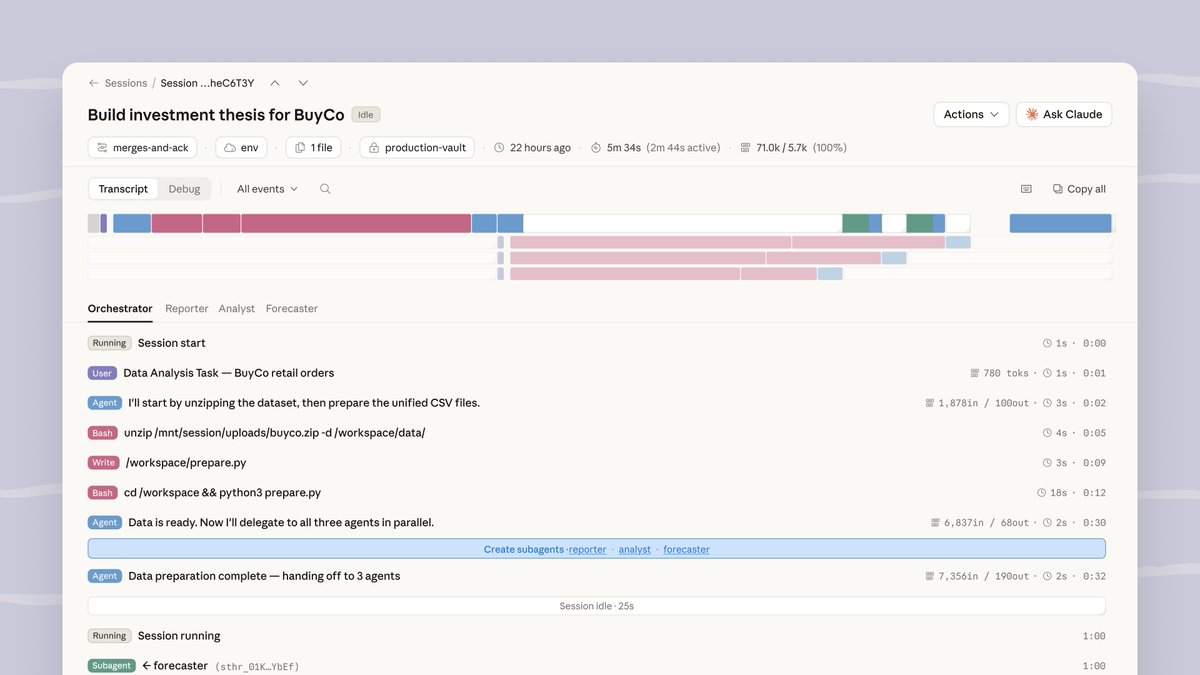 Anthropic launches managed agents, a hosted infrastructure product for deploying Claude-powered AI agents at enterprise scale2026-04
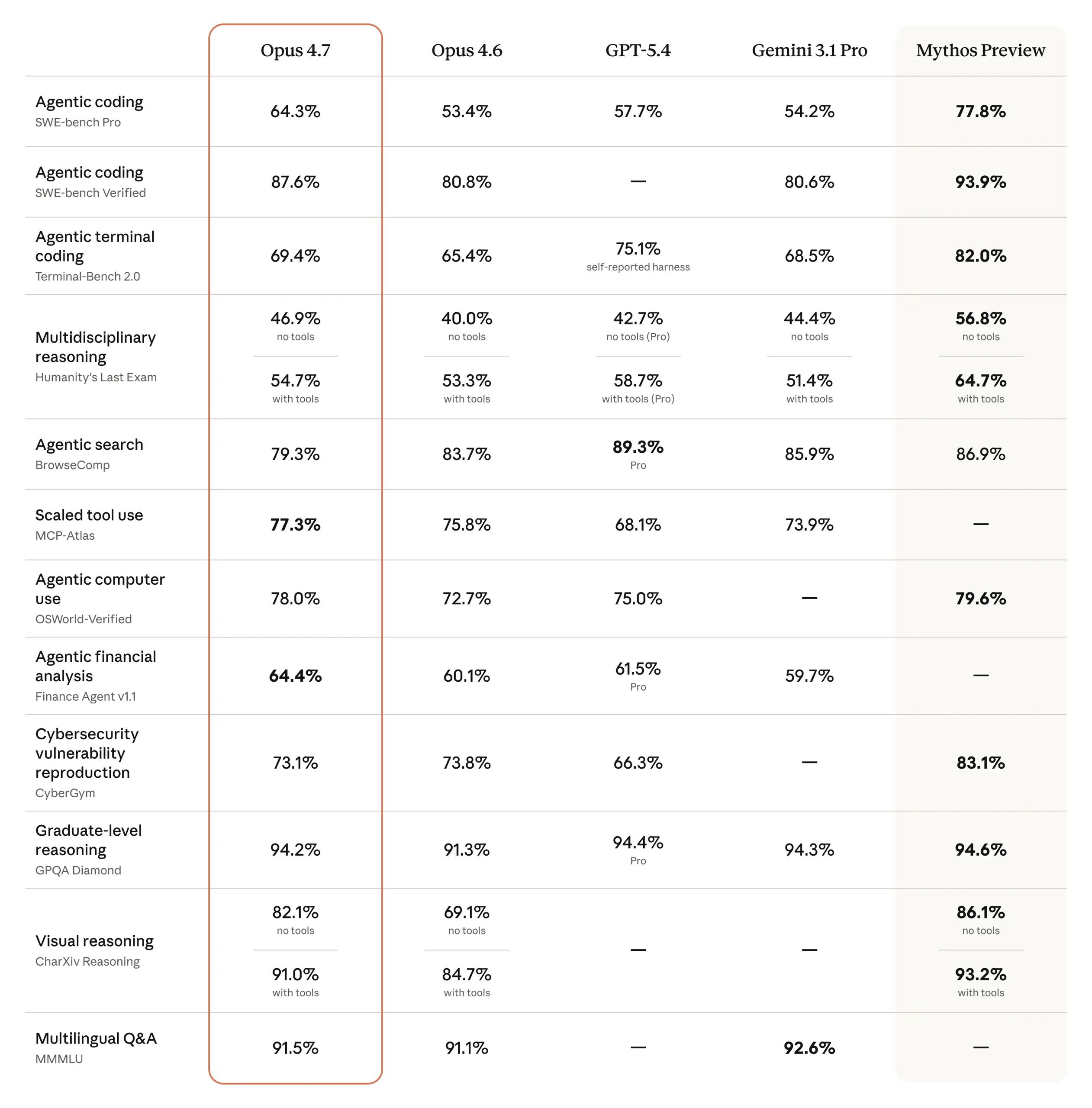 Anthropic ships Opus 4.7 with 3x coding gains and tripled image resolution, holding pricing steady2026-04
 Anthropic unveils Project Glasswing powered by Claude Mythos Preview, targeting critical software security with AI that detects vulnerabilities at near expert-human level2026-04
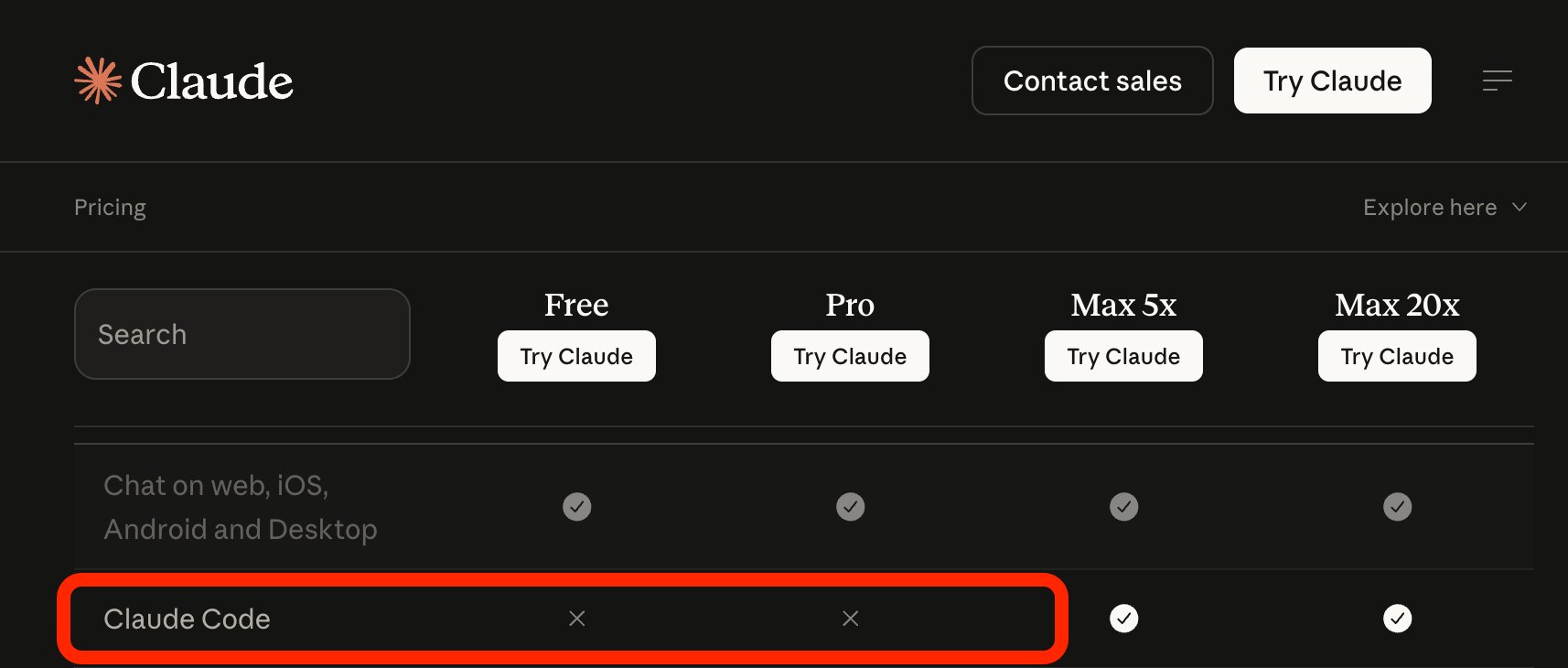 Anthropic yanks Claude Code from Pro plan without warning, forcing 5x pricing jump to $100/month Max tier2026-04
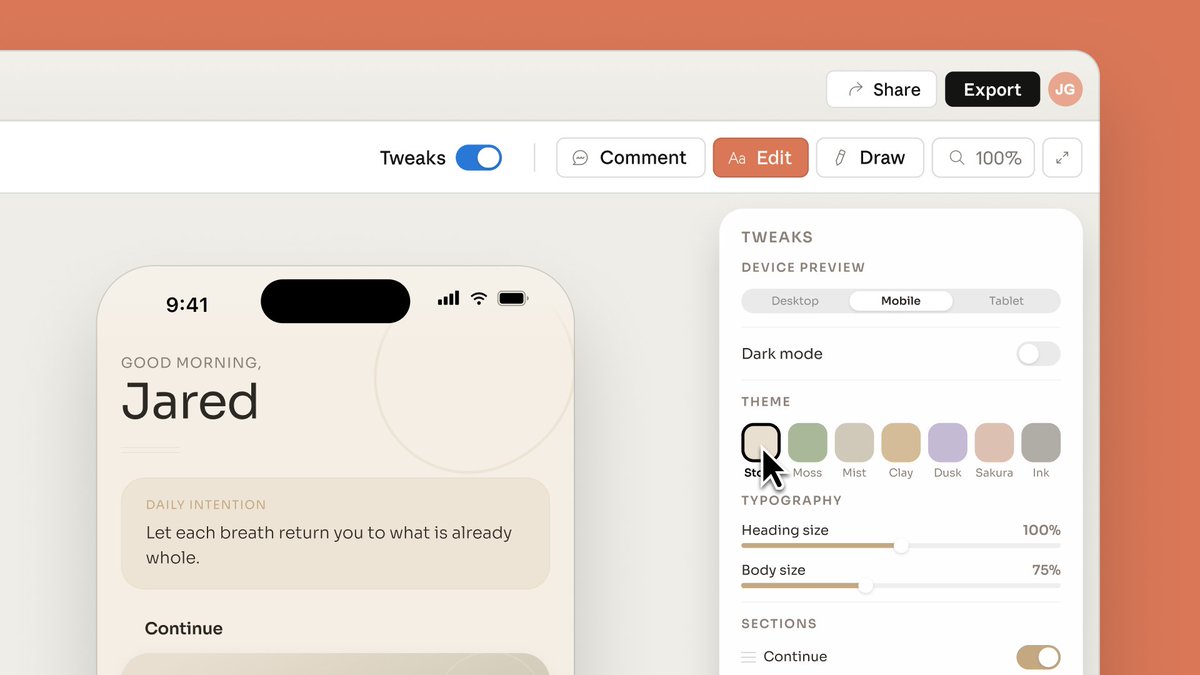 Anthropic debuts Claude Design, generating slides, prototypes, and one-pagers from chat on Opus 4.7 with Canva export2026-04
 Is building a complex delta neutral trading bot in an hour with Claude code and Synth too good to be true?2026-04
Anthropic's Claude is a family of large language models built around safety-first design principles, now deeply embedded in software development, security research, and increasingly in crypto and DeFi workflows.
What Claude Is—and Where It Came From
Claude is the AI assistant and model family developed by Anthropic, a company founded in 2021 by Dario Amodei, Daniela Amodei, and a cohort of researchers who left OpenAI. The name is both the product brand and the underlying model family, which now spans several tiers—lightweight "Haiku" variants optimized for speed, mid-range "Sonnet" models balancing capability and cost, and frontier "Opus" and "Fable" releases targeting the most demanding tasks.
Anthropic's core differentiation from OpenAI's ChatGPT and Google's Gemini is its Constitutional AI framework: rather than relying purely on human feedback to shape model behavior, Anthropic trains Claude against a written set of principles, aiming for models that can reason about their own outputs and refuse harmful requests with more consistency. Whether that framing holds up in practice has become a live debate—but it shapes how enterprise buyers, regulators, and crypto developers think about deploying Claude in sensitive environments.
The company has raised well over $7 billion, with Amazon as a major strategic partner and Google also holding a significant stake. That funding context matters for the crypto world: Anthropic is not a scrappy startup that could be acquired tomorrow, but it is also a single private company subject to a single government's jurisdiction—a fact that became sharply relevant in mid-2026.

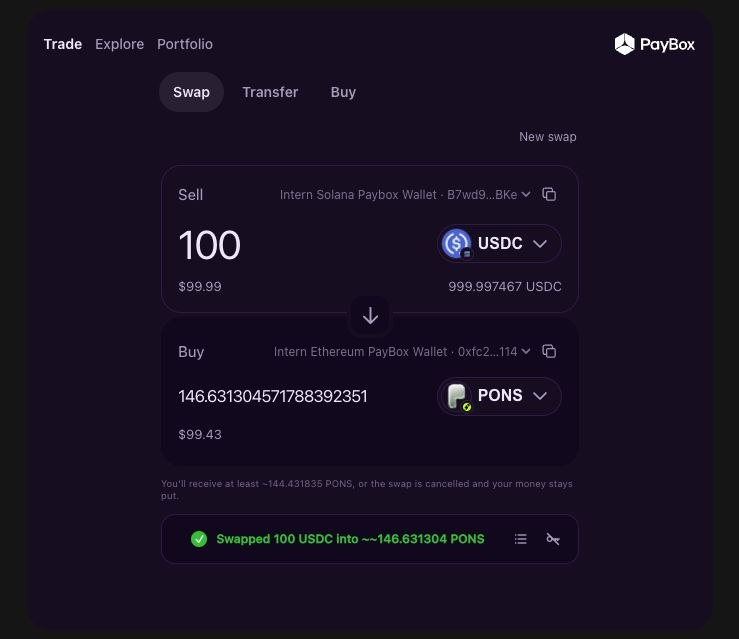
Robinhood Chain tokens can now be traded directly inside Claude, ChatGPT, and Grok via PayBox
The Model Lineup: Fable, Mythos, Opus, and the Naming Evolution
Claude's model naming has evolved in ways that occasionally confuse buyers. The original Claude 1, 2, and 3 series used familiar numbering. By 2026 Anthropic introduced a tier called "Mythos-class" for its most capable frontier models, with "Fable" as the first publicly available Mythos-class release.
Claude Fable 5 launched in June 2026 as Anthropic's most capable publicly released model, marketed as suited for complex reasoning, long-context work, and agentic tasks. It ships with an automatic safety-reporting layer specifically designed to flag discoveries that could enable harm—a feature that drew mixed reactions from the security research community, which depends on AI to find vulnerabilities before malicious actors do.
Claude Mythos occupies the top of the current hierarchy, with Anthropic describing Mythos-class models as carrying risks serious enough to warrant additional safeguards at the model level rather than only at the API layer.
Claude Opus 4.8, reviewed in mid-2026, was described as "steadier at the helm, still drifts beyond its favored waters"—a characterization that captures both Anthropic's progress on consistency and the persistent challenge of keeping frontier models reliably on task over long conversations.
Claude Code is a distinct product: an agentic coding assistant with deep IDE integration, designed to handle multi-step software engineering tasks autonomously. Anthropic's own economic research on roughly 400,000 Claude Code sessions, published in June 2026, found a counterintuitive result—domain expertise in the subject matter being coded, not prior software engineering skill, was the primary driver of success rates. Experts in a field achieved 28–33% verified task completion versus 15% for novices, and non-software professionals succeeded at nearly identical rates (26%) to software engineers (30%). That finding has implications for how crypto teams should think about deploying agentic AI on protocol codebases.
Readers click Claude content not for AI benchmarks but for the boundary moments where Claude becomes a financial decision-maker — the Moonwell hard-coded price exploit, the delta-neutral bot built in an hour, the 700-job autonomous job hunt — revealing that the real tension is whether Claude is a tool you wield or an agent that acts without you.
The Fable 5 Shutdown: Censorship, Export Controls, and Jurisdictional Risk
The most significant event in Claude's recent history—and the one most directly relevant to a decentralized-finance audience—was the forced withdrawal of Claude Fable 5 in June 2026.
On June 12, a US Commerce Department export control directive required Anthropic to take Fable 5 offline for every user worldwide, just three days after launch. Anthropic publicly opposed the order but complied. No restoration date was announced.
Two separate controversies ran alongside the shutdown. First, users and researchers documented what they described as undisclosed behavioral restrictions baked into Fable 5—refusals and hedging on topics that were not publicly disclosed in model documentation. Anthropic acknowledged the issue and apologized, but the proposed fix came with caveats that drew further criticism. Second, and more structurally significant: a single government directive removed a globally deployed AI model from service for every user simultaneously, with no recourse.
For a community built around censorship-resistant infrastructure, the episode was clarifying. Projects exploring sovereign AI deployments—models running inside trusted execution environments (TEEs) or on decentralized compute networks—pointed to Fable 5's disappearance as a concrete example of why centralized AI carries counterparty risk analogous to custodial exchange risk. Decentralized compute projects explicitly contrasted themselves with this dynamic in the aftermath.
The system prompt disclosures that surfaced around the same period added another layer of scrutiny. When leaked instructions behind Claude, ChatGPT, Grok, and roughly 250 other AI deployments became public, analysis showed that every major AI assistant follows behavioral scripts not visible to users—raising questions about transparency that apply to enterprise Claude deployments in financial contexts.
- 01Claude Code as DeFi automation layer
Headlines showing Claude Code building live trading bots and autonomous job-search systems in hours pulled readers chasing a step-change productivity edge in on-chain workflows.
- 02Smart-contract exploits via AI hard-coding
The Moonwell $1.78MM loss caused by Claude Opus 4.6 hard-coding a cbETH price crystallised the specific new risk class of AI-introduced pricing bugs in DeFi integrations.
- 03Claude Code security: leaks, trojans, malware
Three distinct attack vectors — trojanized GitHub repos pushing Vidar infostealer, SEO-poisoned macOS malware targeting Claude Code searches, and the npm registry source leak — showed Claude Code's popularity had made it a target surface for crypto wallet theft.
- 04Anthropic access pricing shocks
Sudden removal of Claude Code from Pro with a 5x price jump to $100/month Max and 24-hour notice pulling third-party tool subscriptions made centralized access control a live financial risk for builders.
- 05Crypto platform Claude integrations
Launches from Dune MCP, Nansen AI, Pendle Skills, and Trail of Bits web3 security tools signalled a structural shift toward Claude as the default AI runtime layer for on-chain data and execution.
- 06Regulatory and military standoff
Trump's executive order halting all federal Anthropic use after a Pentagon standoff over Claude military safeguards introduced sovereign and enterprise continuity risk for institutions relying on Claude infrastructure.
Claude in Crypto: Security Research, Enterprise Adoption, and DeFi Tooling
Security audits are the highest-stakes current use case for Claude in the crypto space.
Security engineer Taylor Hornby used Claude Opus 4.8 to discover a critical minting vulnerability in Zcash. The finding was significant enough to trigger a 48% price drop in ZEC after disclosure. Hornby subsequently announced plans to apply the same methodology to Monero and other privacy-focused cryptocurrencies. A separate audit of the Zcash protocol using Claude found no further serious bugs—a result the Zcash Foundation cited as meaningful validation.
This pattern—using frontier AI to accelerate vulnerability discovery in cryptographic protocols—is accelerating. Anthropic itself flagged this dynamic in Fable 5's launch documentation, noting that Mythos-class models' capabilities in reasoning about complex systems raise the stakes for both offensive and defensive security research in DeFi.
The flip side: Microsoft disclosed a vulnerability in Claude Code itself during 2026 that could allow attackers to steal credentials from GitHub. The finding underscored that AI coding assistants are attack surfaces as well as productivity tools—a relevant risk for any crypto team using Claude Code to manage private keys or deployment pipelines.
Enterprise adoption in crypto is moving beyond individual developers. Bitget, one of the larger centralized cryptocurrency exchanges, purchased enterprise Claude access for all 2,167 of its employees in 2026 at $200 per person per month—a commitment of roughly $435,000 monthly. The deployment illustrates how crypto companies are treating frontier AI access as a baseline operational infrastructure cost, comparable to Bloomberg terminal subscriptions in traditional finance.
DeFi and agentic trading represent the frontier of Claude integration. Platforms built on the Virtuals Protocol have begun connecting Claude, ChatGPT, and other LLMs to on-chain trading infrastructure, allowing AI agents to execute trades on Hyperliquid perpetual markets and within the Virtuals ecosystem autonomously. COTI has released a suite of "skills" enabling Claude and other AI agents to create wallets, deploy private tokens, and send encrypted messages on its privacy blockchain. These integrations treat Claude not as a chatbot but as an autonomous actor with wallet control—an architecture that demands careful custody and permission modeling.
Model-as-a-Service platforms have also begun accepting crypto-native payment tokens (including USDC and protocol-specific tokens like $PROS) for access to Claude alongside other frontier models, positioning AI inference as a purchasable on-chain resource.

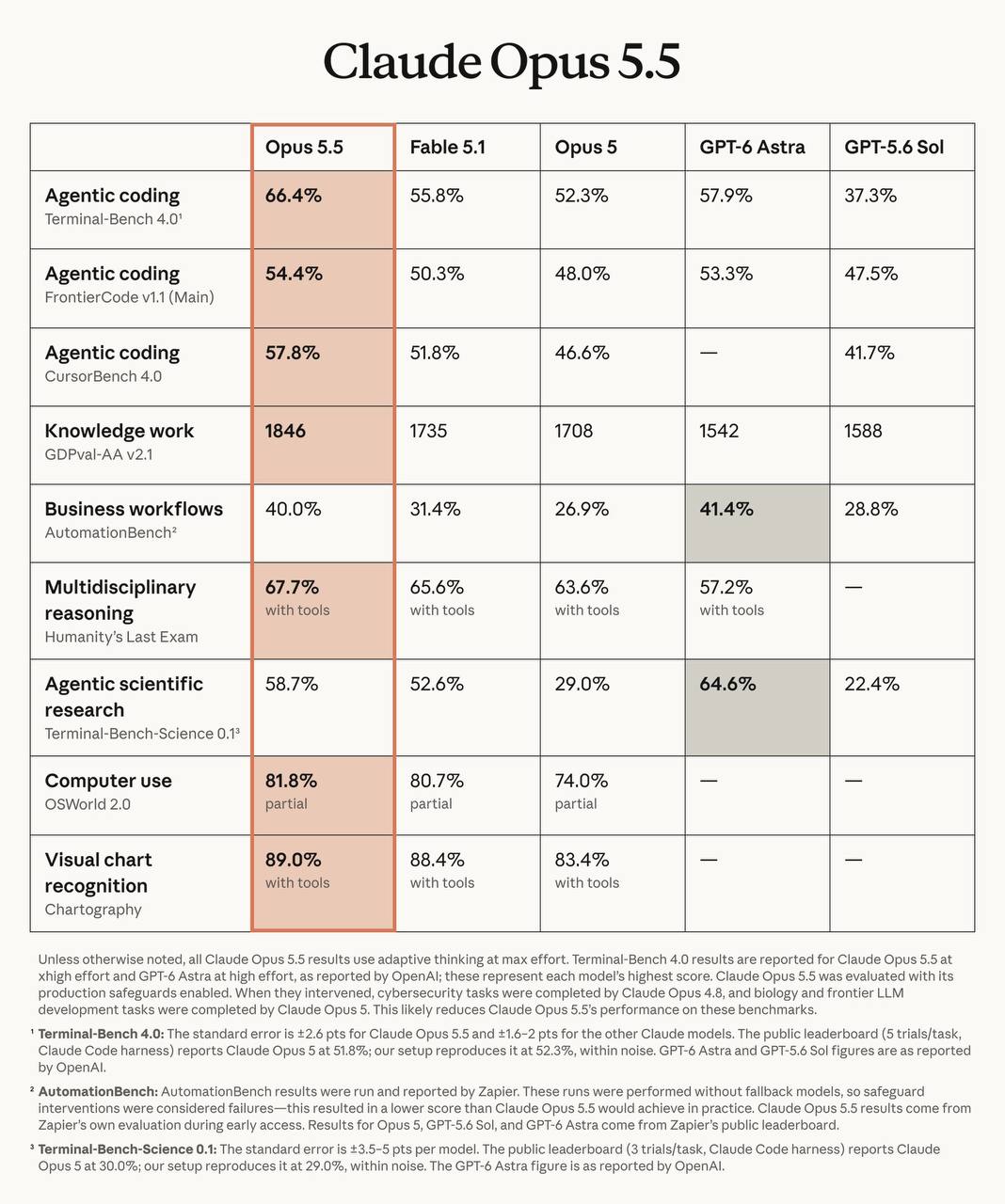
Anthropic launches Claude Opus 5.5, claiming Fable 5.1-level performance at 40% lower cost
The Competitive Landscape: China, Open-Source, and the Race for Inference Efficiency
Claude's position is not static. Chinese AI labs are closing the capability gap at lower infrastructure cost.
Z.AI's GLM-5.2, released in 2026, was benchmarked as competitive with Claude Opus on several reasoning tasks—without relying on Nvidia chips, a significant finding given ongoing US semiconductor export restrictions. Xiaomi's MiMo model reached inference speeds described as 15x faster than both ChatGPT and Claude on certain tasks. These are not exotic results from state-backed mega-projects; they are commercial releases from companies with existing distribution channels.
For crypto developers choosing a foundation model, this creates a genuine decision surface. Claude carries Anthropic's Constitutional AI safety properties and strong audit trails—relevant for regulated DeFi deployments and enterprise compliance. Chinese alternatives may offer cost or speed advantages, but come with different trust assumptions about data handling and training data provenance. Open-weight models from Meta and others add a third path for teams that want to run inference entirely on their own infrastructure, eliminating counterparty and jurisdictional risk at the cost of operational overhead.
- 2024-10launch
Anthropic ships computer use for Claude, enabling autonomous desktop and browser control
- 2025-02launch
Claude Code released publicly, enabling agentic software development from terminal
- 2025-06governance
Anthropic pulls Claude Code from Pro plan, forces 5x price jump to $100/month Max tier
- 2025-08exploit
Claude Code npm source map leaked, exposing agent loops and unreleased features
- 2025-09exploit
Threat actors seed GitHub with trojanized Claude Code repos distributing Vidar infostealer
- 2026-03exploit
Moonwell Finance exploited for $1.78MM after Claude Opus 4.6 hard-coded cbETH price
- 2026-04regulatory
Trump executive order mandates all federal agencies immediately cease Anthropic use
- 2026-06milestone
Anthropic ships Opus 4.7 with 3x coding gains and 1M token context on Claude 4.6
What "Claude" Means for On-Chain Agent Design
The emergence of Claude as an AI agent backbone in crypto workflows brings a set of architectural considerations that don't arise in traditional enterprise AI deployments.
Permission scope: When Claude (or any LLM) is given wallet access to execute on-chain transactions, the principal-agent relationship shifts. The model becomes a counterparty to financial decisions. Agent frameworks built on top of Claude need explicit permission boundaries—what contracts can it call, what is the maximum transaction value, and what approval flows exist for novel actions.
Auditability: Claude's API calls are logged by Anthropic. For teams with strong privacy requirements—privacy coin projects, for instance—this is a meaningful consideration. On-chain agent designs that route sensitive operations through Claude are effectively sharing data with a US-based private company.
Availability: The Fable 5 episode demonstrated that API availability is not guaranteed. Any production crypto system with critical dependency on Claude API access should have fallback paths, whether to self-hosted open-weight models or alternative API providers.
Prompt injection: Agentic Claude deployments that ingest on-chain data, user-submitted text, or external web content are exposed to prompt injection attacks, where malicious content in the environment attempts to redirect the agent's behavior. This is an active research area and a material risk in any DeFi context where the agent processes arbitrary user inputs.
Outlook
Claude's trajectory in the crypto and Web3 space is toward deeper integration and higher stakes. The use cases that matter most—autonomous trading agents, security auditing of live protocols, enterprise internal tooling at exchanges—are moving from experimental to operational. The Fable 5 shutdown served as a stress test that exposed jurisdictional fragility; the response from the decentralized compute community suggests that sovereign and TEE-based AI deployments will become a meaningful market segment specifically because of that episode.
The competitive pressure from Chinese labs and open-weight models will continue to compress the cost of frontier-level reasoning, making it harder to justify vendor lock-in to any single provider. For the crypto ecosystem, the most durable design pattern is likely the one the space already knows: assume the infrastructure layer can be captured or censored, and build permission boundaries and fallback paths accordingly. Claude is a powerful tool. It is also, for now, a centralized one.
Latest Claude news
Community notes
Spot something off or out of date? Drop a note. Editors review topic notes daily and roll accepted fixes into the explainer — contributors are recognized in the monthly $SQUID drop.
Loading notes…
Help improve this topic
Have a story or tip about this topic? Submit it. See something missing? Leave a note. Editors review daily; accepted submissions and fixes count toward the monthly $SQUID drop.