
In‑depth explainer on OpenAI’s mission, structure, GPT and ChatGPT products, IPO path and mega‑valuation, and how its AI dominance, tokenized pre‑IPO markets, and agentic tooling are reshaping crypto trading, DeFi design, and macro narratives.
+21 sources across the wider coverage universe
 OpenAI mandates macOS app updates after Axios supply chain attack exposes code signing certificates2026-04
 OpenAI Foundation commits $100M+ to AI-driven Alzheimer’s research, backing drug design, biomarkers, and datasets to crack medicine’s toughest disease2026-04
 Coinbase international policy VP Tom Duff Gordon departs for OpenAI to lead EMEA policy2026-04
 OpenAI CEO Sam Altman speaks out after Molotov attack on his home, reflecting on AI fears, personal mistakes, and the need to democratize powerful technology amid rising tensions2026-04
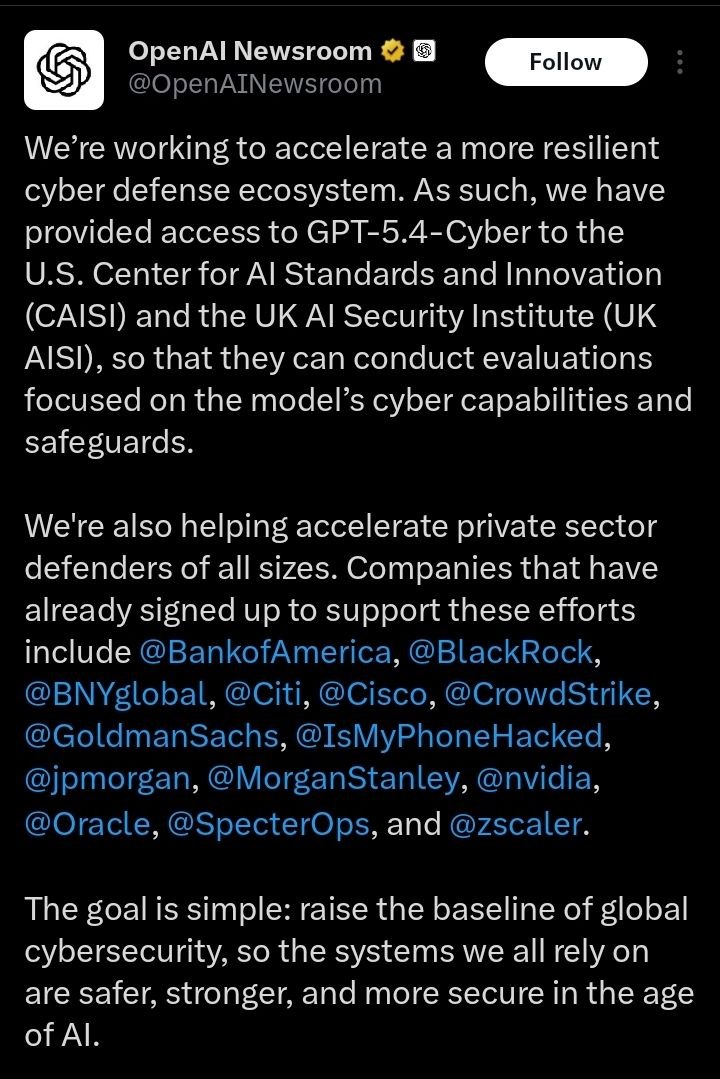 OpenAI expands cybersecurity push with GPT-5.4-Cyber access for US and UK agencies, partnering with banks and tech giants to strengthen global AI defense systems2026-04
 OpenAI launches GPT-Rosalind for life sciences and drug discovery, with Amgen, Moderna, and Allen Institute on early access2026-04
OpenAI, AI Mega-Labs, and the Crypto Markets
An AI research and deployment company best known for ChatGPT, OpenAI has become a central player in the global race to build artificial general intelligence (AGI), while simultaneously emerging as a macro force that increasingly shapes capital flows, valuations, and narratives across both TradFi and crypto markets. For a crypto audience, understanding OpenAI means understanding not only its technology and governance, but also how its prospective IPO, private-market tokenization, and the broader AI arms race are reshaping the way digital assets are priced, traded, and regulated.
What Is OpenAI?
OpenAI describes itself as an AI research and deployment company whose mission is to ensure that artificial general intelligence benefits all of humanity. The organization was founded in 2015 with an explicit focus on long‑term safety and broadly distributed benefits, positioning itself as a counterweight to purely profit‑driven AI development. Over time, OpenAI has become synonymous with the generative AI boom, largely because of its GPT model family and its consumer product ChatGPT, which together have defined the public imagination of what large language models can do. As a result, OpenAI now sits at the intersection of cutting‑edge science, geopolitics, and global capital markets.
From the outset, OpenAI’s mission has been framed in unusually expansive terms: rather than optimizing for a narrow product or market, it seeks to guide the trajectory of AGI itself. That ambition has influenced everything from its early nonprofit structure to its more recent transition into a hybrid model that combines a mission‑driven foundation with a large, profit‑oriented operating company. The organization’s leaders argue that such a structure is necessary to fund the enormous compute, talent, and data costs associated with frontier AI research while still anchoring strategic decisions in a public‑interest mandate. Critics, however, point out that this duality also creates tensions between fiduciary obligations to investors and broader societal commitments, a theme that has surfaced repeatedly in legal disputes and governance debates.
Technically, OpenAI is best known for the GPT series of large language models and the ChatGPT interface that made them widely accessible to both consumers and enterprises. These systems generate text, code, and increasingly multimodal outputs in response to natural language prompts, and they are deployed through both cloud APIs for developers and full‑stack applications for end users. As the models have grown more capable and integrated into workflows, they have begun to function not just as tools, but as a new kind of computational “substrate” that other software—and increasingly, financial systems—can build on. This is precisely where OpenAI becomes directly relevant to crypto: it is both an object of speculation via tokenized private‑market exposure and a provider of infrastructure used to automate on‑chain activity.
For market participants accustomed to token‑native networks like Bitcoin and Ethereum, OpenAI presents a different kind of entity: a centralized, equity‑financed, mission‑driven corporation that nonetheless exerts influence on token prices, narratives, and trading structures. Some commentators in crypto circles have even framed OpenAI as the “Bitcoin” of AI labs—dominant, first to scale, and system‑defining—while likening rival Anthropic to “Ethereum” and smaller labs to altcoins that raise capital on speculative research roadmaps. Whether or not one accepts that analogy, it captures an important reality: the AI lab landscape has begun to mirror the stratified, narrative‑driven structure of crypto markets, with OpenAI occupying the flagship role.

ARK Invest tokenizes ARKVX onchain, giving eligible investors exposure to OpenAI, Anthropic, Stripe and other private and public tech firms

History and Corporate Structure
From Nonprofit Lab to Hybrid Foundation–PBC
OpenAI was founded in 2015 as a nonprofit research lab with the express goal of ensuring that AGI, if achieved, would benefit everyone rather than being controlled by a small number of actors. In 2019, it created a for‑profit subsidiary under a “capped‑profit” model, designed to raise the capital needed for large‑scale AI experiments while limiting investor returns beyond a certain multiple so that any extreme upside would flow back toward the mission. This structure was unusual by Silicon Valley standards, blending philanthropic rhetoric with venture‑style capital formation, and it sparked early debates about whether mission and profit could truly coexist.
In October 2025, OpenAI announced a further evolution of its structure, formalizing a two‑tier system consisting of the OpenAI Foundation and a public benefit corporation called OpenAI Group PBC. Under this updated arrangement, the nonprofit is now the OpenAI Foundation, which continues to control the for‑profit OpenAI Group. OpenAI Group PBC, unlike a conventional corporation, is explicitly required to advance its stated mission and consider the interests of stakeholders beyond shareholders, embedding public‑benefit language into its corporate charter. This shift moved OpenAI closer to the growing class of “mission‑locked” entities that aim to balance social goals with the demands of raising large sums of private capital.
A key detail in the new structure is that, as of the closing of a recapitalization, the OpenAI Foundation holds a 26 percent equity stake in OpenAI Group, valued at approximately 130 billion dollars based on OpenAI Group’s then‑current valuation. This implies a market valuation of around 500 billion dollars for OpenAI Group even before a public listing, placing it among the most highly valued private technology companies in history. For crypto investors, this valuation is not merely a curiosity; it underpins a growing ecosystem of tokenized instruments and synthetic exposures that attempt to mirror or front‑run the eventual IPO, sometimes via offshore structures and pre‑IPO futures. These dynamics parallel pre‑TGE (token generation event) markets in crypto, where traders speculate on valuation and demand before an asset is formally listed.
The structural evolution has not, however, eliminated controversy. Because the OpenAI Foundation controls the PBC yet holds only a minority equity stake, questions persist about whether mission governance can meaningfully constrain a massively capitalized operating company under competitive and geopolitical pressure. Board composition, investor influence, and the exact legal force of “public benefit” clauses are closely watched, especially as OpenAI expands its relationships with governments and systemically important corporations. For observers in decentralized finance, this arrangement is almost the mirror image of on‑chain governance: rather than token holders voting on protocol changes, a small set of board members and foundation trustees wield decisive power over the direction of a technology that underpins trillions of dollars in potential productivity.
Financial Picture and Scale
OpenAI’s financials illustrate both the scale of its ambitions and the inherent difficulty of building frontier AI systems within a traditional corporate framework. According to audited financial documents reported by independent journalists and verified by major financial media, OpenAI generated approximately 13.07 billion dollars in revenue in 2025, while incurring about 34 billion dollars in costs and expenses. This produced an operating loss of roughly 20.92 billion dollars, with a net loss attributable to the company of about 38.5 billion dollars once accounting for various adjustments. Those figures represented a nearly eight‑fold increase in losses versus 2024, when OpenAI reportedly lost around 5.09 billion dollars.
The year 2025 also coincided with OpenAI’s conversion from a nonprofit‑controlled capped‑profit subsidiary structure into the updated hybrid model described above, creating substantial one‑time accounting effects. In particular, the reorganization produced a roughly 41.55 billion dollar loss tied to changes in the fair value of convertible interests and warrant liabilities, contributing to a reported net loss of about 60.35 billion dollars before certain noncontrolling adjustments. After factoring in losses attributable to noncontrolling members and redeemable noncontrolling interests, OpenAI’s net loss attributable to the company itself for 2025 stood at approximately 38.53 billion dollars. While some of these items reflect non‑cash fair‑value adjustments, the sheer magnitude underscores how capital‑intensive the frontier AI race has become.
At the end of 2025, OpenAI reportedly held just over 50 billion dollars in assets, with nearly half of that balance in cash. This war chest is essential given the escalating cost of training larger multimodal models, acquiring or leasing specialized AI accelerators, and deploying infrastructure at global scale. It also supports aggressive go‑to‑market efforts, including enterprise sales teams, partner programs, and research grants aimed at seeding new applications of OpenAI’s models. For crypto markets, these numbers signal both opportunity and risk: on one hand, AI infrastructure build‑out can be a powerful tailwind for related hardware, energy, and even AI‑themed tokens; on the other hand, the need to raise tens or hundreds of billions in equity could temporarily divert capital from Bitcoin and other risk assets, as some market commentators have suggested in discussing upcoming mega‑IPOs and secondary offerings.
From a valuation standpoint, the combination of rapid revenue growth and massive losses creates a familiar pattern for technology investors: OpenAI resembles an ultra‑scaled, platform‑like cloud business in its topline metrics, but one whose unit economics are still being worked out in real time as model costs, pricing, and competitive dynamics shift. For crypto investors inclined to draw analogies, this resembles early‑stage L1 blockchains that spend heavily on incentives and infrastructure to secure network effects, betting that eventual dominance will sustain premium pricing or alternative monetization. In both cases, the key question is whether the eventual steady‑state economics justify the present valuation and capital intensity.
Regulation, Lawsuits, and Governance Battles
OpenAI’s prominence has inevitably drawn legal and regulatory scrutiny, including high‑profile disputes with former backers and newer rivals. A federal judge in San Francisco recently dismissed a trade secrets lawsuit filed by Elon Musk’s AI company xAI, which alleged that OpenAI had encouraged a former xAI engineer to disclose confidential information related to xAI’s Grok chatbot. The court found that xAI had failed to demonstrate that OpenAI induced or even knew of any such disclosures, and OpenAI stated that the engineer in question had never worked for the company. This dismissal marked Musk’s second legal loss against OpenAI in a short period, following an earlier jury verdict rejecting claims that Sam Altman had betrayed OpenAI’s original nonprofit mission by steering it toward a for‑profit model.
These lawsuits highlight the broader debate over OpenAI’s governance and mission drift. Critics argue that the shift from a pure nonprofit to a hybrid foundation‑PBC structure, combined with growing commercial entanglements, risks subordinating safety and openness to profit motives. Supporters counter that only a well‑capitalized, commercially viable entity can hope to meaningfully influence the trajectory of AGI development in a world where competing labs and state actors are racing ahead. This tension is particularly salient for crypto communities, which tend to be skeptical of centralized, profit‑driven institutions that sit at the heart of critical infrastructure.
At the same time, OpenAI’s deepening engagement with governments underscores its emerging systemic importance. Reporting from major business outlets has indicated that OpenAI CEO Sam Altman and the White House are engaged in ongoing discussions about a potential U.S. government equity stake in the company. While details remain fluid, such a stake would be unprecedented for a private software firm and would underscore the extent to which AI is now viewed as strategic infrastructure akin to energy, telecom, or defense. For markets, a government stake could influence everything from regulatory oversight and export controls to perceived downside protection, much as implicit guarantees shape expectations around systemically important banks.
For crypto observers accustomed to the largely permissionless, jurisdiction‑agnostic nature of blockchains, this degree of state entanglement is both a contrast and a cautionary tale. It suggests that as technologies cross the threshold into systemic significance, the logic of public oversight and national interest tends to override purely market‑driven equilibria. Whether something similar might one day occur for crucial crypto infrastructure—such as major stablecoin issuers or dominant L1s—remains an open question, but OpenAI’s trajectory offers a preview of how states may approach privately built systems that underpin public capabilities.
Leviathan readers engage with OpenAI not as an AI product story but as a power-concentration event — every spike in clicks traces back to who controls the company, its capital, or its output: Altman's ouster and return, the non-profit restructuring, crypto tokenization of its equity, and blockchain benchmarks that position OpenAI as infrastructure for on-chain systems.
Products and Technology: GPT, ChatGPT, and the AI OS Vision
The GPT Model Family and APIs
OpenAI’s core technology is the GPT family of large language models, which evolved from early research systems into production‑grade engines for text, code, and multimodal reasoning. These models are primarily accessed via APIs that expose capabilities such as text completion, chat, embeddings, and function calling, allowing developers to embed AI into their own applications and services. Over time, OpenAI has expanded its portfolio to include models optimized for specialized tasks—such as reasoning‑focused models and lighter‑weight variants for cost‑sensitive use cases—while iterating rapidly on flagship generations like GPT‑4 and GPT‑5.
A notable feature of OpenAI’s model strategy is the aggressive retirement of older models from its consumer interfaces, even while continuing to support some of them in the API for a transitional period. For example, OpenAI deprecated GPT‑4o and several related models in ChatGPT on February 13, 2026, including GPT‑4.1, GPT‑4.1 mini, OpenAI o4‑mini, and earlier GPT‑5 variants, while keeping those models available to API users for some time. Later, it announced that reasoning‑oriented models such as o3 would be retired from ChatGPT after a 90‑day sunset period, alongside the retirement of GPT‑4.5 from the ChatGPT interface. At the same time, OpenAI has gradually rolled out newer models such as GPT‑5 to users across Plus, Pro, Team, and Free plans, while making advanced reasoning models like o3‑pro available to Pro and Team subscribers.
From a product‑strategy perspective, this cadence reflects a desire to keep the flagship interface focused on the newest, most capable models, while allowing developers who have built on specific versions to manage migrations via the API. For enterprises and DeFi protocols that embed OpenAI models deep in their stack, however, frequent model turnover introduces both technical and governance risk: changes in output behavior, pricing, or deprecation timelines can materially affect downstream systems. This is especially salient when models are used to automate financial decisions, where subtle shifts in behavior could influence trading outcomes or risk assessments. It is analogous to protocol upgrades in crypto, except that the governance process is opaque and controlled by a centralized provider rather than executed through transparent on‑chain voting.
ChatGPT as Consumer and Enterprise Platform
ChatGPT is the consumer and enterprise interface that turned OpenAI from a research lab into a household name. Initially launched as a web‑based chat interface for GPT‑3.5 and later GPT‑4 models, ChatGPT quickly scaled to hundreds of millions of users by offering a flexible conversational interface for tasks ranging from drafting emails to writing code. Over time, OpenAI has introduced subscription tiers such as ChatGPT Plus, Pro, Team, Business, and Enterprise, each providing different model access, usage limits, and administrative controls. Enterprise and educational customers also gain features such as enhanced privacy guarantees, user management, integrations, and the ability to deploy “custom GPTs” tailored to organizational knowledge bases.
OpenAI’s model retirement policy also plays out within ChatGPT. In early 2026, GPT‑4o—a highly capable multimodal model—was deprecated from the ChatGPT interface, even as some enterprise customers retained access within custom GPTs until early April of that year. Later, models such as GPT‑5.1 variants and GPT‑4.5 were scheduled for retirement from ChatGPT as the company shifted users toward newer versions. This pattern underscores that ChatGPT is not a static product but a constantly evolving front end over a moving layer of models and tools. For users building workflows or businesses on top of ChatGPT’s interface, it means that long‑term stability depends on OpenAI’s product roadmap and commercial choices.
From an enterprise perspective, ChatGPT increasingly functions as a platform rather than a single application. Organizations can plug in proprietary data, define tools and APIs that the model can call, and orchestrate multi‑step workflows involving internal systems. In this sense, ChatGPT competes not only with other chat interfaces like Anthropic’s Claude but also with broader productivity platforms, low‑code tools, and even operating systems. For crypto teams, this opens the door to building AI‑driven interfaces for wallets, trading tools, and governance dashboards that sit on top of existing infrastructure, effectively making ChatGPT a universal frontend for both off‑chain and on‑chain operations.
Toward a “Superapp” and AI Operating System
Recent reporting and commentary emphasize that OpenAI is no longer positioning ChatGPT as “just a chatbot,” but as the nucleus of a broader AI “superapp.” This envisioned superapp would integrate chat, coding tools, AI agents, and orchestration features for daily workflows, transforming ChatGPT into something closer to an AI operating system for work and life. Analysts and commentators have described this as OpenAI’s biggest redesign of ChatGPT since its launch, with the goal of moving away from chat as the primary interaction metaphor and toward agents that can autonomously execute tasks across multiple applications.
In this emerging model, AI agents become the primary interface rather than manually typed prompts. Users might specify high‑level goals—such as “optimize my DeFi yield strategy within my risk parameters” or “prepare my company’s quarterly reporting pack”—and agents would coordinate with tools, APIs, and documents to complete the work. Chat becomes just one of several modalities for interaction, alongside visual dashboards, continuous background processes, and programmatic triggers. This is conceptually similar to how, in crypto, smart contracts automate interactions between users, protocols, and assets once certain conditions are met.
The aspiration to make ChatGPT into a superapp also has strategic implications for distribution and platform power. If ChatGPT becomes the default layer through which users interact with productivity tools, services, and even financial products, then OpenAI gains gatekeeping power similar to a mobile OS or dominant cloud provider. For crypto, the implications are twofold. First, AI‑native interfaces could make interaction with complex protocols dramatically easier, lowering the learning curve for new users and potentially expanding adoption. Second, the centralization of that interface in a single corporate platform raises concerns about censorship, surveillance, and single‑point‑of‑failure risks—precisely the issues that decentralized systems were designed to mitigate.
OpenAI says review of model actions after Hugging Face incident will take months

Competitive Landscape: Anthropic, Google, xAI and Others
Anthropic as “Ethereum” to OpenAI’s “Bitcoin”
Within crypto communities, a popular meme compares OpenAI to Bitcoin and Anthropic to Ethereum, with other AI labs cast as altcoins. The analogy is not perfect, but it contains several suggestive parallels. OpenAI, like Bitcoin, was early to mass awareness and has become the default reference point for its category, particularly through ChatGPT and the GPT brand. Anthropic, like Ethereum, positions itself as more explicitly oriented around safety, governance, and extensibility, emphasizing constitutional AI and more structured reasoning in its Claude models. Meanwhile, smaller and newer labs attempt to differentiate on niches such as open‑source models, low‑cost inference, or particular modalities, somewhat akin to specialized L1s or L2s.
The altcoin analogy also reflects differences in capitalization and narrative strategy. OpenAI and Anthropic have raised tens of billions of dollars from hyperscale cloud providers and strategic investors, often on the basis of ambitious research roadmaps and projections about AGI’s transformative economic impact. In crypto terms, this resembles early‑stage protocols raising on whitepapers and future utility, except that the securities involved are private equity, convertible instruments, and complex financing arrangements rather than tokens. The analogy becomes literal in the realm of tokenized private markets, where platforms wrap fractional exposures to OpenAI and Anthropic into on‑chain instruments that trade alongside altcoins, often on the same interfaces and using the same collateral.
Competition between OpenAI and Anthropic has intensified, particularly around enterprise offerings and pricing. Reports in both tech and crypto media have framed OpenAI as seeking a “price war” with Anthropic and other labs, aiming to make its models cheaper and more feature‑rich in order to capture developer mindshare and cloud usage. For developers and crypto protocols building AI‑powered products, this competition can translate into lower costs and faster access to frontier capabilities. For the labs themselves, however, it can compress margins in a context where training and serving costs remain high, raising questions about sustainable business models and the long‑term equilibrium of the AI lab ecosystem.
Hyperscaler Alliances and the AI Arms Race
Major AI labs like OpenAI and Anthropic are deeply enmeshed with hyperscale cloud providers, which supply the compute, storage, and networking necessary to train and deploy large models. Microsoft has become OpenAI’s primary strategic partner and infrastructure provider, while rivals like Anthropic have secured multi‑billion‑dollar partnerships with firms such as Amazon and Google. This has led some analysts to describe the current moment as an “AI arms race” in which cloud giants compete to secure exclusive or privileged access to leading models, while AI labs compete for the capital and compute needed to push the frontier further.
The financial scale of this arms race is extraordinary. Commentators in both traditional finance and crypto have noted that upcoming capital raises and potential IPOs from AI and space‑related firms—including OpenAI and SpaceX—could collectively amount to hundreds of billions of dollars. In one widely discussed view, large equity offerings and infrastructure investments by firms like OpenAI, Google, and SpaceX may temporarily draw capital away from Bitcoin and other digital assets, as institutional investors rebalance portfolios into what they perceive as the next wave of high‑growth tech opportunities. Over longer horizons, however, AI‑driven productivity gains and new business models could expand the overall risk‑asset pie, potentially benefiting both equities and crypto.
For crypto builders, the hyperscaler alliances introduce a practical constraint: most access to frontier AI is mediated through centralized cloud platforms that sit outside of on‑chain governance and are subject to state regulation and corporate policy. This dependence is at odds with the ethos of permissionless decentralization and raises questions about whether, and how, the crypto ecosystem can develop more sovereign AI infrastructure over time. It also suggests that any attempt to build truly decentralized AI systems will have to contend not only with technical challenges but also with the entrenched economic power of existing alliances.
Legal and Ethical Conflicts with Rivals
The dismissed xAI trade secrets case against OpenAI is emblematic of broader legal and ethical tensions among AI labs. In that case, xAI alleged that OpenAI had encouraged a former xAI engineer to leak confidential information about Grok, its competing chatbot, but the court found insufficient evidence that OpenAI had solicited or received such information. OpenAI maintained that the engineer had never been employed there, and the judge concluded that xAI failed to show that OpenAI knew any secrets might have been disclosed. While OpenAI prevailed in this instance, the case illustrates how fiercely contested talent and intellectual property have become in the AI domain.
Beyond litigation, AI labs frequently clash in the public sphere over safety, openness, and the pace of development. Rival firms and some independent researchers argue that OpenAI’s push toward ever‑more‑capable models and products like a ChatGPT superapp risks entrenching a single corporate actor at the center of global information flows and decision‑making. Others contend that delaying or restricting deployment in the name of safety could simply cede ground to less constrained actors, including state‑backed projects or open‑source coalitions that may not prioritize alignment. These debates mirror long‑standing disputes in crypto over whether rapid innovation or conservative security postures better serve users and the public interest.
For crypto markets, the main takeaway is that AI lab competition is not just a matter of feature comparisons; it also encompasses deep disagreements about governance, disclosure, and social responsibility. These disagreements influence regulation, shape public narratives, and ultimately affect valuations—both of the labs themselves and of AI‑adjacent assets, including tokenized exposures. As more capital and political attention flows into AI, it will likely become increasingly intertwined with the policy debates that already surround crypto.
OpenAI and the Tokenization of Private Markets
Why Crypto Cares About a Non‑Token AI Lab
On the surface, OpenAI is an equity‑financed company with no native token, making it fundamentally different from decentralized networks like Bitcoin or Ethereum. Yet crypto traders and builders care about OpenAI for at least three intertwined reasons. First, OpenAI has become a macro driver: its funding rounds, product launches, and potential IPO are large enough to influence global risk sentiment and capital allocation, much as mega‑cap tech IPOs once did for earlier cycles. Second, OpenAI’s models are increasingly used as tools within crypto, powering trading bots, analytics, and user interfaces that sit atop on‑chain infrastructure. Third, OpenAI’s private equity has itself been financialized through tokenized instruments and pre‑IPO derivatives that trade on crypto rails, offering synthetic exposure to its valuation.
In practice, some market commentators frame OpenAI’s forthcoming public listing—and those of peers like Anthropic and SpaceX—as part of a broader “AI trade” that competes with Bitcoin for marginal institutional capital. When large institutions anticipate multi‑hundred‑billion‑dollar AI equity offerings, they may rebalance away from BTC or other risk assets in the short term to participate in these deals, potentially contributing to crypto drawdowns. At the same time, AI‑themed crypto tokens and RWA (real‑world asset) projects can benefit from heightened interest, as traders look for more accessible ways to express views on AI‑driven growth without directly buying private equity or IPO allocations.
From a structural perspective, OpenAI’s hybrid foundation‑PBC model and its concentration of power over a key layer of digital infrastructure also resonate with ongoing crypto debates about centralization versus decentralization. Just as Bitcoiners worry about mining centralization and Ethereum users debate L2 governance, crypto observers scrutinize how much control a small set of board members, investors, and state actors may exert over OpenAI. This scrutiny intensifies as OpenAI’s systems are integrated into products that manage identity, information access, and financial flows.
Synthetic Exposure via Tokenized RWAs and Pre‑IPO Perps
One of the most direct connections between OpenAI and crypto markets is the tokenization of pre‑IPO exposure. As OpenAI’s valuation has climbed, secondary markets for its private shares and derivatives have proliferated, including platforms that bring those exposures onto public blockchains. On‑chain derivatives protocols and RWA platforms have created instruments that reference private valuations of firms like OpenAI, SpaceX, and Anthropic, enabling global traders to speculate on these companies’ future IPO prices.
On Arbitrum, for example, the Variational platform has listed pre‑IPO markets referenced to companies such as SpaceX, Anthropic, and OpenAI, describing this as a shift toward private markets becoming programmable and accessible through smart contracts. These listings allow traders to take long or short positions on implied valuations, often using stablecoins as collateral, without ever holding underlying equity. Similarly, infrastructure such as Orderly Network has promoted permissionless creation of perpetual markets for pre‑TGE and pre‑IPO assets, enabling users to build their own derivatives markets around upcoming IPOs, airdrops, and token launches.
Beyond single‑name exposures, some projects advocate for “tokenized startup baskets” that represent diversified portfolios of growth‑stage startups, rather than concentrating risk in a single company. In such designs, an SPV or similar legal entity holds private shares or economic interests in multiple firms, including potentially OpenAI and SpaceX, and issues tokens that track the basket’s net asset value. This approach seeks to restore some of the broad, early‑stage access to upside that public markets once offered before companies began staying private for longer, locking out retail investors from much of the growth phase.
These innovations bring real benefits in terms of accessibility, liquidity, and global reach, but they also introduce layers of legal and basis risk. Token holders depend on the integrity of the off‑chain vehicle, the accuracy of reported valuations, and the enforceability of claims on underlying assets. Price dislocations between on‑chain markets and eventual IPO pricing can be severe, especially if sentiment or information is asymmetric. In addition, regulators may view some of these instruments as unregistered securities offerings, leading to enforcement actions or pressured delistings. Instances of derivatives platforms losing markets tied to firms like OpenAI and Anthropic, whether due to risk management or regulatory concerns, underscore how fragile these arrangements can be.
For crypto traders, the key is to understand that “OpenAI exposure” via tokenized instruments is not the same as owning OpenAI equity. It is exposure to a constructed economic claim whose behavior depends on legal structure, market design, and regulatory tolerance. As with synthetic tokens referencing Bitcoin or equities on offshore exchanges, due diligence on counterparty and structural risk is essential.
Design Patterns, SPVs, and Regulatory Risks
Tokenized startup platforms typically rely on a combination of legal wrappers and on‑chain primitives. Off‑chain, SPVs or funds hold the underlying private assets, whether through direct shares, secondary rights, or economic interests such as total return swaps. On‑chain, tokens represent pro‑rata claims on the SPV, sometimes with additional governance or fee‑sharing rights. This bifurcated structure aims to keep the securities‑law exposure within a regulated entity, while allowing global trading of derivative tokens using standard crypto rails.
However, this design raises nontrivial questions. Securities regulators may view publicly traded tokens that track private equity as de facto public offerings, especially if they are marketed to retail and lack appropriate disclosures. Jurisdictional conflicts arise when investors in one country trade tokens that reference assets subject to another country’s securities laws, potentially through entities that lack robust KYC or investor protections. Moreover, even well‑structured SPVs may face limits on secondary transfers, consent rights from underlying companies, or contractual restrictions that complicate redemption.
Platforms that list synthetic OpenAI exposures must therefore navigate a complex web of legal, reputational, and market risks. Some exchanges have chosen to delist or limit such markets, citing uncertainty about regulatory treatment and the potential backlash from issuers or authorities. Others proceed more aggressively, betting that demand for pre‑IPO access will outweigh legal risk or that jurisdictional arbitrage can shield them. The resulting patchwork resembles the early days of tokenized securities and ICOs, where experimentation often outpaced compliance.
For OpenAI itself, these tokenized markets are largely external phenomena, but they have indirect effects. On one hand, they can help price discovery and signal investor demand ahead of an IPO. On the other, they may complicate regulatory filings, draw unwanted scrutiny, or create misaligned incentives if speculative on‑chain valuations diverge sharply from internal expectations or official offering prices. As OpenAI moves closer to public markets, the interplay between on‑chain and off‑chain valuations will become a more important area for both regulators and investors to monitor.
OpenAI's Sam Altman calls for outside oversight and standards to prevent AI power concentration

AI x DeFi: Building with OpenAI’s Models On‑Chain
Agentic DeFi and GPT‑Powered Trading
Beyond serving as an object of speculation, OpenAI’s models are increasingly used as tools within crypto itself. Developers deploy GPT‑style models to analyze on‑chain data, generate trading signals, assist with smart contract development, and even execute semi‑autonomous trading strategies. In this “agentic DeFi” paradigm, AI agents interact with wallets, DEXs, and lending protocols based on high‑level instructions from users, potentially running 24/7 strategies that would be infeasible to manage manually.
Some infrastructure projects explicitly position themselves as bridges between large language models and on‑chain execution. They provide toolkits that allow AI agents to create wallets, sign transactions, deploy private tokens, and interact with DeFi protocols, often with privacy features layered in through specialized blockchains or cryptographic techniques. These toolkits may support multiple AI providers, including OpenAI’s Codex‑style coding models and competing systems like Claude, and expose dozens of tools for different on‑chain actions. The result is a nascent ecosystem in which AI decisions are coupled directly to financial primitives, raising both opportunities for efficiency and new forms of systemic risk.
For example, an AI agent might be tasked with continuously reallocating a portfolio across stablecoin farms, DEX LP positions, and lending markets based on yield, risk, and governance signals. Such an agent would likely scrape protocol documentation, parse governance proposals, and monitor price feeds, using large language models to interpret unstructured information and map it to concrete actions. While this can increase responsiveness and reduce operational overhead, it also introduces failure modes if the model misinterprets data, is manipulated through adversarial prompts, or behaves unpredictably following a model update.
Infrastructure to Bridge AI APIs and Smart Contracts
Technically, connecting OpenAI’s models to smart contracts requires infrastructure that spans off‑chain and on‑chain domains. AI inference still occurs off‑chain, typically via API calls to OpenAI’s servers or those of competing providers, because running frontier models directly on‑chain is computationally infeasible with current technology. Smart contracts therefore rely on oracles, relayers, or specialized middleware to receive AI‑generated recommendations or actions and translate them into signed transactions.
This architecture raises classic oracle‑problem issues. If a DeFi protocol relies on AI output to set parameters, rebalance portfolios, or manage risk, then the integrity and availability of the AI provider become critical systemic dependencies. Outages, censorship, or silent changes in model behavior can propagate into on‑chain states. Frequent model retirements and version changes—such as OpenAI’s removal of GPT‑4o and GPT‑4.5 from ChatGPT, or the migration to GPT‑5 and o3‑pro—compound this challenge, as behavior may shift without a corresponding change in the API surface.
One response is to treat AI agents as off‑chain advisors rather than autonomous controllers, requiring human or multi‑sig approvals for any critical actions. Another is to diversify across multiple AI providers or models, much as protocols diversify across price oracles. More experimental approaches involve cryptographic attestation of model identities and outputs, secure enclaves, or on‑chain verification of certain aspects of computation. Yet all of these solutions are in early stages, and the centralized control that AI labs exert over model training and deployment remains a tension point for a DeFi ecosystem that aspires to minimize trusted intermediaries.
Centralization Risks and Governance Considerations
For DeFi protocols, the use of OpenAI’s models introduces governance questions that go beyond typical vendor management. Because model internals are proprietary and updates are unilaterally controlled by OpenAI, protocol communities must decide how much discretionary power to grant to AI systems whose behavior they cannot fully audit or predict. This is particularly sensitive in contexts like credit underwriting, collateral whitelisting, or compliance monitoring, where AI‑driven decisions may have legal or ethical implications.
Model retirements underscore the importance of explicit governance around AI dependencies. When OpenAI announces that a widely used model will be deprecated from ChatGPT or the API after a certain date, developers must migrate to newer models that may behave differently under the same prompts. In a DeFi context, such migrations are not trivial: they may require governance proposals, security reviews, or even protocol upgrades. Without clear processes, protocols risk either ossifying on outdated models or making ad hoc changes that circumvent community oversight.
In the longer term, the crypto ecosystem may seek to develop more open and verifiable AI systems that align better with decentralized governance. This could involve open‑source models whose training data and weights are publicly available, or consortium‑governed models run by DAOs and validated through transparency commitments. OpenAI’s current dominance and centralized structure make it an imperfect fit for these aspirations, but its role as the leading provider of frontier capabilities means that, for now, many projects will continue to rely on its tools while exploring more sovereign alternatives.
- 01Altman governance crisis and return↗
The board ouster, Emmett Shear interlude, and reinstatement with a restructured board generated repeat clicks because it exposed how fragile control of the most-capitalized AI lab actually is.
- 02Sora video product arc
Three separate Sora headlines — announcement, launch day, and shutdown of the standalone app — show readers tracking whether a marquee AI product can survive its own operating costs.
- 03Crypto and on-chain integration↗
Worldcoin's identity rollout, Kraken tokenizing OpenAI equity exposure via xStocks, and the Paradigm EVMbench smart-contract benchmark pulled readers who want OpenAI to matter inside DeFi, not just alongside it.
- 04Non-profit to for-profit restructuring↗
Altman's public pivot on OpenAI's governance structure signaled a coming IPO and redistribution of control, directly affecting who captures value from the most-used AI platform.
- 05AI model competition and capability leaps↗
GPT-4 Turbo, o3-mini, and the open-weight GPT-OSS release each marked a capability threshold; DeepSeek R1's emergence added a geopolitical competitive frame that amplified reader urgency.
- 06Copyright and regulatory exposure
The NYT lawsuit and Stanford's consent/training-data findings framed OpenAI's scale as a liability vector, a recurring concern for readers watching regulatory overhang on AI assets.
Policy, Public Interest, and Systemic Importance
Government Oversight and Potential Equity Stakes
OpenAI’s combination of technical capability and societal impact has drawn growing attention from policymakers and regulators. The reported discussions between Sam Altman and the White House about a potential U.S. government stake in OpenAI illustrate how seriously governments take the strategic importance of frontier AI. A government equity stake would be highly unusual in the context of a software or internet company, evoking comparisons instead to state involvement in critical infrastructure sectors such as defense, energy, or telecommunications.
Such a stake could be structured in various ways, from a direct equity purchase to preferred shares or warrants, possibly tied to specific oversight mechanisms, security commitments, or access guarantees for public institutions. Proponents might argue that it aligns OpenAI’s incentives more closely with national and public interests, ensuring that capabilities central to economic competitiveness and national security are not solely controlled by private shareholders or foreign entities. Opponents might worry about politicization, regulatory capture, or international escalation if other governments respond in kind by backing their own national champions.
For crypto markets, the prospect of government equity stakes in AI firms is a reminder that technologies deemed systemically important may ultimately be pulled into the orbit of state power. It challenges the assumption that key digital infrastructures will remain purely private or market‑driven. The contrast with Bitcoin and public blockchains is stark: whereas OpenAI’s control structure can be reshaped through negotiations among corporate boards, investors, and governments, control over decentralized networks is distributed across miners, validators, and token holders, with no central cap table to negotiate over.
Research Programs and Economic Impact
To complement its commercial activities, OpenAI operates programs aimed at understanding and shaping the broader economic impact of AI. The OpenAI Economic Research Exchange, for example, commits around 50 million dollars in funding and tools to leading institutions and researchers studying how AI will affect labor markets, productivity, inequality, and economic policy. Through this initiative, OpenAI seeks to generate rigorous evidence and frameworks that can guide both public debate and its own strategy, while also building relationships with academia and policy circles.
Similarly, OpenAI’s Partner Network is designed to accelerate enterprise AI adoption by investing approximately 150 million dollars in a global ecosystem of strategic and solutions partners. These partners help organizations design, deploy, and scale AI applications using OpenAI’s models, bridging the gap between research capability and practical implementation. For enterprises, this reduces the friction of adopting advanced AI; for OpenAI, it extends distribution and embeds its technology deeply into existing business workflows.
The combination of research funding and partner enablement positions OpenAI as both a technology provider and a thought leader on AI’s economic implications. This dual role can be constructive, but it also raises questions about agenda‑setting and epistemic power: when the same company that builds the models also funds research on their impact and trains consultants to deploy them, it can shape the narrative about what kinds of AI futures are possible or desirable. For crypto communities already wary of centralized gatekeepers, this concentration of influence may reinforce the perceived need for open and pluralistic alternatives in both technology and economic analysis.
Concentration of AI Power and Implications for Open Systems
More broadly, OpenAI’s rise contributes to a concentration of AI capabilities in a small number of well‑capitalized labs, often in partnership with a handful of cloud giants. Industry analyses suggest that a large majority of commercial AI revenue is captured by a few firms, including OpenAI, Anthropic, and major tech conglomerates, while open‑source projects and smaller startups account for a smaller share despite their outsized influence on innovation. This concentration mirrors patterns seen in Web2, where a small number of platforms dominate advertising, search, and social networking.
For open systems advocates, including many in crypto, such concentration raises alarms. If a single company or tight oligopoly controls the most capable models, then access to advanced AI becomes subject to their pricing, policy, and compliance decisions. Developers whose applications fall afoul of acceptable‑use policies, geopolitical considerations, or commercial priorities may find themselves cut off from critical capabilities, much as some projects have been deplatformed from traditional cloud or payment providers. This dynamic clashes with the ethos of permissionless innovation that underpins public blockchains.
At the same time, the existence of powerful, centralized AI labs has spurred efforts to build open‑source and decentralized alternatives, funded in part by crypto communities and DAOs. While these projects currently lag frontier closed models in raw capability, they offer greater transparency and controllability, which can be crucial in trust‑minimized financial contexts. OpenAI’s dominance, therefore, serves both as a practical resource and as a foil against which decentralized AI efforts define themselves.
Analytical Frameworks for Crypto Investors
Reading OpenAI’s S‑1 and Valuation Narratives
In late 2025, OpenAI confirmed that it had confidentially submitted a draft S‑1 registration statement to the U.S. Securities and Exchange Commission, a customary step toward a potential initial public offering. The confidential nature of the filing means that detailed financials and risk factors are not yet public, but the move signals that OpenAI is actively exploring the option of becoming a listed company on U.S. markets. Analysts and the financial press have speculated that OpenAI may seek a debut valuation approaching or even exceeding one trillion dollars, which would place it among the largest IPOs in history.
Comparative analyses with prior mega‑IPOs, such as Saudi Aramco, Alibaba, and other top offerings, highlight both similarities and differences. Like those companies, OpenAI operates in a sector with enormous perceived growth potential and geopolitical significance. Unlike them, it is still in the early stages of monetizing a relatively new category—general‑purpose AI models—and faces uncertain unit economics given the rapid evolution of technology, competition, and regulation. Investors evaluating a future OpenAI S‑1 will need to pay careful attention not only to revenue growth and loss trajectories, but also to disclosures around compute costs, contractual commitments with cloud partners, intellectual property risks, safety obligations, and governance arrangements between the OpenAI Foundation and OpenAI Group PBC.
For crypto‑native investors, it can be useful to draw analogies to evaluating L1 and L2 protocols. Metrics like daily active users, developer activity, protocol revenue, and token emissions have analogs in MAUs, API usage, enterprise contracts, and share‑based compensation. The “tokenomics” of OpenAI’s capital structure—how different classes of equity, convertible securities, and warrants share upside and control—may resemble complex token distribution charts, with early investors, employees, and strategic partners occupying different tranches. Understanding who controls what, and under what conditions, is as important for OpenAI equity as it is for governance tokens in leading DeFi protocols.
Interpreting AI Mega‑IPOs Through a Crypto Lens
The prospective OpenAI IPO, along with capital raises and potential listings from firms like SpaceX and other AI infrastructure players, has implications for crypto markets that go beyond simple competition for capital. In the short term, large equity offerings can create liquidity events that prompt institutional investors to reallocate from existing holdings, including Bitcoin and high‑beta altcoins, into what they perceive as the next major growth stories. This can contribute to periods of underperformance for crypto, particularly if AI equity narratives dominate financial media and bank research.
Over longer horizons, the relationship can be more complementary. If AI‑driven productivity gains and new business models increase global growth expectations, they can raise risk appetite across asset classes, benefiting both equities and crypto. Furthermore, AI‑enabled financial innovation—such as AI‑assisted underwriting, automated compliance, or personalized portfolio construction—could increase the usability and appeal of digital assets. In this sense, OpenAI’s success could indirectly expand the addressable market for crypto, even if it competes for attention and capital in the near term.
For traders in tokenized pre‑IPO markets, mega‑IPOs introduce an additional layer of strategy. On‑chain derivatives that reference OpenAI’s implied valuation offer a way to front‑run or hedge expectations about the eventual offering price, much as BTC futures allow traders to express views on halving cycles and ETF approvals. However, just as in BTC markets, the interplay between narrative, leverage, and uncertainty can produce sharp dislocations. Underpricing or overpricing of OpenAI’s IPO relative to on‑chain expectations could trigger violent repricings in tokenized instruments, with cascading effects on collateral and liquidation dynamics in DeFi protocols that support them.
Monitoring Catalysts: Product, Regulation, Competition
From an analytical standpoint, three categories of catalysts are likely to matter most for OpenAI‑related trades and narratives.
First, product developments, including the release of new model generations like GPT‑5 and beyond, significant improvements in reasoning or multimodal capabilities, and the maturation of the ChatGPT superapp vision, will influence perceptions of OpenAI’s technological lead and monetization potential. For example, a widely adopted agentic workflow platform integrated into enterprise systems could justify premium revenue expectations, whereas signs of stagnation or quality issues might bolster the case for competitors or open‑source alternatives.
Second, regulatory and policy events—including possible government equity stakes, AI safety regulations, antitrust investigations, and export controls on compute—could reshape OpenAI’s operating environment. A government stake might be seen as de‑risking some downside scenarios while increasing political scrutiny; strict safety or liability regimes could raise costs but also erect barriers to entry for smaller players. For tokenized markets, the key question is how such developments will influence both fundamental valuations and the legal risk of synthetic exposures.
Third, competitive dynamics—including moves by Anthropic, Google, xAI, and open‑source communities—will continually revise expectations about OpenAI’s share of the AI value pool. Major breakthroughs or pricing shifts by rivals could erode assumptions about OpenAI’s dominance, while high‑profile legal victories or strategic partnerships could reinforce it. Crypto investors tracking OpenAI‑related narratives would do well to monitor these catalysts in the same way they track protocol upgrades, regulatory enforcement, and competitive launches in DeFi.
- 2023-07launch
Worldcoin official global launch
- 2023-11governance
Sam Altman ousted by OpenAI board; Emmett Shear named interim CEO
Sam Altman reinstated as CEO; new board formed with Bret Taylor as chairman
GPT-4 Turbo announced at OpenAI DevDay
- 2023-12regulatory
New York Times files copyright lawsuit against OpenAI and Microsoft
- 2024-12launch
Sora video generation model publicly launched
- 2025-01milestone
DeepSeek R1 released; Altman acknowledges competition; global markets react
OpenAI submits confidential S-1; for-profit restructuring formalized
Outlook
OpenAI occupies a unique position at the crossroads of AI, global capital markets, and the crypto ecosystem. Structurally, it is a mission‑anchored yet profit‑seeking hybrid, balancing a foundation’s public‑benefit mandate with the demands of a capital‑intensive, high‑growth operating company. Technologically, it continues to push the frontier of large language models and agentic systems, moving from chat interfaces toward a superapp and AI operating system vision that could reshape how individuals and institutions interact with software.
For crypto, OpenAI matters along three main dimensions. It is a macro driver whose funding cycles and eventual IPO can influence risk sentiment and capital allocation. It is a technological supplier whose models power an emerging class of AI‑driven DeFi and trading systems, even as their centralized nature poses governance and dependency risks. And it is an object of financialization, with tokenized pre‑IPO exposures and RWA structures that bring its valuation into on‑chain markets, blending private equity with permissionless trading.
As AI and crypto continue to converge, the balance between open and closed systems, between centralized platforms and decentralized protocols, will become more salient. OpenAI’s trajectory—its governance choices, partnerships, regulatory engagements, and product strategy—will play an outsized role in determining how this convergence unfolds. For a crypto audience, the task is not merely to speculate on OpenAI’s valuation, but to understand how its evolution will shape the broader landscape of programmable markets, digital assets, and the future of economic coordination.
Latest OpenAI news
ARK Invest tokenizes ARKVX onchain, giving eligible investors exposure to OpenAI, Anthropic, Stripe and other private and public tech firmsOpenAI says review of model actions after Hugging Face incident will take monthsOpenAI's Sam Altman calls for outside oversight and standards to prevent AI power concentration OpenAI adds email, calendar, and Slack plugins to ChatGPT Voice, powered by GPT-6 models
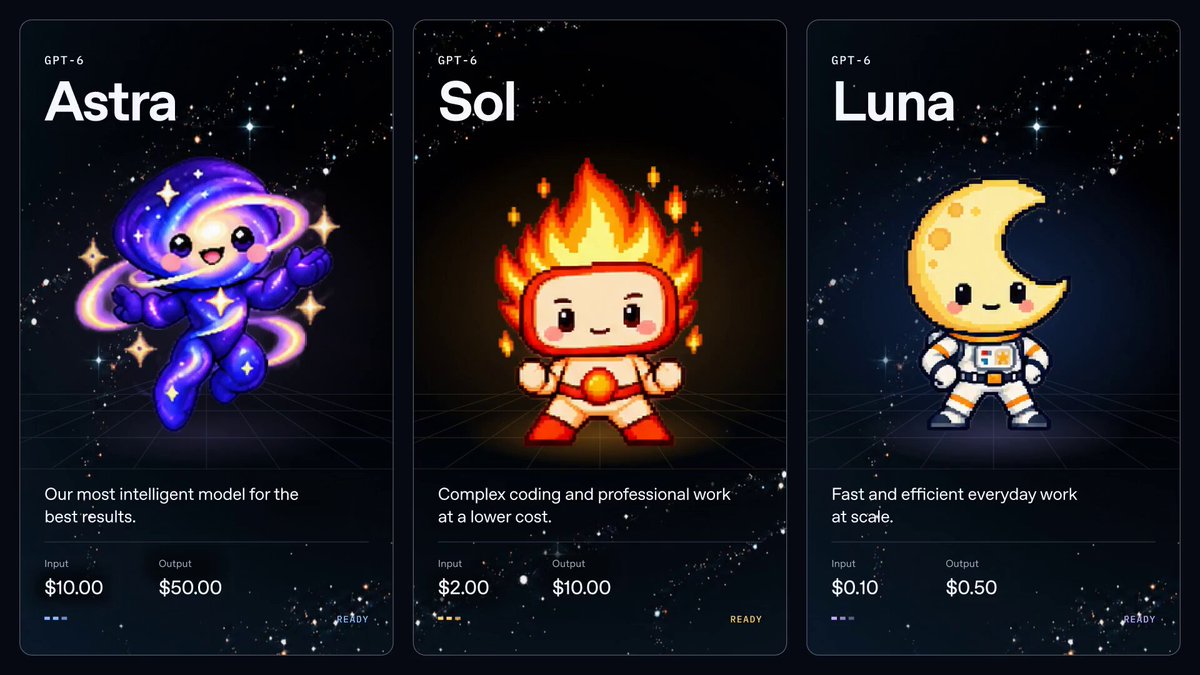 OpenAI launches GPT-6 Sol and GPT-6 Luna, bringing GPT-6 Astra’s advances to faster, more affordable models built for work at scale
 OpenAI forms independent math advisory group to guide AI research standards, result disclosures and tools for mathematical research and learning
Sources
18 records from 8 domains
help.openai.com
openai.com
channelnewsasia.com
wheresyoured.at
youtube.com
facebook.com
instagram.com
x.com
Community notes
Spot something off or out of date? Drop a note. Editors review topic notes daily and roll accepted fixes into the explainer — contributors are recognized in the monthly $SQUID drop.
Loading notes…
Help improve this topic
Have a story or tip about this topic? Submit it. See something missing? Leave a note. Editors review daily; accepted submissions and fixes count toward the monthly $SQUID drop.