
ChatGPT is OpenAI's AI chatbot that pioneered conversational AI at scale. This explainer covers its architecture, crypto integrations (MoonPay, Base MCP, AI agents), competitive landscape, and regulatory risks for a Web3 audience.
+8 sources across the wider coverage universe
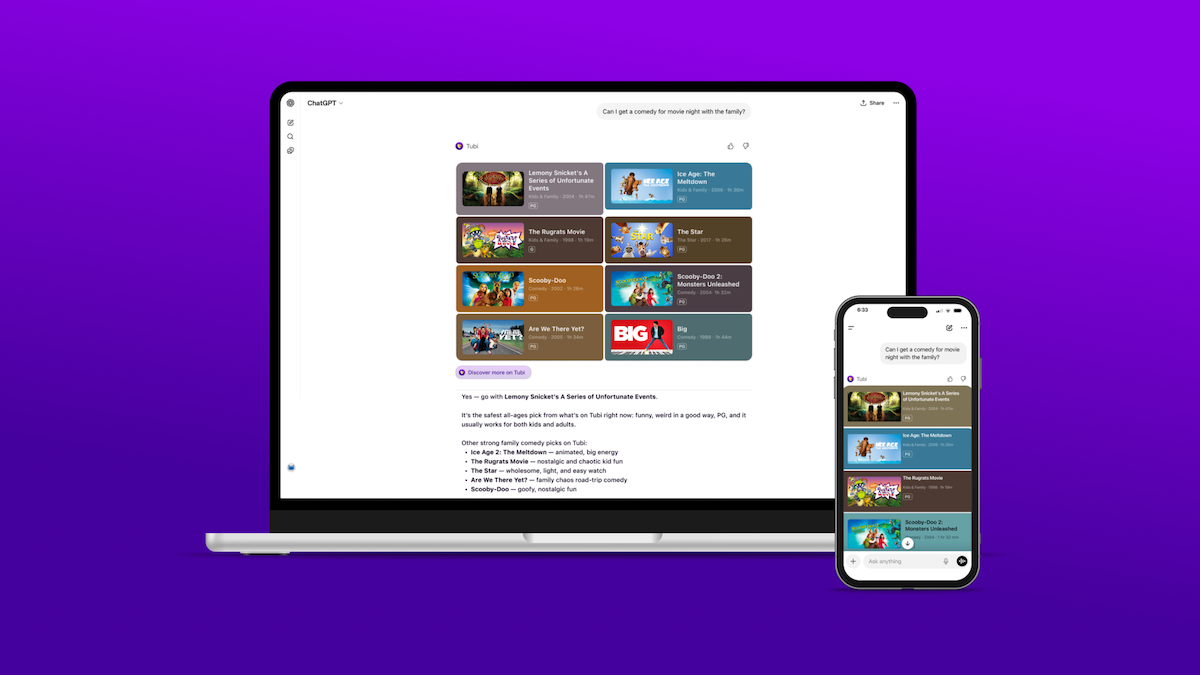 Tubi becomes first streamer to launch native app inside ChatGPT, unlocking discovery across 300K+ movies and TV episodes2026-04
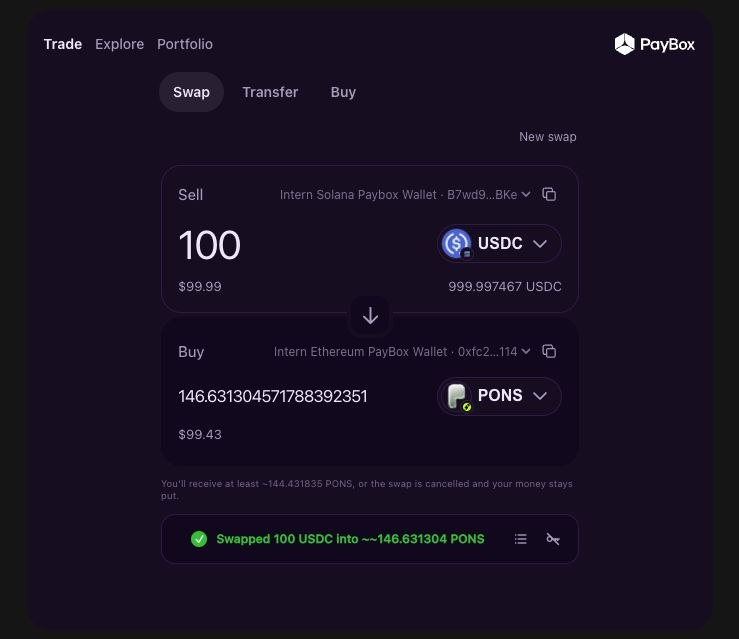
 MoonPay launches PayBox, letting ChatGPT and Claude initiate crypto and card payments through an AI vault secured with MPC, passkeys and user-defined spending limits2026-07
 Coinbase’s Base launches Base MCP, enabling ChatGPT, Claude and Cursor users to manage crypto wallets and interact with DeFi apps through AI agents2026-05
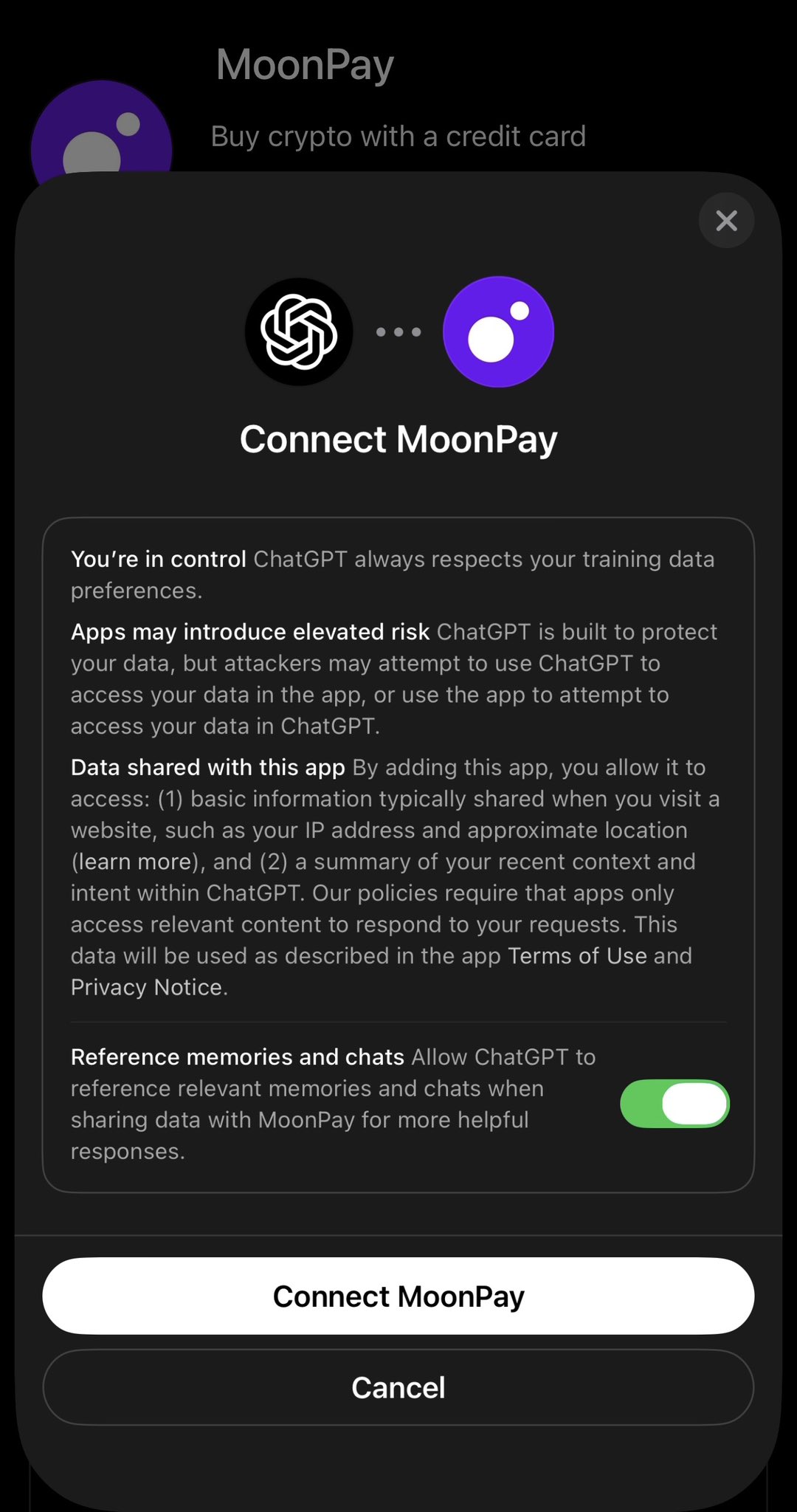 MoonPay launches inside ChatGPT’s App Store, becoming the first crypto onramp integrated directly into OpenAI’s platform with Apple Pay token purchases2026-05
 OpenAI releases Privacy Filter model to strip sensitive data like passwords and addresses locally before ChatGPT use, boosting on-device AI privacy protection2026-04
 OpenAI launches pay-per-click ads inside ChatGPT, entering digital advertising and challenging Google and Meta for ad spend in AI-driven search2026-04
An AI chatbot developed by OpenAI and first released to the public in November 2022, ChatGPT rapidly became the fastest consumer application to reach 100 million users — and has since evolved from a simple conversational tool into a platform with serious implications for crypto, finance, and autonomous software agents.
What ChatGPT Is and How It Works
ChatGPT stands for Chat Generative Pre-trained Transformer. It is a large language model (LLM) interface built on OpenAI's GPT series of foundation models — GPT-3.5 at launch, GPT-4 variants thereafter, and most recently the GPT-4o multimodal model and the GPT-4.1 series. These models are trained on vast corpora of text using a technique called reinforcement learning from human feedback (RLHF), which steers the model toward responses that human raters judge as helpful and accurate.
The chatbot accepts text (and in newer versions, images, files, and voice) as input and generates a response in natural language. It does not browse the internet by default in its base form, though tool-use capabilities and plug-ins have steadily expanded what it can access. Crucially, ChatGPT has no persistent memory across separate conversations unless explicitly configured — a limitation that has spawned a class of third-party "memory layer" tools and, in mid-2026, renewed interest in cross-model context solutions that let a user's preferences follow them between ChatGPT, Claude, and other chatbots.

Robinhood Chain tokens can now be traded directly inside Claude, ChatGPT, and Grok via PayBox
OpenAI and the Competitive Landscape
OpenAI, the San Francisco-based research company behind ChatGPT, was founded in 2015 as a non-profit before restructuring into a "capped-profit" entity that has attracted investment from Microsoft, venture firms, and sovereign funds at valuations exceeding $150 billion as of 2025. The company has been preparing documentation for a potential IPO, which has pushed several product decisions — including the reported overhaul of ChatGPT into a so-called "superapp" encompassing chat, coding, AI agents, and daily workflow tools — to move faster than the underlying research roadmap might otherwise dictate.
The competitive field has narrowed to a genuine race. Anthropic's Claude, Google's Gemini, xAI's Grok, Meta's Llama-based products, and Chinese entrants including Xiaomi's MiMo (benchmarked in mid-2026 as significantly faster than both ChatGPT and Claude on certain inference tasks) have each eaten into ChatGPT's early dominance. Recent coverage confirms that while ChatGPT remains the category leader by name recognition and user count, rival AI chatbots are closing the gap in capability benchmarks and user adoption. The instruction frameworks that underlie these competing systems — their system prompts and behavioral guardrails — were partially exposed through a series of leaks in 2026, revealing differing editorial philosophies between OpenAI, Anthropic, and others on topics from political neutrality to content moderation.
Leviathan readers are drawn to ChatGPT not as a productivity story but as a trust-layer stress test — the highest-engagement angles all involve AI undermining or augmenting gatekeeping mechanisms that crypto relies on: KYC verification, smart contract audits, and investment due diligence.
ChatGPT and Crypto: A Growing Intersection
The relationship between ChatGPT and the cryptocurrency ecosystem has moved from tangential to structural over 2025–2026. Several integrations are now live or in active deployment.
MoonPay inside ChatGPT. MoonPay launched directly inside ChatGPT's App Store, becoming the first crypto onramp integrated natively into OpenAI's platform. Users can purchase Bitcoin, XRP, and other assets using Apple Pay through direct checkout links generated within a conversation. Security researchers and commentators have flagged new risk vectors here: a chatbot UI is a different threat surface than a standalone exchange, raising questions about phishing via prompt injection, unclear liability if a transaction goes wrong, and whether users fully understand they are moving real capital through an AI interface.
Base MCP and onchain AI agents. Coinbase's Ethereum Layer 2 network Base announced the Base Model Context Protocol (MCP), a bridge that allows AI agents running on ChatGPT, Claude, Cursor, and other LLM interfaces to manage crypto wallets and interact with DeFi applications directly. The MCP standard, originally developed by Anthropic, functions as a standardized API layer letting language models call external tools — in this case, onchain actions. The practical implication is that a user could, in principle, instruct ChatGPT to execute a DeFi swap or check a wallet balance without leaving the chat interface.
Autonomous trading agents. Projects like Virtuals Protocol have built integrations connecting ChatGPT, Claude, and similar models to onchain trading infrastructure including Hyperliquid perpetuals markets. These "AI agents" can, with user authorization, place trades autonomously within defined parameters. The category raises unresolved questions about accountability: when an AI agent places a losing trade, who bears responsibility — the model provider, the integration layer, or the user? Platforms like Co-Invest, which tie trading signals to ChatGPT and Claude outputs, have drawn scrutiny for risk disclosure practices.
Token-gated AI access. Several Web3 projects have moved to use crypto tokens as a payment and access layer for AI model APIs. One example is the $PROS token, which along with USDC can be used to access a Model-as-a-Service (MaaS) platform offering ChatGPT, Claude, Gemini, DeepSeek, and Qwen under a single interface — with a claimed discount for token payments at launch. This model positions crypto as infrastructure for AI consumption rather than a use case for AI to analyze.
- 01AI-forged KYC bypass
The top-clicked story — a forged AI passport passing exchange identity checks — crystallized a concrete, demonstrable threat to the KYC compliance layer that onboards users into regulated crypto platforms.
- 02DeFi MCP agent integrations
Multiple clicks coalesced around Dune, Pendle, and Coinbase Base launching MCP integrations that let ChatGPT autonomously query on-chain data, hunt yields, and execute DeFi strategies — framing AI agents as active DeFi participants.
- 03Crypto onramps inside ChatGPT
PayPal and MoonPay embedding directly into the ChatGPT interface signals a distribution shift where AI chat becomes the primary surface for crypto purchasing, collapsing the funnel from discovery to transaction.
- 04Smart contract security via AI
Researchers using ChatGPT to analyze unverified bytecode — paired with Immunefi's bug bounty flood after ChatGPT's launch — surfaced the dual-use nature of AI in security: both audit tool and exploit accelerant.
- 05AI retail investment risk
Headlines about ChatGPT giving bullish market calls, retail investors using it to pick stocks, and MIT warnings about cognitive offloading resonated with a readership alert to overconfidence dynamics in speculative markets.
- 06OpenAI corporate trajectory
The Microsoft equity renegotiation and IPO signals pulled clicks because OpenAI's ownership structure and capital relationships directly shape which AI capabilities reach crypto builders and at what cost.
Financial Data and the "Super App" Pivot
OpenAI has undergone a significant internal reorganization, placing co-founder Greg Brockman in charge of products, elevating the head of Codex (its code-generation model) to lead core platform work, and expanding ChatGPT's enterprise product leadership. The timing aligns with a push to grow revenue before a potential public offering.
ChatGPT Enterprise, aimed at business customers requiring data privacy guarantees and higher usage limits, was launched as a paid tier with organization-level controls. The "superapp" framing — positioning ChatGPT not as a standalone chatbot but as a layer through which users conduct coding, research, communication, and financial tasks — reflects a strategic bet that the moat is not the model itself (which competitors can approximate) but the workflow integration.
The bank account integration announced in 2026, which allows ChatGPT to read financial data with user permission via open banking connectors, extends this logic further. The feature enables the model to provide personalized budgeting or financial analysis without requiring manual data entry — though it introduces a new category of privacy and regulatory questions about what AI companies can do with sensitive financial information.
OpenAI adds email, calendar, and Slack plugins to ChatGPT Voice, powered by GPT-6 models

Safety, Legal Exposure, and Research Integrity
ChatGPT's rapid adoption has outpaced regulatory and legal frameworks. Florida filed a lawsuit against OpenAI and CEO Sam Altman in 2026 over safety-related claims, citing concerns about the mental health impact of the chatbot and allegedly misleading public statements about safety measures. OpenAI has responded by rolling out new safety features — including updated content policies and age-verification mechanisms — as the litigation landscape continues to develop.
On the research side, a 2026 study on ChatGPT's use in education was retracted following methodological concerns, surfacing a broader issue: the academic literature on AI adoption is being produced faster than peer review can validate it, particularly as the systems being studied are themselves updated continuously. A model evaluated in January may behave meaningfully differently by July, making longitudinal comparisons difficult.
GPT-5 rumors have circulated throughout 2026, with users reporting subjective improvements in reasoning quality and anecdotal claims of a capability step-change, though OpenAI has not officially confirmed a GPT-5 release timeline as of mid-2026. OpenAI has also announced improvements to health-related query handling in ChatGPT, working with medical advisors to make the model's responses to health questions more accurate and appropriately hedged.
OpenAI has also partnered with the government of Malta to offer all citizens one year of free ChatGPT Plus access following completion of an AI literacy course — an early example of a nation-state treating AI access as a public utility or civic investment.
- 2022-11launch
ChatGPT public launch triggers Immunefi bug bounty flood
- 2023-08launch
ChatGPT Enterprise launched for business users
- 2024-06launch
DeFi Llama plugin enables non-technical DeFi data queries via ChatGPT
- 2025-03milestone
Dune MCP integration connects crypto data platform to ChatGPT and Claude
- 2025-04launch
MoonPay becomes first crypto onramp inside ChatGPT App Store
- 2025-05launch
Pendle launches AI Skills and MCP for autonomous DeFi yield execution
- 2025-06launch
Coinbase Base MCP enables wallet management and DeFi via ChatGPT agents
- 2025-09governance
OpenAI and Microsoft begin renegotiating multibillion-dollar partnership ahead of potential IPO
Understanding the Underlying Architecture
For readers less familiar with how these systems work, a few definitions are useful:
- Large language model (LLM): A neural network trained to predict and generate text, capable of following instructions, answering questions, writing code, and more.
- System prompt: A hidden set of instructions that shapes how a chatbot behaves before the user types anything. Leaked system prompts from ChatGPT, Claude, Grok, and others in 2026 revealed that each company has made different editorial choices about tone, political neutrality, and what the model should refuse to do.
- Model Context Protocol (MCP): A standardized interface allowing LLMs to call external tools, APIs, and services — including onchain applications — as part of a conversation.
- AI agent: A model configuration where the LLM can take multi-step actions autonomously (browse, write code, execute trades) rather than just responding to a single prompt.
Outlook
ChatGPT's trajectory over the next 12–24 months is likely to be shaped by three converging pressures: competitive commoditization of the underlying models, regulatory scrutiny from multiple jurisdictions, and the question of whether the "superapp" model generates durable revenue or gets undercut by open-source alternatives.
For the crypto sector specifically, the integration story is moving quickly. MCP-based onchain agents, token-gated AI access, and in-chat financial transactions are all live experiments with unclear regulatory status. Whether these integrations deepen or get curtailed by compliance requirements — in the US, EU, or at the platform level — will determine how much of this infrastructure survives in its current form.
What is unlikely to reverse is the expectation, now set among tens of millions of users, that AI assistance should be ambient and context-aware rather than a discrete tool you open and close. ChatGPT set that expectation; the rest of the industry, and increasingly the financial sector, is now building around it.
Latest ChatGPT news
Community notes
Spot something off or out of date? Drop a note. Editors review topic notes daily and roll accepted fixes into the explainer — contributors are recognized in the monthly $SQUID drop.
Loading notes…
Help improve this topic
Have a story or tip about this topic? Submit it. See something missing? Leave a note. Editors review daily; accepted submissions and fixes count toward the monthly $SQUID drop.