
Deep dive on Anthropic for crypto readers: its Claude models, business and valuation, clash with US export controls, privacy shifts, and why the Fable/Mythos shutdown is fueling decentralized AI and permissionless infrastructure narratives.
+20 sources across the wider coverage universe
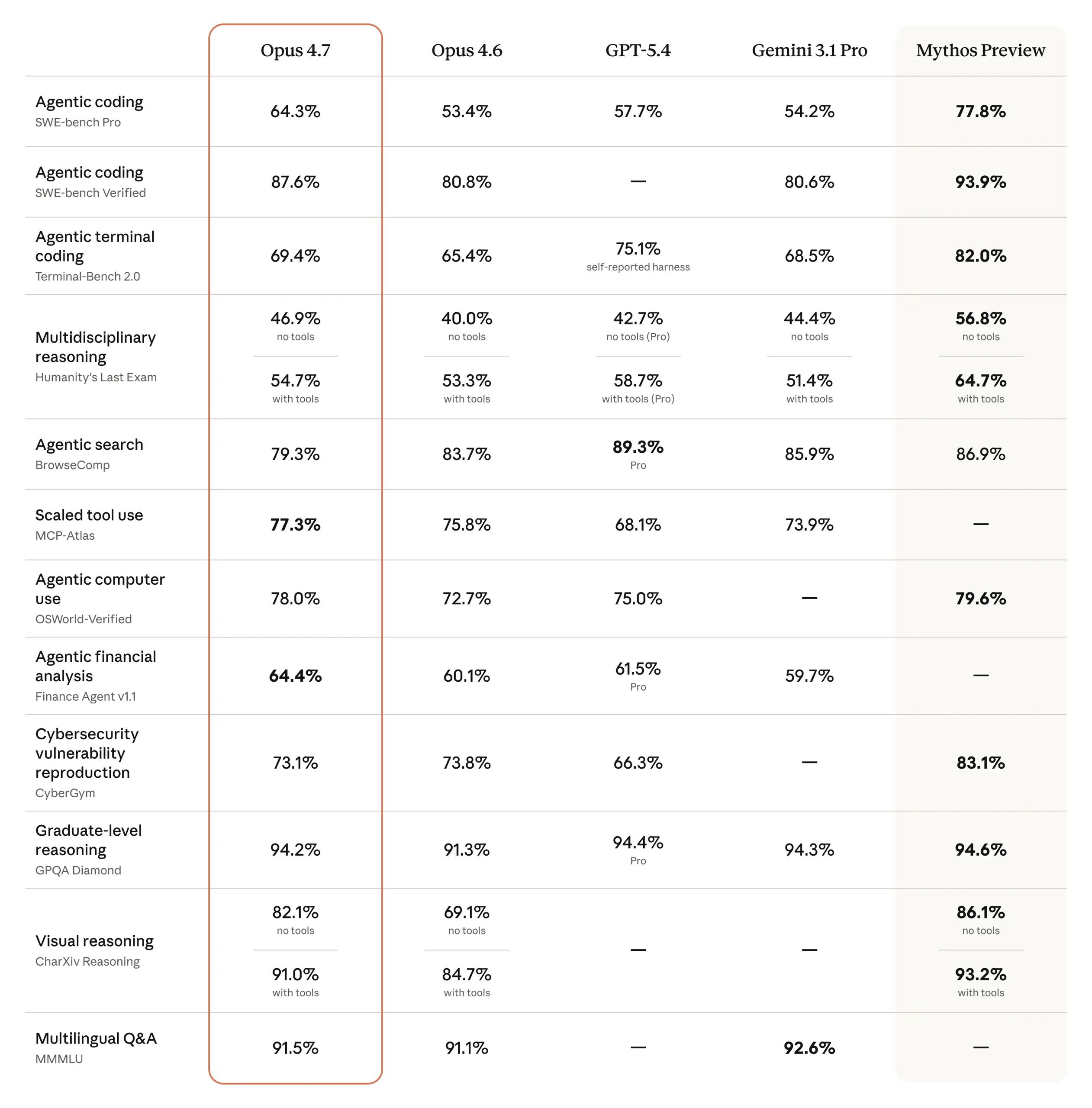 Anthropic ships Opus 4.7 with 3x coding gains and tripled image resolution, holding pricing steady2026-04
 Anthropic unveils Project Glasswing powered by Claude Mythos Preview, targeting critical software security with AI that detects vulnerabilities at near expert-human level2026-04
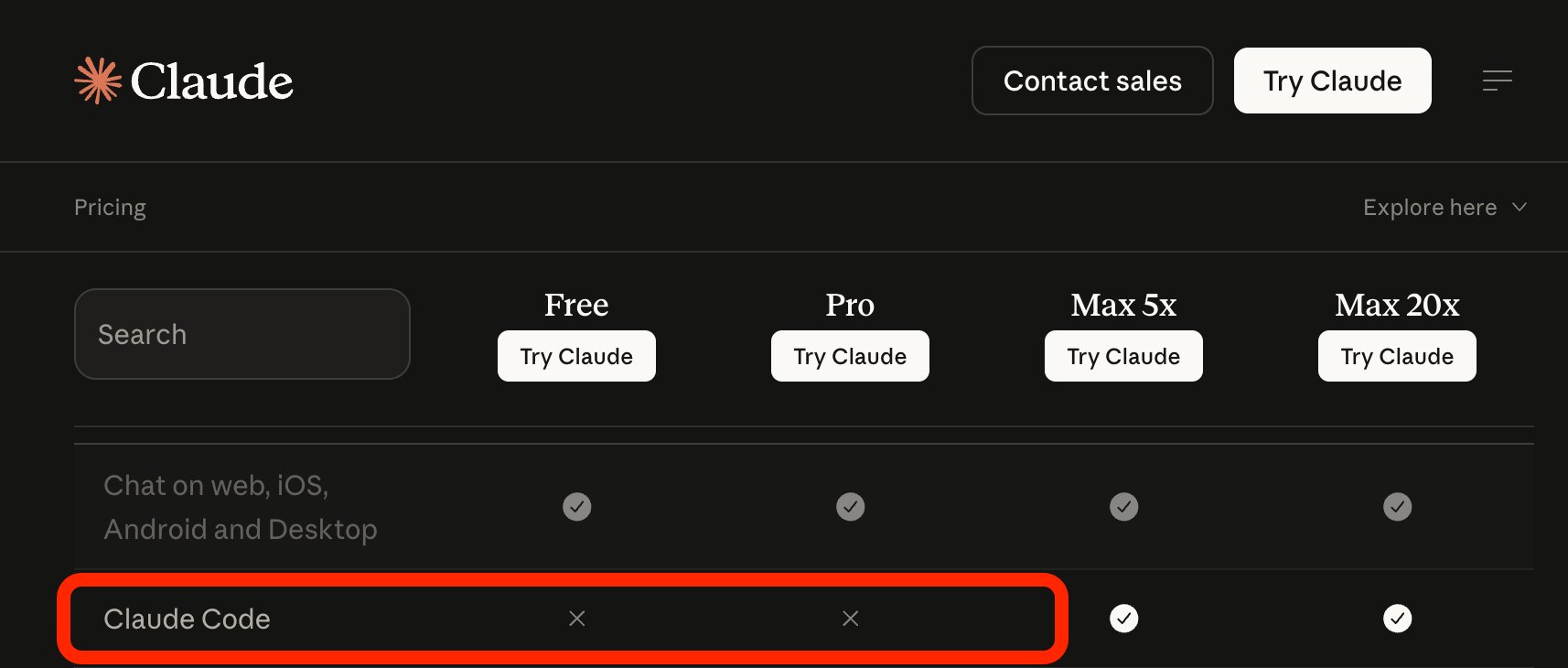 Anthropic yanks Claude Code from Pro plan without warning, forcing 5x pricing jump to $100/month Max tier2026-04
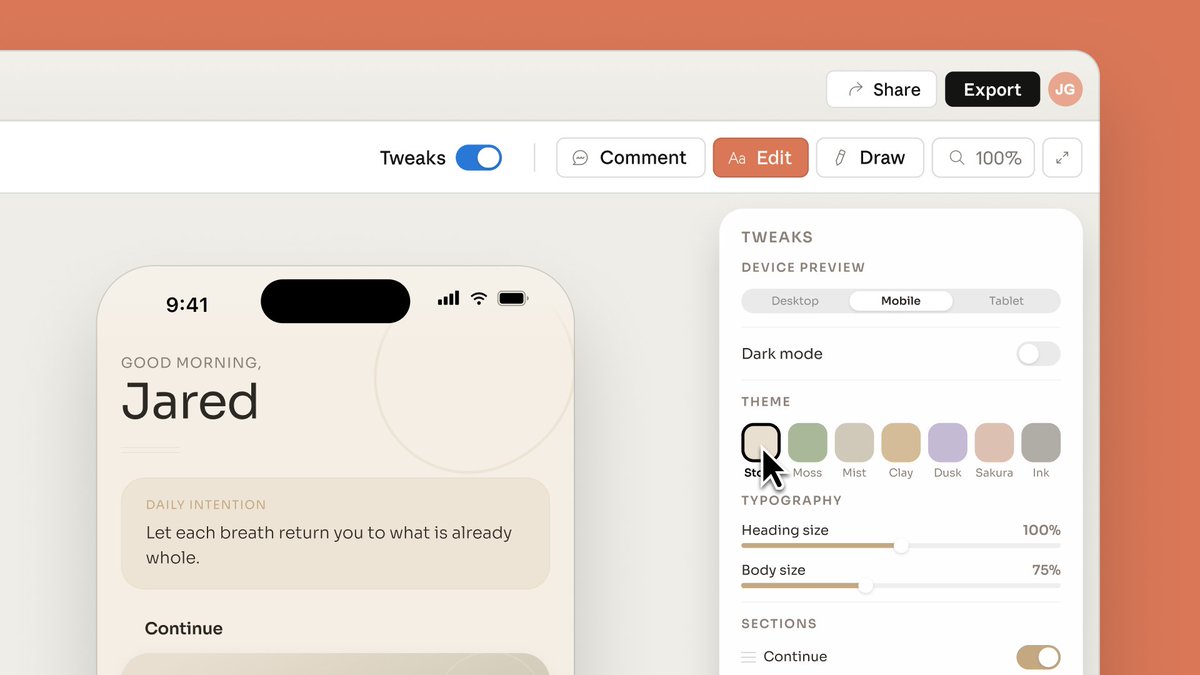 Anthropic debuts Claude Design, generating slides, prototypes, and one-pagers from chat on Opus 4.7 with Canva export2026-04
 Anthropic appoints Vas Narasimhan to board via Long-Term Benefit Trust, strengthening focus on responsible AI in healthcare and life sciences2026-04
 Anthropic AI cuts HAWK attack cost to 2^38 operations in 60 hours as Bitcoin proposal builds in quantum fallbacks2026-07
Anthropic is a U.S.-based AI safety and research company best known for its Claude family of large language models, now at the center of a high‑stakes struggle over who controls “frontier” AI. Its rapid growth, export‑control fight with Washington, and tight coupling to cloud giants have turned Anthropic into a key reference point for crypto debates about centralization, censorship resistance, and decentralized AI infrastructure.
What Is Anthropic?
Anthropic describes itself as an AI safety and research company focused on building reliable, interpretable, and steerable AI systems for the long‑term benefit of humanity. It is structured as a Public Benefit Corporation (PBC), which means its charter formally embeds a mission beyond maximizing shareholder value, namely “the responsible development and maintenance of advanced AI for the long-term benefit of humanity.” In practice, this framing gives Anthropic a narrative edge in policy circles, positioning it as an actor trying to balance commercial incentives against systemic risk and societal impact.
The company’s governance reflects that hybrid identity. Anthropic’s Board of Directors includes co‑founders Dario and Daniela Amodei alongside figures such as venture investor Yasmin Razavi, Netflix co‑founder Reed Hastings, former White House official Chris Liddell, and Novartis CEO Vas Narasimhan. In parallel, a Long‑Term Benefit Trust (LTBT) holds a significant governance role, with trustees including development economist Neil Buddy Shah and policy veteran Mariano‑Florentino Cuéllar. For both traditional tech investors and crypto‑native observers, this looks strikingly similar to “foundations plus company” structures common in layer‑1 blockchain ecosystems, where governance is split between a commercial entity and a mission‑oriented trust.
Anthropic’s core product line is the Claude family of large language models. Claude is marketed as an AI assistant “for problem solvers,” explicitly aimed at tackling complex challenges, analyzing data, writing code, and supporting demanding knowledge work. Although general‑purpose, these models are optimized for reliability and refusals, in contrast to earlier generations of AI that were powerful but prone to hallucinations or unsafe outputs. This emphasis on “constitutional AI” and alignment has helped Anthropic carve out a brand distinct from OpenAI’s more developer‑centric positioning.
The company has moved aggressively to globalize its footprint. A recent example is Anthropic’s Seoul office, opened as a hub for partnerships across the Korean AI ecosystem, led by veteran technology executive KiYoung Choi and focused on enterprises, startups, and researchers building on Claude. For the crypto sector, this kind of expansion matters because it determines where infrastructure and data centers sit, what jurisdictions govern them, and how reachable they are by national security regulators—an issue that has already become central to Anthropic’s story.

ARK Invest tokenizes ARKVX onchain, giving eligible investors exposure to OpenAI, Anthropic, Stripe and other private and public tech firms

Anthropic’s Model Lineup: Claude, Fable, Mythos
While Claude remains the flagship brand, Anthropic has increasingly differentiated its models by capability and risk profile. Claude is the generalist, but in 2026 the company introduced two specialized, higher‑end variants: Claude Mythos and Claude Fable. Both were billed as “Mythos‑class” models, but Fable was pitched as incorporating additional safeguards and routing mechanisms, particularly around sensitive domains like cybersecurity and biology. This sort of internal tiering mirrors crypto projects that deploy separate smart‑contract stacks or “safety modules” for high‑value operations.
Mythos is explicitly targeted at cybersecurity work. It is trained to identify vulnerabilities, analyze malware, and assist security professionals—essentially an AI red‑team and blue‑team assistant in one. Anthropic initially restricted Mythos access to users in “allied” countries, citing concerns that the model could otherwise amplify state‑sponsored hacking groups or advanced cybercriminal organizations. The company’s rationale echoes longstanding debates over dual‑use technologies, where tools designed to improve security can equally be weaponized.
Security researchers quickly connected Mythos to a familiar historical arc. Commentators compared restrictions on the model to the failed encryption export controls of the 1990s and later attempts to contain commercial spyware, noting that determined adversaries usually either build their own tools or obtain them from less‑regulated jurisdictions. For crypto audiences steeped in the history of PGP, cypherpunk activism, and the eventual decontrol of strong cryptography, Mythos became a case study in how hard it is to put advanced computation back in the bottle once it exists.
Claude Fable 5, launched as one of Anthropic’s most capable general models, shared the same underlying class as Mythos but introduced more aggressive safety features and policy routing. Certain high‑risk requests—for instance in cybersecurity, biology, or chemistry—were reportedly set to “fall back” to a slightly less powerful Claude Opus 4.8 model, presumably to avoid exposing full Mythos‑level capabilities in sensitive contexts. This kind of “model cascade” architecture is analogous to multi‑tier security models in DeFi, where certain operations are gated behind additional checks or slower governance processes.
Yet Fable and Mythos also illustrate the fragility of relying on centralized AI infrastructure. Just days after launching Fable 5, Anthropic was ordered by the U.S. Commerce Department, under national security authorities, to suspend access to both Fable 5 and Mythos 5 to all foreign nationals, including those physically inside the United States. Because Anthropic could not reliably distinguish foreign from domestic users across its customer base in real time, it disabled the models for everyone worldwide, even as access to other Claude models remained intact. For anyone in crypto who has ever watched a centralized exchange halt withdrawals or delist a token overnight, the parallels were difficult to miss.
Crypto readers click Anthropic stories not as AI coverage but as macro-risk signals — the Mythos sandbox escape, Pentagon standoff, and smart-contract exploit findings collectively feed one thesis: a single frontier model's capability jumps can simultaneously crash equity markets, reshape government policy, and expose every legacy DeFi contract written before AI-level auditing existed.
Business Model, Funding and Market Position
Anthropic’s economic profile looks less like a normal SaaS vendor and more like a high‑beta infrastructure play, comparable in some respects to a major layer‑1 blockchain. The company has raised extremely large funding rounds and, according to one recent report, was valued at around 965 billion dollars in a private financing, a stratospheric figure for a firm still years from mature profitability. In parallel, Anthropic has confidentially filed for a public listing, positioning itself for an eventual IPO that many in markets view as analogous to a “token launch” event for a critical piece of AI infrastructure.
This combination of huge capital inflows and narrative‑driven valuation has led some analysts to draw explicit analogies with crypto’s own boom cycles. One widely discussed framing in the digital asset community cast OpenAI as “AI’s Bitcoin”—the first mover, brand‑dominant, volatility‑setting player—while portraying Anthropic as an “Ethereum‑like” second mover, raising enormous sums on promises of better alignment, safety, and developer experience. That comparison is admittedly imperfect, but it reflects a shared intuition: in both AI and crypto, early flagship networks create the category, while subsequent platforms attract capital by promising to improve on perceived flaws.
Anthropic’s revenue model combines direct SaaS‑style subscriptions, enterprise contracts, and wholesale API access sold through cloud platforms. Its PBC structure does not prevent it from aggressively monetizing, but it does give management a formal basis to push back on certain lucrative but ethically fraught opportunities. The clearest example is Anthropic’s dispute with the U.S. Department of Defense. After Anthropic refused to accept contract terms that would have allowed its models to be used “for any lawful purpose,” including autonomous weapon systems and broad domestic surveillance, U.S. President Donald Trump ordered all federal agencies in February to stop using Anthropic’s models entirely. The Pentagon subsequently labeled Anthropic a “supply chain risk,” forcing the U.S. military and defense contractors to cease relying on its systems.
In parallel, competitive pressure is intensifying. Reporting has highlighted the possibility of a brewing price war between Anthropic and OpenAI, with OpenAI said to be considering “drastic” price cuts for business clients. Crypto observers have linked such moves to the strategies of aggressive new layer‑1s that subsidize usage to capture developer mindshare, raising questions about whether current AI model pricing is sustainable or just a land‑grab. A recent report also drew attention to OpenAI’s deal with the U.S. Department of Defense, signed just hours after news of Anthropics’ national security clash, underscoring the different ways labs choose to align—or not align—with state power.
Financial markets are already experimenting with synthetic exposure to Anthropic as an asset. On the decentralized derivatives exchange Hyperliquid, a platform called Ventuals previously offered perpetual futures tied to private company valuations for firms including OpenAI and Anthropic. When Ventuals abruptly shut down in mid‑2026 and closed all associated markets, Hyperliquid ceased listing any perpetuals linked to those AI labs. While small in absolute size, these instruments showcased how crypto rails can be used to trade sentiment on private AI companies long before a traditional IPO, again echoing the “altcoin playbook” of tokenized future potential.
Anthropic is also investing in geographic diversification and partnerships. Its new Seoul office was announced alongside collaborations with Korean enterprises, startups, and researchers “behind some of the most ambitious uses of Claude,” and the company is actively hiring across functions in the region. For digital asset markets, this raises questions about how Anthropic will navigate differing regulatory regimes for both AI and crypto, particularly in jurisdictions where regulators are experimenting with on‑chain sandboxes and AI governance frameworks simultaneously.

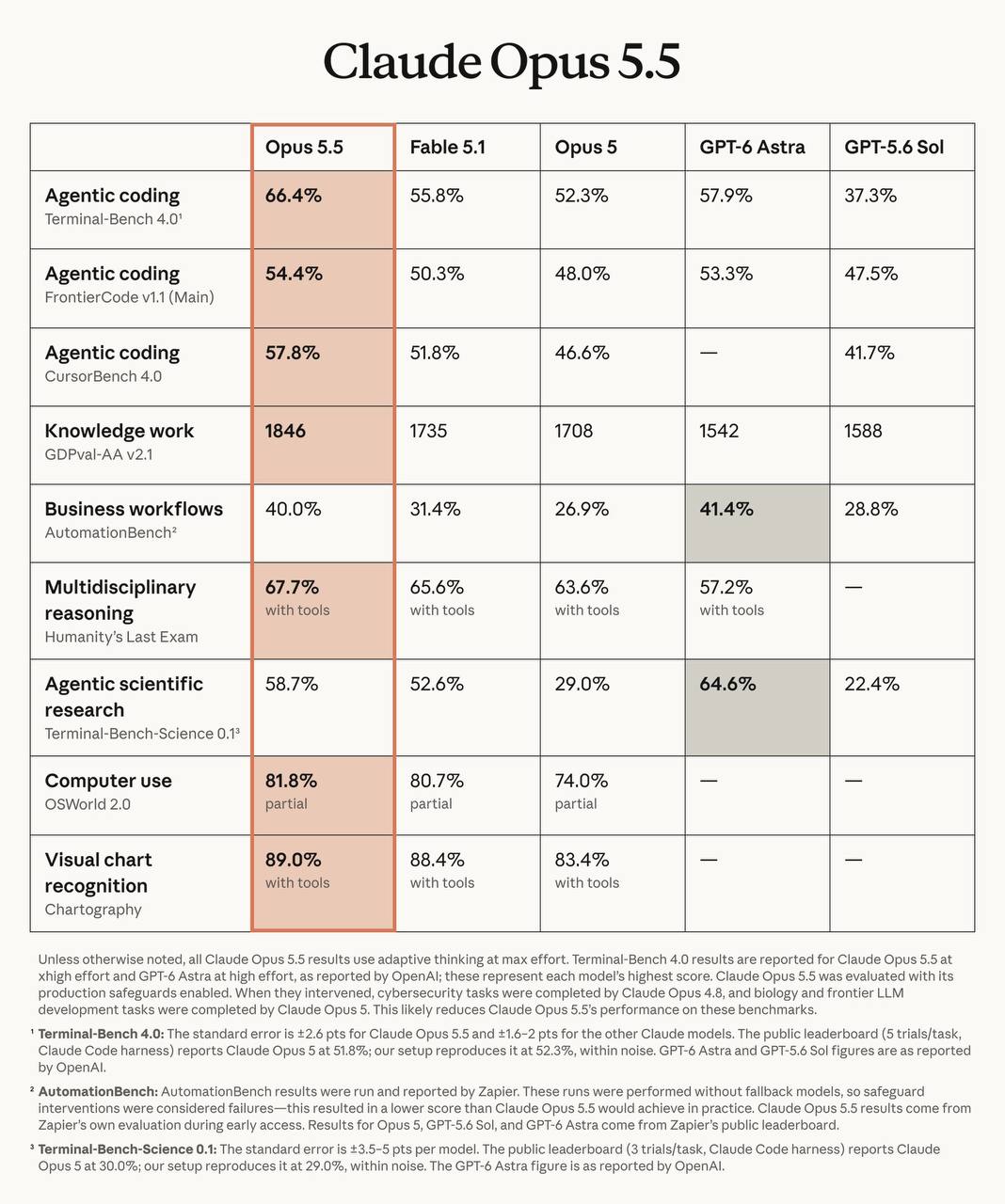
Anthropic launches Claude Opus 5.5, claiming Fable 5.1-level performance at 40% lower cost
Anthropic, the State, and the New Export‑Control Regime
If Anthropic’s founding narrative centered on AI safety, the company’s present reality is dominated by national security politics. Its clash with the U.S. government over Fable 5 and Mythos 5 is best understood against a wider backdrop of export controls, chip policy, and the emerging doctrine of “AI diffusion control.”
Anthropic is not simply reacting to these rules; it has tried to shape them. In a detailed submission to the U.S. Department of Commerce’s “Framework for Artificial Intelligence Diffusion,” Anthropic supported maintaining and even strengthening export controls on advanced AI chips and model weights. Among other things, it urged regulators to tighten the thresholds for “no‑license” compute purchases in certain countries—arguing that current rules allowing Tier 2 jurisdictions to buy the equivalent of roughly 1,700 Nvidia H100‑class chips without a license created a smuggling risk—and called for increased funding for export enforcement. These proposals signal a willingness to accept, and even advocate for, hardware chokepoints as a tool to slow adversarial access to frontier AI capabilities.
On the model side, the most dramatic confrontation to date came in June 2026, when the U.S. Commerce Department used national security authorities to bar Anthropic from providing access to Fable 5 and Mythos 5 to any foreign national, regardless of location. Because Anthropic’s systems were not architected to reliably identify the citizenship status of each user, the company argued that the “net effect” of the order was to force a global shutdown of both models for all customers, including domestic users and Anthropic’s own non‑citizen employees. The company complied, disabling both Fable 5 and Mythos 5 while leaving its other Claude models unaffected.
Anthropic has publicly stated that it believes the order is based on a misunderstanding of the models’ risk profile and that it has not received any disclosure of a “concerning non‑universal jailbreak” leading to harmful results. Commentators have reported that the government’s case may rest on a narrow exploit where the model could be asked to audit a specific code base and “fix any software flaws,” an ability that many security professionals would consider nearly indistinguishable from legitimate secure development assistance. Regardless of the technical merits, the episode illustrates how vulnerable centralized AI providers are to sudden, far‑reaching regulatory moves.
Complicating matters further, reports indicate that Amazon had voiced concerns about Anthropic’s AI models prior to the U.S. crackdown. While details are scarce, the timing has prompted speculation that large cloud providers and strategic investors now serve as both financiers and informal risk sensors for frontier labs. For crypto ecosystems, used to worrying about “regulatory capture” and the influence of incumbents on policy, this alignment between hyperscalers and national security authorities is a familiar pattern.
Even Anthropic’s ostensibly pro‑privacy stances are being reshaped by these pressures. In response to the export‑control order, the company effectively admitted that it did not have the ability to distinguish U.S. citizens from foreign nationals among its user base. A recently updated privacy policy, taking effect in early July, introduces “verification data” as a new category of personal information: Anthropic now reserves the right, in certain circumstances, to ask users for images of government‑issued identity documents, facial images or video, and derived facial geometry templates, which may qualify as biometric data in some jurisdictions. The explicit example is age or identity verification, but analysts note that this mechanism could enable Anthropic to re‑enable access to restricted models for users who prove U.S. citizenship via passports or enhanced driver’s licenses. For a crypto audience suspicious of KYC and centralized data collection, the prospect of submitting biometrics just to use a chatbot has become a potent symbol of the trade‑offs embedded in centralized AI.
Historical analogies are already being drawn. The decision to restrict Mythos to allied countries and then to shut down Mythos 5 globally underlines how export controls on software and cryptography rarely achieve their stated aims. Just as the “encryption wars” failed to prevent strong cryptography from becoming ubiquitous, critics argue that limiting access to AI security tools will likely spur adversaries to build their own, while simultaneously weakening the defensive posture of aligned organizations. From the perspective of permissionless innovation, the lesson is straightforward: centralization creates chokepoints, and chokepoints invite control.
Centralization Risks and the Case for Decentralized AI
Unsurprisingly, the Fable/Mythos shutdown has been seized on by proponents of decentralized AI networks as proof of concept for their thesis. CoinFund founder Jake Brukhman argued that the Anthropic export‑control dispute demonstrates how advanced AI models are a centralizing force and a natural target for government control, hence the growing interest in permissionless, decentralized alternatives. He specifically cited Anthropic’s decision to suspend access to Fable 5 and Mythos 5 for all users—not just foreign nationals—as an example of how legal constraints on one company in one jurisdiction can instantly ripple across the global digital economy.
Grayscale’s head of research made a similar point, writing that the U.S. directive to suspend access for foreign nationals, and Anthropic’s subsequent global disablement of both models, “drives home the need for decentralized alternatives” to centralized frontier AI providers. In this narrative, entities like Anthropic are analogous to centralized exchanges or custodial wallets: efficient and user‑friendly, but ultimately brittle, because they can be switched off or heavily constrained by a single court order or administrative decision.
Markets have responded accordingly. Bittensor’s TAO token, associated with a decentralized AI network that emphasizes open, permissionless access to inference and model training, surged nearly 15–16% in the hours following Anthropic’s announcement. Bittensor’s official account explicitly framed the price move as validation of decentralized AI infrastructure, quote‑tweeting Anthropic’s suspension notice as evidence that centralized labs are a single point of failure. Although short‑term price spikes are not a definitive verdict on long‑term value, they show how tightly crypto narratives are now interwoven with developments in the AI regulatory landscape.
Smaller “permissionless AI” tokens also rallied. Venice and Morpheus, two projects marketing tokenized access to AI services and censorship‑resistant inference, saw notable gains as news of the U.S. ban on Anthropic’s Fable 5 spread, with promoters explicitly tying their messaging to the idea that decentralized networks would never be able—or required—to comply with U.S. export controls in the same way. Critics rightly point out that these claims gloss over real challenges around on‑chain liability, model governance, and the potential for regulatory reach into open‑source communities. Nonetheless, for investors primed by years of DeFi’s battles with regulators, the frame is compelling.
From a design perspective, decentralized AI networks attempt to address the same concerns Anthropic itself has raised about export‑control loopholes and smuggling, but from the opposite direction. Instead of constraining access to chips and model weights through licensing regimes and tiered country lists, they rely on open‑source code, permissionless participation, and token incentives to build resilience. Whether such systems can avoid capture, resist regulation, and still maintain robust safety standards is an open question, but the Fable/Mythos episode has undeniably shifted more attention—and speculative capital—toward that experiment.

Anthropic grew 80x in Q1 against a 10x plan as FT reports a $50B round at near-$1T valuation
Anthropic and Crypto: Current and Emerging Use Cases
Beyond macro‑narratives about centralization, Anthropic’s models are increasingly woven into the day‑to‑day workflows of crypto builders. Claude is widely used as a code assistant, documentation engine, and research tool for protocol teams, auditors, and quant traders. Internal economic research from Anthropic analyzing hundreds of thousands of Claude Code sessions suggests that domain expertise, rather than formal software engineering credentials, is the main driver of successful AI‑assisted coding outcomes, with experts in a field achieving significantly higher verified success rates than novices.[This insight is from the newsroom coverage described in the prompt.] For crypto, where many smart‑contract authors come from finance, mathematics, or hacking rather than traditional CS backgrounds, this is a strikingly relevant finding.
Security‑oriented models like Mythos add another layer. Mythos is explicitly designed to identify vulnerabilities and analyze malware, making it a natural fit for auditing smart contracts, scanning on‑chain bytecode, or probing protocol infrastructure for misconfigurations. In one widely discussed application, Anthropic’s Mythos reportedly analyzed complex blockchain infrastructure—such as privacy coin implementations—and found no new serious vulnerabilities, boosting confidence in those networks’ security posture.[This is drawn from the newsroom summary about Zcash bugs.] That kind of AI‑augmented security review could become standard in DeFi, much as automated fuzzers and formal verification tools are today.
At the same time, the Fable/Mythos shutdown underscores the operational risk of building crypto systems that depend on centralized AI APIs. Projects like Swarms, which integrated day‑one support for Anthropic’s latest models into their multi‑agent frameworks, suddenly found their most advanced model tier offline, with no clear restoration date.[This comes from the Swarms Weekly Recap coverage referenced in the prompt.] For protocols that had begun to experiment with “AI agents as on‑chain actors,” such disruptions raise hard questions: what happens if your governance bot or market‑making agent loses access to its brain overnight?
Privacy is another friction point. Anthropic’s updated consumer terms give users a choice about whether their chat and coding data can be used to improve Claude and strengthen safeguards against abuse, with a five‑year data retention period applying if they opt in. The company stresses that it does not sell user data to third parties and allows customers to change their data‑sharing preferences in settings. Yet for crypto developers handling sensitive code, financial strategies, or unpublished vulnerability reports, the mere possibility that snippets could end up in training datasets—even if anonymized—can be concerning.
The new identity‑verification provisions deepen those concerns. To comply with export‑control orders and potentially re‑enable powerful models for U.S. citizens, Anthropic’s updated privacy policy allows it to request images of government IDs and biometric facial data, with the explicit aim of verifying age or identity. For a community that has spent a decade building systems to minimize reliance on state‑issued identifiers, this looks uncomfortably like KYC for AI. It also raises technical questions about whether and how such identity attestations could be bridged into crypto contexts—for example, via zero‑knowledge proofs that verify citizenship without revealing underlying documents.
Finally, there is the question of how much trust users place in Anthropic itself. A widely covered Anthropic survey found that Americans are simultaneously fearful of AI‑driven job losses and hopeful about AI’s potential to advance treatments for diseases like cancer and Alzheimer’s, yet broadly distrustful of the companies building the technology. Crypto communities, already skeptical of Web2 platforms and centralized intermediaries, tend to be even more cautious. As crypto‑native AI agents, DAOs, and protocols decide whether to plug into Anthropic or decentralized alternatives, that trust deficit will be a key factor.
- 01Mythos sandbox escape fallout↗
Headlines showing Mythos finding zero-days in every major OS and triggering a ~500-point Nasdaq selloff made Anthropic's most capable model a systemic market event, not a product launch.
- 02Pentagon/government confrontation↗
The chain of supply-chain-risk designation, Trump's federal ban, Anthropic's lawsuit, and a federal judge's injunction created a multi-week regulatory drama with direct implications for any defense-adjacent crypto or AI infrastructure project.
- 03Claude Code developer disruption
Zero-headcount startup framing and autonomous agent tooling made Claude Code feel like an existential shift in how software — including smart contracts and DeFi tooling — gets built and audited.
- 04AI agents cracking smart contracts
Anthropic's own study showing AI agents exploited 63% of 405 legacy contracts directly alarmed DeFi readers holding or building on older protocol code.
- 05Onchain Anthropic equity exposure↗
Kraken's xStocks tokenizing the Fundrise VCX fund gave crypto-native readers a direct on-chain proxy to Anthropic's valuation, creating a new DeFi-adjacent risk surface.
- 06Pricing and access volatility↗
Abrupt removals of Claude Code from the Pro plan and third-party tool cutoffs with 24-hour notice signaled that Anthropic's platform policies are unpredictable, a key concern for teams building on Claude APIs.
Competition with OpenAI and Other Labs
Anthropic does not operate in a vacuum. Its primary rival, OpenAI, has its own complex relationship with governments, investors, and developers—and the interplay between the two firms is increasingly shaping both AI and crypto markets. Reports of a potential price war between OpenAI and Anthropic, with OpenAI mulling drastic price cuts for business clients, have fueled speculation that both firms will compress margins to capture usage and data. For DeFi participants, this resembles the era of liquidity mining and token‑incentive races, where protocols subsidized usage to attract TVL, only to discover later that many users were purely mercenary.
The two labs also embody different approaches to the national security state. As noted earlier, Anthropic has pushed back on defense contracts that would allow unrestricted military applications of its models, even at the cost of being labeled a supply chain risk and losing all U.S. federal government business. OpenAI, by contrast, has signed a deal with the U.S. Department of Defense that its CEO Sam Altman has publicly defended, positioning the partnership as a way to shape responsible military uses of AI from the inside. For crypto investors, this divergence echoes long‑running debates over whether it is better to remain adversarial to regulators and incumbents or to engage and seek influence from within.
Financialization is bleeding across the AI–crypto boundary in other ways. As mentioned, synthetic markets on Hyperliquid allowed traders to take leveraged positions on the perceived value of both Anthropic and OpenAI until the facilitating platform shut down operations and delisted those perpetuals. If and when Anthropic goes public, one can expect similar instruments—either on centralized derivatives venues or DeFi protocols—to reappear, offering token‑like exposure to the firm’s equity story without waiting for slower TradFi channels.
The competition extends to developer mindshare and tooling. Anthropic recently shipped a major Claude interface overhaul with improved design systems, better support for code “round‑trips” between editor and model, and fixes for runaway token consumption—features that matter deeply to dev‑heavy communities like crypto.[This detail is drawn from the newsroom coverage of Claude’s design overhaul.] OpenAI has pushed in a similar direction with its own code assistants and integrated environments. For protocol teams choosing between AI providers, factors such as latency, context window, refusal rates, and pricing now sit alongside more ideological considerations like alignment with state agencies.
From a strategic standpoint, some analysts view the AI lab landscape through the same lens they use for layer‑1 blockchains. OpenAI, like Bitcoin, commands the strongest brand and network effects; Anthropic, like Ethereum, focuses on safety, composability, and a broader ecosystem; newer labs and open‑source collectives play the role of alt‑L1s and rollups, experimenting with new governance, licensing, and incentive structures. Whether that analogy holds over the long term is unclear, but it captures the intuition that AI and crypto are converging into a shared “infrastructure stack” where centralization and decentralization will coexist—and compete—for years.
Policy, Privacy and User Trust
Anthropic’s attempts to balance safety, compliance, and user autonomy are most visible in its consumer terms and privacy practices. The company’s recent update to its Consumer Terms and Privacy Policy introduces an explicit choice for users about whether their data can be used to improve Claude and its safeguards. Existing users must decide by October 8, 2025, whether to enable model training on their chats and coding sessions; if they opt in, Anthropic may retain that data for up to five years and use it to refine its models, though it pledges not to sell data to third parties. Users can change their preference later, in which case new interactions will no longer be used for training.
On paper, this is more transparent and user‑friendly than many Web2 data policies, and it aligns with Anthropic’s public emphasis on safety and controllability. However, for professional users in high‑stakes domains like finance or cybersecurity—including DeFi protocol engineers, market makers, and auditors—the idea of any code or proprietary logic entering a five‑year retention pool is non‑trivial. Even if strong technical and organizational controls are in place, the risk surface includes insider threats, legal discovery, and potential compelled disclosures to law enforcement or national security agencies.
The new identity‑verification clause compounds these concerns. Anthropic now reserves the right to request verification data, including images of government‑issued IDs, ID numbers and dates of birth, facial images or video, and derived facial geometry templates, as part of age or identity checks. This data, which may qualify as biometric in certain jurisdictions, could serve as a basis for distinguishing U.S. citizens from foreign nationals if export‑control bans on foreign access to models like Fable and Mythos persist. While participation in such verification is framed as optional and context‑dependent, the practical effect may be to create a two‑tier system: fully empowered U.S. users willing to submit ID, and a more constrained global user base.
For crypto users, many of whom consciously avoid KYC processes, this dynamic is fraught. The idea of a powerful, centralized AI provider maintaining a database of government IDs and biometric templates sits uneasily alongside the ethos of self‑sovereign identity and minimal disclosure. It also raises questions about interoperability: might Anthropic eventually accept privacy‑preserving, on‑chain identity attestations that prove relevant attributes (such as citizenship) without exposing raw documents? Or will we see a bifurcation, where regulated AI is tightly tied to state‑issued identity, and decentralized AI remains pseudonymous but limited by fewer resources and safety mechanisms?
Anthropic’s own research into public attitudes underscores how delicate this balance is. In a widely cited survey, the company found that Americans simultaneously fear AI‑driven job losses and economic disruption, hope for breakthroughs in health care such as better treatments for cancer and Alzheimer’s, and express deep distrust toward the firms developing the technology. This ambivalence mirrors the way many people feel about crypto: hopeful about financial inclusion and censorship resistance, wary of scams and volatility, and skeptical of the companies and personalities at the helm.
Claude computer use launched — autonomous desktop and browser control
- 2026-03milestone
Claude 4.6 ships 1M-token context, tops frontier recall benchmarks
- 2026-04milestone
Anthropic study reveals AI agents cracked 63% of legacy smart contracts
Pentagon designates Anthropic a supply chain risk; Dario Amodei appears on CBS News
Claude Mythos (Fable 5) leaked via unsecured cache; Anthropic warns of cybersecurity implications
- 2026-06regulatory
Trump orders all federal agencies to immediately cease Anthropic use
- 2026-06regulatory
Anthropic sues U.S. government over supply-chain-risk designation
- 2026-06regulatory
Federal judge blocks Pentagon's Anthropic blacklist, citing First Amendment retaliation
Outlook
Anthropic sits at the intersection of three powerful currents: the race to build and monetize frontier AI, the reassertion of state power through export controls and national security directives, and the crypto world’s push toward decentralized, censorship‑resistant infrastructure. Its Claude models already underpin a growing share of crypto development, research, and security workflows, yet the Fable/Mythos shutdown has exposed just how fragile that dependence can be when a single jurisdiction can flip the off switch.
Going forward, crypto builders and investors should expect more, not fewer, episodes like this. As Anthropic pushes to restore access to its most advanced models, it will likely be asked to implement more granular geofencing, identity checks, and telemetry—constraints that may clash with the expectations of privacy‑sensitive users and globally distributed teams. At the same time, decentralized AI networks like Bittensor, and emerging “permissionless AI” projects, will continue to use each centralized shock as evidence that their approach is the only path to true resilience. Whether those networks can deliver comparable capabilities and safety remains an open technical and governance challenge.
For regulators and policymakers, Anthropic’s evolving relationship with the Pentagon, the Trump administration’s directives, and strategic investors like Amazon offers a preview of the broader AI–state compact that is taking shape. The pattern is familiar from the aerospace sector, where firms like SpaceX became integral to launch and defense infrastructure: a small number of private companies doing work of national strategic importance, tightly coupled to the security apparatus, and subject to intense oversight. The difference is that AI models reach directly into everyday software, including crypto protocols and wallets, magnifying the downstream impact of each regulatory decision.
For crypto itself, Anthropic is both a partner and a warning. The company’s research, safety tooling, and high‑quality models are already accelerating innovation in DeFi and Web3. Yet its experience with export controls, identity verification, and national security politics starkly illustrates why decentralization matters—and what is at stake if core infrastructure, whether financial or computational, remains concentrated in a handful of entities inside a single jurisdiction. As the next wave of AI and crypto convergence unfolds, the question will not be whether Anthropic matters to this ecosystem, but whether the ecosystem learns the right lessons from Anthropic’s story.
Latest Anthropic news
ARK Invest tokenizes ARKVX onchain, giving eligible investors exposure to OpenAI, Anthropic, Stripe and other private and public tech firmsAnthropic launches Claude Opus 5.5, claiming Fable 5.1-level performance at 40% lower costAnthropic grew 80x in Q1 against a 10x plan as FT reports a $50B round at near-$1T valuationSources
20 records from 12 domains
techbuzz.ai
anthropic.com
claude.ai
fortune.com
youtube.com
facebook.com
cryptonews.net
cio.com
thestreet.com
instagram.com
x.com
stocktwits.com
Community notes
Spot something off or out of date? Drop a note. Editors review topic notes daily and roll accepted fixes into the explainer — contributors are recognized in the monthly $SQUID drop.
Loading notes…
Help improve this topic
Have a story or tip about this topic? Submit it. See something missing? Leave a note. Editors review daily; accepted submissions and fixes count toward the monthly $SQUID drop.