
Deep dive on Microsoft’s role in crypto: from Azure AI infrastructure and OpenAI partnership to Web3 ventures, security research on crypto-stealing malware, and quantum risks to Bitcoin, with analysis for traders, builders, and DeFi institutions.
+13 sources across the wider coverage universe
 New ARS research by t54 Labs and collaborators from Google DeepMind and Microsoft aims to standardize risk with escrow and collateral systems for agent-based economies2026-04
 Microsoft warns Tor-based crypto clipper spreads via USB shortcuts to steal seed phrases and swap wallet addresses2026-06
 Microsoft-backed Space and Time launches virtual vaults for institutional lending, enabling real-time, cryptographically verified collateral tracking across CEX and DeFi2026-05
 Raoul Pal says Ethereum is crypto's equivalent of Microsoft's operating system, arguing ETH remains the financial sector's preferred settlement and application layer2026-06
 Injective partners with Microsoft to launch Nova Program, bringing Azure credits, grants, and incubation to AI and crypto builders as ecosystem expands across China2026-04
 Microsoft loses exclusive OpenAI licensing and cloud rights but keeps $135B stake and tech access through 2032 as revenue sharing ends2026-04
Microsoft, AI Infrastructure, and Crypto: An Evergreen Guide
Microsoft is a global software and cloud company whose AI and infrastructure bets increasingly shape how digital assets are built, traded, and secured. For a crypto-native audience, it functions less as a competitor to blockchains than as a centralizing force in compute, data, and security that every on‑chain project ultimately has to reckon with.
Understanding Microsoft through a crypto lens means treating it as a layered platform: it operates the Windows and Xbox consumer stack, runs a dominant enterprise cloud in Azure, steers one of the most important AI model pipelines through its partnership with OpenAI, and provides security telemetry that now directly affects how safely you move Bitcoin, Ethereum, or stablecoins across the network. It backs key Web3 infrastructure firms like Space and Time, helps launch developer programs with chains such as Injective, and powers institutional experiments in on‑chain lending and cryptographically verified data feeds. At the same time, its threat intelligence arm is publishing detailed research on malware designed explicitly to steal seed phrases and hijack crypto transfers, turning Microsoft into both a gatekeeper and a first responder for digital-asset security. As AI agents, Copilot-style assistants, and personal compute accelerators spread across Windows and Azure, the company’s choices about security, openness, and business models will increasingly frame what is possible for DeFi builders, trading firms, and everyday wallet users. This explainer walks through that landscape in depth, with an eye toward what matters most for crypto.
1. Microsoft’s Place in the Digital Economy
1.1 From operating systems to global cloud and AI provider
Microsoft began as a personal computer software company but has evolved into a diversified platform spanning operating systems, productivity software, cloud infrastructure, gaming, professional networking, and developer tooling. It is widely recognized as the company behind Windows, which still powers a large share of desktops, and Office, which has become the default productivity suite for enterprises globally. Over the last decade it has added and integrated major assets such as Azure for cloud computing, Xbox for gaming, LinkedIn for professional social networking, and GitHub as a dominant code-hosting and collaboration platform. Each of these pillars matters to crypto for different reasons, from developer culture and open source dynamics to the infrastructure that underpins centralized exchanges and institutional trading systems.
The company’s transition from a packaged software vendor to a subscription- and services-driven business has reshaped its incentives. Instead of simply selling licenses, Microsoft now monetizes ongoing usage of cloud resources, productivity tools, and AI capabilities, meaning its growth is directly tied to how much compute and data passes through Azure and how deeply Copilot-type tools are embedded into daily workflows. For crypto participants, this positions Microsoft less as a one-time vendor and more as an infrastructure landlord whose pricing, throttling, and compliance choices can influence everything from exchange latency to the economics of running a rollup sequencer. That shift also explains why its security posture and threat intelligence updates, such as new research on crypto-stealing malware, carry real operational weight for exchanges, custodians, and trading firms relying on its stack.
1.2 The strategic pivot to AI and “copilot for the web”
A visible inflection point in Microsoft’s strategy arrived with the launch of its AI-powered Bing and Edge experience in early 2023. The company described this as reinventing search by combining traditional web indexing with a conversational interface, bringing together search, browsing, and chat in a unified experience that users could invoke from anywhere on the web. This “copilot for the web” framing made clear that Microsoft intended generative AI not simply as a feature but as a new layer of interaction on top of its existing products, starting with Bing and then propagating across Windows, Office, and developer tools. The preview initially rolled out in a controlled fashion via Bing.com, with plans to scale to millions of users and extend to mobile devices. That sequence underscored a pattern the crypto industry knows well: launch with constrained access to iterate safely, then scale distribution once both user experience and risk management have matured.
This early AI push set the template for everything that followed, from Microsoft 365 Copilot to the more recent Web IQ and Scout offerings. Web IQ, for example, exposes a set of grounding APIs that connect AI agents to Bing’s search index, allowing them to browse the web, retrieve information, and reason over up-to-date content in a structured way. Microsoft has framed this as a free or low-cost capability that, in some benchmarks, has outperformed competing solutions from OpenAI and Google at web-based tasks, although pricing and general availability have remained unspecified. For crypto builders, these capabilities make it easier to imagine AI agents that monitor protocol updates, governance proposals, and on-chain data while grounded in high-quality web search, yet also raise questions about centralization and dependency on a proprietary index.
1.3 Why a crypto audience should care
From a purely blockchain-centric perspective, Microsoft can appear irrelevant: it does not operate a public blockchain, issue a native token, or run a major consumer wallet. Yet that misses how deeply Microsoft infrastructure is entangled with the broader financial and crypto economy. Major centralized exchanges, institutional liquidity venues, and TradFi market infrastructure use Azure for compute, networking, and data storage, often alongside or in competition with Amazon Web Services. Azure is also the substrate on which many machine-learning pipelines, pricing models, and risk systems run, particularly as the firm doubles down on AI infrastructure spending and partnerships. That means a significant share of the models that price options on Bitcoin or supply liquidity to DeFi markets may ultimately depend on Microsoft-managed infrastructure.
At the same time, the company’s security products and telemetry give it a privileged vantage point into global malware trends, including threats specifically designed to target cryptocurrencies. Microsoft’s discovery and naming of the Tor-based “Crypto Clipper” malware—which spreads via USB shortcuts, scans the clipboard for wallet data, and swaps addresses before a user pastes—illustrates how its endpoint protection business now intersects directly with user-level crypto risk. Its guidance on disabling AutoRun, blocking malicious shortcut execution, and monitoring for suspicious Tor-based traffic has become operational guidance for exchanges, funds, and high-net-worth users who rely on Windows systems. Even if you never touch a Microsoft-branded crypto product, its stack mediates large parts of the environment in which digital assets are built, traded, and stolen.
1.4 A company that “owns the rails” rather than the tokens
Thinking like a crypto investor, Microsoft is best understood as a company that builds and rents out the rails on which AI- and data-intensive applications run, rather than as an issuer of scarce digital assets itself. Statista estimates that the four biggest U.S. tech platforms—Microsoft, Alphabet, Amazon, and Meta—expect to invest up to 725 billion dollars on capital expenditure in 2026, with most of that directed at AI-related infrastructure such as data centers, chips, and networking equipment. Microsoft, Alphabet, and Meta have each raised their spending forecasts for 2026 as AI demand has surged, while Amazon has kept its projection at about 200 billion dollars, highlighting both competition and coordination among these platforms. In practice, this spending makes their data centers the “Layer 0” on which a vast array of applications, including crypto exchanges and DeFi analytics, depend.
This level of capital intensity also illuminates why decentralized protocols like Filecoin emphasise that their storage capacity is already deployed across independent providers, without needing to recoup a 700‑billion‑dollar buildout through traditional enterprise pricing. For crypto communities, the contrast between centralized hyperscalers and permissionless networks is not just ideological; it is a concrete question about who sets the rules that everyone else must build around. When the core compute and networking substrate are controlled by a handful of profit-maximizing corporations, their strategic priorities—from AI ethics to cybersecurity to compliance with sanctions—inevitably shape the playing field on which Web3 experiments unfold. Microsoft’s role in this broader shift is therefore central to any serious discussion about the future of crypto infrastructure.

Coinbase and Microsoft dismantle EvilTokens, an AI cybercrime platform, leading to arrests
2. Azure, AI Infrastructure, and the New Compute Power Structure
2.1 The CAPEX race and infrastructural centralization
The escalation of capital expenditure by Big Tech has turned AI infrastructure into one of the most capital-intensive industries on the planet. According to Statista, Microsoft, Alphabet, Amazon, and Meta are collectively expected to spend up to 725 billion dollars on capital expenditure in 2026, an increase of roughly 77 percent over the previous year’s record spending of about 410 billion dollars. The bulk of this goes toward data centers, chips, and networking equipment—essentially the physical and logical substrate of AI and cloud computing. Microsoft’s share of this spend reflects its ambition to remain at the forefront of both general-purpose cloud and AI-specific workloads, in competition and collaboration with hyperscalers like Amazon and Google. For crypto market participants, these figures are not merely macro curiosities; they quantify the centralization of compute that underlies the broader digital economy.
This concentration of spending among four firms creates a feedback loop. As they deploy increasingly specialized hardware and bespoke networking to support large-scale AI training and inference, the marginal cost of running workloads on these platforms can become lower than using smaller clouds or on-premise hardware, especially for highly parallelizable tasks. That economic gravity can pull in more start-ups, including many in the Web3 space, who choose Azure or its competitors simply because they offer the most cost-effective or reliable performance. Over time, this can lead to a paradox where decentralized protocols and DeFi applications run on top of highly centralized infrastructure controlled by a few corporate actors. Microsoft’s strategy, in this context, is to be both a neutral platform and a differentiated provider of AI-native services that lock in customers at higher layers of the stack.
| Company | 2026 CAPEX signal (per Statista) | AI/Infra focus area |
|---|---|---|
| Microsoft | Raised 2026 spending forecast vs 2025 | AI data centers, model hosting, cloud services |
| Alphabet | Raised 2026 spending forecast vs 2025 | AI search, cloud, specialized chips |
| Meta | Raised 2026 spending forecast vs 2025 | AI for social products, recommendation engines |
| Amazon | Maintained 2026 projection at about 200B USD | AWS cloud, logistics, AI infrastructure |
Statista’s analysis emphasizes that most of this spending is explicitly tied to AI infrastructure. Crypto and Web3 projects that rely on these firms’ clouds thus inherit the geopolitical, regulatory, and business risks of this concentrated CAPEX structure.
2.2 Azure as a critical substrate for finance and defense
Azure’s importance goes beyond hosting SaaS applications or corporate intranets. Its infrastructure now underpins sensitive government and defense workloads, underscoring the trust placed in Microsoft’s security and compliance regimes. The U.S. Department of Defense recently signed deals with Nvidia, Microsoft, Amazon Web Services, and Reflection AI to deploy their AI technologies and models on classified networks for what it describes as “lawful operational use.” Under these agreements, Microsoft’s AI hardware and models will be deployed in Impact Level 6 (IL6) and Impact Level 7 (IL7) environments, which are among the highest security classifications for information systems deemed critical to national security. These environments require stringent physical protections, strict access controls, and robust audit mechanisms. For crypto audiences, the takeaway is that the same platform that hosts DeFi analytics tools and centralized exchange back-ends is also being entrusted with highly sensitive military AI applications.
This dual-use character of Azure—serving both commercial finance and defense—means that regulatory and security incentives can become intertwined. As Microsoft works to satisfy IL6 and IL7 requirements, the auditing and observability tools developed for classified workloads may trickle down into commercial offerings, which can be both beneficial and constraining for crypto users. On the one hand, improved security standards and logging might help exchanges and institutional traders meet compliance obligations in areas like market surveillance and anti-money-laundering. On the other hand, deeper observability and automated policy enforcement could make certain types of privacy-preserving or jurisdictionally ambiguous activity more difficult to host on mainstream clouds. For DeFi protocols that pride themselves on permissionless access, the decision to run critical components on Azure is therefore a strategic one that balances operational reliability against potential future constraints.
2.3 From Bing to Web IQ: AI as the new interface layer
Microsoft’s AI investments have also transformed how users and agents interact with information on the web. The 2023 launch of the AI-enhanced Bing and Edge experience introduced a unified interface in which search, browsing, and chat coexist. Instead of forcing users to sift through search results manually, the system can synthesize answers, follow-up questions, and multi-step workflows within a single conversational pane. For crypto users, this means tasks like researching a new protocol, reading its whitepaper, and summarizing risks can be compressed into a single interaction, albeit one mediated by proprietary models and alignment decisions. Bing’s AI layer became, in effect, a copilot for navigating the web’s fragmented information landscape, including crypto media and documentation.
Building on that foundation, Microsoft has introduced Web IQ, a set of grounding APIs that connect AI agents directly to Bing’s index, allowing them to perform embedded browsing, retrieval, and reasoning without exposing the full complexity of search to end users. Initial reports suggest that this free AI capability has outperformed alternatives from OpenAI and Google on certain web-browsing benchmarks, although Microsoft has yet to clarify final pricing or general availability. For crypto trading firms and analytics platforms, Web IQ makes it easier to build agents that monitor real-time news, regulatory announcements, or protocol changes and then feed that information into trading models or risk dashboards. However, relying on a single vendor’s index and ranking algorithms also introduces potential biases in what information gets surfaced and how quickly new threats, such as security disclosures or governance exploits, are recognized.
2.4 RTX Spark and personal AI on Windows
AI is not only moving into the cloud; it is also being pushed to the edge, onto users’ laptops and desktops. NVIDIA and Microsoft have announced that they are reinventing Windows PCs for the age of personal AI agents, introducing RTX Spark as a technology that powers the world’s first Windows PCs purpose-built for personal agents. These machines are designed to deliver up to one petaflop of AI performance locally, enabling users to run sophisticated models and agentic workflows without always relying on cloud inference. For crypto users, this opens up a range of possibilities, from running privacy-preserving trading bots and risk models on-device to using local agents as intermediaries between wallets and dApps.
The move toward high-performance personal AI on Windows also has security implications. On-device agents that monitor clipboard activity, browser sessions, or screenshots could, in principle, help protect users from phishing or malware by recognizing anomalous behavior or detecting when a pasted address does not match a known contact. Conversely, as Microsoft’s own research on the Tor-based Crypto Clipper malware shows, the same OS-level hooks and scripting capabilities can be abused by attackers to steal wallet data, exfiltrate screenshots, and hijack transactions. The introduction of RTX Spark makes Windows PCs more powerful platforms for both defense and offense in this arms race. Crypto users who embrace personal agents will need to decide how much access to grant them, how to harden their systems against malicious scripts, and how to balance the convenience of automation against the risk of deeper system integration.
Readers click Microsoft-crypto stories most when Microsoft is the threat surface — malware harvesting wallet keys, nation-state AI weaponization, and centralized developer tooling — revealing the audience treats Microsoft less as a crypto ally and more as the largest single point of failure in the web3 security stack.
3. OpenAI, Copilot, and the Agentic Future
3.1 The OpenAI partnership as a strategic fulcrum
Microsoft’s modern AI push cannot be understood without its deep partnership with OpenAI. In 2023 the company announced a third phase of this long-term collaboration, committing a multiyear, multibillion-dollar investment to accelerate AI breakthroughs and commercialize them across its product stack. The partnership gives Microsoft priority access to OpenAI’s cutting-edge models and research, while OpenAI relies on Azure as its primary cloud provider for training and serving those models at scale. In effect, Microsoft has positioned itself as both the commercial distributor and the infrastructural backbone of OpenAI’s technology, integrating GPT-style models into products ranging from Office to GitHub.
This alliance has had cascading effects on the competitive landscape. It has spurred rivals like Google and Amazon to accelerate their own generative AI initiatives, leading to a proliferation of models, benchmarks, and claims about relative performance. Microsoft has publicly asserted that some of its latest AI capabilities, including those exposed via free offerings and Web IQ, surpass alternatives from OpenAI and Google on certain tasks, particularly web browsing and agent grounding. While such claims should be interpreted cautiously, the direction of travel is clear: Microsoft wants to be seen not merely as OpenAI’s hosting provider but as a first-class AI platform that can compete on model quality and tooling. For crypto participants evaluating which models to plug into trading systems or agent frameworks, this means the Microsoft–OpenAI alliance is both a source of powerful capabilities and a locus of vendor risk.
3.2 Copilot as the user-facing AI layer
On top of these models, Microsoft has built a series of “Copilot” experiences that turn raw model capacity into user-facing tools. The company’s initial branding of Bing’s AI as a “copilot for the web” foreshadowed the later rollout of Microsoft 365 Copilot, GitHub Copilot, and Windows-integrated Copilot assistants. These products aim to embed AI into the everyday workflows of knowledge workers and developers, from drafting emails and documents to writing code and querying enterprise data. Copilot is not a single product so much as a design pattern: AI as an ever-present assistant that sits alongside familiar applications and can act on their content.
To give organizations more control over these assistants, Microsoft offers Copilot Studio, a platform for building, customizing, and governing AI agents. The Copilot Studio roadmap for the 2026 release wave includes features such as automated web and desktop app control via “computer use,” code interpreter functionality on SharePoint sources, and tools to define custom metrics for analytics and evaluate the quality of AI-generated responses. It also emphasizes safety and governance, with planned capabilities to strengthen security of Copilot Studio agents through additional threat protection, detect and prevent credential oversharing, and block the use of maker-provided credentials for authentication. For crypto exchanges, trading firms, and DeFi projects, these features hint at a future where AI agents can automate parts of onboarding, compliance, customer support, or internal reporting, but must be tightly governed to avoid leaking secrets or executing risky actions.
3.3 Scout and OpenClaw: always-on agents as a platform
Beyond general-purpose Copilot experiences, Microsoft is experimenting with more specialized agent platforms. Microsoft Scout, described as an “always-on personal agent,” is built on top of OpenClaw, an open-source technology stack that reflects the company’s stated commitment to building with the community while extending capabilities for enterprise use. Scout is available as an experimental release through a program called Frontier, requiring enrollment, Intune policy configuration, and an explicit opt-in attestation. Users with an existing GitHub Copilot license can download and install Scout, which then integrates into their workflows as a persistent agent that can monitor and act on various signals.
For a crypto audience, Scout is significant as a practical instantiation of the “agentic” paradigm: instead of simply answering questions, the agent can be delegated tasks that unfold over time and involve modifying artifacts, running tools, or interacting with external systems. Microsoft Research has studied such delegated workflows and found that even advanced models can introduce sparse but consequential errors when acting autonomously over many steps, highlighting the need for robust evaluation and oversight. These concerns become acute when agents are connected to production systems or financial workflows. In the crypto context, an always-on agent might, for example, be tasked with monitoring on-chain positions, tracking liquidation risk, or automating rebalancing strategies. If misconfigured or compromised, it could also accidentally leak API keys, misinterpret risk limits, or execute trades in response to adversarial inputs.
3.4 “Token capital” and owning your learning loops
In public remarks, Microsoft CEO Satya Nadella has articulated a concept he calls “token capital,” arguing that companies will need to build and own their own AI capabilities in addition to traditional human capital. The core idea is that generic frontier models, including those supplied by partners like OpenAI, will increasingly become commoditized, and the durable competitive advantage will lie in the proprietary data, fine-tuning, and feedback loops that organizations use to adapt those models to their domain. Nadella frames token capital as the accumulated value of a company’s learning loops: the way it captures interactions, refines models, and turns experience into better AI behavior over time.
For crypto-native organizations, this concept dovetails with long-standing discussions about protocol moats, community governance, and data ownership. Exchanges, DeFi protocols, and trading firms that rely purely on off-the-shelf AI models risk being outcompeted by those that build domain-specific agents trained on their own order-flow, on-chain activity, and user-intent data. Yet doing so often means hosting sensitive data and model weights on platforms like Azure and integrating deeply with tools such as Copilot Studio or Scout. The trade-off becomes clear: building token capital in Nadella’s sense may require trusting Microsoft with critical components of your AI stack, even as you try to preserve decentralization and censorship resistance at the protocol level. For crypto projects that see themselves as alternatives to centralized data monopolies, the tension between leveraging Microsoft’s AI capabilities and maintaining independence will likely intensify.
4. Web3, Data, and On-Chain Experiments
4.1 Historical engagement with blockchain and decentralized tech
Microsoft’s engagement with blockchain technology predates the current AI boom. In earlier years it experimented with Azure-hosted blockchain services, offering managed infrastructure for enterprise chains and consortia. While some of those offerings were later discontinued or restructured, the company’s interest shifted toward supporting Web3 projects through its venture arm and cloud programs, rather than operating a public blockchain itself. This strategic choice aligns with its broader preference for being an infrastructure provider rather than a token issuer, allowing it to benefit from growth across multiple chains and layers without being tied to the fortunes of any single protocol.
At the same time, Microsoft’s stewardship of GitHub has made it a de facto intermediary for large portions of the open-source ecosystem, including core protocol development for many public blockchains. This raises both opportunities and concerns. On one hand, integrations between GitHub, Azure, and Copilot can significantly accelerate development and testing for Web3 teams, especially when combined with automated CI/CD pipelines. On the other hand, centralization of code hosting and developer identity under a single corporate umbrella introduces chokepoints that conflict with decentralization ideals. Microsoft’s proactive work on securing GitHub-based workflows in the age of AI agents, including research into vulnerabilities in AI-driven GitHub Actions, therefore has direct implications for crypto projects.
4.2 Space and Time: institutional on-chain lending and cryptographic data
One of the clearest examples of Microsoft’s involvement in Web3 infrastructure is its backing of Space and Time, a decentralized data warehouse that connects enterprise data with blockchain data to enable advanced analytics and on-chain use cases. Space and Time is supported by M12, Microsoft’s venture fund, signaling a financial and strategic commitment rather than a purely technical partnership. The company recently launched Virtual Vaults, a feature designed to power institutional on-chain lending by enabling real-time, cryptographically verified collateral tracking across centralized exchanges (CEXs) and DeFi platforms. The idea is to create a transparent yet privacy-conscious data layer that lets institutions prove the existence and status of collateral without revealing sensitive details.
For crypto markets, this kind of infrastructure tackles a persistent trust gap between CeFi and DeFi. After high-profile failures of centralized platforms, there is strong demand for mechanisms that can cryptographically attest to reserves, collateralization ratios, and risk exposures in a way that both regulators and market participants can verify. By integrating with Azure and leveraging M12’s backing, Space and Time positions itself as a bridge between traditional institutions and permissionless finance, with Microsoft effectively underwriting part of the technical and business risk. This also aligns with the company’s focus on high-assurance data environments, as seen in its IL6/IL7 defense contracts, suggesting a broader strategy of building trusted data layers across sectors.
4.3 Injective Nova: seeding Web3 developers in Asia
Another vector of Microsoft’s Web3 engagement is through developer programs that combine cloud credits, grants, and incubation support. At the Hong Kong Web3 Festival, Microsoft joined forces with Injective, a Cosmos-based layer-1 focused on DeFi derivatives and orderbook-style trading, to launch the Injective Nova Program. The initiative offers Azure credits, grants, and incubation resources to support top builders working at the intersection of AI and Web3. By providing both compute resources and ecosystem support, Microsoft positions itself as a preferred infrastructure partner for projects that want to leverage AI in DeFi, whether for more efficient pricing, risk management, or user experience.
For the crypto community, partnerships like Injective Nova demonstrate how hyperscalers try to capture emerging ecosystems at the earliest stages, embedding themselves into the tooling and funding environment that new protocols rely on. In exchange for Azure credits and access to Microsoft’s AI stack, projects may prioritize integrations with its services or adopt design patterns that assume the presence of its cloud features. While this can accelerate innovation, it also risks creating a hidden centralization layer beneath ostensibly decentralized protocols. Builders need to weigh the short-term benefits of support and performance against the long-term desire for infrastructure independence and exit options.
4.4 Tokenized exposure to Microsoft and other Big Tech names
Even if Microsoft does not issue its own cryptoasset, its equity has become accessible through tokenized markets that mirror or synthesize exposure to listed stocks. On various platforms, including emerging on-chain venues such as Based powered by Tradexyz, users can hold positions in companies like Apple, Microsoft, Amazon, and Tesla in a self-custodial way, using the familiar “your keys, your assets” ethos of crypto. These instruments allow traders to take views on Big Tech’s AI and cloud strategies without relying on traditional brokers, blending equities and digital assets into a single portfolio interface. For Microsoft, this adds an on-chain liquidity and sentiment layer on top of its traditional equity markets.
From a regulatory and market-structure standpoint, such tokenized exposures raise important questions. Some are backed by custodial holdings of the underlying stock, while others are purely synthetic, using derivatives or hedging strategies on centralized venues to replicate price movements. For crypto participants, it is essential to understand whether a given “MSFT” token represents a claim on real shares, a synthetic price feed, or something in between. Regardless, the existence of these products underscores the degree to which Microsoft has become a macro proxy for AI and cloud infrastructure more broadly, and therefore a natural target for crypto traders looking to express views on the centralization of compute versus the growth of decentralized alternatives.
4.5 Microsoft and decentralized infrastructure alternatives
The scale of Microsoft’s infrastructure spending has sparked comparisons with decentralized alternatives in areas like storage and compute. Statista’s projection that Big Tech CAPEX on AI infrastructure could reach 725 billion dollars in 2026 contrasts sharply with the more modular, pay-as-you-go nature of networks such as Filecoin, where capacity is already deployed across independent providers and priced through market mechanisms. Crypto advocates argue that because these decentralized networks do not need to recover massive capex investments via enterprise pricing, they can offer more competitive and censorship-resistant services in the long run. Microsoft, though, can respond with integrated offerings, enterprise support, and compliance assurances that many decentralized competitors cannot match today.
For builders deciding where to host critical services, the trade-offs revolve around reliability, latency, compliance, and control. An exchange might run its matching engine and risk systems on Azure for predictability and regulatory comfort, while pushing archival data or less sensitive workloads to decentralized storage networks. A DeFi protocol might rely on oracles that aggregate data from both centralized clouds and decentralized nodes. In all these arrangements, Microsoft is an unavoidable reference point, whether as a direct provider or as the benchmark against which decentralized alternatives must be measured. The crypto ecosystem’s long-term goal of building a more open, resilient infrastructure stack will therefore be shaped partly in response to Microsoft’s strategic moves.
- 01nation-state AI cyberattacks↗
The combination of sovereign adversaries (Iran, North Korea, Russia, China) adopting generative AI for offensive ops landed the highest click count, signaling readers see Microsoft as the canary for escalating state-sponsored crypto and infrastructure threats.
- 02crypto wallet malware harvesting↗
Three separate Microsoft-adjacent malware stories — StilachiRAT targeting MetaMask/Phantom/Coinbase Wallet extensions, Lumma infecting 394,000 Windows machines, and a fake Ledger Live app draining 16.8 BTC — collectively drove heavy clicks, showing readers track Windows as the primary attack surface for wallet compromise.
- 03Saylor's Bitcoin board pitch
Michael Saylor's 3-minute Microsoft board presentation and the accompanying $5T market-cap thesis pulled readers who see a Microsoft Bitcoin allocation as the highest-leverage corporate adoption catalyst still on the table.
- 04Infura decentralization partnership
Infura teaming with Microsoft and Tencent to increase censorship resistance struck readers as an irony worth investigating — handing infrastructure resilience to the world's most centralized cloud incumbents.
- 05CBDC institutional on-ramp
Brazil selecting Microsoft alongside major banks for its CBDC pilot signaled to readers that Microsoft is quietly embedding itself in sovereign digital-currency rails, with implications for permissioned vs. permissionless money.
- 06GitHub developer dependency risk
pcaversaccio's call to reduce reliance on GitHub and the VSCode Solidity extension honeypot scare both tapped reader anxiety that Microsoft controls the toolchain Ethereum developers depend on, creating a centralization vector invisible on-chain.
5. Security, Malware, and the Crypto Clipper Wake-Up Call
5.1 Microsoft as a security and threat intelligence provider
Beyond its role as a cloud and software provider, Microsoft operates one of the largest security businesses in the world, encompassing endpoint protection, identity management, and threat intelligence. Its telemetry spans billions of devices running Windows and other Microsoft software, giving it visibility into malware campaigns that might remain hidden from smaller security vendors. This visibility is particularly relevant to crypto because a significant proportion of retail and professional trading activity still occurs on Windows machines, from local wallet management to professional trading terminals. When Microsoft’s security team publishes details about malware targeting cryptocurrencies, the findings have direct operational relevance for market participants.
One example is Microsoft Threat Intelligence’s work on securing CI/CD pipelines in an “agentic” world, where AI agents participate in coding and deployment workflows. The company analyzed Anthropic’s Claude Code GitHub Action and found that misconfigurations could expose CI/CD workflow secrets when AI agents interacted with them, highlighting the risk that powerful but opaque AI components might mishandle credentials or perform unintended actions. Although this specific case relates to software supply chain security rather than end-user wallets, the pattern is consistent: as AI becomes embedded in development and operational tooling, new attack surfaces emerge. For crypto projects that rely heavily on automated CI/CD for deploying smart contracts, back-end services, or trading infrastructure, paying attention to Microsoft’s security research is increasingly crucial.
5.2 The Tor-based “Crypto Clipper” USB malware
The most directly crypto-relevant example of Microsoft’s security work is its analysis of a Windows-based cryptocurrency clipper campaign that has been active since early 2026. According to Microsoft Threat Intelligence and Microsoft Defender Experts, this campaign involves a malware family that combines clipboard theft, wallet address replacement, and Tor-based command-and-control (C2) communication, with worm-like propagation via USB drives. Initial access typically occurs through malicious shortcut files (with a .lnk extension) placed on removable USB storage devices; when a user executes such a shortcut, it stages a worm component, checks whether the device is already infected, and, if not, deploys the main clipper/stealer module. Importantly, the malware does not rely on a traditional installer or exposed IP-based C2 infrastructure. Instead, it uses Windows Script Host and ActiveX to launch a bundled Tor client (renamed ugate.exe), routes its traffic through a local SOCKS5 proxy, and connects to a hidden-service C2 server.
Once the Tor connection is established, the malware registers the infected device with the C2 server using a generated victim GUID and enters a continuous loop. It polls the C2 for instructions, monitors the clipboard approximately every 500 milliseconds, and performs high-frequency data theft and manipulation based on what it finds. Among its capabilities are extracting seed phrases and private keys, hijacking cryptocurrency addresses by replacing copied wallet strings with attacker-controlled alternatives, exfiltrating screenshots, and executing arbitrary code sent by the attacker (via an EVAL-like mechanism). This combination effectively turns a piece of financially motivated clipper malware into a lightweight backdoor, giving attackers both immediate opportunities for theft and persistent footholds for further compromise.
5.3 Targeting seed phrases, keys, and wallet addresses
The clipper malware’s design is finely tuned to the realities of crypto usage. It inspects clipboard contents for patterns that match 12- or 24-word BIP39 seed phrases, validating them against a word list to reduce false positives. When it detects such a phrase, it saves it to a local file as a backup, then exfiltrates it via Tor to the C2 domain, retrying network transmission until it is acknowledged and deleting the local backup once successful. The malware also detects cryptocurrency keys for Ethereum and Bitcoin’s Wallet Import Format (WIF), capturing and exfiltrating them along with contextual screenshots. In parallel, it monitors for cryptocurrency addresses and, when it identifies a suitable string of alphanumeric characters, replaces the copied value in the clipboard with an attacker-controlled address before the user pastes it into a wallet or exchange interface.
This behavior means that users can do everything “right” in terms of manually copying an address and pasting it into a transaction form, yet still send funds to an attacker if their device is compromised. Since the malware checks that the address fits expected patterns and may target multiple chains, there is no easy visual cue that something is wrong beyond carefully verifying each pasted address character by character, ideally against a known contact book or allowlist. The additional screenshot exfiltration provides attackers with further context, such as wallet balances or exchange interfaces, allowing them to prioritize high-value targets and adapt their tactics. For professional traders and funds, this is particularly alarming because it implies that sensitive trading setups and risk dashboards might be captured and analyzed by adversaries.
5.4 Defensive practices and behavioral detection
Microsoft’s security guidance emphasizes that defenders should focus on behavioral signals rather than static indicators, given the malware’s lightweight and script-based nature. Recommended monitoring includes detecting script interpreters such as wscript.exe or cscript.exe spawning unusual child processes, observing localhost:9050 or similar ports being used as local SOCKS5 proxies, and correlating script activity with network events involving curl, PowerShell, or cmd.exe. Screen-capture commands and clipboard inspection routines are also considered strong signals when present on devices that handle sensitive financial workflows. Microsoft Defender for Endpoint detects multiple components of this threat under names such as “Suspicious JavaScript process” and “Possible data exfiltration using Curl,” while Microsoft Defender Antivirus identifies the malware as “Trojan:Win32/CryptoBandits.A.”
On the operational side, Microsoft advises organizations to disable AutoRun or AutoPlay for all removable media, block the execution of .lnk files from USB drives via Group Policy, and restrict unnecessary use of script hosts where possible. Rather than treating these as ad hoc tips, crypto businesses should incorporate them into their standard device-hardening baselines, especially for any machine used to manage significant amounts of crypto or sensitive credentials. Staff should be trained to view USB devices as inherently risky, treat unknown shortcuts with suspicion, and always verify wallet addresses after pasting, ideally using out-of-band confirmation when moving large sums. While such practices cannot eliminate risk, they raise the cost and complexity for attackers and reduce the likelihood that a single compromised endpoint will lead to catastrophic losses.
5.5 Lessons from the Claude Code CI/CD vulnerability
The Crypto Clipper case is not the only example of Microsoft flagging AI-related security risks with direct implications for crypto. In separate research, Microsoft Threat Intelligence examined Anthropic’s Claude Code GitHub Action and discovered that, under certain configurations, it could expose CI/CD workflow secrets when AI agents were invoked as part of automated pipelines. The concern was that an AI agent, given access to repository contents and environment variables, might inadvertently log or leak credentials, or be manipulated into revealing them through crafted prompts or malicious code in the repository. For projects that use GitHub Actions to deploy smart contracts, infrastructure, or trading bots, such leaks could compromise private keys, API tokens, or other critical secrets.
The broader lesson is that integrating AI agents into devops pipelines introduces new and subtle attack surfaces. Just as the Crypto Clipper malware exploited clipboard behavior and Tor proxies to steal wallets, misconfigured AI-powered Actions can turn routine automation into a channel for exfiltration or privilege escalation. Crypto teams that embrace AI-assisted development and deployment therefore need to apply the same rigor to their AI tooling as they do to their smart contract audits and key management practices. This includes restricting the scope of secrets accessible to AI-driven Actions, auditing logs for unusual requests or outputs, and staying abreast of security advisories from Microsoft and other vendors. As AI and crypto increasingly intertwine, Microsoft’s dual role as tooling provider and security researcher will become even more central.
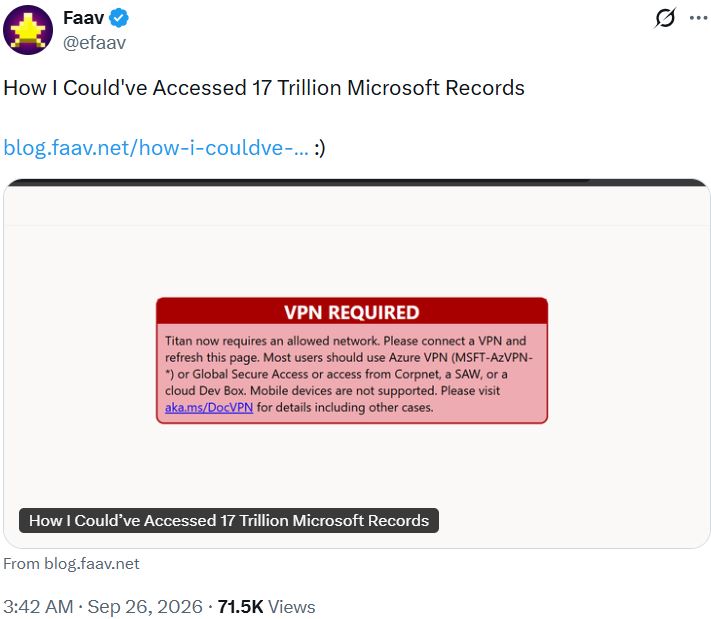
Researcher details how he could have accessed 17 trillion Microsoft records
6. AI, Crypto, and the Policy Landscape
6.1 Defense, surveillance, and the future of secure systems
Microsoft’s defense contracts and AI deployments in classified environments raise significant questions about the future of secure communications and cryptography, topics that are central to crypto. By deploying AI hardware and models in IL6 and IL7 environments, the company is directly involved in systems that handle highly sensitive information and are subject to rigorous oversight and auditing. These systems are designed to streamline data synthesis, enhance situational awareness, and support decision-making for military operations. While details about the specific models and use cases remain classified, the direction of travel is toward deeper integration of AI in defense and intelligence workflows.
For crypto communities, this has two implications. First, technologies and practices developed for high-assurance environments may eventually influence commercial security standards, including how clouds handle encryption, key management, and audit trails. This could either strengthen the privacy and integrity of hosted crypto workloads or, conversely, normalize pervasive monitoring and automated compliance checks. Second, as governments invest heavily in AI capabilities, the risk of advanced offensive operations—such as automated vulnerability discovery, cryptanalysis, or large-scale disinformation—rises. Crypto protocols and wallets that depend on widely used cryptographic primitives must anticipate a world in which state-backed actors have access to increasingly powerful AI tools for attack and surveillance. Microsoft’s involvement in both sides of this equation—building defenses and enabling potential offensive capabilities—makes it a key actor in the geopolitics of cryptography.
6.2 Competition with Google, Amazon, Meta, and others
In the AI race, Microsoft competes and collaborates with other tech giants like Google, Amazon, and Meta, creating an oligopoly of AI and cloud infrastructure. Statista’s CAPEX estimates underscore this, with all four companies dramatically increasing their AI-related investments. Google continues to integrate generative AI into search and productivity tools, Amazon leverages AWS’s dominance for AI and ML services, and Meta deploys AI across social products and recommendation systems. Microsoft differentiates itself through its deep partnership with OpenAI, integration of Copilot across its portfolio, and newer offerings like Web IQ and Scout. Independent research teams and start-ups, such as Sentient’s work on self-evolving agents, further add to the ecosystem by developing techniques that frontier labs, including Microsoft’s, can adopt or extend.
For crypto projects choosing AI partners or infra providers, this competitive landscape means that vendor lock-in and interoperability need to be considered carefully. A DeFi protocol might rely on Google for data analytics, Microsoft for model hosting, and Amazon for global content delivery, creating a patchwork of dependencies. Alternatively, it might standardize on one provider for simplicity, at the cost of greater exposure to that provider’s policy and pricing decisions. Competition does bring some benefits, such as lower pricing and more feature innovation—Microsoft’s claim that its free AI beat OpenAI and Google at browsing reflects such dynamics. Yet the structural reality remains that a small number of firms control most of the global AI compute, which has long-term implications for censorship resistance and permissionless innovation.
6.3 Crypto exchanges, custodians, and enterprise AI
Major centralized crypto exchanges and custodians are increasingly turning to enterprise AI tools to enhance their operations, from fraud detection and customer support to market surveillance and compliance reporting. In this context, Microsoft’s Copilot ecosystem, Azure AI services, and security products become attractive offerings. Exchanges may use Azure-hosted models to analyze transaction patterns for anti-money-laundering compliance, deploy Copilot-style assistants to help employees navigate internal knowledge bases, or integrate Web IQ into their research and risk teams to monitor regulatory developments and protocol updates in real time. Some may even explore Scout or similar agents for 24/7 monitoring of on-chain exposures and operational metrics.
At the same time, crypto businesses must be mindful of data sovereignty, privacy, and regulatory requirements when sending data to third-party AI services. Sensitive customer information, transaction histories, and internal decision-making processes cannot be casually fed into external models without robust contractual and technical safeguards. Here, Microsoft’s emphasis on safe sharing, threat protection, and governance in Copilot Studio is relevant. Features like detecting credential oversharing or blocking certain credential types help enforce better hygiene, but they do not eliminate the need for careful system design. Crypto-native firms will need to balance the benefits of Microsoft’s AI offerings against the imperative to minimize data exposure and retain control over their token capital—the proprietary learning loops that differentiate them.
6.4 Legal battles and corporate accountability
The broader AI landscape has already seen high-profile legal battles, including a lawsuit by Elon Musk against OpenAI and Sam Altman that also named Microsoft as a defendant. A jury ultimately ruled that Musk had waited too long to bring the case, leaving Altman, OpenAI, and Microsoft free of liability. For crypto observers, the outcome underscores both the difficulty of challenging the governance of fast-moving AI ventures and the resilience of Microsoft’s legal position as a strategic partner rather than a direct operator of controversial AI models. The case also highlights a theme familiar from crypto: early collaborators may disagree about mission drift, commercialization, or governance, but courts and regulators often lag technology, making it challenging to resolve such disputes in real time.
For investors and builders, the key lesson is that corporate governance and contractual arrangements matter deeply in shaping how AI capabilities are controlled and monetized. In Microsoft’s case, its structured partnership with OpenAI has allowed it to benefit from cutting-edge research while maintaining a degree of legal and operational distance. Crypto projects entering into partnerships with AI providers or hyperscalers should study such arrangements carefully, ensuring that intellectual property rights, data usage, and exit options are clearly defined. As AI and crypto become more entangled, disputes over alignment, control, and commercialization will likely become more frequent, and the precedents set by companies like Microsoft will be influential.
7. Gaming, Metaverse, and Digital Ownership
7.1 Xbox, metaverse thinking, and leadership shifts
Microsoft’s Xbox division gives it a significant role in the gaming industry, which is often seen as a precursor to broader metaverse and digital ownership trends. The company has expanded the Xbox leadership team with notable hires, including Matthew Ball, a leading industry analyst and author whose 2020 essay and subsequent book on the evolution of gaming toward the metaverse helped shape mainstream understanding of virtual worlds. Ball has joined Microsoft as Chief Strategy Officer for gaming, while other leadership roles include Scott Van Vliet as Chief Technology Officer. This infusion of strategic and technical expertise signals that Microsoft views gaming not just as a console business but as a broader platform for virtual economies and social interaction.
Gaming has long been a testing ground for digital goods, from in-game currencies to skins and collectibles. While Microsoft has not fully embraced blockchain-based NFTs or on-chain assets within Xbox ecosystems, the conceptual overlap is clear. As AI becomes more integrated into game design and player experiences, and as cloud gaming brings large-scale virtual environments to more users, the question of how digital ownership is defined and enforced will continue to surface. For crypto communities, Microsoft’s decisions about interoperability, user identity, and modding rights in gaming could foreshadow how it approaches more general metaverse or digital workspace environments where tokenized assets and identities might one day play a role.
7.2 NFTs, digital rights, and corporate walled gardens
Despite the conceptual alignment, Microsoft has been cautious about integrating NFTs or public-blockchain-based assets into its mainstream consumer products. This caution reflects both regulatory uncertainty and a desire to maintain control over user experience and monetization. In a world where users can already spend substantial amounts on in-game items and subscriptions, the introduction of permissionless, transferable assets raises complex questions about fraud, user safety, and business models. From a crypto perspective, this tension between walled gardens and open ecosystems is familiar: many users want the composability and self-custody that blockchains provide, but platform holders worry about losing control and undermining existing revenue streams.
Microsoft’s role as steward of platforms like Xbox, Windows, and LinkedIn means that it has the power to either facilitate or impede the integration of decentralized identity, payments, and assets into mainstream digital life. While some experimental integrations with Web3 services have occurred at the margins, there is no broad embrace yet. For crypto builders, this suggests that the path to mainstream adoption may not run through deep integration with Microsoft’s consumer platforms in the near term, but rather through parallel ecosystems that nonetheless rely on its infrastructure and tooling. Over time, competitive pressures and user demand may push firms like Microsoft to adopt more open approaches, but the timeline remains uncertain.
7.3 GitHub, developer identity, and open-source governance
GitHub is a crucial part of Microsoft’s portfolio and one of the most important sites of open-source activity in the world. Most major crypto protocols host their code on GitHub, making it a central hub for developer identity, collaboration, and governance. Microsoft’s stewardship has so far been relatively hands-off in terms of direct interference with project governance, but the integration of AI coding tools like GitHub Copilot and the emergence of AI-assisted GitHub Actions, such as Claude Code, has changed the security and operational landscape. As discussed earlier, misconfigured AI actions can expose secrets or perform unintended operations, making it essential that crypto teams treat their CI/CD pipelines and automation scripts as critical security components.
The question of whether code and developer identity should be centralized under a single corporate umbrella is not merely philosophical. In the context of sanctions, law enforcement actions, or policy shifts, platforms like GitHub could face pressure to restrict access to certain repositories or users. For now, Microsoft appears to be positioning itself as a neutral facilitator, focusing on security and productivity rather than direct governance. But crypto communities that prize censorship resistance and decentralization should diversify their tooling and consider contingency plans for code hosting and collaboration. Microsoft’s choices in this domain, even if well-intentioned, are a reminder that much of today’s “decentralized” ecosystem relies on centralized infrastructure for critical functions.
Microsoft-backed OpenAI launches GPT-4 Turbo
Sam Altman reinstated as OpenAI CEO; Microsoft partnership reaffirmed
- 2023-12regulatory
New York Times sues OpenAI and Microsoft for copyright infringement
- 2024-12governance
Michael Saylor presents Bitcoin treasury case to Microsoft board of directors; shareholders vote against adoption
- 2025-02milestone
Microsoft unveils Majorana 1 quantum chip with Australian collaboration
- 2025-03exploit
Microsoft discloses StilachiRAT malware targeting MetaMask, Phantom, Coinbase Wallet browser extensions
Pentagon signs AI deployment deals with Microsoft, Nvidia, and AWS for classified networks
Microsoft security blog reports Tor-propagating crypto-clipper malware swapping clipboard wallet addresses
8. Microsoft as a Trade in Crypto Portfolios
8.1 Big Tech equity as a macro proxy for AI and compute
For traders and investors straddling both traditional and crypto markets, Microsoft’s equity functions as a liquid proxy for the broader themes of AI, cloud, and digital transformation. As the company commits to massive CAPEX expenditures on AI infrastructure, partners deeply with OpenAI, and integrates AI into its product stack, its stock price reflects market expectations about the future value of these investments. Crypto traders who hold or short tokenized representations of MSFT on-chain are effectively taking positions on the relative strength of centralized AI infrastructure versus decentralized compute and data networks. A bullish view on Microsoft may coexist with a belief that certain crypto assets will thrive as complements rather than competitors to Big Tech.
Tokenized equities and synthetic exposures bring these dynamics into DeFi, allowing traders to collateralize positions, build structured products, or express cross-asset views without leaving the on-chain environment. For example, a trader might go long decentralized storage tokens while shorting synthetic MSFT to bet that Filecoin-style networks will capture some of the value that would otherwise accrue to centralized hyperscalers’ CAPEX plans. Alternatively, an investor might hold both MSFT and Ethereum, viewing them as different layers of the emerging digital infrastructure stack—one centralized and regulated, the other permissionless and globally accessible. In all cases, understanding Microsoft’s strategic direction becomes essential to informed trading.
8.2 Managing centralization risk through portfolio construction
From a risk management perspective, Microsoft represents both a source of systemic risk and a potential hedge. Its dominance in cloud infrastructure and AI means that outages, security incidents, or policy changes could have far-reaching effects on crypto exchanges, DeFi front-ends, and on-chain analytics providers that rely on Azure. Holding MSFT equity or its tokenized equivalent can thus be seen as a way to hedge exposure to the very infrastructure on which many crypto businesses operate. If, for example, regulatory or technical shocks impact Azure usage in the crypto sector, Microsoft’s other revenue streams might buffer the impact on its stock, providing some diversification.
At the same time, concentration of infrastructure risk among a few hyperscalers argues for diversifying across clouds, including smaller providers and decentralized alternatives. Portfolio construction strategies that combine exposure to Microsoft and other Big Tech names with positions in decentralized infrastructure tokens can be interpreted as meta-bets on the trajectory of centralization versus decentralization in the digital economy. For institutional allocators, Microsoft’s large market capitalization and liquidity make it a convenient instrument for such strategies; for retail traders, tokenized shares on on-chain platforms democratize access without requiring traditional brokerage accounts.
8.3 Quantum computing, cryptography, and the Bitcoin question
Another dimension of Microsoft’s relevance to crypto is its work in quantum computing. The company has revealed a quantum chip that it claims is “1,000x more reliable” than previous generations, sparking discussion about the timeline on which quantum computers might threaten classical cryptographic schemes used in Bitcoin and other blockchains. Increased reliability in qubits and error correction suggests progress toward practical quantum systems that could, in time, challenge widely deployed public-key cryptography. While the precise horizon for such a threat remains debated among experts, each incremental improvement in quantum hardware narrows the margin of safety for protocols that do not plan for quantum resistance.
For Bitcoin and other major networks, the long-term question is whether and how to transition to quantum-resistant schemes without fragmenting consensus or undermining security in the process. Microsoft’s contributions to quantum hardware and software, alongside work by other players, will influence the pace at which such a transition becomes urgent. Crypto projects and investors should monitor this domain, not because a quantum break is imminent, but because the path-dependency of protocol decisions makes early planning valuable. In a world where Microsoft and its peers push quantum capabilities forward, blockchains that are agile in adopting quantum-safe cryptography may command a premium in perceived security.
Outlook
Microsoft sits at the intersection of AI, cloud infrastructure, security, and enterprise software, making it a pivotal actor in the environment in which crypto and Web3 evolve. Its partnership with OpenAI, massive CAPEX commitments to AI data centers, and integration of Copilot-style agents into everyday workflows position it as both a powerful enabler and a potential centralizing force. For crypto markets, Microsoft is not a direct competitor in the sense of issuing tokens or running public blockchains, but it shapes the rails on which exchanges, protocols, and trading systems run. Its threat intelligence, exemplified by detailed analyses of crypto-targeting malware like the Tor-based Crypto Clipper, is already influencing best practices for wallet security and device hardening.
Over the coming years, the interplay between centralized AI platforms and decentralized crypto networks will intensify. Programs like Injective Nova and investments in Web3 infrastructure such as Space and Time show that Microsoft is willing to support on-chain innovation, especially where it intersects with institutional needs. At the same time, its role in defense, quantum research, and global cloud governance underscores the scale of its influence. For crypto builders and investors, the pragmatic stance is to treat Microsoft as a critical piece of the environment: leverage its tools and infrastructure where they add value, remain vigilant about the security and centralization risks they introduce, and build decentralized alternatives that can coexist and, when necessary, operate independently. In that sense, understanding Microsoft is an essential part of understanding the future trajectory of both AI and crypto.
Latest Microsoft news
Sources
18 records from 11 domains
blogs.microsoft.com
microsoft.com
facebook.com
x.com
markets.businessinsider.com
techcrunch.com
instagram.com
learn.microsoft.com
statista.com
nvidianews.nvidia.com
thegamebusiness.com
Community notes
Spot something off or out of date? Drop a note. Editors review topic notes daily and roll accepted fixes into the explainer — contributors are recognized in the monthly $SQUID drop.
Loading notes…
Help improve this topic
Have a story or tip about this topic? Submit it. See something missing? Leave a note. Editors review daily; accepted submissions and fixes count toward the monthly $SQUID drop.