
AWS is crypto's largest cloud dependency — enabling exchanges, AI agents, and key management while its outages expose decentralization limits; x402 and AgentCore Payments are deepening the AWS-stablecoin relationship.
+34 sources across the wider coverage universe
 AWS open-sources architecture bridging SWIFT ISO 20022 financial messaging to onchain settlement via Chainlink2026-04
 Stripe positions Tempo blockchain and stablecoin stack as 'AWS for money,' sees Global South leading demand2026-04
 Privy enables AWS Bedrock AgentCore AI agents to autonomously pay for APIs, MCP tools, and web content using USDC via secure Privy wallets2026-07
 Coinbase brings x402 agent payments to AWS CloudFront and WAF for a quarter of the web2026-06
 AWS Marketplace integrates Chainlink data standards, enabling developers to connect traditional cloud services with blockchain apps using Data Feeds, Streams, and Proof of Reserve2026-04
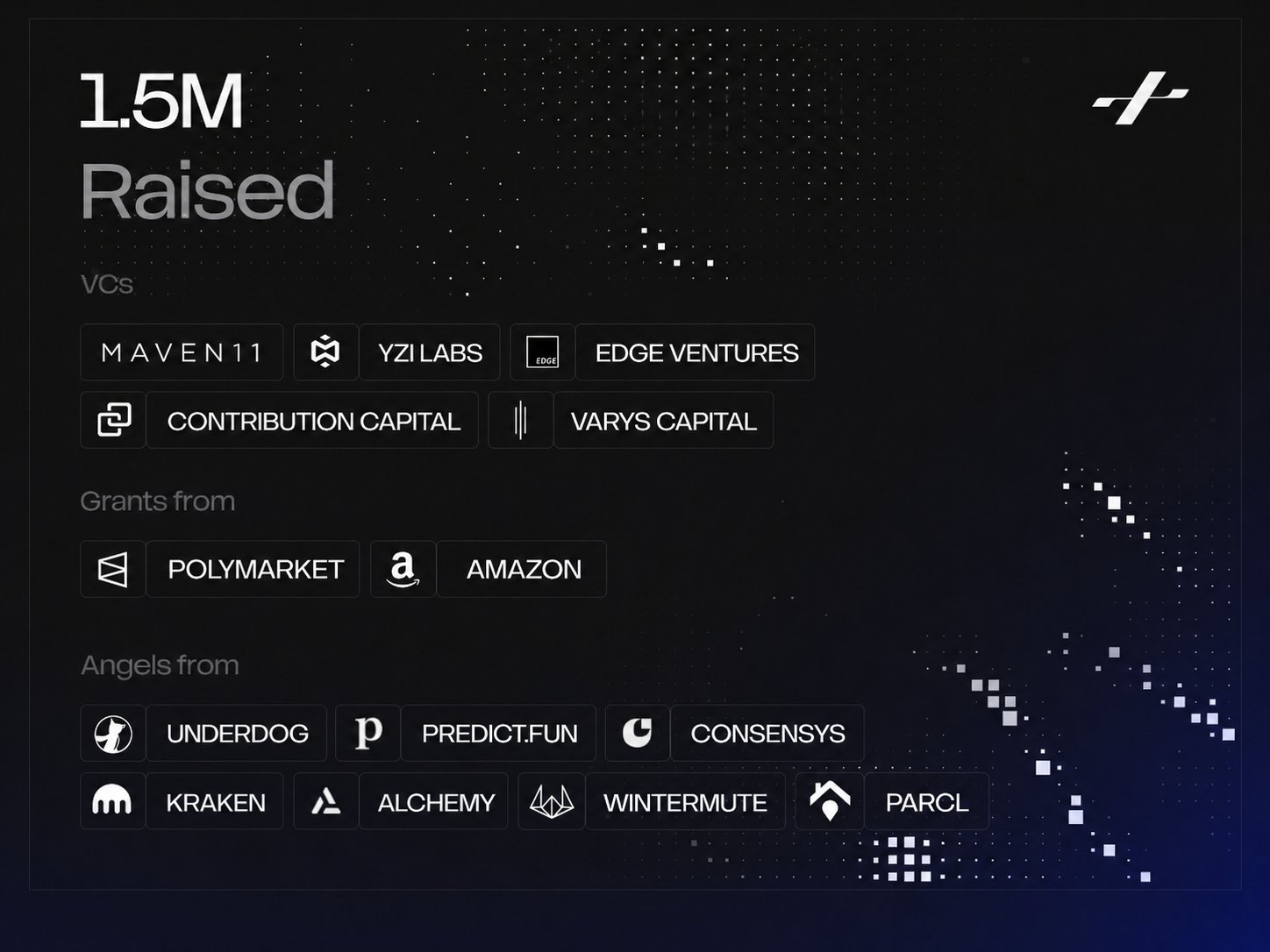 AI analytics platform Polysights raises $1.5M pre-seed funding to combat insider trading in prediction markets. The raise was backed by YZi Labs S3, Maven 11 Capital, and angels from Kraken and Consensys, plus grants from Polymarket and AWS.2026-06
Amazon Web Services (AWS) is the world's largest cloud computing platform and, whether the crypto industry intended it or not, one of its most critical pieces of infrastructure.
Cloud computing and decentralization make an uncomfortable couple. Blockchain networks promise censorship-resistant, trustless systems — yet the servers validating those transactions, hosting the APIs that traders use, and storing the data that fuels on-chain applications overwhelmingly run on a handful of hyperscaler data centers. AWS sits at the center of that tension, simultaneously enabling and threatening the decentralized future its customers are building.
What AWS Actually Is
Amazon Web Services, launched in 2006 as a side project inside Amazon's retail business, is now a $100 billion-plus annual revenue division offering more than 200 cloud services: computing (EC2), object storage (S3), content delivery (CloudFront), security tooling (WAF), machine learning accelerators (Trainium, Inferentia), confidential computing (Nitro Enclaves), and much more. When a startup says it "runs in the cloud," it usually means AWS.
Market research consistently puts AWS at roughly 30-33% of the global cloud infrastructure market, ahead of Microsoft Azure and Google Cloud. That concentration matters for the crypto industry because it means a single vendor's reliability problems become the whole sector's reliability problems — as several high-profile incidents have made clear.

AWS open-sources architecture bridging SWIFT ISO 20022 financial messaging to onchain settlement via Chainlink
The Coinbase Outage: A Case Study in Cloud Dependency
In May 2025, a data center overheating event at an AWS facility cascaded into an eight-hour disruption across Coinbase — the largest U.S.-regulated crypto exchange by volume. Trading halted. Deposits and withdrawals froze. Retail and institutional customers were locked out of their accounts during hours of market volatility. The incident was not unique to Coinbase; FanDuel and other AWS customers were also affected.
Coinbase's postmortem, released shortly after, was unusually candid. The exchange confirmed that AWS infrastructure failures were the proximate cause and announced plans for regional redundancy upgrades — essentially, distributing workloads across multiple AWS regions so that a single data center failure cannot take down core services. The company pointed finger at AWS cloud outage in its public communications, though Amazon's own service health dashboard acknowledged the underlying infrastructure event.
The episode touched a nerve. Critics pointed out that exchanges marketing themselves as alternatives to traditional finance were running on the same centralized infrastructure as any conventional fintech. A platform promising 24/7 market access had an eight-hour blackout because a facility's cooling system failed.
Readers click AWS stories not to follow cloud news but to stress-test crypto's decentralization claims — the top clicks reveal a consistent anxiety that 'trustless' infrastructure secretly routes through Amazon's us-east-1.
Centralization Risk and the Decentralization Paradox
The Coinbase outage is the sharpest recent illustration of a structural tension: crypto's decentralized rails route through centralized pipes. AWS, Azure, and Google Cloud together host a majority of the nodes for major public blockchains, the APIs that wallets and exchanges use to read chain state, the oracles that push real-world prices on-chain, and the front ends users actually interact with. A targeted attack on one of these providers — or even just an operational failure — can effectively pause significant portions of "decentralized" finance.
This is not a purely theoretical concern. Ethereum's node geography has been mapped repeatedly, consistently showing that a large fraction of full nodes run in AWS data centers. When AWS's us-east-1 region has gone down in the past, Ethereum's peer network thinned noticeably even though the underlying consensus layer kept running.
The crypto industry's response has bifurcated. Some projects are doubling down on cloud but hardening their deployments (multi-region, multi-cloud, active-active failover). Others are building genuinely decentralized alternatives to the infrastructure layer itself.
AWS in the AI Agent Payment Stack
Away from the outage narrative, AWS has been moving aggressively into the emerging market for agentic AI infrastructure — and this is where crypto re-enters the picture in a more constructive role.
In 2025, Coinbase, AWS, Google Cloud, and Stripe began collaborating around x402 — a revival of the long-dormant HTTP 402 "Payment Required" status code — as a machine-native payment protocol for AI agents. The concept is straightforward: an AI agent making an API call can attach a payment directly to the HTTP request, in stablecoins, without human intervention. Publishers and API providers can then accept agents as paying customers.
Coinbase reported that since launching x402, the protocol has processed over $100 million in transactions, with 90% of on-chain agentic stablecoin transaction volume running on Base (Coinbase's Layer 2 network). AWS followed by integrating x402 support into CloudFront and WAF — two of its most widely deployed services — meaning publishers behind AWS infrastructure can start accepting USDC payments from AI agents with relatively minimal integration work.
AWS launched what it calls AgentCore Payments, framing agentic micropayments as a native capability rather than a bolt-on. The ambition is that an AI agent spinning up compute, calling a data API, or requesting a model inference can settle that bill autonomously in stablecoins, removing the need for pre-negotiated contracts, invoices, or human approval loops.
Events like "The Agentic Economy: Payments, Commerce & AI-Native Platforms," hosted partly at the AWS Builder Loft in San Francisco, have drawn builders, investors, and operators to work through what infrastructure needs to exist before agentic commerce can function at scale. The recurring themes: identity for agents, payment rails that work at sub-cent amounts without per-transaction overhead, and settlement in assets that don't require a bank account.

OpenAssets brings tokenization infrastructure to AWS Marketplace
Confidential Computing: Nitro Enclaves and Key Management
One AWS product that has found genuine traction in crypto is Nitro Enclaves — isolated compute environments that run inside EC2 instances and can be cryptographically attested. Code running in a Nitro Enclave can prove to an external verifier, using a signed measurement, that it is running a specific, unmodified program without any operator or administrator being able to inspect or tamper with it at runtime.
For blockchain key management, this property is valuable. Companies like Turnkey have built their signing infrastructure on Nitro Enclaves, allowing them to manage private keys and execute transactions on behalf of users without those keys ever being accessible — even to Turnkey's own engineers. The enclave generates and holds keys; the attestation document gives clients confidence that the operator cannot extract them.
This is a narrower claim than full self-custody, but it meaningfully reduces the trust surface compared to a conventional key management service. The trade-off is that it still depends on Amazon's hardware and the integrity of the Nitro attestation chain — which is why some teams in the crypto space regard it as a bridge to fully decentralized signing rather than a final destination.
- 01AWS outage chain exposure
Coinbase going down during an AWS disruption made the dependency visceral and undeniable for retail readers.
- 02L2 vs L1 AWS dependency gap
The post-mortem quantifying that Base and other L2s are far more AWS-dependent than Solana reframed the L1 vs L2 debate as an infrastructure risk question.
- 03compromised AWS key minting attack
A single stolen cloud credential minting 80M unbacked stablecoins showed that off-chain key management is now a first-order DeFi exploit vector.
- 04AWS as fintech settlement layer
Headlines positioning AWS as the 'moment for money' and bridging SWIFT ISO 20022 to onchain settlement signal that AWS is actively competing to own financial rails, not just host them.
- 05AWS AI agent crypto payments
AgentCore Payments launching native crypto micropayments for AI agents made AWS a direct participant in the agent economy, not just infrastructure for it.
- 06institutional AWS co-branding
Circle Arc listing AWS alongside BlackRock and Visa as anchor partners signals that AWS validation is now a trust signal enterprises require before joining onchain networks.
Egress Fees: The Hidden Tax on Crypto Data
AWS's pricing model creates friction that the Web3 data layer movement has latched onto as a rallying point. Cloud storage costs have fallen dramatically, but data egress — moving data out of AWS — remains expensive by design. Providers charge for outbound bandwidth because it creates lock-in: once your data lives inside one cloud, moving it somewhere else or sharing it externally carries a cost that can reach six figures for large datasets.
The crypto and open-source AI communities have quantified some extremes. Sharing a five-petabyte dataset with a partner institution in Europe can trigger $450,000 in AWS egress fees before any computation runs. AWS reportedly charges $20,000 in API fees for a model reading its own training data stored in S3. Google Cloud charges roughly six times more to move training data than to store it.
Decentralized storage networks, particularly Filecoin, have positioned themselves as alternatives explicitly on this point. Filecoin charges no egress fees by design; data is retrievable from any provider holding a copy, and the economics of storage deals are separated from retrieval. Whether decentralized storage can match AWS's reliability, redundancy, and tooling at scale is a separate question — but the egress fee argument has proven rhetorically powerful with AI research teams and open-weight model developers who are moving large training corpora.
AWS Trainium and the AI Training Stack
AWS competes with Nvidia in AI model training through its own custom silicon: Trainium (for training) and Inferentia (for inference). Trainium 2 chips are deployed in EC2 trn2 instances and are priced to undercut Nvidia H100 clusters for certain workloads.
Research labs and AI companies have used Trainium clusters for published training runs, and AWS has highlighted EdgeCloud partnerships with institutions in the UK and Middle East that have run breakthroughs on Trainium infrastructure. Anthropic — the AI safety company that recently raised $65 billion at a roughly $965 billion valuation — has multi-cloud compute deals with AWS, Google, and Azure for scaling its Claude models, with AWS holding a significant anchor position.
For the crypto audience, the AI training story matters because inference and training costs feed directly into the economics of AI agents and on-chain AI applications. Cheaper AI compute lowers the floor for what an agent can profitably do per transaction — which improves the unit economics of agentic payment schemes like x402.
Stripe positions Tempo blockchain and stablecoin stack as 'AWS for money,' sees Global South leading demand
Crypto Mining Detection in AWS
AWS has published guidance on detecting and preventing unauthorized cryptocurrency mining in customer environments — an operational security concern for any organization running significant cloud workloads. Cryptojacking (hijacking compute for mining without the resource owner's knowledge) is a persistent threat vector, typically entering through compromised credentials, unpatched container images, or misconfigured IAM policies.
AWS's GuardDuty service can flag anomalous compute patterns consistent with mining workloads, and the company maintains threat intelligence feeds tuned to known mining pool endpoints. For crypto-native companies running cloud infrastructure, this is a useful defensive layer — though it also illustrates the asymmetry: the same cloud that processes your legitimate blockchain transactions is actively filtering out illegitimate ones running on your tab.
- 2021-12milestone
AWS us-east-1 outage disrupts Coinbase and major crypto services
- 2023-10milestone
October 20 AWS outage; post-mortem shows L2s most dependent, Solana least
- 2025-04exploit
Resolv $25M exploit traced to compromised AWS key minting 80M unbacked USR
- 2025-05launch
AWS open-sources SWIFT ISO 20022 to onchain settlement architecture via Chainlink
- 2025-05launch
AWS launches AgentCore Payments for AI agent crypto micropayments
- 2025-06launch
Circle Arc testnet launches with AWS, BlackRock, and Visa as institutional partners
Sovereign Alternatives and the Migration Question
The centralization critique has produced a cottage industry of "Web3 infrastructure" alternatives promising to move enterprise applications from AWS onto decentralized node networks. The migration calculus is not simple. AWS's operational guarantees — SLAs, compliance certifications, 24/7 support, mature tooling — are difficult to replicate. For regulated entities like exchanges that need SOC 2, PCI DSS, and in some cases SEC-adjacent compliance frameworks, hyperscaler certifications carry real weight.
Some in the crypto space draw an analogy to Avalanche's infrastructure ambitions. Analyst commentary has described Avalanche as approaching a "crypto's AWS moment" as BlackRock, PayPal, Shopify, and participants in Japan's growing tokenized securities market build on AVAX infrastructure. The framing is telling: "AWS moment" has become shorthand for the point where a platform's network effects and developer ecosystem become self-reinforcing.
Whether any Web3 infrastructure platform can replicate AWS's breadth of services — not just storage or compute, but databases, CDNs, security tooling, ML pipelines, and managed Kubernetes — remains an open question.
Outlook
AWS's relationship with crypto is consolidating around several vectors simultaneously: the company is becoming an active participant in stablecoin payment infrastructure (x402, AgentCore Payments), a supplier of confidential computing for key management, and an AI compute provider whose costs directly affect on-chain AI economics. At the same time, its role as a concentration point for crypto trading infrastructure continues to generate concern, particularly after the Coinbase outage demonstrated that "decentralized" exchange infrastructure can have a single point of failure in a data center cooling system.
The most likely trajectory is not replacement but layering. Decentralized storage and compute networks will absorb specific use cases where their economic or trust properties are genuinely superior — open training datasets, censorship-resistant data availability, cryptographic key management. The rest — low-latency APIs, complex managed services, compliance-grade infrastructure — will stay on hyperscalers. The pressure from the x402 and AgentCore Payments integrations suggests AWS sees the stablecoin and crypto-native payment market as a growth vector worth investing in, not a threat to route around.
Latest AWS news
AWS open-sources architecture bridging SWIFT ISO 20022 financial messaging to onchain settlement via ChainlinkOpenAssets brings tokenization infrastructure to AWS MarketplaceStripe positions Tempo blockchain and stablecoin stack as 'AWS for money,' sees Global South leading demandPrivy enables AWS Bedrock AgentCore AI agents to autonomously pay for APIs, MCP tools, and web content using USDC via secure Privy walletsCoinbase brings x402 agent payments to AWS CloudFront and WAF for a quarter of the webAWS Marketplace integrates Chainlink data standards, enabling developers to connect traditional cloud services with blockchain apps using Data Feeds, Streams, and Proof of ReserveCommunity notes
Spot something off or out of date? Drop a note. Editors review topic notes daily and roll accepted fixes into the explainer — contributors are recognized in the monthly $SQUID drop.
Loading notes…
Help improve this topic
Have a story or tip about this topic? Submit it. See something missing? Leave a note. Editors review daily; accepted submissions and fixes count toward the monthly $SQUID drop.