
Monad is an EVM-compatible Layer 1 using parallel execution and MonadBFT consensus to target 10,000 TPS — bringing Ethereum tooling compatibility to Solana-class throughput, with a growing DeFi and RWA ecosystem post-mainnet launch.
+15 sources across the wider coverage universe
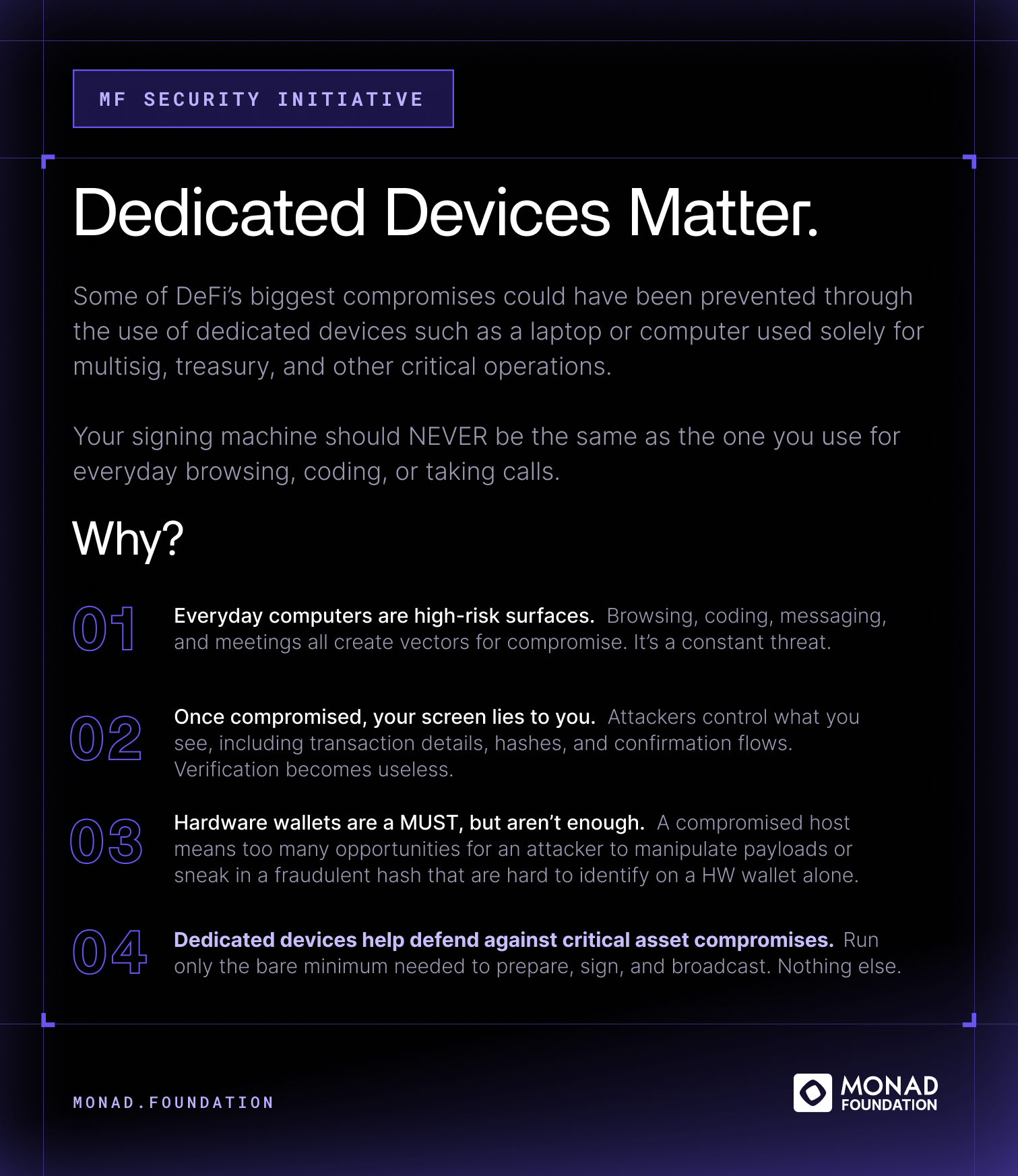 Monad Foundation rolls out device subsidy program for teams with $2.5M+ TVL, funding dedicated signing laptops to boost multisig and treasury security across its ecosystem2026-04
 Neutrl launches Credit Vault on Monad, offering delta-neutral yield strategies with AUSD deposits and layered returns from sNUSD and ecosystem incentives2026-04
 How Monad achieves parallel execution: concurrent transaction processing, conflict detection, and re-execution combine to deliver faster blocks while maintaining Ethereum’s ordered state model2026-04
 Monad ecosystem expands as tokenized stocks go live on Monday Trade, bringing real-world equities onchain for seamless trading and DeFi integration2026-04
 Monad's Keone says Phantom's decision to remove the network is a step backward, recommending MetaMask, Backpack, Rabby, Rainbow, Infinex and Ambire2026-07
 Phantom will end Monad support on August 12, urging users to migrate funds from Phantom Wallet to another compatible EVM wallet before the deadline2026-07
A high-performance, EVM-compatible Layer 1 blockchain engineered for parallel transaction execution, Monad is designed to close the throughput gap between Ethereum's composability and Solana-class speed without sacrificing developer familiarity.
What Monad Is and Why It Exists
Ethereum's virtual machine (EVM) processes transactions sequentially — one after another, in strict order — creating a hard ceiling on how many operations the network can confirm per second. For years, teams building decentralized applications either accepted that ceiling or migrated to faster but EVM-incompatible chains, losing access to tooling, audited contract libraries, and the largest developer base in crypto.
Monad's premise is that the sequential constraint is an implementation choice, not a fundamental requirement of the EVM model. The network respecifies the execution environment so that non-conflicting transactions — those that touch different state — run concurrently across CPU cores, while dependent transactions are still processed in the correct deterministic order. The result is a claimed throughput of 10,000 transactions per second with 1-second block times, against Ethereum mainnet's rough ceiling of 15–30 TPS.
Critically, Monad preserves full EVM bytecode compatibility. Solidity and Vyper contracts deploy without modification. Wallets, indexers, and developer tools built for Ethereum work against Monad's RPC without changes. This is the network's core pitch to developers: Ethereum's UX and ecosystem, at a fraction of the cost and latency.

Monad and Category Labs to unveil privacy solution for institutional activity on public ledgers

The Technical Architecture
Monad's performance claims rest on three interlocking design choices: parallel execution, pipelining, and a custom consensus layer called MonadBFT.
Parallel execution is the headline feature. When Monad's runtime receives a block of transactions, it runs an optimistic concurrency control pass, speculatively executing transactions in parallel and then checking for state conflicts after the fact. Transactions that touched the same storage slots are re-run serially to preserve determinism; the majority that are independent commit immediately. This is conceptually similar to how modern databases handle concurrent writes under optimistic locking.
Pipelining decouples the four phases of block production — consensus, execution, storage, and network propagation — so they overlap rather than sequence. While validators are reaching agreement on block N, the execution layer is already processing block N-1, and storage writes for block N-2 are being flushed to disk. This assembly-line approach eliminates idle time at each stage and is a significant contributor to latency reduction beyond what parallelism alone provides.
MonadBFT is a Byzantine Fault Tolerant consensus protocol derived from HotStuff, the same lineage underlying Diem (Facebook's cancelled stablecoin network) and several other high-throughput chains. HotStuff-based protocols are leader-based and achieve linear message complexity — the number of messages validators exchange grows linearly with validator count rather than quadratically, which matters at scale. Monad adds pipelining at the consensus layer itself, allowing multiple rounds of the BFT protocol to overlap.
Underlying all of this is MonadDb, a purpose-built storage engine optimized for the access patterns that EVM execution creates. Standard databases like LevelDB or RocksDB, used by many EVM clients, were not designed with EVM state tries in mind. MonadDb is structured around the trie structure EVM state requires, reducing the I/O overhead that has historically been a bottleneck in high-throughput EVM nodes.
Readers click Monad primarily to resolve a single tension: whether its $225M Paradigm-backed technical narrative is genuine innovation or a rebrand of borrowed architecture — making the Avalanche fork accusation the lens through which every other headline (TVL, token price, ecosystem buildout) gets re-read.
The MON Token and Launch
Monad's native token, MON, is used to pay transaction fees and to stake for network security. The network's mainnet went live in 2025 following an extended testnet period that attracted a substantial developer community — over a million wallets were active on testnet before the mainnet launch, reflecting significant speculative and genuine builder interest.
The token distribution followed a pattern familiar in the post-2023 airdrop cycle: a portion allocated to early testnet participants and community contributors, with vesting schedules for team and investor allocations. Coinbase listed MON near launch, providing immediate centralized exchange liquidity alongside decentralized venues. The founding team raised approximately $225 million in a Series B round led by Paradigm in 2024, giving the project substantial runway to reach mainnet and support ecosystem growth.
The Ecosystem in 2025
Since mainnet launch, Monad's ecosystem has expanded across DeFi, payments, real-world assets, and infrastructure — tracking the typical L1 adoption arc, but at compressed timelines due to the size of the community that formed during testnet.
DeFi infrastructure arrived early. PancakeSwap — one of the largest decentralized exchanges by volume, originally built on BNB Smart Chain — launched on Monad with boosted liquidity incentives on WMON pairs, instantly providing on-chain liquidity depth. Credit protocols followed: FalconX launched a tokenized credit vault on Pareto Credit, using Monad as the settlement layer for institutional lending; Neutrl deployed a delta-neutral yield product accepting AUSD deposits. These are not typical retail DeFi products — they signal that institutional actors are treating Monad as a credible execution venue.
Tokenized real-world assets emerged as a notable vertical. Monad partnered with Centrifuge, the protocol that helped pioneer on-chain structured credit, to bring tokenized Treasuries and credit funds to the network via deRWA wrappers that enable 24/7 liquidity and DeFi composability. Monday Trade brought tokenized equities — actual stock exposure — on-chain on Monad, allowing DeFi-native users to trade real-world assets without leaving the ecosystem.
Payments and privacy are also live. AnomaPay launched on Monad, offering shielded transfers and balance-hiding privacy for stablecoin and asset transactions — targeting the substantive user concern that all on-chain activity is publicly visible. Rain, a crypto-to-fiat payments company, began exploring Monad support for its Visa card product, which lets users spend stablecoins at traditional merchants across 150+ countries.
USDC is live on Monad, providing the stablecoin liquidity that DeFi applications require to be practically useful. Bridging infrastructure from LI.FI, SimpleSwap, and generic cross-chain routers means users can move assets from Ethereum, Solana, BNB Smart Chain, and other networks into the Monad ecosystem without significant friction. LI.FI also launched a validator node, deepening its stake in the network's security.
- 01Paradigm mega-round legitimacy
A $225M raise led by crypto's most credible VC firm became the proof-of-concept for Monad's L1 ambitions, drawing readers who needed to understand what Paradigm saw that others didn't.
- 02Avalanche fork accusations
Andre Cronje's claim that Monad's architecture derived from Avalanche — and founder Keone's non-denial alongside a failure to rename testnet gas fees from $AVAX to $MON — gave readers a concrete technical credibility test to audit.
- 03DeFi blue-chip day-one deployments
Curve, Curvance, Gearbox, and Mento all launching on or near mainnet signaled that established DeFi protocols were betting on Monad's performance claims before the chain had proven itself.
- 04MON token economics and overhang
A 27% team allocation, a $2.5B FDV sale price, and MON trading below its debut price immediately raised questions about whether retail buyers were subsidizing insiders.
- 05Testnet instability events
A public testnet halt — arriving shortly after the much-anticipated February 19 launch — let skeptics score a concrete data point against Monad's high-throughput reliability claims.
- 06Institutional and RWA integration
Mastercard's Crypto Partner Program entry and Centrifuge's tokenized Treasury wrappers suggested Monad was positioning for enterprise legitimacy beyond crypto-native DeFi.
Security and Incidents
No maturing DeFi ecosystem avoids exploits, and Monad's has been no exception. The most significant incident to date involved Echo Protocol, a Bitcoin DeFi (BTCFi) platform issuing synthetic Bitcoin (eBTC) on Monad.
In mid-2025, an admin key leak allowed an attacker to mint approximately 1,000 eBTC — notionally valued at around $76 million at prevailing prices — without backing collateral. The attacker deposited a portion into the Curvance lending protocol on Monad, borrowed WBTC against it, bridged those funds to Ethereum, and converted them to ETH, extracting roughly $816,000 in realized value before the exploit was detected. The gap between the $76 million minted and the $816,000 extracted reflects the fact that the attacker could not liquidate 1,000 eBTC without collapsing its price — a structural limit on maximum damage from synthetic-asset exploits.
Echo Protocol's team acted swiftly: they recovered control of the admin key and burned the remaining 955 eBTC still held by the attacker, eliminating the outstanding unbacked supply. The incident is a reminder that admin key security is orthogonal to blockchain speed — an exploit enabled by operational security failure will occur on fast chains as readily as slow ones. It also illustrates the risk profile of synthetic asset protocols on any new network: the code may be sound, but key management and multisig rigor matter as much as the smart contract audit.
Separately, SolvBTC announced the closure of its burn-mint cross-chain permissions for several assets across multiple chains including Monad, as part of a broader operational risk management review. This kind of conservative action — tightening cross-chain exposure during volatile market conditions — reflects a maturing risk culture among multi-chain protocols.
Monad vs. the Parallel Execution Field
Monad is not the only project pursuing parallel EVM execution. Sei v2, Neon EVM on Solana, and Ethereum's own long-term roadmap (through stateless clients and eventual parallelism research) all touch the same problem space. The competitive framing most commonly drawn, however, is Monad vs. Solana.
Solana processes transactions in parallel using a different model — Sealevel, which requires transactions to declare their account dependencies upfront rather than detecting conflicts after the fact. This pre-declaration approach avoids speculative re-execution but imposes a different developer burden and is not EVM-compatible. Monad's approach is more opaque to developers (conflicts are handled internally) but preserves byte-for-byte Solidity compatibility.
The practical question for developers choosing between them comes down to ecosystem and tooling. Solana has a mature, high-volume DeFi ecosystem and a distinct programming model (Rust, Anchor). Monad offers EVM compatibility and the ability to fork Ethereum mainnet protocols with minimal changes. For teams already building in Solidity, Monad reduces migration cost to near zero; for Solana-native teams, it offers little.
- 2024-04milestone
Paradigm leads $225M Series B for Monad Labs
- 2025-02launch
EVM public testnet launches February 19
- 2025-02milestone
Monad testnet halted shortly after launch
- 2025-04milestone
MON token sale on Coinbase at $2.5B FDV; oversubscribed but MON debuts below sale price
- 2025-05launch
Mainnet launches; Curve, Curvance, and Gearbox deploy day one
- 2025-05milestone
Ecosystem surpasses $350M TVL; weak fee generation flagged by analysts
- 2025-05exploit
Echo Protocol exploit: 1K eBTC mint enables max-borrow WBTC on Curvance
- 2025-06milestone
Monad joins Mastercard Crypto Partner Program
Outlook
Monad's credibility in the parallel-execution L1 race rests on whether its throughput claims hold under realistic congestion — adversarial, high-contention workloads are different from benchmark conditions. Early mainnet data will be the first real test of MonadBFT and the parallel executor at scale.
The ecosystem trajectory is positive: institutional credit, tokenized assets, stablecoin payments, and privacy tooling all arrived within months of mainnet launch, ahead of the pace typical for new L1s. The Echo exploit is a setback for ecosystem confidence but not a protocol-level failure. The bigger medium-term question is developer retention — whether the teams building on Monad testnet convert to permanent mainnet deployments as competing chains also sharpen their EVM-compatibility stories. If throughput holds and the developer community sustains, Monad is positioned as a serious contender for the high-performance EVM niche that Ethereum itself cannot yet serve.
Latest Monad news
Community notes
Spot something off or out of date? Drop a note. Editors review topic notes daily and roll accepted fixes into the explainer — contributors are recognized in the monthly $SQUID drop.
Loading notes…
Help improve this topic
Have a story or tip about this topic? Submit it. See something missing? Leave a note. Editors review daily; accepted submissions and fixes count toward the monthly $SQUID drop.